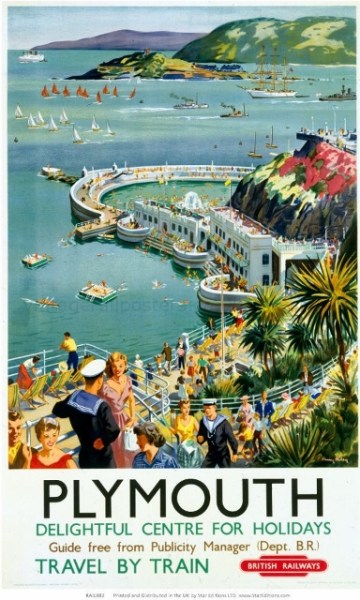
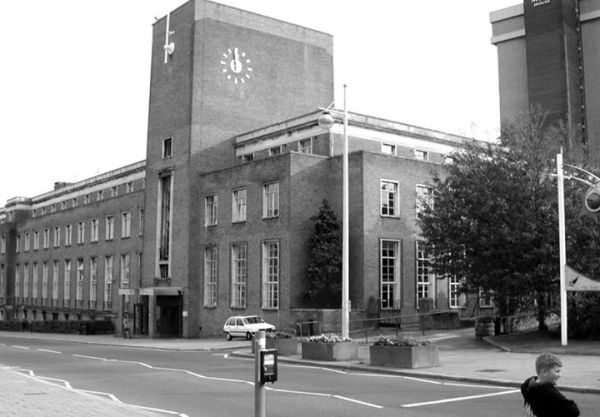
There is an old church in my hometown of Plymouth, Devon, England. As a child, I was used to seeing it right in the city centre. To me, it looked like a total wreck: no roof, with grass growing wildly inside the four remaining walls. I often wondered why was it still there?
Once one of the finest post-Reformation Gothic churches in the country, Charles Church now stands unexpectedly in the middle of a busy, modern roundabout. To anyone approaching it, the ruins serve as a deeply evocative landmark—a symbolic, silent witness to the devastating bombardment of the city during the Second World War, and the countless lives lost during those long years. For anyone familiar with Plymouth’s history, it remains the spiritual and symbolic heart of the city’s endurance. But the history of this place begins long before the Blitz.
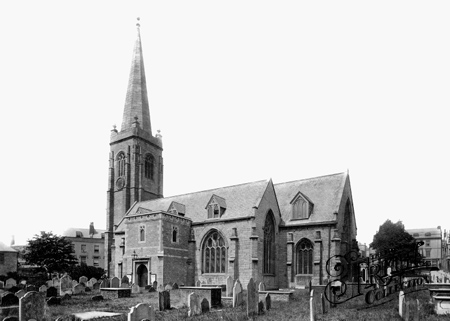
Charles Church 1889
Built around 1640, the church came to be because King Charles I granted permission for a second parish to be created to ease the burden on the ancient St. Andrew’s Church. It wasn’t that St. Andrew’s was too small—it could comfortably seat 1,200 people—but rather, the town was experiencing deep religious controversy. Plymouth had grown into a fiercely Puritan town (a friction hinted at years earlier by the Pilgrim Fathers, who noted they felt at home here, “kindly entertained and courteously used by divers friends there dwelling”). (1)
Because of these theological differences between the Crown and the mainly Presbyterian Puritan townsfolk, the King ignored the request for a new church for seven years.
Eventually, Robert Trelawney—a Plymouth-born merchant, MP, and royalist sympathiser who would later settle lands in Maine—persuaded the King to finally sign the Act of Parliament in the summer of 1641. It cost the town £150. Construction was soon interrupted by the chaos of the English Civil War. (2)
Although its first minister, Francis Porter, began preaching to his flock in 1643, the building wasn’t officially completed and consecrated until 1665. Naturally, it was dedicated to “King Charles the Martyr.”
For the next three centuries, Charles Church was a thriving centre of spiritual life. By 1818, it was an Evangelical parish undergoing a massive expansion under its most famous minister, the Reverend Dr Robert Hawker. Dr Hawker served the parish for an impressive 43 years. He was a deeply compassionate man, beloved for educating the poor and supporting the needy. (3)
It was during this vibrant era, in 1818, that my own history intertwined with the church. My third great-grandparents, Mary Rogers (born in Penryn, Cornwall, in 1791) and William Bulford (born in Topsham, Devon, England, in 1786), were married there—very likely by Dr Hawker himself. William worked as a rope maker at the nearby Devonport Dockyard, and together he and Mary went on to raise eight children.
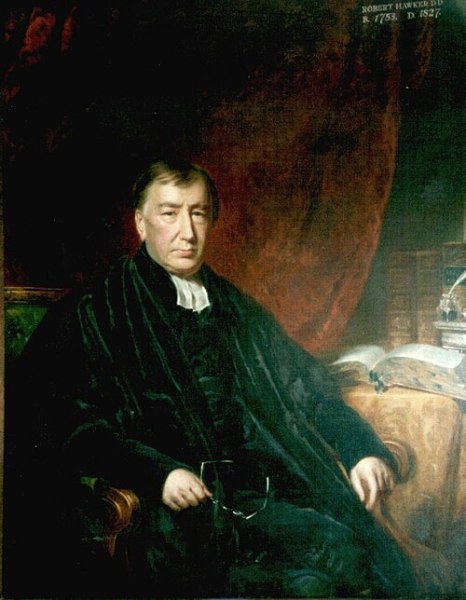
Portrait of Dr Robert Hawker
As the 19th century pressed on, the parish’s compassion would be tested by tragedy. In June 1832, Plymouth’s first terrible cholera epidemic struck, brought ashore by infected sailors. It tore through the densely populated town. The doctors did what they could, but without the medical knowledge of isolation, hundreds succumbed.
The tragedy struck the rectory itself: Charles Church Vicar James Carne and his wife, Charlotte, died within just four days of each other, having caught the disease while tirelessly tending to their dying flock. A memorial tablet honouring the victims used to stand in the churchyard.
A second wave of cholera devastated the overcrowded, unsanitary slums of the nearby Barbican in 1848. Local clergy, like the medically trained Rev. G.H. Hetling and Rev. George Prynne, walked the slums day and night. The devastation was absolute; on one haunting night, they entered a tenement housing court off Stonehouse Lane only to find every single inhabitant dead. (4)
The church survived the centuries of pestilence and political upheaval, only to meet its own end on the nights of March 21st and 22nd, 1941. During the height of the Plymouth Blitz, German incendiary bombs rained down, entirely gutting the beautiful structure.
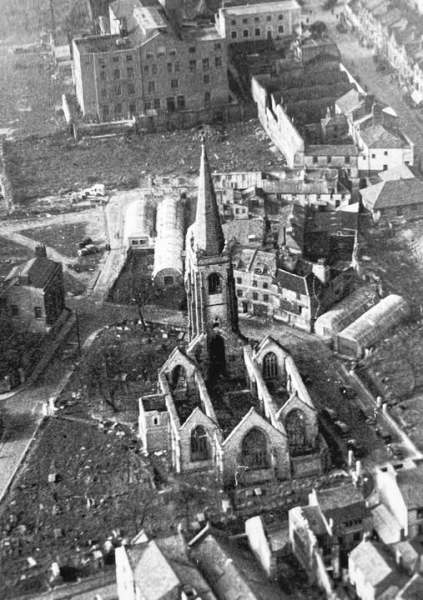
Charles Church after the bombing, March 21st and 22nd, 1941
Instead of rebuilding it, the city chose to leave the shell intact. Today, it remains just as I saw it as a child: a roofless monument, encircled by traffic, keeping its silent vigil for the parish it served for 300 years. (5)
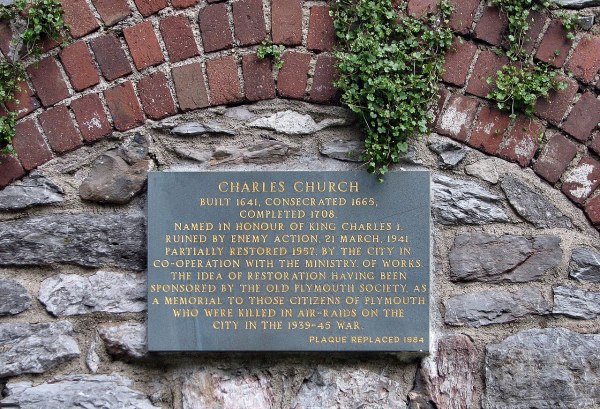
Click the link below to see a photo of Charles Church today.
Taken 30 Sept 2009
Sources
2.https://en.wikipedia.org/wiki/Robert_Trelawneyhttps://en.wikipedia.org/wiki/
3. https://en.wikipedia.org/wiki/Robert_Hawker
4. https://en.wikipedia.org/wiki/The_Barbican,_Plymouth
5. https://historicengland.org.uk/images-books/photos/item/DP086899