Tag Archives: France

A Journey to Granny Bulford: Memories of the Torrey Canyon Disaster

It is the 25th of March, 1967, and my father, my then-boyfriend, John, and Dad’s second wife, plus me are on our way to St Austell, in Cornwall, England. We were visiting Dad’s mother, my Granny Bulford, whom I never really knew, as my parents had divorced when I was seven.

We were in Dad’s new white Mini Minor, a small car. In fact, a very small car. Dad’s head brushed the interior of this small vehicle. Dad was 187.96 cm (6′ 2″), I was 180.34 cm (5’11”), and my boyfriend was about the same. I think the only comfortable person was his second wife, who was petite!

I never understood why he would buy such a small car, but, as I matured, I realised it was affordable, dependable, and low on fuel. Economic pragmatism over physical comfort, that was my Dad!

An Austin Mini 1967

Thank goodness, the trip from Plymouth to St Austell in Cornwall was only 50 to 60 minutes. The drive was along the spectacular Cornish coast. We enjoyed the scenery, and I was excited to be meeting Granny Bulford after all these years.

About half an hour into the trip, the sharp, suffocating stench of oil permeated the car. We knew exactly what it was, and our lighthearted trip turned into a sense of helplessness.

A week earlier, on Saturday the 18th of March, 1967, the supertanker The SS Torrey Canyon, carrying 120,000 tons of Kuwaiti crude oil, had run aground on Pollard’s Rock, Seven Stones Reef, between Lands’ End, Cornwall and the Isles of Scilly. It made headlines everywhere, and now, we all saw the true visuals of the disaster. (1)

We stopped and stood in silence on a cliff headland and looked out to sea. Although we were too far away to actually see the wreck, we could smell and see the devastation it had caused. As it spread to Brittany and Normandy in France, it became known as a ‘Marée noire’.(Black Tide) (3)

Map Showing The Spread of The Torry Cannyon Oil Spill
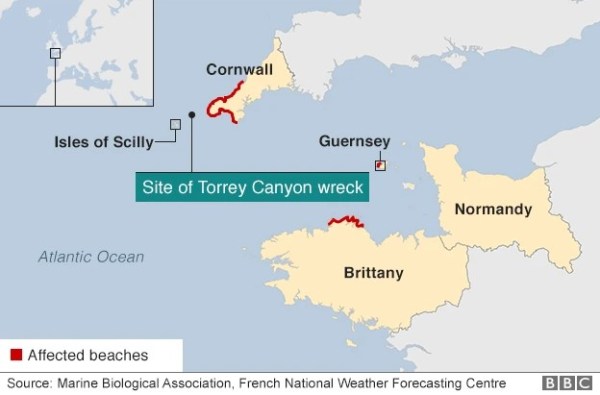
The sea in the distance was black, whilst where we stood, it was still the beautiful Celtic green-blue. We could all see that was to soon change. Over the month, it had become the source of a massive, 35-mile-long oil slick.

The Wreck Of The Torry Canyon
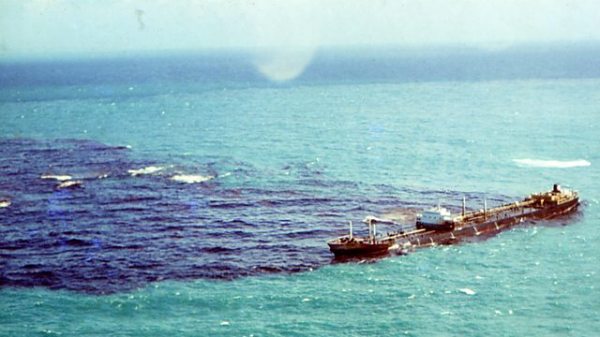
Everyone was quiet on the remaining drive. As Dad pulled away from the headland, the sharp, cloying scent of oil followed us. We all realised that this was going to be a huge cleanup operation to save the wildlife, the beautiful Cornish beaches, and the ocean. The cleanup had begun on the 20th of March. (See Notes Below)

That still, uncomfortable silence seemed to follow us. When we arrived, the air was clearer, but the atmosphere remained heavy. I was struck by the scale of things – everything felt smaller here. I was surprised to see how tiny Granny was. She just came up to my Dad’s armpit!

She was quite welcoming and ushered us in for tea and pasties. Waiting in the dining room was her eldest daughter, my Aunt Florence. This aunt, whom I had never seen since I was, according to my mother, about a year old, didn’t greet me with a hug or even a smile. She simply GLARED at me, all the time through the visit. It looked like she really did not like me. After an hour or two, I started to feel really uncomfortable.

Trying to start a conversation with her, I was met with only a yes or no. What had I done to deserve such behaviour, I wondered? Nobody else seemed to notice, or pretended not to. Eventually, we left. I never saw either one of my relatives again. My Granny died the following year, aged 86, four months after my wedding to John.

Once in the car, I whispered to John, ” Wow, I was so uncomfortable with Aunt Florrie, staring at me all the time, with such dislike’ My soon-to-be husband turned and said ‘I don’t think it was dislike. Maybe she was staring at her younger image; she was the absolute image of YOU. The facial resemblance was astonishing!”

I was speechless.

It’s quite a “Twilight Zone” and perhaps vanity moment to wonder all these years later, if the woman I thought was glaring at me with dislike was maybe staring in total shock because she was looking at a younger, taller version of herself? Or, maybe the contrast between the modern, liberated woman in a mini-skirt and the traditional, religious aunt in the tiny house?

The family in Cornwall were very religious, and perhaps me, in my fashionable mini, riding in a Mini, smoking, being in the WRAF, accompanied by my boyfriend, was just too much for her? I will never know. At 100 years old (when she passed in 2009), she certainly had the “longevity genes,” even if her social graces were a bit rusty that day!

(1) https://ejatlas.org/print/torrey-canyon-oil-spill-uk#:~:text=Beaches%20were%20left%20knee%2Ddeep,to%20be%20the%20last%20one

A Grainy Video of Some of the Cleanup. https://youtu.be/IV-EhBesVjg

BBC Article, & Photos of the Cleanup https://www.bbc.com/news/uk-england-39223308

NOTES

The Torry Canyon Oil spill was the UK’s worst environmental accident. It wasn’t just the sheer scale of the spill, but also the chaotic and often counterproductive “war” the government waged against the sea to clean it up. To be fair, the UK government had not had actual experience of a disaster of this scale.

The problem increased due to the methods used in the cleaning tasks. The first stage was to use too much ‘detergent’, which sounded harmless; in reality, it was harsh, highly toxic chemicals which affected the marine environment and its populations. The ‘Cure’ was worse than the disease. The British government was completely unprepared, treating the spill like a military invasion, using methods that are now considered environmental malpractice. (1)

Bombing The Wreck

Next, the Government tried Bombing the wreck. The RAF (Royal Air Force) and the Royal Navy dropped 161 bombs, rockets and thousands of gallons of napalm and kerosene on the ship to burn off the oil! It was a spectacular failure. The cold seawater extinguished the fires, and many bombs missed the target entirely! Both John and I felt a “professional” interest in the failed bombing mission.

Bulldozing The Beaches:

Poured onto the beach and into the sea, whilst it broke up the oil, it killed almost all marine life it touched – limpets, crabs and seaweed. Other methods, such as ploughing detergents into the sand with a bulldozer, buried the oil deep underground, where it remained for decades. After all this effort, some Cornish beaches turned a bright green due to the limpets, which eat algae, being killed, leading to massive, unchecked bright green blooms.

The Environmental And Social Impact

Beaches were left knee-deep in sludge, and an estimated 30, 000 to 75, 000 seabirds perished. Mostly guillemots, puffins, and razorbills. This ecological catastrophe, of images of oil-soaked birds and the black sludge on the pristine beaches, gave birth to the modern environmental movement in the UK.

The Legacy

This disaster led to a total overhaul of International Maritime Law. Before 1967, a ship’s liability was often limited to the value of the ship itself, which, in the case of the Torrey Canyon, was a single surviving lifeboat worth about £50. This led to the “1969 International Convention on Civil Liability for Oil Pollution Damage”, ensuring that ship owners (not just taxpayers) are held strictly liable for such disasters. (1)
Part Two of Remembering Great-Grand Uncle Arthur Symons – The Price of Survival

This is part two of my Great-Grand Uncle Arthur Symons’s experiences in WWI. Arthur emigrated to Canada in 1901, arriving in Halifax, Nova Scotia, on the SS Soman. (1)

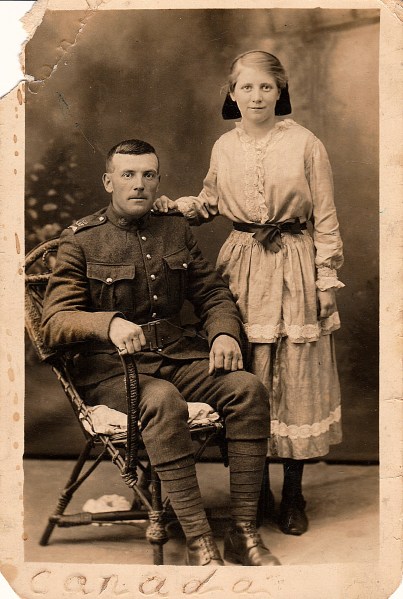
When WWI broke out, Uncle Arthur enlisted in the 56th Battalion Canadian Over-Seas Expeditionary Force in 1915 in Calgary. He was then shipped back home to the UK to train. While there, he visited his sister Lilian and her daughter Edith, my Grandmother.

Arthur Symons with Edith Bevan his niece, my Granny.

Granny was 15 years old.

At Salisbury, Wiltshire, England, the Canadians trained for four months, most of it in terrible mud, as England experienced one of its wettest winters in decades. While most troops stood up well to the awful conditions, Canadian equipment did not. Much of it was soon discarded in favour of British types. The Canadians learned basic soldiering in England after a hasty mobilization and a difficult, uncomfortable winter. Their real training would come at the front.

After training, Arthur was sent to France and later Belgium. At the Third Battle of Ypres, better known as Passchendaele, the troops fought there from July to November 1917. Both sides suffered appalling conditions and heavy casualties. “The name Passchendaele has become synonymous with mud, blood and futility”. Arthur was wounded in 1917 at Passchendaele. (2)

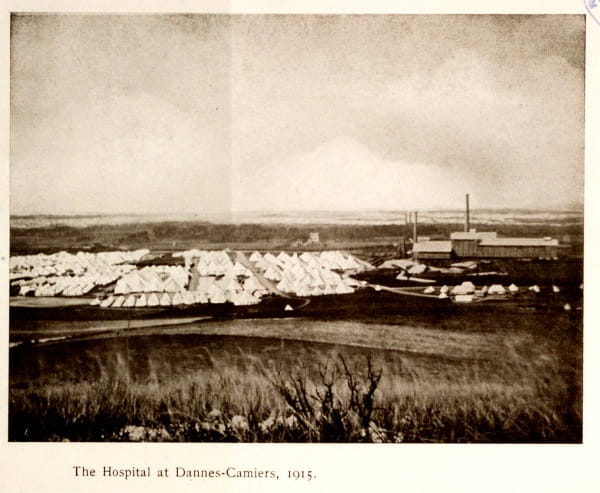
The Government of Canada Library and Archives search had Arthur’s Attestation Papers and detailed medical treatments at “No. 4 General Hospital Dannes Camiers” (2) among many other hospital visits.

Searching for Dannes Camiers Hospital, led me to the Royal College of Surgeons of England and the following information. (2)

Shortly after the war broke out, McGill University organised the ‘No. 3 Canadian General Hospital’ to serve in France. The hospital was established at Dannes Camiers in the Pas-de-Calais area on 19th June 1915 under canvas. A staff of 35 Officers, 73 Nursing Sisters and 190 rank and file. Life under canvas that cold wet November was tough, with deep mud, storms, frost and collapsing tents. The conditions so undermined the health of one Lieutenant Colonel Yates that he was invalided to England where he died the following year.

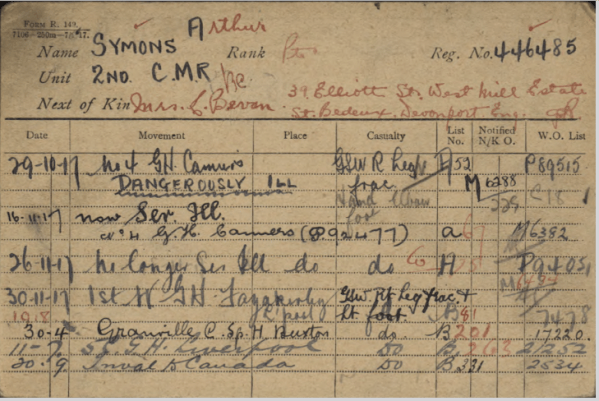
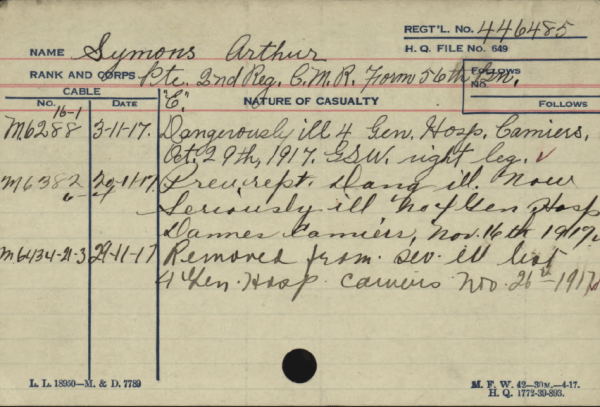
Arthur’s admission to the Dannes Camiers Hospital was on the 29th of October 1917. The first line of his medical records states he is ‘Dangerously ill’ with GSW (gunshot wounds) R. Leg fracture and left foot.

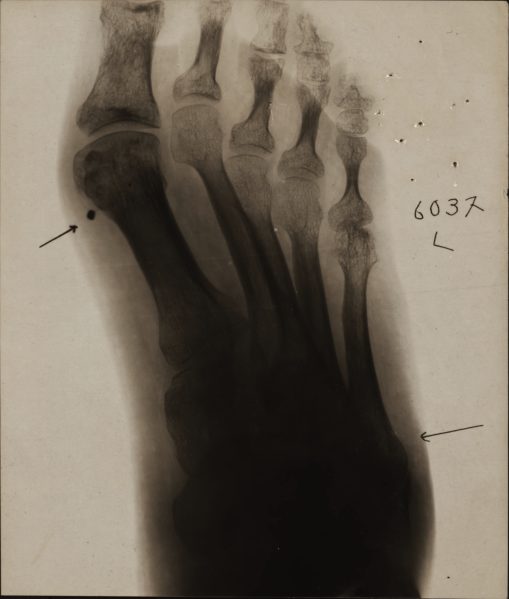
By the 16th of November, Arthur is now ‘seriously ill’ There follows 99 pages – starting with his Attestation Paper – then very detailed treatments and x-rays from various hospitals in France, England and Alberta, Canada. It makes for fascinating reading.

Three pages from Arthur’s 99 pages of hospital notes and X-rays.

On the 30 of November 1917, Arthur was transferred to the 1st West General Hospital Fazakerly, Liverpool England. After 5 months of treatment, Arthur was again moved to the Canadian Special Hospital Buxton, Derbyshire, England.

NOTE: Amongst the patients at Buxton, was Frederick G Banting, who would return to Canada after the war to continue research into diabetes and the use of insulin in its treatment, for which he was awarded the Nobel prize. (3)

His last transfer was on July 11, 1918, to the 5th Canadian General Kirkdale, Liverpool, England.

Eventually, on the 20th of September, 1918, Arthur was Invalided to Canada. He was sent to the Ogden military convalescent hospital in Calgary, Alberta. A short visit to the Calgary General Hospital, then back to Ogden.

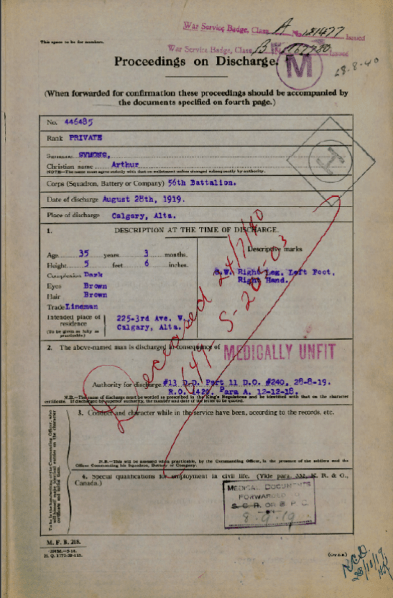
Finally, after nearly 2 years at 5 different hospitals, Arthur was sent to the Banff Rest Camp, and discharged on August 28, 1919, medically unfit for further service. He was 35 years old.

Arthur went on to marry and have two children and was employed in the Civil Service

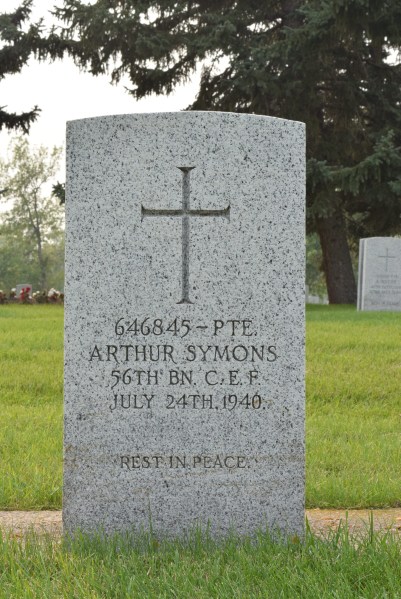
This rather poignant note dashed across his discharge papers state ‘Deceased 24/7/40’

Excerpt from The Calgary Herald, July 26, 1940, page 2
Arthur Symons, 54, of 2409 Centre Street South, died in hospital here Wednesday afternoon. Born in Leicester, England, he came to Calgary 32 years ago and was employed in the civil service for 17 years. He is survived by his wife, Catherine, one son, Arthur, and one daughter, Dorothy.
Alberta Death Reg. #1940-08-201498

Great-Grand Uncle Arthur Symons is buried in Burnsland Cemetary, Calgary Alberta, Canada. (Photo credit Ron Reine)

RIP Uncle Arthur.

Part 1 of Great-Grand-Uncle Arthur’s experiences in WW1:

(1) https://genealogyensemble.com/2024/11/11/remembering-great-grand-uncle/

(2) https://www.rcseng.ac.uk/library-and-publications/library/blog/we-will-remember-them-no-3-canadian-general-hospital/

(3) https://buxtonmuseumandartgallery.wordpress.com/2019/12/13/canadian-red-cross-special-hospital-buxton-1915-1919/

(4) Dr. Frederick Banting

Searching for Ancestors in France

Many original documents of French ancestors are available online via the 92 of the 95 departmental archives in France.

To make it easy for you to use these wonderful public resources, I have compiled the links into a single pdf document, which you can download from this link: Master copy 10 12 13 Les Archives départementales en France.

Also included are maps so that you can figure out which modern department holds the historic records you need to find.


Genealogy Societies of France

Genealogy Societies in France

If you are interested in joining a genealogical society in France to pursue your research, the information found within this list may be very helpful.

The document contains a comprehensive list of 95 departments and their genealogical societies.

The following information is noted for each of the societies.

  • location,
  • number of years in existence
  • email address
  • internet addresses
  • cost of membership

Right Click and choose  open in a new window:  Genealogy Societies of France.

Learn How to Research French Archives

One of the most experienced researchers in the Quebec Family History Society is also one of the group’s most generous members. Jacques Gagné, who has researched the records of the Protestant churches of Quebec, Scandinavian genealogy, the Huguenots, Loyalists, Acadians, Aboriginal families and other ancestral groups, has recently turned his attention to France. Now he is willing to train other members of the QFHS to research their ancestors in France. This is a unique opportunity, not only for anyone with French Canadian roots, but for those who want to expand their genealogical skills and to give back to the genealogical community.

Jacques has compiled links to the archives of 92 out of 95 departments of France into a single pdf document, which you can download from this link: Master copy 10 12 13 Les Archives départementales en France. Also included are maps so that you can figure out which modern department holds the historic records you need to find.

Updated dates: Jacques will be volunteering at the QFHS library on May 20 and May 23, from 10 a.m. to 3 p.m. If you are interested in researching your ancestors in France, come to the library on one of those days to learn how. Once you have experience in researching your own ancestors, Jacques hopes you will be willing to pass on that knowledge to others.


The Trail of the Huguenots in Europe, the U.S.A and Canada

The Trail of the Huguenots in Europe, the United States, South Africa and Canada
Author: G. Elmore Reaman
QFHS #UEL-REF HG 010.01 R4 1972
Total pages: 318
From page 137 to page 205, this section of the book address the Protestant families in Nouvelle France (New France)
Being a book owned by the United Empire Loyalist’ Association of Canada, it cannot be taken out of the library.

The following is an excerpt from this superb book by G. Elmore Reaman.

It is a generally accepted point of view in Canada that Frenchmen have always been Roman Catholics and that Protestantism has had little or no reliationship with France. It has been further accepted that there was no connection between Protestant French and the exploration of Canada by the French. A careful study of both of these points of view will show that they are untenable. It may come as a surprise to learn that historians of this period state on good authority that, if it hadn’t been for the business enterprise of Huguenots in France and their desire to found a colony where they could remain loyal to the King of France and yet enjoy freedom of worship, it is doubtful if there would be many French in Canada today. Furthermore, it is quite possible that had the French allowed Huguenots to migrate to Canada in the seventeenth century, England would have stood a slim chance of conquering Canada.

Such information does exist in authentic sources, but few persons in Europe or America—and that includes Canada—have any knowledge of it. French Roman Catholics have naturally advanced their point of view and Protestants have never thought it worth while to investigate it. Huguenot Societies in France, England, and the United States are not aware that from 1534 until 1633 Canada was practically Huguenot controlled nor do they know that many of the earliest settlers in Upper Canada (Ontario) were descendants of émigrés from France, some of whom first went to the British Isles, then to the United States, and finally to Ontario.
G. Elmore Reaman

G. Elmore Reaman (1889-1969) was born in Concord, Ontario, he received his education at the University of Toronto, McMaster University, Queen’s University, Cornell University.

Dr. Reaman’s materials are found at the University of Waterloo Archives.

Posted by Jacques Gagné for Genealogy Ensemble

Jacques Gagné’s book review

M Jacques Gagné est un chercheur en généalogie, bénévole depuis plus de dix ans à la Quebec Family History Society.  Il a compilé plusieurs dizaines de listes de ressources pour les chercheurs.  On en retrouve en ligne,  dans la section des membres de la QFHS, certaines de ses nombreuses compilations.  On en nretrouve en bibliothèque aussi à la société.  Il a travaillé, entre-autres, sur les actes manquants des églises protestante du territoire que couvre le Québec contemporain pour la période 1759-1899.  Il a travaillé sur maints projets, dont les églises des missions des premières nations, sur les Huguenots, tant en Europe qu’en Amérique, sur les missionnaires itinérants, sur les ressources disponibles sur les Acadiens, les Canadiens- Français et en ce moment  sur les départements français.

M Gagné a écrit une série de critiques de livre dont voici la première que nous vous présentons.

Members of QFHS know him, and in the members only section of the QFHS you find some of his compilations.  Many of his works are available at the QFHS library.  He has been working hard for years to provide tools to help us look up and find genealogical information on French, Huguenots, First Nations….

”Jacques Gagné has been a volunteer genealogical researcher at the Quebec Family History Society for the past ten years, handling a wide variety of genealogical cases. For several years, Jacques has conducted in-depth research on the missing Protestant Church Registers for what is now the province of Quebec, from 1759 to 1899. To date, more than 1,000 churches are listed. Now he has provided an extensive guide to Family Searches on the Internet.”

Here is one of a series of book reviews he has prepared for the French Research Group at QFHS.

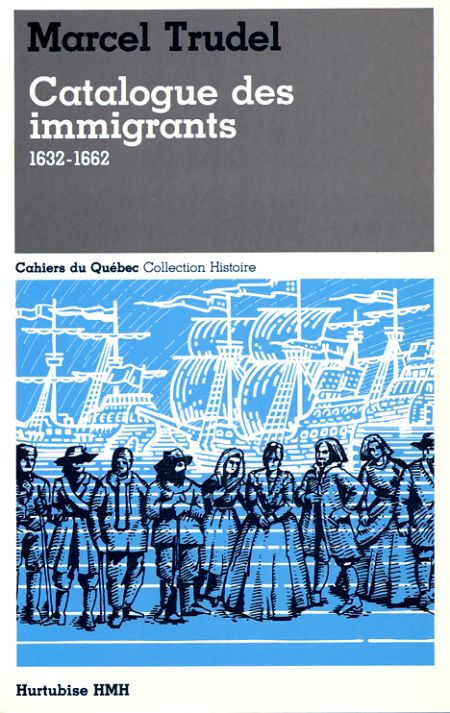
Marcel Trudel
Catalogue des immigrants 1632-1662
569 pages
QFHS #REF HG-150.99 T7

Trudel

Marcel Trudel (1917-2011) was a longtime professor at the Université Laval in Québec City and at the University of Ottawa. Recipient of many awards during his lifetime as an historian. In 1971 he was made Officer of the Order of Canada – In 2004 he was made a Grand Officer of the National Order of Québec.

Within this 569 pages detailed research guide, Marcel Trudel has addressed 3,000 immigrants from 1632 to 1662 who had settled in Nouvelle France.

Monsieur Trudel in comparison to Marcel Fournier and René Jetté has taken a different approach in his work.

All three historians in my opinion are offering a different perspective to the research process of one’s ancestor in France.

I have never taken the time to compare the results posted by Marcel Trudel or by René Jetté or by Marcel Fournier, but in my opinion, all three have researched and compiled superb material.

Marcel Trudel as part of is excellent dictionary has spent considerable time in offering his readers, precise details such as the age of an immigrant, the type of work he or she did in France, from where they came from, were these immigrants capable of signing their names to documents such as acts of baptism, marriage, death or notarial records and what type of work they did once they settled into Nouvelle France.

Jacques Gagné


French and French-Canadian resources at QFHS

L’association Quebec Family History Society, à Pointe -Claire dans l’ouest de l’ile de Montréal, a une groupe de recherche francophone en plus de toutes les activités orientées vers les recherches anglophones.  M Jacques Gagné, un membre de la société et chercheur chevronné du côté de la recherche française, nous offre quelques mots et conseils:
” En plus de posséder un des plus grands dépôt de revues et publications anglophone des iles britanniques et du Canada, à part de celui du BAnQ sur Viger  à Montréal, la société reçoit plusieurs publication en français.  Le plus importantes étant:
>> Mémoires de la Société généalogique canadienne-française
>> L’Ancêtre de la Société de généalogie de Québec
>> L’Entraide généalogique de la Société de généalogie des Cantons de l’est
Les membres de la QFHS qui désirent devenir des experts en recherches d’ancêtres de France, devraient commencer par les publications à la QFHS.
C’est en fait comment j’ai débuté il y a plusieurs années”
Jacques Gagné
La QFHS a même un spécial pour nouveaux membres jusqu’en juillet 2014
QFHS_Logo

The Quebec Family History Society in Pointe-Claire (West Island of Montreal) has a wonderful library that is opened quite a few hours a week, and from which members from out of town may even borrow books by mail.

Jacques Gagné, one or our members for quite a few years, our local French research expert supports the  France Research Group at

QFHS.  Here’s his two cents worth about starting some French Quebec research:

”Periodicals at QFHSOver the years under the leadership of Claire LindellMary Plawutsky, Daphne PhillipsBruce HendersonTed Granger, Diane Bissegger, the QFHS Library has been a primary repository of periodicals from the British Isles and from most provinces of Canada.To my knowledge, only the Archives nationales du Québec on Viger has a larger collection of genealogical magazines.This article will only address the aspect of research tips dealing with France.

Three periodicals in Québec, all three kept at the QFHS Library are superior to others in regard to the French Canadians and Acadians;
>> Mémoires de la Société généalogique canadienne-française
>> L’Ancêtre de la Société de généalogie de Québec
>> L’Entraide généalogique de la Société de généalogie des Cantons de l’est

Others revues (periodicals) dealing with the French Canadians and Acadians are also stored within the shelves of the QFHS Library.

QFHS members who wish of becoming experts in the research process of ancestors in France, should begin their expertise journey with the French language periodicals kept at the QFHS Library.

This is basically how I started a number of years back.”

Jacques Gagné

The QFHS is even having a new-members special until July 2014

Researching Your Ancestors in France

Map of France 1740
Map of France 1740

 Are you researching your ancestors? Do you want to know what part of France they came from;  where they began their journey to New France?  If so, you might be interested in the new group formed by members of the Quebec Family History Society (QFHS).

The France Research Special Interest Group meets every 4th Sunday of the month at 1:00 pm to 3:00 pm at the QFHS Library and Center at 173 Cartier Avenue in Pointe-Claire, Quebec  just off of Highway 20 (opposite the CLSC).

QFHS members are welcome  to join  these monthly meetings.  Together, in a friendly and informal setting, new and experienced genealogists gather to discuss our French ancestors. The focus of the group is to share researching techniques available on the Internet. France has a wealth of free websites containing numerous databases and extensive archives  for each of the 95 departments dating back in time to  the 1500s.

If you are not a member and are interested in joining the group or want know more about QFHS, visit the website at www.qfhs.ca.