
“Supercalifragilisticexpialidocious”

“Supercalifragilisticexpialidocious” called out my grade two teacher as the last word on our daily spelling test. It was the surest way to get our full attention on that April Fool’s Day!

When I begin to work on a story about one of my ancestors, it is not always clear on how to best start the story.  One very helpful tip, from the Genealogy Ensemble writers group, has been to find a way to capture the reader’s interest in the first few sentences.

Dick Francis, a famous British jockey and thriller writer (and one of my favourite authors), began almost all of his books in this fashion.

Here are some examples of excellent openers from stories posted on our website Genealogy Ensemble:

  1. A Small Life by Barb Angus – https://genealogyensemble.com/2015/10/21/a-small-life/

“I hold the documents as gently as I would the child for whom I have searched for so long. A birth certificate. A death certificate. Four days apart.”

  1. Call me Ismael by Mary Sutherland- https://genealogyensemble.com/2015/11/04/call-me-ismael/

“He arrived when the service was almost over. He walked to the pulpit and announced the last hymn “Seigneur Tu donne Ta Grace.” As the organ played he collapsed to the floor. So ended the life of Ismael Bruneau, my great grandfather.”

  1. The Cipher by Sandra McHugh – https://genealogyensemble.com/2017/02/08/the-cipher/

“When I say that my grandfather, Thomas McHugh, worked as a cipher, Bletchley Park, MI5, and Russian spies immediately come to mind. He was neither a Russian spy nor did he work as a cipher during the war. His employer was the Bank of Montreal and it was his first job when he came to Canada in 1912.”

  1. No Fairy Tale Ending by JaniceHamilton https://genealogyensemble.com/2015/02/11/no-fairy-tale-ending/

It must have been a happy wedding. For a girl from relatively humble American roots to marry the owner of one of Quebec’s vast seigneuries, this must have seemed like a wonderful match. And the groom had recently lost his parents, so family members were no doubt pleased to see him marry. Unfortunately, there was no fairy-tale ending to this story.”

  1. Like Father, Like Son by Lucy H. Anglin – https://genealogyensemble.com/2016/06/01/like-father-like-son/

“My husband was mesmerized by the photo of a young man hanging in a sling close to the giant propeller of the airplane he was repairing.  He had never seen it before.  It was a photo of his father, Allan, in his early twenties.”

Nonsensical words are great fun for children, but I think the opening sentences of these stories are excellent examples of how to capture my interest as an adult reader.
Aren’t Birthday Parties Fun?

By Sandra McHugh

Aren’t birthday parties fun? I was thinking this recently when we celebrated my daughter’s 30th birthday at the Auberge Saint-Gabriel in Montreal. I was also thinking how a birthdate is such an important indicator in genealogy research.

A birthdate and a place of birth places a family member in a period of time and in a location that can tell us a lot about the social context in which the person lived. Buildings and their uses can also tell us a lot about a place.

The Auberge Saint-Gabriel in Montreal is one of the oldest buildings in the city.  It was built by Etienne Truteau, a French soldier in 1688. 1 In 1754, it was the first inn in North America to be issued a liquor license. 2 Over the centuries it has had many vocations, including the Beauchemin printing press operation founded in 1860 and that printed the newspaper Le Patriote.3

And who doesn’t love a good ghost? It is said that the Auberge Saint-Gabriel is haunted by a little girl who lost her life when a fire raged through the ground floor, trapping her and her grandfather upstairs while her grandfather was teaching her to play the piano.4

Today, the Auberge Saint Gabriel is a trendy restaurant and reception centre right in the middle of Old Montreal. If you go inside, you can see that the owners continue to maintain the building as much as they can in the style that it was built. You can appreciate the thick brick walls, stained glass windows, and the many antiques that grace its rooms. If you like, you can go down to the basement to visit the place where there was a fur trading post. Today, this fur trading post is a speakeasy, called The Velvet.5

I am quite confident that almost all of my ancestors who lived in Montreal would have at least walked by or had business in or around the Auberge Saint Gabriel.  And who knows? Maybe our descendants would be pleased to know that we dropped off our car at the door of the Auberge Saint Gabriel for a fun-filled night at the speakeasy.

What buildings are important to your family’s history?

  1. L’Auberge Saint-Gabriel web site. <http://aubergesaint-gabriel.com/historique/>, accessed June 12, 2017.
  2. Wikipedia article on Auberge Saint-Gabriel. <https://en.wikipedia.org/wiki/Auberge_Le_Saint-Gabriel>, accessed June 12, 2017.
  3. Wikipedia article on Auberge Saint-Gabriel, accessed June 12, 2017.
  4. Benoit Franquebalme, “Garou : Propriétaire d’une auberge hantée !”, France Dimanche, January 1, 2016, <http://www.francedimanche.fr/infos-people/musique/garou-proprietaire-dune-auberge-hantee/>, accessed June 12, 2017.
  5. L’Auberge Saint-Gabriel web site, accessed June 12, 2017.


New Book Tells History of Mile End

Hundreds of special events are taking place in 2017 to mark the City of Montreal’s 375th birthday, but the one that means the most to me is the publication last month of a history of the Mile End district of Montreal. Some 200 years ago, that was where my three- and four-times great-grandparents lived.

There, at the intersection of the only two roads for miles around, Stanley Bagg and his father Phineas ran an establishment called the Mile End Tavern. Their landlord and future in-law, an English-born butcher named John Clark, probably came up with the name Mile End. The tavern was at the corner of what is now Saint-Laurent Boulevard and Mont-Royal Avenue, and the whole area eventually acquired the same name.

Mile End has no formal boundaries, but it is essentially just to the northeast of Mount Royal, as far as the railroad tracks. Some of the area’s streets are known far beyond Montreal: Saint-Urbain, for example, was made famous by author Mordecai Richler, and both Saint-Viateur and Fairmount streets have bagels named after them. Other well-known streets include Laurier, Parc, Saint-Joseph and Jeanne-Mance.

IMG_8942
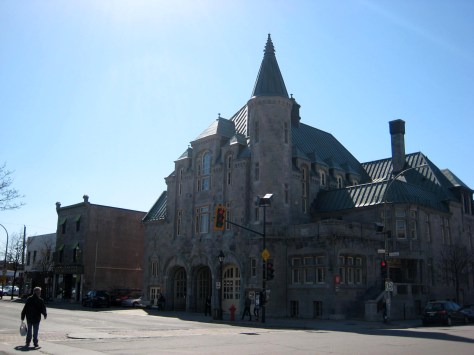
This fire station at Laurier and Saint-Laurent was once town hall of the suburban Ville de Saint-Louis. jh photo.

It is a vibrant neighbourhood, home to musicians, teachers and software developers, trendy restaurants, second-hand shops and rows of triplex and duplex dwellings, often featuring Montreal’s iconic outdoor staircases.

Histoire du Mile End, the first book to focus on the area’s history, was written by former journalist Yves Desjardins. His journalism background shows: he has researched his subject thoroughly in newspaper accounts, archival sources and academic articles, and pulled it all together in clear, concise language. I can attest to how readable it is because, although the book is in French, I have had no trouble reading it. It helps that the book is generously illustrated with historic photos and maps.

Over the decades, Mile End has been home to waves of immigrants, starting with French Canadian job-seekers who moved to the city from the Laurentians, and including Jewish immigrants from Eastern Europe, Italians, Portuguese and Greeks. Many of the area’s residents worked in the nearby Peck Building, labouring in low-paying jobs in the garment industry; today, the Peck Building is home to Ubisoft, a major player in the video game industry.

Just as it takes a village to raise a child, sometimes it takes a community to write a book. Yves had help from friends and neighbours — many of them members of the local history group Mile End Memories — who gave him access to their own research and expertise. I provided him with information about my ancestors the Baggs and the Clarks, and the collaboration paid off for both of us: I was able to fill in family information he didn’t have, and he helped me understand the historical context of my ancestors’ lives.

I learned that Saint-Laurent Boulevard, the traditional dividing line between the western part of the city, where the majority of English-speaking Montrealers live, and the eastern part, which is overwhelmingly French-speaking, was the only road leading north out of the city in the early 1800s. The Baggs owned much of the land on the western side of Saint-Laurent, and it remained primarily rural until the 1890s. Much of the land on the east side was owned by the Beaubien family, and early residents worked in local tanneries and quarries.

At the end of the 19th century, a group of real estate promoters from Toronto tried to develop a “strictly high class suburb” in Mile End called the Montreal Annex. While they did manage to attract a few professionals and their families, the scheme eventually failed. For decades, most of Mile End’s residents were strictly working class, or worked at skilled trades such as shoe-making and carriage-making.

carriage drive
Carriages, not cars, once used this entrance between row houses. jh photo.

Meanwhile the area experienced many growing pains as politicians argued over taxes and infrastructure, and promoters battled to provide the public transportation (by electric tram and rail) that was key to the area’s growth.

Today, as the city of Montreal rebuilds its infrastructure and controversy surrounds plans for future residential projects and transportation corridors, it seems that some things haven’t changed much.

Yves Desjardins. Histoire du Mile End, Québec: Éditions du Septentrion, 2017.

See also:

Janice Hamilton, “The Mile End Tavern”, Writing Up the Ancestors, Oct. 21, 2013, http://writinguptheancestors.blogspot.ca/2013/10/the-mile-end-tavern.html

Mile End Memories, http://memoire.mile-end.qc.ca/en/ This site includes articles in English and in French, photos, an interactive map that indicates the location of many historic buildings, including the Auberge du Mile End (Mile End Tavern), and a link to summer walking tours of the area.

This article was simultaneously posted on http://writinguptheancestors.blogspot.ca