When my mother died in November 1961, my father hired various nannies to run the household and look after his four children. The revolving nanny door made it difficult and stressful for everyone and finding a new wife and mother quickly became Dad’s priority.
A friend suggested he compile a checklist of his seven most important criteria, which were “all essential and the absence of any one eliminates the prospect”. Several names were scrawled on his list but there was nobody named Elizabeth. Our future stepmother must have been completely off the grid!
Elizabeth Fulcher arrived in Montreal from England in 1961 to teach at a girls’ private school. Once she had settled into her new life in Montreal, she joined a social club in the spring of 1962, and she met my Dad, Tom Anglin, there. After a few games of tennis, they began to date regularly. Thinking back to that time, she recalls: “I thought he was a nice, honest person”.
This wasn’t going to be your typical whirlwind romance.
Elizabeth took the opportunity to get to know the four of us children, as well as Dad, while they were dating. It seemed to be a mutually advantageous relationship for us all as Elizabeth had always wanted a family and now a family wanted her. However, the decision required rational thought as well as emotional feeling. Years later, she admitted her love for us equalled her love for our father.
Tom proposed nine months later, in February 1963, choosing the woman who would love his children just like Captain Von Trapp chose Maria in “The Sound of Music” — our favourite family movie. Elizabeth recalled, “He proposed after we went to a dinner dance at the Queen Elizabeth Hotel. I had an idea that he was going to, it was in February and could have been a Valentine’s Day Dance. He could charm and was a good dancer so I always felt good about dancing with him.”
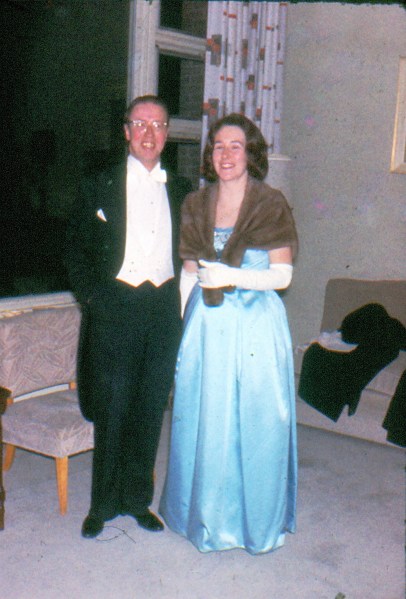
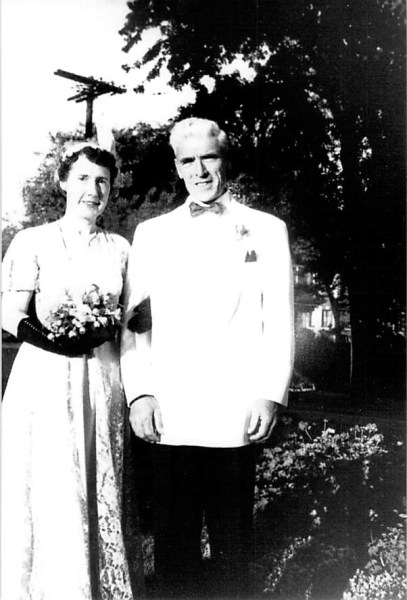
Their Engagement – Elizabeth and Tom going to the Ball 1962
My father arrived in England, only two days before the wedding in July 1963, after organizing summer camps for the children and a leave of absence from his company. Fortunately, he had already passed muster when Elizabeth’s twin, Diana, spent the previous Christmas with us all.
They married in the local church in Iken, steps away from where Elizabeth grew up. Her stepmother, Eileen, decorated the church with masses of flowers, Diana was her bridesmaid and the children of the local farm hands made up the choir. Family and friends watched eagerly as Elizabeth walked down the aisle to the organist’s rendition of…what else but “Oh Canada”!
The newlyweds briefly honeymooned around Western Europe skipping the last stop as Elizabeth just wanted to go “home” and start her new life as wife and stepmother. “We had four days in England to pack up and leave,” she says. “Then we picked up the kids from camp the next day. We all drove out to the summer cottage in Knowlton (Eastern Townships, Quebec) and Tom went back into Montreal to work during the weeks”.
I had just turned six years old when I stepped off the camp bus. I remember looking down at the clogs on my stepmother’s feet and thinking “those are funny shoes” and at the same time realizing “this is my new mother”.
The whole family moved back to Montreal at the end of the summer. The children (aged six to 14) started back to their schools and Tom returned to work. Elizabeth launched into her new life with an impressive and loving energy. Fully committed to her new role, she oversaw the needs of the children, carefully managed a monthly budget, and prepared dinner for six every night… never failing to greet Tom at the door with a kiss and asking about his day.
There wasn’t a hint of wickedness in our new stepmother.
1963- My stepmother, Elizabeth, with her new (instant) family
Five more summers in Knowlton flew by with just the four of us children before the family grew to include my three half-sisters born between 1966 and 1971.
Ultimately, her physical education training continued to prove useful as she juggled a houseful of babies and teenagers!
“Eddie! Come on, Ed. Frank forgot his lunch and you have to take it to him.”
Ed’s heart sank. He had no school today but, instead of playing with his friends, he would have to make his way all the way from Verdun to Montreal West so that he could give Frank the lunch he forgot. It was sitting right there, on the kitchen table when Frank left – and he forgot it again!
My uncle, Frank McHugh, worked as a tramway driver and he drove the tram on the 63 or 64 route that went along Sherbrooke Street West in Montreal. The unlucky little boy who always had the job of taking him his lunch was my dad, Edward McHugh.
Uncle Frank’s full name was Francis Strachan McHugh. He was born in Dundee, Scotland in 1904 and emigrated to Canada with his parents and six siblings in 1912. His younger brother, Edward, was born in 1914. So, by the time Frank had found work as a tramway driver in the 1920’s, Edward was old enough to travel across the city and bring him his lunch.
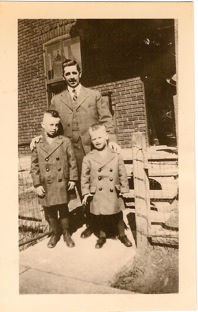
Thomas McHugh with sons, Edward (left) and James (right). Edward was about eight years old in this picture, about the time he would have carried Frank’s lunch to him.
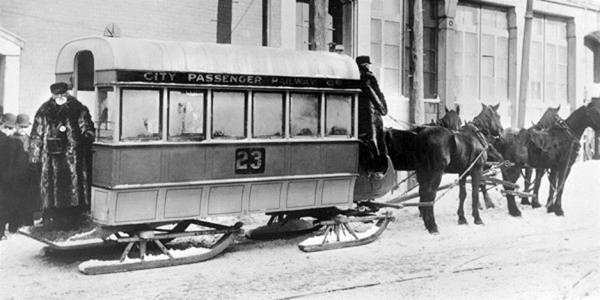
The first public transportation company in Montreal, The Montreal Passenger City Railway Company (MPCRC) was established in 1861 when the first horse-drawn tramway came into service along Notre Dame Street. The horse-drawn tramway had two employees on-board, a driver and a conductor who collected the fares. The passengers simply hailed the tram when they wanted to get on and signaled to the driver when they wanted to get off.1
Horse-drawn winter tramway on St. Catherine Street (around 1877), Société de transport de Montréal (STM) website, Tramways History
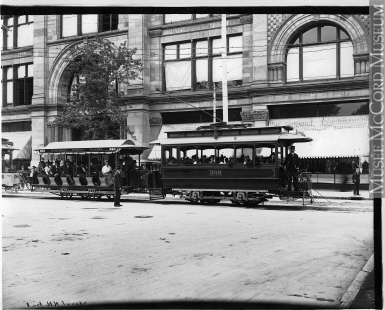
The MPCRC eventually became the Montreal Street Railway Company (MSRC). The MSRC introduced the first electric powered tramway, The Rocket, on September 21, 1892. The electric tramways immediately became very popular as they were much faster than the horse-drawn tramways. 2
By the time Uncle Frank became a tram driver, his employer was the Montreal Tramways Company (MTC). The MTC, created in 1911, acquired all the other transit companies on the island at that time. The citizens of Montreal, concerned that a private company had a monopoly over the public transit in the city, put pressure on the city, and the Montreal Transit Commission was created in 1918 to oversee the MTC. 3
Electric trams, Ste-Catherine Street, Montreal, McCord Museum, Wm Notman and Son, 1895
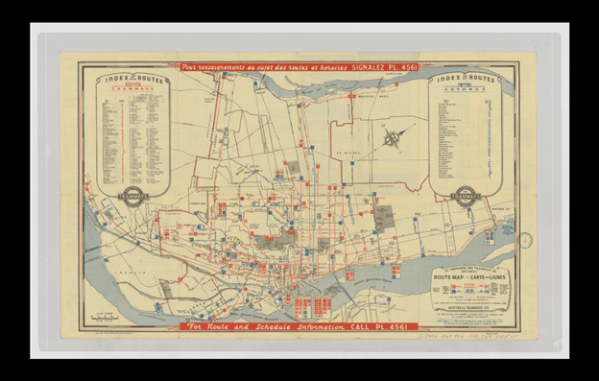
At the time that Uncle Frank worked as a tramway driver in the early 1920s, it was the peak of the operation of the tramway system in city. At that time, the MTC carried nearly 230 million passengers per year. 4 In 1924, the company published this map of the Montreal Transit system.5
Route map of bus and tramways in Montreal, Bibliothèque et Archives nationales du Québec, collection numérique
By the mid-1920s, the city began transitioning to buses, with the first major replacement of the tramway in 1936 in the city’s east end on Notre Dame Street. 6 Uncle Frank followed suit and drove the bus that went along Sherbroooke Street West. But by that time, if he forgot his lunch, he was out of luck.
When cars became popular in Montreal in the 1950s, Uncle Frank quit his job as a bus driver and became a taxi driver.
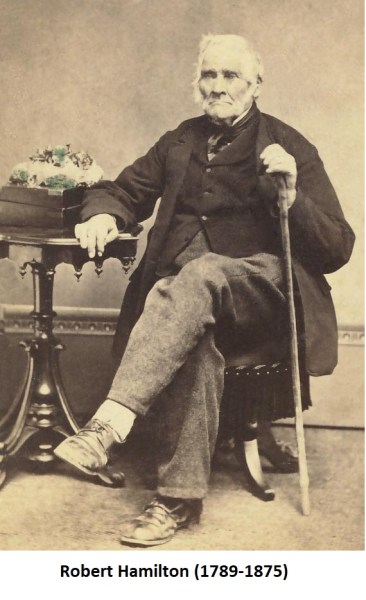
A few years ago, someone gave me a copy of the Hamilton family tree, starting with immigrant couple Robert Hamilton ((1789-1875) and his wife Elizabeth Stobo (1790-1853) and including up to six generations of their descendants. Dates, places and occupations were not mentioned, however, and I wondered who these distant relatives were. Fortunately, the Hamilton family is well documented on Ancestry.ca, however, the Scottish habit of using the same names over and over makes the task confusing.
Their health also interested me. A number of my direct ancestors died of heart disease, so I wondered whether my great-grandfather James Hamilton’s siblings also suffered from this condition.
In 1829, Robert and Elizabeth immigrated from the town of Lesmahagow, Lanarkshire to Scarborough, Canada West, now a suburb of Toronto, Ontario, where many of their friends and relatives also settled. When they arrived, their children – Elizabeth, Janet, Agnes, Robert, Margaret and James — were still young. Robert continued to practice his trade as a weaver, meanwhile reinventing himself as a farmer.
Elizabeth Stobo died at age 63, while Robert Hamilton lived to the ripe old age of 86. Two of his sisters also came to Canada, and both had long lives. Agnes Hamilton (1791-1878) and her husband Robert Rae and their four young children arrived in Ontario in 1832. Robert Rae was killed by a falling tree within weeks of their arrival, but Agnes and her children eventually purchased their own farm in Lambton County, Southwestern Ontario. According to her death record, Agnes died of “old age” at 87.
Robert’s younger sister, Janet Hamilton (1800-1882), married in Canada. Her husband, farmer John Martin, was originally from Dumfriesshire. John died at age 83 and Janet succumbed to “dropsy from heart disease.” at 81. The Martins had two sons and a daughter.
Scarborough Township had fertile soil and the Hamiltons must have enjoyed their new lifestyle because the next generation were all farmers. The 1861 census – 32 years after the family immigrated – showed that four of Robert’s children remained in Scarborough Township and neighbouring Markham, while the other two settled about 230 kilometers away in Southwestern Ontario. Eventually one branch of the family – mine – became pioneers again, this time moving to Western Canada.
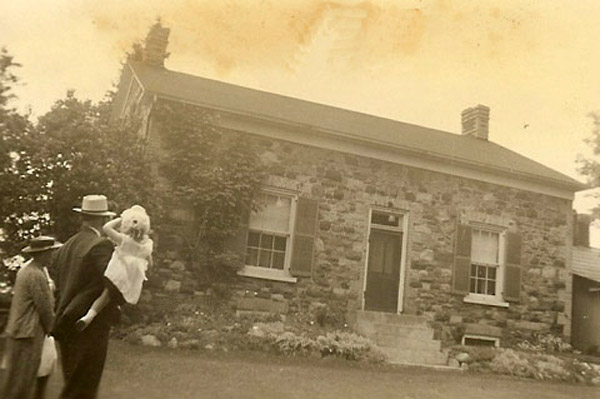
Robert’s and Elizabeth’s eldest daughter, Elizabeth (1817-1894), married farmer William Oliver (c. 1814-1904), who was from Dumfriesshire. Around 1842, the couple settled in a part of Scarborough that did not yet have a road. They cleared the trees, built a two-story stone house and established a farm that became known for its beautiful flower garden. When they finally sold the property some 35 years later, it brought them more than $100 an acre! They retired to Agincourt, where Elizabeth died of cancer at age 76. They had no children.
In 1842, Janet Hamilton (1818-1897) married Robert Reid (1810-1880), who also came from Lesmahagow. They raised nine children on their farm in Markham. According to her death record, Janet died at age 79 of “old age and heart disease” and all of her sons and daughters died of stroke or heart disease between the ages of 49 and 89.
Robert Hamilton’s stone farmhouse in Agincourt, Scarborough. This photo was taken in the early 1940s. courtesy Alison Wright.
Agnes Hamilton (1821-1897) married Scarborough farmer James Green (c. 1816-1872) from Dumfriesshire and raised seven children. Agnes’s many grandchildren called her Nannie. When James and his family left Ontario, Agnes’s son James purchased his uncle’s Scarborough property. Agnes died of bronchitis at age 76.
Robert Hamilton (1824-1871) was a farmer like his father, but he left the Scarborough area for cheaper agricultural land in Bosanquet Township, Lambton County. This part of Southwestern Ontario, near the shores of Lake Huron, was opened to settlement in the 1830s, but development was hampered in the early years by a lack of roads. It remained rural, and farmers there grew primarily wheat and peas and raised pigs and cattle. Robert and his wife, Janet Smith (1824-1899), had five children. Shortly after being counted in the 1871 census, Robert died of typhoid fever at age 46. In the 1881 census, the widowed Jennet was listed as “female farmer,” living with her grown daughter and three sons. In many families, the oldest son would be counted as head of the family, but not in this one. Of their children, only James married, and some of his descendants still live in the area today. Robert, his wife and children are buried in Pinehill Cemetery, Thedford, Ontario.
Margaret Hamilton (1827-1891) married James Gordon (c. 1820-1903) and had seven children. They settled in Middlesex County, in Southwestern Ontario, around 1860 and farmed there for 22 years. After selling that property, they purchased a small garden farm. Margaret died at age 64 of angina. Descendants of this family also remain in Southwestern Ontario.
As for James Hamilton (1829-1885), after farming in Scarborough for more than 20 years, in 1882 he became a founding settler of Saskatoon, which at that time was an alcohol-free community of farms surrounding a tiny hamlet. His wife and family moved West the following year. In 1885, James travelled east to visit his relatives and he died there of a heart attack at age 56. He is buried beside his parents in St. Andrew’s Presbyterian Cemetery, Scarborough.
Thus I discovered that the first generation of my Scottish immigrant ancestors were farmers and that most enjoyed long lives, although heart disease made a frequent appearance in their death records. My great-grandfather was the outlier, leaving Ontario for the West long before any other members of the extended family did so. And while his sons went to university and became professionals, the majority of their cousins remained in farming for at least one more generation.
Notes: Here are some suggestions for researching this period of Ontario history.
Local organizations, such as the Scarborough Historical Society, are an invaluable resource. See http://scarboroughhistorical.com. Several books about the community mention Scarborough’s early settlers by name. See The Township of Scarboro, 1796-1896, edited by David Boyle, Toronto, 1896 (http://www.archive.org/stream/cu31924028900970/cu31924028900970_djvu.txt) Also, The People of Scarborough: A History, by Barbara Myrvold, published by the City of Scarborough Public Library Board, 1997, gives a comprehensive overview of the community’s history. It is available online as a PDF from the Toronto Public Library.
Scottish baptismal records can be found on Familysearch.org. The image of this church document should be viewed on the Scotland’s People website.
If you find your early Ontario ancestor on Ancestry, you will likely see links to other references to that person, although occasionally the link is to another person with a similar name, or to a son or daughter.
The original marriage documents contain identifying information such as the names of the parents of the bride and groom and occupations.
View census records to see where the family was living every ten years, the name of the current spouse, the names of the children living in the same household, and each person’s occupation. The 1901 census includes the day, month and year of each individual’s birth, although that date may not correspond with other records. (Census informants made mistakes.) City directories are also useful, although they only list the household head.
Ontario death records from this period can be found on Ancestry.ca by searching the database “Ontario Canada, Deaths and Deaths Overseas, 1869-1948.” Some women are listed under their married names, others under their maiden names. These death documents usually include the date and place of birth as well as the date, place and cause of death.
For many children, cousins are their first playmates. Others never get to meet their cousins even as adults. I have experienced both scenarios.
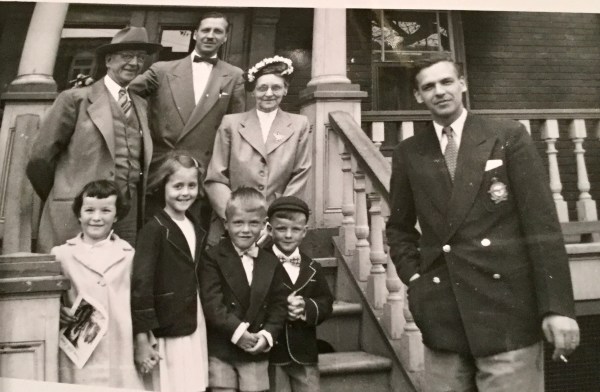
When my father, Ian Angus, and his brother Oswald were discharged from military service following WW II, they returned to their home in Quebec City and the jobs they left when they enlisted. Ian settled in the suburb of Sillery and Oswald in Ste. Foy. Both eventually had three children each. Although the children did not attend the same schools, they visited frequently and celebrated holidays and birthdays with their parents and grandparents.
Angus cousins with fathers and grandparents
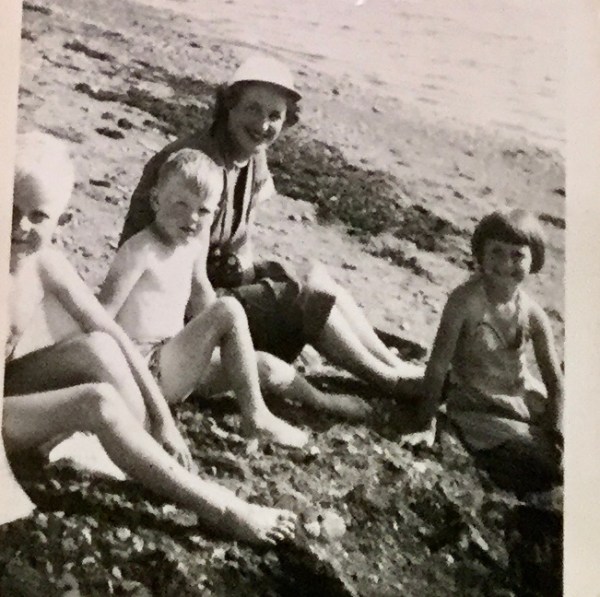
My mother’s Willett family came from New Richmond on the Gaspe Coast. Two of her brothers, together the fathers of four children, remained there. Keith and my grandfather worked the family farm. Ralph, an electrician, built a home across the road from the farm. Every year my father bundled the family into an old Pontiac he named Rebecca and drove eight hours to spend the summer holidays with my Willett uncles, aunts and cousins. The kids picked strawberries, fished in the brook, and swam in the frigid waters of the Baie de Chaleur, a story much like Cynthia Rylant’s in The Relatives Came. “Then it was hugging time. Talk about hugging!” 1
Willett cousins with Aunt Kay on Baie de Chaleur beach
My seven Angus and Willett cousins were playmates as children and we remain close to this day.
But my mother had other siblings, two sisters who never married and a brother who married but died young and childless.
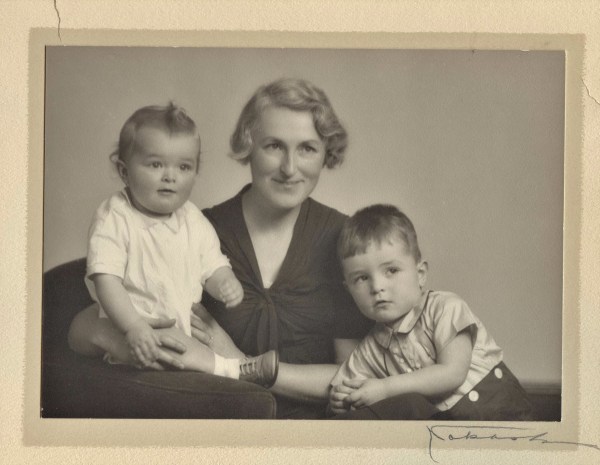
A third sister, Madge, also died young leaving two young sons, David and Paige, aged four and six. Their father owned an apple orchard in Abbotsford south of Montreal. Albert remarried and fathered two more children. He kept in touch with Madge’s family by sending a barrel of apples to each household every Christmas although the families never actually got together.
Paige and David with mother Madge
David grew up to become a notary in Montreal where I finally met him as an adult. He never married. When his father died, his step-mother and half-sister Louise moved into his home in Westmount where they remained until his mother’s death. Louise moved to Whitby, Ontario and later David joined her when he retired.
Paige forever remained a romantic mystery. My mother and aunts spoke about his early career in the Royal Canadian Airforce and a stint with the Canadian Snowbirds, a RCAF demonstration squadron, with adventures in the sky that further romanticised him for me. He later moved to the United States to fly with American Airlines and in 1971 he applied for American citizenship.2 He, too, never married. In 1972 a news article listed him as First Officer and one of the crew of Flight 96 flying from Los Angeles to New York who safely landed a plane load of 56 passengers and 11 in crew in Detroit when the cargo hold burst open in flight.3
A few years ago, David phoned to tell me that Paige had been diagnosed with Alzheimer’s, the disease that has haunted the Willett family. My mother and five of her six siblings died with Alzheimer’s and now Paige was the first of our generation to succumb. David and Louise helped him to move back to Canada and enter a care residence in Ottawa near the home of his half- brother Stephen. In 2014, two years later, David called to tell me Paige had died at age 75. We had never met; we were never playmates; we were not even adult friends.
And what happened to David? I have not heard from him since he called about Paige’s death. My emails do not bounce back but they are never answered. The message on his telephone says that his phone cannot accept incoming calls. My calls to all the Whitney names listed in Ottawa and Whitby prove fruitless. None of them are the Whitney family for whom I am looking. Ancestry gives me David’s his birth date but not that of his death. Perhaps David, who would now be 86, is still alive but struggling with Alzheimer’s, the curse of the Willett family.
Rylant, Cynthia. The Relatives Came. Scholastic Inc. New York, 1985.
In 1837 and 1838 Upper and Lower Canada led rebellions against the Crown and the political status quo. The root cause of resentment in Upper Canada was against the corruption and injustice by local politicians
Among the recommendations in this report was the establishment of responsible government for the colonies, one of the rebels’ original demands (although it was not achieved until 1849). Durham also recommended the merging of Upper and Lower Canada into a single political unit, the Province of Canada.
The contents of this database: contains splendid books, essays, studies, articles, biographies, dissertations, papers of the English and French languages. Many of these works are written by university professors, historians, a few archivists of the 19th and 20th centuries plus those of more recent times.
Notes: above excerpts are from en.wkipedia.org and The Canadian Encyclopedia.


 Genealogy Ensemble