The Fortin House and Manoir Papineau

In the1600s  my ancestors left France and embarked on an adventure to New France. In 1651 Julien Fortin de Bellefontaine settled in Chateau Richer, near Quebec City, and built a home, while Claude Jodouin landed in Ville Marie (Montreal) in 1666 and remained in the area.
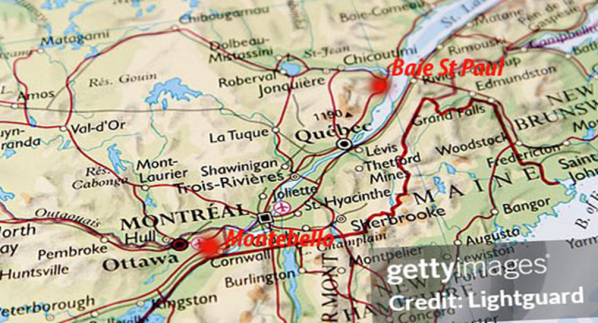
The Jodouin descendants moved east of Ville Marie (Montreal) to Varennes and Verchères on the south side of the St Lawrence River. Fortin descendants settled east of Quebec City in the Charlevoix, Baie St. Paul, Cap St. Ignace region on the north shore of the St. Lawrence River.

My third great-grandfather Francois Xavier Fortin (1755-1853) was born and baptized in Saint Pierre and Saint Paul church in Baie St. Paul and married Marie Rose Lemieux (1773-1853) at Saint Ignatius of Loyola Church in Cap St Ignace in 1793.
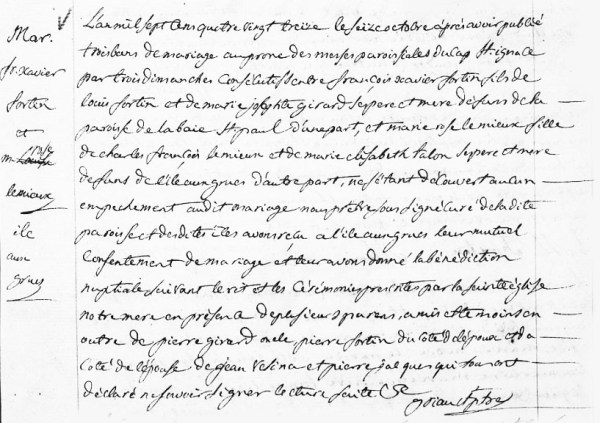
Marriage of Francois Xavier Fortin and Marie Rose Lemieux

Francois was a blacksmith and a farmer. While living in Cap St Ignace, they had two children. The births of their other nine children reveal that they moved four times over the years. I don’t know why they moved so often. Perhaps, the community required a blacksmith.

Their third child, Francois Xavier died in 1800 in St. Hyacinthe. Three more children were born in that community. Research does not enlighten us about the events that led to their next move. In 1808 they were living in Rigaud where their son Moyse Hypolite was born. The family settled in 1810 in the Seigniory de la Petite Nation in Montebello.

Joseph Papineau (1752-1841) became the first Seigneur de la Petite Nation in Montebello. He was a notary, surveyor, and landowner, who had bought land from the seminary in Quebec between 1801 and 1803.     
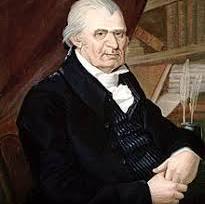
Joseph Papineau -first Seigneur de la Petite Nation

In 1810 Papineau sold land to Francois Xavier Fortin who built a home where the family finally settled in Montebello, Seigneury de la Petite Nation on the shores of the Ottawa River. For over fifty years the Fortin family farmed the land. Today this home is known as The Fortin House. It played a significant role in the history of the area.
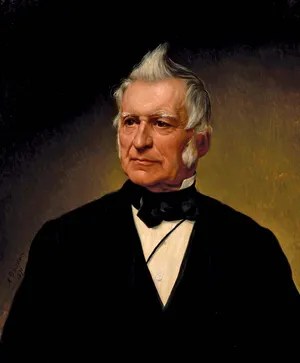
Louis Joseph Papineau

 Joseph Papineau’s son Louis Joseph (1786-1871) purchased land from his father and began to build on the property. During the construction (1848-1850) of the Manoir Papineau, Louis Joseph and his family “borrowed” Francois Xavier Fortin’s home and they lived in his house while the manoir was being built. Changes were made to the Fortin house to accommodate the large Papineau family.
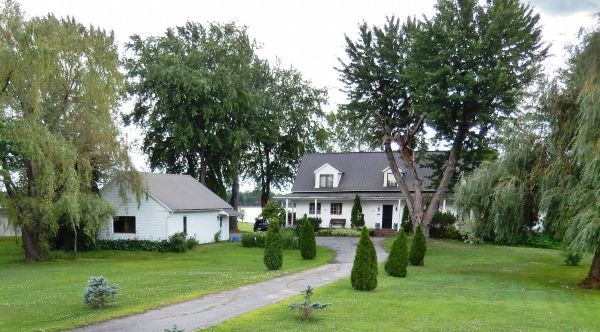
 The Fortin House “borrowed by Louis Joseph Papineau

Louis Joseph had an interesting career as a politician, a leader of the Patriot movement, a speaker of the House at the National Assembly, and for a time, was exiled due to his involvement in the Rebellion of 1837.
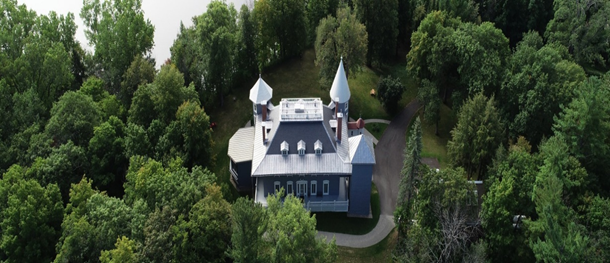
An aerial view of Manoir Papineau

The Manoir is situated on Cap de Bonsecours

Parks Canada manages Manoir Papineau.

  It is a National Historic site.   

Research does not tell us where Francois Xavier and Rose were living while the manoir was being built and the Papineau family were in the Fortin home, however, one might surmise that the Fortin children were married and living in the area. Perhaps, as was the custom at the time they cared for their elderly parents.
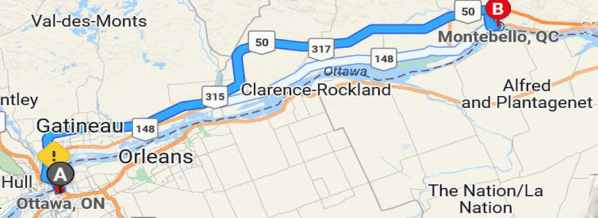
Route from Montebello to Ottawa

In November 1853 Rose passed away, and within two short weeks, Francois Xavier followed in December. Both are buried in the Notre Dame de Bonsecours cemetery in Montebello.
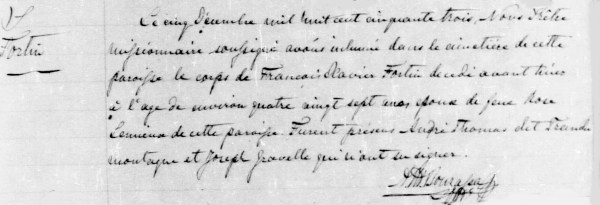
The Burial of Francois Xavier Fortin

In 1900 The Fortin House and surrounding farm were purchased by the Huneault family who continue to farm the land.

Sources

 Généalogie Québec, Francois Xavier Fortin/Marie Rose Lemieux mariage. https://www.genealogiequebec.com/Membership/LAFRANCE/acte/359845

 Généalogie Québec, Francois Xavier Fortin death/burial. https://www.genealogiequebec.com/Membership/LAFRANCE/acte/5961939,

“Canada, Québec, registres paroissiaux catholiques, 1621-1979,” database with images, FamilySearch (https://familysearch.org/ark:/61903/3:1:3QSQ-G99W-X984?cc=1321742&wc=HCZJ-T38%3A13629401%2C13629402%2C14536101 : 16 July 2014), Cap-Saint-Ignace > Saint-Ignace-de-Loyola > Baptêmes, mariages, sépultures 1768-1822 > image 250 of 745; Archives Nationales du Quebec (National Archives of Quebec), Montreal.

“Canada Census, 1851”, database, FamilySearch (https://www.familysearch.org/ark:/61903/1:1:MWRX-R5H : 1 October 2021), François Xavier Fortin, 1851.

“Canada, Québec, registres paroissiaux catholiques, 1621-1979,” database with images, FamilySearch (https://familysearch.org/ark:/61903/3:1:3QS7-8993-W5FP?cc=1321742&wc=HZM6-7M9%3A24354201%2C24354202%2C25955601 : 16 July 2014), Sainte-Madeleine-de-Rigaud > Sainte-Madeleine-de-Rigaud > Index 1802-1876 Baptêmes, mariages, sépultures 1802-1817 > image 403 of 540; Archives Nationales du Quebec (National Archives of Quebec), Montreal.

https://parks.canada.ca/lhn-nhs/qc/manoirpapineau

https://parks.canada.ca/lhn-hs/qc/manoirpapineau/culture/histoire-history/personnages-people/chronologie-chronology

https://www.thecanadianencyclopedia.ca/en/article/louis-joseph-papineau
https://www.biographi.ca/en/bio/papineau_joseph_7E.html

The Life of a Sailor

My 2X great-grandfather, George Murray Boggie, born in 1826 in Old Deer, Aberdeen, Scotland,1 spent his whole life in the Royal Navy. This was a life of adventure, variety, and camaraderie, but also homesickness, hard work, long hours, and sometimes sickness.

George didn’t start out wanting to be a sailor. When he was 15, and perhaps earlier, he and his brother, James worked as apprentice writers in Peterhead, Aberdeenshire. They lodged with John Bradie, a newsroom keeper. 2 John probably worked at the same newsroom as George and James.

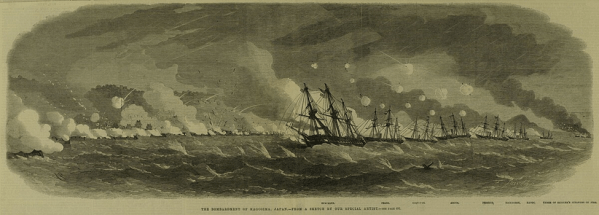
It turned out that writing was not the job for George. George started volunteering in the navy when he was 20. He served on about 14 ships between 1846 and 1854. In January 1854, he was serving on the HMS Euryalus. He then signed his indenture papers on 13 February 1854, which committed him to ten years of continuous service in the Royal Navy.3 The HMS Euryalus was commissioned in 1853 and soon after George joined the crew, it was deployed to the Baltic to take part in the Baltic Campaign as part of the Crimean War.4 The HMS Euryalus was part of an Anglo-French fleet that entered the Baltic to attak the Russian naval base of Kronstadt.5

Euryalus leading the line of battle during the Bombardment of Kagoshima, 18636

While I do not have a picture of Great-Grandfather George, Royal Navy Form 95 says that he was 5 ft., 7.5 inches tall, with a ruddy complexion, dark hair, and blue eyes. He had a tattoo on his left arm, his initials: G.M.B. 7

George was already married and a father with two children when he started his indentureship. His daughter, Mary, was 4 and my great-grandfather, Henry was just two years old. His wife, Elspeth Milne would have had her hands full with a young family and an absent husband. Elspeth would also have been worried about George as he was in active military service. As George remained a member of the Royal Navy his entire working life, it is probable that he participated in many battles.

Sailors were constantly at work when at sea. All ships were dangerous workplaces and injuries and death as a result of injuries were common. Their sleeping quarters were cramped, the sailors’ sleep was often disturbed, and their meals were neither copious nor balanced. Although some ships did issue a daily ration of lime juice and sugar, but in quantities not exceeding one ounce of each, assumably to prevent scurvy. The ships were cold, damp, and uncomfortable and their clothes could be damp for months at a time.  Most ships did not have a physician or surgeon on board so some health conditions could not be addressed quickly. Sailors’ wages were usually paid in arrears as a deterrent to desertion.8

Sailors were susceptible to tropical diseases and while dysentery can be caught anywhere, It’s a more common condition in tropical areas of the world with poor water sanitation. The Royal Navy sailed the world over, often in tropical waters. Dysentery on board was common. It is contagious and can be contracted from eating food prepared in unsanitary conditions or by drinking contaminated water. 9

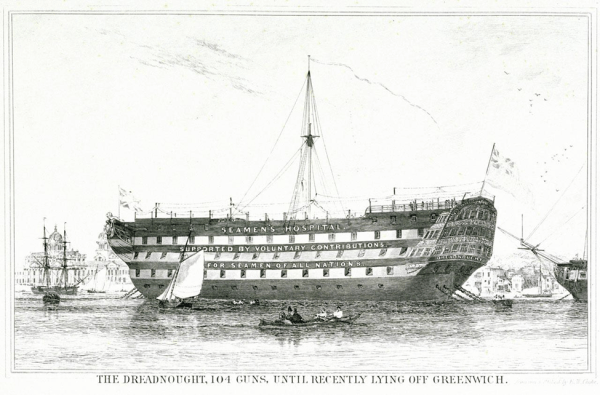
As George worked on 14 ships before he signed up for continuous service in 1854, he already had a good idea of what he was getting into. On 5 February 1847, George was admitted to the Dreadnought Seaman’s Hospital to treat dysentery.10 The registration indicates that he was victualled for 46 days which, I believe means that he was paid for the 46 days that he was in the hospital.

The Dreadnought Seamen’s Hospital provided seafarers with hospital care for 150 years. It started in 1821 as a wooden warship moored in the River Thames at Greenwich, England. After 1870, the hospital transferred to dry land at the former Greenwich Hospital Infirmary, and the hospital continued to treat sailors in Greenwich until its closure in 1986.11 In 1987, a Dreadnought Unit opened at St. Thomas Hospital in London.12

The ‘Dreadnought’, 104 Guns, At present Lying off Greenwich For The Seamen’s Hospital, ©National Maritime Museum

George was a member of the Royal Navy during the second half of the 19th century and, at that time, naval warfare underwent a complete transformation due to steam propulsion and metal ship construction. While Britain was required to replace its entire naval fleet, it managed to do so through unparalleled shipbuilding capacity and financial resources.13 When George started his career, he served on a wooden hulled steam frigate. By the time he completed his career, he would have seen great leaps of technological improvements.

  1. Scotland’s People, Old Parish Registers, Boggie, George Murray, 1826, Old Deer, Aberdeenshire, accessed 7 June 2024.
  2. Scotland’s People, 1841 Census, Boggie, George Murray, Peterhead, Aberdeenshire, accessed 12 June 2024.
  3. Form 95, Indentured royal navy papers, Boggie, George Murray, dated 13 February 1854, National Archives, accessed 3 July 2024.
  4. Wikipedia, HMS Euryalus (1853), https://en.wikipedia.org/wiki/HMS_Euryalus_(1853), accessed 20 November 2024.
  5. Wikipedia, Crimean War, https://en.wikipedia.org/wiki/Crimean_War#Baltic_theatre, accessed 20 November 2024.
  6. Wikipedia, HMS Euryalus (1853), https://en.wikipedia.org/wiki/HMS_Euryalus_(1853), accessed 20 November 2024.
  7. Form 95, Indentured Royal Navy Papers, Boggie, George Murray, dated 13 February 1854, National Archives, accessed 3 July 2024.
  8. The Old Operating Theatre, Life at Sea: The Working Conditions and Health of a Sailor, https://oldoperatingtheatre.com/life-at-sea-the-working-conditions-and-health-of-a-sailor/, accessed 13 November 2024.
  9. Cleveland Clinic, Dysentery, https://my.clevelandclinic.org/health/diseases/23567-dysentery, accessed 20 November 2024.
  10. Ancestry, Dreadnought Seamen’s Hospital Admissions, 1826-1930, Boggie, George Murray, accessed 13 November 2024.
  11. Royal Museums Greenwich, https://www.rmg.co.uk/collections/hms-nhs-nautical-health-service-transcription-project, accessed 20 November 2024.
  12. Seafarer’s Hospital Society, https://seahospital.org.uk/about-us/our-history/, accessed 20 November 2024.
  13. Wikipedia, The Royal Navy, https://en.wikipedia.org/wiki/Royal_Navy#:~:text=At%20the%20start%20of%20World,during%20the%20following%20four%20months

REMEMBERING GREAT-GRAND-UNCLE

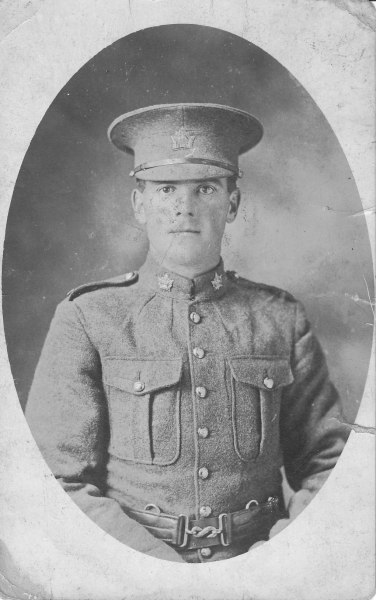
Arthur Symons, Private, 56th Battalion, Canadian Over-Seas Expeditionary Forces.

I once had a great-granduncle, Arthur. Until I started doing Genealogy, I had no idea there was such a title, but there it is, and I had one.

Of course, I never met him, but, as it is Remembrance Day I wanted him to be remembered.

My Granny’s mother, Lilian, had a family of five siblings, and Arthur was her younger brother. He was four years younger than her. Granny told me that Arthur immigrated to Canada in the early 1900s.

Despite many searches. I could find no information on his immigration. However, months after I started my research, I came across a border crossing Manifest from Canada to Sweetgrass, Montana.

It had all the information I had been searching for!

At this point, I was not sure he was even married, but the info on the border crossing gave me missing details and Arthur was beginning to become a real person.

The Manifest stated Arthur was 50 years old, accompanied by his wife, Catherine, son Alexander, and daughter Dorothy. It was dated the 18th of July, 1936. The family were visiting Yellowstone Park and Glacier Park. it gave Arthur’s address in Calgary, Alberta and his occupation as a Postal Porter. (1) It stated that he arrived in Canada at Halifax, Nova Scotia on the 19th of March, 1901 on the SS. Soman.

I haven’t yet found the passenger list for the SS Soman, but I keep looking.

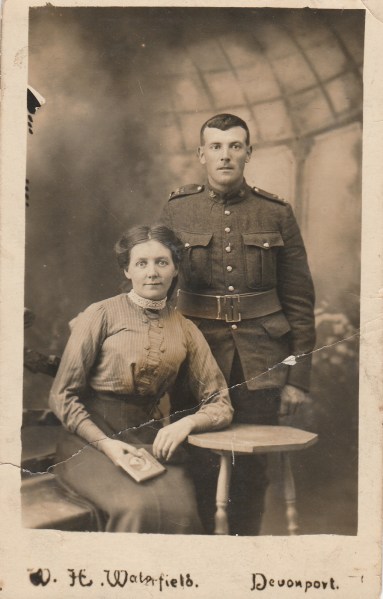
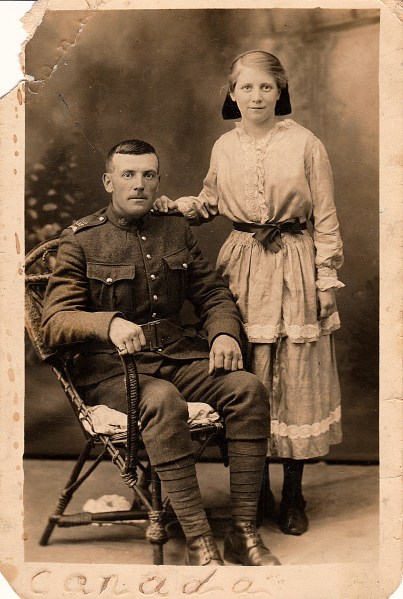
When WWI broke out, he enlisted in the 56th Battalion Canadian Over-Seas Expeditionary Forces on May 3, 1915, in Calgary, Alberta. He was shipped back to the UK for training. While ‘back home’, he visited his sister Lilian – my great-grandmother – and had these photos taken with his sister and my Granny, Edith Bevan O’Bray.

Arthur Symons with his sister Lilian Symons Bevan. C. 1914-18

Arthur Symons with my Granny, Edith Bevan C. 1914-18.

Arthur Symons was born in Leicester, Leicestershire, England, in 1886. His siblings were Lilian Mary Symons—my great-grandmother; Thomas, who died in infancy; Arthur, Olive, and Ada, who was my Gran’s favourite Aunt, and only two years older than her.

Aunt Ada was also my Godmother. Together, they joined the WRNS (Women’s Royal Naval Service) in 1918 (2)

Great-grand-uncle Arthur fought at the Battle of Passchendaele and was severely wounded in the right leg, right hand and left foot. He was transferred to the Granville Special Hospital, located in Ramsgate, Kent, England. An orthopaedic facility to treat soldiers with damaged limbs. Later because of air raids on the Kent coast, the hospital was moved to Buxton. He was medically discharged on 28th August 1919.

In part Two, I will explore his stay in the Granville Special Hospital for Canadian troops. The first line of his medical records, dated November 29, 1917, stated he was “Dangerously ill.”

(1) Canadian Postal Porter – Porter – Worker having manual handling duties, typically at a large sorting office or railway station in London. Tasks included the loading, unloading, segregation and transfer of mailbags or other containers. Porters were also employed at some other locations, such as the PO Savings Bank.

(2) Granny and her Aunt in the Women’s Royal Naval Service.

Philadelphia Story

After my great grandfather retired from a successful 40-year career in the wholesale food business, he took an active interest in the stock market and managed his own investments during the time of the Great Stock Market Crash of 1929. Would he lose his life savings like so many unfortunate others at the time?

In a letter to his eldest daughter Josephine, my grandmother, dated June 2, 1932, he wrote:

“…if we could get rid of a lot of these Rotten Banks and Stock Market thieves the world would come around all right in no time. A person has no show with that New York Stock Exchange. Just a lot of crooks and I don’t think these common stocks have any value at all, not worth the paper they are written on, most of them, but all this will come (out) all right but people have got to lose a lot of money and that’s that.”

William Thomson Sherron (1863-1932) was born in Salem, New Jersey, the son of Albert Wood Sherron and Eveline Stokes Gaunt Githens. His wife, Gertrude Gill, (1869-1940), born in Philadelphia, was the daughter of Thomas Reeves Gill and Josephine Love.

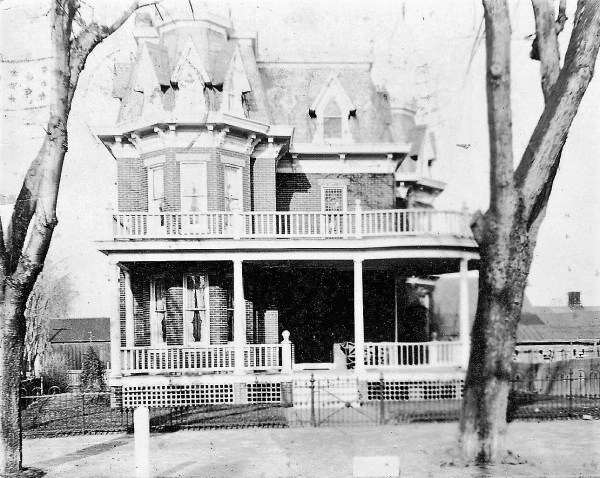
In November 1891, William and his bride settled in their new family home at 100 W. Broadway, Salem, New Jersey, where they stayed for the next twenty years. This beautifully refurbished Queen Anne style Victorian house still proudly stands today.

(Their first home -100 W. Broadway, Salem, New Jersey)

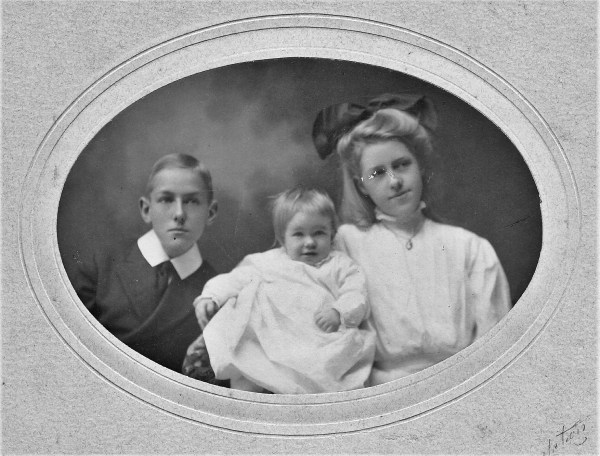
The couple had three children – Josephine (1893-1964) Social Media – Then and Now, Roger (1895-1963) Sherron and his Texas Betty and Alberta (1906-1992) Elopement … or not?. Josephine, my grandmother, her stockbroker husband and their two sons eventually settled in Montreal, Quebec. Their son Roger had mental health issues and lived with them until their deaths. Alberta married very young, had a son nine months later and remarried happily a while after that and had three more children.

(Roger, Alberta and Josephine Sherron – 1906)

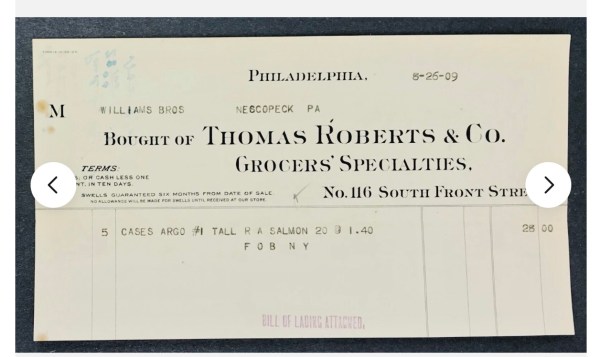
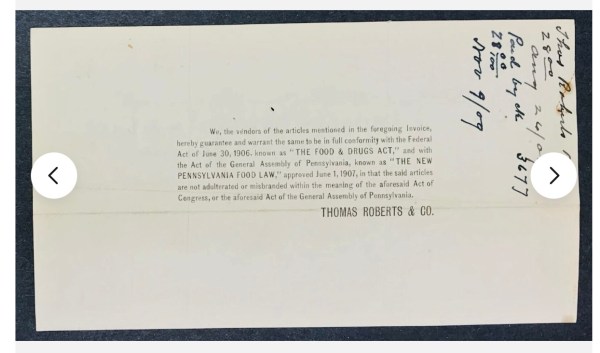
William first worked for Thomas Roberts & Co. in the wholesale grocery business for 25 years in Philadelphia before going into the same business for himself in 1905 at the age of 42. He opened his own office at no. 37 South Front Street, Philadelphia, about a half mile from their new home at 261 W. Harvey where they lived for the another twenty years.

(Invoice – front and back from the grocery wholesale business)

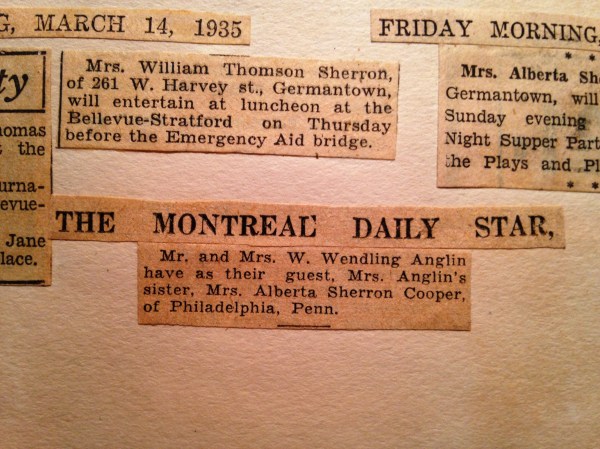
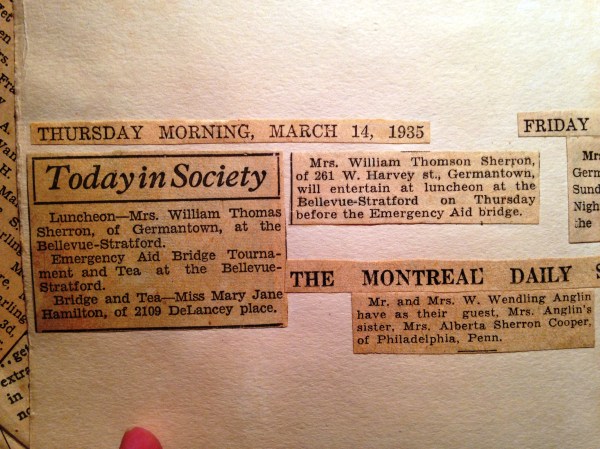
His wife and daughters took an active role the local Germantown social scene. Their endless teas, luncheons, bridge parties and charity fundraisers were regularly featured in the social pages of the local newspaper.

(Gertrude Sherron and her daughters in the Society Pages)

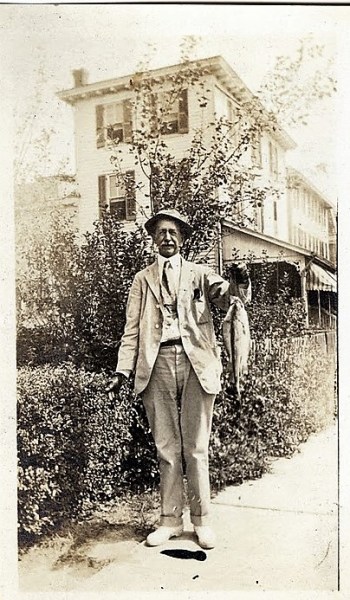
Along with the usual collection of family posed photographs in my dusty old boxes, I found a delightful photo of 55-year old William. He is holding up a string of sizable fish, possibly bass, outside “the Windsor Avenue cottage” (which looks more like an old country inn). He is wearing a light coloured baggy jacket and matching pants with a proper shirt and tie, white shoes and a floppy “fishing” hat. The smile on his face reflects pure joy for the day’s “catch”.

(William and his catch of the day!)

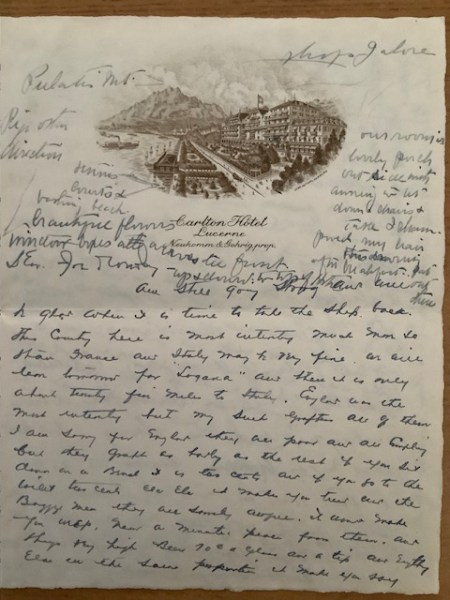
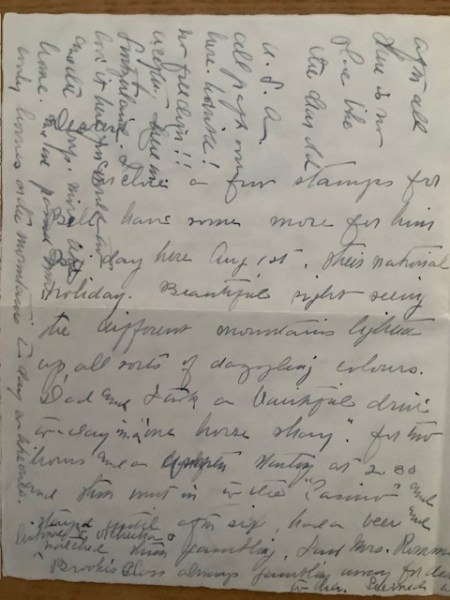
In 1930, just a couple of years before William’s death, the couple enjoyed an extended trip to Europe. They stayed at the famous luxurious Carlton Hotel in Lucerne while visiting Switzerland and I have the note sent to their daughter Josephine. William began the correspondence writing at a slant that became a little more difficult to maintain as he ran out of room on the notepaper. Then Gertrude took over filling every remaining inch of the note – to the bottom, up the sides and finishing up at the top of the page! Nevertheless, I could just barely make out from their undecipherable scrawls that they “adored Switzerland”, the hotel was “a dream” and “Interlaken was perfect”. As for Paris, Gertrude didn’t mince words when she exclaimed “Paris is a horribly dirty city.” However, she “loved London” and thought the people dressed “heaps better than in Paris.” At one point in the note, William generously invited their daughter to join them and wrote “I will pay the fare.”

(Excerpt of their note to their daughter Josephine)

So, it seems that William didn’t lose his money in the stock market after all, and had plenty to splurge on a once-in-a-lifetime trip to Europe with his wife.