
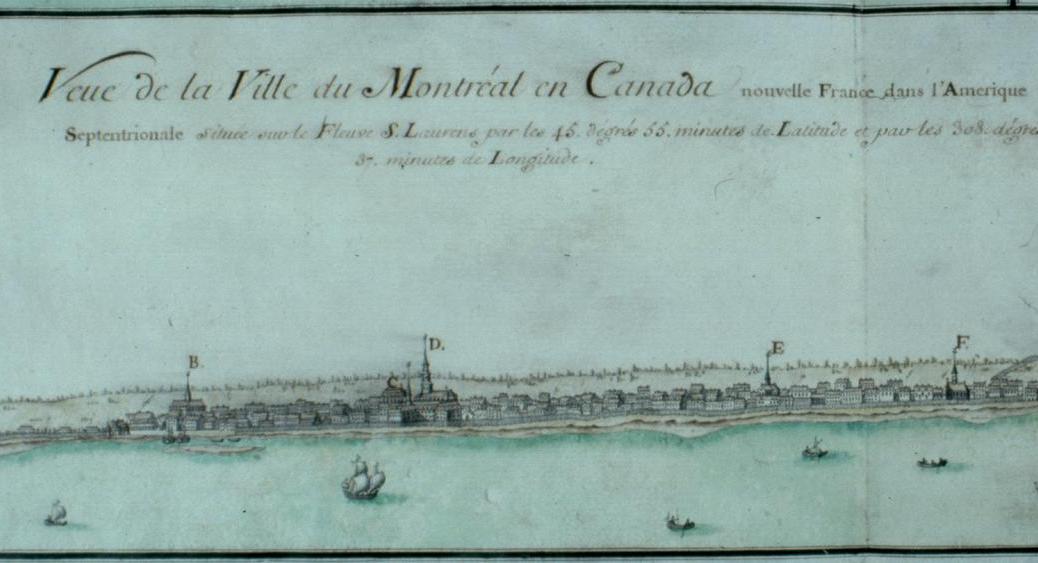
Recently, I’ve been wondering about the white slave who successfully escaped after allegedly burning down New France’s third Hotel-Dieu hospital and 45 homes in what is now Old Montreal in 1735.
I can’t help feel sorry for the man who was brought to Canada as an indentured slave (engagé or trente-six mois due to the thirty-six month duration of his contract) primarily because he was young, healthy, strong enough to serve as a labourer and poor. In return for his work, he got room and board, clothing and a salary, but he had no rights beyond that. His employers could send him anywhere to do just about anything; and according to New France law he had little recourse.
A brief summary of his life appears online in the Canadian Mysteries series dedicated to the fire.
Originally from Butenne in Franche-Comté, Claude Thibault was found guilty of salt trafficking [illegal sale of salt]. Condemned to end his days in the king’s galleys, his sentence was commuted to a life in exile in Canada. He arrived in Québec with a dozen other salt traffickers, including Jacques Jalleteau, in September 1732.
On the night of April 10, he was seen at the site of the fire, but disappeared when Angélique was arrested the following day. Despite warrants issued for a wanted person throughout the colony, Thibault was never again seen.1
I imagine he used his acumen to create a new life under a new name, perhaps in the fur-trading industry. After all, as a faux-saunier (salt smuggler), he had to develop a lot of entrepreneurial skills. As someone who purchased salt in low-tax regions and sold it on the black market in high tax regions, he had to be skilled at finding clients and creating a distribution hub without being caught by the King’s agents.
The King’s decision to set up an unfair tax regime began in 1680, when he decided to pass a law varying the taxes (gabelle) on salt per region. Salt was an important commodity at the time, and controlling it was an important economic lever. In addition to using it to spice and cure food, people in France also needed enough salt to tan animal skins. In some regions, such as Brittany, people could buy one “minot” (about 37 litres) of salt for as little as 1 livre, while citizens of Main, Anjou and other “high gabelle” regions had to pay as much as 61 livres per minot. The law even forced them to buy a minimum quantity of salt every year, whether they needed it or not.
Smugglers thrived in the seeming injustice, but if they were caught, punishment was severe. They faced fines beginning at 300 livres and leading to jail time of anywhere from 10 days to three months. At first, only the most serious convicts were exiled to New France, but in 1730, Jean Frédéric Phélypeaux, the Comte de Maurepas, began insisting that convicted faux-sauniers should be sorted, with the most healthy or those with useful skills be sent overseas as enslaved labourers on three-year contracts. Eventually, the scheme ended in when King Louis XV of France removed Maurepas from his job in 1749.
Unfortunately, Thibault was caught when Maurepas’ scheme was fully underway, and he had few other ressources to avoid exile.
Alain Racineau, who has studied salt traffickers like Thibault at length, describes most of them as poor rural people, primarily day labourers and small merchants struggling to survive.
They were recruited from the poorest levels of society: casual agricultural labourers, petty artisans and traders, unemployed vagabonds. They frequently affirmed that they had taken up smuggling “pour gagner leurs vies.”2
Thibault’s life didn’t get any easier once he arrived in New France. His contract was purchased by fur-trader and merchant Francois Poulin de Francheville and his wife Thérèse de Couagne, who owned several slaves. After M. Francheville died in late 1733, the widow decided to sell Thibault’s girlfriend to a friend in Quebec City. Plans were established for her to be sent away in the spring of 1734, after the ice melted from the Saint Lawrence River.
On February 22, 1734, Thibault and his lover decided to run away, setting fire to her bed as a distraction. They had hoped to reach the English colonies, but bad weather stopped them. They got stuck in Châteauguay and were eventually captured by three militia captains.
Thibault was thrown into jail on March 5 for breaking his contract. He was released on April 9, just one day before the large fire that began in the Francheville home on St. Paul Street.
Thibault disappeared just before his girlfriend got arrested, was convicted and executed. On April 19, authorities set up a manhunt
…given that we are in no State at present to forward the description of the said Thibault with the present order, the Said Captains will take care to arrest and Interrogate all Young men who are unknown vagabonds coming from the direction of Montréal toward Québec and passing through their area, to ask of Them their names and surnames, who they are, where they come from, and where They are going; and upon failure by the said passers-by to provide adequate Information on their persons, And for the slightest doubt or suspicion regarding their responses, And in consideration of public safety, We expressly ordain that the said Captains have them arrested Immediately, and taken under sound and due guard to the gaols of This city;3
They never found him.
Two years later, authorities officially took him off the most wanted list.
1Beaugrand-Champagne, Denyse, Léon Robichaud, Dorothy W. Williams, Marquise Lepage, and Monique Dauphin. “Torture and Truth: Angélique and the Burning of Montreal,” Great Unsolved Mysteries in Canadian History Project, 2006, https://canadianmysteries.ca/sites/angelique/contexte/references/personnages/2229en.html
2Racineaux, Alain, ‘Du faux-saunage à la chouannerie, au sud-est de la Bretagne’, Mémoires de la Société d’histoire et d’archéologie de Bretagne, 1989.
3Archives nationales du Québec, Centre de Québec, Fonds des Ordonnances des intendants de la Nouvelle-France, E1, S1 P2622, Hocquart, Gilles, Ordinance given to the captains of the militia for the arrest of Claude Thibault, April 19, 1734, https://canadianmysteries.ca/sites/angelique/proces/rumeurcircule/1889en.html .
 Genealogy Ensemble