HISTORY OF MY SURNAME

Children the world over have been bullied at school and in their neighbourhoods. I was no exception. As a child in primary school, I remember kids calling me ‘Bullfrog’ which, of course, I hated!

Many years later, I am researching and doing genealogy, trying to find out the origin of the name I hated as a child. I always knew there was a camp in Wiltshire, England called Bulford Camp. Family members have visited the area, especially to take photos of the area name, posing proudly next to the sign.
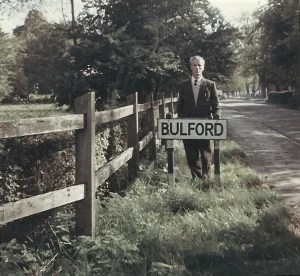
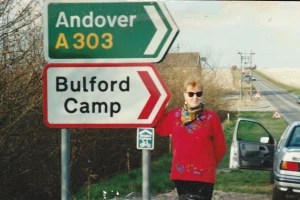
My Uncle Roy Bulford. Circa. 1960’s. Marian Bulford. Circa 1990’s

From a quiet country road to a major motorway

Less probably, the name may have come from a lost place called Bulford in Strensall (North Yorkshire), presumed to have been located at a ford of a river near Strensall. Yet another reason the name “Bulford” may have originated from is “Bull’s Ford”, a crossing point of the River Avon in Wiltshire, where bulls were driven across. (1)
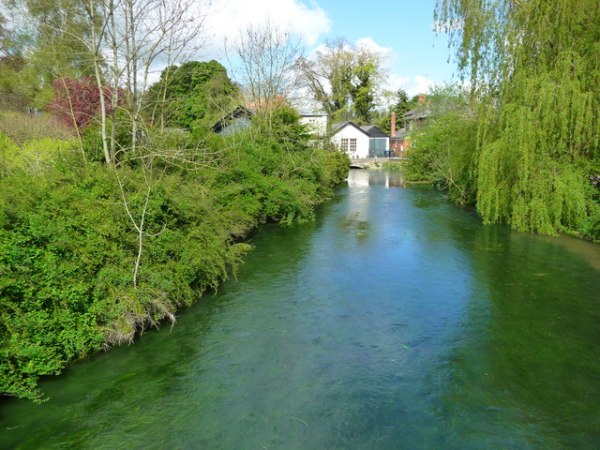
 The River Avon Meanders Through Bulford

© Copyright Chris Talbot. Licensed for reuse under this Creative Commons License.

Bulford is a village and Parish in Wiltshire, England. It is near Salisbury Plain, close to RAF Upavon, where I was posted whilst in the WRAF (Women’s Royal Air Force). The Bulford Army camp is separate from the village but within the parish. It seems the Army camp is named after the ford that gave the village of Bulford its name. ‘Bulut ieg ford‘ is from an Old English phrase which means ‘ragged robin island ford” Why could we not have picked Robinford instead of Bulford?? (2)

Bulford is recorded in the Wiltshire Charter Rolls of 1199 as Bultiford and as Bultesforda in 1270. It is then recorded as Bulteforde in the Ecclesiastical Tax Records of 1291. (3)

The village of Bulford has a history of Roman and Saxon settlements. In the 1086 Domesday Book, there were 39 households at Bulford. However, there are not actually any Bulford family names, as seen below with a page taken from the Domesday Book. Only the religious and the titled were included!

Catalogue description Place name: Bulford, Wiltshire Folio: 68v Great Domesday Book: (4)

Reference:E 31/2/1/2046
Description:Place name: Bulford, Wiltshire
Reference:E 31/2/1/2046
Description:Place name: Bulford, Wiltshire Folio: 68v Great Domesday Book Domesday place name: Boltintone People mentioned within entire folio: Abbess of St Mary of Amesbury; Abbey of Sainte-Marie of Bec; Abbey of St Mary of Amesbury; Agenulf; Alweard; Alweard the priest; Beorhtric; Canons of Church of Lisieux; Church of Brixton Deverill; Eadgifu; Earl Harold; Hugh d’Avranches, Earl of Chester; Roger de Montgomery, Earl of Shrewsbury; Edward; Father of Agenulf; Gerald the priest of Wilton; Gilbert; Godwine; Abbey of Sainte-Marie of Grestain; Hamo; Hearding; Ketil; King Edward as lord; Nuns of Abbey of St Mary of Amesbury; Osbern the priest; Osmund, thegn; Queen Matilda; Regenbald the priest; Robert, Count of Mortain; Siward; Turold; William
Date:1086
Held by:The National Archives, Kew
Legal status:Public Record(s)
Closure status:Open Document, Open Description

Surnames in England were not used before the early Middle Ages, around the 11th to 12th centuries. Before that, people were known by a single name, usually according to their physical features, occupation, or their father (patronymic). To begin with, surnames were fluid and changed over time, or as a person changed his job. For example, John Blacksmith might become John Farrier as his trade developed. As the country’s population grew, it became necessary to distinguish between people.

Surnames in England began to be used during the early Middle Ages, around the 11th to 12th centuries. Before this, people were usually known by a single name. The earliest surnames were often derived from:

  1. Occupations – for example, “Smith” (blacksmith) or “Baker.”
  2. Geographical locations – such as “London” (someone from London) or “York” (someone from York). (I feel this is probably where my surname comes from.)
  3. Patronymics – surnames based on the father’s name, like “Johnson” (son of John).
  4. Physical features – such as “Brown” (for someone with brown hair or a darker complexion). (5)

Most of my paternal Bulford family live in and around Devon and Cornwall now; however, Ancestry.com tells me that from the 1700 Census and Voter lists, there were 127 Bulford surnames in America!

One of my paternal grandfather’s brothers, George, emigrated to work in the mines in Detroit, Michigan then ended his career working for the Ford Motor Company.

In 2016, I was in touch with his granddaughter, Barbara, my second cousin, on Ancestry. She invited me to her family tree, and we exchanged much information regarding her Bulford family. We had pleasant FaceTime and email exchanges, until her too-early passing in 2020 at the age of 66 years. I wrote about her here: https://genealogyensemble.com/2021/05/12/my-american-cousin/

SOURCES

(1) (2) (3) https://en.wikipedia.org/wiki/Bulford

(4) https://opendomesday.org/place/SE6360/strensall/

The link above is to the Open Domesday Book, which also states that “Hundred of Bulford. (The next largest division from a “hundred”, and the one most recognisable today, are Shires. Devonshire, Wiltshire, Lancashire, etc). Status: No longer exists as a named location but can be identified on the ground’ There were 85 places in the ‘hundred’ of Bulford in the Domesday Book”
(5) https://www.historic-uk.com/CultureUK/Surnames/

Miss Lindsay’s Curtain Call (updated)

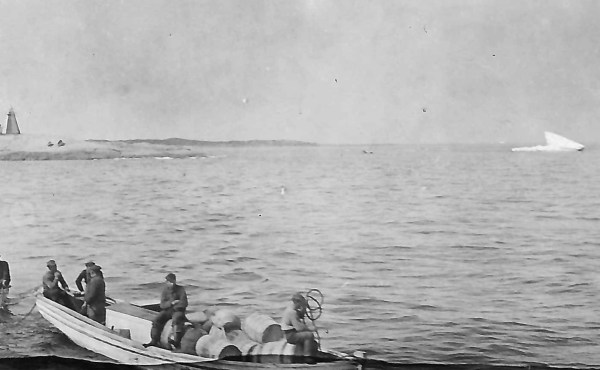
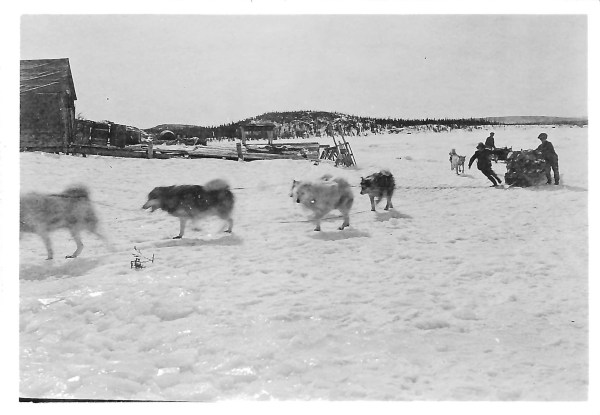
(Correction: I have been informed that is more likely that Reverend Henry Gordon took these photos, developed them and gave them to Miss Lindsay. The dog team photo would have been taken by Rev. Gordon during the winter and the fishermen in the boat must be south of Cartwright due to the lighthouse.)

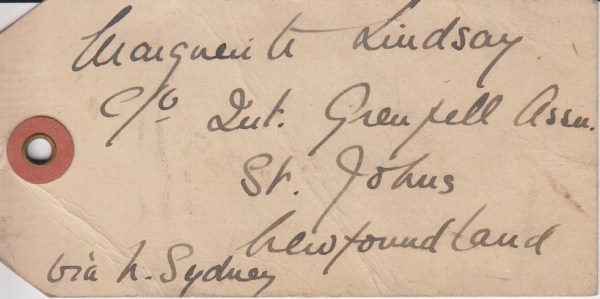
Miss Lindsay’s baggage tag- June 1922

Just over 100 years ago, my great-aunt volunteered as a summer teacher with the Grenfell Mission in Cartwright, Labrador, under Henry Gordon. In August 1922, just days before she was due to return home to Montreal, Quebec, she disappeared. Her body was found four months later, in December 1922, with a bullet through her heart.

I already wrote and published her story in seven parts (links below) and thought I had gleaned every bit of information possible from my “dusty old boxes.” But our ancestors want their story told and my great-aunt, Marguerite Lindsay (1896-1922), had quite a blockbuster to tell. Perhaps it was she who “tweaked” my cousin to finally look into his unopened boxes of family papers and memorabilia.

You can’t possibly imagine my excitement when I received his email:

Hi Lucy,

Apologies for taking so long to get to this. I attach scans of the small

black-and-white prints of Labrador scenes that I found in the box of

clippings and photos. I assume that this is from when Stanley (sic) visited

the area after Marguerite’s death but don’t know for sure. Only two had

writing on the back – the dog team at rest and the school house. I

scanned those too in case you recognize the writing.

Lots of love!

Doug”

Eureka!

It appears that Miss Lindsay had access to a camera while she was there! And yes indeed I recognized her handwriting! It matched the writing on the tag on her baggage that accompanied her when she travelled to Labrador in June 1922. She went there to look after the youngest students (orphaned by the Spanish Flu epidemic) along with another volunteer, Anne Stiles from Boston, while their regular teacher took their summer break. Between the two of them, they oversaw all the children’s lessons, meals and activities.

A few days before she disappeared that August, she mailed a letter to her brother Stanley in Montreal. That precious last letter shared a long and loving detailed description of her life in Cartwright. The five newly discovered photos seem to match several parts in her last letter.

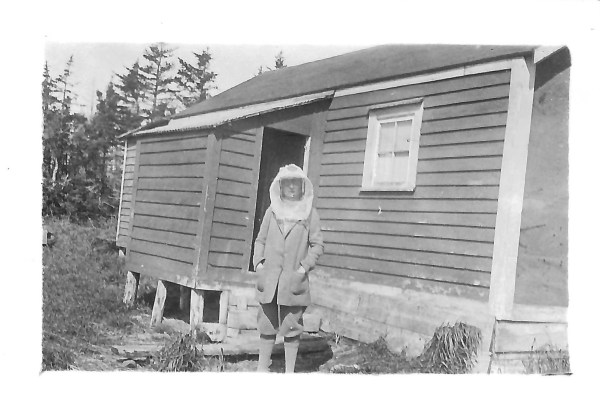
1. The first photo is of Marguerite wearing a hat she fabricated to protect her from all the bugs. The cabin in the background was a family home as she shared a room with Anne Stiles in the school dormitory that summer. This photo along with the commentary in her letter helps me imagine being there myself.

Miss Lindsay wearing her bug hat outside a family home beside the school in Muddy Bay

It is really cold here and foggy quite often, but very bracing, and I like it much better than heat; also when it is cold, there are no flies, and that means a great deal. I could compete with Sir Harry Johnson’s bugs in Africa, and match about even. The mosquitoes just swarm: at first you think it is fog or haze, lying low over the marshes, till you try and walk through them. We bathe in citronella. About 50 of them were getting free transportation on different portions of my anatomy, and I remarked to one of the natives, that the mosquitoes were bad; at which he laughed, and said to wait till they hid the sun, then I would call them bad.

The children are terribly bitten, and wail all night when they are extra bad. Well, there is a species of black fly, and their team work with the mosquito is extraordinary. They don’t bother to pierce your epidermis for themselves, but follow exactly in the footsteps of the mosquitoes, and they hurt. I could hardly turn my head for a day, the back of my neck was so bitten. I may have mentioned that there are no such things as screens on our windows; but we put up some surgical dressings, and tacked the gauze up as a slight protection. As little extras there are deer flies, flying ants and sand flies.


2. The second photo represents not only the local day-to-day fishing activities but other adventures like the exciting one she described in her letter.

Local fishermen in boat with Iceberg, south of Cartwright (there were no lighthouses near Cartwright)

It would be a great help if we had ice; but none comes up the bay. Some of the men tried to capture a young iceberg, and tow it home from the outside coast—behind the motor boat, but the friction of the rope wore through the ice, so it never arrived. Last Wednesday, Mr. Gordon told us we had been working so hard, we had better take a day off, and go up the bay with one of the fishermen, on an expedition for wood. We started off in a motor boat, towing an empty scow: just Anne and I, four boys of about 12, and the fisherman.

It was a perfect warm sunny afternoon, and Anne and I were almost asleep on the sloping bow of the boat, when we came around the point into a heavy wind and all but rolled off. It blew up very strongly, and Anne and I and the boys got into the very bottom of the boat, under our rugs for warmth. I was wearing everything I possessed; about what I wear for skiing. The fisherman was having a very hard time with the scow. It looked once or twice as though water would come down on our heads, when our boat got between the waves and it rested on the crest.

It took us over three hours to reach our destination – the point at White Bear river. There we went up to the warm cottage of some very kind fisher-folk, just as it started to pour, and thunder and lightning. We had expected to sleep on the floor, so had brought rugs; but Anne and I were given a bunk in a room about the size of a dugout, which was really comfortable after we had skillfully removed a pane of glass with a knife, the window being purely for ornament. They provided us with a feather bed in the bunk and warm dry rugs and fed us with smoked salmon and caribou meat. It was loads of fun.


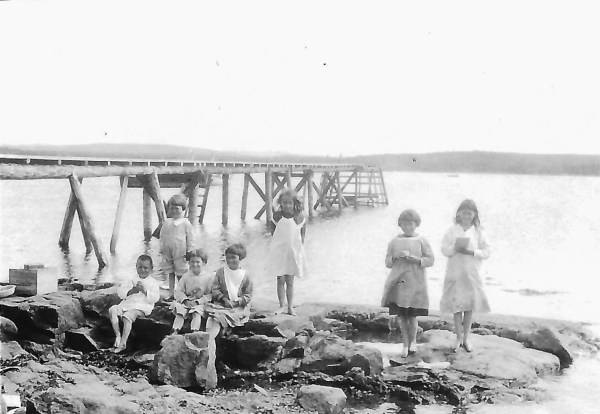
3. The third photo shows the eager faces of a few of her students by the water’s edge hoping for a swim with Miss Lindsay that afternoon.

Some of Miss Lindsay’s summer pupils waiting for a swim

We are teaching the children to swim; the water is not so cold as you might think. There are some perfect walks around; nowhere are the trees too thick to push through; so though we have got lost once or twice, it is never for long. It is rather fun climbing the mountains; your feet get drenched, in the marsh, but we are used to that now. You would be amused to see me giving the children drill, and getting them to breathe through their noses.

We are going across the bay to hold nutrition classes, and persuade them to order whole wheat flour, instead of white.


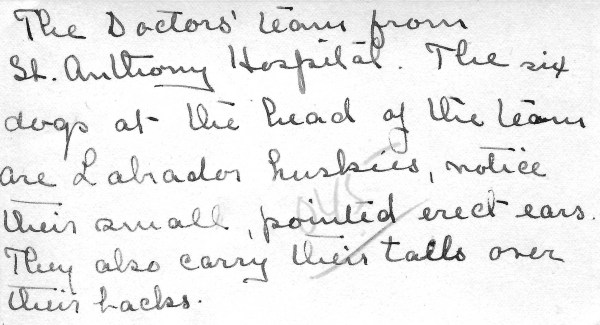
4. The fourth photo is of a dog and sled team. According to her note on the back, it belonged to the Doctor from St. Anthony (about 570km away). She noted that two Labrador Huskies lead the team and made special mention of their curled tails and pointed ears.

Local dog and sled team delivering wood in the winter time to the public school in Muddy Bay with a handwritten note on the back


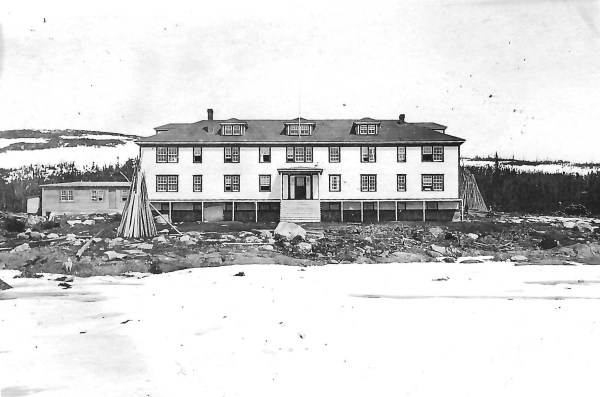
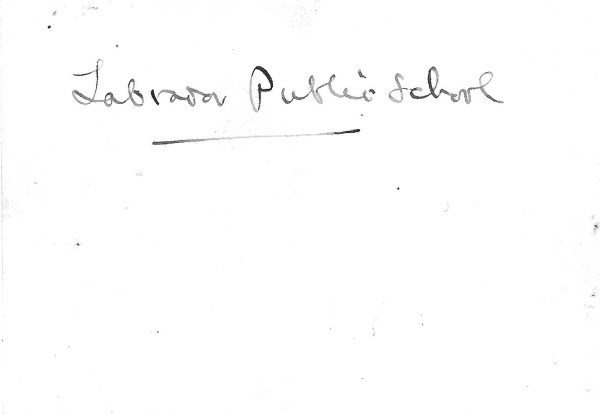
5. The fifth and final photo is of the newly constructed Labrador Public School in Muddy Bay, near Cartwright, which later burned down. The school in Cartwright today was named after her superior: The Henry Gordon Academy. To this day, the children are told Miss Lindsay’s story. Her handwritten note on the reverse side of this photo makes it that much more special for me.

Labrador Public School in Muddy Bay with handwritten note on the back.


I am so delighted about the recent discovery of these photos and very grateful to my cousin for finding these gems! I remain eagerly optimistic for more of Miss Lindsay’s undiscovered treasures to appear someday!

Miss Lindsay – Part 1

Miss Lindsay – Part 2

Miss Lindsay – Part 3

Miss Lindsay – The Early Years

Miss Lindsay’s Last Letter

how i came to write miss lindsay’s tale

The Mothering Bureau

Dusty Old Boxes

Benjamin Workman, MD: Leading the Way

One spring day in 1819, a young man named Benjamin Workman stood on the dock at Belfast, Ireland, trying to decide where he should immigrate to in North America. He had relatives in the United States, but before he booked his passage, he wanted to check on the safety of the vessels that were scheduled to leave soon.

He noted that the captain of the New Orleans-bound ship appeared to be drunk, the mate of the ship going to New York swore profusely, and the crew of vessel going to Philadelphia ignored his questions, but the captain of the Sally, bound for Quebec, impressed him favourably, so that’s the ship he chose. He later noted that this had been a lucky choice since yellow fever was widespread in American port cities that year.1

Benjamin left Ireland on April 27 and arrived in Montreal a few weeks later. He was 25 years old and had 25 guineas (a coin worth one pound, one shilling) in his pocket.

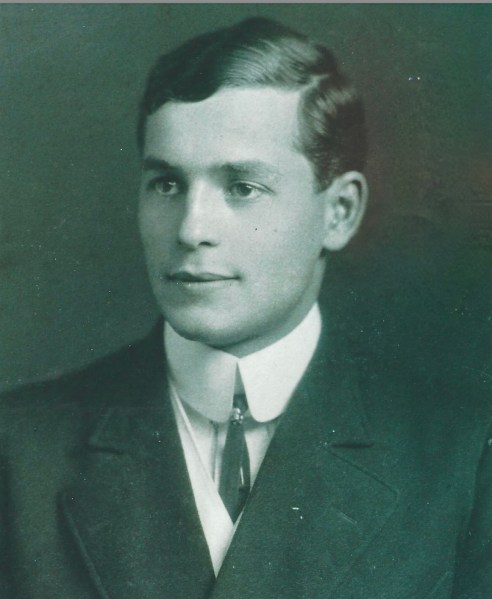
This photo of Dr. Ben Workman appears in Christine Johnston’s book The Father of Canadian Psychiatry, Joseph Workman

His choice of Canada turned out to be a good decision: within 10 years, all of his eight younger siblings and both of their parents had followed him. The Workmans were all hard-working, ambitious and smart, and they took advantage of the opportunities available to them in their new homeland. Four of Ben’s brothers (Alexander, Joseph, William and Thomas) became prominent in business, medicine and politics. His only sister, Ann (1809-1882), married Irish-born Montreal hardware merchant Henry Mulholland and was my great-great-grandmother.

Benjamin’s parents were Joseph Workman (1759-1848) and Catherine Gowdey (1769-1872). Ben was born on Nov. 4, 17942 in the village of Ballymacash, County Antrim, near Lisburn, where the family lived in a small house near the top of a hill.  

Joesph was a teacher in Ballymacash, but he left teaching for a job as a manager for a local landowner, and as a deputy clerk of the peace for the area. Without its only teacher, the local school had to close, so young Ben started studying on his own, reading the Bible and geography books while his father helped him with arithmetic. When Ben was 11, Joseph apprenticed him to a linen weaver, but it soon became clear that Ben had no talent in that field. What he really wanted to do was study. Eventually, Ben went back to school, where he excelled in grammar and the classics. After he graduated, he found a teaching job in Belfast, then another position near Lisburn.   

Ben’s decision to leave Ireland was influenced by an event that took place in 1817. As he was eating his evening meal at his parents’ home, a dozen beggars came in the gate and asked for food and money. Perhaps realizing how widespread poverty was in Ireland, he began to think about going to North America.3

Montreal suited Ben well: other Irish and Scottish immigrants arrived there around the same time, and there were work opportunities for all. He immediately found a teaching job, but after that school’s owner disappeared with its funds, several parents who had noticed what a good teacher Ben was started a new school, with Ben as headmaster.

The Union School, as it was called, was unique. For one thing, girls were admitted, although they were taught separately by a female teacher. It was also successful. By the spring of 1820, it had 120 pupils, and it remained the largest English school in Canada for 20 years.4 Several of its graduates went on to have distinguished careers in business and politics. In 1824, Ben became the sole owner of the school, but he eventually turned over the responsibility of running it to his brother Alexander, who had come to Montreal in 1820.

In 1829, Benjamin switched careers and became a newspaper editor, partnering with a friend to purchase a weekly Montreal newspaper, the Canadian Courant. It had been founded in 1807 as the Canadian Courant and Montreal Advertiser. Ben published the newspaper until 1834, using it to promote his liberal religious views, social welfare issues, and the temperance movement. When the paper ceased publication, Ben blamed distillers, saying that their advertising had dried up because of his support for temperance.

Meanwhile, Ben experienced several tragedies in his personal life, as he was married twice and became a widower twice. He married Margaret Manson, a teacher at the Union School, in 1823. The couple had no children and Margaret died seven years later. He married Mary Ann Mills on October 14, 1838, in Franklin, Michigan, and the couple had three children: Mary Matilda, born in July 1840; a son, Joseph, who was born in November 1841 and died at age 10 months; and Annie, born in July 1843. Mary Ann died two months after Annie’s birth, and Ben’s mother, Catherine, looked after his two daughters.

Soon after that, Ben took up his third career — as a druggist. For several years in the 1840s, Lovell’s city directory of Montreal listed “B. Workman & Co., chemists and druggists”, located at 172 St. Paul Street, corner Customs House Square.5 Meanwhile, he studied medicine at McGill University, graduating in 1853, at age 59. He was henceforth known as Benjamin Workman M.D., which helps differentiate him from several other Benjamins in the family.

During these years as a pharmacist and doctor, Ben demonstrated compassion and generosity, often providing care to people who were too poor to pay. Then, in 1856, he reinvented himself again and moved to Toronto, where he assisted his brother Joseph run the Provincial Lunatic Asylum, the largest and most progressive psychiatric hospital in Canada at the time.

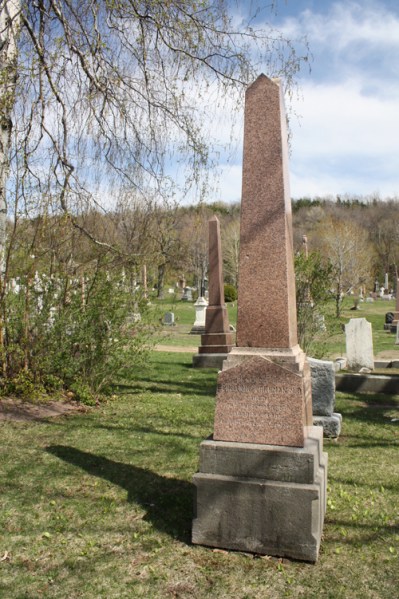
Benjamin is buried in Montreal’s Mount Royal Cemetery, near the Workman family plot. JH photo.

Benjamin Workman is probably best remembered as the founder of the Unitarian Congregation in Montreal.  In Ireland, the Workman family had attended the Non-Subscribing Presbyterian Church of Ireland in Dunmurry. Its members strongly believed in freedom of thought in religion.6

When Ben first arrived in Montreal, there were not enough Unitarians to organize a congregation, so he attended the St. Gabriel Street Presbyterian Church. When the city’s Unitarian congregation was permanently established in 1842, he played a key role.7

In 1855, Ben got into a disagreement with the congregation’s minister, Rev. John Cordner, a man he himself had recruited for the job. Benjamin argued that Cordner had excessive authority, and when the rest of the congregation sided with their minister, Ben withdrew from the church. Soon after, he moved to Toronto, joining the Unitarian congregation his brother Joseph had helped to found there. He got along well with the Toronto congregation’s members and their minister, and he ran the Sunday School there for many years.

Ben lived with his daughter Anne in Uxbridge Ontario at the end of his life, dying there on Sept. 26, 1878, several weeks short of his 84th birthday. He was buried a few days later next to the large Workman family plot at Montreal’s Mount Royal Cemetery.

This article is also posted on http://www.writinguptheancestors.ca.

See also:

Janice Hamilton, “Dr. Joseph Workman, Pioneer in the Treatment of Mental Illness” Writing Up the Ancestors, Oct 26, 2017, https://www.writinguptheancestors.ca/2017/10/dr-joseph-workman-mental-health-pioneer.html

Janice Hamilton, “Henry Mulholland, Hardware Merchant” Writing Up the Ancestors, March 17, 2016,  https://www.writinguptheancestors.ca/2016/03/henry-mulholland-montreal-hardware.html

Notes:

The children of Joseph and Catherine Workman were: Benjamin (1794-1878), Alexander (1798-1891), John (1803-1829), Joseph (1805-1894), William (1807-1878). Ann (1809-1882), Samuel (1811-1869), Thomas (1813-1889), Matthew Francis (1815-1839).

Benjamin kept a journal in which he recorded his memories of growing up in Ballymacash, and an account of the Workman family’s 200-year history in Ireland.  A large online database called A Family Orchard: Leaves from the Workman Tree, https://freepages.rootsweb.com/~database/misc/WORKMAN.htm, includes a family history going back to the 1600s, that was part of Ben’s journal. The late Calgary researcher Frederick Hunter prepared this site and database. 

Catherine Gowdey’s name has been spelled in various ways, including Gowdie and Gowdy.

Thank you to Christine Johnston, former archivist and historian of the First Unitarian Congregation of Toronto, and author of a biography of Ben’s brother Joseph.

Sources: 

1. Christine I. M. Johnston, The Father of Canadian Psychiatry: Joseph Workman, Victoria: The Ogden Press, 2000, p. 16.

2. A Family Orchard: Leaves from the Workman Tree, https://freepages.rootsweb.com/~database/misc/WORKMAN.htm, accessed Jan. 31, 2025.

3. The Digger, One Family’s Journey from Ballymacash to Canada, Lisburn.com, http://lisburn.com/history/digger/Digger-2011/digger-19-08-2011.html, accessed Jan. 31, 2024.

4. Nicholas Flood Davin, The Irishman in Canada, London: S. Low, Marston, 1877, p. 334, Internet Archive, https://archive.org/details/irishmanincanada00daviuoft/page/334/mode/2up, accessed Jan. 31, 2025.

5. Lovells Montreal Directory, 1849, p. 246, Bibliothèque et Archives nationales du Québec (BAnQ), https://numerique.banq.qc.ca/patrimoine/details/52327/3652392, accessed Jan. 31, 2024.

6. Christine Johnston, The Father of Canadian Psychiatry: Joseph Workman, p. 15.

7. Christine Johnston. “The Irish Connection: Benjamin and Joseph and Their Brothers and Their Coats of Many Colours,” CUUHS Meeting, May 1982, Paper #4, p. 2.

Is There a Doctor in the House?

Ismael Edgard Bruneau

As far as I can tell, Ismael Edgard Bruneau (1887 – 1967), my great uncle, was the first doctor in our family and maybe still the only doctor. His father wanted him to follow in his footsteps and become a minister, so when Edgar entered McGill in 1907, he registered for an Arts degree. During his university years, he decided he would rather be a doctor. He finished his Arts degree in 1910 while concurrently studying medicine and received that degree in 1912.

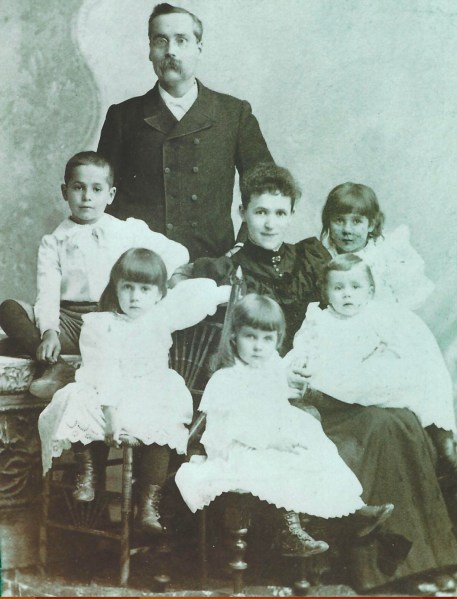
Edgar, as he became known, was the first of ten children of Ismael Bruneau and Ida Girod, my great-grandparents. He was born in Green Bay, Wisconsin, where his father served as a French Presbyterian minister. The family moved to Holyoke, Massachusetts, Quebec City and Montreal, where he did most of his schooling.

Ismael & Ida Bruneau with children Edgar top left, Hermonie, Helevetia, Sydney and Beatrice

He interned in Montreal and Ottawa and then practiced for a short time in Swift Current, Saskatchewan.

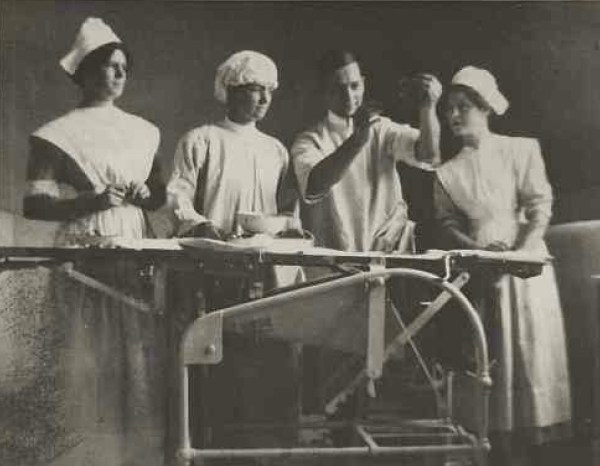
Dr Edgar Bruneau demonstrating techniques

When WWI began, he joined up with friends from McGill in the McGill Machine Gunners unit and was sent overseas in 1915. His father was unhappy with his decision to be a regular soldier and thought he should at least use his medical degree. Soon after arriving in England, he transferred to the Royal Army Medical Corp as a first lieutenant. This certainly didn’t keep him safe, as he served in France and Italy, being wounded twice and also severely gassed. Captain Bruneau was sent home to Canada in mid-1918. While in England, he visited with his Uncle Ernest Girod and became engaged to his cousin Marie but that relationship was over before he sailed home.

Edgar opened an office in Montreal as a general practitioner where he stayed his whole career. He lived on Park Avenue and had an office in his house with reception rooms on the ground floor and living space on the upper floor.

He also volunteered at the Montreal Dispensary through the 1920s. This clinic, established in 1850, gave health care to the poor. It was in downtown Montreal on St. Antoine Street, run by volunteer doctors and supported solely by donations. In the late 1920s, the Dispensary had financial difficulties and nearly closed but survived when it received a bequest of $10,000.

In the late thirties, Edgar suffered from a tubular disease in which the kidneys were damaged by lack of oxygen and blood flow, and so, for three years, he had to give up his practice. He was a much-loved doctor, as his patients visited him whether or not they needed care.

Edgar married Marie Eveline Lemoine in 1923. Before their marriage, they were in a car accident. He was driving on a street with streetcars when the traffic policeman gave him the signal to proceed. Unfortunately, the way was not clear and the car was hit by a streetcar. Eveline was thrown against the windshield, badly cut and she lost vision in one eye. Edgar felt responsible for her, so they married. Still, the marriage lasted 31 years until her death in 1954. Edgar was very social and attended all family gatherings but Eveline never did..

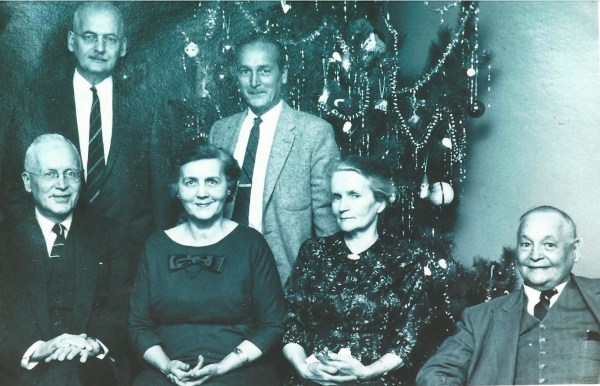
Six of the Bruneau children; Back row, Herbert & Gerald. Front row, Sydney, Edmee, Helvetia & Edgar ~1960.

One night, in the late 1950s, Edgar fell, going downstairs to his basement to fix the furnace. He broke his leg and wasn’t discovered until his housekeeper arrived in the morning. His brother Herbert wrote that when he was found, his leg was black and although the doctors saved it at that time, it resulted in gangrene. Edgar, like most of his siblings, had developed type II diabetes, which resulted in poor circulation in his legs. He first had his toes removed, then later, after many operations, most of his leg was amputated.

Edgar spent his final years at the St Anne’s Veteran’s Hospital in St Anne de Bellevue, Quebec. My sister said she never wanted to visit him as one of us told her he hung his leg in a stocking on his door at Christmas. Edgar is buried in Montreal’s Mount Royal Cemetery alongside his wife

Notes:

Recollections by Victor Herbert Bruneau , May 19, 1976.

Edgar was a keen fisherman.

He joined the Masonic Order and became a Shriner.

He was very musical; played the organ for his father’s services from the age of ten and he could play any tune he heard on the piano. He was popular with his comrades during the war and a good host afterwards.

I have no pictures of Evelyn. Edgar went to all the family functions and was very social but never Evelyn. She did play bridge and was mentioned in the newspaper as an attende at Karnac bridges put on by the Shriners.