Huntly Ward Davis, Montreal Architect

With additional research from Justin Bur

Huntly Ward Davis (1875-1952) was a Montreal architect who designed elegant downtown homes, banks and institutional buildings in the first half of the 20th century. Some of those buildings still stand today, others have disappeared. Many of Montreal’s heritage buildings, built when the city was Canada’s most important business and banking center, have been demolished and replaced by high-rise office towers and apartment buildings. As a result, Davis has been largely forgotten by the public, but his descendants – my cousins – are proud of his architectural legacy.

Huntly Ward Davis. Bagg family collection

Huntly was born in Montreal on October 22, 1875, the oldest son of Moses Davis (c. 1847-1909), head of a customs brokerage firm, and Lucy Elizabeth Ward (1850-1924). Moses was originally from St. Andrews, Quebec, a village on the Ottawa River between Ottawa and Montreal.1  

His mother’s father was well known in business and in politics. James Kewley Ward (1819-1910), was born on the Isle of Man, located in the Irish Sea. James immigrated to New York State in 1842 and married his first wife, Elizabeth King, there. The family moved to Lower Canada in the early 1850s and James bought a lumber mill on the Maskinongé River, northeast of Montreal.

Elizabeth died when daughter Lucy was four years old. James remarried and he and his second wife, Lydia Trenholm, had a large family. Lucy’s granddaughter later recalled how warm and compassionate Lucy was, so perhaps she grew up helping her younger siblings.

In the 1870s, the Ward family moved to Montreal, where James opened a sawmill on the Lachine Canal and expanded his business interests to cotton. A Liberal in politics, he served as mayor of the village of Côte St. Antoine (now the City of Westmount) from 1875 to 1884, and in 1888 he was appointed to the Legislative Council of Quebec. He was known for his generosity to charities.2

Moses Davis and Lucy Ward were married in Montreal in 1874, and Huntly, the eldest of their three sons, was born the following year. Huntly attended school in Montreal, then studied architecture in Boston, graduating from the Massachusetts Institute of Technology in 1898. He returned to Montreal and eventually went into partnership with architect Morley Hogle. After Hogle’s sudden death in 1920, Huntly worked on his own.3 He was a member of the Quebec Association of Architects and of the Royal Architectural Institute of Canada.

House at 1814 Sherbrooke Street W. near St. Mathieu, designed by Hogle and Davis in 1908. The ground floor window was added later and the house is still there today. Photo, taken 1986, from Repetoire d”architecture traditionelle sur le territoire de la Commununaute Urbaine de Montreal, Architecture domestique 1, Les Residences.

Huntly married Evelyn St. Clair Stanley Bagg (1883-1970), eldest daughter of Robert Stanley Bagg and his wife Clara Smithers, on Oct. 26, 1910, at Montreal’s Anglican Church of St. James the Apostle. The following day, The Gazette’s society reporter called the event “one of the prettiest of the season’s fashionable weddings” and described the bride’s ivory satin gown, embroidered with seed pearls.4

Huntly and Evelyn lived in an apartment building that Huntly had designed on Summerhill Avenue, a short street off Côte des Neiges Road, just up the hill from the house where Evelyn had grown up. Evelyn lived on Summerhill for the rest of her life and the couple’s granddaughter still remembers the spacious eight-room apartment and the furniture Huntly had designed.

Huntly and Evelyn also had a country house at Ste. Marguerite, in the Laurentian mountains north of the city. That was where Huntly died, suddenly, on October 12, 1952, at age 76.5 His name is on a plaque in the Bagg family mausoleum at Mount Royal Cemetery.

Huntly and Evelyn had one daughter, Clare Ward Davis (1911-2007). As an adult, she often repeated expressions she had learned from him as a child that reflected his simple sense of justice: “never assume”; “I divide, you choose”; and “a nectarine is a plum’s mistake”.

This down-to-earth approach to life was alsoreflected in the buildings he designed. Son-in-law Norton Fellowes, who was also a Montreal architect, prepared an obituary of Huntly, focusing on his professional activities and published in the Royal Architectural Institute of Canada Journal.

Norton wrote, “In the early years of the 20th century, Mr. Davis was a ‘contemporary architect’ for during this era of post-Victorian vulgarity, he allied himself with that small group of young architects who saw beyond the ornate fashion of the day and consistently designed quiet, dignified town houses, country homes, banks and institutes of learning, always in the tradition of fine craftsmanship and classical proportion. The Greenshield and Townsend country houses still grace the bays of Lake Manitou in the Laurentians and the main building of the Children’s Memorial Hospital, the Trafalgar Institute, the Walter Molson residence on McGregor Street, and the head office of the Bank of Toronto in Montreal are all still permanent monuments to a man who followed the highest traditions of the profession.

“During the last few years, although well beyond the age when others retire, Mr. Davis, at the age of 75, was still young enough to understand the trend to more functional design and it was not surprising that in 1952, he designed and supervised the building of several small, efficient new branches for the Bank of Toronto in the Montreal area. Mr. Davis thus worked with dignity and courage for a full half century as a member of the architectural profession.”6
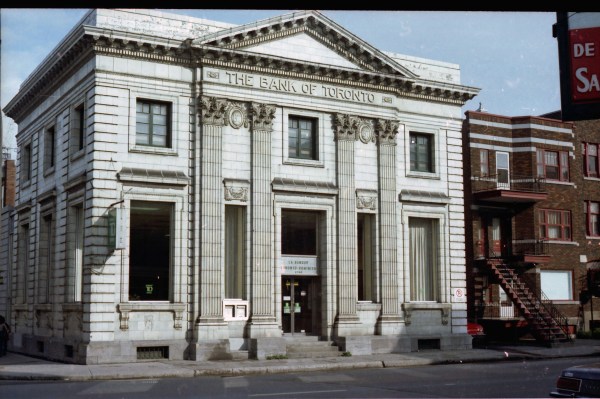
Hogle and Davis designed this branch of the Bank of Toronto in Montreal’s Hochelaga-Maisonneuve district. It features a white vitrified terracotta facade. Source: : l’Atelier d’histoire Mercier-Hochelaga-Maisonneuve (AHMHM).

Neither is it surprising that he designed at least one building for his wife’s family. The Bagg family had extensive properties in Montreal, mostly in the Mile End area, just east of Mount Royal, but they also owned a few properties downtown. In 1926, Huntly designed a brown brick apartment block on Ste-Catherine Street West, near Guy, for the Stanley Bagg Corp. It was three stories, with small shops on the ground floor.

He may have been involved with another project on land that belonged to the Baggs, a commercial building at the southwest corner of Ste-Catherine Street and Peel. It was built in 1911, shortly after Huntly and Evelyn were married, however, no architect’s name was mentioned in any newspaper reports or in the building’s lease. All building permits were destroyed in a 1922 fire at city hall.

The gleaming, white vitrified terracotta façade (a treatment popular between 1910 and 1915) of the H&M clothing store still stands out at this busy intersection in the heart of downtown. Thousands of people pass by it every day. Although his name was never officially associated with it, this may be the most familiar building Huntly designed.

Notes

Some sources, including the Biographical Dictionary of Architects of Canada, spell his name Huntley, however, his baptism record and a letter written by his mother spell it Huntly. I have used his mother’s spelling. Most architectural references say H.W. Davis.

The lot on Ste-Catherine just west of Guy (St. Antoine Ward, lot 1679, minus a strip of land previously detached for a laneway,) was purchased by the Estate of the late Stanley Clark Bagg in 1885, probably as a rent-generating property. At the time, a three-story brick building and several other buildings were on the lot. The property passed to the Stanley Bagg Corp. when it was founded in 1919. The current building, designed by Huntly Ward Davis, was constructed in 1926. The property was sold in 1957.

The property at Ste-Catherine and Peel (Saint-Antoine Ward, lot 1477) was purchased by the Bagg Estate in 1879. At the time there were three, three-storey stone-front brick houses on the lot. In 1886, these buildings were converted to shops with flats above. They were demolished in 1911 and construction began on the current building, at a cost of $60,000. The Stanley Bagg Corp. sold the property in 1951. 

Sources

  1. “Mr. Moses Davis Died Suddenly Last Night”, The Montreal Star, April 17, 1907, p. 6. Newspapers.com, accessed Oct. 28, 2025.
  2. Leslie Quilliam and Victor Neale, “James Kewley Ward”, Kelly Dollin, editor, New Manx Worthies, Manx Heritage Foundation/Culture Vannin, 2006, iMuseum, https://imuseum.im/search/collections/people/mnh-agent-94625.html, accessed Oct. 27, 2025.
  3. “Huntley Ward Davis”, Biographical Dictionary of Architects in Canada, 1800-1950, Robert G. Hill, editor, http://dictionaryofarchitectsincanada.org/node/825, accessed Oct. 27, 2025.
  4. Social and Personal, The Gazette, Oct. 27, 1910, p. 2. Newspapers.com, accessed Oct. 27, 2025.
  5. Huntly Ward Davis, Obituary, The Gazette, Oct. 15, 1952, p. 14, Newspapers.com, accessed Oct. 27, 2025.
  6. Norton A. Fellowes, “The Late Huntley Ward Davis, Montreal Architect,” Royal Architectural Institute of Canada, Nov. 13, 1952

This article also appears on my family history blog http://www.writinguptheancestors.ca

Discovering Family Connections Through Obituaries

Somerled School Kindergarten class 1957/1958

I recently discovered that I am related to my kindergarten teacher’s husband! There are certainly tangled webs of relationships all through our family histories. Following direct ancestor lines often leads you to people you might know about. Exploring other branches of siblings, aunts, and uncles can uncover connections you never knew you had. This is how this one was untangled.

The online death notice for Shirley Harris (1927-2025) in the Montreal Gazette caught my eye. Her name sounded familiar so I started reading her obituary. It mentioned she was 98, had a brother, John and sister, Ann. These names didn’t ring a bell, so I closed it just as my eyes caught the name Paul von Colditz. I remembered that there was a connection with a Shirley von Colditz and our family.

Ida Bruneau, one of my mother’s cousins, wrote a family history, “The Short History of the Bruneaus and Girods”. In it, Ida mentions Shirley von Colditz as a very dear friend of hers. They discovered they were distant cousins. Shirley descended from Medard Bruneau (1811-1892) and Ida and I from his brother Barnabé. They were the sons of Antoine Bruneau (1773-1847) and Marie Robidoux (1775-1847). This meant that Shirley and Ida were third cousins once removed.

My husband and I used to be members of the Montreal Badminton Squash Club. An Eric von Colditz also played badminton there. Years ago, I read Ida’s book. After that, I asked Eric if he thought we were very distant cousins. He said no. Shirley was his stepmother.

I carefully reread the obituary. “Shirley was the devoted wife of the late Paul von Colditz and the loving sister of the late John Harris ( the late Patricia Reynolds).” Patricia Harris was the name of my kindergarten teacher. I knew her maiden name was Reynolds, as my mother knew her sister Moyra Reynolds. Pat’s obituary confirmed she had sisters-in-laws Shirley and Ann. So I was related to her husband John.

Mrs. Harris and Miss Gael were my two kindergarten teachers at Somerled School in Notre Dame de Grace, Montreal. I started there in the fall of 1957. This school just opened in January 1957. I was in the first class to go through all the grades at Somerled School. I enjoyed kindergarten and remembered my teachers fondly.

John and Pat Harris had two children, Kathy and John. At one time, their son John lived on Percival Ave. in Montreal West, where I also lived. During a street-wide garage sale, my husband returned from down the street. He said, “One of your teachers is selling tea cups in front of a house.” I went and had a chat with Mrs Harris. Her son was someone I recognized but never talked to. He had a wife, three daughters and a dog. I figure John and I are fourth cousins once removed. Unfortunately, he no longer lives on Percival. I can’t tell him of our connection. Not even six degrees of separation.

Notes:

A Short History of the Bruneau Girod Families by Ida Bruneau. Ste. Agathe des Monts, Quebec, May 1993. Page 8. A copy in the hands of the author.

https://montrealgazette.remembering.ca/obituary/shirley-harris-1092955467

https://montrealgazette.remembering.ca/obituary/patricia-harris-1065848692

Shirley Harris was the daughter of Irene Bruneau (1901-1987) and Herbert Harris. 

Irene was the daughter of Eugene Albert Bruneau (1875-1939) and Eliza W. Thompson

Albert was the son of Ophir Bruneau (1848-1920) and Hermaline Piche (1949-1901)

Ophir was the son of Medard Bruneau (1811-1892) and Marie S. Megrette (1822-1853)

Medard was the son of Antoine Bruneau (1773-1847) and Marie J. Robidoux 1775-1847)

Barnabé and Medard were brothers:

Barnabé was the son of Antoine Bruneau (1773-1847) and Marie J. Robidoux 1775-1847).

Ismael was the son of Barnabe (1807-1880) and Sophie Marie Louise Prud’homme (1812-1892).

Sydney was the son of Ismael Bruneau (1852-1918) and Ida Girod ( 1862-1927).

Sydney was my grandmother Beatrice’s brother

Ida Bruneau was the daughter of Sydney Bruneau ( 1893-1979) and Ruth Dawson ( 1894-1971).

This makes Ida and Shirley 3rd cousins once removed!

Moyra Reynolds was on the women’s executive at the Catherine Booth Hospital. She worked alongside my mother, who was also a cousin of John Harris. Moyra and her friend Eileen glued my mother’s little tatted flowers onto hasty notes. These cards were sold for the benefit of the Catherine Booth Hospital. Moyra was living in the Montclair Residence when my mother moved in. They lived on the same floor. Moyra was excited that my mother was coming and hoped to make more hasty notes. Unfortunately, she soon suffered a stroke and was in hospital for a while. She came back to the Montclair. However, her needs were too great for them to handle and she moved to another residence.

One time when I was visiting my mother, a young woman was clearing out Moyra’s room. I thought afterwards that she might have been Moyra’s niece and my kindergarten teacher’s daughter. I am sorry I didn’t speak to her.

There was a family connection with Somerled School and another connection to Percival Avenue. Percival Ave is a street of just three blocks in the town of Montreal West. Ida’s sister Mary Bruneau and her husband George Davidson once lived on Percival. Their home was just across the street from where John Harris later lived. Ed Hawkes married my mother’s cousin Ephese Jousse, also related to John Harris. His parents lived a block south on Percival. I live on Percival now!

Greek Tragedy

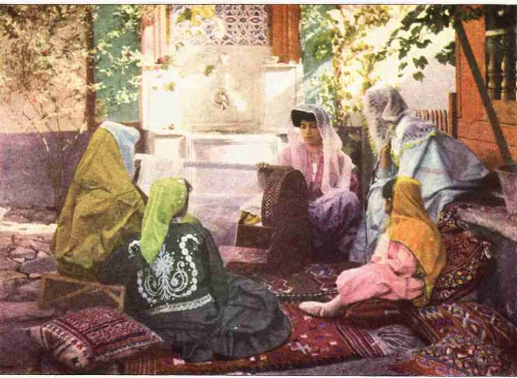
Syrian girl with her wares. (National Geographic, November, 1925. Article cited below. This magazine is in the public domain according to Library of Congress. Gervaise Courtellemont. Lumiere company.


Prologue: In my last post I explained how I recently learned, through DNA, that my biological father was likely Pontic Greek on the father’s side. Pontic Greeks are Orthodox Christian Turks who believed they are descended from ancient Greeks, who once lived on the southern coast of the Black Sea in cites like Samsun and Trabzon and who speak either a unique form of Greek or Turkish. In that post, I also wrote about the 1923 population exchange between Greece and Turkey. Here, I elaborate.

In 2010, I visited my older brother who lives in Denmark at his holiday home in Plomari, Lesbos, Greece. The large island of Lesbos is off the northwest coast of Turkey. On a good day you can see Turkey from the capital city of Mytilini. It’s only 17 miles away.

Back in 2010, before I explored my DNA, I naturally assumed I was half French Canadian and half Yorkshire British, just like my older brother, but I also knew, deep down in my heart of hearts, that I resembled the Greek locals, both in looks and in temperament.

Plomari village from the back window of my brother’s place.
The harbour is two streets down.

Today, I understand that I am very likely related to some of those local Greek citizens on Lesbos, perhaps even closely related. I know this because of a photograph I recently discovered in an article from the November, 1925 National Geographic magazine.

Greek refugees arriving in Mytilini. 1923

There is no shortage of online information on the 1923 Greek/Turk ‘population exchange’ that came on the heels of a horrific event referred to back then as ‘The Smyrna Holocaust,’ but I had high hopes that this story entitled History’s Greatest Trek. Tragedy stalks through the near east as Greece and Turkey exchange 2,000,000 of their people, written in real time by a world class journalist in a world class magazine, would shed some light on the path my Pontic bio-father (or grandfather) may have taken to reach Montreal, Canada in 1954.

I have tree matches in Samsun, a port on the Black Sea in northern Turkey. My mother, who lived and worked in the Notre Dame de Grace area of the city, likely knew Greek men whose grandparents fled Smyrna (now Izmir) in 1922, on the west coast of Anatolia on the Mediterranean Sea. Could I connect the two places?

I was not disappointed. Right at the beginning of the sixty page article there’s a picture of a young Greek man from Samsun. The caption reads: A Refugee from Samsun. He took part in the first trek of 100,000 refugees from the Anatolian interior.

According to online sources, post WWI, most elite Greeks in Samsun were killed off and all other able-bodied men sent into the interior to join the Turkish army.

Clearly, some of these Pontic Greek men and women escaped the Turkish hinterland to make it to the Mediterranean coast and Smyrna in 1922, in the hope of catching a ride to safety.

This 60 page article from 1925 is a classic piece of National Geographic reporting. It is workman-like in its execution with a prose style on the flowery side. The article offers readers a succinct historical and political perspective on the infamous 1923 population exchange between Greece and Turkey. The reporting is objective: The Muslim story is discussed with as much respect as the Christian story. And, of course, the article contains many, many photographs, about one hundred of them. Oddly, the prettiest colour ones all depict quiet Turkish life.

There’s a fascination here with exotic dress, from what I can see.


Still, the author, Melville Chater, pulls no punches as he uses his gift with words to capture the true horror of the situation in the port of Smyrna during the late summer of 1922: the hope, despair, death and disease and, eventually, the chaos, the total breakdown of civilized life.

Chater and his companion were in that coastal city when the Greek military lines collapsed in August, 1922, effectively ending the three year old Greco-Turkish war. They were in Smyrna in September to witness the Greek soldiers flee home on their military barques, leaving only ‘neutral’ observer boats in the habour.

Immediately thereafter, they saw the victorious Turkish cavalry enter the city, the riders’ left palms outstretched in a peace gesture, and a few days hence they witnessed the great fire of Smyrna that forced local citizens to flee in chaos to the quay and mix with the tens of thousands of refugees from further afield amassed there. By this time “the city had become a gigantic blast furnace… Affrighted faces mingled with wild-eyed animals, and human cries with the neigh of horses, the scream of camels, and, last, the squeaking of rats, as they scuttled by in droves from the underworld of a lost Smyrna.”

The beginning, late August, 1922.

“Refugees from anywhere within 150 miles inland herded seaward into Smyrna. At first they came in orderly trainloads or in carts, with rug-wrapped bedding, some little household equipment, and perhaps even a few animals, But as the distant military momentum speeded up, the influx became a wild rabble of ten, then twenty, then thirty thousand a day. Their increasingly scanty possessions betokened a mad and yet madder stampede from the scene of sword and fire, until September 7 saw utterly destitute multitudes staggering in, the women wailing over the first blows of family tragedy, whereby mothers with no food for their babies had been forced to abandon their older children in wayside villages….

….By now Smyrna’s broad quay swarmed with perhaps 150,000 exiles who camped and slept there, daily stretching their rugs as makeshift shelters against the sun, whose furnace-like heat was the mere forerunner to a terrible epic of fire.”

The Greek Army flees,the Turkish cavalry arrives.

On September 23rd, a fire breaks out in the Armenian quarter. The Turks give permission for women and children and old men to leave. People are dispatched to Athens to organize a flotilla of rescue boats. The Turks then give the rescuers one week to evacuate the refugees or they will be forced into the interior. Further chaos ensues.

“Uncounted hundreds were crushed to death or pushed over the quayside to drown, on that first day, when eight ships, convoyed by American destroyers left with 43,000 souls aboard. For those left behind there remained but six more chances—a chance a day—then the black despair of deportation into the interior.

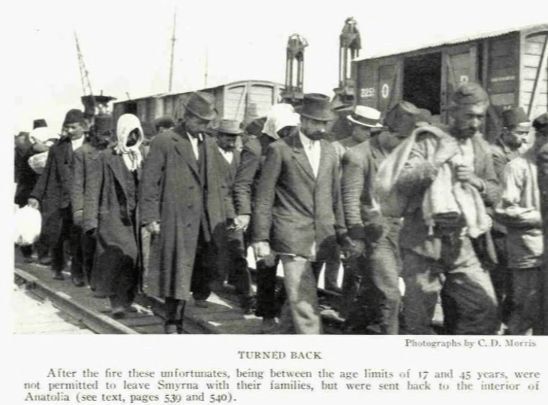
These men were not allowed to leave Smyrna after the fire with their families. “Everyone from peasants to bankers” is how these Anatolian Greek refugees are described in the article. Also as “human derelicts” and descendants of ‘those adventurous spirits who had followed Alexander the Great into Asia.” Some men apparently escaped at Smyrna, swimming to rescue boats under the cover of night. Some wealthier men bought their way onto boats. 300,000 thousand people were evacuated in two weeks, including 100, 000 ‘cellar-hiders’ in Smyrna, uncovered by the Turks in a house-to-house search.

The aftermath:

A notification is posted permitting (well, forcing) all non-Muslims to leave Asia Minor before November, 30, 1922. Hoardes of Anatolian Greeks, former prisoners of war, men, women and children, head to the Black Sea coast.

“With ship-deserted quays, as at Smyrna, and with the Black Sea ports glutted with sidewalk-sleeping, disease breeding paupers, who had been thrifty cottagers a few weeks before, the gap was finally bridged by the arrival of Greek ships flying the Stars and Stripes and convoyed by American destroyers….

….”By January, 1923, Athens had slammed its official doors protesting against further expulsions.”

With a big nudge from the US, Britain and the League of Nations, Athens agreed to accept hundreds of thousands more Christian Greek refugees in an exchange for Muslims living in Greece.

The exchange would begin in May, 1923 and be carried out in various ways. Most Greek refugees are funnelled to the Athens region as well as to Thessonaliki in the northern part of Greece and to some Aegean Islands like Lesbos.

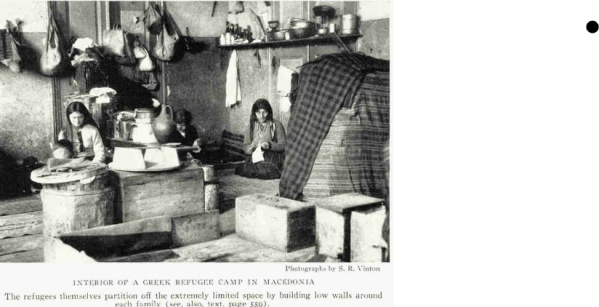
They live in refugee camps rife with disease and death. There is little usable land left in Greece due to past wars.

Greece, then a country of 6 million souls, would take in almost a million and a quarter refugees within a year of the Smyrna disaster, increasing its population by 25 percent.

“There is no adequate parallel whereby to convey even remotely a picture of Greece’s plight in 1923,” Chater summarizes.

Pretty heavy stuff – and yet the 1925 magazine article somehow manages to maintain the feel of a breezy travelogue.

Greek refugee camp Macedonia

Epilogue:

In the style of Virginia Woolf’s 1925 masterpiece Mrs. Dalloway, I imagine a comfortably middle class lady, back in the mid 1920’s, perhaps my husband’s grandmother in her favourite club chair in her cottage in Westmount, flipping through this very issue of the National Geographic, cup of tea in one hand. The inky new pages crackle as she turns them with her free hand. “How awful,” she whispers under her breath when she gets to the bit about the Greek women holding their still-born babies at their breasts because they had no place to bury them. And, then, “How pretty,” as she eyes the flowing costumes on the Turkish women, the colourful mosques and the charming minurats. And, then, as she comes to the full-page advertisement for Campbell’s Soup at the end of the article, she perhaps thinks, “Yes, tomato soup for the children, for tomorrow’s lunch.”

Here’s the archive.org link.

https://archive.org/details/nationalgeographic19251101/page/550/mode/2up?q=mosques

Getting the Names Right

In the last mad dash to send Beads in the Necklace to print, we had to make sure that the names in the stories were right. Genealogists struggle with the difficulties of names every day.

There was the question of those pesky hyphens. In French Canada, hyphenated names are common. But not every double name takes a hyphen. Then what about apostrophes that were simply dropped?

And accents. Some French names had accents and others not. There seemed to be no rhyme or reason.

Some of the people in our stories had unusual names. Hermonie? Maybe it was Harmonie? Or even Hermionie? It was Herminie. And is it Catherine or Catharine? Or Isabelle or Isabella?

And how many ways can you spell Jodouin? Each source document seemed to have a different spelling.

And then what about place names. Do we use the French place name or the anglicized place name? With or without accents?

All these variations in the names made me think of my husband’s surname. I asked him, “Why do some people in your family spell their name Delatolas as Dellatolas, with two letter ls?

He shrugged, “I dropped an “l” when I emigrated to Canada.”

“Besides, my father and my brother had already dropped an “l”. Anyway, who cares?”

“Well,” I muttered, “Genealogists care.”

French-Canadian Leadership in WWI

Most history books define the Battle of the Somme as a disaster, but French Canadians can claim it as their first military success.

It also represented the integration of a new kind of leadership in European battle tactics, one in which every soldier counted.

Both of those realities are due to the contribution of the 22nd Regiment, known colloquially as the Van Doos based on its French name “vingt-deux.” Today the unit holds an official French name, the Royal 22e Régiment, an important symbol of its identity and importance.

“It’s arguable that the tactics that the Van Doos taught the Canadians won the war,” said author and historian Desmond Morton, who had authored forty-seven books about Canada by the time he died in September 2019. “It was formed and was trained in a way that was uniquely French-Canadian. The Colonel of the Regiment was an ex-cadet of the Royal Military College…Tremblay had a different philosophy of leadership and he showed it.”

One of the most recognized leaders was Lieutenant Colonel Thomas-Louis Tremblay, who led the Van Doos during their WWI triumphs and left behind his French-language diaries to inspire followers.

Tremblay was the first to use tanks to get over and past enemy dug-outs during an artillery barrage. The tactic relied on every soldier being willing to move through active artillery and kill defenders individually in hand-to-hand combat. The brutal but effective operation enabled his unit to capture the village of Flers-Courcelette from the Germans on September 15, 1916. They held the position for two days.

The 22nd Batallion’s effectiveness in Courcelette persuaded General Sir Arthur William Currie, who was in charge of the Canadian Army, to change his thinking about Vimy Ridge. Tunnels, barbed wire and three rows of trenches protected the strategic site to such an extent that tit was considered largely impregnable by the British and French. The French-Canadian success at Courcelette made them think that maybe someone could capture the strategic site.

The following spring, the Van Doos and three other Canadian divisions moved toward the 14-km-long escarpment at 5:30 a.m. on Monday, April 9, 1917. It took four days, 3,598 deaths and 7,000 wounded men to capture the ridge.

Success was due primarily to training that ensured that every soldier knew what to do and did it, even as commanding officers died.

The Vimy capture may have relied on the Van Doo success at Courcelette, but the Van Doos themselves would never have existed without a private donation by prominent Montreal entrepreneur and philanthropist Arthur Mignault. In 1914, the head of the Franco-American Chemical Company donated $50,000 to create a regiment “composed of and officered by French Canadians.” His offer resulted in the creation of the 22nd Battalion (French Canadian) CEF on October 14, 1914. Mignault and then Opposition leader Sir Wilfred Laurier spent the next month recruiting a full contingent of more than 20,000 men who formed the bulk of Tremblay’s men.

Migneault, who made his fortune selling iron pills to women with anemia, had already enlisted with the 65th Regiment “Carabiniers Mont-Royal” five years earlier. After his 22nd Division success, he went on to subsidize the founding of two additional French-Canadian divisions, but they got folded into the 22e to replace casualties.

Migneault had hoped to be appointed to lead a battalion. Realizing that subsidizing infantry divisions wouldn’t make that happen, he decided to fund military hospitals. Just as the Van Doos were heading to war in early 1915, Mignault succeeded in encouraging the Canadian government to build a French Canadian stationary hospital near the German frontlines in Saint-Cloud. By November 1915, Mignault was on his way to France along with 100 men to set up the hospital.

Laval University followed suit with a second French Canadian Hospital, and both became so important, the French renamed part of Joinville-le-Pont near Paris the “quartier des Canadiens.”

Mignault not only realized his ambition to become a colonel, but a month before his death in 1937, the Royal Canadian Army Medical Corps promoted him to the honorary rank of Brigadier General. He was the first French Canadian to hold that rank.

Members of the Royal 22e Régiment fought in Italy and in the Pacific during World War II, in Korea, in the Gulf War, and in Afghanistan. They were also the first Regular Force regiment to mount the King’s Guard in London in 1940, and repeated the experience again for their hundredth anniversary in 2014. They also served during the Oka Crisis in 1990.

Today, the regiment forms the largest unit in the Canadian Army, with three Regular Force battalions, two Primary Reserve battalions, and a band. Its ceremonial home is La Citadelle in Quebec City, although members are stationed at Valcartier and other bases throughout Quebec.