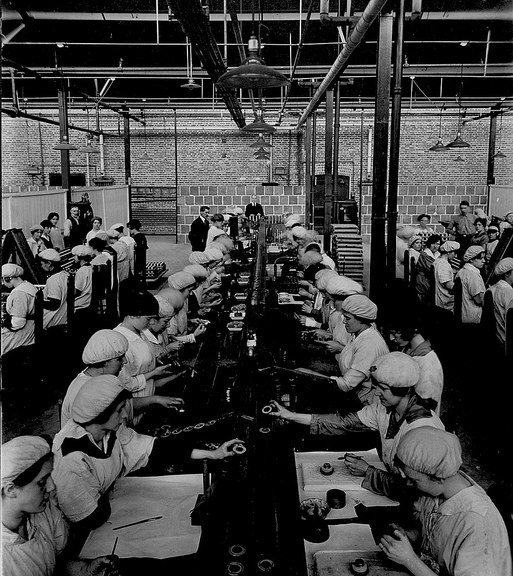
During World War I, 4,000 people, many of them women, assembled eight million fuses in a building locally known as “La Poudrière.” Given that the job required mounting a detonator cap over a gunpowder relay charge and attaching a safety pin (read more about WWI fuses here), the job was risky and monotonous at the same time.
Who were these people? How can we honour their work?
Recently, while looking through the records of World War I soldiers, I realized that their records may offer us ways to discover our homefront heroines. Several women moved to Verdun and lived within walking distance of the armament plant while their husbands or brothers served overseas.
Patrick Murray
When Ethel Henrietta Murray’s husband Patrick volunteered for the Canadian Over-Seas Expeditionary Force on Wednesday, April 12, 1916, the couple lived at 80 Anderson Street, in downtown Montreal.[1]
According to his military records, he died on October 29, 1917, driving with the 4th Brigade of the Canadian Field Artillery. She went by the first name Henrietta. Initially, she had moved to 1251 Wellington Street. Later, she lived at 956 Ethel Street.[2]
None of her addresses exist anymore, nor have I yet found any evidence explaining why she moved to Verdun. Based on her address and circumstances, however, I suspect that she—and three other women who lived nearby—worked at “la poudrière.”
La Poudrière
Locals call a building that currently houses 64 units for senior citizens “La Poudrière,” which means powder keg. The Canadien Slavowic Association (l’Association canadienne slave de Montréal) operates the space.
I haven’t yet looked into the records of the company to find out if there is a list of employees so that I can see if Ethel or Henrietta Murray appears on their rolls.
Other women I’d like to verify include Marjorie Victoria Stroude Luker, Ellen or Helen Elizabeth Winsper, and Mrs. John Sullivan. These three women also lived within walking distance of la poudrière between 1916 and 1919.
Military records include the addresses of these women because all of them received telegrams about loved ones being wounded or killed overseas.
Arthur Stroude
Marjorie’s husband Arthur was wounded in Italy on August 20, 1917, and then died of the flu in Belgium on December 2018. Although the couple lived in Point St. Charles when he signed up, her benefits were sent to her at 714 Ethel Street by the time he died.[3]
George Winsper
Ellen or Helen Elizabeth Winsper, the wife of George Winsper who died on November 7, 1917, had moved from Rosemont to 196 St. Charles Street in Pointe St. Charles by the time he died.[4]
William Wright
Two records mention the grief of Mrs. John Sullivan when Private William Wright, a steamfitter from Scotland, died in action at St. Julien on April 24, 1915. Neither have her first name. One document describes William, who was 21 when he died as the adopted child of Mr. and Mrs. John Sullivan. The one I think is correct mentions that she is his sister. Her address at the beginning of the war was 9 Farm Street, Point St. Charles, the same as his when he enlisted. His medals were sent to her at 431A Wellington St., Point St. Charles.[5]
If these women worked together, as is possible, they too risked their lives.
Employees with the British Munition Supply Company–which was created by The British Government under the auspices of The Imperial Munitions Board–faced the possibility of accidental explosions. Britain paid $175,000 in 1916 to construct a building that could contain shockwaves. It also included a saw-tooth roof to prevent sunlight from entering.[6]
British Munitions Limited
One description of their work comes from the biography of Sir Charles Gordon, who led the team that arranged for building construction.
The IMB had inherited from Sir Samuel Hughes’s Shell Committee orders for artillery shells worth more than $282 million, contracts with over 400 different factories, and supervision of the manufacture of tens of millions of shells and ancillary parts. Its most serious problem was acquiring time and graze, or percussion, fuses for the shells produced by its factories. There was no capacity to create and assemble these precision parts in Canada, and contracts with American companies had proved dismal failures.
The problem was given to Gordon to solve. He recommended that fuse manufacturing be done in Canada. The IMB set up its own factory in Verdun (Montreal) to make the delicate time fuses. Skilled workmen and supervisors were quickly brought over from Britain to train Canadian workers. British Munitions Limited, the IMB’s first “national factory,” was open for business by the spring of 1916. The last order from Britain, for 3,000,000 fuses, came in 1917 and the last fuses were shipped in May 1918. British Munitions was then converted by the IMB into a shell-manufacturing facility.[7]
Another source I read said that Dominion Textile Company purchased the site for its textile operations when the war ended in 1919. Two decades later, Defence Industries Limited revived the site for a shell factory during World War II, between 1940 and 1945. David Fennario’s book “Motherhouse” offers a good look at the women’s lives during this second wartime era.
[1] Attestation Paper, Library and Archives Canada, RG 150, #347740, Patrick Murray, a derivative copy of the original signed by Patrick.
[3] Attestation Paper and address card, Library and Archives Canada, RG 150, #1054006, Arthur Luker.
[4] Attestation Paper and address card, Library and Archives Canada, RG 150, #920146, George Winsper.
[5] Library and Archives Canada, RG 150, #26024, William Wright.
[6] “Usine à munitions pour retraités slaves” by Raphaël Dallaire Ferland, ttps://www.ledevoir.com/societe/354100/usine-a-munitions-pour-retraites-slaves, accessed September 22, 2018.
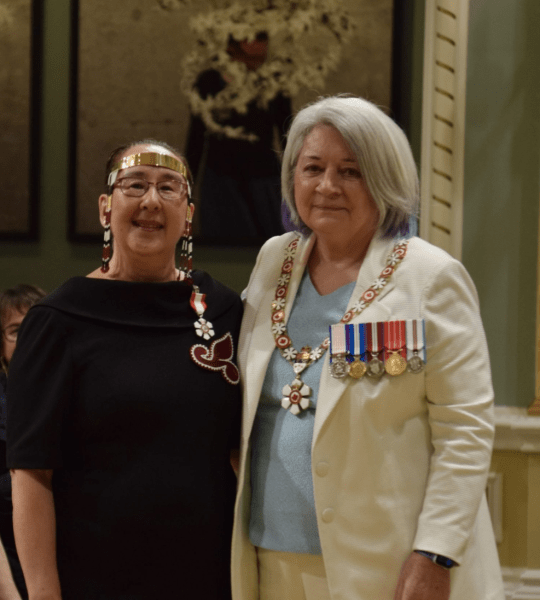
Nancy Karetak Lindell is my nephew Jon Lindell’s wife, my niece by marriage.
It is with great pride that I acknowledge her many contributions and her recent appointment to the Senate of Canada.
It is indeed “History in the Making”.
The Senate of Canada Crest
December 19, 2024 Ottawa, Ontario
The Prime Minister, Justin Trudeau, today announced that the Governor General, Her Excellency the Right Honourable Mary Simon, appointed the following individuals as independent senators to fill vacancies in the Senate.
Nancy Karetak-Lindell, for Nunavut
Nancy Karetak-Lindell has been a strong voice for the North in Canada throughout her life, advocating for the region’s unique cultural, economic, and environmental interests. From 1997 to 2008, she was the first Member of Parliament to represent the newly established riding of Nunavut. A strong Inuk leader, she served as President of Inuit Circumpolar Council Canada. She is also an active member of her community and the recipient of various honours, including the Order of Canada.
These new senators were recommended by the Independent Advisory Board for Senate Appointments and chosen using a merit-based process open to all Canadians. Introduced in 2016, this process ensures senators are independent and able to tackle the broad range of challenges and opportunities facing the country.
Below is a biography of Nancy’s many accomplishments.
A Biography of Nancy Karetak Lindell
December 19, 2024 Ottawa, Ontario
Nancy Karetak-Lindell has been a strong voice for the North in Canada throughout her life. Born and raised in Eskimo Point (now Arviat), she has first-hand experience of the challenges faced by Inuit and has long been advocating for her region’s unique cultural, economic, and environmental interests.
Fluent in Inuktitut and English, Ms. Karetak-Lindell worked for 15 years in managerial positions for the Arviat Housing Association and Eskimo Point Lumber Supply. In 1997, she ran and was elected as the first Member of Parliament representing the newly established riding of Nunavut and the first female Member of Parliament for the Eastern Arctic. She was re-elected in 2000, 2004, and 2006, serving 11 years in Parliament.
During her time on the Hill, Ms. Karetak-Lindell was Parliamentary Secretary to the Minister of Natural Resources and sat on various parliamentary committees, groups, and associations, including as Vice-Chair and Chair of the Standing Committee on Aboriginal Affairs and Northern Development. She was also a key player in the negotiations to establish Nunavut as a political jurisdiction in Canada.
After leaving politics, Ms. Karetak-Lindell worked as a consultant, independent contractor, guest speaker, election officer, and instructor. She was Director of the Jane Glassco Northern Fellowship Program, chaired the Indigenous Knowledge Program at the International Polar Year Conference, and served as President of Inuit Circumpolar Council Canada, where she advocated for Inuit at the international level.
Ms. Karetak-Lindell has been an active member of her community, serving on the Arviat Hamlet Council, the Arviat Education Council, the Kivalliq Regional Education Authority, Sport North, and the Board of Governors of the Nunavut Arctic College. She also served as Chair of the Nunavut Development Corporation and of the Nunavut Business Credit Corporation, as a board member for Polar Knowledge Canada, as a Trustee for Nunavut Trust, and as Secretary-Treasurer for the Kivalliq Inuit Association. She helped found and volunteered at the Arviat Amateur Athletic Association and gave her time to various other community groups.
In recognition of her leadership and contributions, she was invested as a Member of the Order of Canada and received the Queen Elizabeth II Diamond Jubilee Medal.
Nancy Karetak-Lindell Vows to be the Northern Voice for Nunavut in SenateArticle written by By Nehaa Bimal
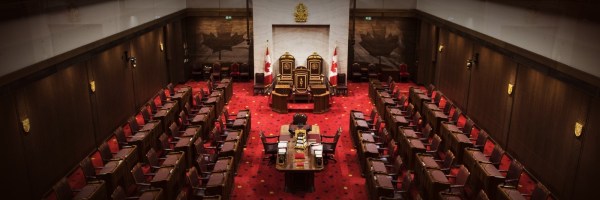
Nancy Karetak-Lindell is Nunavut’s new senator, Prime Minister Justin Trudeau announced Thursday in a news release almost a year after the territory’s lone seat became vacant
“It hasn’t really sunk in for me yet,” Karetak-Lindell said in a phone interview an hour after her appointment was announced.
“I am truly honoured and humbled that I’m able to be selected for this position,” she said.
The territory’s only seat in the Senate — the upper house in Canada’s Parliament — has been vacant since Dennis Patterson retired last December, nearly a year ago.
At 67, Karetak-Lindell is set to serve until she reaches the Senate’s mandatory retirement age of 75. The Senate appointment comes with a base salary of $178,100 a year, according to the Library of Parliament.
She said she plans to focus on issues important to the North, including the high cost of living, housing shortages, and access to education.
“Inuit and people in the North really need to have a voice speaking on their behalf, making sure our points of view, our values and our knowledge are being used to make decisions in the North,” Karetak-Lindell said.
While she expects to travel frequently down south for her new role, she said Arviat, where she was born and raised, will remain her home.
This is not Karetak-Lindell’s first time making leadership strides in the south.
She made history in 1997 as a Liberal MP — the first female MP for the Eastern Arctic, and the inaugural representative for the newly established Nunavut riding.
Re-elected in 2000, 2004 and 2006, she served 11 years in Parliament, where she was parliamentary secretary to the minister of natural resources and chairperson of the Aboriginal affairs and northern development committee.
Representing the largest geographical riding in Canada, Karetak-Lindell said it is important to work collaboratively with others to ensure northern perspectives are understood in Ottawa.
“When you’re one lone voice representing such a large and unique riding, you have to work with people to make sure other colleagues understand the message you’re trying to share,” she said.
Nunavut’s current MP Lori Idlout, acknowledging the challenges of being the territory’s only voice in the House of Commons, congratulated Karetak-Lindell in a Twitter post Thursday.
“I have always admired Nancy, and her appointment will mean Nunavut has another strong Inuk female voice in Ottawa,” Idlout tweeted.
In Parliament, Nunavut has one seat in the House of Commons, whose members are elected, and one seat in the unelected Senate.
Karetak-Lindell’s contributions to the North continued after she stepped down from her MP role in 2008.
She served as director of the Jane Glassco Arctic Fellowship Program, chaired the Indigenous Knowledge Program at the International Polar Year conference, and led the Inuit Circumpolar Council Canada as its president from 2016 to 2018.
Her commitment extended to community work, including serving on the Arviat hamlet council, Arviat Education Council, and Nunavut Arctic College board of governors.
She also held leadership roles with the Nunavut Development Corp. and Polar Knowledge Canada, and co-founded the Arviat Amateur Athletic Association.
Karetak-Lindell’s advocacy has been widely recognized. In 2022, she was invested as a Member of the Order of Canada.
While she is looking forward to taking on the responsibilities of her new role, for now Karetak-Lindell said she is “going through all the wonderful messages I’m receiving from people.”
“I really appreciate the trust that people have in me and the confidence they have in me to represent this position,” she said.
“And I intend to do it with every ability I have.”
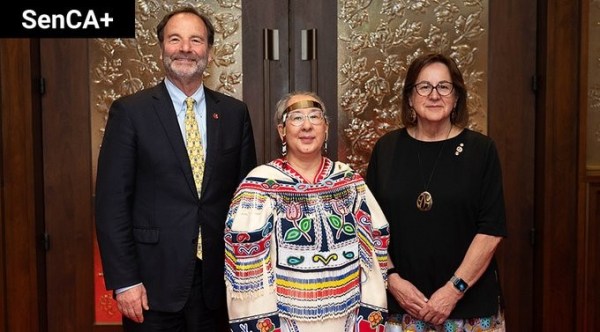
Nancy Karetak Lindell and the Governor General Mary Simon
While my youngest son’s 20-year career at the BBC’s flagship programme, the BBC World Service, is a source of personal pride, this story delves into the rich history of this iconic British institution. For me, as we observed the 80th anniversary of VE (Victory in Europe) Day, on the 8th of May, 2025, the story felt both poignant and emotional.
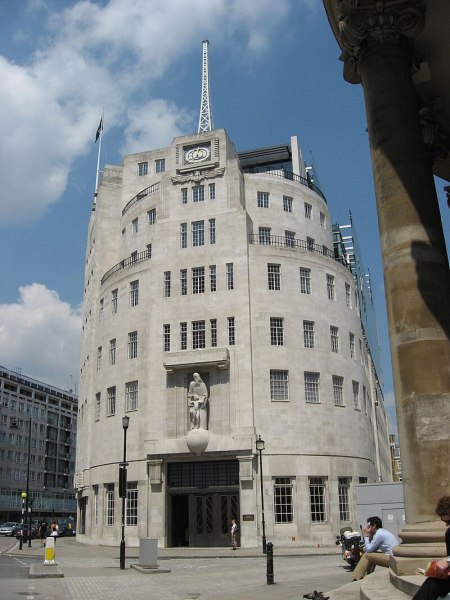
THE BBC’s BUSH HOUSE 1928 – 2012
Bush House was restored after being bombed twice during WWII
First known as the BBC Empire Service, the World Service was launched on the 19th of December 1932 as a shortwave service aimed at English speakers across the British Empire. The BBC World Service is the international broadcasting service owned and operated by the British Broadcasting Corporation. Its goal is to provide impartial and accurate news to global audiences through 42 language services.
When I was growing up in post-war England in the early 1950’s not many people had television, so the radio was my first contact with entertainment. The radio played in the background all day long. There were talks, songs, comic shows, classical music, and the hourly world news.
Saturday mornings, we had Uncle Mac, a show especially for children. Uncle Mac read stories, played songs, and greeted children when they got home from school. Uncle Mac was played by Derek Ivor Breashur McCulloch, OBE (1897 – 1967), who was born in my hometown, Plymouth, Devon. He was a radio producer and presenter and the head of children’s broadcasting for the BBC from 1933 until 1951. He became known as Uncle Mac on Children’s Hour and Children’s Favourites. (1)
The BBC, originally known as the British Broadcasting Company, first began broadcasting on the 18th of October, 1922. Its first broadcasts were made from London. Broadcasts began in November from Birmingham and Manchester, and in December from Newcastle upon Tyne. In Plymouth, the first broadcast was heard in March 1925.
The BBC began daily broadcasting in Marconi’s London studio, 2LO, in the Strand, on the 14th of November, 1922. The majority of the BBC’s existing radio stations formed the BBC National Programme and the BBC Regional Programmes. Throughout the 1920’s many firsts were added as the BBC began broadcasting from studios all over England and Scotland. (2)
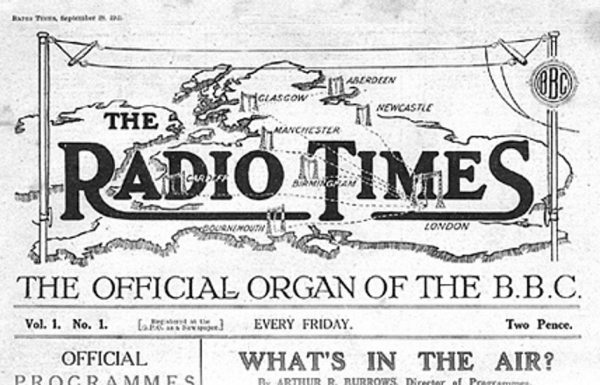
By September 1923, the first edition of ‘Radio Times’ was produced, listing the few programmes available. When I grew older, I found the Radio Times a great read, as it included not only programme times, but gossip about the actors. Below is an early addition of the BBC’s “official organ’
THE RADIO TIMES – THE OFFICIAL ORGAN OF THE BBC
A few notable programmes included the first Scottish Gaelic broadcast, heard on the 2nd of December, 1923, and the opening, by King George, of the British Empire Exhibition at Wembley Stadium, in April, 1924.
IN 1925, the six electronically generated ‘pips’ to indicate the Greenwich Time Signal (GTS) – now, GMT (Greenwich Mean Time) – were heard for the first time. These pips were invented by the Astronomer Sir Frank Watson Dyson (No relation to Sir James Dyson, inventor of the Dyson vacuum cleaners) and John Reith, the Director General of the BBC.
The majority of the BBC’s existing radio stations formed the BBC National Programmes and the BBC Regional Programmes. Through the 1920s, many ‘firsts’ were added as the BBC broadcast from studios all over England and Scotland.
In September 1939, the fledgling BBC Television Service was suspended, around 20 minutes after the conclusion of a Mickey Mouse cartoon, owing to the imminent outbreak of World War II. There were fears that the VHF transmissions from Alexander Palace would act as perfect guidance beams for enemy bombers attempting to locate central London.
For me, the most interesting part of BBC history was the war era, beginning on the 3rd of September, 1939, when Britain declared war on Hitler’s Germany. In the fight against fascism, broadcasting played a starring role as informant, morale-booster, entertainer and propaganda weapon. For the public, BBC radio provided a constant and reliable source of information about the war’s progress. The BBC also broadcast to occupied Europe, providing moral support to the resistance. (3)
On the radio, National and Regional Programmes were combined to form a single Home Service. Additionally, the service’s technicians and engineers were needed for such war efforts as the development of radar.
The wartime BBC was involved in a range of top-secret activities, working closely with the intelligence agencies and military and the BBC played an important part in WWII, frequently transmitting secret words, music and coded messages to the French underground.
For example, to indicate the start of D-Day, the operation was given the code name “Overlord” and the BBC’s Radio Londres signalled to the French Resistance with the opening lines of the 1866 Verlaine poem “Chanson d’Automne” The first three lines of the poem, “Les sanglots longs / des violons / de l’automne” (“The long sobs of autumn’s violins”), would mean that Operation Overlord was to start within two weeks. These lines were broadcast on 1 June 1944.
The next set of lines, “Blessent mon coeur / d’une langueur / monotone” (“wound my heart with a monotonous languor”), meant that it would start within 48 hours and that the resistance should begin sabotage operations, especially on the French railroad system; these lines were broadcast on 5 June at 23:15.
The coded messages can be heard below in this video.
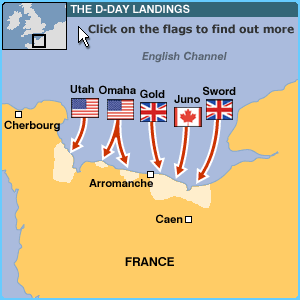
Operation Overlord, launched on June 6, 1944, D-Day, was the Allied invasion of Normandy, France. This large-scale amphibious operation aimed to liberate Western Europe from Nazi control. It involved massive land, air and sea assaults, with nearly 160,000 troops crossing the English Channel. The assault targeted five beaches in Normandy: Utah, Omaha, Gold, Juno, and Sword. It was the largest amphibious invasion in military history.
THE BEACHES OF NORMANDY, FRANCE
Today, I regularly listen to the BBC World Service, Radio 4 and Radio 4 Extra, which repeat programmes from the early 1950s to the 2000s, bringing back nostalgic memories of ‘home’.
The BBC Home Service ended on September 30, 1967, when it was replaced by BBC Radio 4. The first broadcast on Radio 4 was “Farming Today”.
BBC HOUSE TODAY
The famous writer of 1984 and Animal Farm worked in the Empire Service of the BBC from 1941 to 1943.
George Orwell at the BBC in 1943.
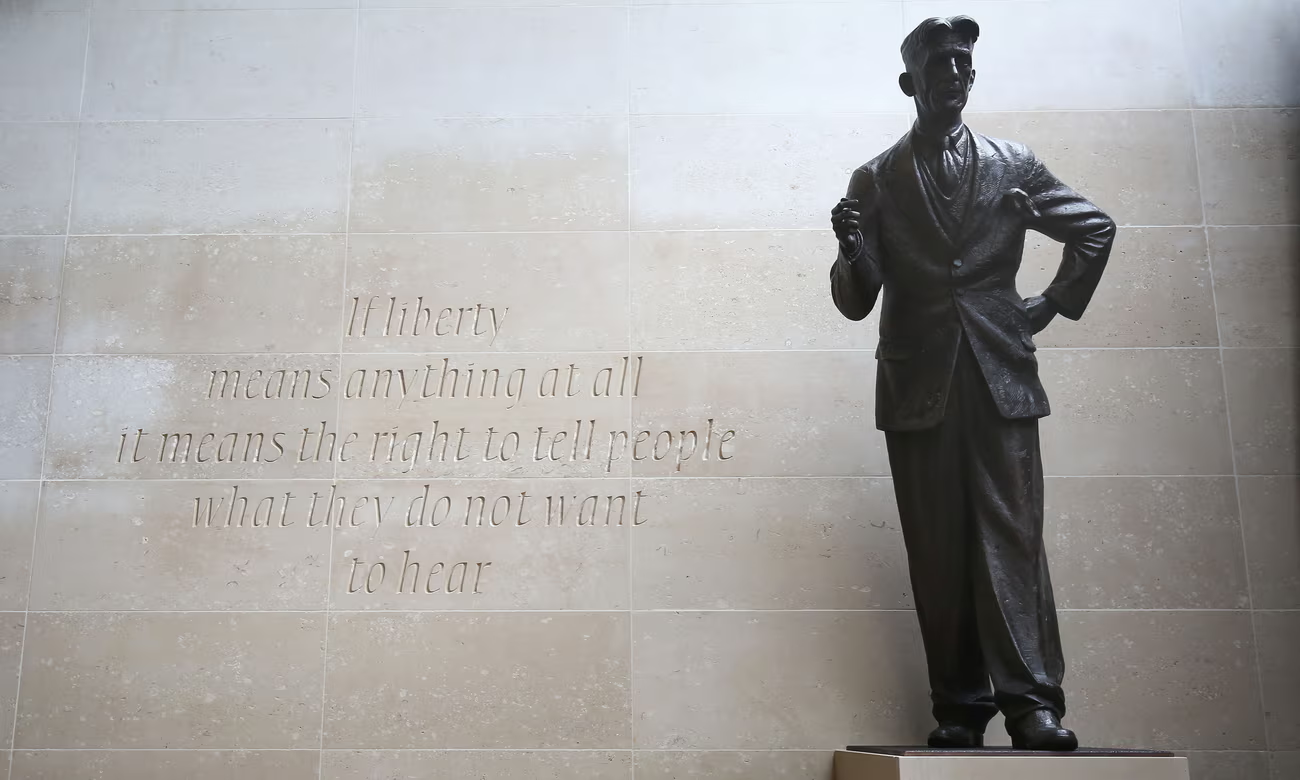
Outside the new BBC building in London stands a statue of George Orwell, and behind him these words:
“If liberty means anything at all, it means the right to tell people what they do not want to hear.”
The head of BBC history, Robert Seatter, said of Orwell and the statue that “He reputedly based his notorious Room 101 from Nineteen Eighty-Four on a room he had worked in whilst at the BBC, but here he will stand in the fresh air reminding people of the value of journalism in holding authority to account”.(4)
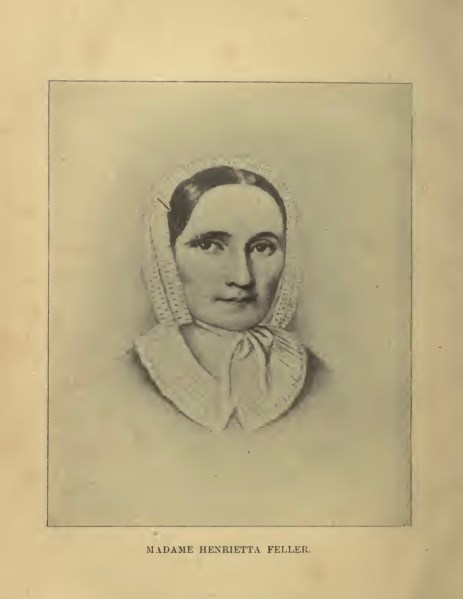
A young Protestant widow from Switzerland came to Canada in 1835 to convert the heathens. If it wasn’t for Henriette Feller, my family might still be speaking French and attending Roman Catholic services.
Henriette Odin (1800 – 1867) was born in Montagny, a village, outside of Lausanne, Switzerland. Her Protestant ancestors had been driven out of France when Louis XIV revoked religious freedoms and many took refuge in Switzerland. Her father was the director of the Vantonal Hospital at Lausanne.
“Wisdom and love distinguished both parents and their influence on the family was of the happiest kind.”
As a teenager, Henriette began visiting in the hospital and her tender and gentle demeanour was a comfort to the patients. She learned to change dressings and considered becoming a nurse but then she had a religious awakening.
Henriette married Louis Feller, a widower, in 1822. He was the head of a prison and had a son and two daughters. Their daughter Elize died as a young child and soon after, Louis died of typhoid fever. Louis Feller left all his assets to Henriette. They both gave their lives to a Christian Evangelical sect that wanted to spread the love of Jesus Christ. If you loved Jesus, everything else would be alright. The Swiss government didn’t approve and persecuted those who espoused the evangelical faith.
At an opportune time, Monsieur Henri Olivier and his wife came to Henriette’s Church, Henri as a pastor. He held missionary prayer meetings and under the Société des Missions d’Evangeliques de Lausanne, instructed young men for missionary service.
“Whose business is it to go to the heathen for whom we pray and give?”
The North American Indians became their prime missionary endeavour. Soon Henri, his wife and two young men were sent to Canada to convert the indigenous population to Protestantism using the word of Jesus from the New Testament. The young men went west but the Oliviers preferred to stay in Montreal and work on converting the French Roman Catholics. Henriette corresponded regularly with Mme Olivier, who encouraged her to follow them to Canada. In 1835, Henriette and a young missionary, Louis Roussy, sailed to New York, a journey of 33 days. They then travelled up the Hudson River to Lake Champlain, on the Richelieu River to St Jean, a long tedious journey to La Prairie in an old coach and finally across the St Lawrence River in a primitive boat to be met in Montreal by the Oliviers.
Converting Catholics was hard work, with very limited success because of the strong position of the clergy in the everyday lives of the French Canadians. Henriette thought they could do more good in the rural areas south of Montreal, where the priests and the churches were far apart. Henri Olivier soon returned to Switzerland but Henriette Feller and Louis Roussy stayed.
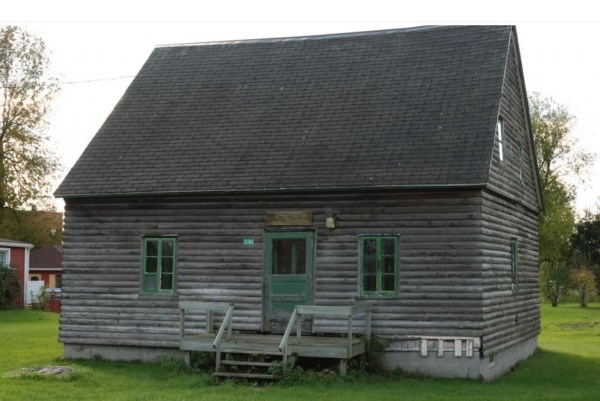
The Levecque family, in Grand Ligne, south of Montreal, offered Henriette their attic space with a room for her to live in and another for the school. She taught the children during the day using the bible and at night, the adults climbed to her room and read and discussed the New Testament.
The Leveque family house used as Henriette’s first school
Troubles escalated with the local Catholics during the rebellion of 1837. Those at the mission were threatened and forced into exile in the United States. They found sympathy for their cause in Champlain, New York and were able to raise money and received continued support from the Americans.
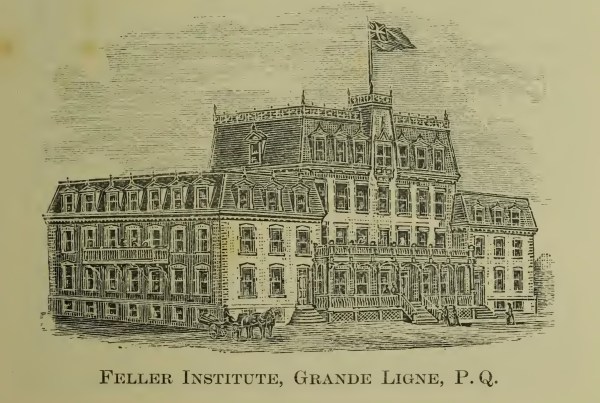
When things quieted down, they returned to Grande Ligne to find the houses emptied, animals taken and crops gone. With the help of several friends of the Mission, they rebuilt. The new construction, a much larger, substantial stone building, housing the mission and the school, opened in 1840. This was the begining of the Feller Institute.
While Henriette, known as Mere (Mother), continued to teach, Louis Roussy, as a colporteur, spread the word of God through the distribution of Bibles. My family lore said that one day, he and Eloi Roy visited my great-great grand mother, Sophie Marie Prudhomme Bruneau. She was interested in what they told her and invited them to stay the night. Her husband Barnabé Bruneau then joined in the discussions and eventually, my great-great grandparents and all their 13 children converted to Protestantism.
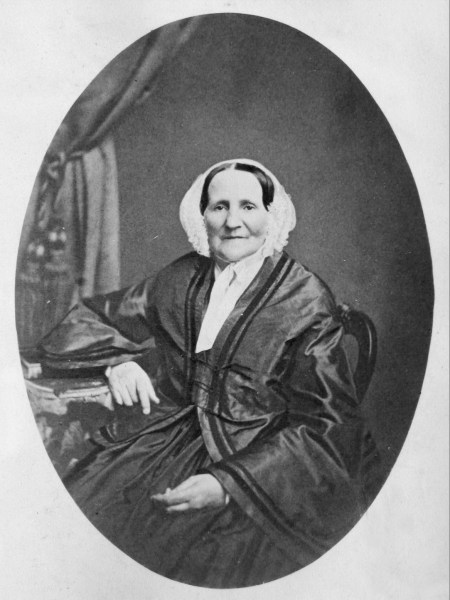
Henriette Feller
The hard work took its toll on Henriette’s health, which was a constant source of anxiety for her close associates. She had pneumonia several times and never completely recovered, even after a trip home to Switzerland. She suffered a stroke in 1865 and although bedridden, was still the driving force for the school until her death in 1868. Henriette Feller is buried in the Grande Ligne Cemetery with many of her converts, including some of my ancestors. Most of my family is protestant to this day.
“Although Madame Feller occupied a somewhat anomalous position, for her influence was well-nigh all-powerful, and few ventured to contradict or oppose one in whom the tenderness of woman and the firmness of man were so happily united, she never overstepped apostolic limits.”
Notes:
Walter N. Wyeth, D.D. Henrietta Feller and The Grand Ligne Mission, Philadelphia, PA. 1898. printed and Bound by C.J. Krehbeil & Co. Cincinnati, Ohio.
Paul Villard M.A., M. D., D. D. Up to the Light the story of French Protestantism in Canada. 1928. Ryerson Press, Toronto, Canada.
PHILIP G.A. GRIFFIN-ALLWOOD Wesley Memorial United Church Cramp Memoir of Madame Feller 244. Mère Henriette Feller (1800-1868) of La Grande Ligne and Ordered Ministry in Canada.
Historical Sketch of the Grande Linge Mission by the President 1893
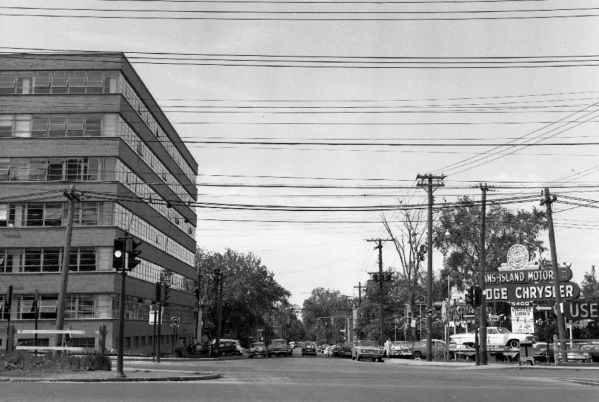
Decarie between Isabella and Dupuis, June 1961. Archives de Montreal VM105-Y-3 545 001-010. My back porch is somewhere in there.
I spent my elementary school years living on Coolbrook, a one-way street in the Snowdon district of Montreal, adjacent busy Decarie.
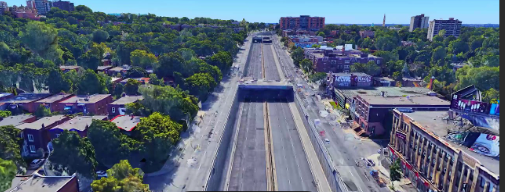
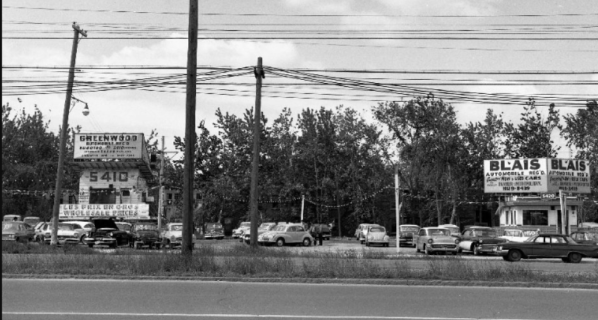
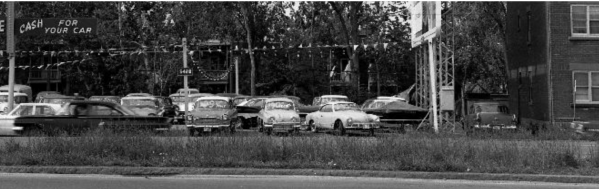
Before Decarie became “the trench” in time for Expo 67 it was a wide boulevard with a stretch of storefronts on the east side of my area including Young’s Vegetable Market and Green’s Pharmacy; and on the west side right behind my upper duplex apartment were a few used car lots as well as one empty lot where we children sometimes played. This lot, I remember, was strewn with dirty old toilet bowls and big baffling, almost supernatural chunks of quartz, but also sprinkled in between with enchanting pink hollyhocks and charming pussy willows. 1.
In those early days, I would cross Decarie at Isabella and skip down a few steps to the basement Decarie Handy Store to spend my 25 cent allowance on, usually, a MacIntosh Taffy or Cherry Blossom, ten cents each in those days. Any extra pennies would go to Lik-M-Aid, a sour powder in a paper tube.
My allowance didn’t permit me to buy the giant, perhaps healthier, Fruit and Nut bar I so craved. It cost 39 cents and I never thought to save up week to week.
The major commercial area in the neighbourhood was one and a half blocks south, up an incline on Queen Mary Road. There was a Woolworth’s on the corner of Coolbrook and Queen Mary with a lunch counter that featured enticing ads for banana splits for, yes, 39 cents. Again, too expensive for me although I imagine I could have always asked my Mom to buy the ingredients and make me one. She wasn’t cheap like my accountant Dad, who made us sign for our meagre allowance in a little booklet he kept for the purpose.
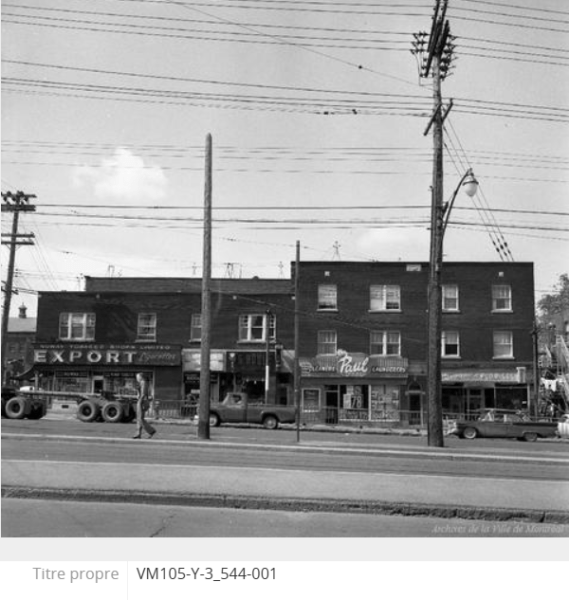
Nuway Tobacco Store with bit Export sign 1961, Montreal archives. There was a little hat shop tucked in beside it. An oddity in the 1960’s when hats were not in fashion especially among the young..
Every fall, we bought our school supplies at the Woolworth’s, sometimes a new pencil case. You could still get the old fashioned wooden ones with the sliding top or a newfangled plastic pouch with a zipper. I still get excited at the sight of an unsullied Hilroy scribbler.
The other stores of importance on Queen Mary was Black and Orange stationery shop, a dingy post-war style store but, still, all that potential in the pens and paper!
And the Zellers further up towards Cote des Neiges, also a bit of a dust bowl. Morgan’s Department store had a small shiny two story branch on Queen Mary, but that store was of no significance to me although my brother, fooling around with friends, once kicked in their showcase window.
And a little further up the street was the NDG library for boys and girls where I borrowed the horsey tome King of the Wind by Marguerite Henry over and over.
Yes, I remember the stores in my area with varying degrees of yearning, for sugar and for learning, but when it comes to the block of Coolbrook on which I lived, I only have half a memory of it.
That’s because I don’t recall one person, not one, who lived on the other side of the street. I suspect no children lived across the street in the 1960’s. Maybe whoever owned those duplexes refused to rent to families with children. And it was the baby boom era!
Corner Isabella and Decarie. Archives de Montreal. This was taken a few yards away to the right of the Decarie Handy Store.
Our duplex block of four homes, two lower, two upper, was one of a stretch of five or more owned by the same man, an unpretentious French Canadian, a Monsieur D. who dressed like a hobo. My mom also said he thought I was the loveliest little girl, so kudos to him. Monsieur D. was very cheap, it seems. He painted all the doors of his brown/red brick buildings dark brown and all the porches grey, casting a gloom over the entire block. He must have got a deal on paint, my mom said.1
Gibeau’s Orange Julep from other side of the trench. wikipedia commons I lived smack in between two of Montreal’s most iconic structures, the Orange Julep and the Snowden Theatre, below, in an otherwise dreary-looking neighbourhood. I visited Orange Julep but once. The drink tasted sulphury to me.It’s a condo today after lying in disrepair for ages. I saw the Lippizanner movie there. Also maybe Sound of Music. I didn’t see many movies as a child. Children were banned from theatres until 1962 in Quebec due to the Laurier Palace Fire of 1927
It didn’t help that in those days no one bothered to decorate their upper or lower balconies with pots of flowers except for the Italian man a half dozen doors down living in a gaudy new duplex (Lovell’s reveals he was a landscaper) and an unknown family in one of the few stand-alone houses on my street, up near Queen Mary Road, who had a very splashy flower garden in summer. One year it snowed in the middle of May and I recollect the sight of a lovely row of red tulips with a cushion of white on top as I passed this tiny cottage on my way to the Nuway Tobacco Store at the corner of Decarie and Queen Mary to buy my mom a carton of Du Maurier cigarettes.
Luckily, the trees along my stretch of street were tall and leafy and during the hot, humid Montreal summers the setting sun dappled the baking macadam with light. I could reach out over my balcony and touch a branch of my very own mystic maple. I do suspect the tree’s leaves protected me – a bit – from the ubiquitous 1960’s air pollution and the lead-laden fumes of the pink, turquoise and fire-engine red Corvairs, Thunderbirds and Mustang convertibles idling on the street below. These automobiles belonged to visitors as few families on our side of the street actually owned a car. Kids cost money, after all.
A glance at Lovell’s Directory on BANQ reveals to me the familiar surnames of families living around us. I recognize, too, the phone numbers, as I dialed many of them over and over during my childhood. The family names from across the street are new to me, of course. Mostly French, some English and one Finn. The breadwinner of the family is the only one listed on Lovell’s, but had any children lived there, French or English or Finnish, I would have seen them playing on the short sloping driveways or on the sidewalk or at least walking to school.
Yes, we kids played out on the street in those days, chanting to skipping games like“double dutch” on those short sloping driveways, bickering over the rules of hopscotch or “yoki” on the sidewalk. The boys sometimes played ball hockey right on the road.2
However, when it comes to the other side of the street, I have no recollection at all. Ain’t memory funny.
I recall not one incident, not one visual. Nothing has imprinted itself on my brain for life, such as when my neighbour’s German Shepherd got hit by a truck late at night and my friend’s mom sobbed loudly on the street and there was leftover blood and sawdust on the curb the next morning.
I don’t recall one bit of gossip about anyone on the other side of the street. On our side plenty: “Did you know the L family’s kids are ONLY fostered? Did you know that in the S family, the Mom makes more than the husband?” Did you hear that the W sons went with two girls they hardly knew on a car trip out West? Real shameful stuff it was!
I don’t even remember seeing anyone out shovelling the walk across the street in winter. And I stared at that side of the street for seven years from my tiny bedroom window. No one picking up garbage strewn around by a stray dog. No one leaving the house in the early morning, rubbers on feet, leather briefcase in hand, felt fedora on brylcreemed head to take the brown and yellow No. 65 bus to some downtown skyscaper like Place Ville Marie.
I have to smile: the 1966 Lovell’s reveals that there were quite a few vacant homes across the street from us. Is it possible that it was harder to rent that block on that side of Coolbrook because of us? Because there were so many boisterous, loud, unruly children (I count about fifteen) playing out on our small section of Coolbrook Street.
As in happens, in 1967, Expo year, while my British grandmother was visiting us from Malaya for the first and only time, my brother was playing ball hockey with a friend when he knocked over one of the Italian man’s pretty flower pots, red geraniums, I think, with a errant slap shot. Supposedly the man was enraged and ran out onto the street and hit my brother with a leather strap, the one and only genuinely violent act I ever heard of on our street- and, yes, it was on our side!
My grandmother, who herself had complained many times about the “shrill” Canadian children playing on the street, convinced my father to move out of the district and within months we were living in a smog-free ex-burb north of the city in a house with a huge yard with at least two weeping willows and more fir trees than I could count.
One broken porch ornament – and a rather Felliniesque incident – and the trajectory of my life took a dramatic turn, for better or for worse, who knows. For sure, my current Facebook friends would be totally different had my brother’s ball just skipped off the railing and missed that freakin’ flower pot! Life, just like hockey, can be a game of inches.
But, as someone who has lived in sleepy suburbs most of her life, I carry that time in the west end of the city deep inside of me, even if it’s only half a memory.
END
1. Our backyard area was especially ugly. It was expansive with a floor of gravel and dirt. Each family had a little yard, yes, with a grey fence about 15 feet by 25 feet, with grass. Our plot contained a giant tree, so no light, and nothing grew there despite my efforts at a garden. We neighbourhood girls would sling blankets over the fence and tie skipping ropes to the wires and play ‘horse.’
Right behind my backyard. Soon the apt at right would be domolished, I think, and that became the vacant lot
A newlywed couple moved in for a while and I recall one time watching from my second story back balcony as the young wife was chased off the porch by her husband who was holding a bucket of water. He caught up to her and swung the bucket and poured the it over her head. I could feel their euphoria. Oh, to be in love.
Beyond the yard was an over-grown alley way, my black cat, Kitty Kat’s, private jungle, where we once saw a pheasant that had flown down from the mountain, so said my mother, and beyond that alley the used car lot. The moms would let kids run wild while at play, as was the usual in the 1960’s, but they would dutifully call their children in for lunch from the backyard porches. One Mom had a bell.
Once I and a friend came upon a ‘hobo’ sleeping in one of the used cars behind our house. He had one leg and he said he was a war veteran. I stole a rather large chunk of left-over roast beef for him, from my house. When my mom wondered what had happened to her leftovers, I told her that I had given it to a stray dog – and she laughed. No fool I.
2. I recall once and only once a huge slimy Norway rat scuttling past us into the drainpipe a we played.. How did that huge thing fit in that tiny hole? A favourite game was yoki ( I thought Yogi) also called elastics or Chinese skipping, where we used a sewing elastic and manipulated it around our lower leg to rhymes. Classic skipping was popular, too, double dutch, etc. “My mother and your mother were hanging out the clothes. My mother gave your mother a punch in the nose. What colour was the blood.” This rhyme sticks in my head probably because my French Canadian mother wasn’t friends with any of the other mothers on the block. She had little in common with them, being French and also a working mother who played competitive bridge at the tony Boulevard Club.
There was a definite pecking order among the children playing on our section of the block in the form of arguments, fights, churlishness, and a lot of one-upmanship. I was a passive observer type, definitely at the lower end of the hierarchy. A good thing too: I recall the two alpha-girls in my group viciously fighting and literally pulling out handfuls of each other’s hair.
My brothers did play ON the road, classic road hockey which was safe on our quiet one-way street. One day a car honked at them and just as they were about to give the guy the finger they noticed it was John Ferguson, the legendary Canadiens enforcer. A rather dishevelled looking man whom we sometimes saw around was related to a playmate of mine. It was Doug Harvey, the Canadiens legend.
Pierre Lalonde, a young teen idol at the time, lived in the Italian man’s place for a few years in the 1960’s. He seemed shy – but he owned two flashy convertibles, both neon aqua and two motorcycles. (I worked in the same building as he did in the early 80’s – a TV station – and lived in the same town as him, in the 1990’s, often seeing him at the pool – but never once spoke to him. I did walk his dog as a child.)
That was the first question that ran through my mind as I began to try to verify what seems to be indicated by a wedding photo of Jean-Baptiste Hurtubise and Marie-Berthe Charette from my grandmother.
My grandmother’s handwriting below the picture indicates: “Mom & Dad Hurtubise, January 7, 1915.”
Census records from 1901 indicate that they were both 25 years old at the time,[1] another fact I wonder about.
Why would a young man of that age be free to marry and settle down when World War I was in full force? Perhaps this is an indicator of how remote the war seemed to Francophone families in Canada prior to the conscription crisis of 1917.
By that time my great-grandfather would have two children and wouldn’t be required to serve. My grandmother, their first child, was born twelve months after they married.
In addition to her parents’ wedding photo, my grandmother kept only two other pictures. One is a photo of a church, presumably where the wedding took place. The other shows four large church bells. Why are they important?
Turns out that the church in the photo still exists, and it still serves a Franco-Ontarian population! I found it by referring to the census showing Marie-Berthe, called Martha, living in Clarence Creek in 1911.
According to Kim Kujawski, Clarence Creek, which is near Ottawa in Ontario, was founded in 1853 by French Canadian farmers from St. Augusine Quebec.
At the time of Jean and Martha’s marriage, it had two steeples, but now the smaller steeple on the right side is missing. I know the church is the same one, however, because a duplicate of my grandmother’s photo appears on the history page of the parish website. [2]
I’m extrapolating from the facts, but it seems as though Martha’s family were among 170 that remained within the parish after 80 others left in 1908. The bells were part of a renewal show of strength two years later. The families expanded their church, bought the bells and hired famed Montreal decorator Toussaint-Xénophon Renaud[3] to renew the interior. His work can still be seen today.
Sources:
[1] Data from the 1911 Census of Canada: her birthdate appears on Enumeration District 21, Cumberland Township, Russell, Ontario, Sarsfield Village, Léonard Village, Bear Brook Village, page 7, line 48; his on Enumeration District 112, Cumberland Township, Russell, Ontario, Sarsfield Village, Léonard Village, Bear Brook Village, page 3, line 25
I’ve never liked the taste of pink bubble gum, but I ate it anyway for years during my childhood and early teen years, just so I could blow bubbles and read the comic strips tucked inside.
We used to get free samples from the Dubble Bubble booth in the Canadian National Exhibition (CNE, or the “Ex”) Food Building. I loved the experience so much that I insisted on eating only that type of gum for the rest of the year.
Same with chocolate bars. No one could get me to eat anything other than Neilson brands, because they gave me a whole bag full of samples one day a year. My then love for Crispy Crunch, Cinnamon Danish, Jersey Milk and various other sugary treats began at the Ex.
Wikipedia has a good summary of the fair, which still takes place every year.
“The Canadian National Exhibition (CNE), also known as The Exhibition or The Ex, is an annual fair that takes place at Exhibition Place in Toronto, Ontario, Canada, on the third Friday of August leading up to and including Labour Day, the first Monday in September. With approximately 1.6 million visitors each year, the CNE is Canada’s largest annual community event and one of the top fairs in North America.1
We went to the Ex every September long weekend for four or five years in a row in the late 1960s and early 1970s because it was a cheap way for my very young parents to entertain two and then three young children. Most of the day was spent gorging our faces in the food building, but we also got to ride rides in the midway, see horses, milk cows and watch the air show.
I like to think that we also read some of the historical plaques on site. According to Jesse Munroe’s 2021 thesis, there are more than a hundred, but if we did, I don’t remember them. Munroe writes that I’m not missing much, given that they highlight a series of colonial events rather than the original people’s experiences that are most important.
The waterfront was always a gathering place where countless First Peoples came together to trade. Algonquian-speaking Anishnaabe held the lake and its islands in high esteem as a source for both food and spiritual renewal.2
My childhood memories of the food building certainly represented spirtual renewal, but looking back on it, I don’t think they encompassed anything that I now consider food. In those days, various companies offered samples of hotdogs, spaghetti, perogies, pizza, waffles and other meal-like substances, but most of the goodies I remember were candy or dessert.
We stopped going to the food building when my youngest sister was still so young that I’m not sure she even remembers it. Given that I used to leave with a massive bag of sugary substances that would last almost to Halloween, her long-term health is probably better off.
Over thirty years have passed since my Mom died. Lately, she has been in my thoughts as I ponder a sad part of her life. Estelle Anita Jodouin, the eighth child of Louis Joseph Jodouin and Louisa Seraphina Fortin, came into this world on January 22, 1909, in Sudbury, Ontario.
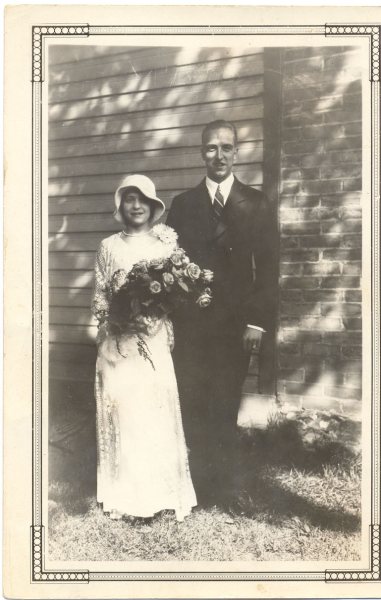
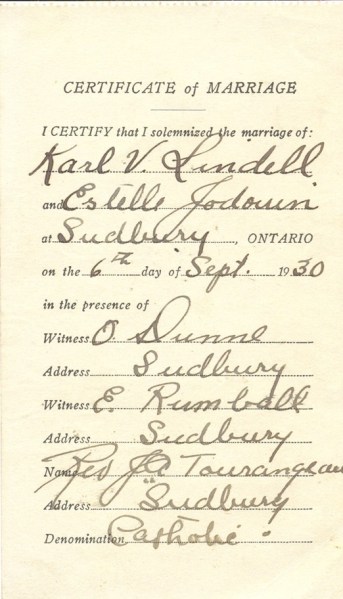
During Labour Day weekend of 1930, at the age of twenty-one, she married a young Finnish mining engineer, and they settled in the area. Over the next eleven years, they had five children. Aunts and cousins were always around to give a helping hand with caring for the children, and they were a tremendous support for Mom, as at the time, Dad was working shifts.
Mom and Dad on their Wedding Day
In 1945, Dad was offered a job in Asbestos, Quebec, a mining town in the rolling countryside of the Eastern Townships. It was a promotion for him. It meant he would no longer be working shifts, but, rather using his skill at designing a shaft for the development of underground mining. At that time, the company had been concentrating on open pit mining of asbestos, a fibre that does not burn and is used in firefighters’ gear, brake linings in cars and home insulation. It was a job for which Dad was well qualified.
It was a difficult move for Mom. She did not know a soul, and her family support system had vanished. She missed her parents, sisters and nieces. Deep down, I do believe she was heartbroken and had difficulty coping with the move, far from family.
In the summer of 1947, Granny, her mother, and Aunt Ted drove down to Asbestos for a visit. Mom was delighted to welcome them. Shortly after their visit, Mom was hospitalized in Montreal for an extended period. Dad visited her regularly and made arrangements for Mrs. Robinson, an elderly lady, to care for us. ( I never knew the reason for the hospitalization as I was 7 years old at the time, and I still do not know all these years later. Was the hospitalization a mental breakdown or perhaps the loss of a child?)
Uncle Leo, Aunt Dickie, Aunt Ted, Gran, Mom,
Paul, Claire,and Cousin Denise
In the summer of 1948, Mom drove my sister Ruth, brothers John and Paul, and me to Sudbury to visit family. On the way, we stopped in Pembroke and visited Mom’s spinster Aunts and continued to Sudbury. Mom had learned to drive at the age of fourteen and was undaunted when undertaking such a long drive. After seeing the scorched land and forests fires we arrived and greeted relatives with open arms and warm hugs. Mom had finally arrived home.
We spent time with Granny Jodouin, aunts, uncles and cousins which created many fond memories. Mom was happy.
On our way home, we stopped in Senneville and visited with Aunt Aline, one of Mom’s older sisters and Uncle George, an avid stamp collector, where I learned about stamp collecting. We then continued our way home.
Around this time, (1948-1949) I vividly remember Mom sitting at the typewriter in the solarium where Dad had a large desk with his CB (Citizen Band Radio). She would be typing letters to Gran and her sisters. At Christmas time she would be in the kitchen making fruitcake to send to family in Sudbury.
For a long time she hung on to her thoughts of home and the family members she had left in Sudbury, so far way.
Her life and our family’s lives were changed. In January of 1950, when at the age of forty-one, Mom gave birth to a little sister, Vicky, while at the same time, Dad received a big promotion. Life was taking on new challenges. These positive events were the beginning of a new outlook on life for Mom. Her loneliness was slowly disappearing. She now had new challenges.
Mom and Vicky
Vicky’s arrival was a blessing for all of us. At 10 years old I now had a real live doll to care for.
Mom had help when a young girl, Ghislaine, came into our lives. She developed a close bond with Vicky, and Mom’s overall health was much better. Her loneliness no longer seemed to trouble her. Her health improved and before long she was able to travel. She visited New York City and attended Broadway plays , enjoyed shopping at Berdorf-Goodman, along with company jaunts to the Carribbean .
Mom in 1963
Over the years she visited Africa, Europe, Japan and became a world traveller with Dad.
Mom’s life was filled with many ups and downs, but with Dad’s support she overcame her difficulties. Her life had taken on a new look, and her loneliness was a thing of the past. She enjoyed life to the fullest!
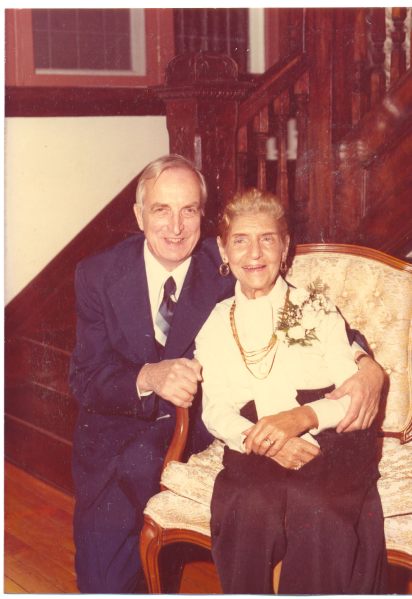
Mom and Dad on their 50th Wedding Anniversary in 1980
Children the world over have been bullied at school and in their neighbourhoods. I was no exception. As a child in primary school, I remember kids calling me ‘Bullfrog’ which, of course, I hated!
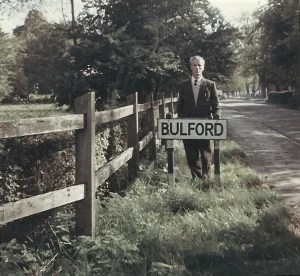
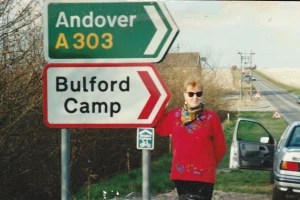
Many years later, I am researching and doing genealogy, trying to find out the origin of the name I hated as a child. I always knew there was a camp in Wiltshire, England called Bulford Camp. Family members have visited the area, especially to take photos of the area name, posing proudly next to the sign.
My Uncle Roy Bulford. Circa. 1960’s. Marian Bulford. Circa 1990’s
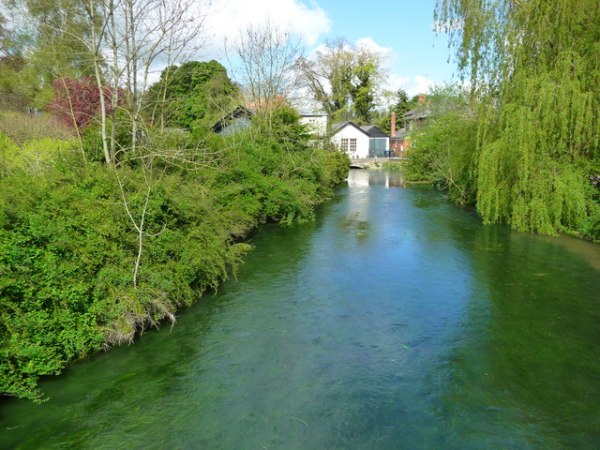
From a quiet country road to a major motorway
Less probably, the name may have come from a lost place called Bulford in Strensall (North Yorkshire), presumed to have been located at a ford of a river near Strensall. Yet another reason the name “Bulford” may have originated from is “Bull’s Ford”, a crossing point of the River Avon in Wiltshire, where bulls were driven across. (1)
Bulford is a village and Parish in Wiltshire, England. It is near Salisbury Plain, close to RAF Upavon, where I was posted whilst in the WRAF (Women’s Royal Air Force). The Bulford Army camp is separate from the village but within the parish. It seems the Army camp is named after the ford that gave the village of Bulford its name. ‘Bulut ieg ford‘ is from an Old English phrase which means ‘ragged robin island ford” Why could we not have picked Robinford instead of Bulford??(2)
Bulford is recorded in the Wiltshire Charter Rolls of 1199 as Bultiford and as Bultesforda in 1270. It is then recorded as Bulteforde in the Ecclesiastical Tax Records of 1291.(3)
The village of Bulford has a history of Roman and Saxon settlements. In the 1086 Domesday Book, there were 39 households at Bulford. However, there are not actually any Bulford family names, as seen below with a page taken from the Domesday Book. Only the religious and the titled were included!
Catalogue description Place name: Bulford, Wiltshire Folio: 68v Great Domesday Book: (4)
Reference:
E 31/2/1/2046
Description:
Place name: Bulford, Wiltshire
Reference:
E 31/2/1/2046
Description:
Place name: Bulford, Wiltshire Folio: 68v Great Domesday Book Domesday place name: Boltintone People mentioned within entire folio: Abbess of St Mary of Amesbury; Abbey of Sainte-Marie of Bec; Abbey of St Mary of Amesbury; Agenulf; Alweard; Alweard the priest; Beorhtric; Canons of Church of Lisieux; Church of Brixton Deverill; Eadgifu; Earl Harold; Hugh d’Avranches, Earl of Chester; Roger de Montgomery, Earl of Shrewsbury; Edward; Father of Agenulf; Gerald the priest of Wilton; Gilbert; Godwine; Abbey of Sainte-Marie of Grestain; Hamo; Hearding; Ketil; King Edward as lord; Nuns of Abbey of St Mary of Amesbury; Osbern the priest; Osmund, thegn; Queen Matilda; Regenbald the priest; Robert, Count of Mortain; Siward; Turold; William
Surnames in England were not used before the early Middle Ages, around the 11th to 12th centuries. Before that, people were known by a single name, usually according to their physical features, occupation, or their father (patronymic). To begin with, surnames were fluid and changed over time, or as a person changed his job. For example, John Blacksmith might become John Farrier as his trade developed. As the country’s population grew, it became necessary to distinguish between people.
Surnames in England began to be used during the early Middle Ages, around the 11th to 12th centuries. Before this, people were usually known by a single name. The earliest surnames were often derived from:
Occupations – for example, “Smith” (blacksmith) or “Baker.”
Geographical locations – such as “London” (someone from London) or “York” (someone from York). (I feel this is probably where my surname comes from.)
Patronymics – surnames based on the father’s name, like “Johnson” (son of John).
Physical features – such as “Brown” (for someone with brown hair or a darker complexion). (5)
Most of my paternal Bulford family live in and around Devon and Cornwall now; however, Ancestry.com tells me that from the 1700 Census and Voter lists, there were 127 Bulford surnames in America!
One of my paternal grandfather’s brothers, George, emigrated to work in the mines in Detroit, Michigan then ended his career working for the Ford Motor Company.
In 2016, I was in touch with his granddaughter, Barbara, my second cousin, on Ancestry. She invited me to her family tree, and we exchanged much information regarding her Bulford family. We had pleasant FaceTime and email exchanges, until her too-early passing in 2020 at the age of 66 years. I wrote about her here: https://genealogyensemble.com/2021/05/12/my-american-cousin/
The link above is to the Open Domesday Book, which also states that “Hundred of Bulford. (The next largest division from a “hundred”, and the one most recognisable today, are Shires. Devonshire, Wiltshire, Lancashire, etc). Status: No longer exists as a named location but can be identified on the ground’ There were 85 places in the ‘hundred’ of Bulford in the Domesday Book”
(Correction: I have been informed that is more likely that Reverend Henry Gordon took these photos, developed them and gave them to Miss Lindsay. The dog team photo would have been taken by Rev. Gordon during the winter and the fishermen in the boat must be south of Cartwright due to the lighthouse.)
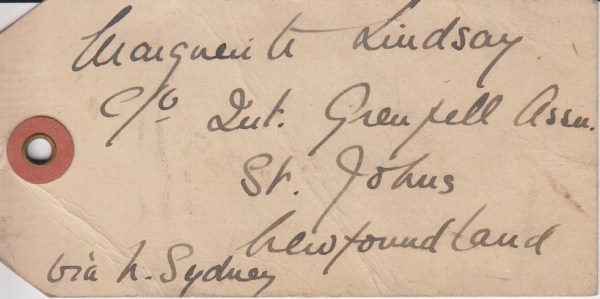
Miss Lindsay’s baggage tag- June 1922
Just over 100 years ago, my great-aunt volunteered as a summer teacher with the Grenfell Mission in Cartwright, Labrador, under Henry Gordon. In August 1922, just days before she was due to return home to Montreal, Quebec, she disappeared. Her body was found four months later, in December 1922, with a bullet through her heart.
I already wrote and published her story in seven parts (links below) and thought I had gleaned every bit of information possible from my “dusty old boxes.” But our ancestors want their story told and my great-aunt, Marguerite Lindsay (1896-1922), had quite a blockbuster to tell. Perhaps it was she who “tweaked” my cousin to finally look into his unopened boxes of family papers and memorabilia.
You can’t possibly imagine my excitement when I received his email:
“Hi Lucy,
Apologies for taking so long to get to this. I attach scans of the small
black-and-white prints of Labrador scenes that I found in the box of
clippings and photos. I assume that this is from when Stanley (sic) visited
the area after Marguerite’s death but don’t know for sure. Only two had
writing on the back – the dog team at rest and the school house. I
scanned those too in case you recognize the writing.
Lots of love!
Doug”
Eureka!
It appears that Miss Lindsay had access to a camera while she was there! And yes indeed I recognized her handwriting! It matched the writing on the tag on her baggage that accompanied her when she travelled to Labrador in June 1922. She went there to look after the youngest students (orphaned by the Spanish Flu epidemic) along with another volunteer, Anne Stiles from Boston, while their regular teacher took their summer break. Between the two of them, they oversaw all the children’s lessons, meals and activities.
A few days before she disappeared that August, she mailed a letter to her brother Stanley in Montreal. That precious last letter shared a long and loving detailed description of her life in Cartwright. The five newly discovered photos seem to match several parts in her last letter.
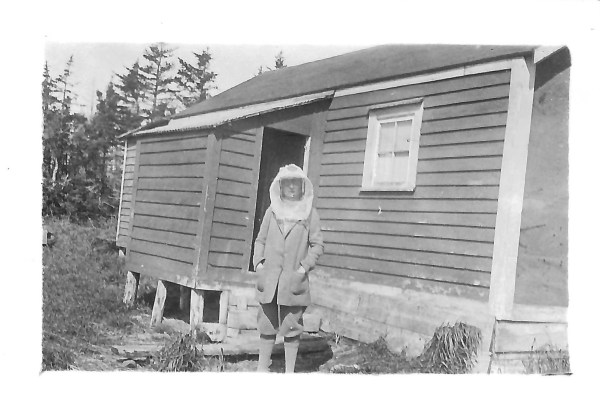
1. The first photo is of Marguerite wearing a hat she fabricated to protect her from all the bugs. The cabin in the background was a family home as she shared a room with Anne Stiles in the school dormitory that summer. This photo along with the commentary in her letter helps me imagine being there myself.
Miss Lindsay wearing her bug hatoutside a family home beside the school in Muddy Bay
It is really cold here and foggy quite often, but very bracing, and I like it much better than heat; also when it is cold, there are no flies, and that means a great deal. I could compete with Sir Harry Johnson’s bugs in Africa, and match about even. The mosquitoesjust swarm: at first you think it is fog or haze, lying low over the marshes, till you try and walk through them. We bathe in citronella. About 50 of themwere getting free transportation on different portions of my anatomy, and Iremarked to one of the natives, that the mosquitoes were bad; at which helaughed, and said to wait till they hid the sun, then I would call them bad.
The children are terribly bitten, and wail all night when they are extra bad.Well, there is a species of black fly, and their team work with the mosquitois extraordinary. They don’t bother to pierce your epidermis for themselves,but follow exactly in the footsteps of the mosquitoes, and they hurt. I couldhardly turn my head for a day, the back of my neck was so bitten. I may havementioned that there are no such things as screens on our windows; but we put upsome surgical dressings, and tacked the gauze up as a slight protection. Aslittle extras there are deer flies, flying ants and sand flies.
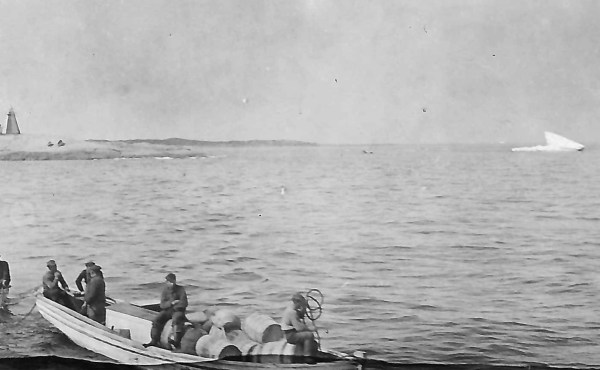
2. The second photo represents not only the local day-to-day fishing activities but other adventures like the exciting one she described in her letter.
Local fishermen in boat with Iceberg, south of Cartwright(there were no lighthouses near Cartwright)
It would be a great help if we had ice; but none comes up the bay. Someof the men tried to capture a young iceberg, and tow it home from the outsidecoast—behind the motor boat, but the friction of the rope wore through theice, so it never arrived. Last Wednesday, Mr. Gordon told us we had beenworking so hard, we had better take a day off, and go up the bay with one ofthe fishermen, on an expedition for wood. We started off in a motor boat,towing an empty scow: just Anne and I, four boys of about 12, and the fisherman.
It was a perfect warm sunny afternoon, and Anne and I were almost asleep onthe sloping bow of the boat, when we came around the point into a heavy windand all but rolled off. It blew up very strongly, and Anne and I and the boysgot into the very bottom of the boat, under our rugs for warmth. I was wearingeverything I possessed; about what I wear for skiing. The fisherman was havinga very hard time with the scow. It looked once or twice as though water wouldcome down on our heads, when our boat got between the waves and it rested on the crest.
It took us over three hours to reach our destination – the point atWhite Bear river. There we went up to the warm cottage of some very kindfisher-folk, just as it started to pour, and thunder and lightning. We hadexpected to sleep on the floor, so had brought rugs; but Anne and I were givena bunk in a room about the size of a dugout, which was really comfortable afterwe had skillfully removed a pane of glass with a knife, the window being purelyfor ornament. They provided us with a feather bed in the bunk and warm dry rugsand fed us with smoked salmon and caribou meat. It was loads of fun.
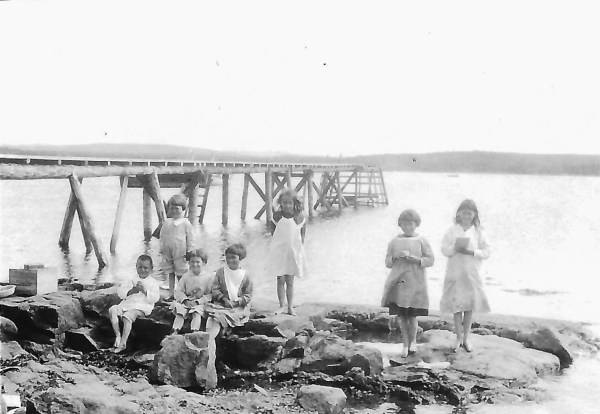
3. The third photo shows the eager faces of a few of her students by the water’s edge hoping for a swim with Miss Lindsay that afternoon.
Some of Miss Lindsay’s summer pupils waiting for a swim
We are teaching the children to swim; the water is notso cold as you might think. There are some perfect walks around; nowhere arethe trees too thick to push through; so though we have got lost once or twice,it is never for long. It is rather fun climbing the mountains; your feet getdrenched, in the marsh, but we are used to that now. You would be amused to seeme giving the children drill, and getting them to breathe through their noses.
We are going across the bay to hold nutrition classes, and persuade them toorder whole wheat flour, instead of white.
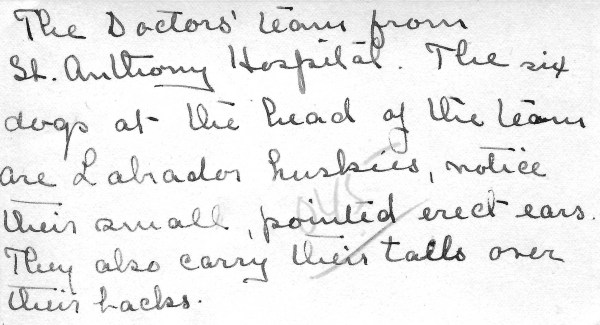
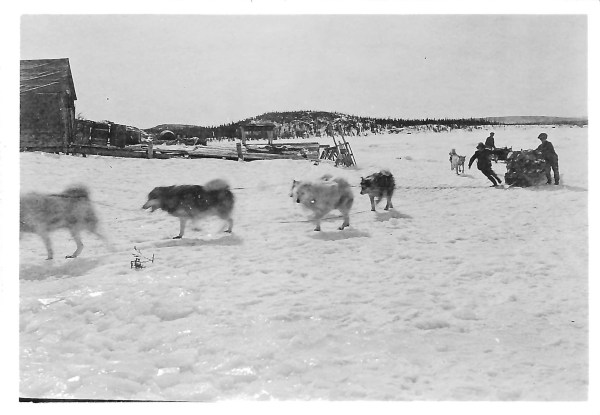
4. The fourth photo is of a dog and sled team. According to her note on the back, it belonged to the Doctor from St. Anthony (about 570km away). She noted that two Labrador Huskies lead the team and made special mention of their curled tails and pointed ears.
Local dog and sled team delivering wood in the winter time to the public school in Muddy Bay with a handwritten note on the back
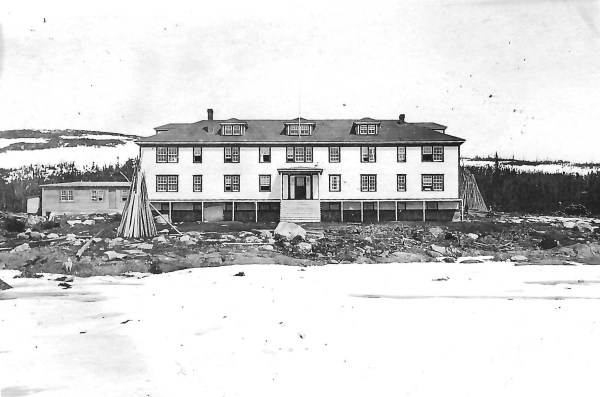
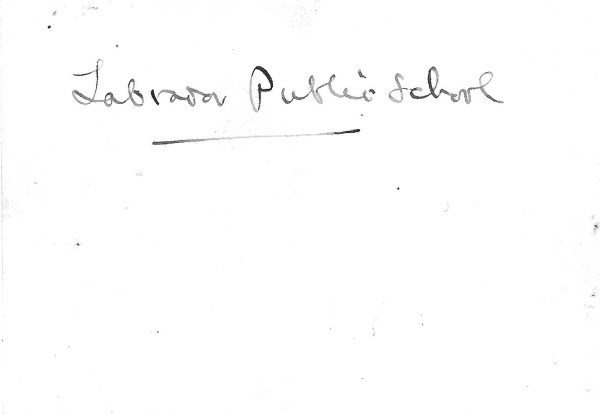
5. The fifth and final photo is of the newly constructed Labrador Public School in Muddy Bay, near Cartwright, which later burned down. The school in Cartwright today was named after her superior: The Henry Gordon Academy. To this day, the children are told Miss Lindsay’s story. Her handwritten note on the reverse side of this photo makes it that much more special for me.
Labrador Public School in Muddy Bay with handwritten note on the back.
I am so delighted about the recent discovery of these photos and very grateful to my cousin for finding these gems! I remain eagerly optimistic for more of Miss Lindsay’s undiscovered treasures to appear someday!


 One description of their work comes from the biography of Sir Charles Gordon, who led the team that arranged for building construction.









 Genealogy Ensemble
