Category Archives: genealogy

The Matriarch (A Remarkable Memory)

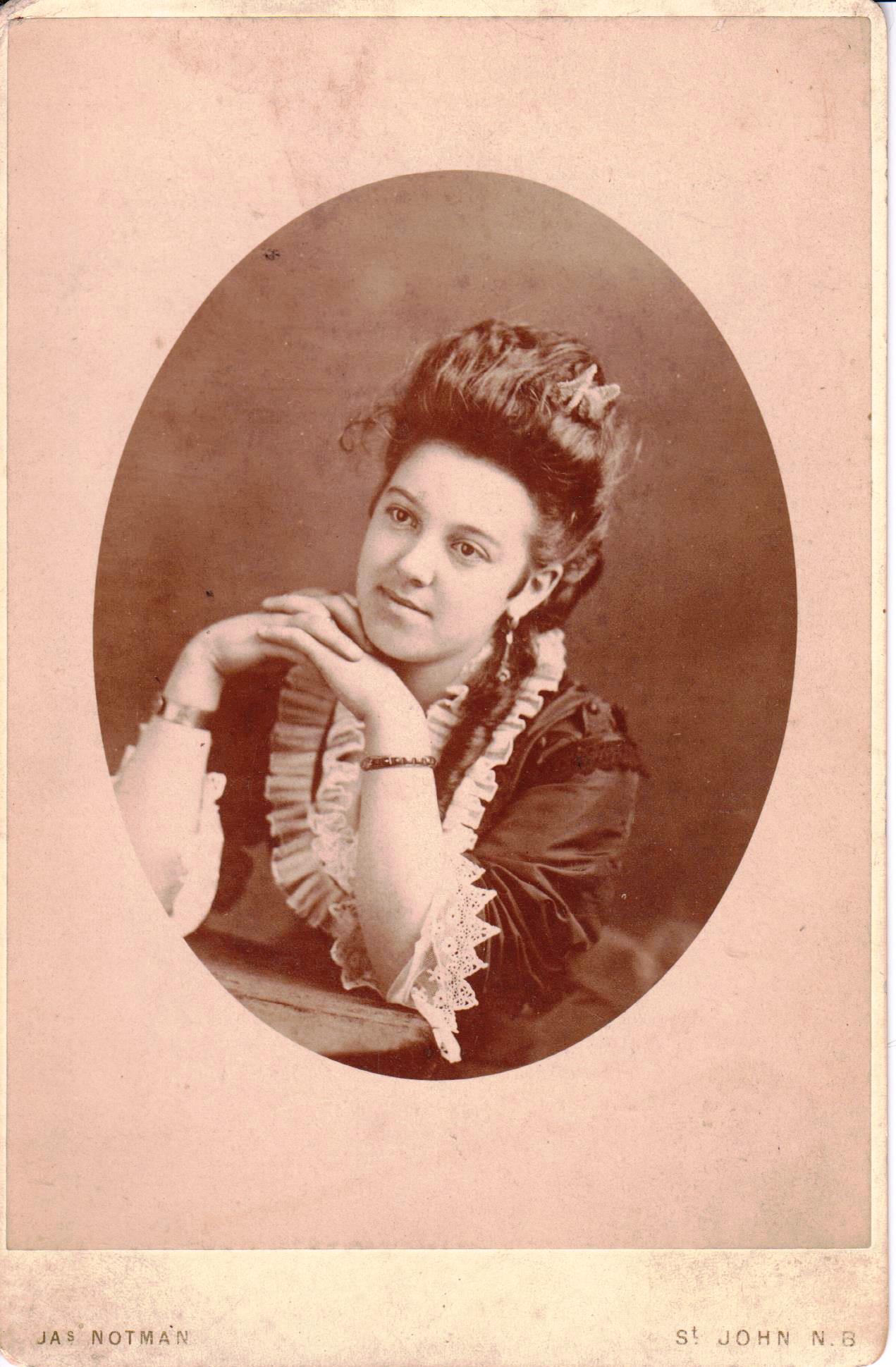
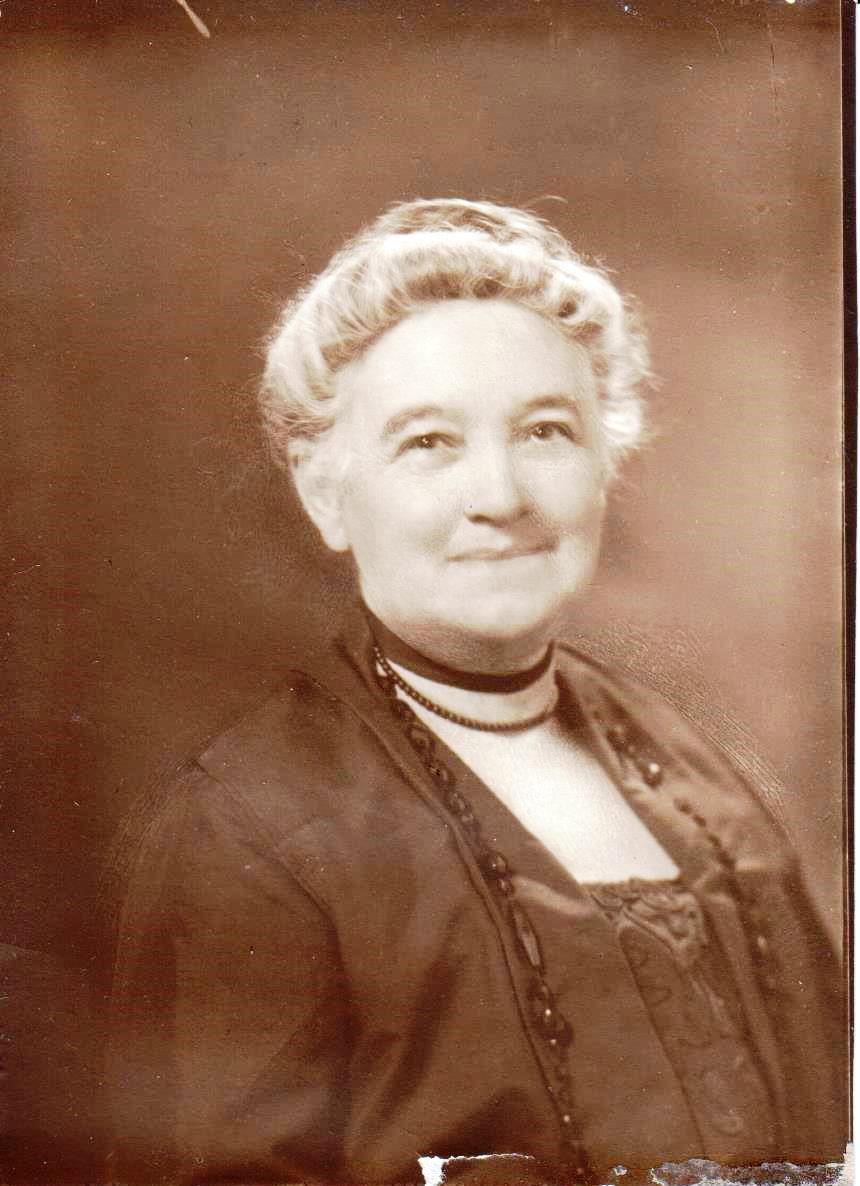
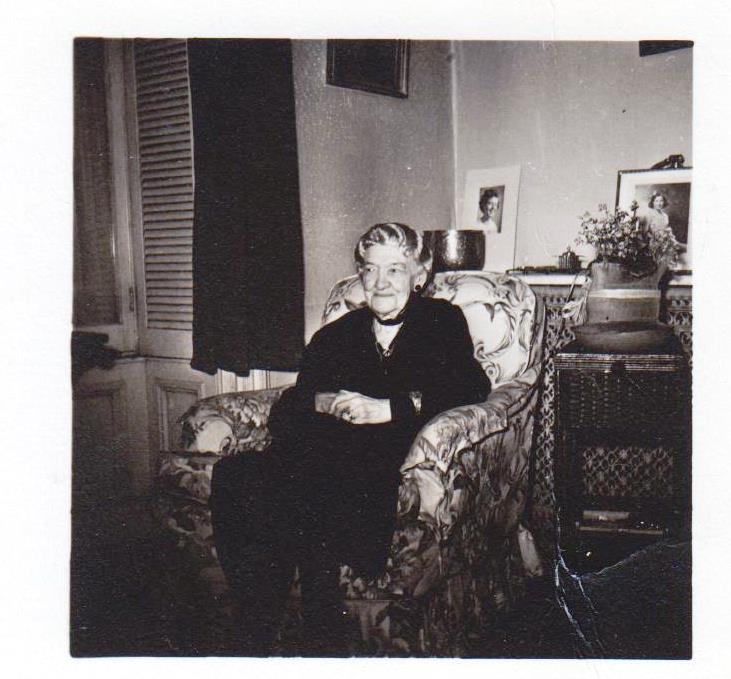
Gertrude Thorpe Davidson (Mrs. James P. Hanington) – 1852-1950

The local newspaper in Saint John, New Brunswick, hit the jackpot when they interviewed 96-year old Mrs. James Peter Hanington in July 1948.  “”I always said I would not be old till I was 90’ said the charming silver-haired lady, with the sparkling dark eyes who was recalling her girlhood days in Saint John”[1].  From a remarkable retentive memory, Mrs. Hanington described events of many decades ago as though they were only yesterday, but was fully aware of and concerned about today’s issues.

One of her fondest memories included waltzing on skates to a live band with a gong sounding every half hour signaling the skaters to reverse direction.  She also recalled attending not-so-very interesting lectures at the Mechanics’ Institute with her girlfriends enabling them to meet the boys at those gatherings.

Entertaining was done in the home and was a simple matter due to the availability of affordable domestic help.  A cook’s wages were only $6 a month! The great expanse of her memories included a small playmate telling her of Lincoln’s death, the street lamplighter with his ladder going from lamp to lamp and the thrill of her first ride on a passenger train from Moncton to Saint John.[2]

Gertrude Davidson (my great grandmother), born in Saint John, NB, in April 1852, was the daughter of William and Mary Anne (Cook) Davidson.  Her father was a prominent lumber merchant and the grandson of the first settler on the Miramichi, who came out from Scotland at the age of 20. Gertrude’s earliest memories of her native city of Saint John were centered about the Davidson home at 98 Germain Street, the fine brick building her father erected for his family and to which she moved at the age of five.

Her father had been confident when the Great Fire of 1877 was at its height that the slate roof and brick walls of his home would be ample protection. He was wrong.

When forced to leave, her father had locked the door to keep out the thieves.  But fire proved a more thorough villain and all treasures were lost.

Gertrude saw the spire of Trinity Church fall that terrible day and was very anxious about the safety of the people.  However, blessed with a wonderful sense of humour, Gertrude commented on the strange attire of the people who attended a church service in the Victoria rink after the fire.  They had obviously escaped without their Sunday best![3]

As much as she loved Saint John, she moved her family to Montreal in 1890, when her husband, a successful local pharmacist, decided to go to McGill University Medical School at the age of 44.  Her seventh daughter (my grandmother) was born in Montreal in 1895, when Gertrude was already 42 years old.  While in Montreal, she raised her family, supported her husband’s new medical career, entertained frequently in her home and was an active member of St. John the Evangelist Church. She was very well respected in the community and enjoyed a large circle of friends.

During her long life, Gertrude had had her full share of illnesses and ailments but her knitting needles were always busy…and without the need of eyeglasses!  Perhaps being married to a Pharmacist turned Doctor had its fringe benefits!

[1] The Evening Times-Globe, Saint John, New Brunswick – July 7, 1948.

[2] The Evening Times-Globe, Saint John, New Brunswick – July 7, 1948.

[3] The Evening Times-Globe, Saint John, New Brunswick – July 7, 1948

Gertrude Thorpe DavidsonMrs. J P Hanington (Gertrude Davidson)Mrs JP Hanington

The Presbyterian Churches: Quebec City to Sherbrooke

This compilation, prepared by Montreal genealogist Jacques Gagné, covers communities south of Quebec City (on the St. Lawrence River) to the Maine border, and east of Sherbrooke. Hundreds of Presbyterian immigrants from Scotland, as well as from Ireland and England, settled in this area in the early 1800s, attracted by its fertile land for farming, its valuable forests, rolling hills and abundant rivers.

The area includes the present-day counties of Arthabaska, Beauce, Buckingham, Compton, Dorchester, Drummond, Frontenac, Lotbinière, Mégantic, Nicolet, Richmond and Wolfe, and communities such as Saint-Georges-de-Beauce, Drummondville and Thetford Mines.

Jacques briefly describes the settlement of these towns and villages and names the churches and missions that met the spiritual needs of the Presbyterians. Name changes are noted where relevant.

The compilation lists Presbyterian cemeteries, local historical societies, books that discuss the histories of these areas and websites of interest. It also identifies repositories, such as church archives and local resource centres, where the birth, marriage and death records of these Presbyterian communities can be found.

Presbyterian Churches – Quebec City to Sherbrooke-3

Vincent Massey’s War-time Contribution

masseyA well-loved letter from my uncle’s collection led me to look more closely at Vincent Massey’s contribution to the Canadian war effort during World War II.

Charles Vincent Massey served as High Commissioner for Canada in London from 1935 until 1946. His wife Alice (formerly Parkin) served by his side fulfilling formal niceties, such as presenting Canadians to the King and Queen and writing letters to the families of fallen soldiers and those who went missing, like my uncle.

The letter she sent to John Mathieu the day his son went missing reads in part:

Dear Mr. Mathieu, This is meant to tell you how deeply my husband and I feel for you since we heard that your son is missing. – we know what these days of anxiety and doubt will mean to you.

Do know with what understanding and sympathy we are both thinking of you.[1]

The note remained within the keepsakes the Mathieu family retained long after the war.

Since then, I’ve discovered that Vincent Massey was one of the key people behind Canada’s participation in the British Commonwealth Air Training Plan (BCATP). The scheme brought 136,849 people to Canada during World War II to train as aircrew and enabled Canada to become a leader in the aviation industry.

Massey was not officially considered a founder to the plan after the fact;[2] but he was the first person to propose the idea in writing. In a 1936 report to Prime Minister William Lyon Mackenzie King, he credits the idea to British Air Minister Lord Swinton.[3]

After Swinton’s proposal was turned down, proposals about the same idea came from other players.

During a 1937 trip to London, for instance, Canadian Minister of National Defence Ian Mackenzie received a memorandum in favour of airmen trained in Canada from RAF Group Captain Robert Lekie.

That memo led to King agreeing to train 15 RAF soldiers within Canada. Proposed trainees increased to 50, then 120, then 135, before King backed out in 1938.

The following September, Massey joined Australian High Commissioner Stanley Bruce to meet with officials in the British Air Ministry and Treasury. The month is described in detail by F.J. Hatch in a Department of National Defence publication called “The Aerodrome of Democracy.”[4]

Hatch questions why Massey didn’t attend the last crucial meeting in which Bruce proposed the project to Harold Balfour, Britain’s Under Secretary of State for Air. As Hatch wrote:

Why Massey was not at this meeting is not clear, but his absence has led Bruce’s biographer, and Balfour himself, to give Bruce the full credit for originating the BCATP concept.[5]

If Massey backed off to ensure that there was no hint of his promotion of the idea to King, his methodology worked.

Over the next three months, King’s government negotiated an agreement with the Australian, British and New Zealand governments to create the (BCATP), which was signed in December 1939.

Implementation in Canada began with the Royal Air Force renting out space for schools across Canada to train recruits before they went to Britain.

I believe my uncle Charles Mathieu was probably one of 5,296 people who trained at one of these. A manuscript passed to me by him begins in 1940:

That same night I was an AC2 on the Midnight train to St. Thomas along with twenty other lads from Montreal. We were assigned as G.D.’s [general duties] to help open up the Technical Training School for Air and Engine Mechanics … I spent six months at St. Thomas doing guard duty and being General Duty Joe, however, my last month spent there was decidedly my best.[6]

There is a question about the status of St. Thomas because it doesn’t appear in a list of 152 installations outlined by Dunmore[7] nor in similar lists detailed by Hatch.[8] It does appear on a bigger list of 231 BCATP facilities found on Wikipedia.[9]

[1] Mathieu, John Charles, personal documents, letters and keepsakes.

[2] The British Commonwealth Air Training Plan, 1939-1945: An Historical Sketch and Record of the Ceremony at R.C.A.F. Station Trenton. Ottawa: Edmond Cloutier, 1949.

[3] Dunmore, Spencer. Wings for Victory: The Remarkable Story of the British Commonwealth Air Training Plan in Canada. Toronto, Ont.: McClelland & Stewart, 1994, pp24.

[4] Hatch, F. J. The Aerodrome of Democracy: Canada and the British Commonwealth Air Training Plan, 1939-1945. Ottawa: Directorate of History, Dept. of National Defence, 1983, pp13-14.

[5] Hatch, p14 quoting three sources: Edwards, Cecil, Bruce of Melbourne, Man of Two Worlds, London: Heinemann, 1965, p 279; Air Ministry, Notes on the History of RAF Training, 1939-44 (London, 1945), p 126; Gillison, Royal Australian Air Force, p 79; Balfour, Harold, Wings Over Westminster, London: Hutchinson, 1973, pp 113-114.

[6] Mathieu, John Charles, personal documents, “All of This Heaven Almost” manuscript, 1947-1950, p1.

[7] Dunmore, Spencer. Wings for Victory: The Remarkable Story of the British Commonwealth Air Training Plan in Canada. Toronto, Ont.: McClelland & Stewart, 1994, pp349-360.

[8] Hatch, F. J. The Aerodrome of Democracy: Canada and the British Commonwealth Air Training Plan, 1939-1945. Ottawa: Directorate of History, Dept. of National Defence, 1983, pp207-212.

[9] List of British Commonwealth Air Training Plan Facilities in Canada, https://en.wikipedia.org/wiki/List_of_British_Commonwealth_Air_Training_Plan_facilities_in_Canada,” Wikipedia. Wikimedia Foundation. Web. 12 July 2015, accessed July 23, 2015

Barnabé Bruneau, Why a Protestant?

IMG_9033
Barnabe & Sophie Bruneau

Whenever I tell someone my ancestors were French Protestants, I always get the reply, “Oh, Huguenots”, but that is not the story. Francois Bruneau came to Quebec in 1659 from France and he was a Catholic. He married Marie Provost a Filles du Roi in 1669 and they began our French Catholic line. The family remained Catholic until Barnabe Bruneau had a bone to pick with the church and became a Baptist. The reasons why depend on who is telling the story.

Barnabé was the son of Antoine Bruneau and Josephte Robichaud. He and his second wife, Sophie Prudhomme, the daughter of Jeramie Prudhomme and Louise Decarie, lived in Sainte Constant Quebec. There they farmed, raised their children and attended the local Catholic Church. Barnabé owned a number of parcels of land, one of which was just inside the border of Sainte-Catherine in the parish of La Prairie. 

In 1856 when the church was collecting the tithe due them from his land, both parishes wanted their tax. Barnabé refused to pay the Curé of Sainte-Catherine. He tried to stop his tithe obligation, by telling the Curé he was leaving the Catholic Church, but they still sued him. With his lawyer Joseph Doutse, who had the reputation of being a great adversary of the Catholic Church, Barnabé went to court and won. With that, he decided to attend the Baptist church, Eglise Baptiste de Saint Constant. He was the first person in the St Constant region to convert to the evangelical faith.

Barnabé’s parents had already died and were safely buried in the crypt of the St Constant Catholic Church, so they were not upset by his conversion. His brother Médard continued to attend the Catholic Church until one Sunday the priest preached that Protestants were devils with cloven hooves, who worshipped Satan and didn’t belong to the true church. Médard came home from church and demanded to see Barnabé’s feet. When they were not cloven, he denounced the priest as a liar and he too left the church and became a Baptist.

As there are notarial documents about the court case this is probably close to the truth but depending on which cousin you ask you will get other stories. One was that the Bruneau brothers learned that the local priest had been “fooling around” with some wives while the husbands were working in their fields and so they left the Catholic Church and became Baptists.

There was another version for those who didn’t want their family to have been involved in any scandals. The Catholics in the area saw that their tithes did not provide for any schooling while the Protestant church was very interested in educating their children and had begun setting up schools. The Catholics in the area tried to persuade the church to start a school but finally, in frustration, the whole congregation walked out of the Catholic Church and joined the Baptist Church.

They certainly did become Protestants. The family committed themselves to the Protestant church as Barnabé’s son Ismael, my great-grandfather had the calling and became a Presbyterian minister.

Bibliography:

Bruneau, Ida. A Short History of the Bruneau – Girod Families. 1993.

Duclos, R.P. Histoire du Protestantisme Francais au Canada et aux Etas-Unis. Montreal, Canada: 1912.

Prévost, Robert. Mon Tour De Jardin. Sillery, Québec: Septentrion, 2002. Print.

Gagné, Jacques. Baptist Churches of Lower Canada & Québec Compiled and researched by: gagne.jacques@sympatico.ca

Photograph of Barnabe and Sophie Marie Prud’homme Bruneau taken by Ayers Photo-Portraits in Jersey City, New Jersey in the 1870s.

This is the link to a story about Barnabe’s son Ismael https://wordpress.com/post/genealogyensemble.com/1237


Illegitimate

Illegitimate
by Marian Bulford

In the March 31st 1901 UK Census Lilian Mary Symons was listed as a ‘servant girl/domestic’ in Leicester, Leicestershire in the employ of Mrs. Mary Whatnall, ‘Retired Lunatic Asylum Matron’ Mrs. Whatnall’s niece also lived in the house.¹

The 18 year old Lilian had, the previous November 25th given birth to a daughter. The father of the baby was a Royal Navy Cooper and master carpenter Thomas Bevan whom Lilian met when she was 17. They had started to court, but neither of them realised she was pregnant when Thomas left for sea. He was gone not knowing he was to be a father and Lilian had no contact with him for the next three years.

Lilian was the oldest in a family of five. Her father was a jobbing gardener and her mother a housewife so they would have had no means to take care of Lilian and another child.

How Lilian must have felt at that time, being pregnant and unmarried is not known, but I can only imagine how she would have had to approach her family and tell them. She also had to tell them that she did not know where Thomas, the father was.

Lilian’s father Thomas Symons unsuccessfully searched for Thomas and he also wrote to the Royal Navy regularly to find out the father’s whereabouts, but to no avail.²

In the 1900’s in the United Kingdom, unmarried pregnant women were often disowned by their families and the work house was the only place they could go during and after the birth of their child. There were no fees, but hard work was expected of the inmates. ³

According to my family, although Lilian was not ‘disowned’ by her family she did give birth to her baby and her child’s birth certificate states the child was born in the ‘Leicestershire Workhouse’.

In addition, the original birth certificate also had the words ‘ILLEGITIMATE’ in large letters stamped over the entire certificate. Lilian immediately tore it up and threw it away. 4

Lilian’s circumstances definitely changed, as I have a wonderful photo of the child at two years old and she is dressed in a very attractive dress with a matching dolly. These are not the usual working attire for someone living in a 1902-era work house and tape recordings of family told me her parents looked after the baby daughter and Lilian went to work for Mrs. Whatnall.

Thomas Bevan did eventually return from sea and Lilian and he got married on 25th April 1904 when the child was three and a half years old.5

In the 1911 Census 10 years later, Lilian is the ‘head’ of a household with three additional children. They lived in the Royal Navy Port of Plymouth, Devon England and Thomas was once again, back at sea.6

The couple went on to have four more children, who all lived to adulthood, including my grandmother, Edith, who had no idea she was born out of wedlock until she was 65 years old, but that is another story!

 Sources:
1 1901 UK Census at Ancestry.com
2 http://www.workhouses.org.uk/life/entry.shtml
3 Family tape recordings
4 Certified copy of a Birth Certificate, Leicestershire City Council, England
5 Registered marriages in April, May and June 1904 Leicestershire, England at Ancestry.com
6 Family tape recordings

Photos Below:

Lilian Mary Symons b. 1882

Lilian Mary Symons 1899

Edith Bevan 1902

Edith Symons Bevan 1902

Thomas Bevan b. 1876

Thomas Bevan, RN

Australia, 1908


The Soldier’s Songs

Anyone with Irish ancestors or roots, should read this compelling and moving tribute to WWI ordinary Irish soldiers found, of all places, next door to Angela Merkel’s Berlin, Germany apartment.

http://www.irishtimes.com/culture/heritage/century/thesoldierssongs

How Now Black and White Cow. Isle of Lewis Obsessions.

This book above, The Genealogy of the Macaulays of Uig and this plaque, below,  in Hudson, Quebec, are related.

The other week, while strolling with our two dogs by the water in Hudson, Quebec, my husband and I passed another  couple walking their enormous pooch, a Newfoundlander-like dog, but one with large black and white patches.

I remarked on the unusual colouring of said canine and one of the owners replied, “Yes,  he’s our Jersey dog.”

I asked my husband,  “Aren’t Jersey cows brown? Those black and white cows you see everywhere are called something else. Aren’t I right?”

“Yes,” replied my husband, who grew up in the country so he knows a lot about such things. “Those black and white cows were developed by a guy from here in Hudson. There’s a plaque up on Mount Victoria? Do you want to do see?” It seems he couldn’t remember the name of the breed of cow, either.

So my husband took me to see this plaque, installed to honour the memory of a local man,Thomas Basset Macaulay, who developed a new breed of cow, the Holstein, on his experimental farm on the shores of the Ottawa River.

T.B. Macaulay, as it happens, was also the long-time President of Sun Life Insurance.

OK. So, what’s all this got to do with two-legged genealogy?

Well, the name T.B. Macaulay rang a bell with me.  I have a self-published book, The Genealogy of the Macaulays of Uig, in my house.

The book once belonged to Edith Nicholson, 1884-1977, my husband’s great aunt,a proud descendant of the Isle of Lewis Scots, those penniless crofters who were cleared from the land in the 1800’s and forced to emigrate to Canada and beyond.

My husband’s great aunt Dede, a teacher, left behind a slew of letters (from 1906 to 1936) and a few other personal possessions, including an 1888 two volume edition of Middlemarch; a yearbook from The Hostel from 1928 (that was McGill’s women’s Phys Ed residence);some yellowed newspaper clippings about the militant suffragettes; and this little genealogy volume, given to her in 1931.

The inscription reads: To Edith Nicholson, in appreciation of her connection with the Nicholson Institute of Stornoway. T.B. Macaulay.

There’s even a picture of Mr. Macaulay inside the book.

And here’s that inscription.

How well Mr. Macaulay knew my husband’s great aunt Dede, I don’t know. Edith had worked at Sun Life between 1917 and 1920, but only as a lowly stenographer in the accounting department.

After that she worked in the Registrar’s office at McGill and as a Tutor-in-Residence at the Hostel and as Assistant Warden at Royal Victoria College. In the 1930’s, Edith stepped out with Carrie Derick, the suffragist and first female full professor at McGill.

Edith’s family, from Richmond, Quebec was cash-poor but well-connected.  J.C. Sutherland, the long-time Superintendent of Protestant Education in Quebec, was a close friend. Edith’s father, Norman, had stumped for Sir Wilfrid Laurier back in the day.

But no Macaulay figures in any of the family’s 1,000 letters, although there are many mentions of Morrison’s and McLeod’s and other Isle of Lewis surnames. As far as I know from the same stash of correspondence, Edith got her job at Sun Life because the head of the Accounting Department lived beside her sister, Marion, on York Avenue in Westmount.

No, these two people didn’t have much in common, except that they were both of Isle of Lewis, Scotland, origin and they both were into genealogy big time. Somewhere along the line T.B. Macaulay learned of Miss Edith’s obsession.

Edith would visit the Hebrides homeland, herself, in 1933. She would bring back loads of information about the Nicolson Education Institute of Stornoway, a school. She was clearly proud of the connection she felt she had with this particular place. And for a few years in the 1930’s she would sign her name Edith Nicolson, without the H.

Now, that’s taking genealogy seriously!

Isle of Lewis genealogy is very well-documented on the Internet. This page leads to a story about how the Nicolsons and the Macaulays of Uig liked to feud over grazing privileges. But, of course.

Edith, second from right, in Navy League uniform, in front of Sun Life Building, 1917, during WWI.

Macaulay’s Secretary wrote the letter to Edith. It was slipped inside the book as was a genealogy of the Nicolson clan from Medieval times and later.

Presbyterian Churches of Quebec City and Montreal

While the historic populations of Quebec City and Montreal were primarily Catholic, both cities have long been home to Presbyterian congregations. The first such churches served worshippers of Scottish origins, while Americans comprised a substantial part of the Presbyterian population in Montreal.

In this compilation, researcher Jacques Gagne has briefly outlined the histories of these churches, including the dates they came into existence, some of the ministers who led them, their locations and name changes over time. Each outline includes links to sources of information about these churches and their records.

Make sure you look at the Repositories sections on pages 14 for Quebec City and 45 for Montreal, as well as the further information links for each congregation. Also, scan the table of contents thoroughly: over the years, a number of churches with the same names (for example, St. Gabriel, St. Andrews and Erskine) appeared, moved or reappeared. Finally, you may find further information on some of these churches by searching Google Books and Google Images.

Presbyterian Churches of Quebec City and Montreal

For more information on the Presbyterian archives of Canada and how to find genealogical information there, see http://www.presbyterianarchives.ca/ and http://www.presbyterianarchives.ca/Interesting%20Facts.html

Thanks to Claire Lindell for editing and formatting this compilation.

Pharmacist then Doctor

Dr. James P. Hanington (1846-1927)

James Peters Hanington (my great-grandfather), and his older brother, Thomas, could make emulsions, ointments, pills or potions for just about anything that ailed you.  They were partners in “Hanington Bros., Chemists” in Saint John, New Brunswick.  Today, they would be better known as pharmacists. According to several testimonials in the 1884 Almanac and Receipt (recipes) Book[1], they were extremely helpful in alleviating all kinds of their customers’ health problems.  Here’s an example:

Dear Sirs,                                                   Gondola Point, Clifton, Kings Co. 1878

Having been troubled for years with pains in my side and severe cough, I was tempted to try a bottle of your “JPH Cough Mixture”, and also a bottle of your “Penetrating Liniment”.  I found immediate relief.  I have used two more bottles since, and am now perfectly well.  Returning you my sincere thanks for your cheap and valuable medicine. 

Yours truly, 

Florence D. McCarthy

In 1890, the partnership was dissolved. Thomas became the local Postmaster and James moved his pregnant wife and four daughters[2] to Montreal, Quebec, where he was enrolled in Medical School at McGill University.  He was one of few of his eleven siblings to leave the province, where his grandfather was known as the first English speaking settler and founder of Shediac, New Brunswick.

The first family home in Montreal, Quebec, was at 278 St. Urbain Street[3].  The family grew to include two more daughters, one born in 1891, shortly after their arrival in Montreal and another born four years later in 1895.  Six girls!  The last one born, when her mother was 43 years old, was my grandmother, Millicent.  Could she have been the result of a special celebration once James had finally completed medical school at the ripe old age of 49?

James graduated from McGill Medical School in 1894, having completed his four year degree, which included First Class Honours in Medical Jurisprudence in his third year[4].

A few years later, he moved his family to 699 Sherbrooke Street, corner of Park Avenue[5], which was a larger home to accommodate his growing family as well as his Physician and Surgeon’s[6] office.  His office hours “8 to 10 a.m., 3 to 4 p.m., 7 to 8 p.m.” were even listed in the directory!  He was a prominent doctor in Montreal for several years.

Although he settled in Montreal, he did, however, keep a lovely old home in Shediac, New Brunswick, called “Burn Thorpe”  where his family would gather in the summers and meet up with their cousins.

JohnYoung Wawa Millicent Mrs JP Hanington DodoTootie Jenjen Dr JamesPHaningtonBurn Thorpe -2

[1] Hanington Bros’. ALMANAC and RECEIPT BOOK, 1884, Published by Hanington Bros., Chemists, Saint John, NB

[2] 1891 Canadian Census

[3] 1891 Lovell’s Street Guide

[4] McGill Medicine 1893–p.81

[5]1897-1898 Lovell’s Street Guide [6]1897-1898 Lovell’s Street Guide  Hanington Bros Almanac 1884James P HaningtonDr James P Hanington

Every Scrap of Paper

 I have stuff, lots and lots of stuff. I have letters tied with string, photographs in envelopes and albums, documents, census printouts and family trees in binders. I have boxes of stuff and filing cabinets of stuff.

One good genealogical process I hadn’t done for a while was to go back through all the information I had collected. You never know what might come out of it. As you learn more, things that meant nothing, suddenly make sense.

Recently, I looked through some binders searching for information I wanted to reference. I love looking through the stuff and reading old letters again and again. In one binder I found a piece of old paper. It looked like it came from a note book but didn’t fit the handmade one that was there. That note book belonged to my great great grandmother Susan Dodds. She married Alexander Bailey in 1843 just before they came to Canada from Ireland. It was sent to her by her sister Eliza and that is all I know about her siblings and families.

IMG_3076

The paper had a list of names and dates:

“Bob Dodd’s daughter born Oct 24 1884, Uncle Robert gied May 5 86, Mr Peil inducted buc 18 – 84, North West Rebellion was 1884, Ellin’s Bob died Dec 11, 1886 and Mary Dodds died 7, 1887.”

Who were these people and how did they connect to the family? Just looking up these dates on Family Search I found that in 1881, a Robert Dodds born about 1809 in Ireland, his son Robert and a servant Ellen Graham were all living together in Toronto. His wife Agnes had died. Robert Jr.(Bob) and Ellen Graham were married in 1883 and a daughter Gertrude was born Oct 24, 1884, also in Toronto. Gertrude appeared to be their only child. Robert senior died May 5, 1886 and then his son Bob soon followed, dying Dec 14, 1886. Both were buried in Mount Pleasant Cemetery. There was no further information on Ellen but in the 1901 census Gertrude was living with her Uncle Andrew Miller and his wife Eliza, both Irish. Was aunt Eliza, Bob Dodd’s sister? Gertrude married Samuel J Wilson and she died 18 May 1935.

I also found a Mary Dodds who died Feb 7, 1887 at 40 years of age. Was she also Bob Dodd’s sister? I confirmed all these dates in less than 30 minutes sitting in my recliner. Unfortunately, I still don’t know for sure how these people connect with Susan Dodds, but they must be related as someone, and I think it was Susan recorded these dates.

In with these family dates was the North West Rebellion 1884. This shows interest in what was happening in Canada at that time. This was the year Louis Riel was captured and hanged. I am still not sure of the meaning of Mr Peil or was it Mr Riel and Inducted buc 1884?

I also have a photo album a “Mrs Barber wanted to leave to Mrs Eagle.” Eliza Jane Bailey Eagle was Susan’s daughter. In it are pictures of a Mary Dodds, Robert Dodds and Eliza Dodds. Most of the pictures have names written underneath, probably by my grandmother Minnie Eagle Sutherland, so they are all people known to the family.

Maybe somewhere is another scrap of paper with answers to these questions.

IMG_7720 IMG_7722 IMG_7725

Bibliography:

“Canada Census, 1871,” index, FamilySearch (https://familysearch.org/pal:/MM9.1.1/M43R-1X4 : accessed 13 March 2015), Robert Dodds, St Partick’s Ward, West Toronto, Ontario, Canada; citing p. 4, line 15; Library and Archives Canada film number C-9970, Public Archives, Ottawa, Ontario; FHL microfilm 4,396,300.

“Canada Census, 1881,” index, FamilySearch (https://familysearch.org/pal:/MM9.1.1/MVFS-PXP : accessed 13 March 2015), Robert Dodds, St-John’s Ward, Toronto (City), Ontario, Canada; citing p. 152; Library and Archives Canada film number C-13246, Library and Archives Canada, Ottawa, Ontario; FHL microfilm 1,375,882.

“Ontario Marriages, 1869-1927,” index, FamilySearch (https://familysearch.org/pal:/MM9.1.1/FMJC-MZK : accessed 13 March 2015), Robert Dodds and Ellen Graham, 13 Sep 1883; citing registration 015093, Toronto, York, Ontario, Canada, Archives of Ontario, Toronto; FHL microfilm 1,869,764.

“Ontario Deaths, 1869-1937 and Overseas Deaths, 1939-1947,” index, FamilySearch (https://familysearch.org/pal:/MM9.1.1/JDG5-BNR : accessed 13 March 2015), Robert Dodds, 05 May 1886; citing Toronto, York, Ontario, yr 1886 cn 22384, Archives of Ontario, Toronto; FHL microfilm 1,853,483.

“Ontario Deaths, 1869-1937 and Overseas Deaths, 1939-1947,” index, FamilySearch (https://familysearch.org/pal:/MM9.1.1/JDR3-1XQ : accessed 13 March 2015), Mary Dodds, 07 Feb 1887; citing Toronto, York, Ontario, yr 1887 cn 19737, Archives of Ontario, Toronto; FHL microfilm 1,853,487.