Tag Archives: Kassel

I Wanna Believe!

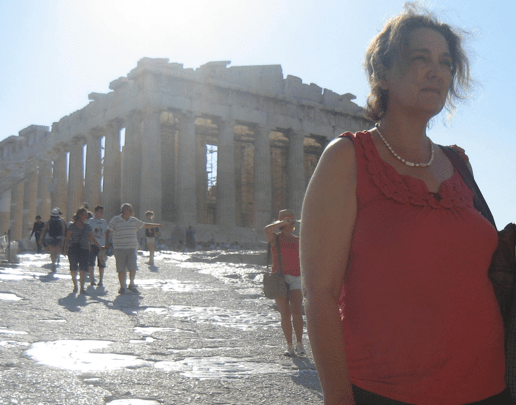
40 plus degrees in Athens, 2010. Do I look as if I belong? On the same trip, in Plomari, Lesvos, Greece, an old Romani woman tried to sell me some lace. I turned her away. Little did I know she might have been a relation. Now, I wish I had bought the lace.

The Truth is Out There. Or Is It?

A short time ago, I wrote a story here about my unknown bio-father’s origins or, at least, his possible origins. He was probably half Black Sea German and Half Pontic Greek. That was my best guess, anyway. My paternal grandparents were likely a mixed German and Pontic Greek couple, I thought, maybe from Odessa, maybe from the Crimea, maybe from Dobrudja in Romania. (Yes, I had done my homework.)1

I was leaning heavily on Ancestry’s ethnicity estimate for this highly unscientific theory – my latest ethnicity estimate says that my DNA signature is 12 plus percent Germanic and 18 percent Anatolia and the Caucasus. Then I have bits and pieces of other places from Denmark (6%) to Mongolia. I get no journeys for the paternal side.

To put this into perspective, I use my mother’s ethnicity estimate. She is a dyed-in-the-wool (sic) back-to-the-boat French Canadian. Ancestry gives her side 37 percent Quebec, 3 percent France, 2 percent Norway, 6 percent Cornwall (Brittany?) 2 percent Northwestern Europe/Southeastern England, and a touch of Indigenous. My one journey is spot on, a swatch of land north of Montreal, the Lachenaie Seigneury.

I have 25, 000 cousin matches on my mother’s side, the closest being related to my mother’s grandmother, Melina Gagnon, at 200 centimorgans.

I have a mere 2,000 matches on the paternal side. Only a handful are ‘closer’ cousins, 30-60 centimorgans. These closer matches live in Turkiye and have Turkish names or live in Germany and have German names. To muddle things up, quite a few of my Turk matches now live in Germany.

Some of my German matches have extensive trees, many that lead to 1860 Besserabia, specifically the Odessa Region, more specifically Hoffungstal and Kassel villages. These are classic Black Sea Germans. One triangulated group with a common ancestor is from Galicia, near L’viv.

None of my Turkish matches have good family trees, but almost all (with one notable exception, my closest match at 3rd cousin)5 have the Pontic Greek journey. I reached out to some of them and they seem very confused about their ‘Greek’ heritage.

This is the sum total of my evidence. It’s all I have to go on. Hence, my half-and-half theory. It makes good sense, I think, until you factor in all of those pesky Romani Gypsies.

Those Mysterious Gypsies

Yes, I have many, many Romani cousin matches, all distant, 15-30 centimorgans. Indeed, the vast majority of my paternal cousins are from the ‘Traveller’ community.

These Romani hail from virtually every corner of Europe.

Yet, my ethnicity estimate on Ancestry gives me only one or two percent Romani – and that took years to show up. Why so many Romani matches with so little Romani DNA?”6

Call Mulder and Scully?

From the very beginning in 2017, I perceived something bizarre on My Heritage. I had a large group of matches, many closely related to each other, all sharing a slim slice of chromosome 17 with me. And, weirdly, these matches lived all over the place in Romania, Bulgaria, Belarus, Albania, North Macedonia, Cyprus, Serbia, Bosnia and Herzegovina, Kosovo, Turkiye, Greece, Finland, Sweden, Poland, Ukraine, Austria, Switzerland, the UK and, yes, Germany.

I was flummoxed. I created a database to make sense of these crazy matches. I joked to my son, “I need to call in Mulder and Scully because the truth is out there and it’s likely very strange.”

But, then, in 2018 Ancestry updated its ethnicity estimate to give me that bit of Romani DNA. Eureka! And, get this, they gave me the Romani journey, too, the only journey on my bio-father’s side. (Alas, they have since removed it.)

Genealogical Mish-mash

Soon after, My Heritage added their ‘communities’ function based on tree evidence and I could see that these chromosome 17 ‘aliens’ were branches of a Romani Gypsy community reaching from Russia to the UK, with the bulk derived from ‘Vojvodina Serbia/Hungary’ as well as ‘Greece/Turkiye/North Macedonia/ and Albania. 2

I looked up Vojvodina. Four subgroups of Romani live in Serbia, apparently: a Romanian or ‘Wallachian’ one; a “white” or Hungarian one; a Bosnian one; and a Turkish one. That didn’t help.

It was a mind-boggling genealogical mish-mash.

It Wasn’t About the Bomb

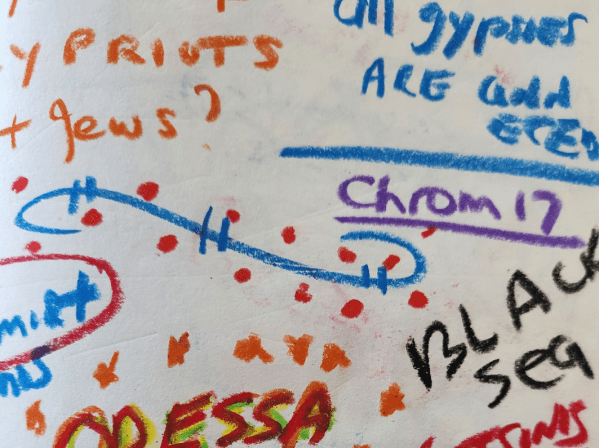
I’m no scientist, obviously, despite that early effort with a database. When in the mood, I turn to colourful doodles – and meditation – to open my mind to the elusive TRUTH.
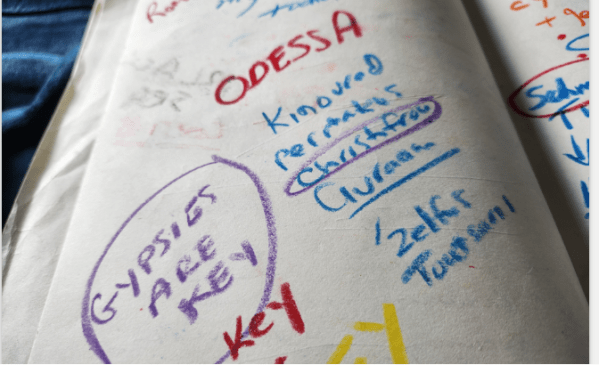
Over the years I’ve filled many notebooks with genealogy doodles, trying to open my mind. Years ago, apparently, I wrote “Gypsies are Key.”

(No luck yet.)

Still, it is clear I am not the product of some kind of alien intervention, or genetic remodelling caused by the massive thermo-nuclear bomb the Americans set off at the Bikini Atoll in March, 1954, when I was conceived. The fallout reached Quebec, apparently. (Wouldn’t that make a good plot for the new X-Files show?)

The truth of my origins is much more down-to-earth. I am a (very small?) part of an ancient and storied community, one that has long been misunderstood and much maligned. Even the word Gypsy has pejorative undertones. They were called Gypsies because it was believed they came out of Egypt when they actually came of out India.

The Problem with the Half-and Half Theory

In those early days, eight long years ago, on My Heritage I had around 40 Romani matches. Today, I have hundreds and hundreds on both the Ancestry and My Heritage platforms, some 50-100 percent Romani, others with lesser amounts. Every day, I get a couple of new Gypsy-related matches, attached to Europeans and Anatolians. (Today’s match, for instance, gets 11% Romani and 75% Ukrainian.) These days, it seems, these Chromosome 17 Romani are essentially the ONLY matches I get on my bio father’s side.5

Here’s my problem: If my bio-father’s Turkish side has chromosome 17 Romani (Albanian names like Gashi and Krasniqi and Berisaj prevail) and his Germanic side has chromosome 17 Romani (often Hungarians with Horvath, Varga, Toth surnames) and these people are all related, how can my bio-dad be ‘half-and-half,’ say with a mom attached to Baden-Wurrtemberg and a dad to Trabzon?

Maybe my bio father was some kind of mish-mash himself and not strictly half Germanic and half Pontic Greek. Maybe the bit of Romani ancestry I have is key to knowing from whence this man came, as I mused on paper many moons ago.

Whatever, I have to assume that the online algorithms (iffy embryonic science or mere infotainment to begin with) are missing something essential…

The Discovery

As it happens I may have discovered a possible explanation for my bio-father’s wacky heritage. It involves an intriguing new theory – not mine.

A while back I got a ‘Romani’ match on My Heritage who had a huge hidden tree (very unusual) and who also matched with me on two chromosomes, 17 as well as 9 (not unusual.)

I messaged the man and he replied that he is a genetic genealogist managing the profiles of a large group of Gypsies from all over the place. (But, I already knew all about that.)

Months later, I contacted the scientist again because, frankly, I had no other avenue to explore with respect to my unknown bio-father.

This time the man, Dr. Douglas Schar, pointed me to his website.

I learned he is a trained scientist (PhD in Botany) of German/Swiss Jewish and Romani extraction. His current area of exploration is Crypto-Jewry and, right now, he is tracing a huge group of Romani people (my group, his group) that he postulates is made up of Crypto Jews.

Gypsy/Jewish Woman?

Now, I can’t pretend to understand the science behind this man’s work but, if I understand his blog posts, he suspects this particular group of Romani (not necessarily ALL Romani) are descended from Yemeni Jews who went to India and then joined a group of Jewish traders, the Rhadanites, on the Silk Road.

This theory is a work in progress, he told me by email. More and more ‘pure’ Romani (members of the Traveller community from all over Europe) are being added to the online databases every day – and finding Jewish heritage. This scientist does not think he is revising the old Out-of- India theory; he says he is just ‘filling in the blanks.’

Yes, he postulates on his blog, the Romani Gypsies came out of India but they were Jewish Indians. They followed the Silk Road, back and forth, from Asia to England, mixing with both Ashkenazi and Sephardic Jews along the way.3
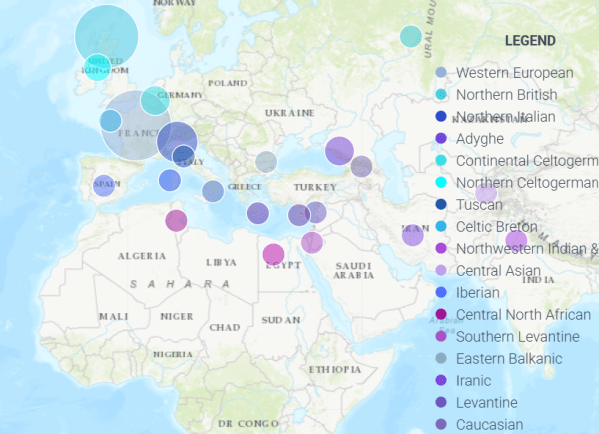
YourDNAPORTAL OUT OF INDIA Lakania map for my genes. This map sure makes the Silk Road Theory look good.

I Still Wanna Believe

I admit, I like the theory: MDLP algorithm gives me high levels of Romanian Jew and Uzbek Jew. And I get big time Iraqi Jew and Yemeni Jew on the Ancient Near East Algorithm. (Dr. Schar is using the Dodecad algorithm on Gedmatch so as ‘to compare apples and apples.’)
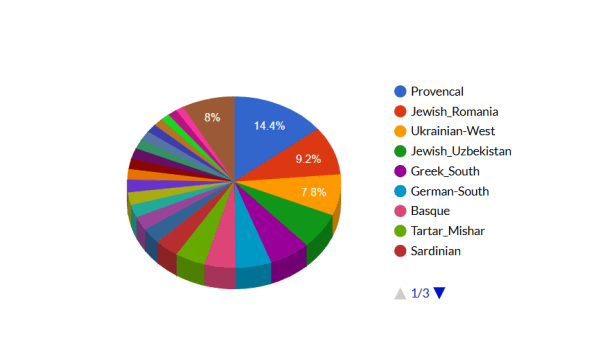
MDLP 22. I suspect the bio-guy was a Ukrainian or Greek, not from any online info, but from my family situation in 1954.

Could this genetic genealogist’s theory explain my unknown bio-father’s wonky, opaque ancestry that perplexes all the online algorithms?

Could it be, that from this perspective, I am much more than one measly percent Romani Gypsy, even if my bio father, whoever he was back in 1954 Montreal, identified as Ukrainian, or German, or Swiss, or Greek or Hungarian or Romanian Jew, or English or French Canadian or WHATEVER. Could it be that, on my bio-father’s side, I derive from a group of people as yet not widely understood?

Good grief. I doubt I will ever know the Truth, even if it is ‘out there’ and, perhaps, not so otherworldly at all.
END

Dr. Schar’s website:

https://gypsyandjewish.com

Dr. Schar’s papers are available on Academia.edu

  1. I did enough research to start on three fictional origin stories about a meet up between a Pontic Greek and a German: Reading Ovid in Dobrudja, Reading Gogol in Odessa and Reading Euripides in Crimea. Each of those authors, all favorites of mine in college by happenstance, have ties with those specific countries.
  2. Two surnames comes up in more than one Romani tree: Gashi and Krasniqi, both the names of Albanian tribes. The Gashi tribe went to Serbia and North Macedonia, which fits. Mustafa too is a common surname. Other Romani communities my matches have include “Serbia/Germany/ Turkiye/France” and “Serbia/Bosnia/Bulgaria/Romania” and “Romani in Russia/Germany/Poland/Czech/Latvia/Lithuania.” See, a real mish-mash.
  3. To further amend the “Out of India” narrative, Dr. Schar says he also believes “this migration was not just east to west, rather that people went east to west and west to east several times in a lifetime. They were most likely traders who travelled the Silk Road, to and fro. “
  4. The other day I watched a show on YouTube about the Middle Ages Guilds in England and learned the top two guilds, in wealth, were textile and spices. (Silk Road items for the wealthiest in England.)
  5. My closest Turkish match on Ancestry (whom I presumed was Pontic Greek) also has 1 percent Romani on her Ancestry ethnicity estimate. (We share 60 centimorgans or third cousin.)Unlike me, she still gets the Romani journey along with the Slovak/Hungary Border journey. (The two appear to go together here.) Oddly, she does not get the Pontic Greek journey. How can that be? (I messaged the lady immediately. She seemed totally perplexed about her Anatolian, Greek Islands, Romanian, Ukrainian, Romani ethnicity results. Soon, she went radio silent on me. That always happens with my Turkish matches, friendly at first until they realize they are not what they think they are.) I have related matches on Tinos in the Cyclades and some platforms give me Andros Island next door. Very specific!
  6. Endogamy is the logical answer. The Romani community is highly endogamous so a 25 centimorgan match ( or even a thousand plus 25 centimorgan matches on the same chromosome) might not mean anything much. In fact, you can say the same for my French Canadian ancestors :)Unless there’s a tree match don’t trust the centimorgan count.
.

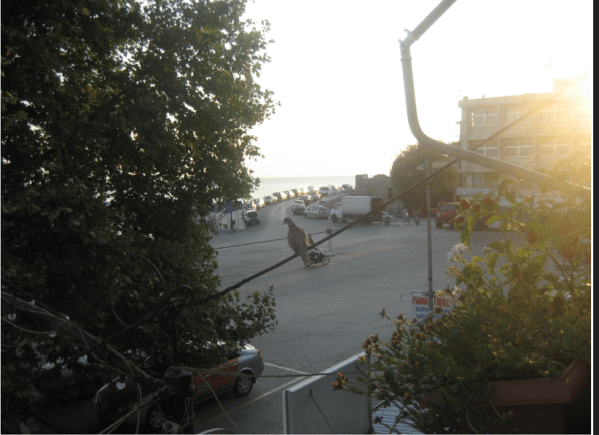
View of the waterfront square from a small resto around the corner from my older brother’s holiday home in Plomari, Lesvos, Greece. Delicious Dolmades. Best I’ve ever had – and I worked in Park Extension, Montreal in the 1980’s. Displaced Greeks from Pontus, Turkiye were sent to Lesvos in 1923. I recall an old Romani woman pestered me at a resto to buy her lace. I declined. She mumbled something that I took to be unpleasant. I thought, “Don’t be mean. I’m as witchy as you are.” Little did I know she may have been a distant cousin. I now wish I had bought the lace!

Genealogy Rabbit Hole

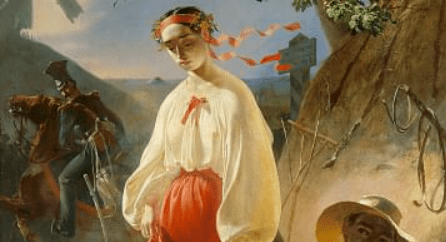
Kataryna, Serf. Taras Shevchenko. (Taras Shevchenko Museum) World History .ORG Creative Commons
Yes, the street in Lasalle is named after this celebrated Ukrainian painter/poet!

Exploring your genealogy is something of a luxury. You need the knowledge to do it, the time to do it, sometimes the money to do it. And you need the ancestors to do it, that is to say ancestors who came from relatively stable, peaceful places; countries where good records were kept.

People in North America and Western Europe sometimes have this luxury, the rest of the world, well, not so much.

My ‘official’ family tree is half French Canadian and half North of England, so easy to put together. My biological tree is half French Canadian and, let’s say, something not Western European, something very, very complicated and sometimes hopelessly obscure.

On Ancestry, the record makes clear that most of my mother’s people hail from the Lachenaie seigneury, north of Montreal. That’s a very small area. There are hundreds of cousin trees to prove this.

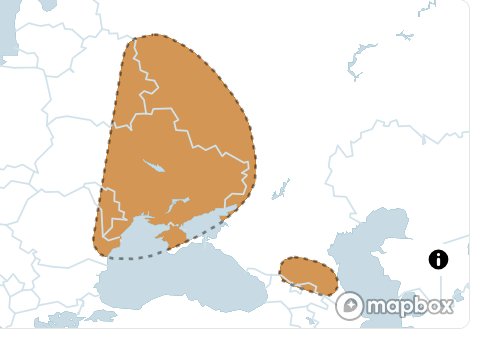
My unknown bio-father’s side is from all around the Black Sea and Eastern Mediterranean. That’s the crux of it, anyway.

My Ancestry Ancestral regions. Not an exact science by any stretch but getting better. The Green is “French”, my Mom. 46% She has a touch British and Norway. My bio-father, a colourful mix of Germanic Europe, Anatolia and the Caucasus and Southern Italy and Eastern Mediterranean, with touches of Balkan, Greece and Albania, Eastern Europe, Persia, Romani, Mongolia, China. Some Crimean Tatars online who have done their DNA have similar mixes without German.

We’re talking an enormous area that for centuries was home to myriad populations, myriad cultures that for economic and/or political reasons moved around a lot.

On Ancestry, my mother’s side has 28,000 matches, none of them that close, but that doesn’t matter because I know who my mother is.

My bio-father’s side has but 1,800 matches, only one match at 60 centimorgans, likely a third cousin, and the rest at 20 centimorgans and below. 1

Still, using Ancestry’s various tools to analyze my paternal side’s origins, my best guess is that my bio father was half Protestant Black Sea German (maternal side) and half Pontic Greek (paternal side.)2

YourDNAPortal’s 1000 year old ethnicity estimate is bang on for my French Canadian side and it gives me 11-20 percent Crimean Tatar from the bio-father’s side!

Incredibly, it has taken me a full seven years to figure this out. I must have the equivalent of a Master’s degree in Black Sea Studies. 🙂

I won’t make fun of you if you don’t know what a “Black Sea German” is, although some of the descendants of these people now live in the Dakotas in the United States and in Western Canada.3

They were people from Baden-Wurrtemburg and Alsace (many winemakers) who took their horse drawn wagon trains to Southern Russia (sometimes by way of Galicia, that is the Poland/Ukraine border or Swabia, the Hungary/Romania border) in the late 18th century at the invitation of Catherine the Great who offered them free land, no taxes, and no conscription in order to re-populate areas formerly held by Turks. Catherine didn’t want those nasty Turks coming back. Later, Alexander I opened up Bessarabia (today’s Moldova) to Germans, offering similar incentives.

It was a difficult life (if you survived the journey) but many of these disciplined, hard-working farmers prospered – until they didn’t. Many ‘extra’ sons or cast-outs were constantly on the move looking for a benevolent, fertile piece of land to call home. Young unmarried women sometimes moved away for work.

Some Black Sea Germans, Protestant and Catholic, moved on from Southern Russia/ Bessarabia to settle in the Crimea on land once held by Tatars.4 In later years, Bessarabian German settlers spread out southward to Dobrucha in today’s Romania at the invitation of the Turks who were still in charge there. Ironically, this is where the displaced Crimean Tatars were now living.

The North American descendants of these Black Sea Germans have done a remarkable job chronicling their ancestors’ migrations and daily lives on various websites and databases. This information includes village censuses.

The most intriguing documents, I think, are the anecdotal “village histories” written down by a leading citizen and/or self-styled local historian. Apparently, there was lots of praying as these people were pious; also lots of drunken brawling, as most every town had a tavern; and lots of hardship, too, death from disease and famine, earthquakes and plagues of all kinds. Meeting your end at the bottom of a well was quite common. Hmm.

Initially, there were a handful of ‘orderly’ villages, 25 to 100 and that number grew to around two to three thousand. Although overwhelmingly populated with Germans in extended family clusters, many Besserabian villages also harboured a few Turks, Bulgarians, Romanians and Jews.

Ancestry’s Beresen and Leibmental enclaves of Black Sea Germans, covering Ukraine mostly.(Some ventured to Caucasus because they felt Mount Ararat to be the site of the Second Coming of Christ.)

Black Sea German citizens were so mobile they often named the last village in which they lived as their ‘homeland.’

Since the borders in Austria-Hungary changed so often, even an officially listed nationality like Polish or Austrian means little.

Nationality back then was very fluid.

That’s why delving into the ‘Germanic’ side of my unknown bio-father’s genealogy, although illuminating in one sense, usually sends me down a dizzying rabbit hole.5

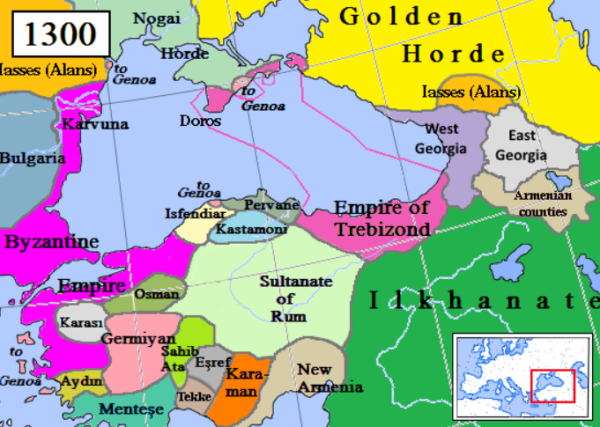
Empire of Trebizond, Wikipedia Creative Commons. “A remote and isolated splinter of the Byzantine Empire.”10
This map goes a long way towards explaining my wonky heritage.

The Pontic Greek side is even more obscure. Pontic Greeks are people who believe they are descendants of the original Greek settlers on the Black Sea in the Classical period. 6

They practised Eastern Orthodox Christianity brought in from Byzantium at a later date, lived in vibrant port cities like Samsun and Trabzon in North Eastern Anatolia, and spoke either a form of Greek or sometimes even Turkish. They mixed up their genes with Armenians. Some dressed like Tatars. Many converted to Islam.

Post WWI, these Christian Greeks were forced by the Turks to leave the Pontus, as it is called, in a series of expulsions and death marches, mostly pushed to the Anatolian interior or towards the Caucasus. (This coincided with the Armenian genocide.)

In 1923, Greeks in Turkiye (mostly Pontic) were exchanged for Muslims in Greece. These Greeks primarily went to Thessaloniki in Northern Greece.7

I know I am derived from Pontic Greeks because I have over fifty matches on Ancestry with that particular “journey.”8 Some of these matches live in Turkiye and have Turkish names and when I contact them they seem very upset to discover they are even a small part Greek. Others are merely perplexed.

Many of my Pontic cousin matches have the tell-tale suffix IDIS at the end of their surnames and identify as Greek. They live in the United States and their immediate ancestors hail from Thessaloniki or southern Russia. 6

A handful have Russian surnames.13

Southern Russia! I have a theory. My male Pontic Greek ancestor from Samsun in Northern Anatolia (where I almost certainly have antecedents) took a boat across roiling Black Sea waters to the Crimea, maybe by way of Sochi, where I have a tree match, and met up with my female Black Sea German ancestor. The mountains of southern Crimea had a climate good for growing grapes. I have many sure-fire ancestors in the village of Huffnungstal, near Odessa. Some of these Hoffs, Bollingers, Lutz’s, and Berreths went on to Crimea.

This is more than a stab in the dark. Call it an ‘educated guess.’

The essential point is this: Because of the complex history of Eastern Europe and the Black Sea area, my bio father back in 195412 Montreal may have identified as a Ukrainian (most likely) or a German or a Greek or maybe even a Turk or a Tatar. Or perhaps a Pole or a Hungarian, or even a Romanian Jew14. Or just a Canadian. His ancestors might have been Steppe nomads, serfs or slaves, farmers, vintners, blacksmiths, soldiers,sailors, shopkeepers, shipping magnates, Romani gypsies, noblemen – or all of the above.

Yes, researching genealogy is challenging for most people but next to impossible for people in my situation, with roots around the Black Sea, even if you know who your parents are.

In Soviet society, post WWII, elders kept family history and stories AWAY from their descendants rather than passing the stories on, according to an academic paper I read.9

This was for their protection.

“The less people knew about their family history the better.”

The Pontic Greek diaspora in Europe and North America now struggles to keep its cultural identity. Persons who went to Thessonaliki or other parts of Greece in the 1923 exchange were often slighted by natives and not considered ‘true’ Greeks, so they didn’t showcase their past.

The other surviving descendants of the citizens of the once dazzling Empire of Trebizond now live in Ukraine (Mariupol) and Kazakstan and Turkiye and many likely don’t know (or want to know) their ethnic heritage.

It’s no wonder I can’t figure out who my bio-father is – and probably never will. His relatives, if they exist at all, reside in places where they don’t do DNA – and sometimes for good reason. But, thanks to modern science and copious online sources, I do know an awful lot about his very mixed-up ethnic heritage.

THE END SON Кінець Das Ende Τέλος Koniec Sfârşit

Footnotes

1. I only get one or two new matches on that side a week, or maybe a month. Most are Americans or Brits with some Romani. (I’m 1 or 2 percent Romani) or distant descendants of Black Sea Germans (Eberhard from North Carolina!) and an occasional Pontic Greek.

2. I only know this because I have a twin who did his Y DNA and the one match had a Turkish name. J2A.. My 3rd cousin match, a Turkish woman, is a stand-alone match, with no mutual matches. Her ethnicity profile mirrors my bio-father’s, though, suggesting to me Crimean Tatar roots. See Note 4. Bob Dylan, apparently has a similar ancestry.

3. I am almost certainly related to the Hemmerlings of Gimli, Manitoba. Are you?

Most Black Sea Germans were repatriated to Germany or Poland during WWII. As the borders changed during the war some had to go back to Russia. A few of these Germans lobbying to return to Germany had ‘mixed marriages,’ according to records kept by the Germans. The mates were mostly Russian, but quite often Moldavian (sometimes referred to as Gagauz, a kind of Christian Turk native to Romania) and but rarely Hungarian, Polish, Bulgarian or Greek.

4. Ancestry doesn’t acknowledge Tatars or Crimean ‘journeys’ but on many other platforms the algorithms give me Crimean Mountain Tatar, at least way back. These people were a mix of Northern Italian (Genoa) Southern Italy and Greece, (Sicily), Allans (Persia) and Goths (Germany) with Nogai, as in Steppe Tatars who in turn have Central Asian and Mongolian. (I have all of these things 🙂 I have only one distant match with a tree totally from Crimea and, yes, the surnames are Tatar.

5. I have a cluster of family trees with people from a town called Hoffnungstal in Bessarabia (Odessa area). I also have a cluster in Galicia (Poland-Ukraine border)in a town called Bruckenthal. There was a trade route between these two areas and smack in the middle was a town called Botosani, Northern Romania, where I also have a tree match- a Jewish match with people who moved to Montreal. Yikes! (Any ideas? Contact me, please!)Added a week later: The immigration path of the Black Sea Germans in my trees seems to go from Baden area to Poland down to Galicia north of Lviv, around Moldova to that bit of Ukraine west of Odessa where Hoffnungstal and Kloestitz (my villages) are. The researcher says there were many long stops along the way. Works perfectly. Bruckenthal Rava Ruska is north of L’viv.

6. The Euripides play Iphigenia in Taurus speaks to this. Iphigenia, daughter of Agamemnon, is saved from death by the goddess Artemis and hidden in the land of the Taurians (Crimea). The Greeks have a long history in Russia. Rich shipping families from the Aegean ran the grain trade there in the 1800s. Many of these rich Greeks assimilated into Russian society. At the founding of Odessa, that became a bustling multicultural economic center, there were already many Greek families, who often were the wealthiest citizens there. At one point the Mayor of Odessa was a Greek.(Odessa Recollected; The Port and the People. Patricia Herlihy. 2018 Boston)

7. According to one online source, the Asia Minor and Pontus Hellenic Research Centre at Chicago, Illinois: In the city of Samsun, where I very likely have some ancestors, 72 Greek community leaders were arrested and sentenced to death in 1921. Other Greek men were killed, imprisoned or conscripted into the army and the women and children sent into exile or deeper into Turkiye where they were forced to change their Greek surnames to Turkish ones.

8. Ancestry gives me no journey on the paternal side, but there is a function that allows me to see the journeys of my paternal matches. These include: all parts of Germany; Black Sea Germans/ Leibenthal Beresen Enclaves; Pontic Greek; Eastern European Roma; North Eastern Hungary/Slovak Border. (That’s on edge of Ukraine near L’viv.) I appear to be connected to Szekelers, a sect of Hungarians who moved to Northern Romania, Bukovina.

9. A. Pahl and Thompson. 1994. Family history was dangerous even for families who left for North America.

10. https://www.grhs.org/pages/Villages A concise list of Black Sea German villages. Many descendants of Black Sea Germans and of French Canadians mixed it up in the Dakotas or Western Canada later on, so I have hundreds of distant ‘unassigned’ matches with both these heritages.

11.https://providencemag.com/2017/09/forgotten-christian-history-turkey-review-byzantiums-empire-trebizond-book-review/

12. In 1954 Crimea was returned by the Russian Soviet Socialistic Republic to the Ukraine SSR. The Russians felt that the Crimea fit more naturally with them.

13. In Family Tree’s public Pontian Greek Y database, the vast majority of subscriber surnames are Russian. This appears to show the extent these people were absorbed into Russian society.

14. MDLP algorithm, that is supposed to be best for people of my bio-father’s ancestry, is unequivocal. I am Romanian. And sometimes a Romanian Jew or Gagauz (that’s the Turkish bit). Lots of Romanian Jews immigrated to Montreal. That would mean perhaps that my closest community is not Black Sea German but Danube Swabian, Wurrtemburg Germans who lived for generations in Romania, Serbia, until expelled after WWII.

This video says genetic studies prove Pontic Greeks are descendants of Ancient Greeks. Indeed, their mountain monasteries preserved elements of Ancient Greek culture long after Byzantium died out. Also, family history information was ‘encoded’ in their dress, the fabrics and patterns of their clothings, every day and ceremonial. Now, that ‘s interesting. Because of their cohesive social system and the make up of their terrain, Pontic Greeks in North Central and Northeast Anatolia largely resisted Turkish invasions.
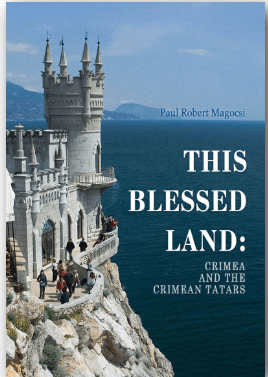
This book, from the University of Toronto Press, 2014 by Paul Robert Magocsi, is available on Archive.org. It contains pics of a Taurian Burial Ground 300 BC; Greek Amphitheatre; a cave village/Jewish Karaite; early 4th Century Christian Basilica; 14th Century Armenian Church; a Genoese Castle, and many mosques, attesting to the rich, complex history of the Crimea, a place still very much in the news for the usual reasons. This was the home of the sedentary TAT Tatars (as opposed to Steppe Tatars) as well as the Northern Pontic Greeks – as distinguished from the Pontic Greeks on the southern coast of the Black Sea in Northern Anatolia.