Tag Archives: Montreal

Peacocks and Cherubim: My Mysterious Aunt Cecile

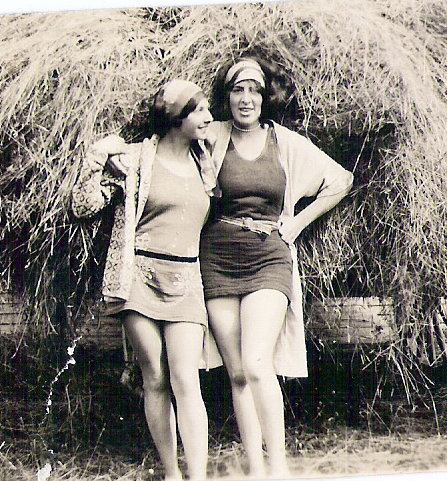
My Aunts Flo and Cecile, circa 1930, in what I assume are bathing suits maybe at Old Orchard Beach Maine where the family vacationed.

It was 1962 or so and my mom, twin brother and I had taken a bus from Old Orchard Beach to Ogunquit, Maine to visit my Aunt Cecile, who was on vacation at the same time as us.

As my brother and I crawled over the jagged and slippery shoreline in front of her hotel we openly wondered why anyone in their right mind would want to vacation in this spot. It was all rocks!

Well, much time has passed and my husband and I love to spend time at picturesque Perkin’s Cove on our short trips to Maine in the spring or fall.

On one such weekend visit, I recall the owners of our b-n-b telling us about pre-WWII Ogunquit: it had once been a bohemian artist’s colony with open air classes and nude models posing on the Marginal Way.

An artist’s colony! Now that explains it. My Aunt Cecile was an artist and a good one at that – but a bohemian, never! I remember her only as sober and serious – and seriously pious. Children were a foreign country to her and her main ambition with regards to me was to convert me to Roman Catholicism.

Marie-Catherine Cecile Crepeau was born in Montreal 1909 to Jules Crepeau and Maria Roy, my grandparents. She had an older brother and sister, Louis and Alice and in 1914 or so another girl her age, Florida, was plucked off the scruffy streets of south central Montreal and brought into the family fold. My mother would appear much later in 1921.

Cecile contracted scarlet fever as a child and suffered severe heart damage. According to her sisters, she was ‘babied’ for most of her childhood, not asked to do very much.

So, it seems she learned to paint.

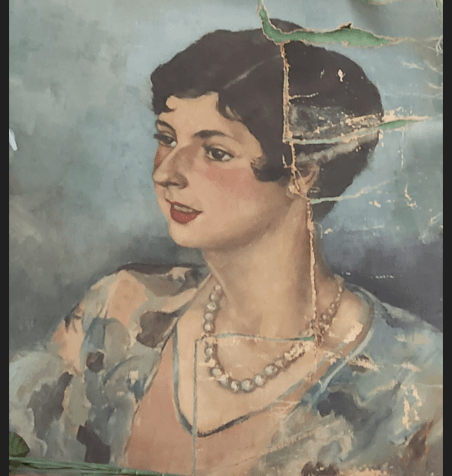
This battered canvas of young Flo is the only one of Cecile’s that I own. It was painted in 1927 when both Cecile and Flo were 18. It is pretty accomplished for so young an artist, I think.

Indeed, in a few years later Cecile would be accepted into the Beaux-Arts in Montreal (perhaps using this portrait in a portfolio) and she would win the first prize for oil painting (considered very much a male domain) in 1937.

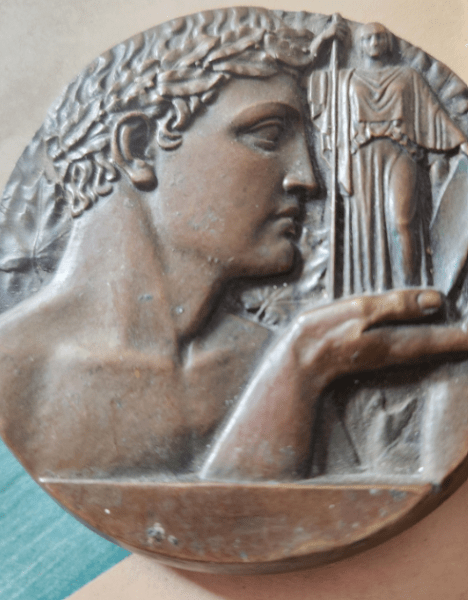
I have the medal somewhere and I found this tidbit from a tabloid called “L’illustre” describing the 1937 Beaux-Art exhibition: “Although the Hall of Paintings has little that is very striking, Therese Boucher’s “Reclining Man’ is vigorously treated. Among the angels, Cecile Crepeau’s is most alluring, in large part because of the curious golden tonality of the ensemble. Her study of a face, placed to the right of the entrance, has life and sincerity, despite some weaknesses. Her blue vase beside a pewter bowl also merits a mention. The female nudes are unimpressive.”

The angel picture I remember well. It loomed over Cecile’s living room and, yes, it was very golden. Another tall tall wall hanging I remember was an oil painting of a statue of St John the Baptist holding his own very hairy head.

I don’t recall the still life mentioned in the newspaper article, but I wish she had put some pretty vases behind Aunt Flo in my painting. It seems unfinished somehow.

The gorgeous and heavy ‘gold’ medal. I wish

My aunt was ‘a perfectionist’ (who suffered migraines for it) said my mother, which might account for why she created so few completed canvases..

Again, according to my mother, a teacher at the Beaux-Arts told her she had the technique but to be a superior artist but she had to ‘live a little.” (I wonder if the teacher was hitting on her.)

In the 1940’s, Cecile is listed in Lovell’s Directory as “housekeeper’ at my widowed grandmother’s Oxford Avenue flat. My mother is working as a stenographer at RKO Motion Pictures just down the street and my Aunt Flo as a greeter at Henry Morgan’s department store downtown. They are providing the financial support. My grandfather, former Director of City Services, had died under mysterious circumstances in 1938.

My brother and aunts in Cecile’s garden on Beaconsfield Avenue. It was lined with statuesque poplars and showcased an ornate wrought iron and marble birdbath! 1956 or so.

In 1951 my grandmother passed away. My mother had already married and moved a short distance way. Flo, too, would soon marry, leaving Cecile to figure out what to do with the rest of her life.

The story goes Cecile tried to became a nun but was turned down ‘due to her bad heart.’ Instead, she married a friend’s father, Amedee Buteau, a retired professor almost 30 years her senior. 1They would take a lower duplex apartment in NDG, filling it with my grandparents’ elegant furnishings. It was a marriage of convenience, no doubt, but it worked.

In the 1960’s, I just loved visiting Cecile’s home. Unlike our dingy and unadorned upper duplex apartment not far away, Cecile’s home was spic-n-span, every surface polished to a high sheen. There was no TV blaring Bonanza or Star Trek, just a giant grandfather clock solemnly marking each quarter hour with a click and a ping. The place felt like a museum with all the curio cabinets filled with so many intriguing things.

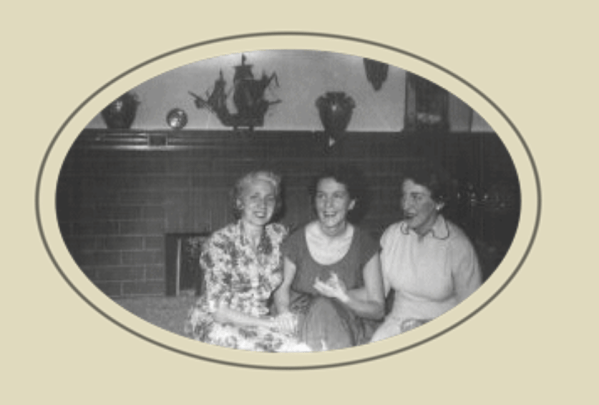
1955, My mom with her sisters.

And mixed in with the fin-de-siecle family treasures were her many multi-media artworks: sculptures, ceramics, watercolours. There were quite a few confusing (to me) religious subjects like bleeding hearts but also some adorable cherubim and many nature studies especially of flowers, birds and butterflies. Indeed, Cecile painted an immense peacock in full display on a wooden blind on the wall behind her bed. The tension between Eros and Thanatos in her beautiful Beaconsfield Avenue abode was quite evident to me, even as a child.

My mother had a very choppy relationship with her sister Cecile so even though we lived but a short bus ride away we didn’t visit her that often. – and I don’t recall her ever visiting us. Cecile’s hair went from red to grey between 1960’s visits I recall.

On at least one occasion I was sent on a sleepover. My aunt was awkward with me and I was determined not to like her, probably picking up on my mom’s vibes. It didn’t help that Cecile brought me to a scary Latin mass at Notre Dame Cathedral, pinning a silly handkerchief to the top of my head. Unfortunately, she did no art with me. Too messy I guess. Too bad as she was a wizard with pastels.

Cecile passed away in 1974 a year or two before her aged spouse. She was 65. My mother sobbed with grief at her passing. “You were always fighting with her,” I recall saying to my mom. “So why are you crying so much?” How naive of me.

All of the family heirlooms fell into the hands of ‘strangers’ upsetting my mother, but one lost canvas pained her in particular. “It was Cecile’s best painting,” she said, “of Alice putting a flower in Florida’s hair before a dance.”

Classic! I can hardly blame my mother for coveting that particular oil painting, one that involved all of her sisters: I wonder who owns it now.

  1. Mon Oncle Amedee was so comically vague in his dotage, seated in his armchair snoozing away with an upside down Le Devoir newspaper folded onto his lap, we children assumed he was expert in some airy-fairy field like ancient philosophy. But, no, quite the opposite. A short search on the Web reveals that in the 1920’s Amadee was a civil engineer, Dean of a Technical College and expert in technical education giving lectures, meeting with policy makers, even writing a book.

Bon Soir et Dors Bien – Good Night Sleep Well

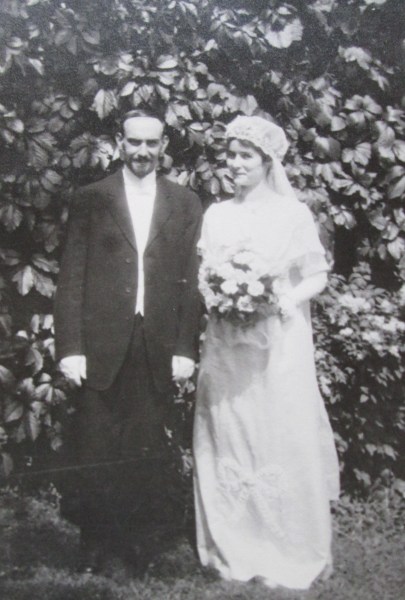
Rene Raguin & Beatrice Bruneau Wedding 1912

“Bonsoir et dors bien”, is how my mother ended her nightly phone calls with her parents. These were some of the few French words I ever heard her speak, which was strange as French was both her parent’s mother tongue. Why did we only speak English?

René Raguin my grandfather, was from Fleurier, Switzerland and came to Canada to teach at the French Protestant school in Pointe aux Trembles, Quebec. He later taught in Trois Rivieres and finished his career at Baron Byng, a school of the English Protestant School Board of Greater Montreal. He also taught teachers how to teach French at McGill University’s summer school.

Beatrice Bruneau met René Raguin when they were both teaching at the Pointes aux Trembles school. This was the one French Protestant school in the Montreal area. Grannie as we called her, descended from French Canadian stock, although born in Green Bay Wisconsin. Her father Ismael Bruneau was a French Presbyterian minister. Her mother Ida Girod was a French speaker from Switzerland and also a Protestant.

René spoke English fluently but with a heavy accent. He always used English when talking with us, his grandchildren and we called him Grandfather. I always wondered why he never communicated with us in French as a French teacher. One much older cousin Don Allchurch, always referred to him as Grandpère as he did speak to him in French.

Beatrice’s father Ismael Bruneau, was “pure laine”, French Canadian through and through. His early ancestors arrived in Quebec from France in the 1630s. His family of Catholics converted to Protestantism in the 1850s and that is where the English crept in. Ismael wasn’t thrilled to speak English as he wrote to his youngest sister Anais, “I write to you in English, dear sister, not to show you I can write a few words in that barbarous language, but for your good as well as mine, for practice makes perfect.” Many of Ismael’s siblings moved to the United States, spoke English and married English speaking spouses.

French was spoken in his home but Ismael’s children all went to English Protestant schools as the French schools were all Catholic and they didn’t even allow Protestants to attend. In the family, religion trumped language. Most of his children also married English-speaking people. His two sons continued to speak to each other in French.

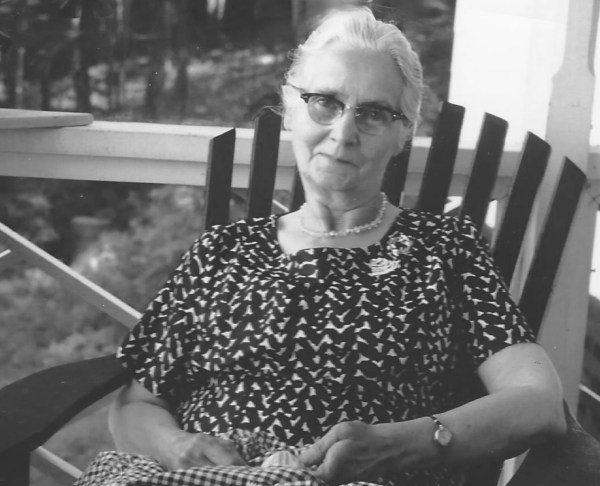
Beatrice Bruneau Raguin

My mother grew up in Dixie on the border of what is now Lachine and Dorval. It was then an English community. Because her father Rene Raguin taught for the English board they didn’t have to pay school fees and so attended English Protestant schools. The children didn’t want to speak that other language. Some evenings her father would say that only French would be spoken at the dinner table. The children wouldn’t say a word and only eat what they could reach.

Rene Raguin

The Scots and Irish immigrants who were my father’s family settled in Toronto and spoke only English. I don’t remember him speaking French to anyone. He always regretted that he couldn’t speak French. He too went to English Protestant schools.

Dorothy, Beatrice, Rene & Mary

We were schooled before French Immersion and though there was some talk about sending us to French Schools, they were still all Catholic and not a choice, so we also attended English Protestant schools.

So in a generation, the French family became English. We didn’t call my mother every night but as we left after a visit she had a new English saying, “Safe home.”

Notes:

A Short History of the Bruneau-Girod Families: Ida Bruneau Ste. Agathe des Monts, Quebec May 1993. Forbes Publications Ltd. Calgary, Canada.

My sister remembers the phrase as “Bonsoir et dors bien Maman” but I said sometimes she was talking to her father.

Ypres Gas Attack Survivor Returns Home

Part Two of Two

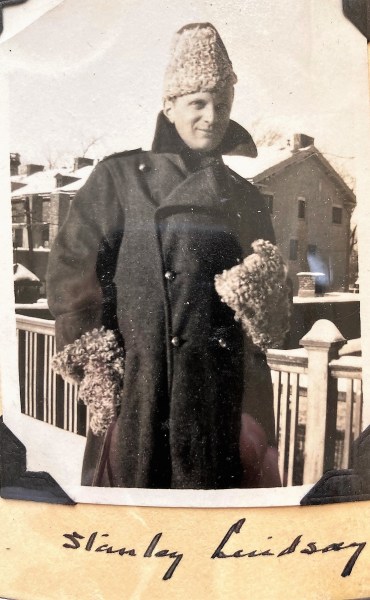
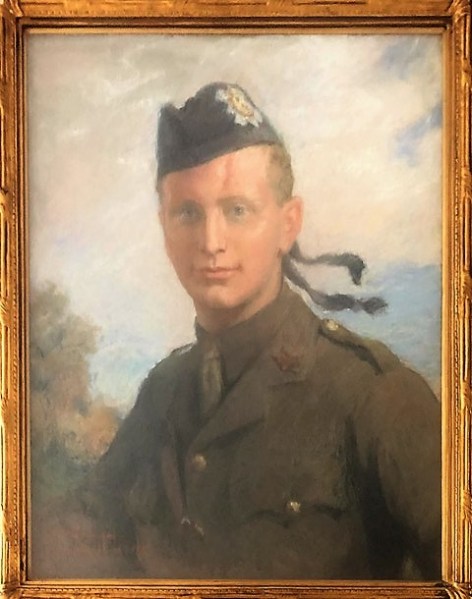
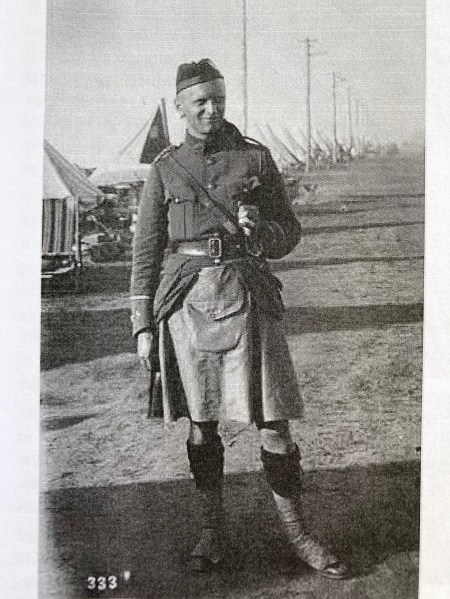
Six months after surviving the battle at St. Julien, Belgium, and the German gas attack in 1915, something entirely different brought Captain Stanley Bagg Lindsay (1889-1965) to his knees. He slipped and fell in the trenches while on active duty, and needed surgery on a hernia on his left side. He was officially declared unfit for duty and was granted sick leave to recover back home in Montreal, Quebec, for the winter.

Stanley Lindsay – winter 1916

Within months of his return to England, the hernia recurred on his right side needing immediate surgery and his health never fully recovered after that. Several bouts of influenza also plagued him throughout the war, before and after his hernias, and weakened him for the rest of his life.

He was 29 when the war ended. He returned to Montreal, but did not resume his studies at McGill University, choosing instead to follow in his father’s footsteps and become a stockbroker. His salary as a Captain had brought in an average of $142 per month during his four years of service. This translates into $3900 per month in today’s dollars. He quite possibly returned to civilian life with a decent nest egg with which to begin his new career.

Stanley’s health issues did not appear to hinder his long career as a stockbroker and eventually he became a partner at Crutchlow, Deare & Co. According to family lore, he purposefully sold off the family’s portfolio of stock investments just before the Great Crash of 1929.1 Perhaps his war experience left him with some kind of sixth sense.

Although Stanley never married, he remained close to his two brothers (and their families) and his three sisters.

Two of his sisters, Marjorie and Marguerite, had been nurses during the war with the Information Bureau,2 a Canadian Red Cross organization in London which cared for Canadian soldiers. Marguerite died young in Cartwright, Labrador, in 1926 while volunteering with the Grenfell Mission.3

Stanley lived with Marjorie and their parents at 455 Sherbrooke Street West (previously known as The Prince of Wales Terrace) until their father’s death in 1931. Then they moved with their mother into an apartment at 1009 Sherbrooke Street West until her death in 1938 and remained there until their own deaths: Marjorie in 1961 and Stanley in 1965. His eldest sister Ada lived in Vancouver with her husband Julius Griffith and their only son, Julius, who became a well known Canadian artist.4

Stanley’s two brothers – my grandfather Sydenham5 (an Anglican priest) and Lionel (a pediatrician) – provided him with ten nieces and nephews to spoil. He absolutely adored my mother Ann and showered her with his love and gifts. He must have been devastated when she died of Hodgkin’s Disease at the age of 36 in November, 1961, having lost his sister Marjorie earlier that year.

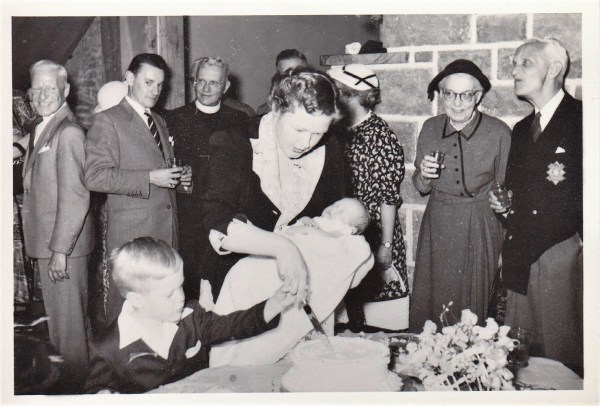
Stanley Lindsay (far right) at Ann’s baby’s christening party 1953

Luckily for me, he devoted his free time to the family history. I have pages upon pages of his beautifully (legible!) handwritten notes about that side of our family. All the usual dates and facts were recorded, but in a clear, more descriptive fashion.

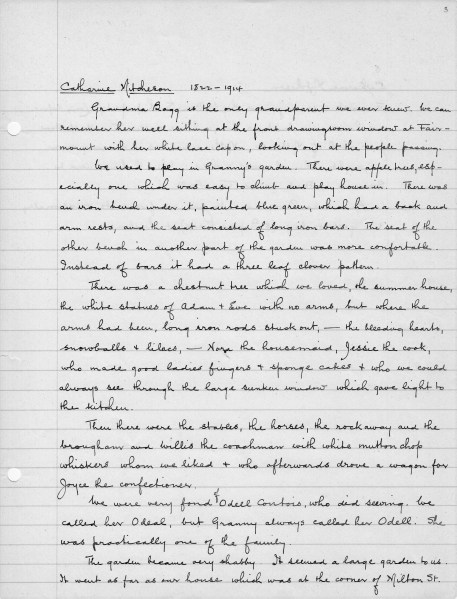
One of his pages about his grandmother, Catherine Mitcheson Bagg, recalled a visit to her home as a boy:

We can remember her well sitting at the front drawing room window at Fairmount with her white lace cap on, looking out at the people passing.

We used to play in Granny’s garden. There were apple trees, especially one which was easy to climb and play house in. There was an iron bench under it, painted blue green…. There was a chestnut tree which we loved, the summer house, the white statutes of Adam and Eve with no arms, … the bleeding hearts, snowballs and lilacs … Nora the housemaid and Jessie the cook, who made good ladies fingers and sponge cakes and who we could always see through large sunken window which gave light to the kitchen.

There were the stables, the horses, the rockaway and the brougham and Willis the coachman with white mutton chop whiskers whom we liked and who afterwards drove a wagon for Joyce the confectioner. We were very fond of Odell Comtois who did sewing…. She was practically one of the family.

The garden became very shabby. It seemed a large garden to us. It went as far as our house which was at the corner of Milton Street. The west side adjoined the Wilson-Smith property. Long before our house was built, a large house called Tara Hall stood just north of Milton Street. Mother [Mary Heloise (Bagg) Lindsay] remembers it burning down one night when she was a child. Where the house used to stand is a street called Tara Hall.”

As well as being everyone’s favourite uncle, an excellent family historian and a successful stockbroker, Stanley belonged to several local clubs including the Canadian Club, the University Club and the Royal Montreal Golf Club.6

After almost dying at Ypres during the Great War, Stanley lived another fifty years.

1https://wiki2.org/en/The_Crash_of_1929 – as referenced 2023-02-23

2https://genealogyensemble.com/?s=the+mothering+bureau

3https://genealogyensemble.com/2022/07/27/miss-lindsay-the-early-years/

4https://www.gallery.ca/collection/artist/julius-griffith – as referenced 2023-02-23

5https://genealogyensemble.com/2016/04/05/the-priest/

6Obituary – The Gazette, 1965-03-03

Tribute to Joan Benoit

With great sadness, we recently learned of the death of Joan Benoit of Pointe Claire, Quebec in late 2022. Joan was a devoted genealogist and volunteered and helped run the Quebec Family History Society (QFHS) for over thirty years. Ever patient, she helped both the experienced and novice genealogist in their research. She was the “go to” person when anyone had a question. In the words of Claire Lindell:

“It was spring of 2012 when I walked in to the QFHS. Joan greeted me with a smile and made me feel welcome. She offered to help me with my quest for ancestors. She took Rene Jetté’s big blue dictionnaire from the shelf and asked me the names of those I was searching. Within minutes I found my mother’s ancestral family … Claude Jodouin who arrived in Ville Marie in the mid 1600s. I was off to the races and have never looked back, thanks to Joan.”

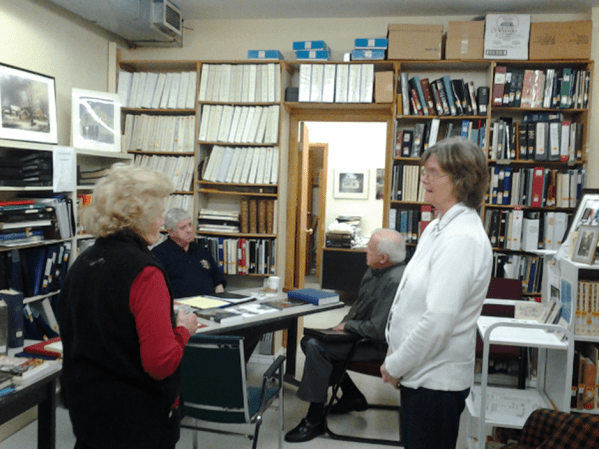
Ruth Dougherty (left) and Joan Benoit (right) chat in front of Earl John Chapman who is seated at the table speaking with Oskar Keller during Military Roots Day, 2012, at the QFHS.

Joan’s extensive knowledge, accompanied by a warm smile, has helped numerous researchers over the years. Many of her fellow genealogists became her friends. As well as being an avid researcher, she also had a vision of what was needed to promote genealogical research and always accepted the challenge to do what was needed. For approximately twenty years Joan was a well-known visitor to the Archives nationales du Québec on Mullins Street in Pointe-Saint-Charles and later the Archives nationales on Viger Square in Old Montreal. She researched hundreds of family lineages.

Jacques Gagné and Joan Benoit enjoyed a friendship of many years, which Jacques says can best be described in Proverbs 27:17, “As iron sharpens iron, so one person sharpens another.” In other words, good friends bring out the best in one another and enhance each other’s strengths.

Joan’s quiet presence, always supportive, will be sorely missed.

Dusty Old Boxes

*Note: This seemed like the perfect time to publish this story again. If you’re lucky, you may inherit a box of family papers someday…and if you’re smart, you will take the opportunity to ask for them when you see everyone over the holidays!

************************************************************************

The latest de-cluttering expert tells us to keep only things that give us “joy”1. All other items should be thanked for their purpose or memories and then given away. At the end of this challenge all that should remain are the things that spark joy in us!

We are told to start with clothes, then books, kitchen cupboards and desktops. Only then, after all that practise detecting feelings of joy over an item, will we be ready to tackle family photos and personal memorabilia.

On the highest shelf of my largest cupboard were three dusty old boxes that I inherited many years ago. They were to be the last step of my de-cluttering project!

I slowly opened the lid of the first box finding lots of old photographs, mostly black and white, some labelled and others not. The first handful of photos was mostly of loving couples and family reunions at the dinner table. Others showed groups of people standing proudly on the front step of a house (a new home perhaps?). The next scoopful were of children at play – sometimes holding family pets in their arms. Another handful produced proud young adults smartly dressed in various uniforms – perhaps starting a new job or ready to go to war. The last bunch showed lazy days on sandy beach holidays, numerous birthday party celebrations and Christmas gatherings.

Frozen moments captured in time from so long ago for me to enjoy now. It all felt so precious. I very gently placed the photographs back, undisturbed, into that first box.

Nothing to be given away.

The second box was filled to the brim with letters and cards. Some still neatly tucked into their envelopes, others held together with yellowing scotch tape and looking well fingered. Most of them had handwritten messages in big loopy writing that was difficult to read. The stamps alone told another story postmarked from places and dates from years ago. Among the letters were also children’s drawings, thank you notes, lists of party guests, festive menus and various well loved recipes.

But my very favourite find in this box were the love letters, written with such passion and lovingly folded into perfect little rectangles and decorated with doodled hearts.

Nothing to be given away.

The last box contained newspaper clippings announcing family births, deaths, weddings and other special events from all my ancestors over the years. And then, underneath all that newspaper, I discovered more treasures!

First, my grandmother’s monogrammed lace handkerchief with a tiny baby’s christening dress complete with a lock of hair tied in a ribbon and stored in a small envelope. Then I picked up the old school primer (book) and several dried flowers fell to the floor. Neatly stored in the bottom were numerous diaries filled with daily messages with the writing continuing up the sides of each page. Finally, carefully folded in tissue paper was an old sampler stitched by my ancestor, as a young girl two hundred years ago. Several of my family’s treasures (and perhaps a little piece of them?) had been lovingly preserved in this last box.

Nothing to be given away.

As I closed the lid on the last box, it dawned on me that someone had already sorted the family memorabilia into those three separate boxes, leaving me to find…three dusty old boxes of pure joy.

1 Spark Joy by Marie Kondo

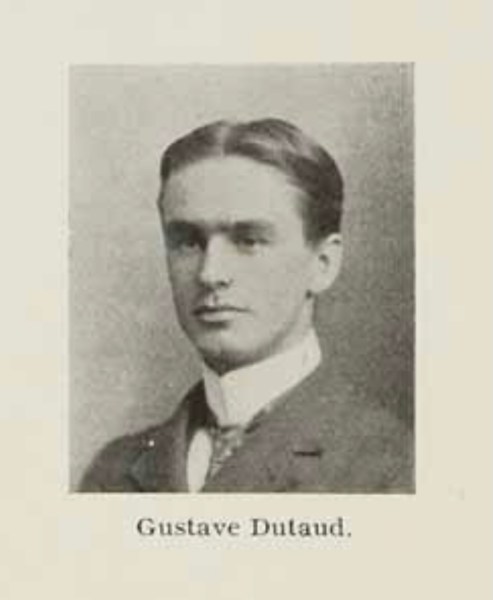
Gustave Dutaud The Lawyer

Gustave Dutaud, a member of the Bruneau family, was my grandmother, Beatrice Bruneau Raguin’s first cousin. I hope they knew each other as both lived in Montreal and from what I have found out, Gustave was worth knowing!

He was well-liked and well-respected as per messages in newspapers after his death. “There is a sense of loss when good men die, something goes from the richness of the world, something we can ill spare. Such is the feeling aroused by the death of Gustave Dutaud.” according to Marguerite Cleary.

“ If he was not conventionally religious he was a fine example of a French Canadian Christian, whom to know was a rare privilege.” said George Hosford.

His mother Virginie Bruneau, was 38 when she married Francois Dutaud and they only had one child. Gustave attended the Feller Institute, in Grande Ligne, Quebec south of Montreal, the school founded by Henriette Feller for French Protestants. She along with Louis Roussy came to Canada from Switzerland as missionaries, to convert the French Catholics. Gustave’s grandparents, Barnabé Bruneau and Sophie Marie Prudhomme heard their gospel and converted in the 1850s along with their children.

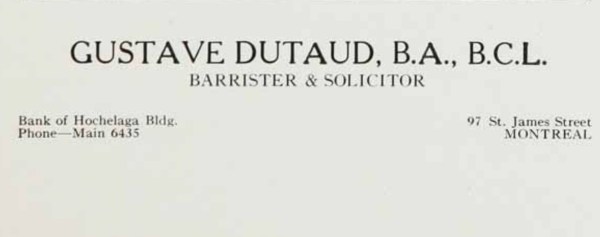
Gustave later entered McGill University where he obtained a BA in 1903 and a Bachelor of Civil Law (BCL) in 1909. He worked as a reporter for the Montreal Gazette while completing his law degree. He was a KC (Kings Consul), an official interpreter for the Court of Kings Bench and practised from his own law firm.

“He had a lion’s heart for anyone who suffered under injustice.” Much of his legal practice concerned a number of social welfare organizations including the Society for the Preservation of Women and Children. He was interested in the troubles of the poor and used his legal training to help them out of difficulties. Gustave won a case for a woman hit by a car on Sherbrooke Street and McGill College, where the driver blamed the pedestrian for the accident.

He lead a busy life. He was a member of the Montreal Reform Club, the goal of which, according to its 1904 constitution, was “the promotion of the political welfare of the Liberal party of Canada.” Also a member of the Knights of Pythias organization which believed, “It is important to promote cooperation and friendship between people of goodwill. One way to happiness is through service, friendship, charity, benevolence and belief in a supreme being.”

In 1923 Gustave took his first trip to Europe. He accompanied the Montreal Publicity Association to a London convention as their honorary legal adviser. Aside from his time in England he also toured France and Scotland. “He returned to Canada more than ever convinced of the desirability of this country as a place in which to live.” He was amazed at the poor living conditions of the French peasant farmers. He described the French Chateaux as, “picturesque but uncomfortable, much nicer in pictures than as places to live.” The French wanted to replace war-damaged stone buildings with the same and not live in stick-built houses common in Canada.

Europe was still suffering after World War I. The group visited the battlefields of France. Gustave found “Verdun a sinister expanse of horrors surrounding a miserable medieval town, which had been destroyed by shell fire. There were still many ghastly reminiscences of the war. A trench where many of the French troops had been buried alive and where the soldiers still stood buried, with the tips of their riffles and bayonets protruding from the ground.”

“The finest things he saw in Europe were the masterpieces at the Louvre while the beauty of Scotland entranced him, as quite the most lovely country visited, more so even than his ancestral France.”

His compassion for people included his parents. They moved to Montreal to live with him after his father became ill. His mother stayed with him after his father’s death, until she died in 1926. Unfortunately, Gustave never married or had children, so when he died in 1949, another line of the Bruneau family ended.

Notes:

Montreal Star, 11 July 1949 page 10. Newspapers.com accessed April 22, 2022. George Hosford. George Hosford roomed with Gustave and later was warmly received at his home and office.

Montreal Star July 7. 1949 Letters to the Editor page 10. Newspapers.com accessed April 22, 2022. Marguerite Cleary. She recalled Gustave Dutaud as a man with a mind that was noble, not conventionally religious, a lover of Anatole France, he expected little from humanity and sided by nature with the underdog, a gentleman.

Gustave Dutaud Obituary: Gazette, Montreal Quebec, Canada. June 25, 1949. Page 15. Accessed from Newspapers.com April 19, 2022.

Old World Living Conditions Poor: The Gazette (Montreal, Quebec, Canada) · 12 Mar 1925, Thursday, Page 6. Accessed from Newspapers.com April 19, 2022. Gustave’s trip to Europe.

McGill Year Books: https://yearbooks.mcgill.ca/browse.php?&campus=downtown&startyear=1901&endyear=1910 Accessed November 21, 2022. Gustave Dutaud McGill BA 1903. He was also in the Drama club while obtaining his BA, and one of only seven students in third year law. Gustave advertised in the 1916 year book as Barrister and solicitor.

Quebec Heritage News: 

The Montreal Reform Club, at 82 Sherbrooke St West, used the building as its city headquarters for half a century. Established on June 17, 1898, the Reform Club was the social wing of the Liberal Party of Canada, and its provincial wing in Quebec. By 1947, the club counted a remarkable 850 members, 670 French-speaking and 180 English-speaking. 

The irony, of course, is that since April of 1973 the building has belonged to the nationalist and pro-independence Société Saint-Jean-Baptiste de Montréal. On May 17, 1976, the SSJB renamed the property La Maison Ludger Duvernay, in honour of the founder of the Society. The Société Saint-Jean-Baptiste de Montréal has never complained of the presence of frightening federalist ghosts within its walls!

https://en.wikipedia.org/wiki/Anatole_France accessed November 27, 2022.

Anatole France: French poet, journalist, and novelist with several best-sellers. Ironic and skeptical, he was considered in his day the ideal French man of letters. He was a member of the Académie Française, and won the 1921 Nobel Prize in Literature, in recognition of his brilliant literary achievements, characterized by a nobility of style, profound human sympathy, grace, and a true Gallic temperament.”

The Debutante

This month a Montreal tradition will resume after a two-year pandemic break: the annual St. Andrew’s Ball will take place at the Windsor Hotel on November 18. The event promises to be “a gala evening of dining, dancing and Scottish pageantry, celebrating Scottish heritage in Montreal,” featuring the Black Watch Pipes and Drums and highland dance performances.

My mother attended this event in 1937, the year that, despite her protests, she was a debutante. Writing under her married name, Joan Hamilton, she recalled that experience 40 years later, and her article, published in Montreal Scene magazine on November 26, 1977, described the endless social gatherings she and her teenage friends attended.

In those days “coming out” didn’t mean what it does today. Then it meant that a young woman of 18 was introduced to society, and to members of the opposite sex, which was important because my mother and most of her friends attended separate private schools for girls or boys.

She wrote, “For a tightly-knit group of Montrealers whose growing up took place in the mid-30s, life consisted of a round of parties that started with events called sub-deb dances and progressed to coming-out balls. Actually, they weren’t as grand as they sound. Life was simpler then, and one lived by a strictly prescribed social code. The sub-deb parties were given at private homes, primarily during the Christmas holidays, and the ages of the future debutantes ranged from 14 to 17.” When the girls became debutantes, the parties became balls.

Although many Canadians were suffering economically during the Depression, my mother recalled that there were dozens of debutantes each season, and there was a ball at least once, and sometimes twice a week from October until February. Many debutantes came out at their own parties, but others were presented at either the St. Andrew’s Ball or charity balls put on by the Royal Victoria Hospital Auxiliary. At that time, most of the balls were held at the Winter Club on Drummond Street, the Hunt Club on Côte Ste-Catherine Road, or the ballroom of the Ritz-Carlton Hotel. The St. Andrew’s Ball took place at the Windsor Hotel.

In Montreal the St. Andrew’s Ball was first held in 1848, but some members of the society preferred a dinner for the men only, and the next ball wasn’t held until 1871. When it next took place, it was described as “the social event of the year,” probably because Queen Victoria’s daughter Princess Louise and her husband were the guests of honour. Over the following years, Montreal’s Scots sometimes celebrated St. Andrew’s Day with a banquet or a concert, and the society did not choose a ball as its principal event until 1896.

According to the Montreal Daily Star, more than 900 people—a record—attended the 1937 edition of the St. Andrew’s Ball, including the Governor General of Canada and his wife, Lord and Lady Tweedsmuir. “Merriment reigns as sons and daughters of auld Scotia lay aside their cares,” the newspaper headline announced.

In the ‘30s, the debutantes wore long white evening dresses and white, elbow-length kid gloves, while their escorts were in white tie and tails. The evening began with dinner parties, with cocktails and wine served. On arriving at the ball, the guests went through a receiving line so the proud parents of the debutante in whose honour the party was being held could introduce her. Then the dancing began, with music provided by an orchestra. Supper was served around midnight, accompanied by champagne.

“One’s partner at dinner was supposed to, and usually did, have the first and last dance and escort you to supper, as well as take you home,” she recalled. “It was a good security blanket.” My mother was not one of those girls who was so popular with the boys that her dance card for the evening was always full. In fact, she hinted that she spent a fair amount of time in the ladies’ room, pretending to be invisible. Nevertheless, she wrote that her teen years were a lot of fun, going to movies, picnics and corn roasts in the summer and taking the train to the Laurentians to go skiing in winter, after the party season had wrapped up.

Two years later life changed for everyone, and some of the young men who had attended those parties went off to war and never came back. Nor did my mother marry one of the boys she was introduced to as a debutante; my parents met in Ottawa, where they were both working, just as the war was ending.

This article also appears on https://writinguptheancestors.ca

Miss Lindsay – The Early Years

Miss Marguerite Lindsay embraced her short life fully for 26 years before she volunteered with the Grenfell Mission and died tragically in Labrador.

Marguerite was the youngest of the Lindsay’s six children. Her father was a stockbroker who later took an active interest in philanthropy – especially the Montreal arts. Her mother actively took part in Church of St. John the Evangelist in Montreal while raising her family. They were one of the prominent English Montreal families at the time and considered to be upper middle class.

At one point the family maintained two homes – their life long home in Montreal at 455 Sherbrooke Street West* and also one in London, at 8 Radnor Place in Hyde Park, acquired at the beginning of the war in 1914.

Marguerite Lindsay – London- 1909

She grew up privileged and loved.

The 14-year span between her and her eldest sibling meant she had the advantage of being doted on by the whole family. Her three brothers were gentlemen and “gentle men” who loved their baby sister dearly. Her eldest sister Ada married and moved to Vancouver and her other sister Marjorie remained single having missed out on her one true love when her parents denied her move to South Africa. Perhaps this enabled Marguerite to pursue her life and interests more freely as Marjorie remained at home with their parents.

The Montreal newspapers, at the time, covered social events that interested the general public. Luckily young Marguerite and her family actively took part in many of these events and her name popped up several times in my research.

Here is an example of the activities during her teenage years:

  • 1910 – Volunteered at the Victorian Order of Nurses (VON) benefit.
  • 1911 – Enjoyed a New Year’s visit to Kingston with brother and mother to visit the Bishop and his family.
Marguerite Lindsay – 1912 – Sweet Sixteen

1915 – Assisted with flower pergola for military tattoo

1916 – Assisted in the sale of candy and small painted programs with Alison Aird at Her Majesty’s Theatre

1916 – Assisted at fundraiser tea for Grenfell (!)

1916 – Volunteered with the Christ Church Guild in charge of fancy (needle) work.

1917 – Assisted with the Red Cross tea and art gallery with special exhibit on war trophies.

1918 – Bridesmaid at friend’s wedding.

1918 – Holiday time at Laurel House NJ with her brother and mother.

1918 – Went to Kingston to visit Bishop Mills and family again.

Marguerite and brother Sydenham (my grandfather) – 455 Sherbrooke Street West – 1917

When Marguerite returned home after her nursing career during The Great War, not surprisingly, there were more women than men. The women’s rights movement had already made progress for women’s suffrage, education and entry into the workplace so there were many opportunities for young women other than marriage.

Now an experienced and mature single lady in her early twenties, she enjoyed the whirlwind of society and, once again, the local newspapers covered it all!

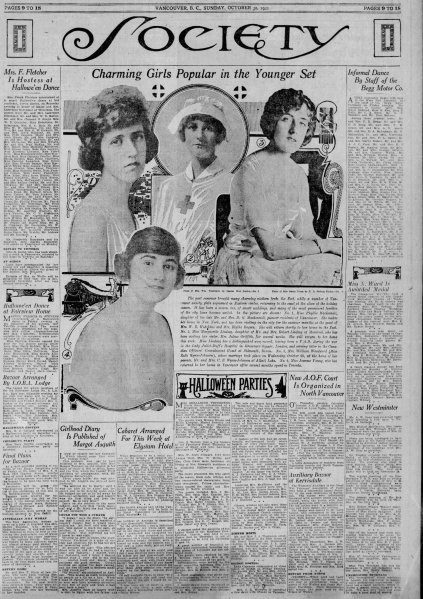
In October 1919, she attended the Prince of Wales Ball and Dinner as one of the 1100 guests. A few months later, her mother hosted a ball for her and her older sister, Marjorie (age 30), at the Ritz Carlton Hotel … probably for them to meet young men and increase their marriage prospects! Later that same year, she enjoyed an afternoon reception held by Commander Ponteves and his officers onboard a French frigate sent to Montreal for the St. Jean Baptiste festivities and yet another dance at the Ritz Carlton … this time for Mrs. Godfrey’s daughters (probably also looking for husbands).

The last year before her death (August 1922) was a busy one. Early in 1921, Marguerite travelled to Lake Manitou in Ontario with her brother Stanley for a weekend of skiing and skating with her friends, the Airds. She then joined the Aird family for “some weeks” in Italy during April and May.

Back she sailed to Montreal in June in time for her oldest brother Lionel’s wedding – and then onto Vancouver for an extended visit with her sister Ada and her family. Whew!

Vancouver society happily welcomed the Montrealer and this was some of her itinerary during her four month visit!

July 7 – Attended a tea to honour the Dame Nellie Melba, an Australian Opera Singer, along with her sister Ada and her aunt Mrs. Herbert Drummond.

Aug 5 – Attended a tea hosted by Mrs. McCrae of Hycroft Manor in honour of the visiting naval officers on the U.S. Battleship Tennessee.

Oct 14 – Assisted at a tea given at the Jericho Club in honour of Mrs. Cornelius Vanderbilt.

Oct 17 – Attended a luncheon with the Kumtuks Group who gave an interesting presentation entitled “A glimpse at the timber resources of British Columbia”.

Oct 22 – Attended a dinner party and informal dance at the Jericho Club again.

Oct 28 – Attended the annual Halloween fancy dress and masquerade at Glencoe Lodge.

Oct 30 – “Miss Marguerite Lindsay, daughter of Mr. And Mrs. Robert Lindsay of Montreal, who has been visiting her sister, Mrs. Ada Griffith, for several weeks will return to her home this week. Miss Lindsay has a distinguished war record, having been a V.A.D. during the war in Lady Juliet Duff’s Hospital in Grosvenor Square, London, and serving later in the Canadian Officer’s Convalescent Home at Sidmouth, Devon.”

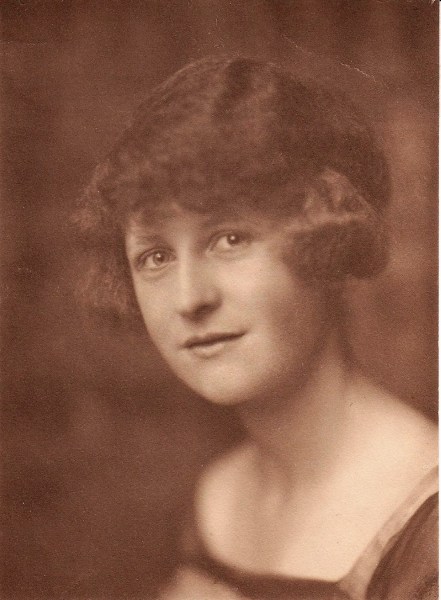
Marguerite Lindsay – October 29 1921 – Vancouver

And at the end of her four month visit, the following glowing tribute was published in a Vancouver newspaper:

“It is always sad when people go, and no one will be more missed than Miss Marguerite Lindsay, who also leaves today. She has been spending the summer with her sister, Mrs. Julius Griffith. She is just full of life, and keen on everything, dancing, tennis, bridge and golf, so has been in great request everywhere.” (Vancouver Daily World, Society Page, 29 October 1921)

Here are all the links to Miss Lindsay’s story:

Miss Lindsay’s Last Letter

how i came to write miss lindsay’s tale

Miss Lindsay – Part 1

Miss Lindsay – Part 2

Miss Lindsay – Part 3

* previously 6 Prince of Wales Terrace and then finally changed to 1009 Sherbrooke Street West

The Goddesses of Expo67

My mother-in-law’s Expo passport. My husband’s family didn’t go to Expo often; there was a summer marriage.

I remember 1967 as the best of year of my childhood. In the US, 1967 was the Summer of Love (flower-in-your-hair hippies) and of war (Vietnam draft dodgers) and of civil unrest (inner city riots) but in Canada it was our Centennial Year, the 100th anniversary of Confederation. For children across the nation it was an especially giddy year: educators from coast-to-coast were teaching their charges how to sing Bobby Gimby’s exuberant CA-NA-DA song, “one little, two little, three Canadians. We love you. Now we are twenty million.”

For Montrealers like me, it was the summer of Expo67, our fabulous world’s fair, situated just a short bus and metro ride away on two man-made islands in the Saint Lawrence River.

I visited Expo 50 times, if memory serves. I sometimes went by myself and I was only 12 years old!

I could go whenever I pleased because I was in possession of a shiny red passport that cost a whole 17 dollars. With his passport you could go from pavilion to pavilion and get it stamped, just like travelling the world.

I no longer have the passport, but it was not lost. My passport was given away by my mother to a beautiful young African woman – and this is how it came about.

Mentewab (probably) at the coffee bar from a Youtube Video
(See notes 1)

A friend of my mother’s had gone through official channels offering to chaperone Expo hostesses from foreign countries. Two Ethiopian hostesses, Hanim and Mentewab, were suggested to her. My mother got into the act and the two girls soon regularly visited our Snowdon home.

Hanim was shy and wore a caftan and hijab. Mentewab was ‘wild’ and wore a halter top, micro-miniskirt and white go-go boots when not in her official costume.

I do not recall having any specific conversations with these young ladies, but I can still see in my mind’s eye their pretty faces as they sat so graceful and ‘grown-up’ on our brown corduroy living room couch, Mentewab so animated, Hanim so quiet.

These women seemed to exotic to me: the reporter in the Gazette had called them ‘goddesses’ after all.

Hostesses from Montreal Star Insert. The media focused a great deal on the attractive and accomplished hostesses of Expo, from Canada and beyond.

I doubt that they were as impressed with us and our dingy upper duplex apartment. These girls must have been from the elite classes to have been chosen to host at Expo.

As it happens, on May 2, I caught a glimpse of their leader, Haille Selassie, as he passed through the Expo crowd to polite applause, a small, very proud-looking man followed by a tiny little dog, Lulu the Chihuahua, whose short legs were working very hard to keep up with her master. My mother, who admired powerful men, was very excited. “The Lion of Judah” she sang out as he passed.

On cold rainy days at Expo I spent a great deal of time in the coffee bar at the Ethiopian Pavilion, a shiny red tent with lion cubs on guard, probably pestering Hanim and Mentewab big time.

And then, in mid-October, Expo was over. I guess the women visited us one more time because that is when my mother gave MY Expo passport away to one of the girls. Upon learning that Mentewab or Hanim didn’t have a passport of her own, she merely grabbed mine and said, “Take this one.” (At least, that is how I remember it.)

Sometimes I wonder if Mentewab and Hanim are still alive (why wouldn’t they be, they were hardly older than me) and whether one of them, living in Addis Ababa or Paris or New York City, occasionally opens a drawer crammed with Expo67 memorabilia and shows to her many grandchildren a shiny red passport belonging to a pimply, brown-haired Canadian girl called Dorothy Nixon – and wonders, in turn, where I am today. I’d like to think so.

A World of Education. No kidding. The copy here acknowledges that Canada is multi-cultural the visuals not so much.
Ethiopian Stamp that was really a stamp.
My husband may not have visited Expo much, but he did keep the newspapers from the opening.
  1. A video about the Ethiopian Pavilion with images of Hanim and Mentewab (I assume) is here.https://www.youtube.com/watch?v=XQAbaRTki-g

Black Market Baby

In 1984, at the age of 35, Harold Rosenberg discovered he had been adopted. Fourteen years later, he found out who his birth mother was – or so he thought. Today, he is still searching for his roots.

His adoptive parents never told him he was not their natural child, and both were already deceased when he learned the truth. His cousin Dinah, who was almost a generation older than him, could only recall that a Mrs. Baker, a matchmaker in Montreal’s large Jewish community, had done Harold’s adoptive father a favour and found the baby. The Rosenbergs had paid Mrs. Baker $1800 to make the arrangements.

Harold Rosenberg, age 8, in 1957.

Harold, who is my husband, tried to find out more, but there were no official records of his adoption and even the record of his birth kept by the synagogue was fake. He followed many false leads and ran into brick walls everywhere he turned.

In 1998, he opened The Gazette to see a front-page article about a group of women who had gathered in Montreal to search for their roots. All had been adopted into Jewish families, most eventually discovered that their birth mothers had been Catholic.

The article described a black-market baby ring that operated in Montreal in the late 1940s and early 1950s, trafficking about 1,000 babies to adoptive parents in Canada and the United States. A small group of doctors, lawyers and various intermediaries arranged these adoptions for childless Jewish couples who could not find babies through regular adoption channels. At the time, it was illegal in Quebec to adopt a child from another religion, and, while there were no Jewish babies available, there were lots of Catholic ones. Most of these babies were delivered at a handful of private maternity clinics in Montreal. The money went to the doctors and the people who arranged the adoptions, or who turned a blind eye to the transfer of small bundles. The mothers were not paid, but they were able to stay for free at the clinics during their last weeks of pregnancy, and they did not have to worry about medical costs.

When the ring was busted in 1954, The Gazette reported, several lawyers and a woman named Rachel Baker were arrested. Suddenly, Harold realized that Mrs. Baker did not just find a baby for his parents, she arranged for many under-the-table adoptions.

Years later, his cousin Moe told Harold that he had seen a tiny hospital bracelet with the name “baby Boyko” in the Rosenbergs’ safe deposit box, and he recalled that a girl named Mary Boyko had lived in his neighbourhood. Harold checked a list that a volunteer researcher had made of single mothers who gave birth in the late 1940s, and there was the name: Mary Boyko. She must have been his birth mother!

Harold asked a friend, a retired police detective, to look for her. It was a challenge because Mary had married someone named Tremblay, and Tremblay is one of the most common family names in Quebec. Nevertheless, three days later, the friend phoned to say that he had found her. Unfortunately, she was deceased, but he had tracked down her husband and her son. They said they had been looking for Mary’s baby for years, and they couldn’t wait to meet him.

Harold became good friends with his new-found half-brother, Sonny Tremblay. All the pieces seemed to fit, except for a few minor details. Meanwhile, he became an unofficial spokesperson for black market babies, participating in television documentaries in English and in French, and being interviewed for newspaper and magazine articles. He hoped to help other adoptees, as well as their birth mothers, learn the truth.

Harold in 2022

In 2020, our sons persuaded Harold to try to find his birth father. He did a DNA test, and he asked Sonny to do one also. Everyone was shocked when the results came back – they were not related! Just to be sure, Sonny’s cousin also took a DNA test, and it confirmed that the cousin is related to Sonny, but not to Harold. He then hired genetic genealogist Mary Eberle, of DNA Hunters, to help him make sense of his DNA results. He had many matches, but no one closer than a third or fourth cousin. Clearly, Harold is of Eastern European descent, and his birth father was probably Ukrainian. Many of his matches on his father’s side live around Cleveland, Ohio, an area where many Eastern Europeans settled.

Recently, he made a big break-through and got in touch with Lynne, a woman in Cleveland with whom he shares a whopping eight percent of his DNA. She is probably a first or second cousin and has been delighted to help out. Harold is still not sure who his birth father was, but at least he now has a genuine, close genetic cousin.

As for the identity of his birth mother, that remains a mystery. Was Harold really born at a Montreal hospital, as his cousin told him? And what should he now make of the story of the baby bracelet and the name Boyko?  Hopefully, he will find out some day soon.

This article is also published on my own family history blog, https://www.writinguptheancestors.ca.

Further information:

Ingrid Peritz, “’Black-market babies’ seek Montreal roots,” The Gazette, May 9, 1998, page 1, www.Newspapers.com

Adam Elliott Segal, “Black Market Babies”, Maisonneuve Magazine, July 18, 2017, https://maisonneuve.org/article/2017/07/18/black-market-babies/

CTV News Montreal, “Special Report: Black Market Baby”, Dec 18, 2017, https://montreal.ctvnews.ca/video?clipId=318300
This interview was done when Harold mistakenly believed that Mary Boyko was his birth mother. I have included it here anyway because it includes more background on the black-market baby ring.