Hart Island

This article is a follow-up to a recent blog entitled “Harbour Lights”.

Harbour Lights

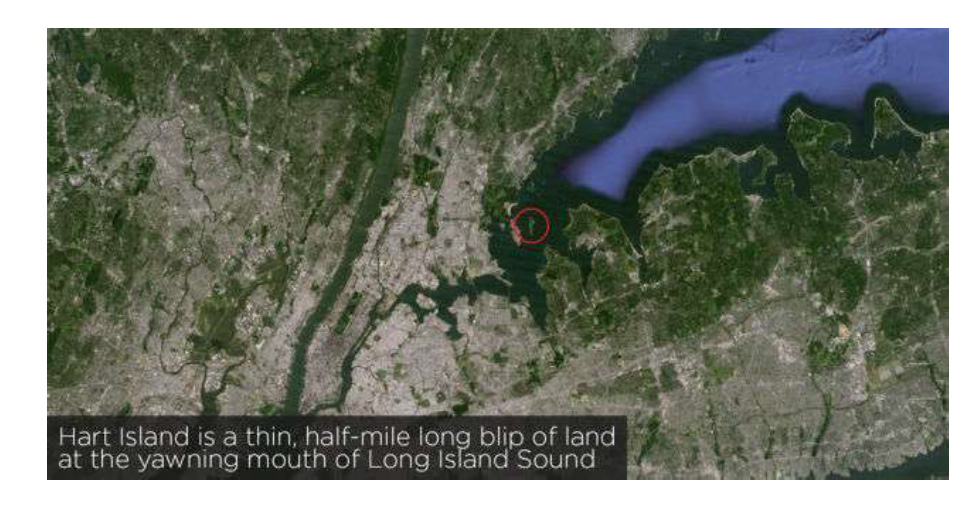
It was noted  that Alpo Hjalmar Lindell had died in the Bowery in New York City and was buried on Hart Island, a Potter’s field. Here is a brief summary of Hart Island.

Hart Island

Hart Island 1

A 101 acre potter’s field

Under the jurisdiction of New York City

Largest tax-funded cemetery in the world

Records are found on microfilms in the Municipal Archives in Manhattan

More than one million dead are buried there

Approximately 1,500 burials a year

One third of the burials are infants

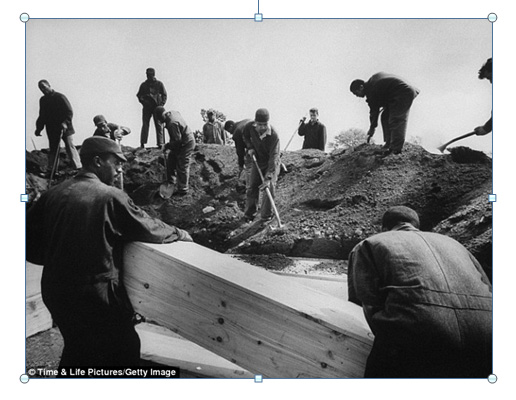
Dead are buried in pine boxes in trenches


Hart Island 2

Babies are placed in various sized coffins and stacked five coffins high

Adults are stacked three coffins high in two rows and 25 across

Trenches were used to facilitate disinterment

Ceremonies have not been conducted at the burial site since 1950

No individual markers are set

Currently historic buildings are being torn down to make room for new Mass burials that are conducted by Riker’s Island inmates who are paid 50 cents an hour

Burials are of those people who could not afford private burials

Those unclaimed within a two week period by relatives were also buried there

Burial records are currently kept within the prison system

New York City Department of Corrections created a searchable database starting in 1977

It is not possible to visit the actual grave where a loved one may be buried

There is one ferry to the island every month, other than the ferry used to transport prisoners from Riker’s Island who work at Hart Island

April 30, 2012 jurisdiction of Hart Island was transferred to the New York City Department of Parks and Recreation from the Department of Corrections


Hart Island 3

In 2008 a Freedom of Information Act request for 50,000 burial records was granted to the Hart Island Project.

“Since 1994, The Hart Island Project has independently assisted families in obtaining copies of public burial records. The group also helps people track down loved ones and negotiate visits. An ecumenical group named the Interfaith Friends of Potter’s Field has intermittently conducted memorial services on the island.”

Visit the following websites :

https://www.hartisland.net/        a video clip

https://www.hartisland.net/burial records/search/plot=317


Source for the above information:

Hart Island, New York    From Wikipedia, the free encyclopedia


Further Reading:

  • Visiting the Island of the Dead A Rare Visit to New York’s Potter’s Field on Hart Island

                By COREY KILGANNONNOV. 15, 2013   The New York Times


  • Is your family member buried on Hart Island, off the coast of New York? Sorry, you can’t visit

            PRI’s The World  February 17, 2015 · 1:45 PM EST

Reporter Alina Simone 


Presbyterian Churches of Lower North Shore and Gaspe Peninsula

Today, most of the people who live along the north and south shores of the St. Lawrence River east of Quebec City and in the Gaspé Peninsula are French-speaking. But in the late 1700s and early 1800s, after the British took New France and began to govern it as Lower Canada, they encouraged English-speaking colonists to come to these regions of Quebec. The settlers included British, Scottish and Irish Protestant immigrants, as well as Loyalists from the United States. Many of these people were Presbyterians, and the records of their births, marriages and deaths can be found in Presbyterian church archives and various other repositories.

This compilation lists the towns and villages where these people lived and identifies the churches or missions that served their spiritual needs. These communities were located in the territories of Cornwallis, Devon, Dorchester, Hertford and Northumberland. Today, these counties are known as Bellechasse, Bonaventure, Charlevoix, Gaspé, Kamouraska, L’Islet, Matane, Montmagny, Rimouski, Rivière du Loup and Témiscouata. Most of these areas were, and still are, rural, but they include towns such as La Malbaie (formerly Murray Bay), Métis, Gaspé and Tadoussac.

Eventually, many of these people left their farms and villages and moved to Montreal, to Upper Canada (Ontario), western Canada or the United States. This compilation is designed to help their descendants track these family roots in Quebec. Thanks to Jacques Gagne for preparing it, and to Claire Lindell for editing.

Presbyterian Churches of Lower Canada North Shore and Gaspe Peninsula

My friend Ruby….

……..of Morin Heights Quebec now of Dollard-des-Ormeaux, is 93 years old.

I have known her for about three years. We talk for an hour every day about her young life and all sorts of interesting subjects. I find her quite open minded with regard to religion, the latest news on the radio, world affairs and articles I download and read to her, as her eyesight is failing.

Ruby was born in Morin Flats, as it was called until 1911, when the name was changed to Morin Heights.[1] There were 5 children in the family, one boy and four girls.

Her great-grandparents were pioneers who came to the area from Ireland in the 1800’s possibly due to the potato famine. Her parents met and married and worked a cattle and dairy farm first in the 1890’s in Leopold, Quebec, but when family started to arrive they moved to Morin Heights so the children could be educated, and they ran the family farm, called ‘The Red and White Farm’ where Ruby was born.

The first settler in Morin was Thomas Seale, from Connaught, Ireland, who had started clearing his farm at Echo Lake in 1848. Families that had originated as pioneers in Gore, Mille Isles and other townships settled Morin along with emigrants directly from Ireland.[2]

The first Census in the area was the 1861 Census of Morin Flats, County of Argenteuil, Quebec, Canada and many of the 470 people named on it when I read them out to her, were familiar to Ruby either as family, friends, or neighbours’ names.[3] So it would seem the residents of Morin Heights tend to stay put!

Ruby’s family farm had four Jersey milk cows, one Holstein, which she tells me gave ‘blue milk’ which was fat free milk, one Ayrshire and 2 Clydesdale horses and some chickens. The family farmed hay, oats, corn and buckwheat. The River Simon ran through their property and Ruby often fished for perch and bass, and her mother cooked them for the evening meals. Ruby told me that they had a small spring next to the river from which her father piped water, into the barn and the house, and that the water was ‘fresh, cold, and the best water around’

In the winter, Ruby had to shovel snow, help in the kitchen and anything else that needed to be done. As she told me ‘We were never bored, we had no time to be bored’
In April, all the family spent a week in the fields, with the ‘stone boat’ a large piece of wood, with ropes at each end. All in a row, and bending down the family cleared the whole field of stones and debris, putting them on the ‘stone boat’ and either pulling it as they went or hitching up one of the horses.
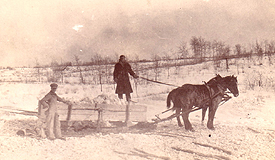
 

Stone boat  A STONE BOAT


The stones would then be piled in a corner of the field, often higher than the children and then Father could plough and sow the fields.

At 4am every day, her Father would rise, curry and comb the horses, clean and feed the animals put wood in the wood burning stove and boil the kettle. By that time Mother was up and the family day began. In summer and spring, Father would milk the cows then put the milk into the metal churns, take it to the road running outside the property and leave it for pickup. Once a week, they received a cheque.

Some milk would be kept back for Mother to make her butter, to sell in the village for extra income. It was Ruby’s job to churn the wooden churner, with the family dog standing very close by, waiting for the butter milk he knew he would get at the end of the churning. Her mothers’ dairy was scoured daily and kept spotless. After the butter was churned and firm, which could take up to three hours or longer, her mother would take the two large wooden paddles and shape the butter into one pound blocks. Then they were wrapped in parchment paper for the trip to the village to sell them at the local shop.

Ruby commented, that in the winter months cows are usually ‘dry’ and calving but Father still had plenty to do. He would go into their woods, and bring out the huge trees, and ‘skin’ them ready for the warmer months, and on the first day of February, he would go to the river and cut huge ice blocks, bring them back and store them in sawdust in the barn, ready for the ice-box in the summer.

When spring came, the cows had fresh green grass, and a herb called Sorrel that they loved to eat, the butter was a beautiful yellow. In the winter, and early spring however, when the cows could not get the lush grass and herbs, Mother had to add a drop of carotene to make the butter look more attractive.
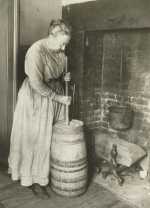
butter churn  CHURNING THE BUTTER


The barn which Father built by hand, was very large, clean and warm and held the cows and two Clydesdale horses. Clydesdale’s can grow to over 18 hands tall. A hand is four inches, so this would be 72 inches or 6 feet. A horse is measured from the ground to its withers. If you feel at the end of a horse’s mane, you will find a small flat spot, which is the withers. [4]
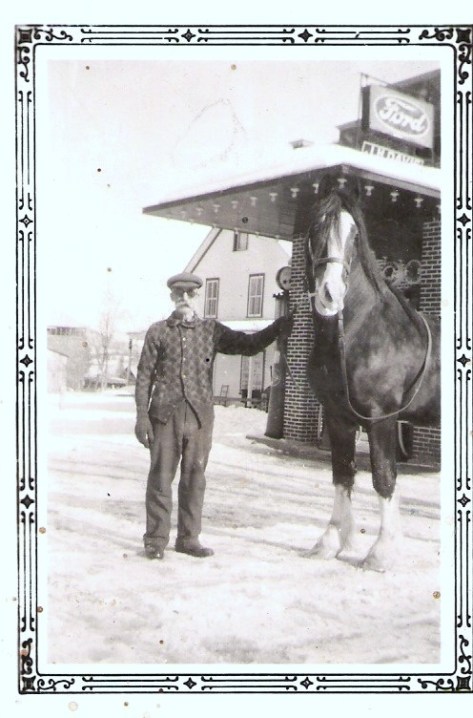
Ruby Father granddad.JPG
RUBY’S FATHER WITH THE CLYDESDALE HORSE

Ruby said that the horses drank an enormous amount of water daily and they had to have their water buckets filled three times a day. They were gentle and calm and the children never felt afraid being in their presence, unlike the Jersey cows! One day, she said, one of the Jerseys kicked her younger sister for no reason and the next day, Father sold her! The Jersey cow, not the sister.

The barn was kept free of rodents by the barn cats, who were never allowed in the house, but fed daily at milking with warm milk given to them on the porch by Mother. The house was lit by oil lamps until Ruby left home at 16 and for a few years afterwards. On a Saturday, it was Ruby’s job to wash the glass chimneys trim the wicks and fill all the lamps in the home. She would also walk to Christieville a long walk, to pick up the mail and shop.

The cast iron wood stove was where Mother did all of her cooking and baking. Ruby said, Mother never made cookies, they were too expensive! Everything else was home made. During the hot days doors and windows were always kept open for a clear draft through the house, to cool the cook.

The girls went berry picking in the summer, looking out for bears whom they could see had left their imprint, whilst they too, picked the berries. Always on 12 July, next to the river, they had a celebration picnic of the ‘Glorious 12th’ an Irish holiday celebrating the Battle of the Boyne where the Protestant King, William of Orange ‘beat the Catholics’ in 1690.

Ruby was home schooled until she was about seven years old, as before that it was too far and too cold for a youngster to walk or ski to school. Of course, there were no school buses. Ruby frequently skied to school in winter and walked there and back in Summer. Occasionally, if the snow was very deep her father would hitch the Clydesdale’s to the sled and take them to school, but not very often as he was too busy!

The one room school house for the high school children, had one teacher, hired from England and he taught them every subject, at every level, including French with the curricular coming from England and exam results sent ‘away’ for marking. There was a total of 8 pupils in Ruby’s high school. At lunch time everyone including the teacher, brought the same thing every day – a peanut butter and jam sandwich, and occasionally a cookie or piece of cake, They drank water. In the summer they all played baseball after lunch and in the Winter, skied. Ruby had homework every single night, and that had to be done after household chores. Ruby left school after passing all her exams, when she was 16 years old.
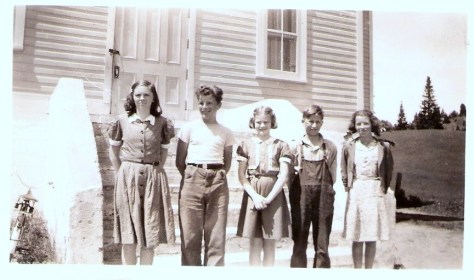
Ruby SAchool Ruby on Right.JPG

RUBY’S ONE ROOM SCHOOL – RUBY ON THE FAR RIGHT

Whenever I download historic information regarding Morin Heights to read to Ruby, she points out that the people I am reading about were her uncles, cousins, her fathers’ brother, or mothers’ family and other family members. There is a Rural Route named after her family and there are many historical articles about the building of churches and other buildings, where her family names are mentioned frequently.

Her Irish/Quebec roots run deep and many of the pioneers of Morin Flats were connected to her or her family, friends or neighbours she remembers.

You can learn a lot from the elderly and I love talking to Ruby about many things, which I hope to continue for many a year, but her stories of her early years are the most interesting!
Sources:
[1 2] http://www.morinheightshistory.org/history.html
[3] http://www.morinheightshistory.org/census/1861MH.html
[4] http://www.clydesusa.com/faq/
……and particularly, my friend Ruby.

Ruby McCullough Clements passed away peacefully on 24 November, 2016, RIP.

Save

Save

The Matriarch (A Remarkable Memory)

Gertrude Thorpe Davidson (Mrs. James P. Hanington) – 1852-1950

The local newspaper in Saint John, New Brunswick, hit the jackpot when they interviewed 96-year old Mrs. James Peter Hanington in July 1948.  “”I always said I would not be old till I was 90’ said the charming silver-haired lady, with the sparkling dark eyes who was recalling her girlhood days in Saint John”[1].  From a remarkable retentive memory, Mrs. Hanington described events of many decades ago as though they were only yesterday, but was fully aware of and concerned about today’s issues.

One of her fondest memories included waltzing on skates to a live band with a gong sounding every half hour signaling the skaters to reverse direction.  She also recalled attending not-so-very interesting lectures at the Mechanics’ Institute with her girlfriends enabling them to meet the boys at those gatherings.

Entertaining was done in the home and was a simple matter due to the availability of affordable domestic help.  A cook’s wages were only $6 a month! The great expanse of her memories included a small playmate telling her of Lincoln’s death, the street lamplighter with his ladder going from lamp to lamp and the thrill of her first ride on a passenger train from Moncton to Saint John.[2]

Gertrude Davidson (my great grandmother), born in Saint John, NB, in April 1852, was the daughter of William and Mary Anne (Cook) Davidson.  Her father was a prominent lumber merchant and the grandson of the first settler on the Miramichi, who came out from Scotland at the age of 20. Gertrude’s earliest memories of her native city of Saint John were centered about the Davidson home at 98 Germain Street, the fine brick building her father erected for his family and to which she moved at the age of five.

Her father had been confident when the Great Fire of 1877 was at its height that the slate roof and brick walls of his home would be ample protection. He was wrong.

When forced to leave, her father had locked the door to keep out the thieves.  But fire proved a more thorough villain and all treasures were lost.

Gertrude saw the spire of Trinity Church fall that terrible day and was very anxious about the safety of the people.  However, blessed with a wonderful sense of humour, Gertrude commented on the strange attire of the people who attended a church service in the Victoria rink after the fire.  They had obviously escaped without their Sunday best![3]

As much as she loved Saint John, she moved her family to Montreal in 1890, when her husband, a successful local pharmacist, decided to go to McGill University Medical School at the age of 44.  Her seventh daughter (my grandmother) was born in Montreal in 1895, when Gertrude was already 42 years old.  While in Montreal, she raised her family, supported her husband’s new medical career, entertained frequently in her home and was an active member of St. John the Evangelist Church. She was very well respected in the community and enjoyed a large circle of friends.

During her long life, Gertrude had had her full share of illnesses and ailments but her knitting needles were always busy…and without the need of eyeglasses!  Perhaps being married to a Pharmacist turned Doctor had its fringe benefits!

[1] The Evening Times-Globe, Saint John, New Brunswick – July 7, 1948.

[2] The Evening Times-Globe, Saint John, New Brunswick – July 7, 1948.

[3] The Evening Times-Globe, Saint John, New Brunswick – July 7, 1948

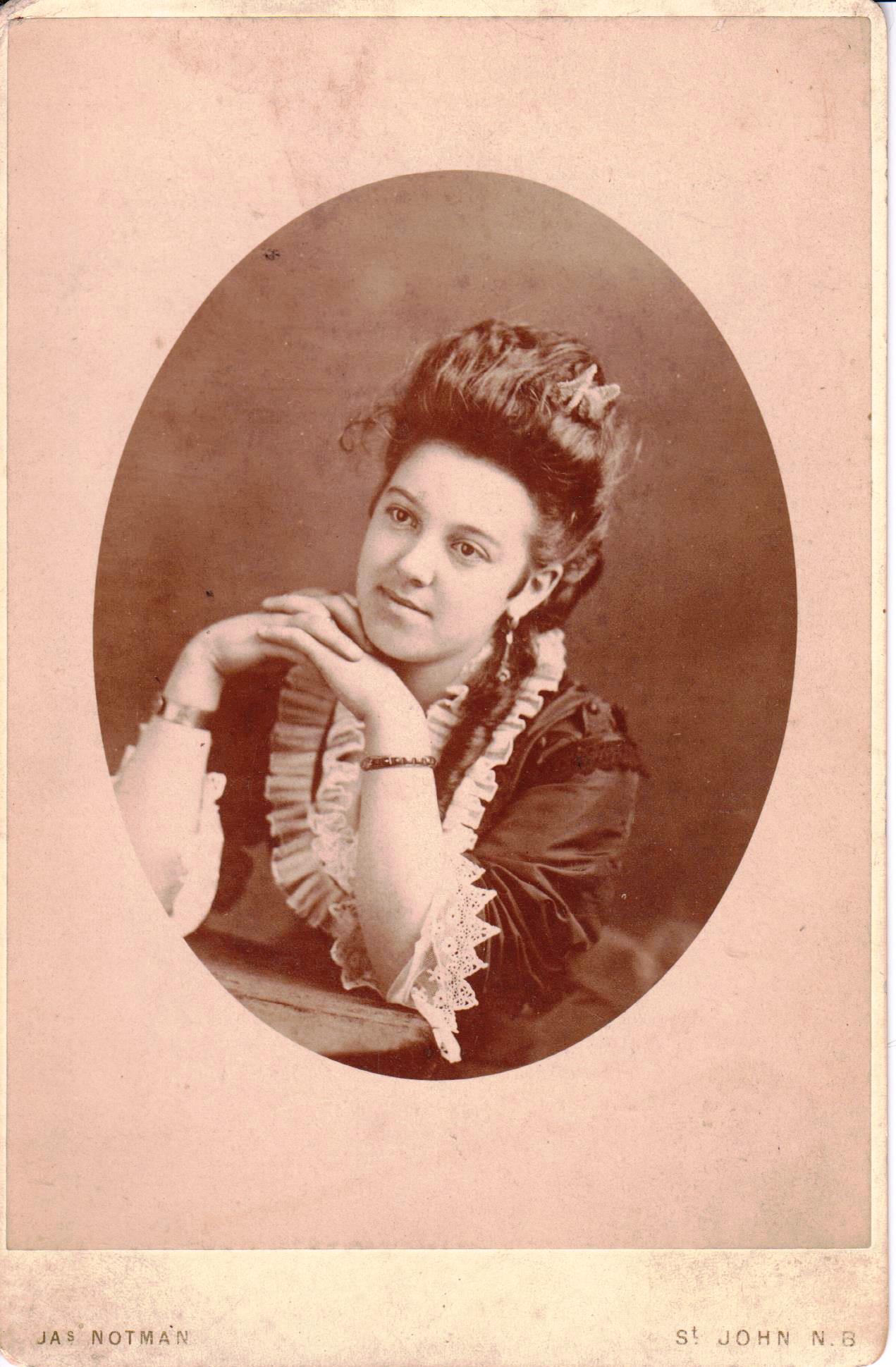
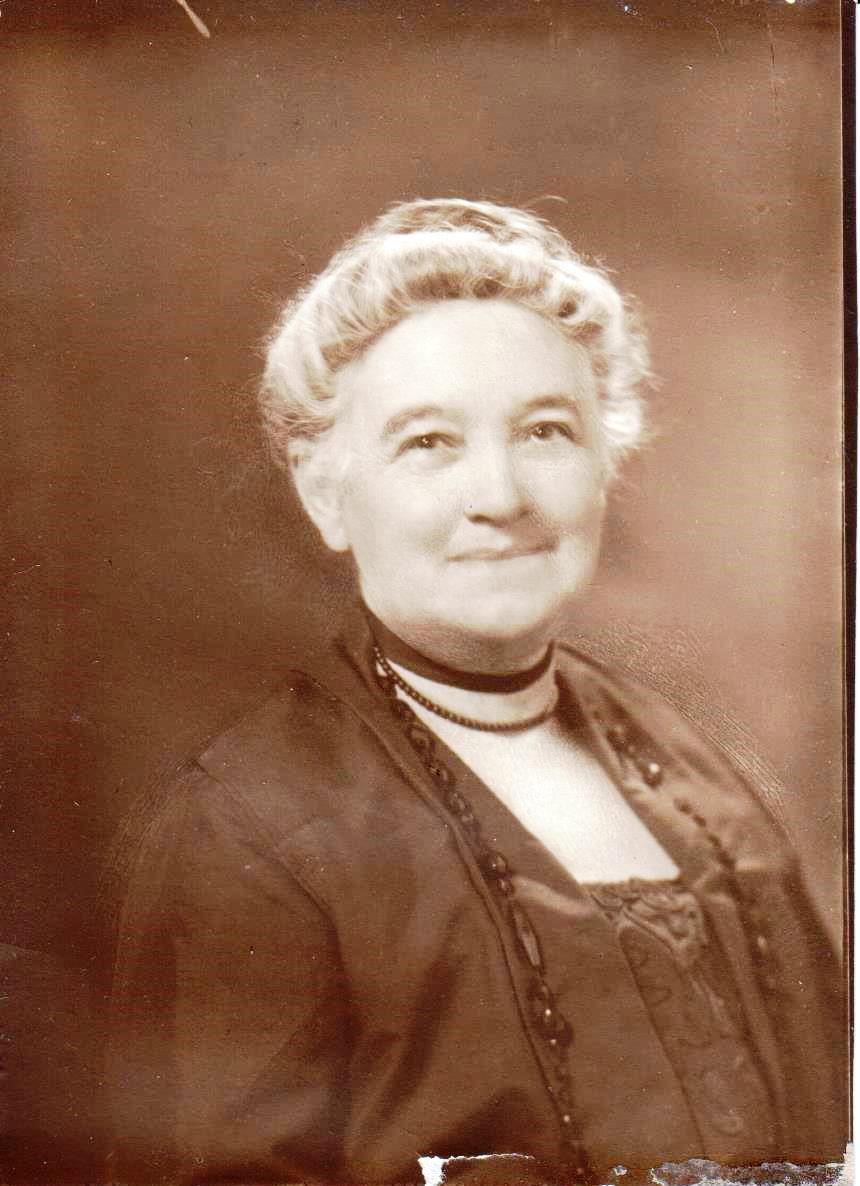
Gertrude Thorpe DavidsonMrs. J P Hanington (Gertrude Davidson)Mrs JP Hanington

The Presbyterian Churches: Quebec City to Sherbrooke

This compilation, prepared by Montreal genealogist Jacques Gagné, covers communities south of Quebec City (on the St. Lawrence River) to the Maine border, and east of Sherbrooke. Hundreds of Presbyterian immigrants from Scotland, as well as from Ireland and England, settled in this area in the early 1800s, attracted by its fertile land for farming, its valuable forests, rolling hills and abundant rivers.

The area includes the present-day counties of Arthabaska, Beauce, Buckingham, Compton, Dorchester, Drummond, Frontenac, Lotbinière, Mégantic, Nicolet, Richmond and Wolfe, and communities such as Saint-Georges-de-Beauce, Drummondville and Thetford Mines.

Jacques briefly describes the settlement of these towns and villages and names the churches and missions that met the spiritual needs of the Presbyterians. Name changes are noted where relevant.

The compilation lists Presbyterian cemeteries, local historical societies, books that discuss the histories of these areas and websites of interest. It also identifies repositories, such as church archives and local resource centres, where the birth, marriage and death records of these Presbyterian communities can be found.

Presbyterian Churches – Quebec City to Sherbrooke-3