Floods!! Then And Now

‘Here it comes’  Dad yells out and we all rush to the front door with our brooms. Sweeping frantically we try to stop the floodwater from creeping into the house but to no avail.

With all the news about the Harvey Irma and Jose hurricanes and the resulting floods and damage, I was reminded of our house when I was about 9 years old in 1954. We lived in Watts Cottages, St. Levan Road Plymouth in Devon England. There were four cottages situated in a small park, in a pretty grassy ‘dip’. and St Levan Road outside the park’s elegant metal railings was the main road for cars and buses. Upon opening our garden gate it led directly to the grass and the park. It was idyllic,  except for one thing…..It flooded when it rained heavily. Plymouth is a very hilly area and our cottages were situated in that dip.

Shortly after my father bought the house, our neighbours could not wait to tell Dad that the four cottages flooded when rain was particularly heavy. Of course, nowadays a sale like that would never happen but this was only 9 years after WW2 and housing in our Naval city was in crisis. Thousands of people lived in prefabs – prefabricated homes built quickly after the war, intending to last for 10 years –  and many families lived together, due to the bomb damage and shortages of homes, so for my Dad to find this pretty cottage, next to a recreation field and a main bus route was wonderful.
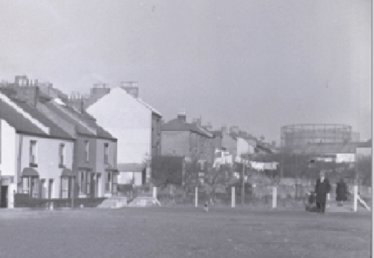
Side view of the Cottages in the park from the recreation ground, Our cottage was the third from the left.

We had lived in our home for about a year before it flooded. It had rained heavily all day and suddenly, the garden had a few inches of water in it, which rapidly became two feet. It crept towards the front door. When Dad had heard about the flooding from the neighbours, he had built a waist-high cement wall and a wooden door to slot in place when it rained. He was hopeful that this would keep the water out of the house – it didn’t.

After our frantic efforts to sweep the water out, it was obviously a useless exercise so my Dad made Mum me and my baby sister all go upstairs, whilst he waded out the front door to try and clear the sewer drain, which was outside our gate in the park area. He was over 6 feet tall, but soon, the water reached his chest. We all watched the drama unfold from our bedroom window. He managed to get the drain cover off, and a huge fountain of water shot up into the air! It kept going for ages and we waited for the floodwaters to recede but it did not happen and I must admit that at nine years old, it was kind of exciting to see! All the neighbours across the street were watching too. Buses stopped on the main road to watch the huge fountain of water cascading over the park. Such drama! What excitement!

The aftermath the next day was not so much fun though. No kind of help from anyone in those days. We just waited for the floodwaters to subside, and then started the usual clean up. No Fire Engines to help pump out the water, no help from the local city officials, no shelters no home insurance just us, Dad Mum and me sweeping out all the stinking mud and trying to dry everything out.

None of the surrounding homes (pictured below) suffered flooding as those four cottages did, and always afterwards, the place smelled of mould and dampness. No wonder I was always sick with bronchitis. It took many years – 18 actually – before those cottages were officially condemned and boarded up.

Long before then the residents including us had just moved out and left behind their dreams and investment. It took another 7 years before they were bulldozed and grassed over. Once officially condemned, the local council paid residents a nominal fee but nothing like the money put into our homes.
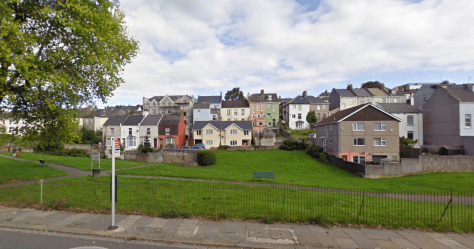
Front view of the site today, after the demolition of the Cottages, still a pretty site. for cottages. The bare green area was where the cottages were situated. You can see how the area slopes downwards.

I have to admit that when I went back to England one year and visited the park, it was a shock to see the houses gone and an empty spot grassed over. It did make me sad and although the victims of the recent Hurricanes had a far, far worse time of it than we ever did, I do know exactly what they went through afterwards…..

Five things we learned publishing our first book

“Someday I’m going to write a book!” How often have you said that, or heard a friend or relative make a similar statement? You probably didn’t hold your breath until it appeared.

So it comes as a surprise to the nine members of Genealogy Ensemble, the family history writing group of which I am a member, that we are actually doing it. In November, we will launch Beads in a Necklace, a book of collected short stories based on our family research.

These real-life stories include a young Scot who immigrated to Canada and became a famous gospel singer, memories of queueing up for food rations in post-war England, and a young girl who was kidnapped from her home in southern Maine by the Abenaki Indians in 1692 and spent the rest of her life in Quebec.

Now that it’s about to be published, I thought it would be worthwhile to look back at some of the lessons we learned that might help potential authors.

Grow Organically

The genesis of Beads in a Necklace goes back to 2012 or so when we decided to write about our families and share our stories. Since then, we have met once a month to critique each other’s work, improve our story-telling skills and gain confidence.

After a while, our stories were so good, we wanted to share them more widely. We began taking turns posting them on our blog, Genealogy Ensemble. The book authors among us kept talking about the possibility of publishing something, but the idea always seemed far away.

Last year, we got serious about the idea. With 2017 being the 375th anniversary of the City of Montreal, where we all live, and Canada’s 150th birthday, we decided it was time to publish a collection our stories: a 250-page book, with a proper binding and a beautiful cover, that we will be able to give to friends and relatives for Christmas.

Start with Structure

We started discussing the project last September. The first step was to each choose our five favourite stories. Each article had to be about 500 words long and include endnotes citing the sources of our facts. Apart from that, there were no rules.

After considerable debate, we agreed on the title Beads in a Necklace, and we came up with a logical way of organizing the stories into sections.

Collaborate

We all pitched in to help at various stages of the process, depending on our areas of expertise. I did most of the editing, with help from Tracey. I had worked as a journalist, and Tracey and Dorothy are also professional writers. That helped a lot: we know how to tighten a longwinded sentence, spot a good first paragraph and structure a story so it flows smoothly. Several members of our group have natural writing talent that they never knew they had, but they are still learning the skills that come from writing on a daily basis. And sometimes writers have to let go of their egos and allow changes. Of course, everyone could say yes or no to editing suggestions, and we always managed to find compromise solutions.

Sandra, who has experience preparing annual reports in the corporate world, did most of the layout, with Claire’s assistance. Claire also knows her way around digital photography and she cleaned up the often scratched or faded photos we wanted to use.

Ask for Help

We even got friends involved: one friend who is a proof reader is making sure there are no typos or missing punctuation marks, while another friend who is a graphic designer has agreed to do the cover.

There have been many details to consider. The people responsible for the layout had to decide on the size of the book and the fonts to use and get quotes from a local printer. Someone has to look after making a digital version available, and we have to crank up our marketing strategy. Last but not least, we had to find a place that is big enough but not too expensive for our celebratory book launch. We found a church hall that is perfect!

Persevere through glitches

Most of the glitches we have encountered have been computer-related. For example, we tried both Google Drive and Dropbox so we could upload files that everyone could edit. Both did the job, but we found Google Drive to be a bit unstable, while for a reason I still don’t understand, I can’t see many of the changes that Sandra and Claire have made to the layout in Dropbox.

This has been a long process. We were editing in January and the book will be launched in November. But we are all thrilled about it. Furthermore, I hope to apply the lessons I have learned from this experience when I write a book about my own family’s history. Just don’t hold your breath until it appears.

This article is also posted on writinguptheancestors.blogspot.ca


The Hometown Tourist

Summer is slowly waning, days are getting shorter, the sun is slipping below the horizon earlier each day and at times there seems to be  a slight chill in the wind. The playgrounds are silent. Schools are back in session.

Where did the summer go? How did you spend your summer? Did you travel to faraway places, relax on a beach, or stay right here in the city and enjoy some of the festivities while celebrating our 375th Anniversary?

The island of Montreal has been my home since the mid-60’s. This summer I became a tourist in my hometown. Several organized guided day tours were a pleasant way of seeing and learning about the many hidden gems tucked away in unusual places.

Did you know that there is a large piece of the Berlin wall in the International Trade Center in Old Montreal, or that there were guided tours of the Seminary?

Recently on a   Saturday afternoon, after a lengthy detour and a drive between orange construction cones another genealogist and I arrived   late   for a guided tour of the Seminary in Old Montreal. We joined the group in the courtyard adjacent to Notre Dame Basilica where the Sulpician Priests during this anniversary year have opened their doors to the public. The last time that happened was during Expo 67, fifty years ago.

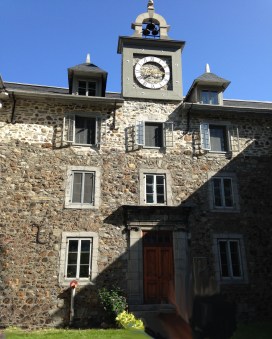
The young guide, Gabriel, was describing the French clock, (from France) noting how the original mechanisms were made of wood. Over the years there were many changes and today it runs on electricity. The bells ring every fifteen minutes, although they are often drowned out by the bells of the Basilica.  French clock tower IMG_0884.jpg

The Priests of Saint Sulpice arrived in Montreal in 1657. From 1663 until 1840 were the owners of the island of Montreal. They were the Seigneurs. They began building the Seminary in 1685 and today it is the second oldest building on the island of Montreal and the oldest building standing that has retained its original purpose.

As you walk by the courtyard on Notre Dame Street it is possible to see where the restoration of the building is ongoing, beginning with the upper third floor which is currently vacant. The restoration team has done their utmost to retain the same look as the lower levels.

From the clock tower in the courtyard our group moved through a narrow passage between buildings and in to the garden, a large spacious area where for many years it provided produce for the Seminary. Today it is a quiet, serene wide expanse of grass, walkways and large trees, several that are over one hundred years old. Recently they planted almost two dozen young trees at the far end of the garden.

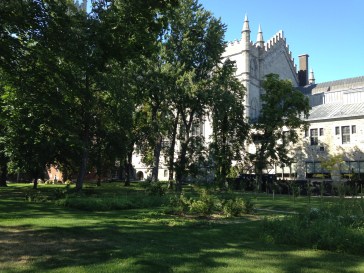
garden IMG_0893.jpg

The tour ended in the garden. However, because we arrived late and missed the visit to the museum we were permitted to go in and view the numerous artifacts found within. The main theme focused on the founding of the Sulpician priests and their mission in New France. One of the items that caught my eye was a hand drawn map of the island of Montreal dating back to 1702 that showed all the different settlements on the island.

Perhaps the most important part of the event was when several people asked about the archives and the possibility of visiting them. The response was surprising as it had always been noted that it was next to impossible to access the archives. The guide noted that there are two permanent archivists and two students working during the summer months. If someone wishes to visit the archives they must have a specific purpose, along with names and dates. The archivist will give your request consideration and inform you if they are able to assist you in your request or they may recommend where you might find answers. He also noted that there is much work to be done in the organizing of all the data they have.

Being a tourist in one’s hometown has been an interesting experience. A cruise on the St. Lawrence gave us a bird’s eye view of the port of Montreal.  A full day bus tour with six different stops along the way covered most of the prominent areas of the city, Old Montreal, up the mountain along Camillian Houde Parkway, a drive up to Mile End area, a brief stop in Welinsky’s and a visit to Fairmont Bagel, just to name a few.

Each of the day trips were rewarding. Although it was strange at first to be a tourist in one’s hometown there were many other Montrealers with the same idea.