Great-Aunt Amelia’s Christmas Goblet

Every year at Christmas dinner, my husband toasts our guests with a small antique goblet. His gesture has become a new family tradition. Before he came across this goblet in our kitchen cupboard, it had sat unused at my parents’ Montreal home for decades. I had no idea what it was or how it came into the family.

A pattern of flowers and leaves encircles the metal goblet and the initials and date “MJM to AJB Dec. 25 1852” are inscribed. I realized it must have originally been a Christmas gift, but from whom and to whom?

Amelia's gobletResearch revealed that MJM was MacGregor Joseph Mitcheson (1828-1886), and AJB was his 10-month-old niece Amelia Josephine Bagg (1852-1938). This must have been a gift MacGregor sent Amelia for her first Christmas. A fancy goblet seems like a rather strange present for a young man to give a baby, so perhaps it was a tradition, or his parents’ idea.

Amelia was the second surviving daughter of Montreal notary and landowner Stanley Clark Bagg (1820-1873) and his wife, Catharine Mitcheson Bagg (1822-1914). Catharine’s family lived in Philadelphia and McGregor J. Mitcheson was the youngest of her three brothers. In 1852, he was age 24 and a law graduate of the University of Pennsylvania who had recently been admitted to the bar of Philadelphia.

Despite the distance between the two cities, Catherine Mitcheson Bagg and her brother seem to have been quite close, so perhaps McGregor and Amelia eventually got to know each other. Amelia was 21 when her father died in 1873, and McGregor was one of the executors of Stanley Clark Bagg’s will, so he may have travelled to Montreal to advise his sister on family matters.

MacGregor J MitchesonMacGregor must have been an unforgettable house guest. His blue-grey eyes and long brown beard give him a rather wild appearance.1 He also had a forceful personality. In a book on Philadelphia lawyers, written some 30 years after MacGregor’s death, a former colleague recalled, “There never was an advocate who fought harder, or who merged his excessively egotistic personality more completely in that of his client. In another important sense was he entitled to great praise. He had a ready and instinctive perception of every essential fact in a case, in all its bearings, and a fine gift of memory for retaining them …..”2

Professionally, he specialized in real estate law. In the community, he was involved in the charity work of the United States Sanitary Commission at the time of the U.S. Civil War, he was president of the Northern Home for Friendless Children and Soldiers’ Orphans for many years, and he was an active member of the Protestant Episcopal Diocese of Pennsylvania.3

MacGregor married at age 41 to Ellen Brander Alexander Bond, a widow with a young daughter, and together they had three children. One died as a child, one did not marry and one married but had no children.

As for MacGregor’s niece Amelia, she also married relatively late at life. She married her first husband, real estate agent Joseph Mulholland, in 1890 and he died seven years later. Her second husband, Rev. John George Norton, Anglican Archdeacon and Rector of Montreal., was a widower.

Amelia had no children of her own, but she was quite close to her niece Gwendolyn Bagg (1887-1963) and Gwen’s husband, Fred Murray Smith — my future grandparents. They probably inherited the goblet when Aunt Amelia died, age 86, in 1938. For them, it would have been a precious reminder of a favourite aunt and a link to a great-uncle who died the year before Gwen was born.

Photo of MacGregor J. Mitcheson by Wm. Notman & Son, Montreal; Bagg family collection.

This article is also posted on http://writinguptheancestors.blogspot.ca

Notes and Sources

I have described the goblet as metal because I do not know whether it is silver or pewter. There is no hallmark.

MacGregor J. Mitcheson was born Joseph MacGregor Mitcheson on Nov. 26, 1828 and died at age 57 on June 29, 1886. These dates are according to the cemetery records of St. James the Less Episcopal Church, Philadelphia. The records of St. John’s Protestant Episcopal Church, Northern Liberties, Philadelphia, held at the Historical Society of Pennsylvania in Philadelphia, say he was baptized on April 17, 1829.

MacGregor eventually lived on Locust Street in downtown Philadelphia in a house designed by architect Frank Furness. See http://www.waymarking.com/waymarks/WMG1GH_MacGregor_Mitcheson_House_Philadelphia_Pennsylvania

  1. “U.S. Passport Applications, 1795-1925,” Ancestry.ca [database on-line] entry for MacGregor J. Mitcheson, 1865; National Archives and Records Administration, Washington DC. ARC Identifier 56612/MLR Number A1 508, NARA Series M1372; Roll # 127.
  2. Robert D. Coxe, Legal Philadelphia: Comments and Memories, Philadelphia: W.J. Campbell, 1908, p. 140, accessed March 3, 2013.
  3. An Historical Catalogue of the St. Andrews Society of Philadelphia with Biographical Sketches of Deceased Members, 1749-1907, printed for the Society, 1907; Google Books, accessed July 19, 2013.
A Wren’s Story: Dorothy Isabel Raguin

IMG_9015

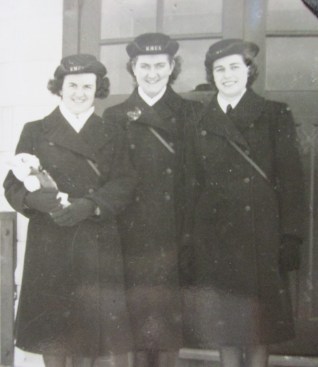
Dorothy Raguin my mother, joined the Women’s Royal Canadian Naval Service (WRCNS) known as the Wrens in April 1943. She left a job teaching grade three at Berthelet School in Montreal to help in the war effort and to look after her brothers, Robert and Arthur Raguin, both serving in the Navy.

She had graduated from The High School of Montreal Girls School in 1939 and then attended MacDonald College for teacher’s training and began her teaching career.

War was declared in September 1939, but it wasn’t until three years later that the Women’s Royal Canadian Naval Service was formed. Dorothy was one of over 6000 women who joined the navy, allowing the shore-based men to go to sea. The navy was the last of the forces to admit women. The first recruits were cooks, clerks and laundry maids but by the end of the war, women filled 39 trades including communication operators, signalman, coders and radar plotters. Their pay was also raised from two-thirds of a man’s to eighty percent. The Navy found women were useful.

The Wrens were inundated with applications even though the Army and Airforce had been recruiting women for two years. These women wanted to join the Navy. As the smallest of women’s services, it claimed to be the most selective. The Wrens were known to have recruited a “better type” of girl. They were ladies, not sailors and kept their hats on indoors.

There was a short three-week course at the WRCNS training centre HMCS Conestoga, in Galt Ontario. This facility which had been a girls reform school was referred to as a “stone frigate.” The women put on the Wren uniform and had a rapid transition into military life. They were given physical training, drill practice and learned about naval traditions and customs.“ They all seemed anxious to serve and do something constructive to help win the war. I found them very receptive to naval tradition and amenable to discipline, said Superintendent Carpenter. ”¹

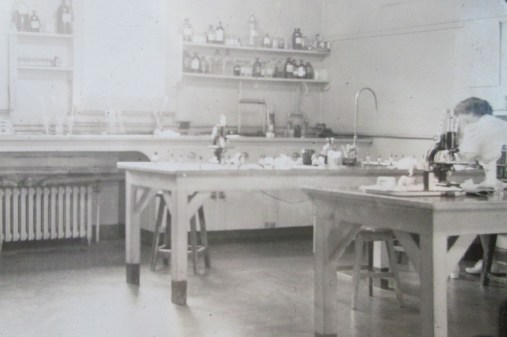
Dorothy was drafted to HMCS Cornwallis September 1943. Mom’s first posting was to a hospital base, Stadacona in Halifax, Nova Scotia. A family friend, Miss Fellows was in charge of the women and had two sick berth attendant positions available. These were prime positions working in the laboratories. One was in haematology and the other in urinalysis. Mom chose blood and a friend got the other position.


IMG_8721
Lab in Halifax 1944


It wasn’t all work, marching and standing in lines. In their free time, they visited the scenic places around Halifax including Peggy’s Cove and Chester NS. There were always men coming and going from the ships and the Wrens used to take some of the patients rowing on the Arm. As innocent women, they were warned to be careful walking on Gottingen Street which had buildings right to the sidewalk, as they could be grabbed from the doorways! Dorothy celebrated her 21st birthday in the Navy with a lobster dinner at the Lord Nelson Hotel, a treat by her cousin Richard Scrivner who was then a Navy Commander. It was her first lobster and she never had another. There was also trip with other Wrens to New York City. They didn’t have to pay for their hotel and received meals for free as a thank you for their service.

IMG_8727
Doreen, Dorothy, Gwen

One of her teaching friends Mary Hawkins wrote in May 1943 from Halifax. “Dorothy Raguin and I met at the ANA (Army, Navy, Airforce) Club yesterday. She looks fit and is getting a kick out of the Wrens. She was in the School for Teachers the year before I was and was teaching at Berthelet. She left a month after I did – to join the Navy. I asked her if the Wrens get their tot of rum and she said, No, but apart from that everything is just the way Nelson left it. I know what she meant.”²

She finished her duty doing discharge physicals at the Royal Canadian Naval Hospital (RCNH) St Hyacinthe, Quebec. Her transfer was mentioned in the Tiddley Times, the Wrens newsletter. “Our hospital staff have been lucky in the acquisition of Dorothy Raguin, Aileen Fee and P.O. Anne Hawke, all lab. technicians with first-hand experience from Halifax.”³ The WRCNS disbanded in August of 1946 as women were not needed in peacetime.

Dorothy saw her brothers only once while she was in the Navy. She arranged dates for them when their ship came into Halifax. Happily, they managed to survive without her care and returned home safely.

IMG_8784
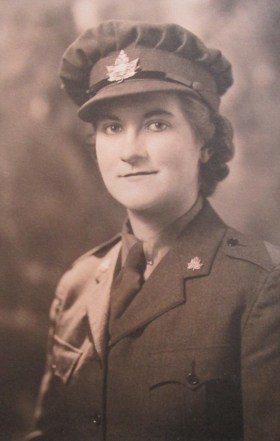
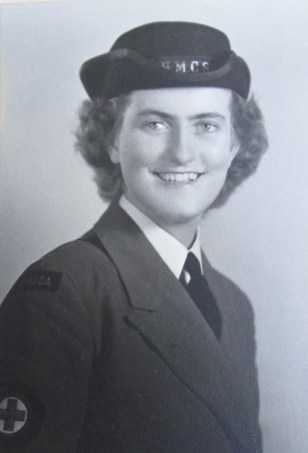
Dorothy Raguin in the Women’s Volunteer Reserve Corps before 1943.


My mother Dorothy Raguin Sutherland, died recently, at 95. She was proud of her service in the Navy and so to honour her and her service to Canada I am posting this story.

Notes:

  1. Superintendent Carpenter on Navy Radio, Recorded10 June 1943 for broadcast 14 and 16 June on CBC. Library and Archives Canada: MG30 E 391 Volume 1.
  1. Buch, Mary Hawkins., and Carolyn Gossage. Props on Her Sleeve: The Wartime Letters of a Canadian Airwoman. Toronto: Dundurn, 1997. Print.
  1. Tiddly Times May – June 1945 Wrens Newsletter page 26.
  1. Huba, Diane., The Wrens 70th Anniversary 2012. Starshell Volume VII No. 58, Spring 2012.
  1. Dorothy Raguin Sutherland reminiscences as told to the author.
  1. www.navaireview.ca/wp-content/uploads/public/vol3num3/vol3num3art5.pdf
  1. www.thecanadianencyclopedia.ca/en/article/wmens-royal-canadian-naval-service/
  2. In the third picture, Dorothy Raguin is not wearing a Wren’s uniform but rather the Women’s Volunteer Reserve Corp (W.V.R.C.) uniform. The main goal of this organization was to fundraise for the war efforts and train women in war-related tasks.

Here is a link to my father Donald Sutherland’s war years.

https://wordpress.com/post/genealogyensemble.com/4615

The Bulford Kiwi

Not many families have a big bird named after them.

Well, we do! It is a New Zealand Kiwi bird and it is carved into the chalk hills in Wiltshire, England. It has been there since 1919, so close to famous, ancient Stonehenge, yet virtually unknown.

During my genealogy searching online for family members, like many researchers, I ‘Googled’ my surname, Bulford, but I would always get sent to ‘Bulford Camp’ in Salisbury, Wiltshire, in the UK, which is a large Army camp that was established in 1897.

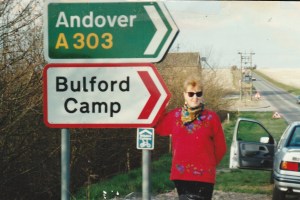
The Bulford Army Base is still in use today alongside Bulford Village and the Church. Many times, over the years, family members would go to Bulford to get our photos taken with the Village sign.

My Uncle Roy Bulford Circa 1960’s
Marian, Bulford Camp sign. 1993. No longer a country road!  

Bulford Village grew up on the gravels beside the river Avon. The meaning of Bulford is difficult but the most likely explanation is ‘the ford where the ragged robins grow’ or ‘ragged robin island’.  Bulut is Saxon for ‘ragged robin’ and in the 12th century the name was Bultesford. ¹

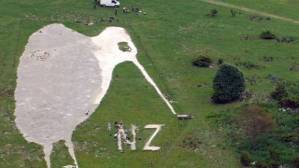
The Bulford Kiwi is carved on Beacon Hill above the military village of Bulford on Salisbury Plain. Hill figures, or geoglyphs, ² are designed to be seen from afar rather than above and are a phenomenon especially seen in England. The letters “N.Z.” are 65 feet (20 m) high.

This one was carved after the First World War by the Kiwis (as the New Zealanders were called), eager to get back home. Apparently, no troop ships were immediately available and the troops had a few riots in protest, so officers decided that they should be kept busy by carving a Kiwi into the chalk hills!

In 1919, the Canterbury and Otago Engineer Battalions started their work. The design was drawn by Sergeant-Major Percy Cecil Blenkarne, a drawing instructor in the Education Staff, from a sketch of a stuffed kiwi specimen in the British Museum.

In real life, Kiwis are a nocturnal, flightless bird about the size of a chicken with long legs and beak. The kiwi’s muscular legs make up around a third of its total body weight and can outrun a man. The chalk Kiwi’s body covers 1.5 acres (6,100 m2).

Kiwi Bird found only in New Zealand

The site was surveyed and the design put on to the site by Sergeant-Major V.T. Low of the education staff. From the Kiwi’s feet to the top of its back is 420 feet (130 m) and the beak is 150 feet (46 m) long.

In the years after the Kiwi’s creation, the Kiwi Polish Company – the very polish used to shine our forces’ issued marching boots – maintained the Kiwi through their offices in London, employing local villagers to do the work. Although it had “little if any advertising value [for the company]”, they explained their interest in its upkeep as its being a memorial to the New Zealand troops.³

The chalk Bulford Kiwi


SOURCES

Bulford parish itself is rectangular, extending eastwards from the banks of the river and the boundaries have remained unchanged for more than a thousand years. In the Middle Ages, there was a settlement called Hindurrington, to the north of Bulford church, that was also on the river gravels. The name may have originated because the settlement was at the back of Durrington, which was on the other side of the river.[1]

http://bulfordparishcouncil.org/history-bulford-village.html [1]

https://en.wikipedia.org/wiki/Hill_figure Info about the chalk figures in the UK [2]

https://en.wikipedia.org/wiki/Bulford_Kiwi shoe polish [3]

FOOTNOTES

Hill figures are cut in the grass to reveal the chalk and include the Cerne Abbas Giant the Uffington White Horse, the Long Man of Wilmington as well as the ‘lost’ carvings at Cambridge, Oxford and Plymouth Hoe.

For further photos of the chalk Kiwi follow this link:

https://www.google.ca/search?q=Bulford+Kiwi+photos&ie=utf-8&oe=utf-8&client=firefox-b&gfe_rd=cr&dcr=0&ei=M88tWo3VE8XL8AfXvqzIBQ

Dear Uncle Bill

Dear Uncle Bill,

While rummaging through the Dusty Old Boxes containing family memorabilia, I came upon letters written by you to your only brother, my father, Tom.  There were also letters written to your sweetheart during WWII while you were stationed in England serving with the RCAF. So I thought the best way to remember you would be in the form of a letter.

Please allow me to introduce myself. My name is Lucy and I am one of your nieces.

Our paths never crossed.  I was only born in 1957 and you died in 1943. Your brother had seven children.  I was his fourth.  His eldest son, born in 1949, was named after you – William Sherron Anglin II.

While staying with my family in England in 2016, I visited you in person at your last known address:  Runnymede Memorial[1], Panel 179, Surrey, UK.  My grandchildren, who always enjoy a challenge, accompanied me in my search to find you. It didn’t take them long to find your panel and you – or your name, that is – inscribed on one of several stone walls, along with 20,000 other airmen,  at this dedicated memorial building on Cooper’s Hill overlooking the Thames River.

Your name was too high up for the children to touch but I brushed my fingers lovingly over your name and told you we were there. I am quite sure you knew it. You had an interest in mental telepathy, as did your grandfather, and his story was documented in the family boxes as well.  (Surgeon and Mentalist)

Throughout your letters to Tom, along with childhood memories, you shared and referred to an interest in The Rosicrucian Order which “is a community of mystics who study and practice the metaphysical laws governing the universe”.[2]

You maintained the belief in an ability to “project” yourself and to send mental messages. I can only guess that a feeling of closeness to your brother by any means must have consoled you greatly while away at war in England.

In your letters to your sweetheart, you described England in general (with the usual complaints about the rainy weather), your life with the RCAF, weekend leaves to Scotland and dances in the mess hall “wishing you were there”.  Although I don’t have her letters in response, I am sure you took great comfort in hearing from her.

You were sent on a training course at the end of May 1943 and, while away, your crew went on a mission without you – never to return. In the last letter to your girl, you confided that you were feeling “depressed” at their loss.  On the very next mission, you went missing as well.

Last picture of Uncle William
Last picture of Uncle Bill (far left) – 1943

Not long afterwards, your sweetheart sent a bundle of your cherished letters, wrapped in a bow, to your mother and wrote “I know I want to forget as soon as I am able, everything – and so I am sending you the few letters I had saved from those Bill sent me from England.  I hope that you would rather have them, than not … perhaps they will make you glad to have something more – to know something else of Bill’s life in England … rather than rake up memories you are trying to forget. For while I want to forget, I feel so sure that you will want to remember.”

Your mother never gave up hope that you would return one day.

Wendling & Josephine Anglin and sons Bill and Tom (1940)

Bill, Wendling  (the stock broker), Josephine, Tom and family dog (1940).

The abundant number of photos found with the letters in these boxes show your 27 years filled with family times – gatherings, annual trips, formal portraits, a few pets and a full life.

You will not be forgotten.

Lovingly,

Your niece Lucy

Note:

http://www.aircrewremembered.com/richmond-bruce.html

William Sherron Anglin was an Air/Gunner and Warrants Officer II with the 429 Squadron flying in a Wellington X bomber, Serial no. HZ471.

Reason for Loss:

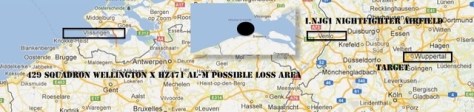
Took off from R.A.F. East Moor, North Yorkshire at 22.36 hrs joining 719 aircraft attacking the town of Wuppertal, the home of the Goldchmitt firm which produced Tego-Film, a wood adhesive used in the production of the HE162 and TA154 (aircraft).  Around 1000 acres was destroyed in the firestorm that followed – 211 industrial buildings and nearly 4,000 houses were totally destroyed. A figure of 3,400 fatalities on the ground has been recorded. Bomber command did not escape lightly on this operation losing some 36 aircraft.

It is thought “probable” that HZ471 was shot down by Lt. Rolf Bussmann, flying out of Venlo airfield, and attacking this Wellington at 3,700 meters with the aircraft falling into the sea off Vlissingen.

429 Squadron possible loss area

[1] https://wiki2.org/en/Runnymede as at November 19, 2017

[2] https://www.rosicrucian.org/ as at November 19, 2017.