Do You Believe in Ghosts?

margsword

I’m sitting on the fence, myself.

Over a decade ago, I discovered an old trunk of  paper memorabilia once belonging to Nicholson family of Richmond, Quebec, my husband’s mother’s ancestors. It contained 1000 letters, 300 from the pivotal 1908-1913 years.

From these missives, I learned a great deal about these  Canadian- born Scots, whose parents were  Hebridean Scots, cleared from the land in the 1800’s and forced to come to Canada. And, because of a rather weird series of coincidences I learned all about a certain Masonic sword.

One  evening back in 2004, about a  year after I first found the trunkload of letters, I received an email.It was from Matthew Farfan, editor of Townships Heritage WebMagazine.

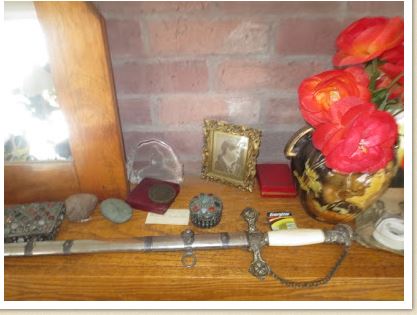
It seems that a  couple in the Okanagan Valley of BC, we’ll call them the C’s, wanted to get in touch with me.  They had Norman Nicholson’s sword!   Norman is my husband’s great grandfather.

I had very recently posted an article about the Nicholsons on Matthew’s webmag with a big pic of Norman in Mason regalia front and center.  The family papers revealed that old Norman Nicholson was a member in good standing of the Sussex Preceptory No. 9, Knights Templar, Sherbrooke.

I immediately emailed this Mr. C. “How in Heaven do you know it is Norman’s sword?”

He explained.   In the early 60’s, his family had rented the Nicholson home, in Richmond, Quebec,  from  Edith Nicholson, Norman’s daughter.  Somehow,  Norman’s sword had been swept up in the bustle when the family moved out around 1965.

Mr. C had adored that house with its steep basement stairs and wondrous attic filled with fantastical (see : old fashioned) things. Mr C remembers  using the silver sword to ‘terrorize’ his sister.
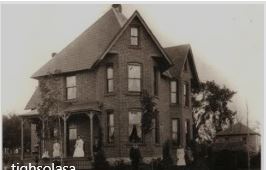
tighsolas

 Tighsolas, built by Norman  in 1896, the year Sir Wilfrid Laurier came to power for $2,700. 


« Phone my wife, » Mr.C  further instructed. « She’ll tell you all about the sword. »

So I did, on the jump, and what a story Mrs. C. related! The sword had been hanging on the BC couple’s wall since the death of her in-laws. Prior to that it had traveled all over North America, as far as California.

In 2004,  Mr. C’s sister visited them. She mentioned, out of the blue, that the silver sword on the wall had a name engraved on it. They checked : the name was ‘Norman Nicholson.

A few months passed. Mrs. C had a sudden impulse to return the heirloom to its rightful owners. (What impeccable timing on her part!)  Her husband’s childhood stampbook provided some clues. Apart from many stamps,  it contained a picture of an old man with handlebar moustache decked out in Masonic garb with said blade at his side, and one envelope addressed to Mrs. Margaret Nicholson, Richmond, Quebec.
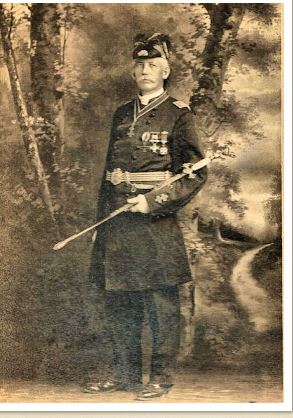
Normanregalia

 Norman in full Masonic regalia. This photo was in the stamp book and returned with the sword in 2004.
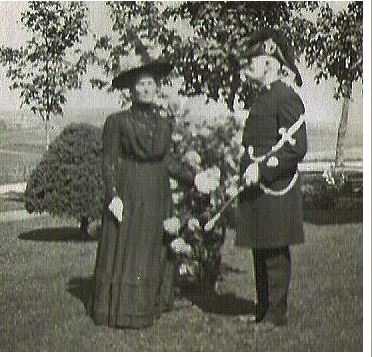
normanmargregalia

Margaret and Norman on Tighsolas lawn. A photo in the Nicholson photo album

Mrs. C googled ‘Norman Nicholson’, but no luck. There were too many people with that name .  She then he entered “Margaret Nicholson” into the search engine and, presto, she  fell upon the Eastern Townships Heritage website with my story and, plunk in the middle, she saw another picture of Norman in his Masonic regalia.

I can see it clearly in my mind’s eye. Over 50 years ago, in the age of Beatlemania and go go boots, an imaginative little boy living in Richmond, Quebec, plumbed the depths of that Nicholson treasure chest full of letters and memorabilia – the same one I discovered  in 2003 at my in-laws’ – and this little boy snitched some stamps and an envelope for his collection and glued it into a page beside an appealing photograph of a snowy-haired swashbuckler, who was really a down-on-his-luck Eastern Township hemlock bark dealer.

A little later,  he took the very sword the old man in the picture was posing with!
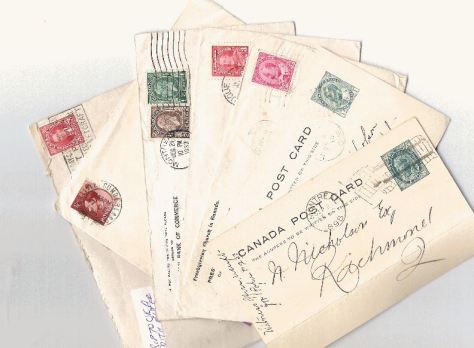
 stanps

(Some Nicholson letters. Many letters in the 1000 envelope stash  had the stamps carefully cut out. I now know where these stamps are!  )

There’s more.

Norman ’s sword arrived at my house  soon after. I showed it to my husband and my sons, Norman’s heirs, then placed it on the mantel.

That very night, as we all watched TV downstairs, we  heard a loud thump in the living room.

We went upstairs to find the Nicholson binder I had put on the coffee table had exploded open. Its cellophane pages were strewn on the floor. Atop the pile was Norman’s death certificate. I kid you not.

It was likely the dog nosing around that caused this to happen, right?  The binder had been filled to bulging with Nicholson documents. Still,  I took no chances. I placed a portrait of Margaret on the mantel beside the Masonic sword.

I like to think that is what Norman was looking for.


PS. Although perpetually cash-strapped due to the crash of the hemlock bark industry in the Eastern Townships around 1900, Norman always found the 3 dollars to pay his monthly fees to the Masons.  Norman’s records reveal he paid a hefty initiation fee, too, in 1888. Fifty dollars!

Clearly it was important to be a Mason in the ET. Apparently, the Presbyterian Church frowned up the society, saying Masons were encouraged to keep secrets from their wives. I know because the Nicholsons clipped a bit from a newspaper, likely the Montreal Witness, claiming as much!

In 1912, Margaret and their daughter, Edith, join the Order of the Eastern Star Chapter in Richmond. Edith became the Secretary. This OES was a female version of the Masons.


This is an updated version of a story published on the Eastern Townships Heritage Webmagazine in 2005.

Québec Genealogical eSociety: A New Type of Family Research Society

I just joined the Québec Genealogical eSociety for $45 Cdn.

Johanne Gervais, a professional genealogist who is passionate about researching Quebec records, founded this online research society last month. It operates in both English and French.

In addition to participating in webinars, the membership will give me access to two important Quebec databases: the BMS2000 and the PRDH database.

According to the website:

The BMS2000 database contains:

BMS records (births, marriages and deaths) from 24 genealogical societies of Québec. Close to 10 million BMS records have been collected.

The PRDH database (The Research Program in Historical Demography) contains:

A repertory of vital events, 1621–1849, for Québec, which includes approximately 2.3 million baptismal, marriage, and burial certificates registered in Catholic parishes prior to 1850. Also included are approximately 26,000 Protestant marriages recorded before 1850 and more than 20,000 certificates of various other types: census records, marriage contracts, confirmations, and lists of immigrants.

A genealogical dictionary of families, 1621-1824 for Québec, which offers a reconstruction of the history of all families who settled in the St. Lawrence Valley, or roughly the current territory of today’s province of Québec, from the beginning of French colonization to 1824.

A repertory of couples and filial relations, 1621–1824 for Québec, which specifies for each spouse the names of his or her parents and the names of his or her other spouses, if applicable, with a link to these couples. In addition, a list of the couple’s children who married before 1824 is supplied, with a link to their first marriage.

If you want to learn more about the society, visit their website or stop by their table at RootsTech2018.

Congratulations on your launch Johanne!

He Couldn’t Serve

IMG_9105

If you weren’t in uniform you weren’t doing your part.” This was a quote from a veteran on Remembrance Day 2017.

My father, Donald Sutherland volunteered for service at the beginning of WWII but was twice rejected for medical reasons. He had to sit out the war working as an accountant and serving in the Blackwatch reserve.

“ Dear Mother, I had my medical test today. It went fairly satisfactorily except that as usual, my heart was a little fast and I have to go in again Thursday am to have a recheck. They do everything under the sun to you and it takes about an hour and a half. Everything else went well and I suppose I’ll be accepted if my heart steadies down next time. I am supposed to go to bed very early on Wednesday night to soothe my nerves. I just expected to have the interview today but they buzzed me right through the whole works, Love Don”

Donald graduated from McGill University in the spring of 1939. He had just turned 22 and he and all his classmates expected to find jobs and begin their adult lives but war was on the horizon. Germany invaded Poland on September 1, 1939, three days later Britain declared war on Germany, followed by Canada a week later. Personal lives were put on hold as young men volunteered for military service.

With his new commerce degree, my father had begun working for Ritchie Brown and Company as an auditor  Once war was declared, he signed up for the McGill Canadian Officers Training Corp (C.O.T.C.). The McGill C.O.T.C. was quickly expanded from 125 to more than 1,400 cadets and 50 instructors. The need for a drill hall spurred the construction of the Arthur Currie Gymnasium. New recruits were trained in map reading, military law, organization, administration and upon completion sent to a branch of service in which they could best contribute their talents and skills.  

In August of 1940, he registered with the Dominion of Canada National Registration Regulations expecting he would soon be in military service. He went in for his medical examination without a thought and was rejected. He later tried again.

Twice he received a certificate of rejection from the Canadian Army. The doctors said he was not able to do strenuous work because of his high blood pressure and mitral valve insufficiency. He also received a rejection notice from the Airforce because that application wasn’t completed.

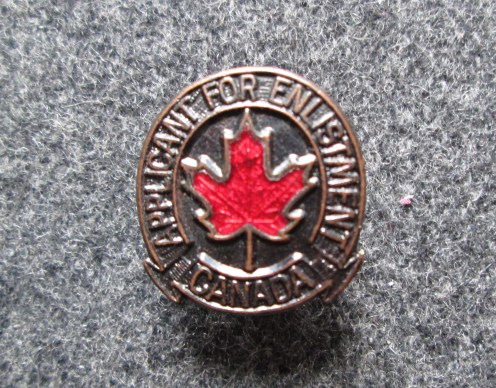
With his second rejection letter from the army came an Applicant for Enlistment badge and card to identify him as an applicant who had failed to meet the minimum medical standards. The lapel badge was to be worn to show the public he had volunteered.

IMG_9118
Applicant for Enlistment Lapel Pin


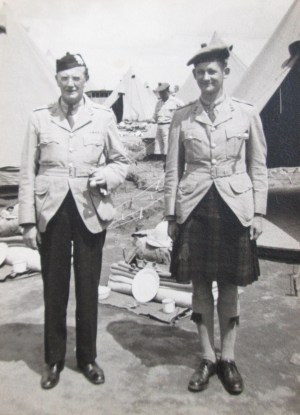
He served in the Black Watch Reserve to the end of the war. As a reservist, he was a part-time soldier while he continued at his day job. He trained raw recruits at camps in Mount Bruno and Farnham, Quebec and garnered high praise from his commanding officer. The battalion’s modified trooping of the colours was written up in the Montreal Gazette, pointing out Lt. D.N. Gatehouse and Lt. D. Sutherland, bearing the flags.

IMG_9095
Commanding Officier & Donald Sutherland Black Watch Camp, Mount Bruno, Quebec  1941


I can only imagine how my father felt, staying home, receiving letters from all his friends serving overseas, while he travelled in Canada auditing company books and marched in Montreal.

Notes:

2017 was the 100th Anniversary of my father’s birth and in his memory, I wrote this story. This is a companion piece to my mother Dorothy Raguin’s war service https://wordpress.com/post/genealogyensemble.com/4470

Letter from Donald Sutherland to his mother Minnie Eagle Sutherland July 28, 1942.

Letter from Major D.L.Carstairs to Lt Gatehouse and Lt. Sutherland July 19, 1942.

Black Watch Stages Colourful Ceremony – The Gazette, Montreal July 20, 1942. The full trooping of the colours was not done in wartime. According to other newspaper clippings my grandmother saved, he marched in a number of parades and ceremonies.

Served under Lieut Col. H.A. Johnston 4th (Reserve) Battalion of the Black Watch.

Here is a link to my mother Dorothy Raguin’s war years.

https://wordpress.com/post/genealogyensemble.com/4470

You can go back!

“It’s so much smaller than I remember!” was overheard again and again as we five sisters toured our childhood home.

The family matriarch awoke one morning weeks before our annual Christmas get together with a brilliant idea! She wanted to organize a family visit to our old home that my father had built 65 years ago. She helped raise his seven children in the 40 years that we lived in that house.

The new owners of the house cautiously agreed to the idea. Little did they know that there were 22 of us gathering at our mother’s Kensington apartment that day! Only twelve of us actually toured the family home.

The memories came flooding back the minute we stepped through the front door.  We were tripping all over ourselves reminiscing about this and that and all the good times. There were sad memories as well  which were acknowledged and gently released.

The most impressive feature of the house was the sunken living room with an entire wall of windows overlooking downtown Montreal. Opposite the windows was a spectacular floor-to-ceiling stone fireplace where many a family photo was taken over the years. The mantelpiece, however,was still annoyingly off centre! The walls echoed with years of children’s dress-up performances and lively after dinner family games of charades and fruit basket.

IMG_1542

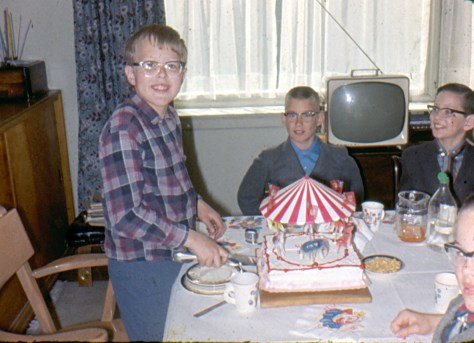
The dining room was the scene of more than a hundred birthday parties over the years. We would march around the table singing and bearing gifts for the celebrant. There are tons of photos depicting this very special family tradition .

BirthdayWithGeorgeTooley62

Sunday nights we watched the Walt Disney movie on the 12″ black and white TV with supper.  Sometimes we would have lemon and sugar roll-up pancakes or for a very special treat Chalet BBQ chicken dinner was ordered in and devoured.

We all remember the delicious roasts (and legendary roast potatoes) for Sunday lunch after church. Somehow the table stretched to include old aunties and uncles or grandparents who would join us. “Dad would methodically carve the roast but we could not wait to eat. I doubt he ever actually enjoyed his dinner as we always clamoured for gravy bread (bread dipped in the meat juices) and seconds.”

The kitchen had been completely renovated (although our stove was still in use!) but it didn’t deter our memory of Dad sitting on his stool at the end of the counter with his water jug from Vermont, eating his healthy breakfasts. On the kitchen wall behind him was the family bulletin board dotted with scraps of important notices and a handmade birthday calendar.

We delighted in seeing the original wood floors and doors, the built-in cabinetry and the bannister (since reinforced). The glass door knobs on the doors throughout the house stood out although I never remember giving them a second thought growing up. The wood floor in the upstairs hall triggered giddy memories of running and sliding the entire length of the hall in stocking feet.

Thanking our hosts, with a promised donation to a homeless shelter, we strolled back to the Kensington apartment to join the others. “Upon entering the crowded  apartment, we were greeted with the delightful smell of roast lamb dinner and we knew we were home”.

3170StSulpice2010

Photo:  3170 St. Sulpice Road, Montreal, Quebec – The house my father built  in 1952.

The White Death

Michael McHugh looked at his son, born only minutes before, with sadness. What would become of him? The room was warm and toasty even though it was one of the coldest winters in Scotland1 when Francis McHugh was born at midnight on February 21, 1895.2 Nevertheless Michael shivered in apprehension. The doctor was clear. Michael did not have long to live. He would likely be dead before the year was out.

Michael’s eldest son, Thomas was present at the birth. He was just nineteen and much too young to shoulder the burden of Michael’s family once Michael died even though Thomas was already contributing to the family’s finances. He worked in a jute factory as a yarn bleacher.3 At the age of 19, Thomas should be thinking of starting his own family one day. But how could he do that when he would have his mother and four siblings under nine to take care of?

Francis was the fifth child.4 The family lived in a tenement situated in the overcrowded industrial area near the jute factories. It is unlikely that the flat had a bathroom. The night that Francis was born, the flat would have been crowded. A female relative or two would have been there to help with the birth and the younger children. Thomas would have fetched the midwife or “howdie.”5 She would have stayed until Francis and his mother, Sarah, were comfortable and taken care of.

Michael had worked his 12-hour days at the jute factory6 until he could no longer manage it. He became increasing weak, losing weight at a rapid rate. He coughed up phlegm and sometimes blood. When he saw the doctor, his worse fears were confirmed. He had tuberculosis. The doctor named it phthisis. Michael knew it as “the white death.”

Michael was ashamed. It was known that tuberculosis was contagious, but the stigma remained. It was considered a poor man’s disease because of the unsanitary conditions of the tenements that the poor lived in.7

The doctor was careful to explain to Michael that it was contagious and Michael was careful not to cough or spit when he was with the children. He probably never carried Francis in his arms, out of fear of infecting him.

Michael died at home three months later.8 It would be about six years before Sarah Jane who was eight at the time of Francis’ birth, would be old enough to work and contribute to the family earnings. In the meantime, Thomas took care of them and he continued to do so, even when he immigrated to Canada in 1912, bringing his mother, his two brothers, his wife and his seven children.9


  1. Wikipedia web site, “Winter of 1894,” https://en.wikipedia.org/wiki/Winter_of_1894%E2%80%9395_in_the_United_Kingdom, accessed November 28, 2017. The British Isles suffered a severe winter in 1894/1895 that ended a decade of harsh winters, sometimes referred to as the Little Ice Age. Because the River Thames froze over, shipping was restricted and the economy suffered. Coal was at a premium.
  2. Birth registration of Francis McHugh, Scotland’s People, Statutory registers, Births, 282/1 384, accessed November 26, 2017.
  3. In the 1991 census, Thomas was 14 and he worked as a yarn bleacher. Scotland’s People 1891 census 282/1 35/48, accessed November 18, 2017.
  4. Scotland’s People 1891 census 282/1 35/48, accessed November 18, 2017. The 1891 census shows the children, Thomas, Sarah and Mary Ann. Edward McHugh was born in 1873, as per the registration of his birth, Scotland’s People, Statutory registers, Births, 282/1 384, accessed November 26, 2017.
  5. National Records of Scotland website. “Safe Delivery, A History of the Scottish Midwife,” https://www.nrscotland.gov.uk/research/learning/features/safe-delivery-a-history-of-scottish-midwives, accessed December 21, 2017.
  6. Dark Dundee web site, “Workers of the Mills,” https://www.darkdundee.co.uk/archive/dundee-landmarks/workers-of-the-mills/, accessed January 18, 2018. A regular working day was 12 hours in the jute mills. Dundee had one of the lowest wages in the country in the 19th century, and the highest cost of living. Low wages meant that there was little for anything that was not a necessity. While the jute mill workers had regular wages, it would have been hard to get themselves out of poverty.
  7. University of Virginia website, “Early Research and Treatment of Tuberculosis in the 19th Century, http://exhibits.hsl.virginia.edu/alav/tuberculosis/, accessed January 18, 2018.
  8. Michael McHugh’s death certificate, date of death May 16, 1895. Scotland’s People, Statutory registers, Death, 282/1 148, accessed November 26, 2017. Cause of death: Phthisis lasting 4 months. It is doubtful that it lasted four months. The four months may have indicated the time that had elapsed since the diagnosis or since he was off work or even bedridden.
  9. Canadian Passenger Lists, 1865-1935 Database, Ancestry.com, accessed November 14, 2017.