The Family Jewels and Other Treasures

Jewelry

My favourite piece of heirloom jewelry belonged to my Aunt Mary (1920- )My Formidable Tante Marie. She wore the delicate turquoise and pearl necklace while posing for one of her promotional photos during her theatre days in Montreal in the late 1940’s. I wore the very same necklace for my wedding day some 50 years later. 

My great grandfather, Dr. J. P. Hanington (1846-1927)Pharmacist then Doctor, gave his bride-to-be, Gertrude Thorpe Davidson (1852-1950)The Matriarch (A Remarkable Memory), an exceptional gold locket when they married in 1874. The back of the locket, engraved with the words “Sapienter Si Sincere” meaning “Wisely if sincerely” is the Davidson Clan Motto. The two photos inside the locket are of Dr. Hanington and their first daughter, Mary Thorpe, who died of diptheria when she was five years old.

Another couple of heirloom pieces, a delicate cameo brooch and a spectacular 89 Seed Pearl Pendant, belonged to my great grandmother, Mary Heloise Bagg Lindsay (1854-1938)Great Granny Bagg (Kittens on the Wedding Dress). However, neither of the pieces were wedding-related to my knowledge.

Furniture

The Gill Cradle was first used by my 4x Great-Grandmother Phoebe Clark Gill (1777-1864). When only three weeks old, Phoebe was taken on horseback by her mother to a place of safety in Philadelphia away from the British in September 1777. The simple mahogany cradle stayed in the family for the next 230 years gently rocking several generations of babies. There are numerous photos taken of us in our christening dresses in that wonderful old cradle. The family donated it to the McCord Museum in 2005 so that it could be preserved for historical purposes and displayed with their collection.

The Gill Cradle - photo

The Carpet Chair was rescued from a fire in 1916 when Rose Cottage, the family home in Shediac, New Brunswick, burned down. It was the family home of my 2x Great-Grandfather Daniel Hanington (1804-1889)“Roaring Dan” and his wife Margaret Ann Peters (1811-1887). It is a useful “catch all” chair as it folds up nicely. I believe the carpet seat is the original one and, for that reason, it is not used as a chair.
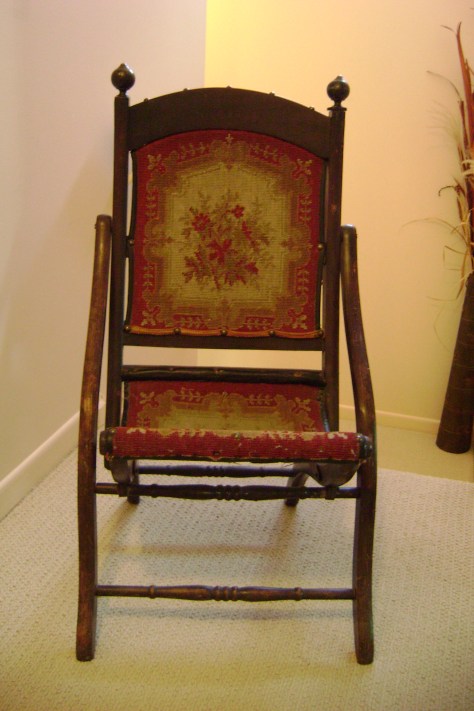
Carpet chair - Hanington

The sewing tables of both my grandmothers fit nicely into different corners of the house. One belonged to my paternal grandmother, Josephine Sherron Anglin (1893-1964)Social Media – Then and Now, and it is a pedestal table. The two drawers are partitioned perfectly to hold sewing supplies and the top folds open to double in size. The other one belonged to my maternal grandmother, Millicent Hanington Lindsay (1895-1982)Granny-Lin, and can be found in The Book of Canadian Antiques1. According to the entry, the Anglo-Quebec style mahogany sewing table is from circa 1830. It has two flaps that open up to extend the work surface as well as a couple of drawers without partitions.

China and Silver

The silver tea set requires polishing several times a year. But once polished – oh my – what an impressive sight! My husband likes to put a tea towel over his arm and serve tea to my friends when we host tea parties. Proper tea parties have become popular again and several tearooms around the city have resurrected the tradition. The set belonged to my Great-Aunt who gave it to my Aunt Mary. When my aunt gave up her home she gave it to me. It must be almost 100 years old.

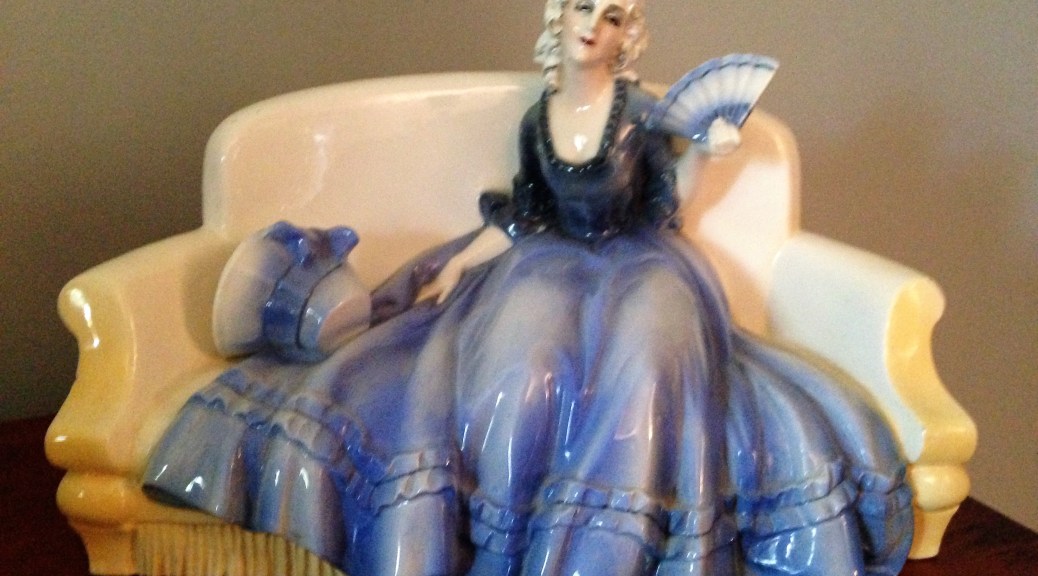
There are two china figurines that are very close to my heart. They belonged to my mother, Ann Lindsay Anglin (1926-1961)The Courtship of Ann and Tommy – Part 1, who died at the young age of 35. They remind me of her. One is a popular Royal Doulton lady figurine kept in the corner glass cabinet in the dining room with some other collectibles. The other figurine is a lovely lady in a spectacular blue gown seated on a loveseat with a blue matching bonnet beside her fanning herself. She is kept on my bedside table. 
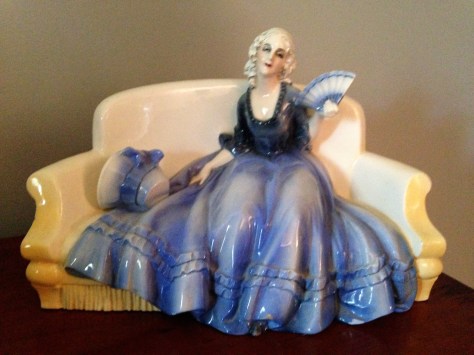
China figurine

Kitchware

Another treasure is an old box from Henry Morgan & Co. Limited with “Tins for Wedding Cake” written on the cover in my grandmother’s familiar scrawl. Inside the cardboard box there is an old tin icing canister with five different tin piping tips and a folded tired stained printed paper with a recipe for “Wedding Cake – 3 layers”. My grandmother was a fabulous cook and must have baked this cake for her three wedded daughters. Priceless! 

Wedding Cake Recipe and Tins (2)

Photographs, Letters and Diaries

Photos, letters and diaries may have no particular monetary value but they are invaluable to us genealogists trying to glean whatever we can from the lives of our ancestors. My dusty old boxes Dusty Old Boxes of cherished paper memorabilia contain heaps of pure joy. A treasure indeed!

1The Book of Canadian Antiques, Donald Blake Webster, p. 62.

Discovery and Imagination

Historical walking tours are a great way to walk in your ancestors’ footsteps. Even if you know a lot about the place your ancestors lived, you are sure to learn a few new facts. I recently visited Drummondville, where my dad, Edward McHugh, lived for eight years during the Great Depression. He, as well as his brother, Thomas, and his sister, Sarah Jane, had gone to Drummondville in 1933 after being out of work in Montreal. They were employed by the Celanese, one of the biggest employers in Quebec during the 1930s. The Celanese was a textile plant and my dad worked in the Silk Factory as an electrician. The Celanese plant in Drummondville was one of the main reasons why Drummondville hardly felt the effects of the Great Depression.

The walking tour I went on was a free tour offered by the Société d’histoire de Drummond (historical society of Drummondville).1 The tour started at Parc Woodyatt, named after James Blain Woodyatt, Director General and member of the Board of Directors of Southern Canada Power. Southern Canada Power built, owned and operated the hydroelectric complex In Drummondville. The public park Woodyatt opened in 1930 and included sports facilities such as a pool, a skating rink and tennis courts.2

My dad, who loved to skate and swim and was an avid tennis player, would have gone to this park regularly.

My dad also loved to go to the theatre and I can easily imagine him spending his Saturday evenings at the Théâtre Capitol, built in 1937. He would have been excited when the theatre opened. This lovely art deco building is currently a multi-screen cinema complex.

Across from the town square is the impressive Roman Catholic Basilica Saint- Frédéric. When the McHugh siblings lived in Drummondville in the 1930s, this church was not yet a basilica. The first church was a chapel built in 1822 and demolished in 1879 as it became too small to accommodate the parishioners. The second church was situated where the Saint-Frédéric Park is now, just in front of the current church. The second church burnt down in 1899. The third church, built at the church’s current location, was completed in 1907 and was the victim of arson in 1921. The fourth church is the one currently standing and it was completed in 1922. It is truly magnificent. It was named a minor basilica by Pope Francis in 2015.4

Image result for eglise saint frederic drummondville

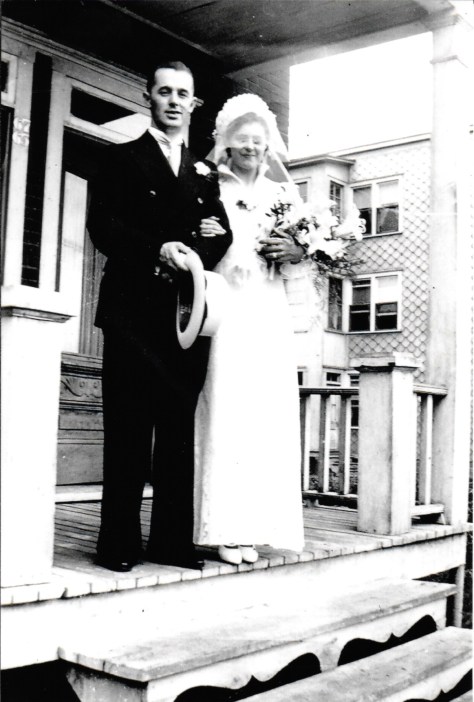
In 1937, my uncle Thomas McHugh and Simone Cloutier, a young lady from Drummondville, were married in Saint-Frédéric.5  A Casavant organ, built in 1930, would have played at their wedding. Fourteen Stations of the Cross grace the church. Stained glass windows represent the life of Saint-Frédéric, an archbishop in France.6 The McHugh family was a large one, with nine siblings. They would probably have all attended the wedding, and would have most likely travelled from Montreal by train.

McHugh, Thomas with Simone Cloutier (maybe)

Sadly, they returned to visit this magnificent church less than one year later. Thomas McHugh died of an illness in the hospital.7 My father, along with his other brothers, signed the register as pallbearers.8 Thomas McHugh is buried in the Saint-Frédéric cemetery on Saint-Joseph Boulevard, not very far from the church.

From the outside I saw the Hôpital Sainte-Croix where, sadly, my uncle would have died. The current site of this hospital was founded in 1927 and, at the time of my uncle’s death, had 18 beds and one operating room. It was run by the Soeurs de la Présentation de Marie. 9

We finished our day by driving through the working class district of Drummondville where the workers of the Celanese lived. I know my dad lived on the top floor of a duplex. He had no car so he would have lived in walking distance from work.

It was truly a day of discovery and imagination.


  1. A sincere thank you to the Société d’histoire de Drummond for this walking tour and for all of the valuable work that they do to preserve the history of Drummondville.
  2. Société d’histoire de Drummond
  3. Société d’histoire de Drummond
  4. Société d’histoire de Drummond
  5. Registration of the marriage of Thomas McHugh and Simone Cloutier, July 17, 1937, Paroisse Saint-Frédéric de Drummond, Registres photographiés au Registres de Arthabaska
  6. Church pamphlet entitled Guide – Visite et histoire de la Basilique Saint-Frédéric de Drummondville
  7. The Drummondville Statesman, “Thomas McHugh Passes Away,” May 27, 1938, accessed March 19, 2016
  8. Registration of the death of Thomas McHugh, May 25, 1938, Paroisse Saint-Frédéric de Drummond, Registres photographiés au Registres de Arthabaska
  9. Société d’histoire de Drummond

A Blacksmith’s Legacy

How does a gardener in a failing economy afford to purchase passage on a ship for a family of four in the hope of bettering his life in Canada? The answer may lie with a blacksmith.

The gardener was my great-great- great-grandfather Charles Brodie, born 1796 in Innerleithen, Scotland. The extended Brodie family lived in three neighbouring villages along the River Tweed: Peebles, Innerleithen and Traquair. The economy of the area rested on raising sheep augmented by wool-weaving. Hand weavers, however, were replaced by machines following the introduction of the steam engine at the beginning of the nineteenth century. Factories were built in cities close to cheap transportation routes forcing workers to leave their farms to find employment. The Scottish border towns fell into economic decline.

The blacksmith was Charles’ great-uncle, Alexander Brodie (1733 – 1811). Alexander was born in Traquair but reached the status of a master blacksmith in London. He designed The Register Stoves and Fire Hearths for Ships. Wood-burning iron stoves were a central feature of ships in those days, essential for cooking and warmth, but at the same time very dangerous. Many ships went to watery graves in flames. Brodie’s design was not only bigger but safer. The Royal Navy placed his stoves in all its ships “to the preservation of many valuable lives” according to a plaque in Traquair’s parish church commemorating his achievement. Alexander was handsomely rewarded for his design.

After the untimely death of his wife and two children, Alexander returned to Traquair. There he put his fortune to work to improve the lives of his fellow villagers. He eventually opened a woolen mill in Innerleithen, ushering in the industrial age. When Alexander died in 1811 his estate, worth over half a million pounds, was distributed, following a twenty-year court feud, among seventeen nieces and nephews. Charles’ father William (1751-1836) was one of the inheritors. Shortly thereafter Charles immigrated to Canada. One can only assume that the money came from his father’s inheritance.

Charles and his wife Elizabeth Kerr (b.1805) arrived in Canada in 1831 with two sons, Charles age twelve (1819-1859), and William age two (1829-1908). They settled in Montreal where the family grew to include two more sons, Robert (1835-1905) and Thomas (1838-1894). Charles was my great-great grandfather.

In 1850 Charles Jr. moved to Quebec City and opened a flour and grocery business. Robert, William and Thomas eventually joined him. Following Charles’ death in 1859 Robert and William formed a new partnership, the W. & R. Brodie Co. This company monopolized flour distribution in Quebec City and was the beginning of what today is the Brodie Flour Company.

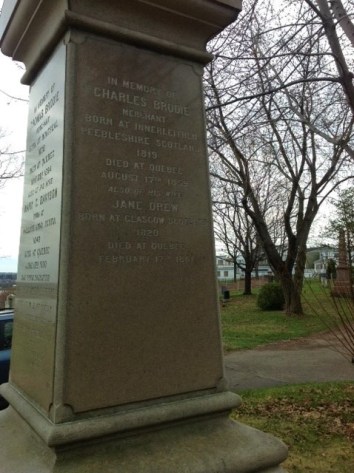
In Quebec City’s Mount Herman cemetery, a granite monument stands high on the cliff overlooking the St. Lawrence River. The four sides of the monument detail the life of each Brodie brother. Two sides include the inscription “Born at Innerleithen, Scotland. Died at Quebec“. A blacksmith’s legacy.

Brodie Grave Stone (2)


Notes and Sources:

Brodie, Peter – ancestry.ca.  Blair Family Tree

http://www.biographi.ca/en/bio/brodie_robert_13E.html

http://www.pastinnerleithen.com/alexander-brodie

William N. Boog Watson (1968) ALEXANDER BRODIE AND HIS FIREHEARTHS FOR SHIPS, The Mariner’s Mirror, 54:4, 409-412, DOI: 10.1080/00253359.1968.10659464