
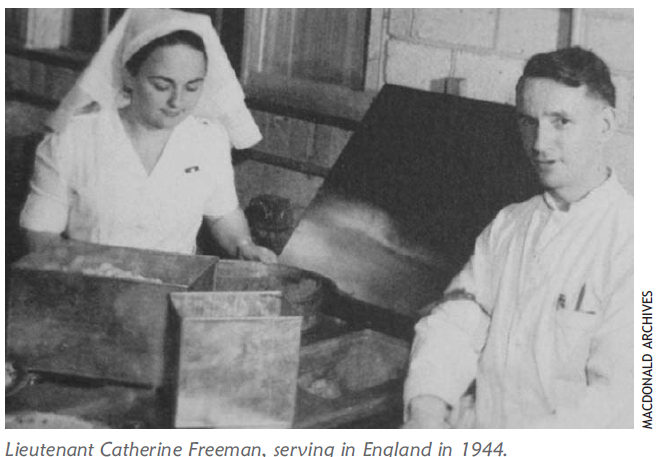
Kitty Freeman: WWII Heroine and Food Research Pioneer

This week, we commemorate the public service contributions of trained dietitian and Montreal philanthropist Mary Catherine “Kitty” Freeman. Freeman was born in Prescott, Ontario 98 years ago Sunday.

During the war years, Freeman helped feed wounded soldiers using limited rations at hospitals in Liverpool, England and Bruges, Belgium . She described her experiences to Bronwyn Chester in 2004 for a newsletter article.

If someone became diabetic, for instance, you’d look after that,” she told Chester. “But mostly you did the best you could with what you had. We had 600 patients at one time, and to break the monotony of meat with a lot of fat in it, along with potatoes and canned and dried food, you’d just go out and buy strawberries.”[1]

Freeman frequently donated to McGill during her lifetime. She also left Macdonald College a million dollar endowment after her death on March 13, 2009. Today, a well-equipped 12-person food laboratory commemorates her contributions. Another $25,000 went to the Canadian Foundation for Dietetic Research.[2]

Clearly, the study of food and nutrition meant a great deal to her, perhaps because she grew up during the Great Depression.

As a young woman, Freeman pursued a Bachelor of Household Science from Macdonald College and dietitian training at Royal Victoria College.

She signed up for the Canadian Army’s Medical Corp as soon as she turned 21 and became eligible for service.

Freeman told Chester that she travelled from Halifax Canada to Liverpool England as the only dietitian on one of three Army hospital ships.

Hospital Ship Travel

Hospital ships carried wounded soldiers from Europe to Pier 21 in Halifax. There, trained technicians transferred patients to hospital trains sent to hospitals across Canada. Military personnel and soldiers then boarded empty ships, just as Freeman did. The ship then returned to Europe for more patients.

Painted white hospital ships displayed large red crosses on each side to indicate that they should receive safe passage.

You can see a photo of one such ship on Roger Litwiller’s website. We can assume that this photo shows a later probably larger ship than the one Freeman sailed on. The Lady Nelson hospital ship didn’t exist until April 1943. It boasted an operating theatre, x-ray machine and wards for 515 people. The December 1944 Index to British Warships document shows only the Lady Nelson in existence that particular year, only two years after Freeman’s passage.[3] That couldn’t be accurate, however. The Letitia hospital ship was refitted with 200 medical personnel and the ability to ship 1,000 patients in 1943 and continued to sail in 1944.

The Geneva Convention specified that enemy bombers and submarines weren’t supposed to target hospital ships, but there were no guarantees. According to Wikipedia, 25 hospital ships were sunk during WWII.[4]

Military Contribution

The hospital ship Freeman was on arrived safely in Liverpool with its two mates in 1941. There, her expertise became a much-needed commodity. Britain struggled to feed itself. Canadian exports accounted for 77% of the wheat and flour consumed in the country. The following year, rations would be introduced across Canada to ensure that enough food went overseas.

Freeman took charge of the military hospital food service. Later, they sent her to Belgium to perform a similar role in harsher conditions. After five years of service, she returned to Montreal. She immediately joined the staff of the veteran’s Saint Anne de Bellevue Hospital as a dietitian

She moved to Queen Mary’s Veteran Hospital before retiring in 1978.

According to a 2005 Veteran’s Affairs pamphlet, Freeman’s experiences were duplicated by many women of her generation.

No account of military service in the Second World War would be complete without mention of the contribution made by the four special branches of the nursing service – the Physiotherapists, Occupational Therapists, Dietitians and Home Sisters. Also, the sisters who served on the hospital trains returning the wounded to destinations across Canada. The end of the Second World War brought the closure of military and station hospitals across Canada. A total of 80 nurses, 30 RCAMC, 30 RCAF and 20 RCN sisters joined the permanent force and served at military establishments across the country; many more staffed the Department of Veterans Affairs’ hospitals to care for hundreds of returning Veterans.[5]

We need to remember the service of these courageous women, including Mary Catherine Freeman.

Sources

[1] Chester, Bronwyn, “Fueling the Forces,” In Focus Agriculture and Environmental Sciences, McGill, Spring 2004, p15, https://www.mcgill.ca/macdonald/files/macdonald/InFocusSpring2004.pdf, accessed September 24, 2019.

[2] “Generous legacy supports dietetic and nutrition research, CFDR Keeping in Touch, Fall 2009, p3.

[3] Index to British Warships, Division of Naval Intelligence, December 1944, http://www.ibiblio.org/hyperwar/USN/ref/ONI/ONI-201/ONI-201-I/ONI-201-I.pdf, accessed September 24, 2019.

[4] https://en.wikipedia.org/wiki/List_of_hospital_ships_sunk_in_World_War_II, accessed September 24, 2019.

[5] “The Nursing Sisters of Canada,” Her Majesty the Queen in Right of Canada represented by the Minister of Veterans Affairs, 2005. Catalogue No. V32-146/2005 ISBN 0-662-69038-9 Accessed September 24, 2019, http://www.veterans.gc.ca/eng/remembrance/those-who-served/women-and-war/nursing-sisters#sisterhist3
To the Lighthouse Part 3

myfatherugby

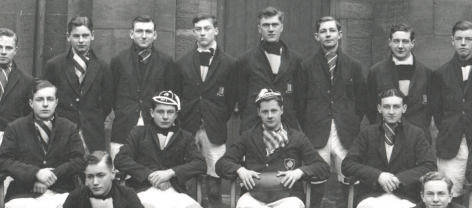
Senior Rugby, St Bee’s School, 1939. Peter Nixon, top row, fourth from left

(To the Lighthouse Part 1: Geological Time, Historical Time, Genealogical Time.)

(To the Lighthouse Part 11: You Don’t Want to be Me.)

To the Lighthouse: Part 111. One Mean SOB

I think, once again, of the thick- legged cads on the colliery team. Tough as nails.  It would be a shame for them to beat us on the rugby field – or on the battlefield.

A pair of kittiwakes soars and shrieks 15 feet over us, just as the eight students approach slowly from the south, at a jogging pace,  two of them cupping their pockets and looking very self-satisfied.

“We got three big eggs,  and one just for you, Nixon,” speaks up Armstrong in a flattering tone.  He’s normally the most belligerent of my young charges. Another with Border Reiver blood. It’s a bribe and a most worthy one.

The Nixon clan was once in thrall to the Armstrong clan, I recall  Grandfather Nixon, a sawmill worker, telling me a few years ago as we walked the well-trod path from his home in Helmsley North Yorkshire to nearby Rievaulx to see the stone quarry where he had laboured as a young man, the famous cathedral ruins and the small thatched cottage, Abbot’s Well, where Mary Ellen Richardson, his wife, my grandmother, grew up. She was a tailor’s daughter.

abbottswellrievaulx

Abbot’s Well Rievaulx, North Yorkshire

“They are falcon’s eggs, we think” interrupts Bell, Armstrong’s sidekick, also of Border Reiver blood. You should have seen the mother. She attacked us with her enormous beak and flapping wings.” Falcon? I now understand this to be a ruse. Or is it?

Can miracles of nature happen? Can schoolboys steal some eggs from a falcon’s nest? Might the war in Europe never really start?

The smirk on the faces of all the young chaps tell me there will be no eggs, gull’s or falcon’s, for luncheon today. It is all a big joke.

“Well, let’s turn around them, we’ll never make to the lighthouse and back with those falcon’s eggs intact,” Armstrong says, stubbornly sticking to his story.  I can taste the savoury most-likely fictitious fried eggs  and it STILL makes my mouth water.

“The headmaster told me to take you to the lighthouse and back,” I say, nonchalantly exercising my power over them as is my right.   The boys groan. I start to run, outpacing them but staying close enough to make sure they don’t delay.

We pass the ruins to the entrance of the old King Pit, once the deepest shaft in the world. 160 fathoms deep built in 1750 by the Lowther family. Or so says a plaque next to it.  I once again think of the boys on the colliery team and their ancestors who worked within these mines. The rise of all the towns around here, Whitehaven, Maryport, Workingham is thanks to the 18th century coal trade with Ireland. The collieries on the coast once covered thousands of acres. I must have read that on another plaque somewhere else.

I have no coal miners in my family tree. We are too tall. I come from farmers, mostly.  My father, Robert Nixon, was a footman at elegant Dunscombe Park in Helmsley before he took the Lutzer ocean liner out of Southampton to Singapore in October, 1912.

He probably already was acquainted with  my mother, Dorothy Forster, as her father, John, was preaching in Helmsley at the time.  Who knows when they got engaged.  Dorothy, a land girl during WWI, a titch of  a woman tasked with leading the enormous Clydesdales through the forests with their loads, followed him to Malaya in December 1921, a mere ten months before I was born.

Robert is  6 foot 4. The gentry like their footmen tall and presentable. Still, Robert preferred to try his luck out in the bug-infested jungle. Perhaps it was Dorothy who insisted, she not wanting to be married to a lowly servant. He started out as a labourer, wielding the whip, but soon rose to be manager of the Batu Caves Rubber Estate in Selangor with almost life and death power over the Indian workers. He was born a servant in England but became a demi-god in Malaya. His imposing height helped him there, too, no doubt. And the fact he is one mean SOB.

Right now, he has the management of two rubber estates in Selangor, just to make ends meet. The economic downturn has made it hard on him and my mother. My mother has taken on a job as the librarian for the Kuala Lumpur Book Club.

BATUACES

Batu Caves Religious Resort, Selangor, Malaya

This war in Europe will not affect them, thank goodness.

I  continue to run into the past, toward Whitehaven on the Cumberland Coast. Sandstone cliffs and igneous outcrops and beaches covered in pebbles. Geologic time, historical time, genealogical time, historical memory, family myth. The rest of the boys follow with Cowen, his cheeks as red as a robin’s chest, slipping behind. I slow down the pace just for him. My little friend.

We pass ‘the candlestick,’ the old chimney of the Wellington Pit.  We’re almost at Whitehaven now.

But an armed guard, an old man in his grey-blue denim LDV jacket, with a gold star on the sleeve, waves at us with his rifle and says, “ Go back!   The lighthouse is off limits. There are motor launches out on the water looking for German subs. Can’t you see?”

The boys gather in a circular group and they all cup their eyes with their hands to look out to sea. A few with very good eyesight, like mine, point in the direction of the boats.

The  old armed guard waves us on.

“Haven’t you St. Beghian’s heard?” he says. “The Huns have attacked Denmark and Norway. The war is on for real.”

And just as he speaks, a lone steel and wood bird buzzes into view. I am the first to see it with my impeccable long range vision, but soon all ten of us stop running and turn our eyes toward the misty sky to gaze into our future.

  1. My father ended up in the RAF, posted at Dorval in Montreal, headquarters of the Ferry Command, where he met my French Canadian mother at a meet-and-greet at the Mount Royal Hotel.

 See  Night Flight, here on this blog

As it happens, one of the St Bees Village boy, a printer’s apprentice, signed up in 1939 and distinguished himself early on. He was then posted in Dorval and died on a flight mission to the Bahamas in 1941. I have no idea whether or not my father knew him, before or after enlistment. He never mentioned this.  There is information on this man, Alan  Rodgers, posted on the St. Bees Village website.

In January, 1941, a few days after Pearl Harbour, the Japanese invaded Malaya, dropping bombs on the ‘green’ in Kuala Lumpur, also hitting the building housing the Kuala Lumpur Book Club.  Four died there in the rubble, but Dorothy, my grandmother, hid under a desk and survived.  She and her husband, Robert, ended up interned at Changi Internment Camp.  Read about it in Beads in a Necklace, our book. Also here at the Globe and Mail. Read  or LISTEN TO a one act play about John Forster’s dementia in A Stranger in his/her Bed.  

Or read the complete story of Dorothy Nixon’s life in the colonies here in my e-book, Looking for Mrs. Peel.

La Fermière Louise Mauger

Louise_Mauger_sculpture

Women are rarely commemorated with a statue. There is one, La Fermière, in front of Marche Maisonneuve in Montreal’s East End. It depicts a woman holding a basket of produce. It was sculpted by Alfred Laliberté and he dedicated it to Louise Mauger, as a glorification of traditional rural values. She was one of the early settlers of Montreal and not the only person celebrated with a monument. Louise was my eight times great grandmother.

1024px-Marché_Maisonneuve_3
La Fermiere statue in front of Marche Maisonneuve

Both Louise (1598) and her husband Pierre Gadoys (1594) were born in Saint Martin d’-Inge in Perche, France. They came to New France about 1636 as part of a settlement initiative by Robert Giffard de Moncel, the first Seigneur of colonial New France. Records have them living and farming on the Beauport Seigneurie in 1636 and Pierre employed by the Société Notre-Dame de Montréal pour la Conversion des Sauvages, at Sainte-Foy or Sillery from 1643 to 1645.

Tracing families back is quite easy in Quebec as the church records of births, marriages and deaths, kept from the beginning of the colonies have been well preserved. My maternal grandmother was a Bruneau and her direct male line goes back to Francois Bruneau, my seven-time great grandfather, who arrived in New France in 1659.

The Bruneau family tree is just part of my story. There are all the women back through the tree who were only a name, their families not mentioned. A seventh times great grandfather is one of 256 grandfathers which means there are also 256 grandmothers who have their own stories.

I started with Sophie Marie Prud’homme who married Barnabé Bruneau, my two times great grandparents. Tracing back the Prud’homme line I arrived at Louis Prud’homme who arrived in New France in the 1640s, where he met and married Roberte Gadoys. Roberte came from France in the 1630s with her father Pierre Gadoys, her mother Louise Mauger and her brother Pierre.

Pierre Gadoys (Gadois, Gadoua) my 8th time’s great grandfather moved his family to Montreal shortly after this because of the many attacks by the Huron and Algonquin on settlers around Quebec City. Montreal was fortified. In 1648, he was the first person to be granted land in Montreal (Ville-Marie) by the governor, Paul de Chomedey de Maisonneuve. He was known as the “Premier Habitant or first farmer”1. The 40 arpents grant was from the current St Paul Street north to the Petite Riviere between St. Pierre and Bleury. In 1666 he was granted another 60 arpents for helping Charles LeMoyne fight the Iroquois.

Just as important as the first farmer is the first farmer’s wife. Louise had a lot of work to do. The couple had six children, possibly seven. Roberte, Pierre and Etienne (is the question mark) were born in France, while Francois, Jeanne and Joseph on the Seigneurie of Beauport and Jean-Baptiste was born in Sainte-Foy when Louise was 43. Jeanne died at birth, Joseph died in his first month and there is no other information about Francois. According to the 1667 census they had 40 acres under cultivation, six cows and a hired servant.

While Pierre Gadoys died in 1667, Louise lived another 23 years and died in Montreal at the age of 92.

Pierre also has a monument but it is a small trapezoid stone marker in Place d’Youville installed in 1992 as part of Montreal’s 350th celebration. It looks more like a concrete form used to block off a road than a commemoration. It is not a lovely bronze statue in the middle of a fountain.

Bibliography:

1. Dollier de Casson, Francois. Histoire du Montreal 1640-1672. pg 88

Jean-Jacques Lefebvre, “GADOYS, PIERRE,” in Dictionary of Canadian Biography, vol. 1, University of Toronto/Université Laval, 2003–, accessed November 29, 2018, http://www.biographi.ca/en/bio/gadoys_pierre_1E.html.

Fournier, Marcel. 1642-1643 Les Origins de Montréal Diffusion au Canada, 2013.

Le Bulletin Recherches Historique Vol XXXIII Levis – Mars 1927 Nos 3 Les Colons de Montreal de 1642-1667 pgs. 180,181.

PRDH-RAB; Origine des Familles Canadiennes; Parchemin Ancestry accessed January 2019.

Sulte, Benjamin: Histoire des Canadiens Français [1608-1880]: origine, histoire, religion, guerres, découvertes, colonisation, coutumes, vie domestique, sociale et politique, développement, avenir January 1, 1882 Wilson et Cie

Senécal, Jean-Guy(senecal@fmed.ulaval.ca); Sep 27, 1998, compilation OCR de trois documents Word disponible en ligne, ses documents se référant principalement au Tome IV & V, Chapitre IV du livreHistoire des Canadiens-Française de Benjamin Sulte, édition 1977.

Notes:

The statue La Fermière was made by Alfred Laliberte in 1915. It was part of a continent-wide city beautification project.

Pierre Gadoys’ sister Françoise was married to Nicholas Godé. They were present at the founding of Montreal.

It is possible but not proven that Pierre and Louise were in Montreal in May of 1642 for the founding ceremony. Their son Pierre, then 11, was said to have attended with his Aunt and Uncle, Francoise and Nicholas Godé. It was thought that Louise was not at the ceremony as she was attending to Jean Baptiste who was only a year old. Pierre first settled in Sillery with his family but had gone to Montreal in the early 1642 and then returned to Sillery as he was there in 1645.

After his death, Saint-Pierre street was named in his honour.

1666 Census – Pierre Gadois the eldest, 72, inhabitant; Louise Moger, 68, his wife; Jean-Baptiste, 25, gunsmith; Pierre Villeneuve, 25, hired servant. 

1667 Census – Pierre Gadoys, 65; Louise Mauger, his wife, 65; Pierre Villeneuve, domestic, 24; 6 cattle, 40 acres under cultivation.  She was buried March 18, 1690 in Montreal. 

Pierre Gadoys: 1594 – Oct 20 1667 Married 1627 de Igé, Saint-Martin, Orne, France.

Louise Mauger: 1598 – Mar 18 1690

Roberte Gadoys: Baptised Sept 15 1628 France – Sept 14, 1716 Montreal

Pierre Gadois: Nov 17, 1631 or 1632 France– May 18, 1714 Montreal

Etienne Gadois: Baptised Nov 17 1631 France – ? Are Pierre and Etienne the same person??

Francois Gadois: Dec 2 1632 Quebec – ?

Jeanne Gadois: June 26 1638 – June 26, 1638 Quebec

Joseph Godois: Sept 28 1639 – Oct 1639 Quebec

Jean-Baptiste Gadois: Mar 1, 1641 Quebec – April 15 1728 Montreal.

The inscriptions on Pierre Gadois Monument In Place d’Youville, Montreal reads, C’est d’ici que Le 4 Janvier 1648 Maisonneuve determina les bornes de la premiere concession accordee a Pierre Gadoys il fixait ainsi l’orientation des rues de la future Ville” and on another side, Stele erigee grace a L’Ordre des Arpenteurs- Geometres du Quebec, a L’Association des Detaillants de Monuments du Quebec, aux Archives Nationales du Quebec, aux Productions D’Amerique Francaise et Au Groupe de Recherche de Raymond Dumais Archivist.”

A Turning Point in Quebec History

This year is the 70th Anniversary of the Asbestos Strike. (1949-2019) It has often been singled out as a turning point in the history of the province of Quebec and has also been referred to as the beginning of the Quiet Revolution.

Asbestos, Quebec is a mining town located in the Eastern Townships midst a beautiful rolling countryside, approximately 120 kilometers from Montreal. It was a company town with an open pit (Jeffrey Mine) where asbestos, a non-flammable fibrous mineral was extracted. They also mined underground and the fibres were extracted and processed in the mill.

For several months before the strike in early 1949 the miners were becoming more and more disgruntled with the working conditions. They sought an increase in wages, better working conditions and an improvement in health care.

Our parish church, St. Aime, was the meeting place for the workers. The parish priest, Father Camillrand was deeply involved in the miners’ plight. The government of Quebec under the firm hand of Premier Maurice Duplessis was aligned with the Canadian John-Manville Company, (CJM) the employer and owner of the entire mining enterprise.

On the eve of Valentine’s Day, 1949 the miners gathered in St. Aime Church in Asbestos. They voted overwhelmingly to go on strike the following day.

I was nine years old during the strike and although It was difficult to comprehend what was happening in our community, I knew that something was awry. I have vivid memories of several events that took place over five months.

Our Girl Guides and Brownies always held their gatherings in the nurse’s residence. At the time of the strike I was a Brownie. Our meetings were put on hold.

1st Asbestos Brownie Pack

At school there was taunting. Some of the students’ parents were on strike while others continued to work. This lent itself to an unpleasant situation for many. Despite the turmoil all around, all in all, life went on as normally as possible for children while the media covered the event in detail. Most townsfolk were sympathetic toward the miners. They were very generous with donations. Many workers did not have money to provide adequately for the families.

The newspapers covered the events daily and, in our home, we received the now defunct Montreal Star and Toronto Daily Star, that always arrived two days later than published. I was eager to read about the strike. At that time, I read articles by Pierre Elliott Trudeau and Gerard Pelletier, both journalists and Jean Marchand, who was a union organizer. They wrote daily columns and kept the public informed. Years later they became members of Parliament and Pierre Trudeau became Prime Minister of Canada.

Everyone in the town was affected by the strike, particularly the merchants. Most of the population in the town worked at one of the CJM operations.

CJM was the main employer, however, the Asbestos strike was not localized in the one town. It included many of the small mining companies in the area. The town of Asbestos had the largest group of miners. The open pit was the largest in North America and one of the largest in the world where they produced what was considered a magic mineral and was used in a multitude of ways. The construction boom after WWII created a large demand for asbestos products; roofing shingles, floor tiles, insulation and brake linings in cars.

Negotiators for the union and the company officials attempted to come to an agreement. It was not to be, and the violence began to escalate when the companies hired outside workers.

In May, Premier Duplessis sent in the Provincial Police. They were lodged in the nurses’ residence where their headquarters were also located.

I remember being frightened seeing the black Mariah bus loaded with burly policemen arriving in town and wondered if there would ever be an end to the ongoing troubles. Would they be able to quell the unrest before lives were lost?

The strike continued throughout May and June. The Provincial Police tactics were brutal. Several miners were seriously injured.  It was time to put an end to the strike.

Finally, in early July all parties negotiated a settlement. The strike ended with the employees having gained few of their demands, one being a small increase in hourly wages. Most of the workers went back to work, while others moved on.

They were tumultuous times that left indelible memories.

Sources: Photograph: Jeffrey Mine 1944 By Harry Rowed – https://www.flickr.com/photos/lac-bac/31123426351/in/album-72157665191042359/, Public Domain, https://commons.wikimedia.org/w/index.php?curid=56279338

There will be a follow-up to this article. ”Asbestos 70 Years After the Strike

Google Map showing Asbestos in relation to Montreal,
Trois Rivieres and Sherbrooke.
A 2018 Google Earth Pro aerial view of Jeffrey Mine no longer in operation.