How genealogy improves historical study

Early on a mid-December morning, back when gatherings indoors happened frequently, I drove to a church in the West Island of Montreal to join descendants of United Empire Loyalists, Orangemen, Irish army regulars and pro-Fenians.

Together, we listened in awe as Dr. Jane G. V. McGaughey, a professor from the Irish studies department at Concordia University talked about a battle that took place in November 1838 on the shores of the St. Lawrence River.1

Traditional historians usually ignore genealogists, but McGaughey, who integrated genealogy into her first book “Ulster’s Men,” treated us like the respected colleagues we are.

Her practice should be more widespread. Genealogists can be some of the most fervent history buffs out there, and historians can build strong platforms if they succeed in getting our attention.

We also help democratize history so that it includes everyday people instead of focussing primarily on elites. Most of my stories feature farmers, store-keepers, carpenters and other working class people.

Because family historians in Canada research specific individuals, we also get interested in the most minute details about small communities. We expose secrets within families. We bust long-held myths, reveal unusual settlement patterns and emphasize the roles of otherwise ignored individuals in societies. We help Canadians discover who they are.

Sometimes, we discover reasons for tourists and visitors to stop by tiny hamlets that used to be important gathering centres. A story about my four-times great grandmother on my father’s side had me investigating a small community on the shores of the Seine River between Winnipeg, Manitoba and Grand Forks, North Dakota, for instance. Today, not many people notice the tiny place next to the Trans Canada and #12 highways, but it played many important roles in previous eras, as an Aboriginal village, a Catholic Mission and as a stopover on the Dawson Trail during the Red River Rebellion. The community was called Oak Point when Marie Sophie (Séraphie) Henault-Canada was born there in 1818. It became St. Anne by the time she died in the same town 74 years later. (Read my stories about Oak Point here and here.)

Researching the minute history of communities across the country can attract diverse audiences. Sharing such research at presentations and get-togethers can create entirely new memories and evolve our culture.

Researcher Monisha Pasupathi described the process in which adults develop individually and together to create a common culture for a paper in the Psychological Bulletin journal.

“…I have argued that talking about past experiences is a process by which our autobiographical memories are socially constructed. I proposed that talk about the past in conversation is coconstructed, and that subsequent memories for events talked about in conversation are likely to be consistent with that socially constructed version. Thus, the content of autobiographical memory is a result of both experiences and social reconstructions of those experiences. Later I suggested that conversing about past experiences both influences and can be influenced by adult development. Socially constructing the past may promote either continuity or change in identity across adulthood.”2

Academics frequently underestimate family historians. Archivist, researcher, and information science professor from the University of Michigan interviewed 29 specific genealogists in detail to discover what kinds of problems they try to solve. Her analysis determined that we are much more detail-oriented and meaning-seeking than she anticipated.

Genealogy and family history are examples of everyday life information seeking and provide a unique example of intensive and extensive use of libraries and archives over time. In spite of the ongoing nature of this activity, genealogists and family historians have rarely been the subject of study in the information seeking literature and therefore the nature of their information problems have not been explored. This article discusses findings from a qualitative study based on twenty-nine in-depth, semi-structured interviews with genealogists and family historians and observations of their personal information management practices. Results indicated that the search for factual information often led to one for orienting information. Finding ancestors in the past was also a means of finding one’s own identity in the present. Family history is also an activity without a clear end goal; after the ancestry chart is filled in the search continues for more information about the lives of one’s forebears. Thus, family history should be viewed as an ongoing process of seeking meaning. The ultimate need is not a fact or date, but to create a larger narrative, connect with others in the past and in the present, and to find coherence in one’s own life.3

Genealogists often work from home, which is why we pay to access historical data.

Some academics worry that the partnership between genealogists and corporations like Family Search and Ancestry emphasize religious or corporate goals over historical accuracy, but those issues stem from consumer-oriented cultures, not from the practice of genealogy itself. Public institutions in France and Quebec have created impressive databanks without the help of religious or private organizations. As public education cuts funding to historical research centres, genealogists have enabled archives, foundations and libraries to collect and protect documents that would otherwise be destroyed.

The people in the room listening to McGaughey were typical of every genealogical presentation I’ve attended. We all represented different sides of a feud going back generations and emotions ran high. Not because we were angry at the others or sought to heal an ancient misjustice. A genealogy presentation is the one place where diversity isn’t just tolerated, it’s sought out. With diverse researchers, the chance of learning about new sources, techniques and ideas grows exponentially. Our excitement came from the possibility that someone might share an important detail that would help us better document an ancestor’s life.

That’s the key difference between family historians and most of our academic cousins. We concentrate on the lives of specific people rather than significant issues or eras. Social historians and those who focus on biography are not so different from genealogists. We too are learning to source digital, secondary and derivative records properly, seek accreditation for the quality of our analyses, and write narrative nonfiction in compelling ways.

Our work certainly reaches a lot of people in word-of-mouth ways. A few years ago, I prepared a mini genealogical report as a gift for my great-aunt’s 96th birthday. The report garnered more attention from the teens and young adults in the family who had never heard of genealogy. They had lots of questions about the small Ontario town in which she was born, the Edmonton home she lived in during her teens and the kind of work she did during World War II. I knew the conversation connected them to their ancestors, when one of the young people told me that “these sound like real people.”

Feminist researchers might consider collaborating with genealogists. In my experience, most genealogists are women, and we have a lot of trouble finding good sources of information to find our female ancestors. Perhaps by linking family historians with academic historians, we could reduce the level of gender bias in historical narrative over time.

So often, the stories we hear about the past are myths made up of half-truths. Academic and family historians can partner to co-create new stories to captivate all Canadians.

1McGaughey Dr. Jane G. V., Family Ghosts: When Personal History and Professional Research Collide, presentation for the Quebec Family History Society, Briarwood Presbyterian Church Hall, Saturday, December 14, 2013, 10h30.

2 Pasupathi, Monisha. The social construction of the personal past and its implication for adult development. Psychological bulletin 127, 2001, p 664.

3 Yakel, Elizabeth, Seeking Information, Seeking Connections, Seeking Meaning: Genealogists and Family Historians, Information Research: An International Electronic Journal, v10 n1 Oct 2004.
Can We Ever REALLY Know our Ancestors?

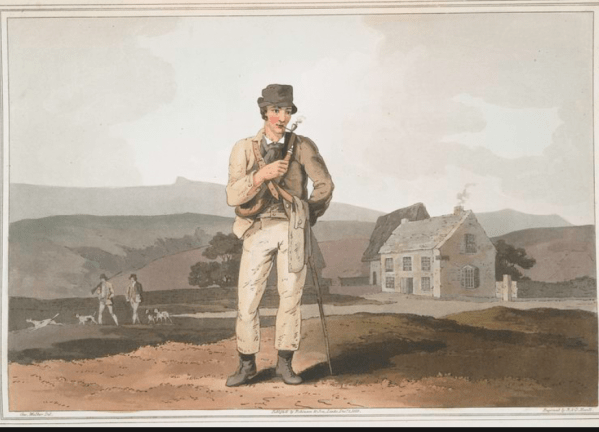
Moor Guide.

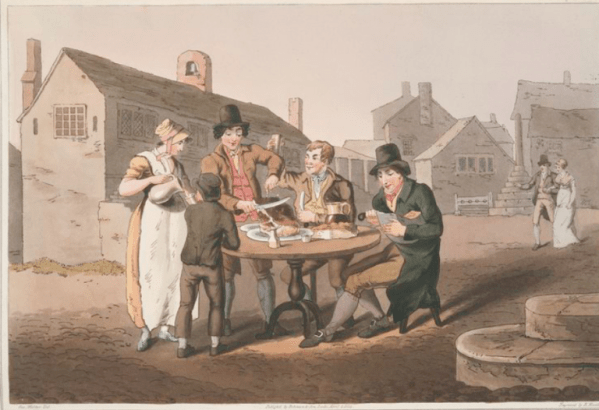
The Costumes of Yorkshire: George Walker, 1813. New York Public Library Online, Public Domain photo

“The past is a foreign country. They do things differently there,” writes L.P. Hartley at the very beginning of The Go-Between, a novel I read and loved in my 20’s.

As a woman who now likes to pen stories based on her family tree, this famous first line has new meaning for me. It makes me ask the question: Despite our best efforts, can we ever really know our more distant ancestors?

Sure, we can absorb with attention the family myths. We can dig out the dates of births, marriages and deaths. We can check out the newspaper record. We can look up legal documents and even research with scholarly precision the historical context of their -often- difficult lives.

But is that REALLY knowing them?

Or is the best way to know our ancestors through our own parents and grandparents, through their inherited behaviours and beliefs that we witnessed first-hand. I have three other ideas.

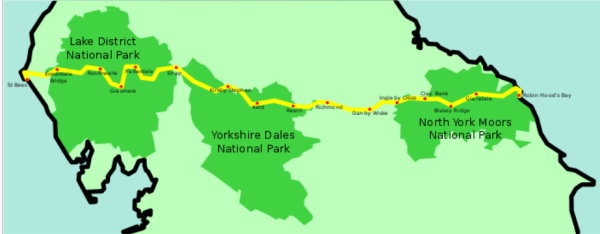
The Coast-to-Coast Walk (WIkipedia Share alike Pic John Carter

1. Visiting the ‘homeland’ can give you a feel for who your ancestors were.

There’s a well-known 182 mile coast-to-coast hike that goes from the soaring sandstone cliffs of St. Bee’s Head on the west coast of Cumbria to the charming storied fishing village of Robin Hood’s Bay on the east coast in Yorkshire. Patching together my father’s Nixon/Forster family tree, I discovered he had ancestors; farmers, lead miners, grocers, servants; living just north and south of – and even directly on – this picturesque route.

This 182 mile ‘footpath’ traverses three national parks: The Lake District, Yorkshire Dales and North York Moors National Parks. It’s a walk that offers up isolated pebbled beaches and quaint historic villages; rugged wildernesses with hilltop cairns; flat easy patches with long sweeping vistas; medieval castles and ancient stone circles; serene valleys dotted with sheep; sturdy Roman roads and magical heather moorlands.

As it happens, I can take this hike anytime (on YouTube) and see with my own eyes pretty much what many of my ancestors saw with their own eyes.

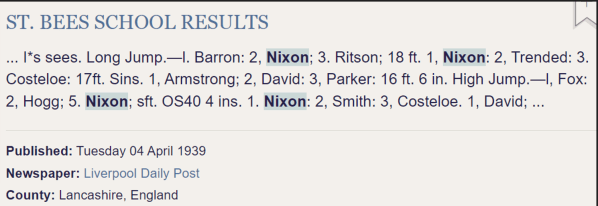
My ancestors had good eyes, I bet, for long distance gazing. Strong legs, too. And leathery skin beaten up by the cold wet winds of the moors. They probably were skinny and didn’t worry about cholesterol as they downed their breakfasts of heavy black rye bread and fatty bacon. Come to think of it, that description fits my ­father pretty well. His exceptional long distance eye-sight and strong legs made him a top athlete in the 1930’s at this boarding school in St. Bees. He was still participating in cross-country ski marathons in Quebec in the 1980s.1

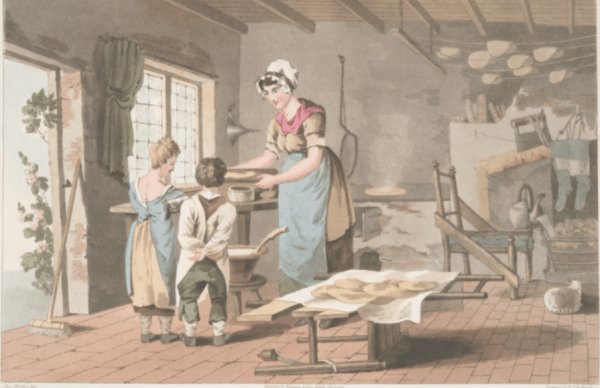
Woman making oatcakes on a Yorkshire farm

2. You can always look to old family recipes to teach yourself something essential about your antecedents.

In my 1960’s Montreal home, on Saturdays when we ate roast beef, I was in charge of making the Yorkshire pudding, and I do believe that it was my father who showed me how to make the batter and take fat drippings from the roast and spoon it into the bottom of the muffin tins.

Still, it was my French Canadian mother who was in charge of the kitchen and her roast was ‘blue’ -practically mooing on the plate a la francaise. My father ate only the outside over-cooked part.

Apart from frying our POM (Pride of Montreal) white bread slices in bacon fat (ICK!) and threatening to feed us smoked herring (double ICK) my British pater (who was born in Malaya, after all) didn’t seem to know much about his native Yorkshire foods. He never mentioned the oatcakes that were a staple of the poor; or the cheese pies eaten on various festive occasions or the special mutton pie made with candied fruit in a rich crust served with fresh fried trout and curd cheesecakes, washed down with ‘home-made’ whisky served as a reward at the end of sheep-shearing season.

As a child of the Raj, my father more often spoke with fond nostalgia of the Mulligatawny soup (curried chicken with apples) he ate on his father’s Selangor Rubber Estate.

Still, somehow, more through his dislikes rather than his preferences, I learned that (generally-speaking) eating plain hearty food was in his North of England blood.

Midsummer Eve in Yorkshire – a time when witches and fairies come out to play with the humans.

3. Consulting out-of-print genealogy books can give you an insider’s knowledge about the people who came before.

I stumbled upon a terrific little volume online: Rambles Through the North Yorkshire Dales. Published 1913 on archive.org. The book even has a chapter on the Yorkshire character. Bingo!

The Yorkshireman, says the author, a native, is notorious for being tight-fisted. “He loves to get the best of a bargain not only for business purposes but as sport.” He is suspicious of strangers, especially of the patronizing upper-crust kind. He is “reticent and hard on the outside with a queer sense of independence and a real and natural sense of humour.”

So right! My father would drive ten miles to save ten cents on gasoline. He could deconstruct a person’s character, a television show, a work of art with one well-chosen (often withering) word. He didn’t follow the current fashion – and mocked us when we wanted to. He was amused by the minutia of everyday life, although I seldom got his subtle jokes.

Yorkshiremen says the book are filled with ‘a fierce romanticism, a strong religious fervour.’ Still, people from the North of England were once very superstitious. These people believed or half-believed in dragons and water sprites, fairies and ‘boggles’ or imps who were often the ghosts of nasty feudal landlords long dead.

Many of the local traditions around holy wells and sacred fires, etc. stem back to pre-Christian times. and are still carried out in various and sundry small towns.

Does this fit my father? No, not at all. My father, educated in mathematics at Oxford, was a pragmatist. Still, he seemed to actually take delight in reading fairy tales to me.

Peter Nixon and Marie Marthe Crepeau

And last but not least, my North of England ancestors spoke funny. Real funny. According to my mother, my father lost his English accent the day he arrived in Canada.

I learned about the Yorkshire dialect by watching the original All Creatures Great and Small television series based on the life of Alf Wight or James Herriot, a veterinarian, in Thirsk, North Yorkshire. In that show, locals were used to play the farmers and I often needed subtitles to understand them!

No, my Yorkshire father never said things like, “Ere, wot’s f’r us tea Mutha” as in “Mother, what are we having for dinner?”

M’of t’sop, d’yawanowt?

I’m going to the shop? Do you want me to get anything?

Put t’wood int ‘ole. Close the door. (Put the wood in the hole)

Sit this sen Darn as in Sit down.3

but I suspect his grandfather, Robert Nixon, who was working as a delver in the local Rievaulx quarry in 1911 certainly did.

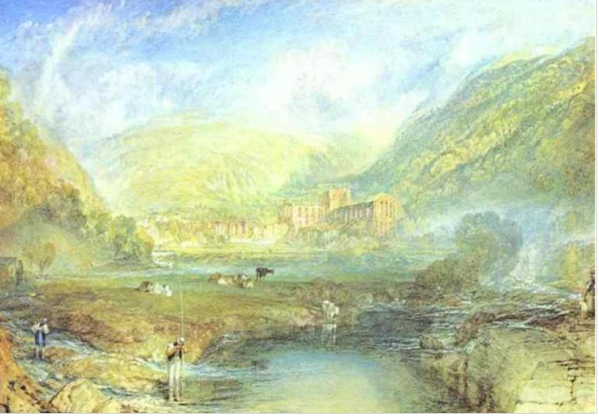
Rievaulx Castle by Turner: There is no shortage of paintings of the North of England, from Victorian Era and beyond, but these paintings seldom depict working people. The few I could find online were not Creative Commons. Indeed, Her Majesty the Queen has a nice one of poor fisher folk in her collection.
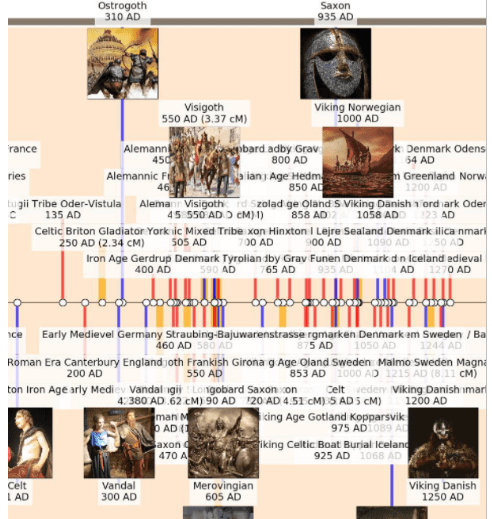
My father’s ancient genes according to mytrueancestry.com. Yes, Danish and Norwegian Viking, Saxon, Visigoth, Merovingian. The history of Yorkshire indicates this is all pretty on spot. He has lot of Celt too. And some deep Illyrian (Croatia). Maybe this has something to do with Hadrian’s Wall and the Roman Legions (mercenaries) who manned the outpost. Apparently, Northern English is riddled with Viking words.
  1. Even better, his younger brother, Michael Nixon, living in Keswick right on the hiking path, was awarded the MBE for performing mountain top search and rescue in the mountains of the Lake Country well into his 80s! https://keswickmrt.org.uk/mike-nixon-mbe-1928-2018/)
  2. I never met Michael. I don’t think my father knew him at all, either.
  3. My father very very often made fun of the Canadian ‘aboot’ for ‘about.’ From what I can see, this ‘aboot’ is right outta Yorkshire so I have to wonder if there was something subconscious going on here: if years before at prep school he had had the ‘aboot’ shamed out of him. My grandmother spoke in the Queen’s English. She was from County Durham but educated at a Quaker School. I know because I have a tape of her speaking about British Malaya from Cambridge University archives. It is not in the public domain so I can’t link it here. https://imfromyorkshire.uk.com/yorkshire-sayings. Here’s a link to BBC Sounds discussion of English spoken in Helmsley North Yorkshire, the home of the Nixons. https://sounds.bl.uk/Accents-and-dialects/BBC-Voices/021M-C1190X0035XX-0301V0

My father was the top athlete at his school in 1939. This he had told me. He always wondered how good he might have been if he hadn’t been a chain smoker. Even better, in 1939, the newspaper record shows, he was the only one in his school to make the Northern England Cricket Team (for schools). This was a big deal, because a famous England coach was to be there! Years ago, I contacted the St Bees Historian who sent me a short record belonging to my father. The historian was impressed by the fact my father had captained all the school teams. I was impressed that he had been in the Shakespeare Club. That’s because my father used to always say “Out out damned Spot” to our dog, named Spotty. LOL. My father also told me a sadder story about how another student had once approached him saying, “I wish I were you.” My father, who basically had been orphaned at five by his Colonial parents, thought “No you don’t.” I put this is another story here on this blog..To the Lighthouse.

Emilien Frechette What a Guy

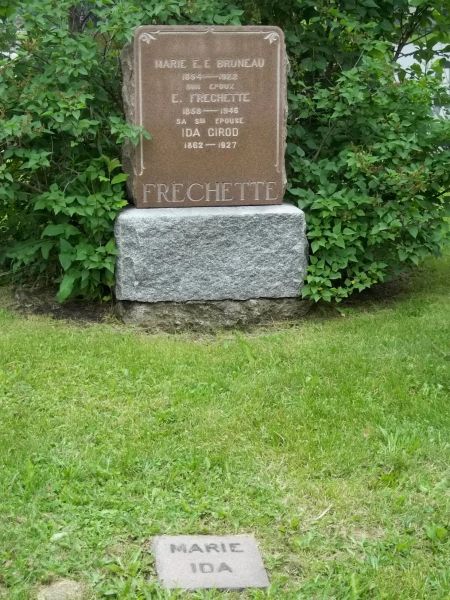
In Mount Royal cemetery, on the mountain in Montreal, lies the grave of Emilien Frechette. On the tombstone are the names of two of his three wives while in front is a little stone marker reading Marie and Ida. All his wives had a connection to the Bruneau family.

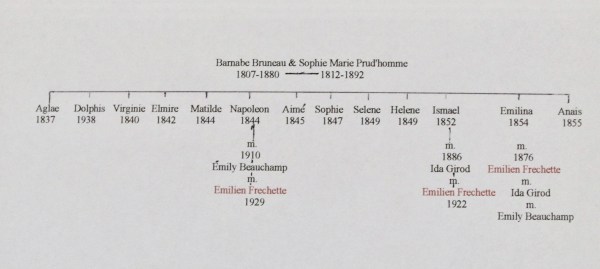
He first became a member of the Bruneau family in his early 30s when he married Marie Emilina Bruneau, daughter of Barnabé Bruneau and Sophie Marie Prud’homme. He must have he enjoyed his wife’s large family, she was one of thirteen children, because after Marie Emilina died he first married one and then a second of her sisters-in-law.

Emilien was born to Emilien Frechette and Philomine Laguë. His father was a Baptist and a farmer on Montreal’s South Shore near Iberville. After his father died, his mother, brother Philippe and three of his sisters moved to Worcester, Massachusetts between 1885 and 1895. Philippe was a carpenter and worked in the building trade while two of his sisters were teachers. I presume that Emilien stayed on the family farm.

With most of his family in the United States, Emilien must have spent time with the large Bruneau clan. In the 1891 census there appeared to be a daughter Alice, 3 who didn’t appear in later censuses. Was she his only child who died young?

After Marie Emilina died in 1922, Emilien must have been lonely on his farm. His brother-in-law, Ismael Bruneau, had died leaving his wife Ida Girod Bruneau a widow. Ida first moved her family from Quebec City to Lachute where she lived with her daughter Helvetia and then spent time visiting family in Switzerland. On her return, Emilien approached her and suggested as they were both alone and he had a large house, maybe they could live together and get married and so they did. My aunt Aline remembers her mother visiting grandmother Ida and coming back with baskets of berries that had to be sorted, cleaned and made into pies.

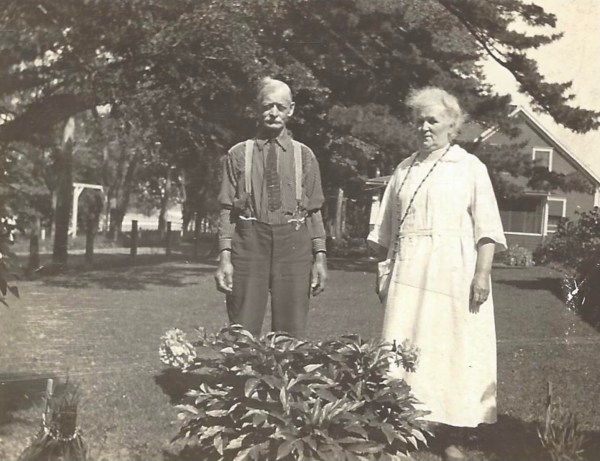
Emilien and Ida on his farm

Unfortunately, Ida was soon diagnosed with cancer and spent her last days in the Montreal General Hospital. She died in 1927 leaving Emilien a widower once again.

One thinks, Emilien liked the comfort of a wife and since another of his brother-laws was dead there was another sister-in-law to marry. In 1929, Emily Beauchamp Bruneau married Emilein Frechette.

Emily Beauchamp married Napoleon Bruneau in 1910. Neither had been married before. Emily was 41 and Napoleon 66 and so there were no children. Napoleon lived all his life in Laprairie, Quebec and kept himself busy. He was a farmer, a veterinarian, a mayor and a justice of the peace. They were both French Protestants. Unfortunately, in 1916 he was hit by a train while in Montreal and killed.

Emily was Emilien’s last wife and they continued to live on his farm in Iberville until his death in 1946. When Emily died in 1951 she wasn’t buried with her husband and his other wives but in her Beauchamp family’s private cemetery in Grenville, Quebec.

My mother remembered “oncle” Emilien. Her grandmother Ida died when she was just five but Emilien, a “nice old man”, kept in contact with all the family. What a guy!

Barnabe and Sophie Bruneau’s Children

Notes:

https://genealogyensemble.com/?s=Ida+Girod/

https://genealogyensemble.com/2015/11/04/call-me-ismael/

https://genealogyensemble.com/?s=Barnabe/

1881 Census Place: St Grégoire, Iberville, Quebec; Roll: C_13203; Page: 60; Family No:268Source Information Ancestry.com and The Church of Jesus Christ of Latter-day Saints. 1881 Census of Canada [database on-line]. Provo, UT, USA: Ancestry.com Operations Inc, 2009. Accessed November 24, 2021.

1891 Census: Place: St Valentin, St Jean, Quebec, Canada; Roll: T-6420;Family No: 157 Sub-district: St Valentin Source Information Ancestry.com. Accessed Nov 20, 2021.

Institut Généalogique Drouin; Montreal, Quebec, Canada; Drouin Collection;Author: Gabriel Drouin, comp. Year: 1929 Ancestry.com. Accessed January 4, 2022.

Library and Archives Canada; Ottawa, Ontario, Canada; Voters Lists, Federal Elections, 1935-1980Year: 1940 Ancestry.com. Canada, Voters Lists, 1935-1980 [database on-line]. Provo, UT, USA: Ancestry.com Operations, Inc., 2012. Accessed January 8, 2022.

British American Land Company at BAnQ

The database contains a wealth of information for genealogists who are researching their ancestor’s land acquisitions in the Eastern Townships.

Many complete documents, books, dissertations, abstracts and theses are available to be downloaded. These are highlighted in green.

Link to map : https://collections.leventhalmap.org/search/commonwealth:4m90f8694

Click on the link below and open in a new window.