Caught up in Change

When he was twelve years old, the person who answered the census described my great, great grandpa as a French-speaking Roman Catholic person.1 As he grew up, I wonder whether that dual identity became even more firm and important to him, perhaps as a rebellious response to massive societal changes where he lived.

Isadore Azilda Doucet was born in 1869 in Ile Verte, fourteen years after the seigneurial system was officially abolished in Quebec. His home in the Témiscouata Valley on the south shore of the St. Lawrence River east of Quebec City was a key outpost for English-speaking Anglican Lords who purchased manors for colonial purposes and later became Quebec’s most important industrialists.

Researcher Maude Flamand Hubert describes the process underway during great great grandpa’s lifetime as follows:

Dans la première moitié du xixe siècle, l’accession à la propriété seigneuriale constitue encore la voie privilégiée afin d’acquérir ce statut socioéconomique tant convoité. Ce brassage s’effectue tout juste à la veille de l’abolition du régime seigneurial, en pleine période d’essor de l’industrialisation et d’une économie capitaliste de plus en plus orientée vers les marchés. Selon le modèle proposé par Serge Courville, comme de nombreux noyaux paroissiaux issus d’une colonisation seigneuriale timide, L’Isle-Verte prend véritablement son élan dans le deuxième quart du xixe siècle (Courville, 1990, p. 26).

In the first half of the 19th century, accession to seigneurial property was still the privileged way to acquire a coveted socioeconomic status. This mixing took place just on the eve of the abolition of the seigneurial regime, in the midst of a boom in industrialization and an increasingly market-oriented capitalist economy. According to the model proposed by Serge Courville, like many parish centres resulting from a timid seigneurial colonization, L’Isle-Verte really took off in the second quarter of the 19th century (Courville, 1990, p. 26).2

Reminders of the old system remained throughout great great grandpa’s lifetime. The area in which he lived once formed part of the Sieur Charles-Aubert de la Chesnaye manor, which was purchased by Alexander Fraser from Lord Caldwell on August 2, 1801.

Eight different waterfalls and a series of salt marshes attracted visitors to the largest settlement in the region, which served as a natural amphitheatre at the head of the Temiscouata Valley. It became a key military post during the wars of independence and the War of 1812.

Alexander Fraser died in 1837 and passed his manor on to his son, Malcolm Fraser. Malcolm died five years later, passing the region on to his brothers William and Edward.

Lord Elgin baptized the largest settlement in the area “Fraserville” in 1850.3 Settlement rapidly increased over the following decades, with schools, courthouses and communication services established. Canada’s first Prime Minister Sir John A. MacDonald lived in the town during the summers throughout the late 1800s.

By 1870, when great great grandpa was only a year old, the Grand Trunk Railway Company opened a terminal in the town creating a dependence on railways that would last for the following 150 years.

By the time he was 17 years old, the Témiscouata Railway connected his city with New-Brunswick. A big pulp and paper mill opened up shortly after.

Doucet lived in Fraserville Town when he turned 22 years of age, and at that time, he still defined himself as Roman Catholic and French-speaking.4 I don’t know what he did for a living, although perhaps he remained on the family farm, given my grandmothers’ farming life two generations later.

There were many other job opportunities around him, but between 1850 and 1919, the city saw large increases in its anglophone population. Perhaps they were the ones to get the well-paying forestry, paper mill and railway jobs.

By the time great great grandpa died on January 4, 1905, the community he lived in was commercial, secular and an industrial powerhouse. Yet the original Francophone farming community continued to thrive. The city reverted to its original name, Rivière-du-Loup, in 1919 and 98% of the current population speaks French.

Photo caption

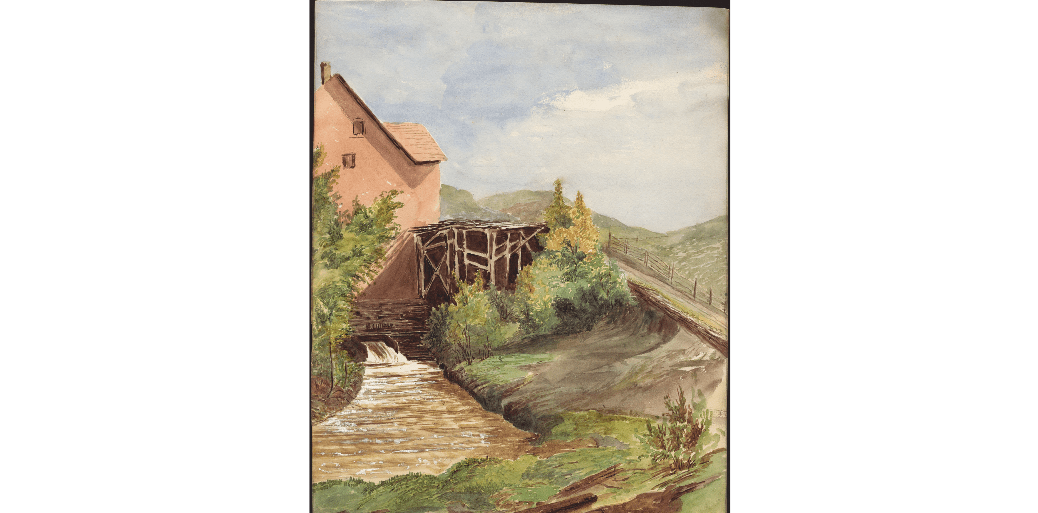
1880 Mill at Rivière du Loup by the Baroness Agnes Macdonald of Earnscliffe (1836-1920) on September 7, 1880, watercolour / aquarelle : watercolour / aquarelle on wove paper, http://central.bac-lac.gc.ca/.redirect?app=fonandcol&id=3007587&lang=eng, accessed on May 30, 2023

Sources

1 Canada Census, 1881, database with images, FamilySearch (https://familysearch.org/ark:/61903/1:1:MVND-LJS : 2 March 2021), Isidore Doucet in household of Alfred Doucet, L’Isle-Verte, Témiscouata, Quebec, Canada; from “1881 Canadian Census.” Database with images. Ancestry. (www.ancestry.com : 2008); citing Alfred Doucet, citing Library and Archives Canada, Ottawa, Ontario.

2 Flamand-Hubert, Maude. Louis Bertrand à L’Isle-Verte (1811-1871): Propriété foncière et exploitation des ressources. PUQ, 2012.

3 Société d’Histoire et de Généalogie de Rivière-du-Loup, https://www.shgrdl.org/rdla.htm

4 Canada Census, 1891, database, FamilySearch (https://familysearch.org/ark:/61903/1:1:MW5P-9L1 : 4 August 2016), Isidore Doucet, Fraserville Town, Témiscouata, Quebec, Canada; Public Archives, Ottawa, Ontario; Library and Archives Canada film number 30953_148224.
The Life and Times of Great-Aunt Amelia

My mother used to tell me that Amelia Norton was her favourite of her four great-aunts on her mother’s side of the family. From what I have learned about Amelia’s life, it appears she was indeed a kind and generous person.

Amelia Josephine Bagg was born in Montreal in 1852. Her father, Stanley Clark Bagg, was a wealthy landowner in Montreal, so Amelia had a privileged upbringing that included a year-long tour of Europe with the whole family in 1868-69, when she was 16.

After her father died in 1873, her brother, Robert Stanley Bagg, took over management of their late father’s real estate, renting out some properties and selling others. Amelia had a strong interest in the Bagg family real estate business, helping to keep the records of sales, and she also owned property in her own name.

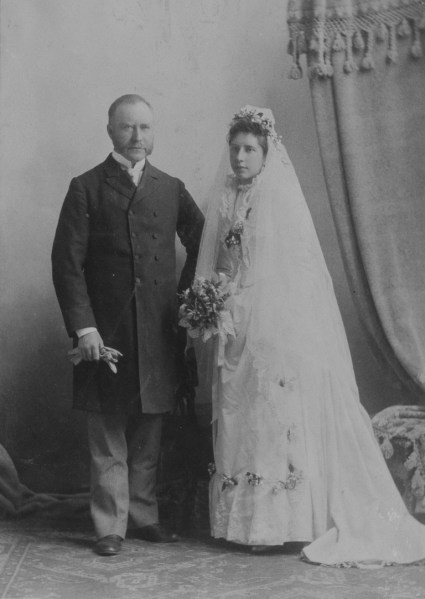
Mr. and Mrs. Mulholland. 1891. Wm. Notman and Son, McCord-Stewart Museum, II-95084 1.

Amelia lived with her mother, Catharine Mitcheson Bagg, until she married at age 38. The wedding took place on Dec. 18, 1890 at Christ Church, Montreal’s largest Anglican church. Her husband was Joseph Mulholland, the eldest son of hardware merchant Henry Mulholland and his wife, Ann Workman. Born in Montreal in 1840, Joseph had a twin who died as an infant. Joseph is connected to me in two ways: in addition to being married to Amelia, his sister Jane Mulholland (1847-1938) and her husband, Montreal banker John Murray Smith (1838-1894), were my great-grandparents on my mother’s father’s side.

As a young man, Joseph had worked in the hardware business. Now, as Amelia’s husband, he started a new career in real estate. In 1891, he and his brother-in-law collaborated in a business venture: Joseph and John purchased a vacant piece of land from Robert Stanley Bagg on Saint Charles Borromée Street (now renamed Clark Street) near Pine Avenue and built a row of attached house there.1 The building, designed by architect Eric Mann, survives to this day.

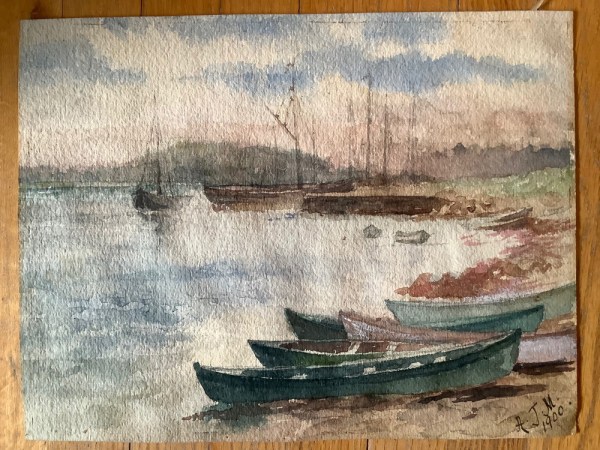
Amelia was known as a talented amateur artist. This watercolour painting of the Montreal waterfront belongs to one of the Bagg family descendants.

Joseph died, age 57, in 1897. Five years later, Amelia married again, this time to Reverend John George Norton, Archdeacon of Montreal.It was a relatively small wedding with only family members and a few close friends present.2 John was born in Ireland in 1840 and he was educated there. He moved to Montreal in 1884 with his wife and two children. His wife died five years later.

As the wife of one of the leading clerics in Montreal’s English-speaking community, Amelia took on a new role, especially in church charities. According to a biography of Archdeacon Norton in The Storied Province of Quebec, “Mrs. Norton is a lady of culture and refinement. Mrs. Norton was a valued ally and helpmate in all the parochial work of the church.”3

At that time, governments gave little funding to health care or social services, so benevolent societies played an essential role in society. As president of the Women’s Auxiliary of Christ Church Cathedral for many years, Amelia was especially interested in its missionary work.4 In addition, her name appeared regularly in lists of donors to various charities published in the local newspapers.

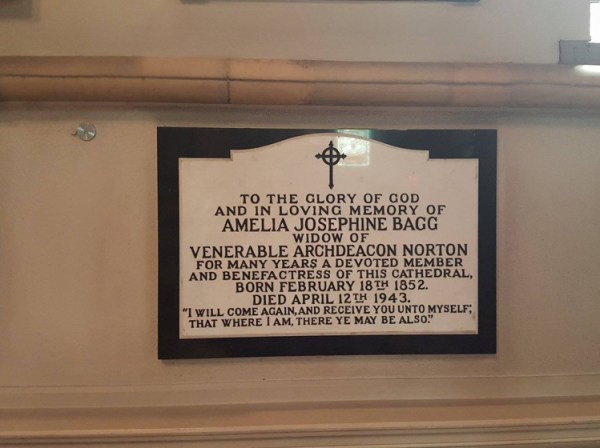
This memorial to Amelia is in Christ Church Cathedral, Montreal. Photo by Genevieve Rosseel.

The couple lived in the church rectory for many years and after John retired, they moved into their own house on McTavish Street, near McGill University. When the Venerable John George Norton, Rector Emeritus and Archdeacon of Montreal John died in 1924 at the age of 84, many people attended his funeral service at Christ Church, where he had officiated for 37 years.

Meanwhile, Amelia seems to have been the go-to person when family members needed help. After Amelia’s Aunt Fanny (Mitcheson) Hague was widowed in 1915, Fanny came to live with the Nortons and remained there until she died in 1919.

My grandparents also went to Amelia for help. They had built a new house just before the Depression hit and my grandfather lost his job. Amelia helped to support the family until my grandfather found a new job after the Depression.

Amelia died in 1943, at age 91, at home on McTavish Street, following a long illness. She is buried with her first husband in the Mulholland-Workman family plot in Montreal’s Mount Royal Cemetery.

Sources

  1. Le Prix Courant: le journal de commerce, 10 Avril 1891, p 13, https://numerique.banq.qc.ca, entry for John Murray Smith, https://numerique.banq.qc.ca/patrimoine/details/52327/2746357?docsearchtext=%22John%20Murray%20Smith%22, accessed June 18, 2023.
  • 2. “Marriage at the Cathedral”, The Gazette, 25 June, 1902, p. 6, Newspapers.com, accessed June 18, 2023.
  • 3. William Wood, editor, The Storied Province of Quebec, Past and Present, Dominion Publishing Company, 1931, vol. 3, p. 118.
  • 4.  “Obituary: Mrs. J. Norton, 91, Dies at Home Here,” The Gazette, April 13, 1943, p. 14, Newspapers.com, entry for Amelia Norton, accessed June 20. 2023.

5.    Mount Royal Cemetery, section F200-c

See also

Frank Dawson Adams, A History of Christ Church Cathedral, Montreal, Montreal: Burton’s Limited, 1941, https://numerique.banq.qc.ca/patrimoine/details/52327/2561503

Janice Hamilton, “Continental Notes for Public Circulation”, April 8, 2020, Writing Up the Ancestors, https://www.writinguptheancestors.ca/2020/04/continental-notes-for-public-circulation.html

Janice Hamilton, “Aunt Amelia’s Ledger”, April 26, 2023, Writing Up the Ancestors,          https://www.writinguptheancestors.ca/2023/04/aunt-amelias-ledger.html

Janice Hamilton, “Henry Mulholland, Montreal Hardware Merchant”, March 17, 2016, Writing Up the Ancestors, https://www.writinguptheancestors.ca/2016/03/henry-mulholland-montreal-hardware.html

Janice Hamilton, “The World of Mrs. Murray Smith”, Feb.24, 2016, Writing Up the Ancestors, https://www.writinguptheancestors.ca/2016/02/the-small-world-of-mrs-murray-smith.html

Janice Hamilton, “Never Too Late for Love,” April 4, 2014.  Writing Up the Ancestors, https://www.writinguptheancestors.ca/2014/04/never-too-late-for-love.html

This article is also posted on the family history blog Writing Up the Ancestors.

The Making of a Canadian Artist

JULIUS GRIFFITH
RCA, OSA, CSPWC, CSGA
(1912-1997)

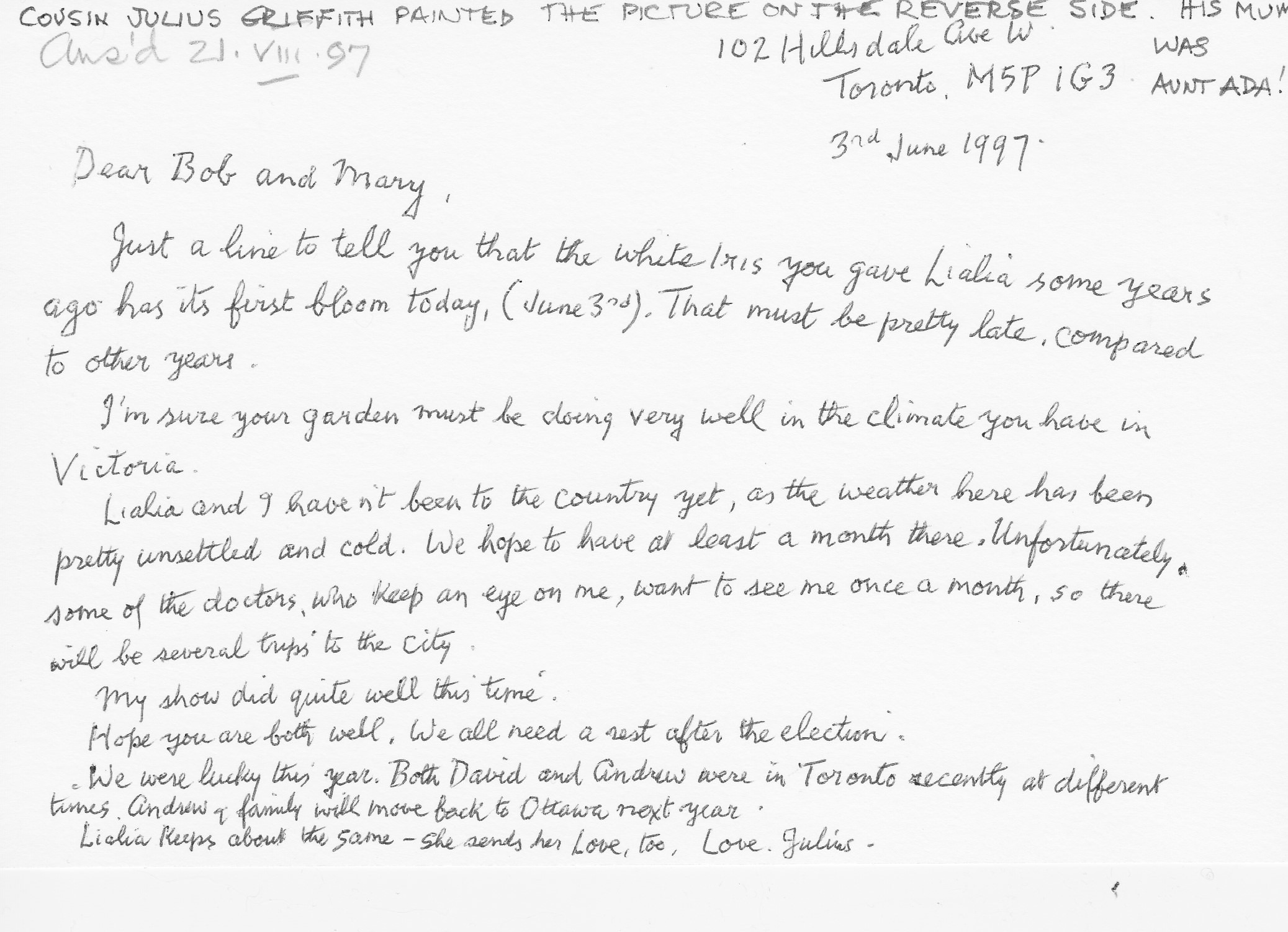
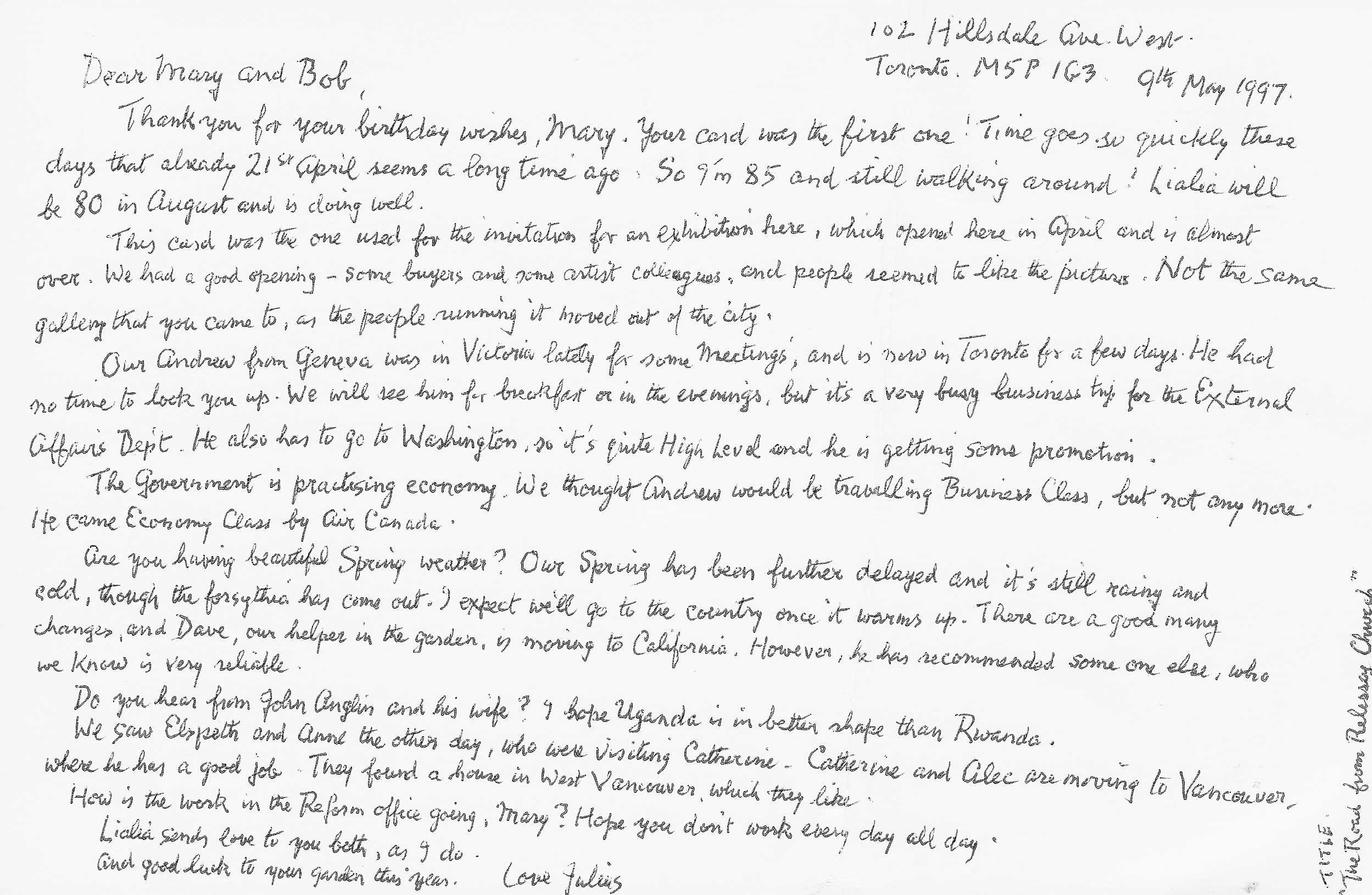
My collection of genealogy treasures includes two picture postcards sent to my Aunt Mary by her talented artist cousin, Julius Griffith, prior to his death in November 1997.

His meticulous handwriting described that day’s garden blooms, commented on the recent election, provided a short health update, news of a son moving back to Ottawa with his family and Lialia sending her love. At the very end, he writes “my show did quite well this time.”

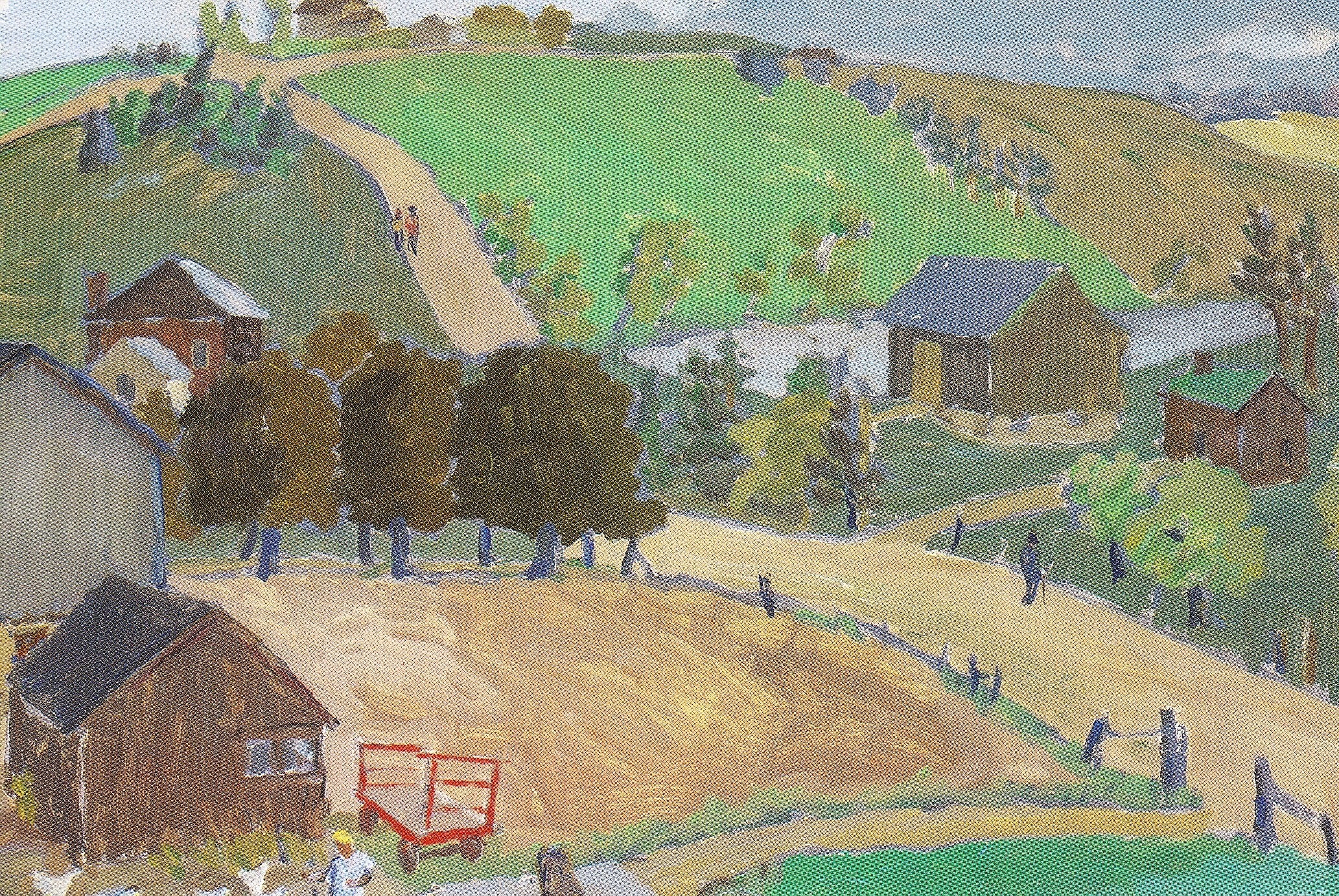
“The Road between Allen’s Farms”

And so it should have. Her cousin, Julius Edward Griffith (1912-1997) was a successful enough painter in watercolour that the members of the Canadian Society of Painters in Water Colours (CSPW), voted for him to be included as a member. Co-founded by a group of prestigious painters including Group of Seven artists A.J. Casson and Franklin Carmichael in 1925, the association continues to exist and has a storied history. For their Diamond Jubilee in 1985, they selected 60 paintings, including one from cousin Julius, and gave them to Her Majesty Queen Elizabeth II. The Queen formally exhibited the collection in Windsor Castle’s Drawing Gallery in 19861.

One of my two postcards could be a replica of his circa 1982 painting presented to the Queen, which was called “The Empty Farmhouse.” The official description describes it as a “watercolour view across fields of a square farmhouse with four windows, surrounded by trees.”

Julius Edward Griffith (1912-1997) was a successful painter in watercolour and oils, a graphic artist, an illustrator, a fine print maker and an art teacher.

As the only child of Katharine Ada Lindsay and Julius Henry Griffith, and born in Vancouver, British Columbia, Julius relished his grandfather Lindsay’s extensive art collection when he visited with him in Montreal, Quebec. Thus began his art education.

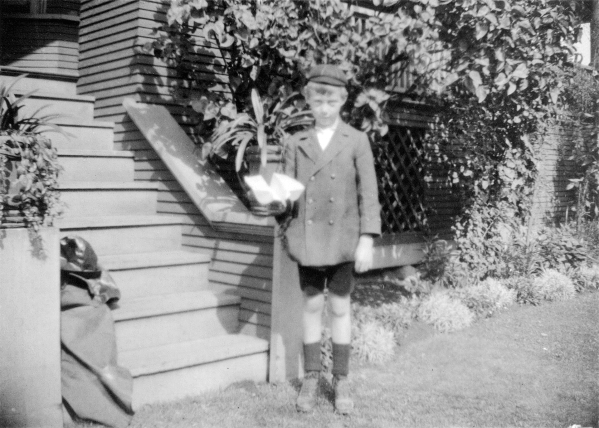
Julius Griffith – 1920

When Julius finished High School at 16, he was too young to attend the Royal Military College, as was his father’s family tradition. Instead, he studied at the Vancouver School of Art (Now Emily Carr University of Art + Design)under Charles H. Scott, F.H. Varley and J.W.G. MacDonald (two of which were Canada’s famous Group of Seven artists2). What a fantastic start to his artistic career! At the same time, he also learned block printing techniques from American artist Bruce Inverarity3 who lived in Vancouver at that time. Julius was immediately drawn to block printing because he enjoyed black and white contrast.

A few years later, he moved to England with his parents and studied at the Slade School of Art4 in London and continued his studies at the Central School of Arts & Crafts with Noel Rooke5 learning the technique of wood carving.

At age 21, Julius returned to Vancouver during the Depression hoping to get any kind of work as an artist. And he did! The owner of the Vancouver Sun newspaper commissioned him to paint two murals on the walls of his building and different groups of people were invited to watch his progress. Among these groups were his previous art teachers, Fred Varley and Jock Macdonald and their students at the time. He must have been so pleased at this role reversal!

In 1938, near the end of his fourth year back in England at the Royal College of Art6, he returned to Vancouver to see his father just before he died. After his father’s death, WWII interrupted Julius’ studies but he returned to England with his mother at that time as he wanted to serve.

During the war he worked with the “Air-raid Precautions” for a time and eventually joined the Red Cross. He worked in a country-house hospital in Sussex and, with so little to do, Julius taught art and learned to speak Russian.

What a serendipitous decision! He fell in love with his teacher – nurse Lialia Oralevs originally from Latvia – and they married quietly a couple of years later before the end of the war.

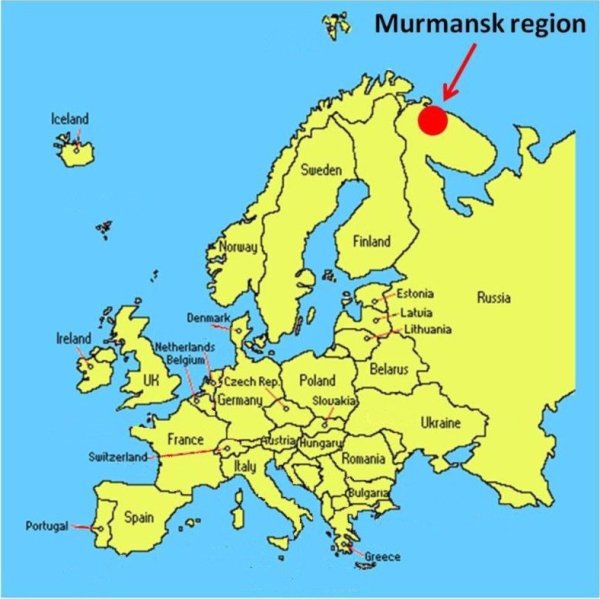
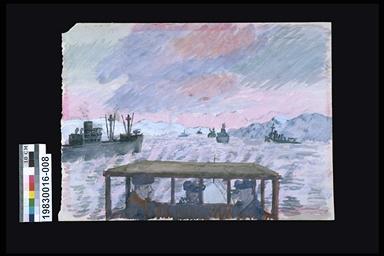
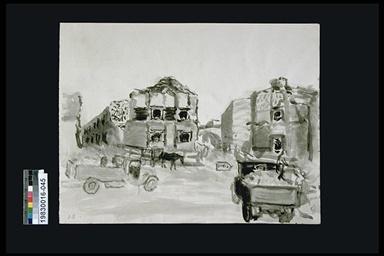
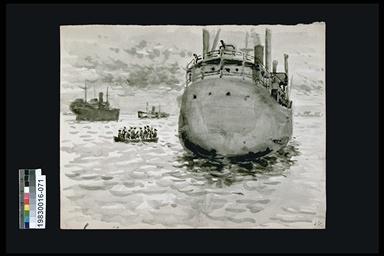
After learning to speak Russian, Julius presented himself in London to the Royal British Navy, passed an oral Russian test and worked as an interpreter under the rank of Sub-Lieutenant stationed in Murmansk7 and Archangel until the end of the war.

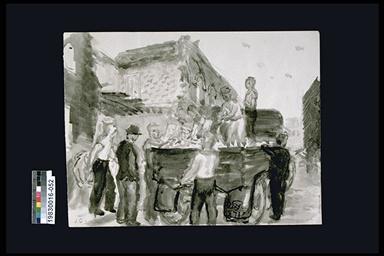
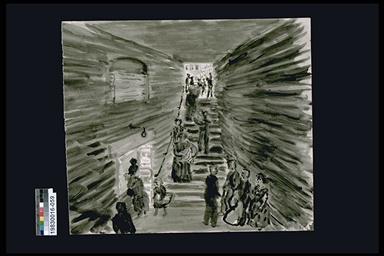
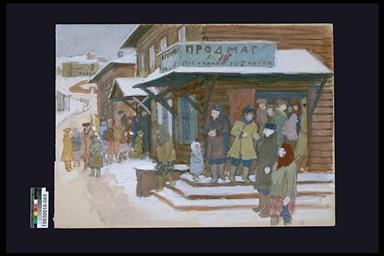
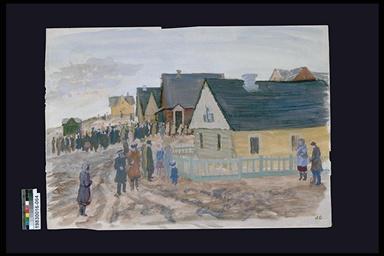
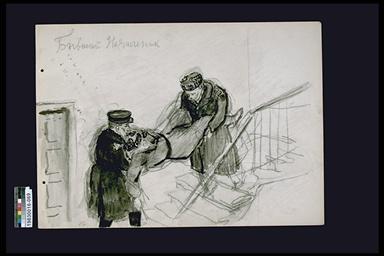
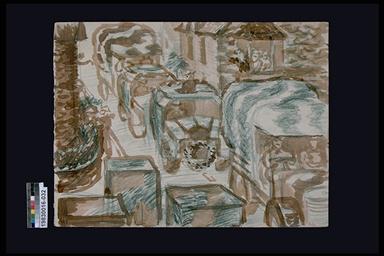
While in Russia, Julius would sketch scenes from memory in the privacy of his room at night and only after his 30-year oath of secrecy expired did he show them to the Canadian War Museum8. They purchased 90 of these drawings and The British War Artists Collection acquired several as well.

After the war, Julius and Lialia returned permanently to Canada. Julius quickly earned a degree at age 34 which enabled him to teach art and support his wife and four sons while continuing to pursue his passion as a graphic artist and wood engraver. Julius taught art in many of the top schools in Toronto – the Western Technical School, Artists’ Workshop, Ryerson Polytechnic Institute, Ontario College of Art, and at Central Technical School.

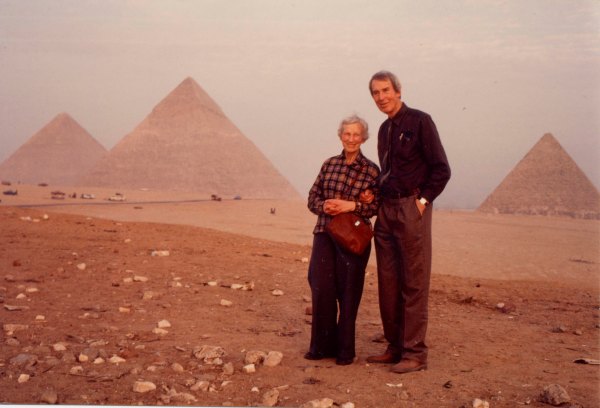
Although I never met Julius, I understand that they made quite the impressive pair with Julius at 6 feet 4 inches towering over five foot Lialia. Not surprisingly, “Julius seemed to develop a slight lilt to the left in later years, probably because he would put is left hand on Lialia’s shoulder and lean to hear or speak to her.” This 1985 photo taken during a trip to Egypt illustrates this charming pose.

Julius and Lialia – 1985 (courtesy of Lorne Griffith)

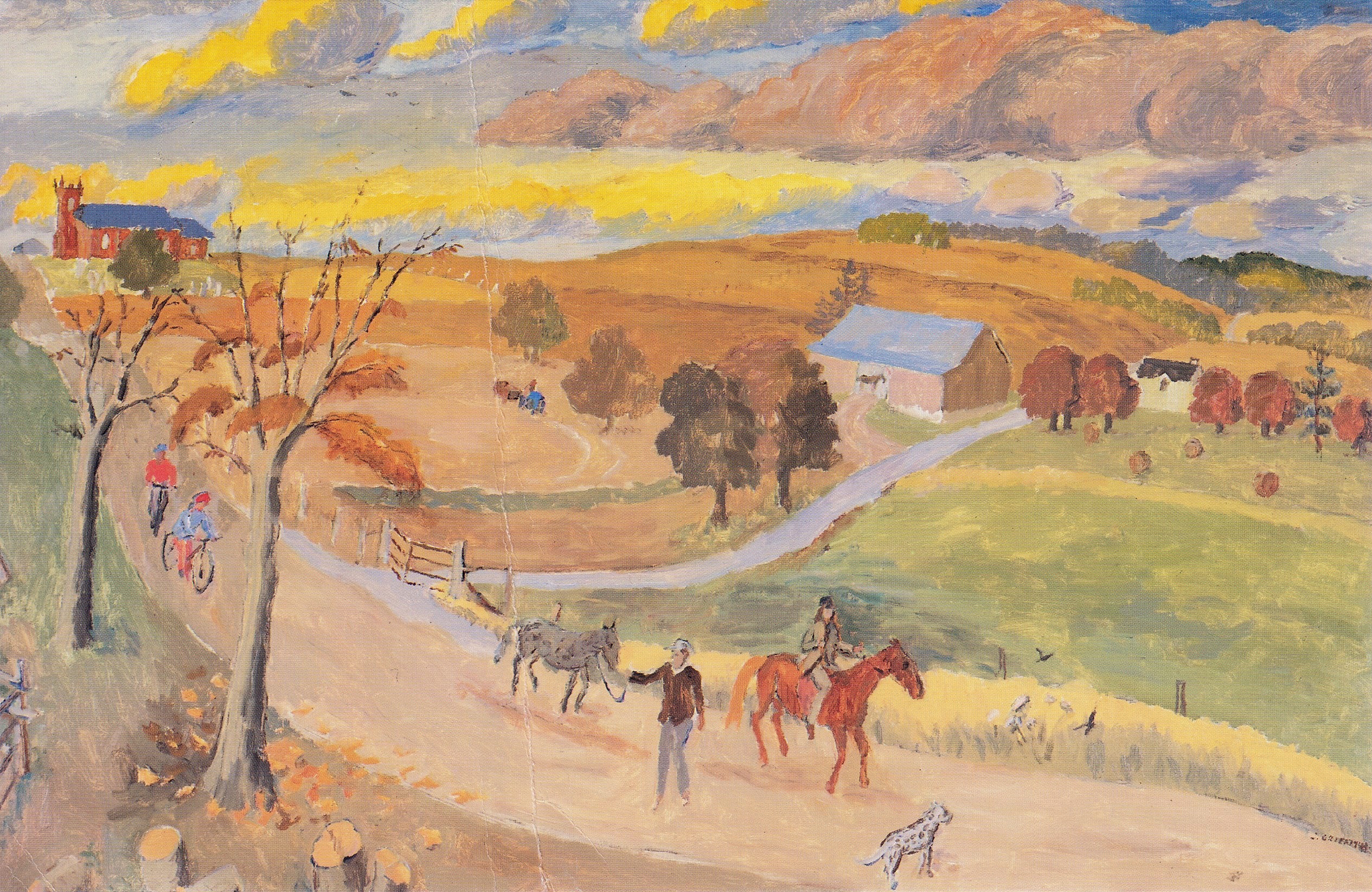
On the other postcard that he sent to my Aunt Mary in 1997, he wrote “This card was the one used for the invitation for an exhibition here, which opened in April and is almost over. We had a good opening – some buyers and some artist colleagues, and other people seemed to like the pictures.”

” The Road from Relessey Church”

Although I don’t have any of Julius’ original paintings, his two picture postcards with his personal handwritten messages are real treasures to me.

NOTE:

Julius’ work is displayed in the collections of the National Gallery of Canada, Canadian War Museum, Imperial War Museum (London), Art Gallery of Ontario, Toronto City Archives, Toronto Public Library, Art Gallery of Hamilton, McMaster University (Hamilton), Carleton University (Ottawa), Glenbow Museum (Calgary), Art Gallery of Greater Victoria (British Columbia), and numerous corporate and private collections.

1https://www.rct.uk/collection/926180/the-empty-farmhouse (as referenced 2023-06-02)

2https://wiki2.org/en/Group_of_Seven_(artists) (as referenced 2023-06-02)

3https://www.fecklesscollection.ca/robert-inverarity/ (as referenced 2023-06-02)

4https://wiki2.org/en/Slade_School_of_Fine_Art (as referenced 2023-06-02)

5https://wiki2.org/en/Noel_Rooke (as referenced 2023-06-02)

6https://wiki2.org/en/Royal_College_of_Art (as referenced 2023-06-02)

7https://wiki2.org/en/Arctic_convoys_of_World_War_II (as referenced 2023-06-02)

8https://www.warmuseum.ca/collections/?type=all&q1=all%3A%3A_contains%3A%3Ajulius%20griffith%20art&sort=title&order=asc&view=grid&size=24&page=1 (Julius Griffith’s 24 paintings

– as referenced 2023-06-02)

Harry’s Story

I never met Harry Jolliffe. I never even knew Harry Jolliffe. So, why a story about an unknown man?

We met Hazel and Roger 35 years ago when they would regularly visit us as friends from our church until they moved from Beaconsfield to Salt Lake City, Utah to be with the family. As we are all British we have had a very comfortable friendship over all these years. We now keep in touch via FaceTime. During the last call, we got on to the subject of families and the Mormon practice of marriage being for the eternities and not ‘Till death do us part’.

In The Church of Jesus Christ of Latter-day Saints, the word sealing refers to the joining together of a man and a woman and their children for eternity. This sealing can be performed only in a temple by a man who has the priesthood, or the authority from God. (1)

Roger then told us a story about a conversation he had with a church member, Harry Jolliffe, back in England in 1975, which has haunted him ever since. I was so fascinated by Roger’s story I felt I had to write it down.

Our friends went to Harry Jolliffe’s home as a representative of their church in 1975, to establish if there were any needs. Harry was 79 years old and had only joined the church 3 months prior. He lived on his own and was still grieving the loss of his wife who had passed away the year before. Roger and his family had only been in the church for a year themselves and knew the challenges of embracing a new faith and wondered what had inspired Harry to join, particularly at his age. Harry then told Roger the harrowing story of his time in a Japanese prisoner-of-war camp

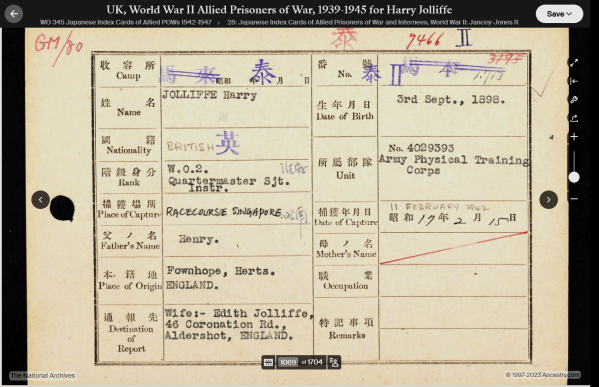
Although captured in Singapore – see below – I cannot read Japanese for the camp Harry was at or of him being sent to any other of the numerous Japanese POW camps on the island of Singapore.

Harry had joined the regular army in the early 1930s and rose to the rank of Warrant Officer in physical training. He was serving in Singapore when the war broke out with Japan. Harry, along with thousands of troops and civilians were swept up and captured.

Below is Harry’s record of his capture at the Racecourse, Singapore, on the 11th of February, 1942. (2)

Harry’s Japanese Index Card of Allied POW 1942 – 1947

After his capture, Harry was then imprisoned in a very squalid Japanese prisoner-of-war camp where both British and Australian troops were prisoners. Starved and ill-treated, many died of neglect, abuse or forced labour.

However, because Harry was physically fit he was used as a boxing opponent for the prison guards to spar with and humiliate in front of their comrades and all the other prisoners. He was given slightly better food in order to keep him fit but was warned to always lose each fight so that the Japanese soldiers would not lose face.

While in the camp Harry became gravely ill and was so sick he went to the hut of an Australian prisoner who was a Doctor. This Doctor had previously removed his own appendix with no anaesthetic or suturing material. The Doctor told Harry, that he thought it may have been a gallbladder infection and to come back the next day. Harry returned the next day, with a fever, and feeling much worse.

The Doctor told him the gallbladder had to come out or Harry would die. As he said these words, four burly prisoners entered the room and held Harry down. The Doctor made the first incision. Harry fainted. When he came to, he looked down and saw all his organs displayed on his stomach, and he fainted again. He came to in his hut, his wound had been sutured with string!

He was at least still alive thanks to the skill of the unknown heroic Australian Doctor. He was weak, and all his fellow prisoners had to feed him, was rice water. Harry wanted to die and end his misery.

That night, Harry had a fevered dream. He was walking up the street to his home, in England. He opened the gate and knocked on the door. Harry’s wife, Edith said ” Oh! Harry! We missed you so much and we need you!’ Harry awoke and immediately felt a very strong will to live and survive. Singapore was liberated by Australian and US forces in 1945, as the war in the Pacific turned in favour of the Allies, and the prisoners were freed. Harry went home to England, via Southampton, where his wife, Edith, met the ship.

She rushed into his arms, and said “Before you say another word, what happened to you, on this date?” Edith continued ” I had a very vivid experience, I heard a knock on the door, and when I opened it, there you were! I thought I was dreaming but you disappeared as I opened my arms to you! I was fully awake. What happened, Harry”? So, Harry related the story, that on that date a gall bladder operation had been performed on him, and he nearly died, but he believed he survived because of that dream.

To our friends, he said “You asked me why I joined the church. The feeling I had during that dream, which stuck with me all my life, was the same feeling I felt when the missionaries were teaching me about the gospel of Jesus Christ”

He had such a strong desire to listen to these young missionaries and when they mentioned that he could be sealed to his wife for eternity, he readily accepted their teachings. Unfortunately, Harry never lived long enough to carry out his wishes to be sealed for eternity to Edith.

Roger believes the story has haunted him all these years because he is meant to do the sealing of Harry and Edith, vicariously. This is the purpose of the Latter-Day Saints temples, to seal together a family for eternity. Our friends have now done the sealing for Harry and Edith.

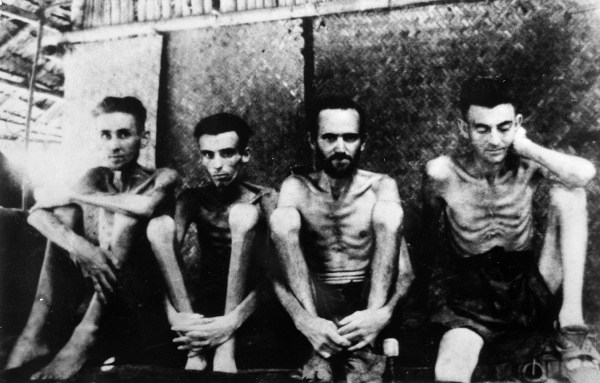
Below is a photo of British Prisoners of War after liberation in Singapore.

L0025435 Prisoners in Changi Jail, Singapore. Credit: Wellcome Library, London. Wellcome Images images@wellcome.ac.uk http://wellcomeimages.org Photograph of four skeletal soldiers. Photograph circa 1943 Published: – Copyrighted work available under Creative Commons Attribution only licence CC BY 4.0 http://creativecommons.org/licenses/by/4.0/

So, not only is Harry’s story inspiring in a spiritual sense, but also a reminder of the bravery of all those prisoners and civilians who endured the most wretched of circumstances.

I am grateful that Roger shared this story with me, thank you.

SOURCES

(1) https://newsroom.churchofjesuschrist.org/article/sealing

(2) https://en.wikipedia.org/wiki/Fall_of_Singapore

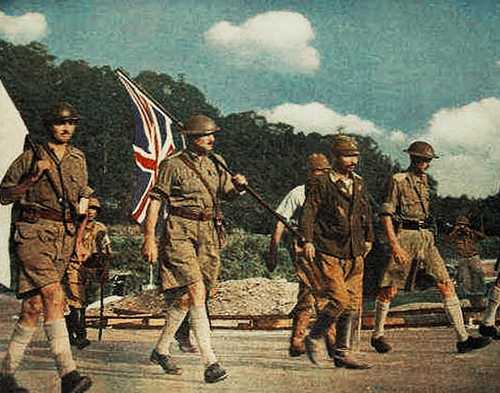
The Surrender of Singapore 1942

Lieutenant-General Arthur Ernest Percival, led by a Japanese officer, walks under a flag of truce to negotiate the capitulation of Allied forces in Singapore, on 15 February 1942. It was the largest surrender of British-led forces in history.

The Poor Families in New France

The Canadian Encyclopedia

The database below contains links to numerous authors who over the years have written books, and articles on the subject of the poor in New France, both in English and French.

Many of these books may be purchased at local bookstores or online while articles are located on the various BAnQ websites..

Click the above link to access the database.