Peacocks and Cherubim: My Mysterious Aunt Cecile

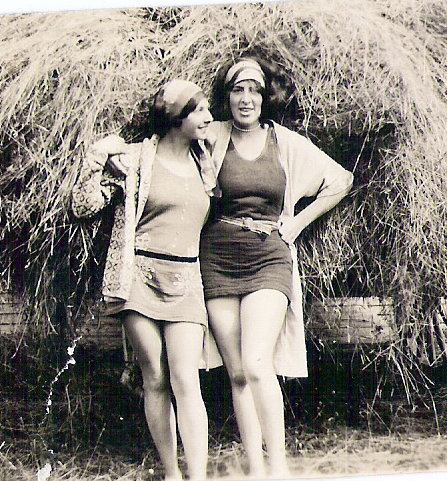
My Aunts Flo and Cecile, circa 1930, in what I assume are bathing suits maybe at Old Orchard Beach Maine where the family vacationed.

It was 1962 or so and my mom, twin brother and I had taken a bus from Old Orchard Beach to Ogunquit, Maine to visit my Aunt Cecile, who was on vacation at the same time as us.

As my brother and I crawled over the jagged and slippery shoreline in front of her hotel we openly wondered why anyone in their right mind would want to vacation in this spot. It was all rocks!

Well, much time has passed and my husband and I love to spend time at picturesque Perkin’s Cove on our short trips to Maine in the spring or fall.

On one such weekend visit, I recall the owners of our b-n-b telling us about pre-WWII Ogunquit: it had once been a bohemian artist’s colony with open air classes and nude models posing on the Marginal Way.

An artist’s colony! Now that explains it. My Aunt Cecile was an artist and a good one at that – but a bohemian, never! I remember her only as sober and serious – and seriously pious. Children were a foreign country to her and her main ambition with regards to me was to convert me to Roman Catholicism.

Marie-Catherine Cecile Crepeau was born in Montreal 1909 to Jules Crepeau and Maria Roy, my grandparents. She had an older brother and sister, Louis and Alice and in 1914 or so another girl her age, Florida, was plucked off the scruffy streets of south central Montreal and brought into the family fold. My mother would appear much later in 1921.

Cecile contracted scarlet fever as a child and suffered severe heart damage. According to her sisters, she was ‘babied’ for most of her childhood, not asked to do very much.

So, it seems she learned to paint.

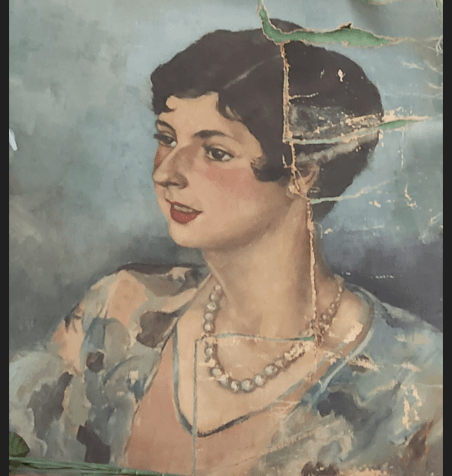
This battered canvas of young Flo is the only one of Cecile’s that I own. It was painted in 1927 when both Cecile and Flo were 18. It is pretty accomplished for so young an artist, I think.

Indeed, in a few years later Cecile would be accepted into the Beaux-Arts in Montreal (perhaps using this portrait in a portfolio) and she would win the first prize for oil painting (considered very much a male domain) in 1937.

I have the medal somewhere and I found this tidbit from a tabloid called “L’illustre” describing the 1937 Beaux-Art exhibition: “Although the Hall of Paintings has little that is very striking, Therese Boucher’s “Reclining Man’ is vigorously treated. Among the angels, Cecile Crepeau’s is most alluring, in large part because of the curious golden tonality of the ensemble. Her study of a face, placed to the right of the entrance, has life and sincerity, despite some weaknesses. Her blue vase beside a pewter bowl also merits a mention. The female nudes are unimpressive.”

The angel picture I remember well. It loomed over Cecile’s living room and, yes, it was very golden. Another tall tall wall hanging I remember was an oil painting of a statue of St John the Baptist holding his own very hairy head.

I don’t recall the still life mentioned in the newspaper article, but I wish she had put some pretty vases behind Aunt Flo in my painting. It seems unfinished somehow.
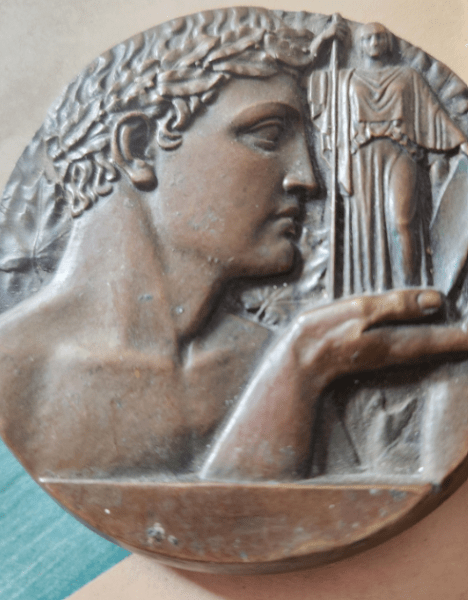
The gorgeous and heavy ‘gold’ medal. I wish

My aunt was ‘a perfectionist’ (who suffered migraines for it) said my mother, which might account for why she created so few completed canvases..

Again, according to my mother, a teacher at the Beaux-Arts told her she had the technique but to be a superior artist but she had to ‘live a little.” (I wonder if the teacher was hitting on her.)

In the 1940’s, Cecile is listed in Lovell’s Directory as “housekeeper’ at my widowed grandmother’s Oxford Avenue flat. My mother is working as a stenographer at RKO Motion Pictures just down the street and my Aunt Flo as a greeter at Henry Morgan’s department store downtown. They are providing the financial support. My grandfather, former Director of City Services, had died under mysterious circumstances in 1938.

My brother and aunts in Cecile’s garden on Beaconsfield Avenue. It was lined with statuesque poplars and showcased an ornate wrought iron and marble birdbath! 1956 or so.

In 1951 my grandmother passed away. My mother had already married and moved a short distance way. Flo, too, would soon marry, leaving Cecile to figure out what to do with the rest of her life.

The story goes Cecile tried to became a nun but was turned down ‘due to her bad heart.’ Instead, she married a friend’s father, Amedee Buteau, a retired professor almost 30 years her senior. 1They would take a lower duplex apartment in NDG, filling it with my grandparents’ elegant furnishings. It was a marriage of convenience, no doubt, but it worked.

In the 1960’s, I just loved visiting Cecile’s home. Unlike our dingy and unadorned upper duplex apartment not far away, Cecile’s home was spic-n-span, every surface polished to a high sheen. There was no TV blaring Bonanza or Star Trek, just a giant grandfather clock solemnly marking each quarter hour with a click and a ping. The place felt like a museum with all the curio cabinets filled with so many intriguing things.
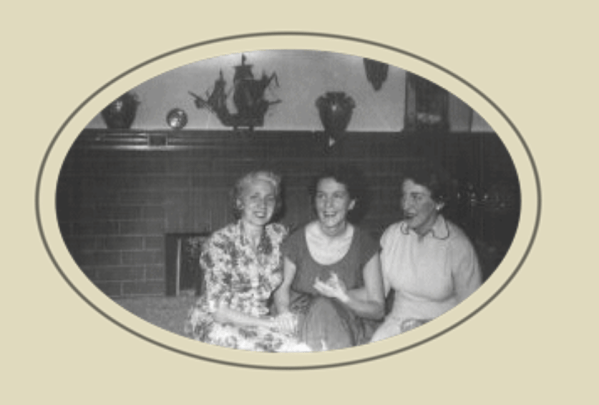
1955, My mom with her sisters.

And mixed in with the fin-de-siecle family treasures were her many multi-media artworks: sculptures, ceramics, watercolours. There were quite a few confusing (to me) religious subjects like bleeding hearts but also some adorable cherubim and many nature studies especially of flowers, birds and butterflies. Indeed, Cecile painted an immense peacock in full display on a wooden blind on the wall behind her bed. The tension between Eros and Thanatos in her beautiful Beaconsfield Avenue abode was quite evident to me, even as a child.

My mother had a very choppy relationship with her sister Cecile so even though we lived but a short bus ride away we didn’t visit her that often. – and I don’t recall her ever visiting us. Cecile’s hair went from red to grey between 1960’s visits I recall.

On at least one occasion I was sent on a sleepover. My aunt was awkward with me and I was determined not to like her, probably picking up on my mom’s vibes. It didn’t help that Cecile brought me to a scary Latin mass at Notre Dame Cathedral, pinning a silly handkerchief to the top of my head. Unfortunately, she did no art with me. Too messy I guess. Too bad as she was a wizard with pastels.

Cecile passed away in 1974 a year or two before her aged spouse. She was 65. My mother sobbed with grief at her passing. “You were always fighting with her,” I recall saying to my mom. “So why are you crying so much?” How naive of me.

All of the family heirlooms fell into the hands of ‘strangers’ upsetting my mother, but one lost canvas pained her in particular. “It was Cecile’s best painting,” she said, “of Alice putting a flower in Florida’s hair before a dance.”

Classic! I can hardly blame my mother for coveting that particular oil painting, one that involved all of her sisters: I wonder who owns it now.

  1. Mon Oncle Amedee was so comically vague in his dotage, seated in his armchair snoozing away with an upside down Le Devoir newspaper folded onto his lap, we children assumed he was expert in some airy-fairy field like ancient philosophy. But, no, quite the opposite. A short search on the Web reveals that in the 1920’s Amadee was a civil engineer, Dean of a Technical College and expert in technical education giving lectures, meeting with policy makers, even writing a book.
Joseph Dufour’s Farm

02

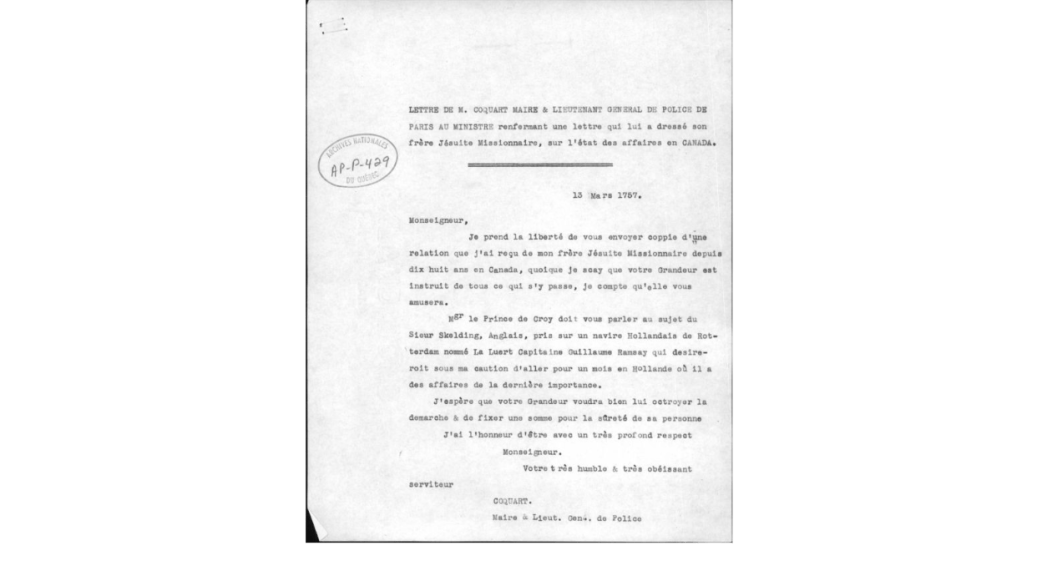
In the winter of 1749-1750, Jesuit Father Claude-Godefroi Coquart travelled through the Malbaie area of New France (now the province of Quebec) inspecting the lands owned by the King of France.

One of two farmers looking after this land was one of my ancestors, Joseph Dufour. Dufour’s farm was called “La Malbaie.”

Coquart’s written report to France describes the farm run by Dufour and his neighbours’ operation in great detail.

Author George McKinnon Wrong describes Coquart’s report on pages 17 and 18 of his 2005 book entitled “A Canadian Manor and Its Seigneurs The Story of a Hundred Years, 1761-1861”:

Father Coquart’s census is as rigorous and unsparing of detail as the Doomsday Book of William the Conqueror. He tells exactly what the Malbaie farm can produce in a year; the record for the year of grace 1750 is “4 or 6 oxen; 25 sheep, 2 or 3 cows, 1200 pounds of pork, 1400 to 1500 pounds of butter, one barrel of lard,”—certainly not much to help a paternal government. The salmon fishery should be developed, says Coquart. Now the farmers get their own supply and nothing more. Nets should be used and great quantities of salmon might be salted down in good seasons. Happily, conditions are mending. The previous farmer had let things go to rack and ruin but now one sees neither thistles nor black wheat; all the fences are in place. Joseph Dufour has a special talent for making things profitable. If he can be induced to continue his services, it will be a benefit to his employer. But he is not contented. Last year he could not make it pay and wished to leave. Nearly all his wages are used in the support of his family. He has three grown-up daughters who help in carrying on the establishment, and a boy for the stables. The best paid of these gets only 50 livres (about $10) a year; she should get at least 80 livres, M. Coquart thinks. Dufour has on the farm eight sheep of his own but even of these the King takes the wool, and actually the farmer has had to pay for what wool his family used. Surely he should be allowed to keep at least half the wool of his own sheep! If it was the policy of the Crown to grant lands along the river of Malbaie there are many people who would like those fertile areas, but there is danger that they would trade with the Indians which should be strictly forbidden.”

For a link to this work, refer to https://archive.org/details/canadianmanorits00wronuoft

The Life of a Church

St. Andrews United Church Westmount, Quebec 

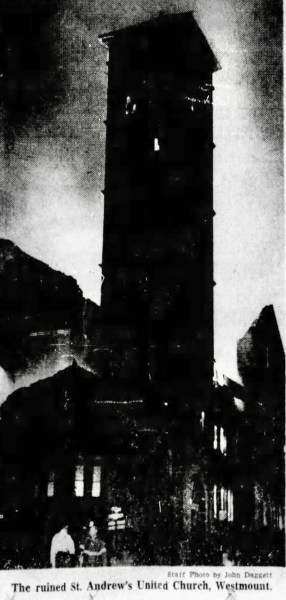
The night St. Andrews United Church, Westmount was razed by fire in 1965, I was thirteen. The whole sanctuary gone. Stained glass windows, memorials to many, melted, the organ burned and the small tower toppled. Charred red bricks littered Staunton Street. Only the tall tower and walls remained of the 57-year-old church.

Montreal Star Aug 4, 1965

This devastating fire occurred, even though the church sat just across the street from the Westmount fire station. The caretaker lived in the back of the building and when he smelled smoke in the afternoon, he went across the street to the fire station. The firemen looked through the whole church without finding anything amiss. They closed the fire doors to the Sunday School and left. Around midnight the church was engulfed in flames and all the firemen in the city couldn’t save the building. It was determined that the fire started in the basement under the sanctuary and hidden there, smouldered for hours. The minister, Reverend D.M. Grant holidaying in Nova Scotia was awakened with a telegram saying his church was burning.

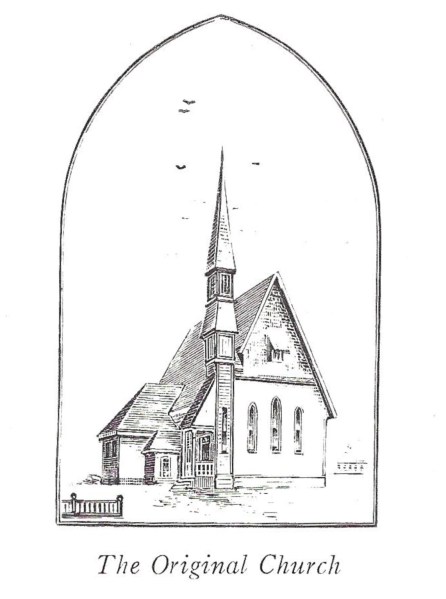
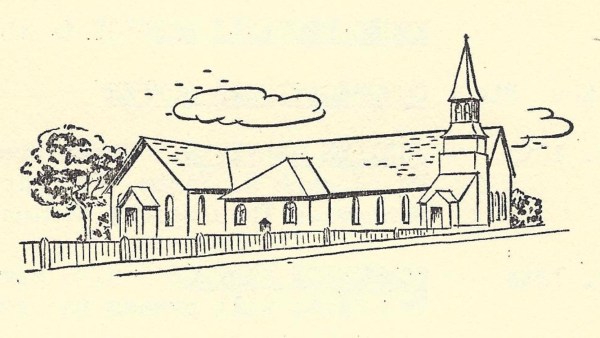
My family was not some of the early Westmount Presbyterians who worshiped in the Mission School from 1869 until 1886. They weren’t even members when a small frame church, Melville Presbyterian, was built on the corner of Cote St Antoine and Stanton St.

According to the booklets written for the Church’s golden and diamond Jubilees, St Andrew’s Church in Westmount was formally founded in 1900. “A difference of opinion caused the division of the members. One group retained the name of Melville Presbyterian Church and moved to Melville Ave where they built a new church. The other group, retained the present church site and became St Andrew’s Church.” In the newspapers of the day I found the reason for the split, alcohol consumption! When Rev. T. W. Winfield was hired, “a promise was extracted from the Reverend gentleman that he would refrain from intoxicating liquors while pastor of Melville Church.” Some members accused him of breaking that promise. The minority moved with the Minister and took the Melville name while the majority stayed in the building and chose the new name St Andrews Presbyterian. 

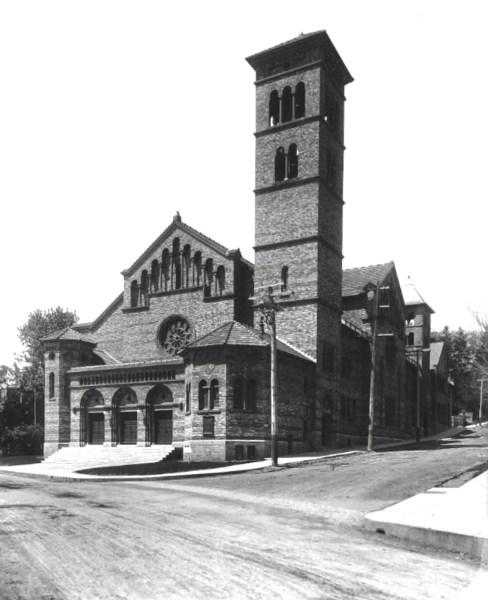
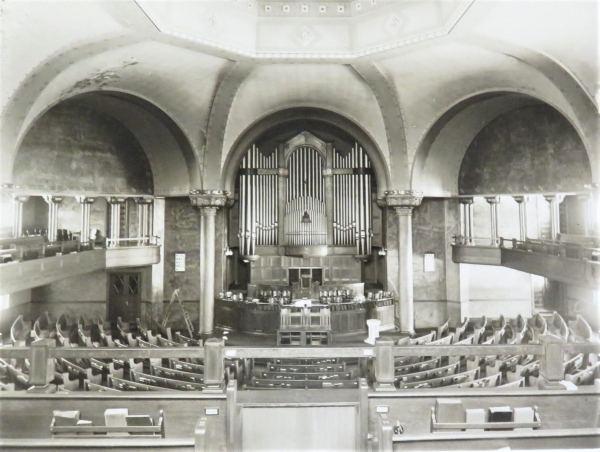
This congregation continued to grow, so in 1908 the red brick church was built. The large sanctuary, surrounded on three sides with balconies held 1100 worshipers. There was a rose window over the front doors and many other stained glass windows on the side walls. It was one of the Presbyterian churches that united with the Methodists and the Congregationalists in 1925 and became St. Andrews United Church.

St Andrew’s Church 1908-1965

I spent many hours in St Andrews Church growing up, as did my father. My grandparents joined the church when they moved from Chomedy Street to Grosvenor Ave in 1912. My grandfather, William Sutherland was a church elder and later so were both my parents. My grandmother Minnie Eagle Sutherland was very involved in church life being president of the Women’s Missionary Society and the Women’s Christian Temperance Union. My mother taught Sunday School and was the head of the Primary department for many years.

Church Interior photo by Alfred Peter Jorbes

We went to Church and Sunday School every week and won prizes for attendance. It was a church of many staircases. The hall behind the church had three sets and before and after church children would run around, up and down the stairs and through the halls. A back staircase off the kindergarten room led down to the basement. It was dark and gloomy and we would only venture down a few stairs before running somewhere else.

I remember Christmas pageants with Roman soldiers in costumes, clanking down the aisle with swords, helmets and leather skirts. I so admired the angels in their light blue satin dresses with wings that I wished I could be one. I was promised I could be an angel the next time they had a pageant but before that happened, the church burned including all the costumes stored in the basement.

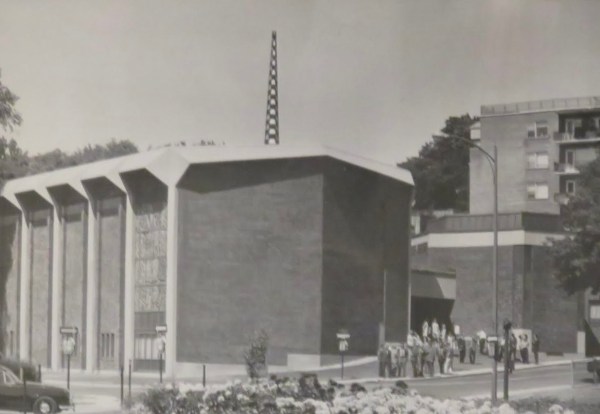
After the fire, the Church was rebuilt although with some controversy and another split. Some of the congregation left because they thought the million-dollar insurance money should be put to better use than having three underused United Churches in Westmount. They were out-voted and the new modern church opened in October 1967. It only held 500 people.

The rebuilt Church 1967

The congregation continued to age, fewer young families joined and people such as myself attended irregularly. St Andrews and Dominion Douglas United, amalgamated in 1985. The committee discussed which church to keep. Dominion Douglas, an old stone church on The Boulevard became the new home with the St Andrew’s congregation moving up the hill. Selwyn House School, across the street, bought St. Andrews. for their expansion. The chapel, including stain glass windows was deconstructed and rebuilt in the Dominion Douglas basement. In 2004 Erskine American United Church, on Sherbrooke Street joined St. Andrews-Dominion Douglas and another name was needed. The congregation became Mountainside United Church.

In less than twenty years Mountainside United Church became impossible to maintain and heat with a diminishing congregation. That building was sold to a developer and the congregation moved to the Birks Chapel on the McGill Campus. I have not attended a service there.

References:

Church Fire: The Montreal Star; Aug 4, 1965 page 3. Downloaded from newspapers.com Dec 29, 2022.

Westmount Mayor Praises Firemen: Montreal Star; August 10, 1965 page 6. Accessed from Newspapers.comDecember 29, 2022

Rising from its Ashes: Montreal Star; June 3, 1967 page 58 Accessed from Newspapers.com December 29, 2022.

Melville Church Difficulty: Montreal Gazette; 28, March 1900 page 10. Accesses from Newspaper.com January 25, 2023.

Date of Separation: Montreal Star; 12 May 1900 page 10. Accessed from Newspapers.com January 26, 2023.

Melville Presbyterian Church: https://cac.mcgill.ca/maxwells/details.php?recordCount=165&Page=4&id=155&pn=&cn=All&pr=All&ct=All&str=&mj=All&mn=All&sta=Built

St Andrew,s Church Golden Jubilee Celebration Bulletin November 5th to 12th 1950. IN the hands of the author.

Our Heritage St Andrew’s Church Diamond Jubilee 1900-1960 booklet. In the hands of the author.

Notes:

The back annex which housed the Sunday school was saved by the fire doors. Books and papers recovered from the Sunday school were stored in our basement for a time but they continued to smell of smoke and were later discarded. The manse next door was also saved but torn down for the new church. 

After the church fire may local churches and synagogues offered the congregation space to worship including Melville Presbyterian Church. I went to confirmation classes at Melville but we had Sunday services in the auditorium of Westmount High School.

Melville Presbyterian Church was built on Elgin Avenue later changed to Melville Avenue, facing Westmount Park. It is now Holy Trinity Serbian Orthodox Church. After the founding of the United Church in 1925, Melville Presbyterian Church amalgamated with Westmount Methodist to form Westmount Park-Melville United Church. The combined congregation worshipped in the Melville Church building for two years, until it was sold [back] to former members who remained with the Presbyterian Church. Victoria Hall served as a temporary site while the new Westmount Park-Melville Church, which is now known as the Westmount Park United Church was built on the western edge of Westmount Park.

The Liverpool Lad

In my last story, https://genealogyensemble.com/2023/06/07/harrys-story/ I wrote about Harry Jolliffe and his trials and tribulations in a Prisoner of War Camp in Japan.

Relating this to my husband, John, he mentioned a memory of his maternal Uncle Ben and his Uncles’ time as a POW in Japan.

It was all second-hand because Benjamin Ronald Hughes died the year my husband was born, in 1948. However, John did have stories from his Mum, about her brother. According to her Uncle Ben suffered terribly during his 3 years as a prisoner.

Ben was born on the 27th of March 1910 the only boy in the family of six in the Toxteth area of Liverpool, Lancashire. His occupation was a messenger. That could have been for the Post Office delivering telegrams or perhaps riding a bicycle delivering groceries and goods.

When Uncle Ben was 15 years old, he joined the Royal Navy as a second-class boy entrant. When he reached 18 years old, in 1929 he was by then a Boy First Class and volunteered again, as an adult Able Seaman, and was posted to HMS Egmont II on 25 September 1931.

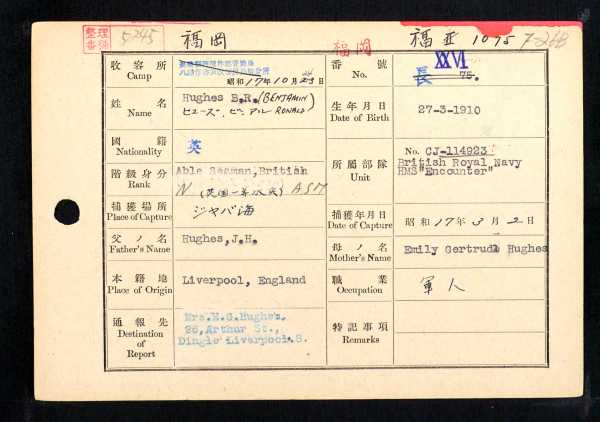
During his service, Uncle Ben served on 15 various Royal Navy ships. War was declared on the 1st of September 1939. On the 1st of March 1942, after three years of fighting, Uncle Ben was reported missing to his family. He was listed as a prisoner of war, by the Japanese. When captured and according to his Japanese POW file below, he was on HMS Encounter which had picked up allies from Malaysia and was scuttled (sunk) by her own crew, after being damaged by gunfire from heavy Japanese heavy cruisers in the Java Sea. (1)

Whilst researching I managed to find Ben’s Japanese POW information. There was not much on it, and I don’t read Japanese. I wanted to find the name of his camp and what he would have laboured at.

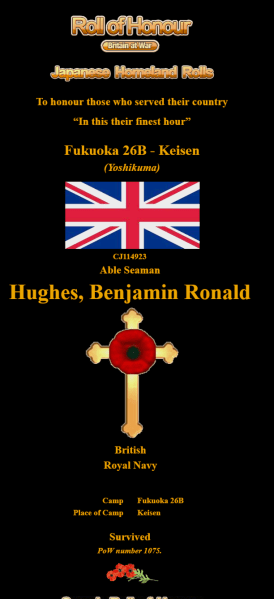
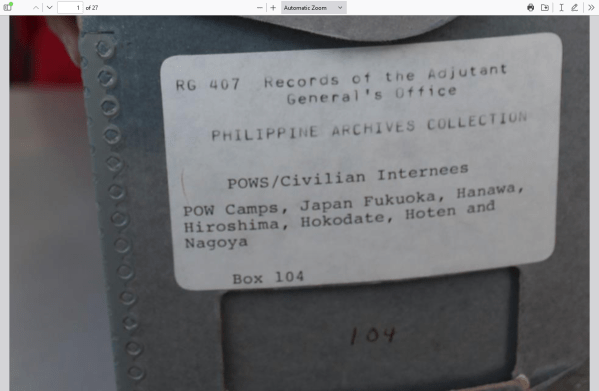
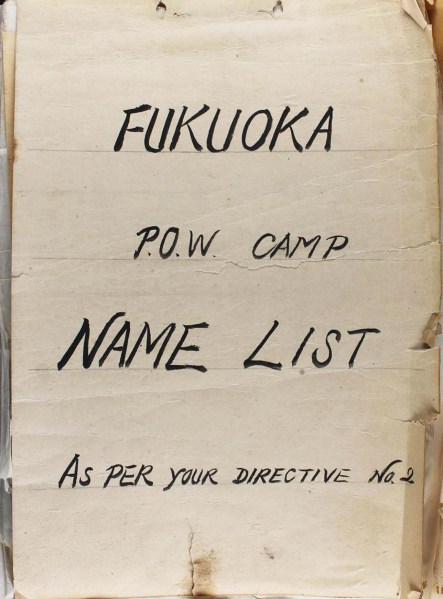
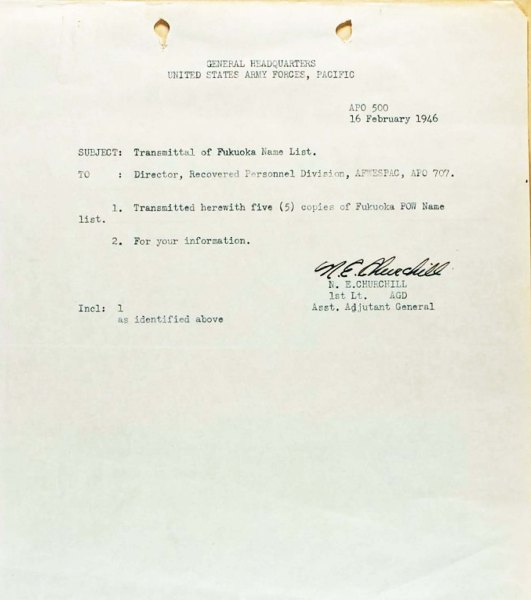
Eventually, I found that he was a POW in Fukuoka- Camp 26 prisoner number 51. The link (2) lists all the prisoners with information on nationality, name, age, and home address. it does make for interesting reading. There were British, Australian and two Dutch prisoners. The servicemen listed were Royal Navy and Army. ALL the men apart from eleven who had obvious illnesses, were listed as ‘Healthy’. The camp prisoners were used for labour in mines in this particular area of Japan.

The first pages of prisoners’ information.

At the war’s end, in 945, Uncle Ben was in the Royal Naval Hospital Chatham, in Kent. It states on his Service Record that he was Invalided out of the Royal Navy from RN Hospital Chatham on the 7th of August 1946. He would have spent time recovering from his terrible experiences.

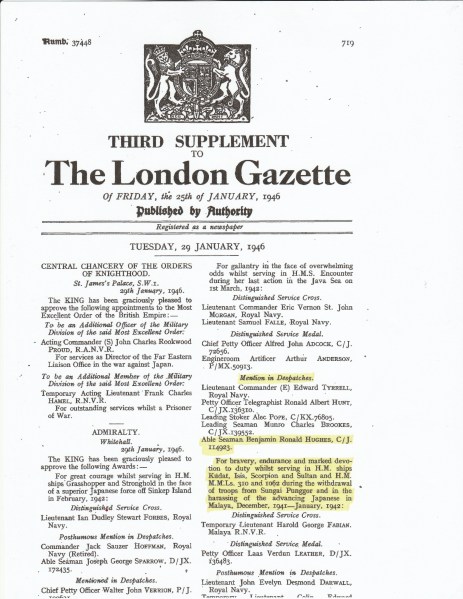
He was granted a war gratuity and a medal. Later, on the 25th of January 1946. Benjamin Ronald Hughes is ‘Mentioned in Dispatches in the London Gazette. It reads as follows.

Able Seaman. Benjamin Ronald HUGHES, C/J. 114923.
For bravery, endurance and marked devotion to duty whilst serving in H.M> ships Kuda, Isis, Scorpion and Sultan and H.M. M. MXS, 310 and 1062 during the withdrawal of troops from Sungai Punggor and in the harassing of the advancing Japanese in Malay, December 1941 – January 1942
“.

My mother-in-law told her son John, that when Uncle Ben returned to his home in Liverpool he was a wreck. Emaciated, haunted, ill and looking twice his age. He was 36 years old. Uncle Ben did not live long to enjoy life and died in 1948 at the age of 38. Because of his young age, a Post Mortem was performed and he was found to have died of bacterial endocarditis. RIP Uncle Ben.

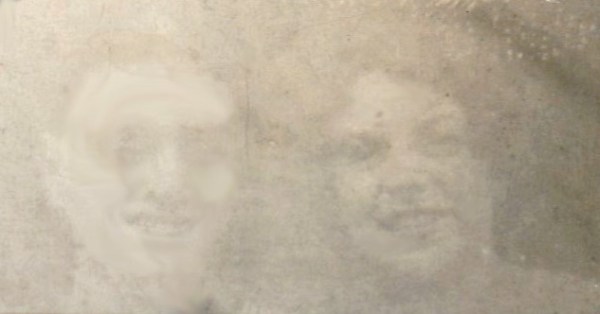
This ‘Ghost’ photo of Ben with his wife, Jessie, is the only photo we have.


(1) https://uboat.net/allies/warships/ship/4378.html

(2) http://www.mansell.com/pow_resources/camplists/fukuoka/fuk_26_keisen/FUK-26_Rosters_1946-02-16.pdf

NOTES

Keisen Yoshikuma Coal Mine Branch Camp (Fukuoka 26-B) Established as Fukuoka No.26 Branch Camp at Yoshikuma Coal Mine in Keisen-cho, Kaho-gun, Fukuoka Prefecture on May 10, 1945.

The POWs were used for mine labour by Aso Mining Company. The son and heir Taro Aso was a past President of Japan in 2008 and the controversy surrounding his family’s use of Korean and Allied POW labour clouded his term of office.

https://en.wikipedia.org/wiki/Aso_Mining_forced_labor_controversy

During the “White Rice Period”, lasting from January to October 1942, Allied prisoners were granted a maximum of ten ounces of rice per day, in addition to two ounces of rancid pork and four ounces of fish monthly. This official figure was often larger than that provided, with theft by Japanese soldiers, themselves suffering from starvation towards the latter days of the war, commonplace within the camps. Red Cross parcels, containing necessary essentials, were accepted by the Japanese authorities, but rather than being redistributed among the prisoners were kept by the Japanese soldiers themselves.

https://historycollection.com/20-horrific-details-about-japanese-pow-camps-during-world-war-ii/

Ralph Dodds, Signalman, Royal Canadian Navy

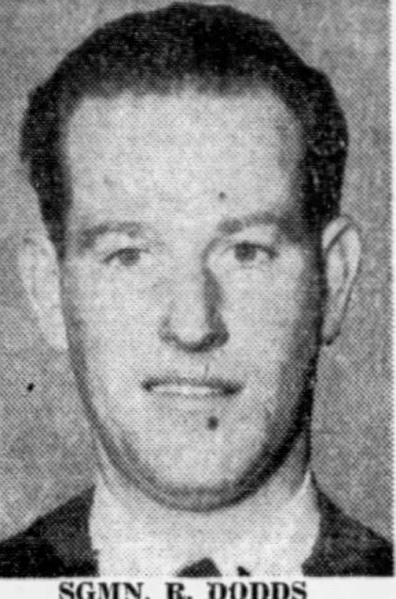
My aunt, Sarah Jane McHugh, was delighted to host the linen shower to celebrate her daughter, Dawna Day’s upcoming marriage to Ralph Dodds. The happy couple announced their engagement in October 1947. Ralph had recently been discharged after serving in the Royal Canadian Navy for over six years.  The couple’s wedding would take place in Vancouver, Ralph’s home town. Dawna was from Montreal.

Ralph was just 20 when he started his navy career in Esquimalt, British Columbia in 1939.1 With the advent of World War II, the Esquimalt Navy base became the largest naval training center in western Canada. 2 Ralph Dodds trained to become a signalman would have learned all aspects of military communications in the Canadian Navy. He would have used semaphore flags, read and transmitted morse code messages, and assured radio communications.3 During his training, Ralph would not have predicted that he would participate in the sinking of a German U-boat during the Battle of the Atlantic, that he would be on a destroyer that participated in a sea fight on D-Day, or that the destroyer he was on would be shipwrecked off the coast of Iceland.

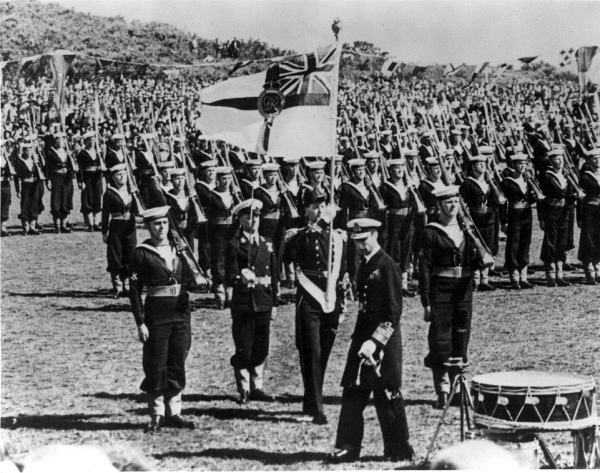
King George VI presents the King’s Colours to the Royal Canadian Navy at Beacon Hill Park, Victoria, 1939. Photo: CFB Esquimalt Naval and Military Museum collection

While Ralph was assigned to a naval station, and to a corvette (small destroyer), for most of his naval career, he was assigned to the HMCS Skeena.

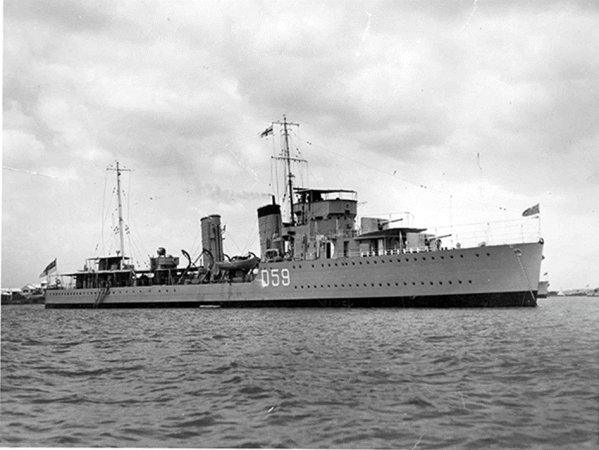
HMCS Skeena, D59, Government of Canada website, Ships’ histories

The HMCS Skeena was commissioned in 1931 in Portsmouth, U.K. and was one of the first two ships built to Canadian order. With the outbreak of the war, the Skeena initially performed domestic escort duties. In May 1940, she was sent to Plymouth, U.K. and became part of the Western Approaches Command, taking part in the evacuation of France and escorting convoys in British waters. She was later assigned to continuous convoy duty.

During one of its escort duties in the Atlantic, the Skeena destroyed U-boat U-588. This happened during ON-115 (ON means Outbound to North America).  There were twelve escort ships for a trade convoy of 43 merchant ships that left Liverpool on July 12, 1942. On July 29, seven U-boats of the Wolfpack Wolf had spotted them. This Wolfpack was quickly joined by another six U-boats of the Wolfpack Pirat. The Wolf Pack tactic, or the “Rudeltaktik,” was devised to attack the Allied convoy system by forming into position effecting a massed organized attack.4 This particular battle resulted in the loss of three of the ships in the convoy and significant damage to two of the ships in the convoy. One of the damaged ships returned to the U.K. and one was escorted to St. John’s, Newfoundland. The Skeena, on which Ralph was a signalman, and the HMCS Wetaskiwin, an escort corvette, destroyed U-boat 588 with depth charges (antisubmarine missiles) on July 31. The hostilities lasted until August 3 when the U-boats lost contact with the convoy due to misty weather. The convoy with the remaining ships reached Boston on August 8, 1942.5

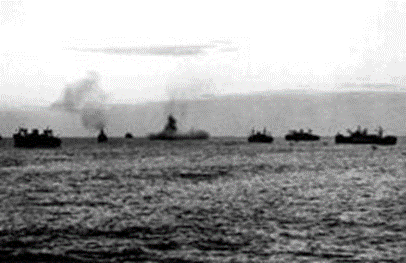
The sinking of American freighters, Edward Rutledge, Tasker H. Bliss and Hugh L. Scott at Fedala Roads, November 12, 1942
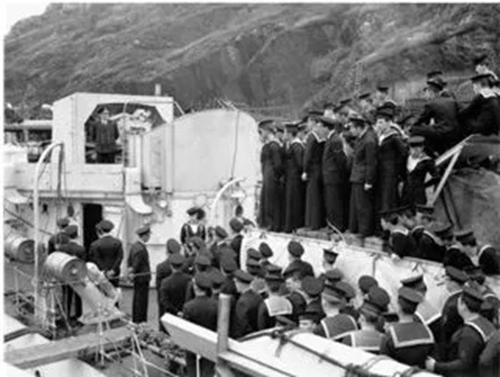
Commodore Leonard Murray congratulating the ship’s companies of HMCS Skeena and HMCS Wetaskiwin for sinking the German submarine U-588 on 31 July 1942. St. John’s, Newfoundland, Aug. 4, 1942. (NAC PA-115347)

The Skeena also participated in a hot sea fight in the Channel on D-Day. The Skeena’s assignment was to prevent enemy U-boats from attacking Allied ships while the Invasion of France was being carried out.

“Torpedoes were shooting about in the Channel and missed the Skeena by only a matter of feet,” said Ralph in an interview he gave to the Vancouver Sun.

The destroyer also had to contend with German Dorniers (bombers) that were bombing the destroyers in the Channel. One of the aerial missiles fell so close to the Skeena that shrapnel was later found on the deck.6

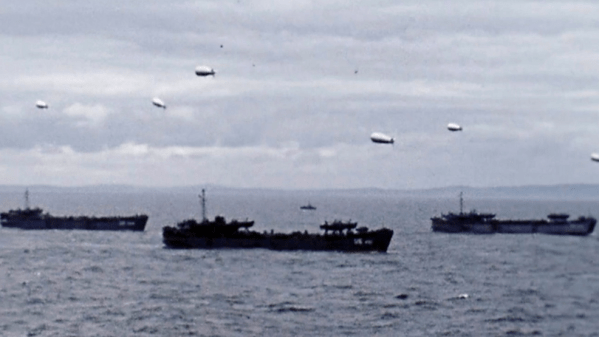
Ships and blimps sit off the coast of France on D-Day, June 6, 1944. War Footage From the George Stevens Collection at the Library of Congress

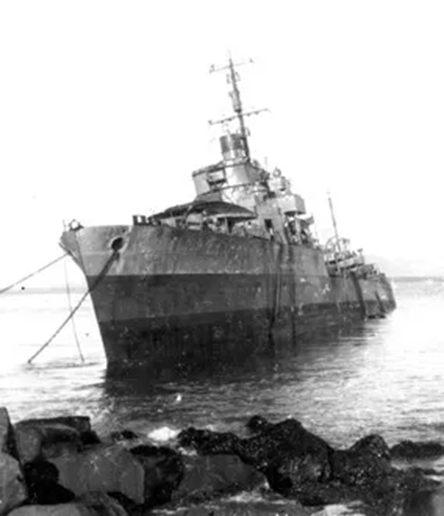
After five years of war, the HMCS Skeena met her end as she sheltered from a violent gale with 15-metre waves off the coast of Iceland, at Videy Island on October 24, 1944. Even though the crew had thrown out a second anchor to secure the ship, the Skeena smashed into the rocks. When the crew abandoned ship, the men were unable to hold the lines. Some crew members were smashed into the rocks, while others were tossed into the sea. Fifteen sailors died.7 Ralph Dodds survived.

HMCS Skeena aground on Videy Island. (Image Source: http://www.forposterityssake.ca/Navy/HMCS_SKEENA_D59.htm#Photos)
  1. Vancouver Sun, D-Day Fight in Channel Recalled by B.C. Sailor, 13 December 1944.
  2. Vance, Emily. Capital Daily, How Canada’s Pacific Fleet Shaped Greater Victoria Over Two Centuries, 1 May 2021, https://www.capitaldaily.ca/news/canadas-pacific-fleet-greater-victoria-two-centuries, accessed 24 July 2023.
  3. Wikipedia, Signaller, https://en.wikipedia.org/wiki/Signaller, accessed 24 July 2023.
  4. Uboataces, German U-Boat, U-Boat Tactics, The Wolf Pack, http://www.uboataces.com/tactics-wolfpack.shtml, accessed 31 July 2023.
  5. Wikipedia, Convoy ON115, https://en.wikipedia.org/wiki/Convoy_ON_115, accessed 26 July 2023.
  6. Vancouver Sun, D-Day Fight in Channel Recalled by B.C. Sailor, 13 December 1944.
  7. Military History Now, HMCS Skeena – Meet One of the Toughest Warships of the Battle of the Atlantic, 12 November 2020, https://militaryhistorynow.com/2020/11/12/hmcs-skeena-meet-one-of-the-toughest-warships-of-the-battle-of-the-atlantic/, accessed 2 August 2023.