
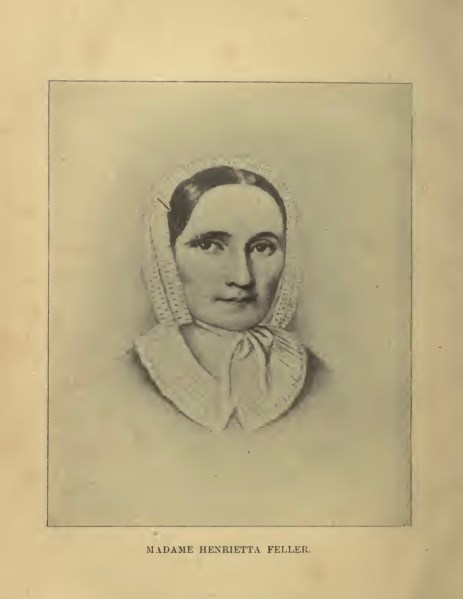
A young Protestant widow from Switzerland came to Canada in 1835 to convert the heathens. If it wasn’t for Henriette Feller, my family might still be speaking French and attending Roman Catholic services.
Henriette Odin (1800 – 1867) was born in Montagny, a village, outside of Lausanne, Switzerland. Her Protestant ancestors had been driven out of France when Louis XIV revoked religious freedoms and many took refuge in Switzerland. Her father was the director of the Vantonal Hospital at Lausanne.
“Wisdom and love distinguished both parents and their influence on the family was of the happiest kind.”
As a teenager, Henriette began visiting in the hospital and her tender and gentle demeanour was a comfort to the patients. She learned to change dressings and considered becoming a nurse but then she had a religious awakening.
Henriette married Louis Feller, a widower, in 1822. He was the head of a prison and had a son and two daughters. Their daughter Elize died as a young child and soon after, Louis died of typhoid fever. Louis Feller left all his assets to Henriette. They both gave their lives to a Christian Evangelical sect that wanted to spread the love of Jesus Christ. If you loved Jesus, everything else would be alright. The Swiss government didn’t approve and persecuted those who espoused the evangelical faith.
At an opportune time, Monsieur Henri Olivier and his wife came to Henriette’s Church, Henri as a pastor. He held missionary prayer meetings and under the Société des Missions d’Evangeliques de Lausanne, instructed young men for missionary service.
“Whose business is it to go to the heathen for whom we pray and give?”
The North American Indians became their prime missionary endeavour. Soon Henri, his wife and two young men were sent to Canada to convert the indigenous population to Protestantism using the word of Jesus from the New Testament. The young men went west but the Oliviers preferred to stay in Montreal and work on converting the French Roman Catholics. Henriette corresponded regularly with Mme Olivier, who encouraged her to follow them to Canada. In 1835, Henriette and a young missionary, Louis Roussy, sailed to New York, a journey of 33 days. They then travelled up the Hudson River to Lake Champlain, on the Richelieu River to St Jean, a long tedious journey to La Prairie in an old coach and finally across the St Lawrence River in a primitive boat to be met in Montreal by the Oliviers.
Converting Catholics was hard work, with very limited success because of the strong position of the clergy in the everyday lives of the French Canadians. Henriette thought they could do more good in the rural areas south of Montreal, where the priests and the churches were far apart. Henri Olivier soon returned to Switzerland but Henriette Feller and Louis Roussy stayed.
The Levecque family, in Grand Ligne, south of Montreal, offered Henriette their attic space with a room for her to live in and another for the school. She taught the children during the day using the bible and at night, the adults climbed to her room and read and discussed the New Testament.
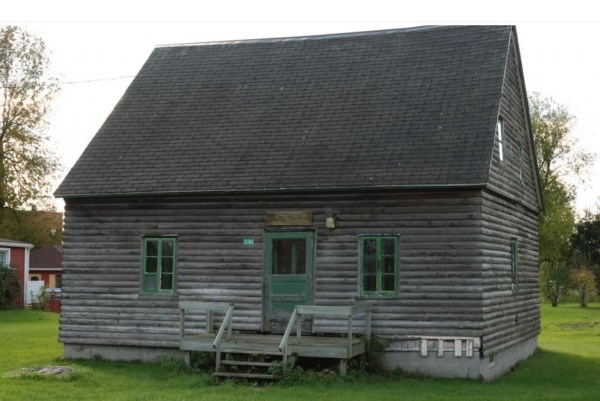
Troubles escalated with the local Catholics during the rebellion of 1837. Those at the mission were threatened and forced into exile in the United States. They found sympathy for their cause in Champlain, New York and were able to raise money and received continued support from the Americans.
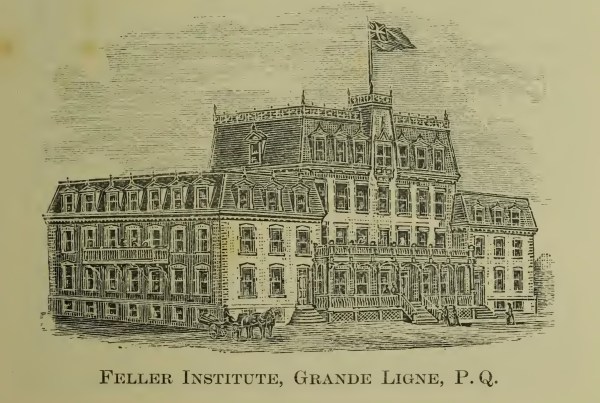
When things quieted down, they returned to Grande Ligne to find the houses emptied, animals taken and crops gone. With the help of several friends of the Mission, they rebuilt. The new construction, a much larger, substantial stone building, housing the mission and the school, opened in 1840. This was the begining of the Feller Institute.
While Henriette, known as Mere (Mother), continued to teach, Louis Roussy, as a colporteur, spread the word of God through the distribution of Bibles. My family lore said that one day, he and Eloi Roy visited my great-great grand mother, Sophie Marie Prudhomme Bruneau. She was interested in what they told her and invited them to stay the night. Her husband Barnabé Bruneau then joined in the discussions and eventually, my great-great grandparents and all their 13 children converted to Protestantism.
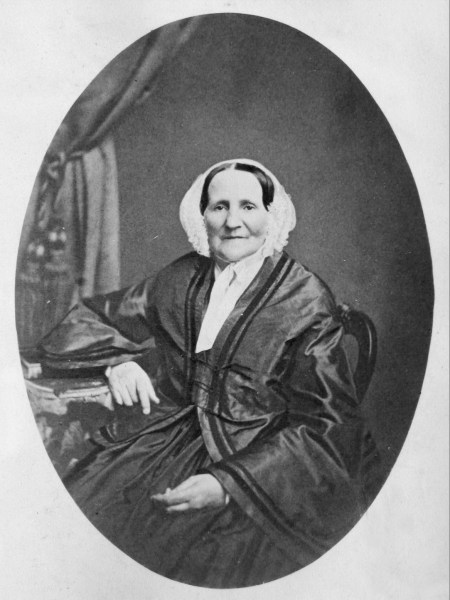
The hard work took its toll on Henriette’s health, which was a constant source of anxiety for her close associates. She had pneumonia several times and never completely recovered, even after a trip home to Switzerland. She suffered a stroke in 1865 and although bedridden, was still the driving force for the school until her death in 1868. Henriette Feller is buried in the Grande Ligne Cemetery with many of her converts, including some of my ancestors. Most of my family is protestant to this day.
“Although Madame Feller occupied a somewhat anomalous position, for her influence was well-nigh all-powerful, and few ventured to contradict or oppose one in whom the tenderness of woman and the firmness of man were so happily united, she never overstepped apostolic limits.”
Notes:
Walter N. Wyeth, D.D. Henrietta Feller and The Grand Ligne Mission, Philadelphia, PA. 1898. printed and Bound by C.J. Krehbeil & Co. Cincinnati, Ohio.
Paul Villard M.A., M. D., D. D. Up to the Light the story of French Protestantism in Canada. 1928. Ryerson Press, Toronto, Canada.
PHILIP G.A. GRIFFIN-ALLWOOD Wesley Memorial United Church Cramp Memoir of Madame Feller 244. Mère Henriette Feller (1800-1868) of La Grande Ligne and Ordered Ministry in Canada.
Historical Sketch of the Grande Linge Mission by the President 1893
https://www.findagrave.com/cemetery/2457971/saint-blaise-baptist-cemetery
https://en.wikipedia.org/wiki/Feller_College
 Genealogy Ensemble