The Man Behind the Black Cross Temperance Society

What made my ancestor think of using a black cross to mark homes of temperance?

Edouard Quertier (Cartier) launched Quebec’s first official temperance society in 1842 by placing a giant black cross on the top of the escarpment in Saint-Denis-de-Kamouraska. So began an organization that would encompass 400,000 of 900,000 Canadian Catholics eight years later.(1)

The symbol created a tradition that continues in Quebec to this day. If you ever go into a home with a bare black cross hanging in the middle of the living room wall, you’ll know you’re in the house of people who do not drink alcohol.

But what gave him the idea?

1842 Arrival in St Denis

Quertier certainly wasn’t feeling inspired when he first arrived in the tiny hamlet or between 10 and 15 families at the edge of a cliff on the Saint Lawrence’s south shore.

How did I accept this arid rock?,” he wrote. “When I arrived [in October], there was not even a piece of board on which to place a bed or a table. I had to go down the slope and rent a small house, or rather a cabin. No matter! I waited there, until my lodging was acceptable.”(2)

Still, Quertier was no youngster when he arrived in Saint-Denis-de-Kamouraska. At 43 years old, he had had four previous jobs before his priesthood and 12 years of experience serving communities.

Le révérend Édouard Quertier, 1864, Fonds J. E. Livernois Ltée, http://numerique.banq.qc.ca/patrimoine/details/52327/3114297

Previous Jobs

Both of his previous roles as parish priest were stressful.

As curate and then parish priest of Saint-Antoine in Montmagmy, he argued frequently with his patron, Father Charles Francois Painchaud.

His bishop got him out of that situation by appointing him parish priest of Sainte-Georges of Cacouna. There, a new church and presbytery were required, but building them was difficult due to arguments between residents who wanted religious leadership and those who believed in the strong separation of Church and State. Despite the conflict, Quertier was able to build a new church and presbytery within the village. He oversaw the presbytery stonemasons and carpenters and got the church walls well underway before resigning the post. His departure halted the building of the church for a time, but it resumed in 1845 and opened for worship in 1848. The belfry didn’t get added until 1892 and full consecration delayed until 1897, but that’s another story.(3)

The experience simply makes clear that Quertier knew he had to do something important quickly to make an impact on his new neighbourhood.

He decided to promote temperance as a movement.

Temperance in Quebec

The issue already had some momentum in Quebec. Popular people like Bishop Charles-August-Marie-Joseph de Forbin-Janson and Charels-Paschal-Télesphore Chiniquy had been telling stories about the evils of alcoholism in weekly masses since 1839. Community residents saw that frequent imbibing often led to fighting, lethargy, poverty, spousal abuse, theft and neighbourhood violence.

Unlike his predecessors, however, Quertier decided to formalize the movement with an official association he called “The Society of the Black Cross.” He created statutes, oaths for members and procedures for joining the society, including the requirement that each member display a plain black cross on the wall of the family living room.

For the next 15 years, Quertier’s campaign for temperance spread. So many French Canadian families displayed the black cross, it became a decor tradition. The Quebecois de Souche society includes a photo that shows the once prevalent look.(4)

Growth and Departure as Leader

In the meantime, Quertier continued building his parish. The wooden chapel that originally opened on December 24, 1841 got replaced by a stone gothic church in 1850.

Seven years after that, Quertier retired. By then, the Society of the Black Cross included believers in almost every parish in Quebec and Quertier’s own parish had grown to encompass 100 families containing “625 souls.”(5)

Temperance continued to be a key issue, not only in Quebec but across Canada. In Quebec, however, the secularism movement also had great strength in many communities. To avoid angering these groups, the Province of Canada passed the Canada Temperance Act that allowed any county or city to hold referendums to consider whether or not to forbid the sale of liquor. This would ensure that communities who wanted to stay dry could do so without forcing prohibition on the entire country.

Life after Death

Quertier spent the rest of his life in Saint-Denis-de-Kamouraska, which became Saint-Denis-de-la Bouteillerie in 2013. After his death in 1879 at 73 years old, the church entombed his body under the crypt of the church. A tombstone says in French:

Here lies lord Edouard Quertier, first parish priest of St. Denis, one of the first apostles of temperance. Died July 17, 1873, aged 73 years, 10 months, 12 days. For 15 years, he lived for you. Pray for him.”(6)

Quertier’s remains continued to draw enough visitors that the church got entirely rebuilt after a fire damaged it on March 9, 1886. Initially, they built a belfry to hold a 2027-pound bell that cost $425,000 the following spring, and new walls on those of the former church by October. Later, they’d add two more bells to the tower.

Quertiers’ campaign for temperance didn’t end when he died. Members of his Black Cross Society were among 20% of Quebec’s population that supported a federal referendum on prohibition in 1898.
The movement grew substantially during World War I.

Temperance, not Prohibition

The Quebec Government declared prohibition in 1919. Then it made several exceptions by legalizing the sale of light beer, cider, and wine in hotels, taverns, cafes, clubs and corner stores.

The prohibition law got repealed entirely to enable liquor sales through a government-run commission in 1921.

In many ways, by choosing control over strict adherence to abstinence, the government duplicated the practicality Quertier included within the original functioning of the Society of the Black Cross.
Any household that became a member of the temperance organization could get a special dispensation to serve alcohol during celebrations, such as baptisms, birthdays and weddings. If the parish priest agreed that a special occasion merited an exception, he would temporarily replace the plain black cross in a home with a white one. The white cross hung on the wall during the celebration. After the celebration ended, the priest would visit to exchange the white cross with a black one and return the home to a liquor-free location.(7)

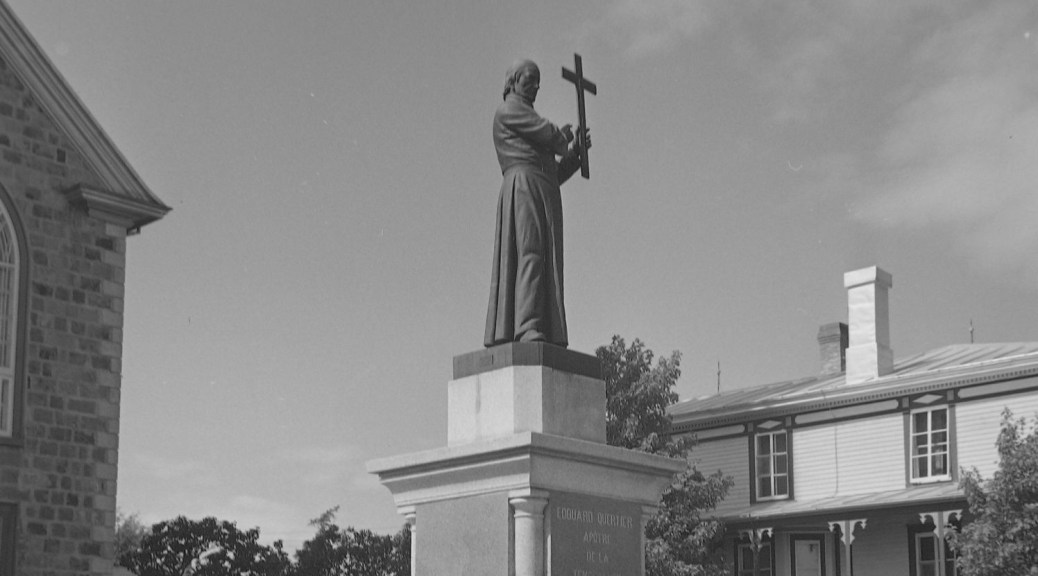
This kind of flexibility enabled temperance to continue growing within Catholic communities in Quebec even after 1921. Some of its proponents resurrected Quertier in the form of a statue in front of his former church in 1925. The statue remains in place today.

Sources

(1) Ferland, Jean-Baptiste Antoine, in a report to the Holy See, 1850 as written in section 8, part 98 of Canada and its provinces, edited by Adam Short and Arthur G. Doughty, Glasgow, 1914, https://archive.org/stream/canadaitsprovinc11shoruoft/canadaitsprovinc11shoruoft_djvu.txt, accessed July 19, 2020.

(2) Julienne Barnard, “QUERTIER, ÉDOUARD,” in Dictionary of Canadian Biography, vol. 10, University of Toronto/Université Laval, 2003–,written in 1972, http://www.biographi.ca/en/bio/quertier_edouard_10E.html, accessed on July 18, 2020.

(3) Ouellet, Jean-Baptiste, Municipalité de Saint-Denis-De La Bouteillerie. https://munstdenis.com/municipalit%c3%a9/historique/, accessed July 18, 2020.

(4) Fédération des Québécois de souche, https://quebecoisdesouche.info/la-croix-noire-croix-de-temperance/, accessed July 18, 2020

(5) La Corporation de développement de Mont-Carmel, https://www.mont-carmel.ca/histoire/, accessed July 18, 2020.

(6) Généalogie Abitibi-Témiscamingue, https://www.genat.org/cimetieres/photo.php?idPhoto=2c0bf0249a01fd83b57322e7b7cb3362, accessed July 18, 2020.

(7) Fédération des Québécois de souche, https://quebecoisdesouche.info/la-croix-noire-croix-de-temperance/, accessed July 18, 2020.

Memories of a Bygone Era

Memories of a Bygone Era 

Every year, as the warm summer fades away and the splendour of autumn colours is upon us, my thoughts turn to a specific memory from my childhood. It is almost like clockwork and never fails.  

Mom, Claire and Paul 

circa 1944

When I was about four or five years old, my mom taught me a song that is forever etched in my memory.  

When the trees take on their beautiful fall colours,  and when gentle breezes send brightly coloured leaves of red and gold gently spiralling to the ground, forming, colourful carpets, I am reminded of a song my Mother taught me more than eighty years ago. To this day, I still sing “Come Little Leaves said the wind one day,” when driving along, enjoying the fall season and all its many vibrant colours. This brings back many fond memories of the bygone era. 

Children’s Song 

“Come, little leaves,” 
Said the wind one day, 
“Come over the meadows 
With me, and play; 
Put on your dresses 
Of red and gold; 
Summer is gone, 
And the days grow cold.” 
 
Soon as the leaves 
Heard the wind’s loud call, 
Down they came fluttering, 
One and all; 
Over the meadows 
They danced and flew, 
Singing the soft 
Little songs they knew. 
 
Dancing and flying 
The little leaves went; 
Winter had called them 
And they were content- 
Soon fast asleep 
In their earthy beds, 
The snow laid a soft mantle 
Over their heads. 

“Come Little Leaves” was written by the American poet George Cooper (1838–1927), with music by Thomas J. Crawford. “Come Little Leaves” was written by the American poet George Cooper (1838–1927), with music by Thomas J. Crawford. 

1945: A Year of Endings and Beginnings, at Home and Abroad.

As I approach my 80th birthday, I begin to think about the year I was born. What a year that was, a year of major global transitions and the historical year of my birth. I was fortunate to be born in November of that year, when most hostilities had ceased in the world and my home town.

However, the hardships in Britain and Europe were just beginning. Now, we had to think about rebuilding our shattered lands.

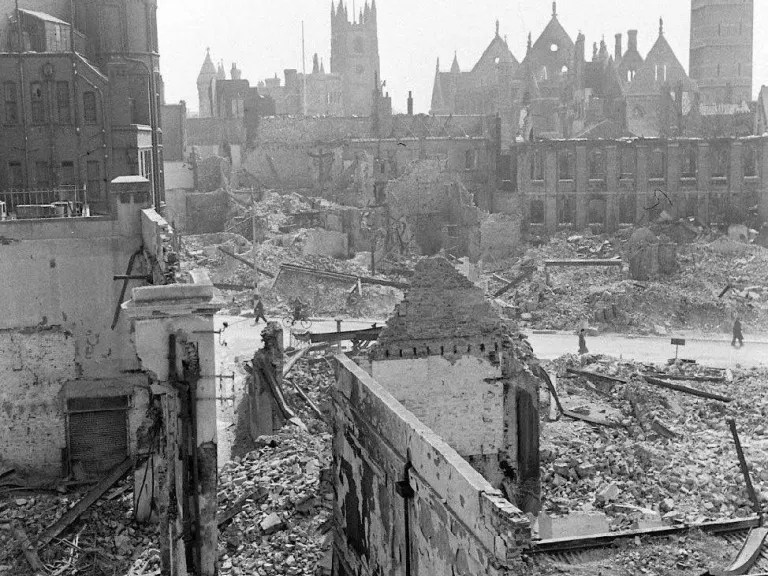
1945. Plymouth, Devon, England, after a Blitz Raid

I have an interest in the ‘Home Front’ events that occurred in Britain during the Second World War, rather than military stories. However, military stories cannot be ignored as 1945 was quite the momentous year in the military and home fronts. Here is a timeline of key events both at home and abroad that occurred in 1945.

January:

World War 2 is in its final phase, even though Germany is in retreat. The British military pressed onward in Germany and Burma. The Battle of the Bulge ended a major German offensive on the Western Front.

It was believed that Plymouth was being singled out for particularly ferocious attacks because it was home to Her Majesty’s Naval Base, Devonport, which was the largest Navy base in Western Europe and the Royal Navy’s repair and refuelling facility. The dockyard was staffed by women during the war, doing what was normally considered to be men’s work, as all the men were away fighting.

On the home front, Britain was impacted by V-2 rocket attacks.

Rationing, especially items like dried and canned fruit, was scarce. The Ministry of Food encouraged households to reduce waste and get creative with recipes. I still practice creating recipes and reducing waste to this day. This story is my 1950 Christmas with rations. Rationing in England lasted until I was 11.

https://genealogyensemble.com/2021/12/29/memories-of-a-1950-british-christmas/

February:

I was conceived!!

Allied bombers begin a major raid on the city of Dresden. Key events in February included the Yalta Conference between the Allied leaders, the beginning of the Battle of Iwo Jima and the final stages of the war in Europe.

The Soviets captured Budapest, Hungary, and also encircled Breslau, Germany (now the modern-day city of Wroclaw, Poland) as Allied forces pushed toward the Rhine in the west.

March:

The 10th British and Allied forces successfully crossed the Rhine, the first time a foreign army had crossed the Rhine since the Napoleonic era.

British forces pushed deeper into Germany with only scattered resistance.

On the 27th and 29th, the final V1 flying bomb fell on Britain.

Remarkable photo of a German V1 fully autonomous early cruise missile hitting the London area in 1945.

April:

1st The Battle of Okinawa continued for 82 days, resulting in heavy casualties for both American and Japanese forces. Japan launched ‘Kamikaze’ attacks against Allied naval forces.

Dr Fritz Klein, an SS doctor, among some of his victims, Belsen, 24 April 1945

Numerous Nazi concentration camps are liberated, revealing the full extent of the Holocaust to the world.

4th Ohrdruf concentration camp, liberated by U.S. Forces.

11th American troops discovered the Buchenwald concentration camp

15th Liberation of the Bergen-Belsen concentration camp, by the British, who found thousands of ill prisoners and corpses.

29th Dachau camp was liberated by U.S. Forces.

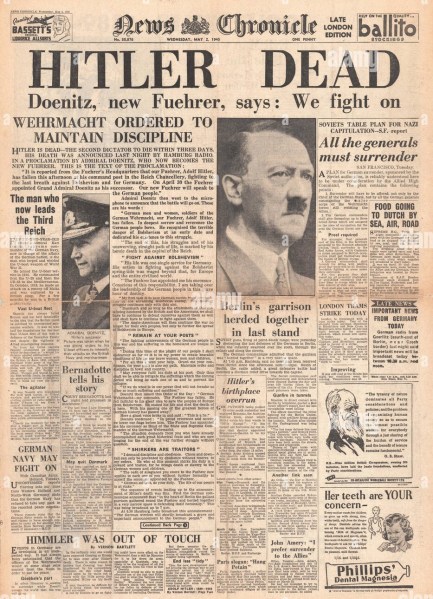
Also on the 29th, Adolf Hitler married Eva Braun in the underground bunker.

30th Adolf Hitler commits suicide, shooting himself at the age of 56 years old, whilst Eva Braun takes a poison pill.

German forces, the last fighting force on the Western Front, surrendered en masse.

May:

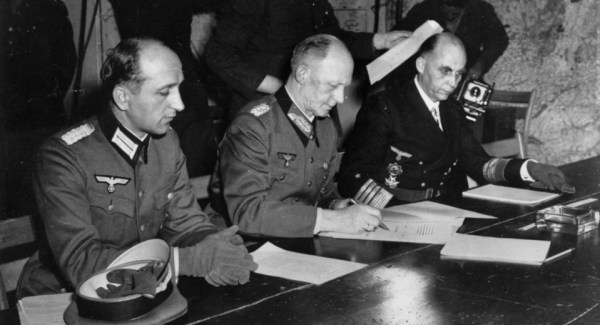
7th Germany signs an unconditional surrender,

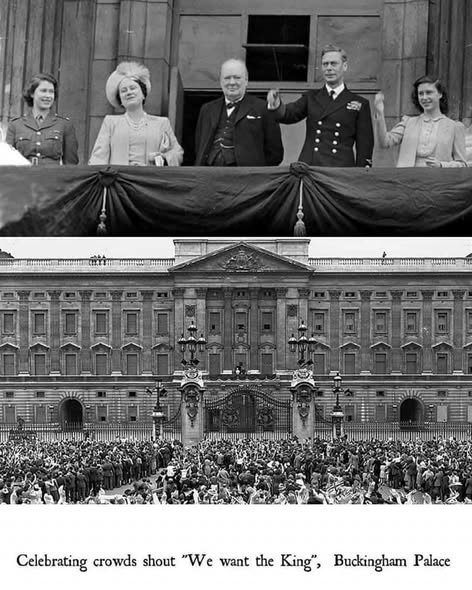
8th VE Day – victory in Europe – Day

On May 7, 1945, Gen. Alfred Jodl signed the surrender of all German forces in Rheims, France. He is flanked by Wilhelm Oxenius (left) of the Luftwaffe and Hans-Georg von Friedeburg, representing Germany’s navy. | AP Photo

23rd Heinrich Himmler commits suicide while in British custody in Lüneburg, Germany.

June:

15th Wartime blackouts ended, and streetlights were turned back on.

The wartime coalition government, led by Prime Minister Winston Churchill, was dissolved, and a general election was held shortly after.

July:

The general election was scheduled to take place on the 5th of July, 1945, the first general election since 1935. However, the results were not announced until the 26th of July, 1945, to allow time for overseas military personnel’s votes to be counted. The Labour Party, led by Clement Attlee, won a landslide victory in the July 1945 election.

August:

The Family Allowances Act was passed to provide financial support to mothers.

15th was Victory over Japan – VJ – day. Celebrating Japan’s surrender after the atomic bombings of Hiroshima and Nagasaki, and the official end to over six years of global warfare

2nd Japan formally surrenders. Now, our country was focused on the return of troops, the beginning of domestic reconstruction and the promises of independence for its colonies.

September:

15th Parades were held in Britain to mark the fifth anniversary of the Royal Air Force’s victory..

16th Hong Kong was reclaimed, ending the four-year Japanese occupation.

The 17th Belsen Trial began for war crimes in Lüneburg, Germany, presided over by a British military court.

18th The Independence of India would be granted “at the earliest possible date”, was announced by Prime Minister Clement Attlee on a worldwide broadcast.

October:

Britain was now fully engaged in the complex aftermath of the Second World War, with the new Labour government pursuing major domestic reforms and the British Army dealing with global instability and the return of war prisoners.

4th An unofficial dock strike began in Britain.

7th The ocean liner SS Corfu docked at Southampton, carrying the first 1,500 prisoners of war to return from Japanese camps in the Far East. Also on the 7th, Rudolf Hess was transferred from Britain to Nuremberg, Germany, to face trial.

The 20th and the 5th Pan-African Congress were held in Manchester, where delegates from across Africa and the diaspora discussed and called for independence from colonial rule, a significant moment in the history of decolonisation.

This month was a period of substantial change as the nation grappled with domestic reconstruction, a new political direction and the challenges of managing a post-war empire and a new global order.

At the end of October, in Palestine, the Jewish Resistance Movement launched the ‘Night of Trains’, a coordinated attack on the British railway network, marking a rise in armed opposition to British authority.

November:

On the 20th, I was born at the Alexandra Maternity Home, below.

At the time, there was no National Health Service (NHS), so no free medical care. I must have been an expensive baby!

The Alex, as it was often called, admitted maternity patients for a period of not less than a fortnight. Fees were charged from 15 shillings (75P) to 42 shillings (£2.20P) per week.. These fees included nursing, food, laundry and all clothing and if necessary, the doctor’s fees. I have no idea of my weight, size or time of birth. Such things were not, unfortunately, recorded.

December:

The government announced its plan for a National Health Service (NHS) to provide free medical care.

1st British military police in occupied Germany arrested 76 Nazi industrialists.

9th, the United States granted Britain a low-interest reconstruction loan of approximately $4.4 billion (US). An additional Canadian loan was for $1.9 billion, scheduled to run for 50 years.

The final payments made in 2006, which settled the debt entirely, were for $83.25 million to the US and $22.7 million to Canada.

Throughout the rest of the year, Allied forces continued to liberate numerous concentration camps, exposing the extent of Nazi atrocities.

In 1945, post-war, Plymouth faced immense devastation from the Blitz, which had destroyed the city’s heart and left thousands homeless. Plymouth was one of the most heavily bombed British cities, due to its status as a major naval port with the large HMNB Devonport dockyard.

The city centre, two main shopping areas, almost all civic buildings, 26 schools, 41 churches, and 3,754 houses were destroyed, with a further 18,000 properties seriously damaged. Around 30,000 people were left homeless, leading to a critical shortage of accommodation. Temporary prefabricated houses were quickly erected to provide immediate shelter. I remember seeing the ‘pre-fabs’ still in use in the 1960s.

The most urgent efforts were to house the population, clear the bombed buildings – which, still, years later, were my playgrounds – and begin an ambitious pre-planned reconstruction project. All the while I was growing up, this building and planning went on. When I left Plymouth at 18, the rebuilding continued until the early 1970s.

Sources:

https://en.wikipedia.org/wiki/Battle_of_the_Bulge

https://www.thedevonseoco.co.uk/plymouth-in-the-blitz/ https://encyclopedia.ushmm.org/content/en/article/liberation-of-nazi-camps

https://www.facebook.com/photo/?fbid=779249228206828&set=gm.1467370817653042&idorvanity=1074810956909032

https://collection.nam.ac.uk/detail.php?acc=1985-11-36-334

Facebook Page: ‘Old Plymouth Society’ Post by Gloria Dixon 7 July 2021

https://www.iwm.org.uk/collections/item/object/205021954

https://www.historic-newspapers.com/en-ca/blogs/timelines/a-year-in-history-1945-timeline?country=CA

Dear Uncle Bill

Dear Uncle Bill,

While rummaging through the Dusty Old Boxes containing family memorabilia, I came upon letters written by you to your only brother, my father, Tom.  There were also letters written to your sweetheart during WWII while you were stationed in England serving with the RCAF. So I thought the best way to remember you would be in the form of a letter.

Please allow me to introduce myself. My name is Lucy and I am one of your nieces.

Our paths never crossed.  I was only born in 1957 and you died in 1943. Your brother had seven children.  I was his fourth.  His eldest son, born in 1949, was named after you – William Sherron Anglin II.

While staying with my family in England in 2016, I visited you in person at your last known address:  Runnymede Memorial[1], Panel 179, Surrey, UK.  My grandchildren, who always enjoy a challenge, accompanied me in my search to find you. It didn’t take them long to find your panel and you – or your name, that is – inscribed on one of several stone walls, along with 20,000 other airmen,  at this dedicated memorial building on Cooper’s Hill overlooking the Thames River.

Your name was too high up for the children to touch but I brushed my fingers lovingly over your name and told you we were there. I am quite sure you knew it. You had an interest in mental telepathy, as did your grandfather, and his story was documented in the family boxes as well.  (Surgeon and Mentalist)

Throughout your letters to Tom, along with childhood memories, you shared and referred to an interest in The Rosicrucian Order which “is a community of mystics who study and practice the metaphysical laws governing the universe”.[2]

You maintained the belief in an ability to “project” yourself and to send mental messages. I can only guess that a feeling of closeness to your brother by any means must have consoled you greatly while away at war in England.

In your letters to your sweetheart, you described England in general (with the usual complaints about the rainy weather), your life with the RCAF, weekend leaves to Scotland and dances in the mess hall “wishing you were there”.  Although I don’t have her letters in response, I am sure you took great comfort in hearing from her.

You were sent on a training course at the end of May 1943 and, while away, your crew went on a mission without you – never to return. In the last letter to your girl, you confided that you were feeling “depressed” at their loss.  On the very next mission, you went missing as well.

Last picture of Uncle William
Last picture of Uncle Bill (far left) – 1943

Not long afterwards, your sweetheart sent a bundle of your cherished letters, wrapped in a bow, to your mother and wrote “I know I want to forget as soon as I am able, everything – and so I am sending you the few letters I had saved from those Bill sent me from England.  I hope that you would rather have them, than not … perhaps they will make you glad to have something more – to know something else of Bill’s life in England … rather than rake up memories you are trying to forget. For while I want to forget, I feel so sure that you will want to remember.”

Your mother never gave up hope that you would return one day.

Wendling & Josephine Anglin and sons Bill and Tom (1940)

Bill, Wendling  (the stock broker), Josephine, Tom and family dog (1940).

The abundant number of photos found with the letters in these boxes show your 27 years filled with family times – gatherings, annual trips, formal portraits, a few pets and a full life.

You will not be forgotten.

Lovingly,

Your niece Lucy

Note:

http://www.aircrewremembered.com/richmond-bruce.html

William Sherron Anglin was an Air/Gunner and Warrants Officer II with the 429 Squadron flying in a Wellington X bomber, Serial no. HZ471.

Reason for Loss:

Took off from R.A.F. East Moor, North Yorkshire at 22.36 hrs joining 719 aircraft attacking the town of Wuppertal, the home of the Goldchmitt firm which produced Tego-Film, a wood adhesive used in the production of the HE162 and TA154 (aircraft).  Around 1000 acres was destroyed in the firestorm that followed – 211 industrial buildings and nearly 4,000 houses were totally destroyed. A figure of 3,400 fatalities on the ground has been recorded. Bomber command did not escape lightly on this operation losing some 36 aircraft.

It is thought “probable” that HZ471 was shot down by Lt. Rolf Bussmann, flying out of Venlo airfield, and attacking this Wellington at 3,700 meters with the aircraft falling into the sea off Vlissingen.

429 Squadron possible loss area

[1] https://wiki2.org/en/Runnymede as at November 19, 2017

[2] https://www.rosicrucian.org/ as at November 19, 2017.