
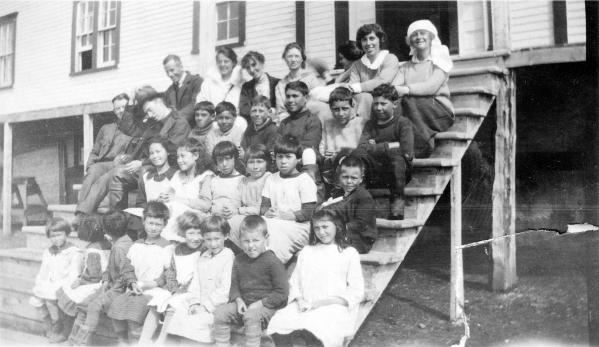
Marguerite Lindsay (top right) with the orphans of Muddy Bay – 1922
It’s hard to believe that over a century ago, my great aunt Marguerite Lindsay (1896-1922) was due to return home in August 1922. But instead, she disappeared.
It feels different to think about someone who passed away so long ago. Their loss doesn’t carry the same weight or mystery as a recent one. It quietly fades into the background, becoming a distant, difficult-to-understand memory.
Back in the summer of 1922, Muddy Bay, a small, close-knit community near Cartwright in Labrador, might have been a place where days blended together and everyone knew each other. Marguerite Lindsay arrived that June, as a young, educated volunteer, to teach the orphan children at the local school during the teacher’s six-week summer break. The whole community, children and adults, welcomed her and loved having her around. In early August, only a few weeks later, she was planning to return to her family in Montreal, Quebec, just as easily as she had come.
The morning before Marguerite was due to leave, the children were given their annual checkup by the local doctor and she wasn’t needed. It was a very hot day, and she told the others she was going for a swim and wouldn’t be back until later. She left around eleven o’clock, just before lunch. When her body was found four months later, a quarter mile from where she had left the others, her wristwatch had stopped at 11:30.
When she didn’t come back for supper that day, a search party quickly got together and started looking in places where someone might have gone swimming. They walked all the nearby paths, including the wooded path near the marshes where she would eventually be found, but sadly, they didn’t find her.
Stanley, Marguerite’s brother in Montreal, visited Muddy Bay at the end of August, a few weeks after her disappearance. He recalled her letters fondly describing the people, the town and the natural beauty of the area. He expressed his gratitude to the community once he heard about their thorough efforts in searching for her.
Summer gave way to autumn, and soon enough, snow began to fall. Life in Muddy Bay continued as usual.
Four months later, in December, her body was found in the frost-covered marshes. She had been shot through the heart and froze beneath the snow, where a hunter’s dogs had discovered her.
The three autopsies that followed over time didn’t provide any clear answers. The media coverage quickly offered sensational headlines, including a self-inflicted shooting in a fall or suicide over a love affair gone wrong. Both those possibilities allowed the story to rest.
Yet, so many questions remained unanswered. What about foul play?
If Marguerite had planned to end her life, why had she recently written a long, warm letter to her brother Stanley, filled with affection and small observations from her days? Why bring a bathing suit? Why did she end up in the marsh along the wooded path instead of near the water?
If her death had been an accident, how could she have shot herself at such an angle, one that clearly didn’t align with a fall? Why did the bullet pass right through her body, never to be found, when a small firearm she might have carried would not likely have had such force? And why was no gun ever found?
And what about the search itself?
Why was the wooded path to the marsh searched first, even though it was thought she had gone in the opposite direction to swim? Who made that decision and who unquestioningly followed suit? In Muddy Bay, like many small communities, influence often went unspoken. Did one or more people kill her and then walk among the searchers, already knowing what had happened?
Perhaps the most difficult thought is not that someone harmed her, but that more than one person may have known something they couldn’t—or felt unable to—say.
Did Marguerite discover a secret or something – whether she knew it or not – that someone didn’t want her revealing when she returned to Montreal? When her voice was silenced, whatever she might have known died with her.
Her story lives on, however, even though the truth can soften and fade over time.
And even when things about Marguerite remain uncertain, the community chooses to remember her over a hundred years later – with a plaque in the local church, the naming of the marsh, a song about her and the careful passing down of her story, making sure she’s never forgotten.
 Genealogy Ensemble
A tragic ending to a lovely young woman’s life.
Thank you for sharing Lucy.
LikeLike