
It is the 25th of March, 1967, and my father, my then-boyfriend, John, and Dad’s second wife, plus me are on our way to St Austell, in Cornwall, England. We were visiting Dad’s mother, my Granny Bulford, whom I never really knew, as my parents had divorced when I was seven.
We were in Dad’s new white Mini Minor, a small car. In fact, a very small car. Dad’s head brushed the interior of this small vehicle. Dad was 187.96 cm (6′ 2″), I was 180.34 cm (5’11”), and my boyfriend was about the same. I think the only comfortable person was his second wife, who was petite!
I never understood why he would buy such a small car, but, as I matured, I realised it was affordable, dependable, and low on fuel. Economic pragmatism over physical comfort, that was my Dad!

An Austin Mini 1967
Thank goodness, the trip from Plymouth to St Austell in Cornwall was only 50 to 60 minutes. The drive was along the spectacular Cornish coast. We enjoyed the scenery, and I was excited to be meeting Granny Bulford after all these years.
About half an hour into the trip, the sharp, suffocating stench of oil permeated the car. We knew exactly what it was, and our lighthearted trip turned into a sense of helplessness.
A week earlier, on Saturday the 18th of March, 1967, the supertanker The SS Torrey Canyon, carrying 120,000 tons of Kuwaiti crude oil, had run aground on Pollard’s Rock, Seven Stones Reef, between Lands’ End, Cornwall and the Isles of Scilly. It made headlines everywhere, and now, we all saw the true visuals of the disaster. (1)
We stopped and stood in silence on a cliff headland and looked out to sea. Although we were too far away to actually see the wreck, we could smell and see the devastation it had caused. As it spread to Brittany and Normandy in France, it became known as a ‘Marée noire’.(Black Tide) (3)
Map Showing The Spread of The Torry Cannyon Oil Spill
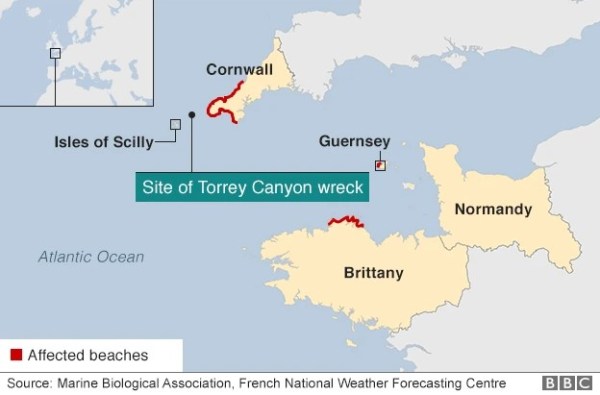
The sea in the distance was black, whilst where we stood, it was still the beautiful Celtic green-blue. We could all see that was to soon change. Over the month, it had become the source of a massive, 35-mile-long oil slick.
The Wreck Of The Torry Canyon
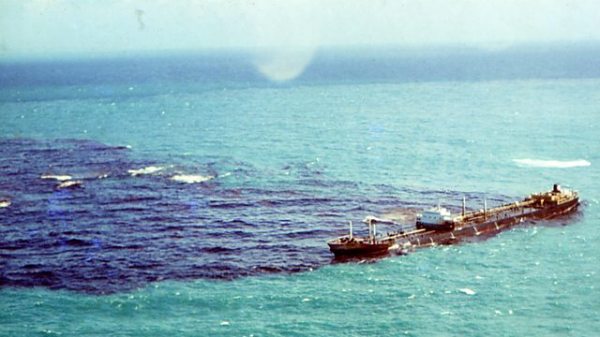
Everyone was quiet on the remaining drive. As Dad pulled away from the headland, the sharp, cloying scent of oil followed us. We all realised that this was going to be a huge cleanup operation to save the wildlife, the beautiful Cornish beaches, and the ocean. The cleanup had begun on the 20th of March. (See Notes Below)
That still, uncomfortable silence seemed to follow us. When we arrived, the air was clearer, but the atmosphere remained heavy. I was struck by the scale of things – everything felt smaller here. I was surprised to see how tiny Granny was. She just came up to my Dad’s armpit!
She was quite welcoming and ushered us in for tea and pasties. Waiting in the dining room was her eldest daughter, my Aunt Florence. This aunt, whom I had never seen since I was, according to my mother, about a year old, didn’t greet me with a hug or even a smile. She simply GLARED at me, all the time through the visit. It looked like she really did not like me. After an hour or two, I started to feel really uncomfortable.
Trying to start a conversation with her, I was met with only a yes or no. What had I done to deserve such behaviour, I wondered? Nobody else seemed to notice, or pretended not to. Eventually, we left. I never saw either one of my relatives again. My Granny died the following year, aged 86, four months after my wedding to John.
Once in the car, I whispered to John, ” Wow, I was so uncomfortable with Aunt Florrie, staring at me all the time, with such dislike’ My soon-to-be husband turned and said ‘I don’t think it was dislike. Maybe she was staring at her younger image; she was the absolute image of YOU. The facial resemblance was astonishing!”
I was speechless.
It’s quite a “Twilight Zone” and perhaps vanity moment to wonder all these years later, if the woman I thought was glaring at me with dislike was maybe staring in total shock because she was looking at a younger, taller version of herself? Or, maybe the contrast between the modern, liberated woman in a mini-skirt and the traditional, religious aunt in the tiny house?
The family in Cornwall were very religious, and perhaps me, in my fashionable mini, riding in a Mini, smoking, being in the WRAF, accompanied by my boyfriend, was just too much for her? I will never know. At 100 years old (when she passed in 2009), she certainly had the “longevity genes,” even if her social graces were a bit rusty that day!
A Grainy Video of Some of the Cleanup. https://youtu.be/IV-EhBesVjg
BBC Article, & Photos of the Cleanup https://www.bbc.com/news/uk-england-39223308
The Torry Canyon Oil spill was the UK’s worst environmental accident. It wasn’t just the sheer scale of the spill, but also the chaotic and often counterproductive “war” the government waged against the sea to clean it up. To be fair, the UK government had not had actual experience of a disaster of this scale.
The problem increased due to the methods used in the cleaning tasks. The first stage was to use too much ‘detergent’, which sounded harmless; in reality, it was harsh, highly toxic chemicals which affected the marine environment and its populations. The ‘Cure’ was worse than the disease. The British government was completely unprepared, treating the spill like a military invasion, using methods that are now considered environmental malpractice. (1)
Bombing The Wreck
Next, the Government tried Bombing the wreck. The RAF (Royal Air Force) and the Royal Navy dropped 161 bombs, rockets and thousands of gallons of napalm and kerosene on the ship to burn off the oil! It was a spectacular failure. The cold seawater extinguished the fires, and many bombs missed the target entirely! Both John and I felt a “professional” interest in the failed bombing mission.
Bulldozing The Beaches:
Poured onto the beach and into the sea, whilst it broke up the oil, it killed almost all marine life it touched – limpets, crabs and seaweed. Other methods, such as ploughing detergents into the sand with a bulldozer, buried the oil deep underground, where it remained for decades. After all this effort, some Cornish beaches turned a bright green due to the limpets, which eat algae, being killed, leading to massive, unchecked bright green blooms.
The Environmental And Social Impact
Beaches were left knee-deep in sludge, and an estimated 30, 000 to 75, 000 seabirds perished. Mostly guillemots, puffins, and razorbills. This ecological catastrophe, of images of oil-soaked birds and the black sludge on the pristine beaches, gave birth to the modern environmental movement in the UK.
The Legacy
This disaster led to a total overhaul of International Maritime Law. Before 1967, a ship’s liability was often limited to the value of the ship itself, which, in the case of the Torrey Canyon, was a single surviving lifeboat worth about £50. This led to the “1969 International Convention on Civil Liability for Oil Pollution Damage”, ensuring that ship owners (not just taxpayers) are held strictly liable for such disasters. (1)
 Genealogy Ensemble
Love this story Marian…beautiful weaving of personal and public. Dot
LikeLike