All posts by Marian Bulford

1945: A Year of Endings and Beginnings, at Home and Abroad.

As I approach my 80th birthday, I begin to think about the year I was born. What a year that was, a year of major global transitions and the historical year of my birth. I was fortunate to be born in November of that year, when most hostilities had ceased in the world and my home town.

However, the hardships in Britain and Europe were just beginning. Now, we had to think about rebuilding our shattered lands.

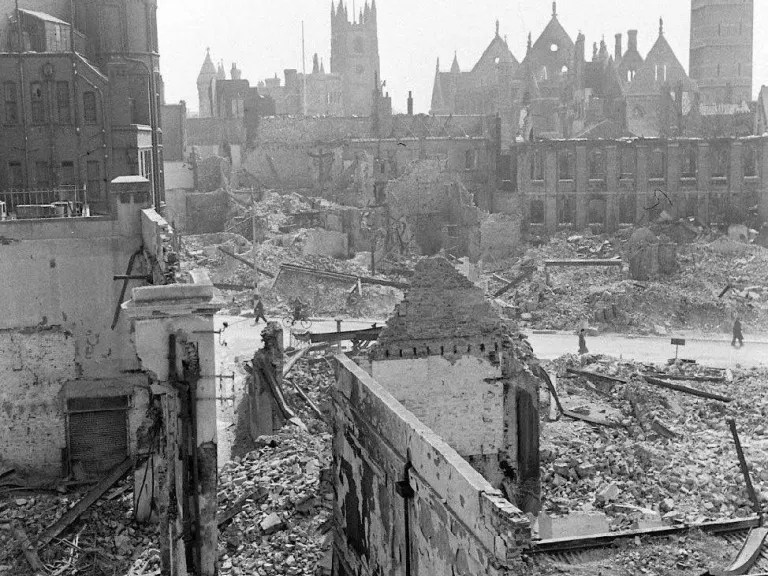
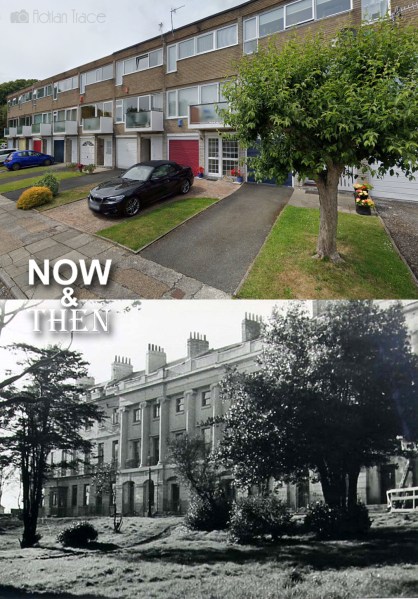
1945. Plymouth, Devon, England, after a Blitz Raid

I have an interest in the ‘Home Front’ events that occurred in Britain during the Second World War, rather than military stories. However, military stories cannot be ignored as 1945 was quite the momentous year in the military and home fronts. Here is a timeline of key events both at home and abroad that occurred in 1945.

January:

World War 2 is in its final phase, even though Germany is in retreat. The British military pressed onward in Germany and Burma. The Battle of the Bulge ended a major German offensive on the Western Front.

It was believed that Plymouth was being singled out for particularly ferocious attacks because it was home to Her Majesty’s Naval Base, Devonport, which was the largest Navy base in Western Europe and the Royal Navy’s repair and refuelling facility. The dockyard was staffed by women during the war, doing what was normally considered to be men’s work, as all the men were away fighting.

On the home front, Britain was impacted by V-2 rocket attacks.

Rationing, especially items like dried and canned fruit, was scarce. The Ministry of Food encouraged households to reduce waste and get creative with recipes. I still practice creating recipes and reducing waste to this day. This story is my 1950 Christmas with rations. Rationing in England lasted until I was 11.

https://genealogyensemble.com/2021/12/29/memories-of-a-1950-british-christmas/

February:

I was conceived!!

Allied bombers begin a major raid on the city of Dresden. Key events in February included the Yalta Conference between the Allied leaders, the beginning of the Battle of Iwo Jima and the final stages of the war in Europe.

The Soviets captured Budapest, Hungary, and also encircled Breslau, Germany (now the modern-day city of Wroclaw, Poland) as Allied forces pushed toward the Rhine in the west.

March:

The 10th British and Allied forces successfully crossed the Rhine, the first time a foreign army had crossed the Rhine since the Napoleonic era.

British forces pushed deeper into Germany with only scattered resistance.

On the 27th and 29th, the final V1 flying bomb fell on Britain.

Remarkable photo of a German V1 fully autonomous early cruise missile hitting the London area in 1945.

April:

1st The Battle of Okinawa continued for 82 days, resulting in heavy casualties for both American and Japanese forces. Japan launched ‘Kamikaze’ attacks against Allied naval forces.

Dr Fritz Klein, an SS doctor, among some of his victims, Belsen, 24 April 1945

Numerous Nazi concentration camps are liberated, revealing the full extent of the Holocaust to the world.

4th Ohrdruf concentration camp, liberated by U.S. Forces.

11th American troops discovered the Buchenwald concentration camp

15th Liberation of the Bergen-Belsen concentration camp, by the British, who found thousands of ill prisoners and corpses.

29th Dachau camp was liberated by U.S. Forces.

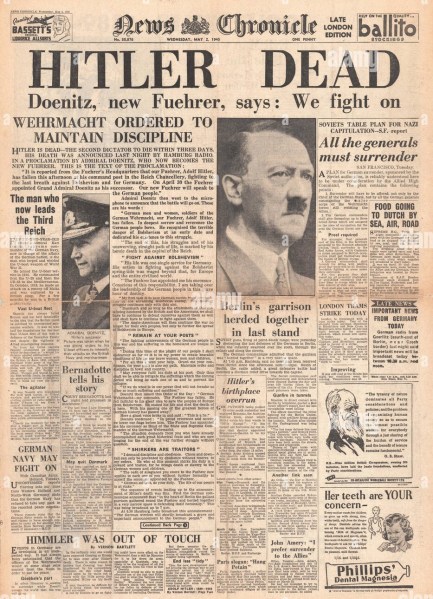
Also on the 29th, Adolf Hitler married Eva Braun in the underground bunker.

30th Adolf Hitler commits suicide, shooting himself at the age of 56 years old, whilst Eva Braun takes a poison pill.

German forces, the last fighting force on the Western Front, surrendered en masse.

May:

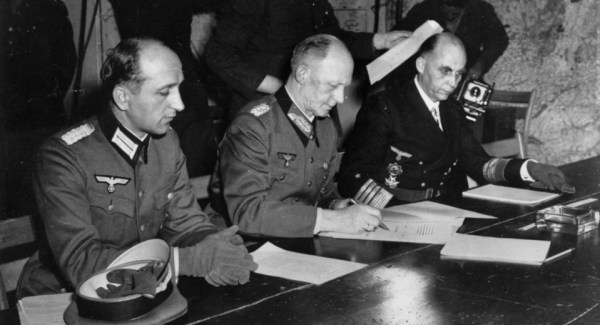
7th Germany signs an unconditional surrender,

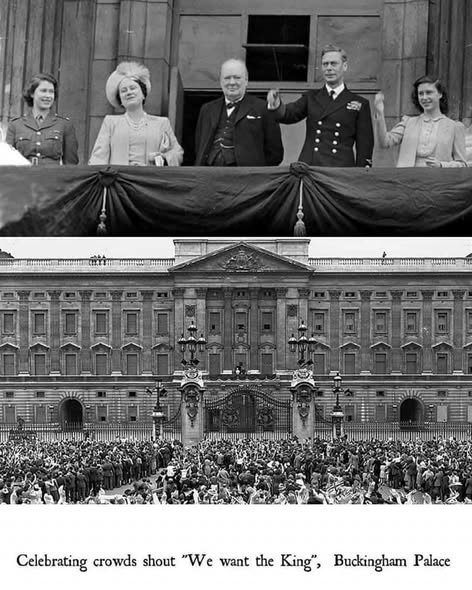
8th VE Day – victory in Europe – Day

On May 7, 1945, Gen. Alfred Jodl signed the surrender of all German forces in Rheims, France. He is flanked by Wilhelm Oxenius (left) of the Luftwaffe and Hans-Georg von Friedeburg, representing Germany’s navy. | AP Photo

23rd Heinrich Himmler commits suicide while in British custody in Lüneburg, Germany.

June:

15th Wartime blackouts ended, and streetlights were turned back on.

The wartime coalition government, led by Prime Minister Winston Churchill, was dissolved, and a general election was held shortly after.

July:

The general election was scheduled to take place on the 5th of July, 1945, the first general election since 1935. However, the results were not announced until the 26th of July, 1945, to allow time for overseas military personnel’s votes to be counted. The Labour Party, led by Clement Attlee, won a landslide victory in the July 1945 election.

August:

The Family Allowances Act was passed to provide financial support to mothers.

15th was Victory over Japan – VJ – day. Celebrating Japan’s surrender after the atomic bombings of Hiroshima and Nagasaki, and the official end to over six years of global warfare

2nd Japan formally surrenders. Now, our country was focused on the return of troops, the beginning of domestic reconstruction and the promises of independence for its colonies.

September:

15th Parades were held in Britain to mark the fifth anniversary of the Royal Air Force’s victory..

16th Hong Kong was reclaimed, ending the four-year Japanese occupation.

The 17th Belsen Trial began for war crimes in Lüneburg, Germany, presided over by a British military court.

18th The Independence of India would be granted “at the earliest possible date”, was announced by Prime Minister Clement Attlee on a worldwide broadcast.

October:

Britain was now fully engaged in the complex aftermath of the Second World War, with the new Labour government pursuing major domestic reforms and the British Army dealing with global instability and the return of war prisoners.

4th An unofficial dock strike began in Britain.

7th The ocean liner SS Corfu docked at Southampton, carrying the first 1,500 prisoners of war to return from Japanese camps in the Far East. Also on the 7th, Rudolf Hess was transferred from Britain to Nuremberg, Germany, to face trial.

The 20th and the 5th Pan-African Congress were held in Manchester, where delegates from across Africa and the diaspora discussed and called for independence from colonial rule, a significant moment in the history of decolonisation.

This month was a period of substantial change as the nation grappled with domestic reconstruction, a new political direction and the challenges of managing a post-war empire and a new global order.

At the end of October, in Palestine, the Jewish Resistance Movement launched the ‘Night of Trains’, a coordinated attack on the British railway network, marking a rise in armed opposition to British authority.

November:

On the 20th, I was born at the Alexandra Maternity Home, below.

At the time, there was no National Health Service (NHS), so no free medical care. I must have been an expensive baby!

The Alex, as it was often called, admitted maternity patients for a period of not less than a fortnight. Fees were charged from 15 shillings (75P) to 42 shillings (£2.20P) per week.. These fees included nursing, food, laundry and all clothing and if necessary, the doctor’s fees. I have no idea of my weight, size or time of birth. Such things were not, unfortunately, recorded.

December:

The government announced its plan for a National Health Service (NHS) to provide free medical care.

1st British military police in occupied Germany arrested 76 Nazi industrialists.

9th, the United States granted Britain a low-interest reconstruction loan of approximately $4.4 billion (US). An additional Canadian loan was for $1.9 billion, scheduled to run for 50 years.

The final payments made in 2006, which settled the debt entirely, were for $83.25 million to the US and $22.7 million to Canada.

Throughout the rest of the year, Allied forces continued to liberate numerous concentration camps, exposing the extent of Nazi atrocities.

In 1945, post-war, Plymouth faced immense devastation from the Blitz, which had destroyed the city’s heart and left thousands homeless. Plymouth was one of the most heavily bombed British cities, due to its status as a major naval port with the large HMNB Devonport dockyard.

The city centre, two main shopping areas, almost all civic buildings, 26 schools, 41 churches, and 3,754 houses were destroyed, with a further 18,000 properties seriously damaged. Around 30,000 people were left homeless, leading to a critical shortage of accommodation. Temporary prefabricated houses were quickly erected to provide immediate shelter. I remember seeing the ‘pre-fabs’ still in use in the 1960s.

The most urgent efforts were to house the population, clear the bombed buildings – which, still, years later, were my playgrounds – and begin an ambitious pre-planned reconstruction project. All the while I was growing up, this building and planning went on. When I left Plymouth at 18, the rebuilding continued until the early 1970s.

Sources:

https://en.wikipedia.org/wiki/Battle_of_the_Bulge

https://www.thedevonseoco.co.uk/plymouth-in-the-blitz/ https://encyclopedia.ushmm.org/content/en/article/liberation-of-nazi-camps

https://www.facebook.com/photo/?fbid=779249228206828&set=gm.1467370817653042&idorvanity=1074810956909032

https://collection.nam.ac.uk/detail.php?acc=1985-11-36-334

Facebook Page: ‘Old Plymouth Society’ Post by Gloria Dixon 7 July 2021

https://www.iwm.org.uk/collections/item/object/205021954

https://www.historic-newspapers.com/en-ca/blogs/timelines/a-year-in-history-1945-timeline?country=CA

A Cornish Homecoming… Our Bulford Reunion: A Family Forged Online

For the numerous years I have been doing genealogy, I have found many, many family names. I have met, but only when very young, paternal family members associated with my research. My parents divorced when I was seven, and after that, I never had any further contact with the paternal side of the family.

However,  13 years ago, I was contacted via ‘Friend Reunited’, a now-defunct website, by a second cousin on my Dad’s side. Samantha was my cousin Cheryl’s daughter, and she was searching for members of the Bulford family to include in her parents’ anniversary gift of genealogy. Through Sam, I was united with Cheryl, my first cousin, and from there, I met more first cousins I had never met before.

This was SO exciting! There was Diane, my Aunt Sylvia’s daughter, Cheryl, Aunt  Florence’s daughter, Joanna, Uncle Roy’s daughter and David and Jonathan, his sons.

All familiar names, but people I had never met or even thought I would ever meet. We all contacted each other via the internet in great excitement, and exchanged the information we had all collected, and they sent me photos I had never seen, of my Dad and his family.

After numerous emails, we decided to meet in the UK when I went over for my annual holiday. As this was the paternal side of my family, we met in Cornwall, where my father and my cousins’ mothers and fathers were all born. I met, once again after 68 years, my Uncle Roy, at his apartment, where he lived with his wife, Aunt Evelyn, 90,

Uncle Roy, at that time, was 94 and the last surviving member of the 11 children born to my father’s family. He died in 2022, when he was 106 years old.

Uncle Roy and Aunt Evelyn

Uncle Roy’s sons, David and Jonathan, were there with their sister Joanna, plus Diane and Cheryl, nieces of my Dad, and suddenly, just like that, I had met five cousins!

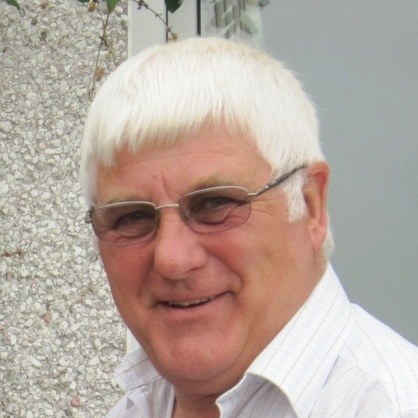
From the left: Marian, Cheryl, Joanna and Diane

My handsome Cuz Jonathan

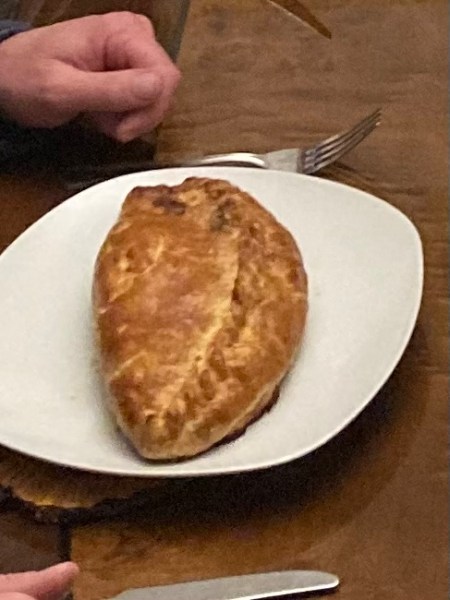
I had brought photos and they had some too, which we all pored over. I learned so much about the family in that short visit, to add to my family tree. First though, lunch and what better way to celebrate our ‘Cornishness’ than with a Cornish Pasty? Made by Joanna, it was delicious

A homemade local treat, the Cornish Pasty, made by Joanna

I showed David and Jonathan a treasured photo of me, aged three, which was taken by Dad on a beach in Newquay, one of the last visits to Dad’s family before the divorce.

I wondered aloud where it could have been taken.

Marian, aged three, Towan Beach, Newquay, Cornwall, England.

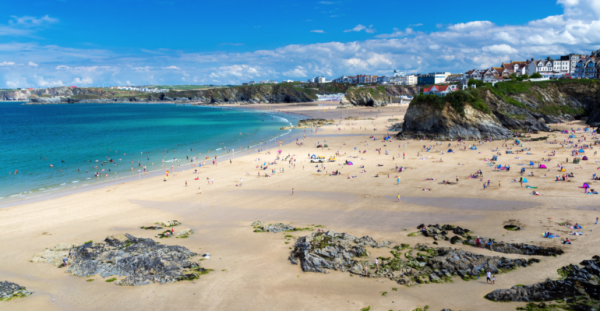
David took me by the hand to the balcony of Uncle Roy’s apartment and opened the door. He pointed to the beautiful beach in view, and said, ‘This is Towan Beach where your photo was taken,’ and there before me, as in my photo, was the beach and the houses on the cliff behind me, still prominent today. Then I did cry. (1)

My other handsome cuz David

Towan Beach today

The next day, we all had a family reunion Sunday lunch with wives and children, in the local pub. We reminisced, we took photos and promised to keep in touch, which we have done so every year for the last 13 years. Every year I visit the UK, we have our Bulford reunion, usually in the West Country at a local pub, and each year I find out more about my Dad’s family.

Photos, war records, marriages, deaths, and some researched information I had that my cousins did not know about were all shared via the internet.

PLUS a recently found USA Bulford branch too, which is the basis for this story.

(1) Source

Hôpital Sacré-Cœur: Architectural Gem in Montréal

Recently, for a minor medical reason, I was referred to Hôpital Sacré Coeur de Montréal, located in the Ahuntsic/Cartierville neighbourhood, North of Montréal. Instead of using the major highway, we decided to travel via Gouin Boulevard. Motoring along a pleasant country road, filled with all manner of houses, trees, flowers and bushes, it was a very enjoyable route.

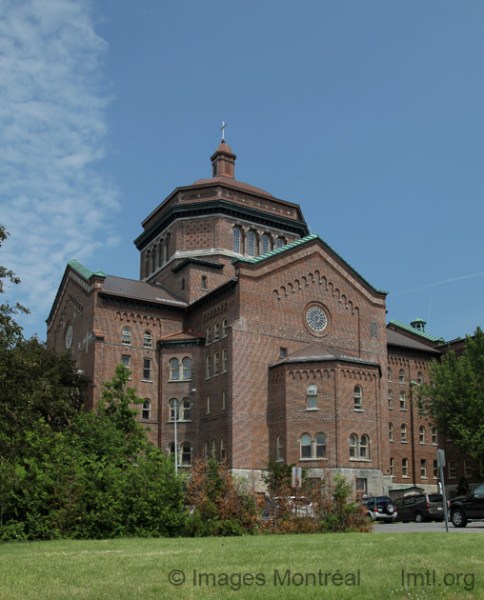
The reason I wanted to write about this hospital I had never seen before was because when we arrived and I saw the majestic gateway that led up to the main entrance, I thought at first the building may have once been a cathedral.

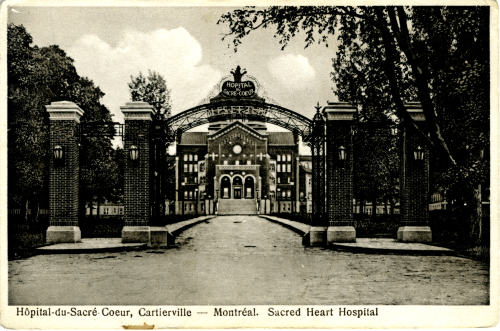
Although the photo below was taken C. 1940, it looks exactly the same today.

Publisher: Novelty Manufacturing and Art Co. Ltd., Montreal


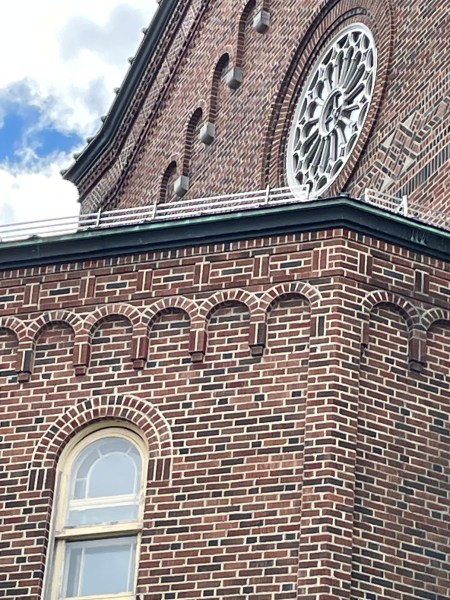
It intrigued me so much that I wanted to learn about the history of this striking building. As we approached the parking lot, I could see the huge cross on the top of the building. The original stonework, which was masterly, really stood out to me.

Picture Alexis Hamel

The original stonework would reflect the architectural styles popular in the late 19th and early 20th centuries, potentially incorporating elements of the Victorian or Beaux-Arts styles common for public buildings of that era.

Picture Marian Bulford

Excited to begin researching, I found a lot of interesting information. For instance, did you know that the institution was originally founded on June 1, 1898, the day of the Feast of the Sacred Heart, by a small group of women located in a building in downtown Montréal? (1)

They named it the Hôpital du Sacré-Cœur de Montréal, and the women cared for a dozen ill individuals, deemed the ‘incurables’. An unfortunate name, but cancer and patients with serious diseases were incurable then. By 1902, support care was provided by the Sisters of Providence.

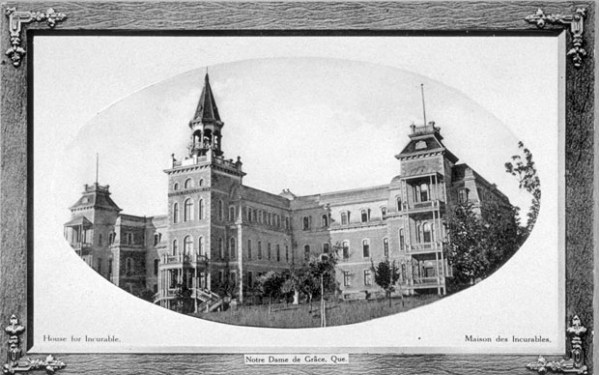
In 1900, the hospital moved to a larger building on Décarie Boulevard in Notre-Dame-de-Grâce (NDG). and was known as the Hôpital des Incurables.

Hôpital des Incurables.

This building was destroyed by fire in March 1923, and in 1926, a new building was built on Gouin Boulevard in Cartierville, where it still stands today. With the new building, the administration reverted to using the original name, Hôpital du Sacré-Cœur de Montréal.

Initially, it specialised in the treatment of tuberculosis. This was soon followed by the development of orthopaedic surgery (Dr. Édouard Samson, 1931) and thoracic surgery (Dr. Norman Bethune, 1933). In 1973, the Hospital became a tertiary care trauma centre for Western Quebec, together with the Institut Albert-Prévost, to provide psychiatric care and was affiliated with the University of Montreal as a research and teaching centre.(2)

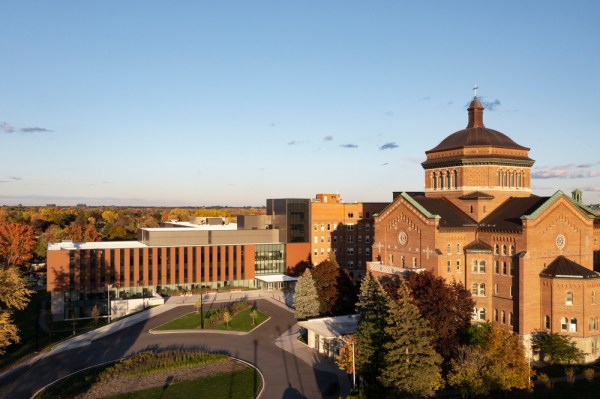
In 2022, an expansion by Provencher_Roy and Yelle Maillé was completed, adding 16,252 square meters, which complements this heritage structure.  (4)

Although a visit to a hospital is sometimes an anxious experience, the building and staff at Hôpital du Sacré-Cœur de Montréal were most helpful and attentive. Young volunteers are situated on each floor, ready to give directions to various parts of this now vast hospital.

Along Gouin Boulevard, we passed the affiliated Institut Albert-Prévost, set in a pleasant park-like area, before reaching the Hôpital du Sacré-Cœur de Montréal.

Entrance to the Institut Albert-Prévost

Before becoming a hospital, Albert-Prévost may have changed names from sanatorium to pavilion, but never its vocation: it has been treating mental health problems for over 100 years. This influence is due as much to the teaching it provides as to the care it gives.

Who was Albert Prévost?

Albert Prévost

He was a Quebec neurologist and forensic physician, born in 1881 and died in 1926. He was the first holder of the chair of neurology at the Université Laval in Montreal and the founder of the institute that bears his name. (5)

SOURCES

(1) (2) https://en.wikipedia.org/wiki/H%C3%B4pital_du_Sacr%C3%A9-C%C5%93ur_de_Montr%C3%A9al

(3 ) https://www.mcgill.ca/medicalmuseum/exhibits/postcard-collection/post-cards/sacre-coeur


(4) https://www.archdaily.com/995774/sacre-coeur-de-montreal-hospital-provencher-roy-plus-associes-architectes-plus-yelle-maille-et-associes-architectes


(5) https://fondationhscm.org/fhscm-1/hospital-albert-prevost

The BBC – British Broadcasting Company

While my youngest son’s 20-year career at the BBC’s flagship programme, the BBC World Service, is a source of personal pride, this story delves into the rich history of this iconic British institution. For me, as we observed the 80th anniversary of VE (Victory in Europe) Day, on the 8th of May, 2025, the story felt both poignant and emotional.

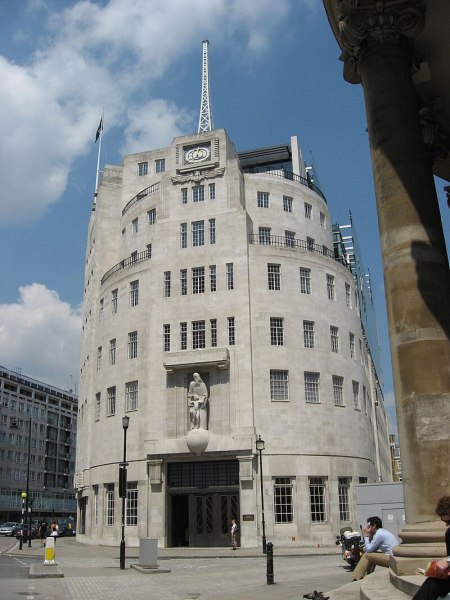
THE BBC’s BUSH HOUSE 1928 – 2012

Bush House was restored after being bombed twice during WWII

First known as the BBC Empire Service, the World Service was launched on the 19th of December 1932 as a shortwave service aimed at English speakers across the British Empire. The BBC World Service is the international broadcasting service owned and operated by the British Broadcasting Corporation. Its goal is to provide impartial and accurate news to global audiences through 42 language services.

When I was growing up in post-war England in the early 1950’s not many people had television, so the radio was my first contact with entertainment. The radio played in the background all day long. There were talks, songs, comic shows, classical music, and the hourly world news.

Saturday mornings, we had Uncle Mac, a show especially for children. Uncle Mac read stories, played songs, and greeted children when they got home from school. Uncle Mac was played by Derek Ivor Breashur McCulloch, OBE (1897 – 1967), who was born in my hometown, Plymouth, Devon. He was a radio producer and presenter and the head of children’s broadcasting for the BBC from 1933 until 1951. He became known as Uncle Mac on Children’s Hour and Children’s Favourites. (1)
The BBC, originally known as the British Broadcasting Company, first began broadcasting on the 18th of October, 1922. Its first broadcasts were made from London. Broadcasts began in November from Birmingham and Manchester, and in December from Newcastle upon Tyne. In Plymouth, the first broadcast was heard in March 1925.

The BBC began daily broadcasting in Marconi’s London studio, 2LO, in the Strand, on the 14th of November, 1922. The majority of the BBC’s existing radio stations formed the BBC National Programme and the BBC Regional Programmes. Throughout the 1920’s many firsts were added as the BBC began broadcasting from studios all over England and Scotland. (2)

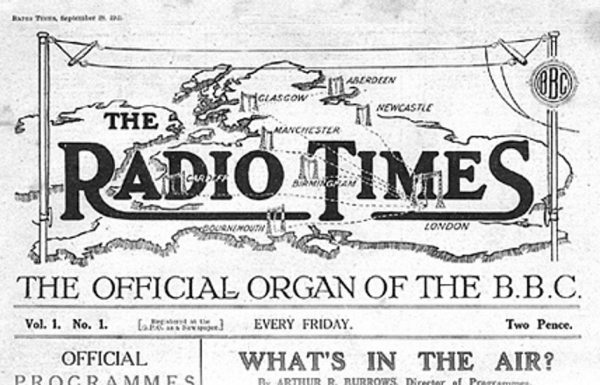
By September 1923, the first edition of ‘Radio Times’ was produced, listing the few programmes available. When I grew older, I found the Radio Times a great read, as it included not only programme times, but gossip about the actors. Below is an early addition of the BBC’s “official organ’

THE RADIO TIMES – THE OFFICIAL ORGAN OF THE BBC

A few notable programmes included the first Scottish Gaelic broadcast, heard on the 2nd of December, 1923, and the opening, by King George, of the British Empire Exhibition at Wembley Stadium, in April, 1924.

IN 1925, the six electronically generated ‘pips’ to indicate the Greenwich Time Signal (GTS) – now, GMT (Greenwich Mean Time) – were heard for the first time. These pips were invented by the Astronomer Sir Frank Watson Dyson (No relation to Sir James Dyson, inventor of the Dyson vacuum cleaners) and John Reith, the Director General of the BBC.

The majority of the BBC’s existing radio stations formed the BBC National Programmes and the BBC Regional Programmes. Through the 1920s, many ‘firsts’ were added as the BBC broadcast from studios all over England and Scotland.

In September 1939, the fledgling BBC Television Service was suspended, around 20 minutes after the conclusion of a Mickey Mouse cartoon, owing to the imminent outbreak of World War II. There were fears that the VHF transmissions from Alexander Palace would act as perfect guidance beams for enemy bombers attempting to locate central London.

For me, the most interesting part of BBC history was the war era, beginning on the 3rd of September, 1939, when Britain declared war on Hitler’s Germany. In the fight against fascism, broadcasting played a starring role as informant, morale-booster, entertainer and propaganda weapon. For the public, BBC radio provided a constant and reliable source of information about the war’s progress. The BBC also broadcast to occupied Europe, providing moral support to the resistance. (3)

On the radio, National and Regional Programmes were combined to form a single Home Service. Additionally, the service’s technicians and engineers were needed for such war efforts as the development of radar.

The wartime BBC was involved in a range of top-secret activities, working closely with the intelligence agencies and military and the BBC played an important part in WWII, frequently transmitting secret words, music and coded messages to the French underground.

For example, to indicate the start of D-Day, the operation was given the code name “Overlord” and the BBC’s Radio Londres signalled to the French Resistance with the opening lines of the 1866 Verlaine poem “Chanson d’Automne” The first three lines of the poem, “Les sanglots longs / des violons / de l’automne” (“The long sobs of autumn’s violins”), would mean that Operation Overlord was to start within two weeks. These lines were broadcast on 1 June 1944.

The next set of lines, “Blessent mon coeur / d’une langueur / monotone” (“wound my heart with a monotonous languor”), meant that it would start within 48 hours and that the resistance should begin sabotage operations, especially on the French railroad system; these lines were broadcast on 5 June at 23:15.

The coded messages can be heard below in this video.

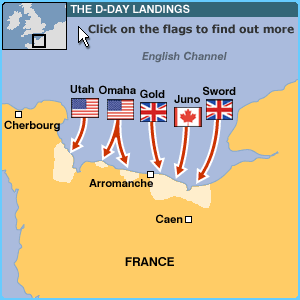
Operation Overlord, launched on June 6, 1944, D-Day, was the Allied invasion of Normandy, France. This large-scale amphibious operation aimed to liberate Western Europe from Nazi control. It involved massive land, air and sea assaults, with nearly 160,000 troops crossing the English Channel. The assault targeted five beaches in Normandy: Utah, Omaha, Gold, Juno, and Sword. It was the largest amphibious invasion in military history.

THE BEACHES OF NORMANDY, FRANCE

Today, I regularly listen to the BBC World Service, Radio 4 and Radio 4 Extra, which repeat programmes from the early 1950s to the 2000s, bringing back nostalgic memories of ‘home’.

SOURCES

(1) https://en.wikipedia.org/wiki/Derek_McCulloch

(2) https://www.bbc.com/historyofthebbc/timelines

(3) https://www.bbc.com/historyofthebbc/100-voices/ww2/secret-war(2

(4) https://orwellinstitute.com/orwell-bbc.html source for the Orwell photo

THE BBC TODAY

The BBC Home Service ended on September 30, 1967, when it was replaced by BBC Radio 4. The first broadcast on Radio 4 was “Farming Today”.

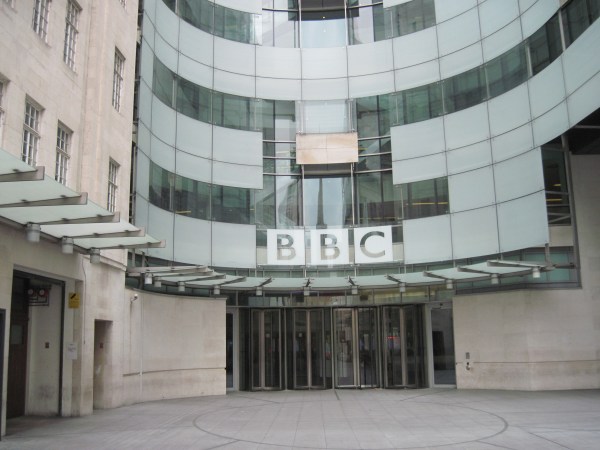
BBC HOUSE TODAY

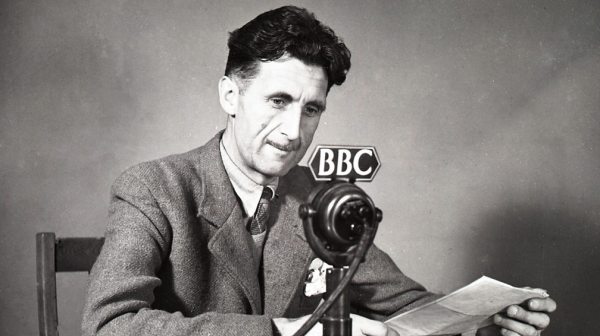
The famous writer of 1984 and Animal Farm worked in the Empire Service of the BBC from 1941 to 1943.

George Orwell at the BBC in 1943.

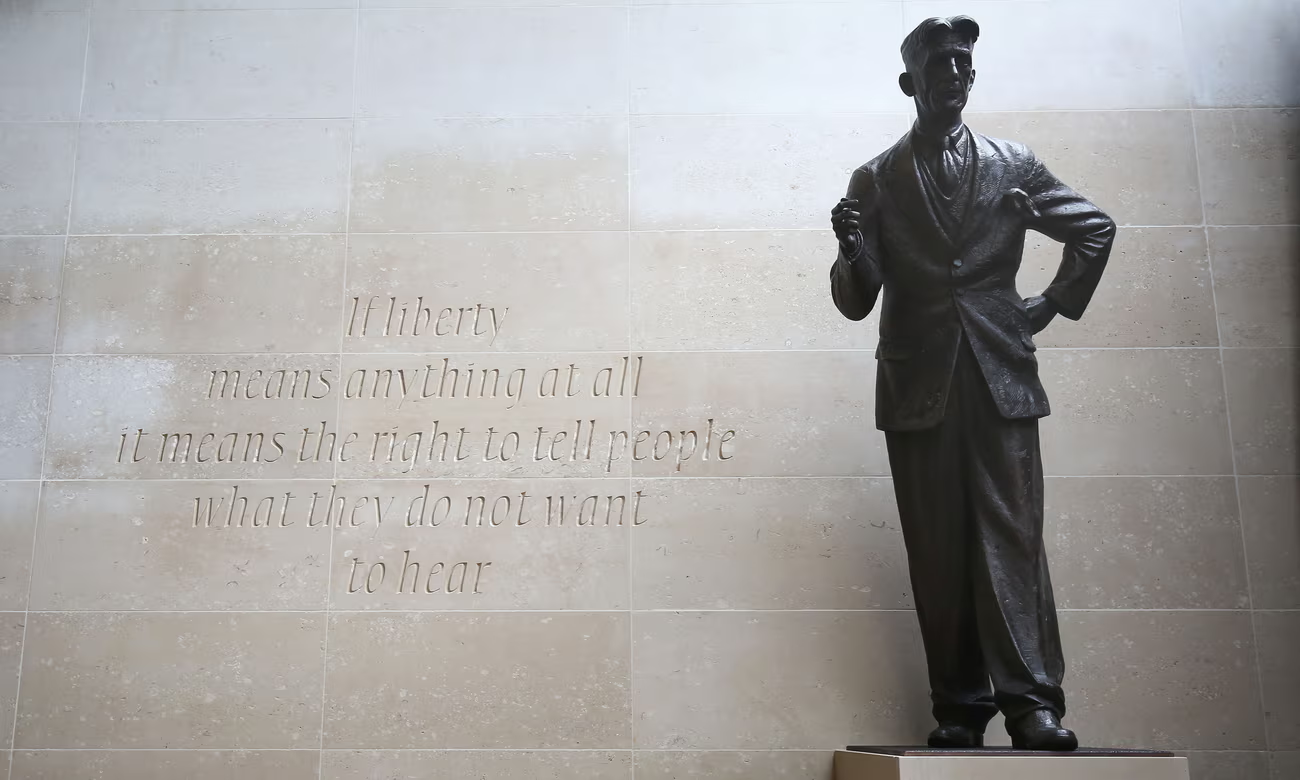
Outside the new BBC building in London stands a statue of George Orwell, and behind him these words:

“If liberty means anything at all, it means the right to tell people what they do not want to hear.”

The head of BBC history, Robert Seatter, said of Orwell and the statue that “He reputedly based his notorious Room 101 from Nineteen Eighty-Four on a room he had worked in whilst at the BBC, but here he will stand in the fresh air reminding people of the value of journalism in holding authority to account”. (4)

HISTORY OF MY SURNAME

Children the world over have been bullied at school and in their neighbourhoods. I was no exception. As a child in primary school, I remember kids calling me ‘Bullfrog’ which, of course, I hated!

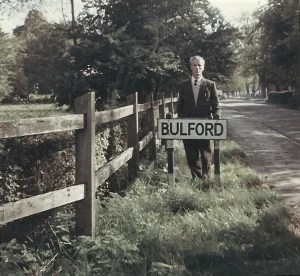
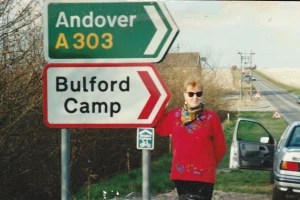
Many years later, I am researching and doing genealogy, trying to find out the origin of the name I hated as a child. I always knew there was a camp in Wiltshire, England called Bulford Camp. Family members have visited the area, especially to take photos of the area name, posing proudly next to the sign.

My Uncle Roy Bulford. Circa. 1960’s. Marian Bulford. Circa 1990’s

From a quiet country road to a major motorway

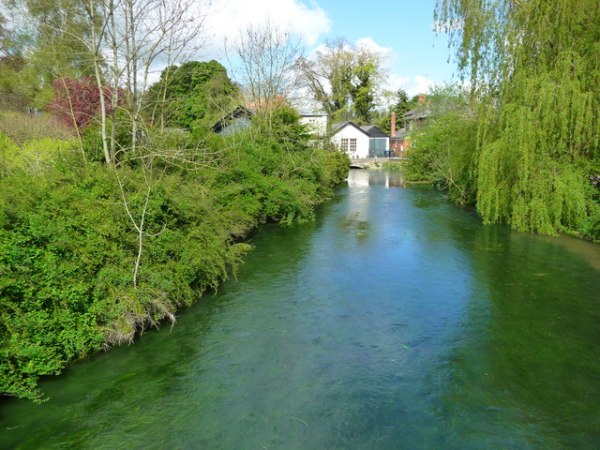
Less probably, the name may have come from a lost place called Bulford in Strensall (North Yorkshire), presumed to have been located at a ford of a river near Strensall. Yet another reason the name “Bulford” may have originated from is “Bull’s Ford”, a crossing point of the River Avon in Wiltshire, where bulls were driven across. (1)
 The River Avon Meanders Through Bulford

© Copyright Chris Talbot. Licensed for reuse under this Creative Commons License.

Bulford is a village and Parish in Wiltshire, England. It is near Salisbury Plain, close to RAF Upavon, where I was posted whilst in the WRAF (Women’s Royal Air Force). The Bulford Army camp is separate from the village but within the parish. It seems the Army camp is named after the ford that gave the village of Bulford its name. ‘Bulut ieg ford‘ is from an Old English phrase which means ‘ragged robin island ford” Why could we not have picked Robinford instead of Bulford?? (2)

Bulford is recorded in the Wiltshire Charter Rolls of 1199 as Bultiford and as Bultesforda in 1270. It is then recorded as Bulteforde in the Ecclesiastical Tax Records of 1291. (3)

The village of Bulford has a history of Roman and Saxon settlements. In the 1086 Domesday Book, there were 39 households at Bulford. However, there are not actually any Bulford family names, as seen below with a page taken from the Domesday Book. Only the religious and the titled were included!

Catalogue description Place name: Bulford, Wiltshire Folio: 68v Great Domesday Book: (4)

Reference:E 31/2/1/2046
Description:Place name: Bulford, Wiltshire
Reference:E 31/2/1/2046
Description:Place name: Bulford, Wiltshire Folio: 68v Great Domesday Book Domesday place name: Boltintone People mentioned within entire folio: Abbess of St Mary of Amesbury; Abbey of Sainte-Marie of Bec; Abbey of St Mary of Amesbury; Agenulf; Alweard; Alweard the priest; Beorhtric; Canons of Church of Lisieux; Church of Brixton Deverill; Eadgifu; Earl Harold; Hugh d’Avranches, Earl of Chester; Roger de Montgomery, Earl of Shrewsbury; Edward; Father of Agenulf; Gerald the priest of Wilton; Gilbert; Godwine; Abbey of Sainte-Marie of Grestain; Hamo; Hearding; Ketil; King Edward as lord; Nuns of Abbey of St Mary of Amesbury; Osbern the priest; Osmund, thegn; Queen Matilda; Regenbald the priest; Robert, Count of Mortain; Siward; Turold; William
Date:1086
Held by:The National Archives, Kew
Legal status:Public Record(s)
Closure status:Open Document, Open Description

Surnames in England were not used before the early Middle Ages, around the 11th to 12th centuries. Before that, people were known by a single name, usually according to their physical features, occupation, or their father (patronymic). To begin with, surnames were fluid and changed over time, or as a person changed his job. For example, John Blacksmith might become John Farrier as his trade developed. As the country’s population grew, it became necessary to distinguish between people.

Surnames in England began to be used during the early Middle Ages, around the 11th to 12th centuries. Before this, people were usually known by a single name. The earliest surnames were often derived from:

  1. Occupations – for example, “Smith” (blacksmith) or “Baker.”
  2. Geographical locations – such as “London” (someone from London) or “York” (someone from York). (I feel this is probably where my surname comes from.)
  3. Patronymics – surnames based on the father’s name, like “Johnson” (son of John).
  4. Physical features – such as “Brown” (for someone with brown hair or a darker complexion). (5)

Most of my paternal Bulford family live in and around Devon and Cornwall now; however, Ancestry.com tells me that from the 1700 Census and Voter lists, there were 127 Bulford surnames in America!

One of my paternal grandfather’s brothers, George, emigrated to work in the mines in Detroit, Michigan then ended his career working for the Ford Motor Company.

In 2016, I was in touch with his granddaughter, Barbara, my second cousin, on Ancestry. She invited me to her family tree, and we exchanged much information regarding her Bulford family. We had pleasant FaceTime and email exchanges, until her too-early passing in 2020 at the age of 66 years. I wrote about her here: https://genealogyensemble.com/2021/05/12/my-american-cousin/

SOURCES

(1) (2) (3) https://en.wikipedia.org/wiki/Bulford
(4) https://opendomesday.org/place/SE6360/strensall/

The link above is to the Open Domesday Book, which also states that “Hundred of Bulford. (The next largest division from a “hundred”, and the one most recognisable today, are Shires. Devonshire, Wiltshire, Lancashire, etc). Status: No longer exists as a named location but can be identified on the ground’ There were 85 places in the ‘hundred’ of Bulford in the Domesday Book”

(5) https://www.historic-uk.com/CultureUK/Surnames/

Part Two of Remembering Great-Grand Uncle Arthur Symons – The Price of Survival

This is part two of my Great-Grand Uncle Arthur Symons’s experiences in WWI. Arthur emigrated to Canada in 1901, arriving in Halifax, Nova Scotia, on the SS Soman. (1)
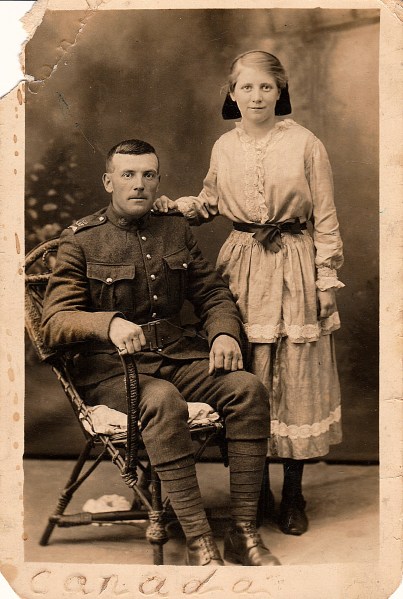
When WWI broke out, Uncle Arthur enlisted in the 56th Battalion Canadian Over-Seas Expeditionary Force in 1915 in Calgary. He was then shipped back home to the UK to train. While there, he visited his sister Lilian and her daughter Edith, my Grandmother.

Arthur Symons with Edith Bevan his niece, my Granny.

Granny was 15 years old.

At Salisbury, Wiltshire, England, the Canadians trained for four months, most of it in terrible mud, as England experienced one of its wettest winters in decades. While most troops stood up well to the awful conditions, Canadian equipment did not. Much of it was soon discarded in favour of British types. The Canadians learned basic soldiering in England after a hasty mobilization and a difficult, uncomfortable winter. Their real training would come at the front.

After training, Arthur was sent to France and later Belgium. At the Third Battle of Ypres, better known as Passchendaele, the troops fought there from July to November 1917. Both sides suffered appalling conditions and heavy casualties. “The name Passchendaele has become synonymous with mud, blood and futility”. Arthur was wounded in 1917 at Passchendaele. (2)

The Government of Canada Library and Archives search had Arthur’s Attestation Papers and detailed medical treatments at “No. 4 General Hospital Dannes Camiers” (2) among many other hospital visits.

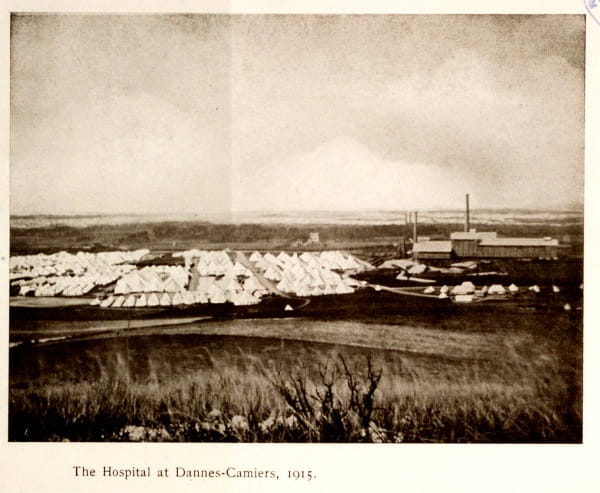
Searching for Dannes Camiers Hospital, led me to the Royal College of Surgeons of England and the following information. (2)

Shortly after the war broke out, McGill University organised the ‘No. 3 Canadian General Hospital’ to serve in France. The hospital was established at Dannes Camiers in the Pas-de-Calais area on 19th June 1915 under canvas. A staff of 35 Officers, 73 Nursing Sisters and 190 rank and file. Life under canvas that cold wet November was tough, with deep mud, storms, frost and collapsing tents. The conditions so undermined the health of one Lieutenant Colonel Yates that he was invalided to England where he died the following year.

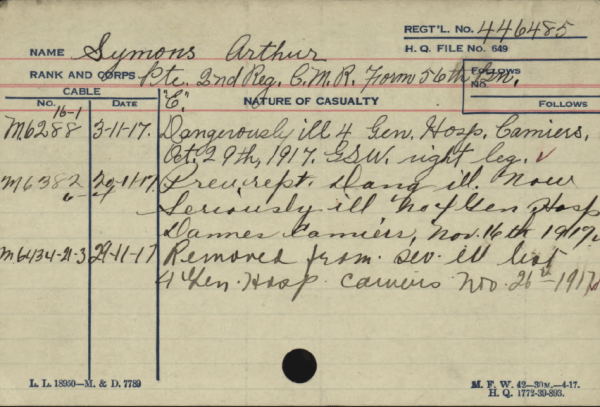
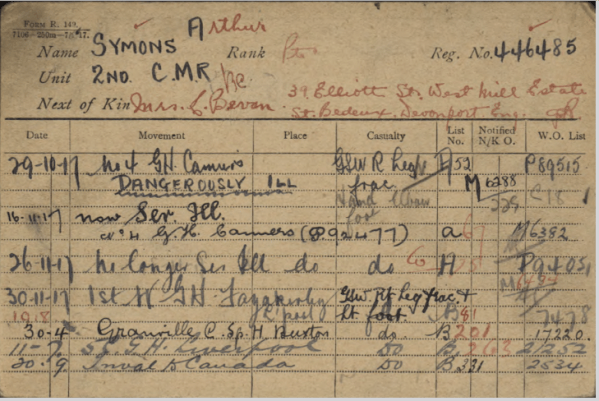
Arthur’s admission to the Dannes Camiers Hospital was on the 29th of October 1917. The first line of his medical records states he is ‘Dangerously ill’ with GSW (gunshot wounds) R. Leg fracture and left foot.

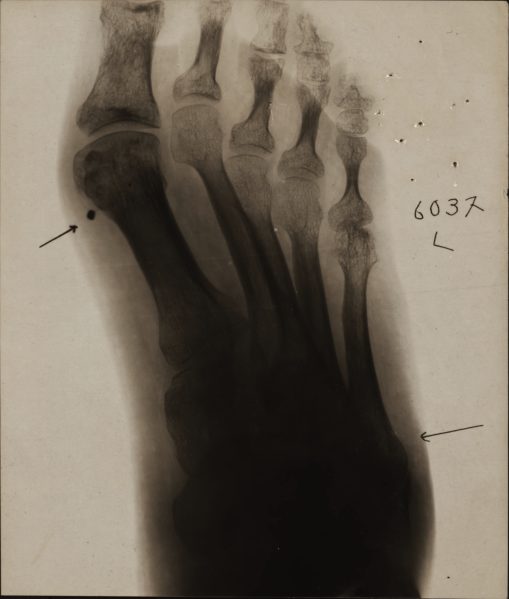
By the 16th of November, Arthur is now ‘seriously ill’ There follows 99 pages – starting with his Attestation Paper – then very detailed treatments and x-rays from various hospitals in France, England and Alberta, Canada. It makes for fascinating reading.

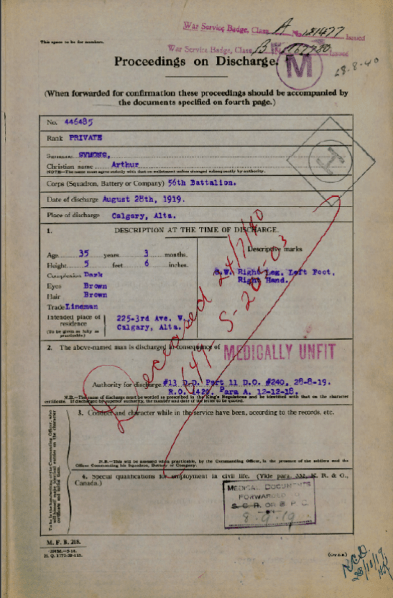
Three pages from Arthur’s 99 pages of hospital notes and X-rays.

On the 30 of November 1917, Arthur was transferred to the 1st West General Hospital Fazakerly, Liverpool England. After 5 months of treatment, Arthur was again moved to the Canadian Special Hospital Buxton, Derbyshire, England.

NOTE: Amongst the patients at Buxton, was Frederick G Banting, who would return to Canada after the war to continue research into diabetes and the use of insulin in its treatment, for which he was awarded the Nobel prize. (3)

His last transfer was on July 11, 1918, to the 5th Canadian General Kirkdale, Liverpool, England.

Eventually, on the 20th of September, 1918, Arthur was Invalided to Canada. He was sent to the Ogden military convalescent hospital in Calgary, Alberta. A short visit to the Calgary General Hospital, then back to Ogden.

Finally, after nearly 2 years at 5 different hospitals, Arthur was sent to the Banff Rest Camp, and discharged on August 28, 1919, medically unfit for further service. He was 35 years old.

Arthur went on to marry and have two children and was employed in the Civil Service

This rather poignant note dashed across his discharge papers state ‘Deceased 24/7/40’

Excerpt from The Calgary Herald, July 26, 1940, page 2
Arthur Symons, 54, of 2409 Centre Street South, died in hospital here Wednesday afternoon. Born in Leicester, England, he came to Calgary 32 years ago and was employed in the civil service for 17 years. He is survived by his wife, Catherine, one son, Arthur, and one daughter, Dorothy.
Alberta Death Reg. #1940-08-201498

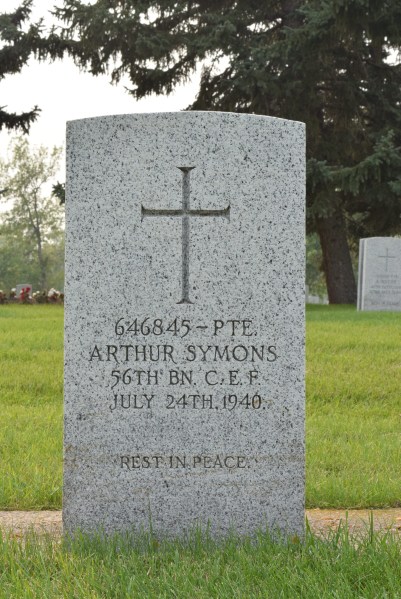
Great-Grand Uncle Arthur Symons is buried in Burnsland Cemetary, Calgary Alberta, Canada. (Photo credit Ron Reine)

RIP Uncle Arthur.

Part 1 of Great-Grand-Uncle Arthur’s experiences in WW1:

(1) https://genealogyensemble.com/2024/11/11/remembering-great-grand-uncle/
(2) https://www.rcseng.ac.uk/library-and-publications/library/blog/we-will-remember-them-no-3-canadian-general-hospital/
(3) https://buxtonmuseumandartgallery.wordpress.com/2019/12/13/canadian-red-cross-special-hospital-buxton-1915-1919/

(4) Dr. Frederick Banting

REMEMBERING GREAT-GRAND-UNCLE

Arthur Symons, Private, 56th Battalion, Canadian Over-Seas Expeditionary Forces.

I once had a great-granduncle, Arthur. Until I started doing Genealogy, I had no idea there was such a title, but there it is, and I had one.

Of course, I never met him, but, as it is Remembrance Day I wanted him to be remembered.

My Granny’s mother, Lilian, had a family of five siblings, and Arthur was her younger brother. He was four years younger than her. Granny told me that Arthur immigrated to Canada in the early 1900s.

Despite many searches. I could find no information on his immigration. However, months after I started my research, I came across a border crossing Manifest from Canada to Sweetgrass, Montana.

It had all the information I had been searching for!

At this point, I was not sure he was even married, but the info on the border crossing gave me missing details and Arthur was beginning to become a real person.

The Manifest stated Arthur was 50 years old, accompanied by his wife, Catherine, son Alexander, and daughter Dorothy. It was dated the 18th of July, 1936. The family were visiting Yellowstone Park and Glacier Park. it gave Arthur’s address in Calgary, Alberta and his occupation as a Postal Porter. (1) It stated that he arrived in Canada at Halifax, Nova Scotia on the 19th of March, 1901 on the SS. Soman.

I haven’t yet found the passenger list for the SS Soman, but I keep looking.

When WWI broke out, he enlisted in the 56th Battalion Canadian Over-Seas Expeditionary Forces on May 3, 1915, in Calgary, Alberta. He was shipped back to the UK for training. While ‘back home’, he visited his sister Lilian – my great-grandmother – and had these photos taken with his sister and my Granny, Edith Bevan O’Bray.

Arthur Symons with his sister Lilian Symons Bevan. C. 1914-18

Arthur Symons with my Granny, Edith Bevan C. 1914-18.

Arthur Symons was born in Leicester, Leicestershire, England, in 1886. His siblings were Lilian Mary Symons—my great-grandmother; Thomas, who died in infancy; Arthur, Olive, and Ada, who was my Gran’s favourite Aunt, and only two years older than her.

Aunt Ada was also my Godmother. Together, they joined the WRNS (Women’s Royal Naval Service) in 1918 (2)

Great-grand-uncle Arthur fought at the Battle of Passchendaele and was severely wounded in the right leg, right hand and left foot. He was transferred to the Granville Special Hospital, located in Ramsgate, Kent, England. An orthopaedic facility to treat soldiers with damaged limbs. Later because of air raids on the Kent coast, the hospital was moved to Buxton. He was medically discharged on 28th August 1919.

In part Two, I will explore his stay in the Granville Special Hospital for Canadian troops. The first line of his medical records, dated November 29, 1917, stated he was “Dangerously ill.”

(1) Canadian Postal Porter – Porter – Worker having manual handling duties, typically at a large sorting office or railway station in London. Tasks included the loading, unloading, segregation and transfer of mailbags or other containers. Porters were also employed at some other locations, such as the PO Savings Bank.

(2) Granny and her Aunt in the Women’s Royal Naval Service.

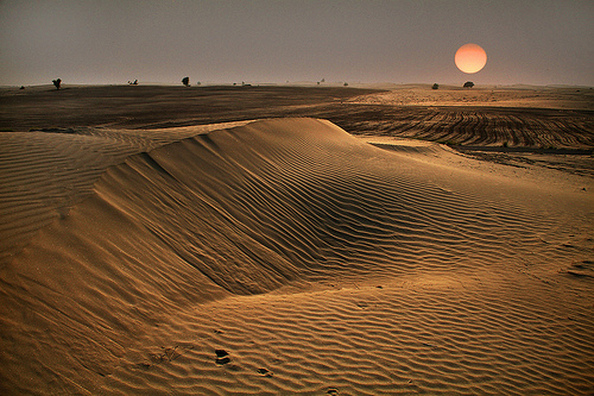
Troop Train Across The Sind Desert 1916

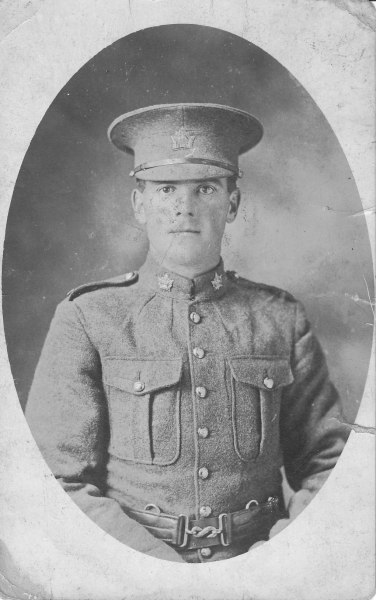
In 1916, William sailed for India. He was to take up garrison duties in Multan, India (now Pakistan) to release regular troops to fight in the War.

William Clegg lived in Liverpool during the early 1900s. He was married to Louisa and together they had eight children; one child was stillborn, one child died at age two and another at six years of age, leaving five living children.

At that time and for many years afterwards, life in Liverpool was hard. Living conditions were crowded, poor and unhealthy. There was not much work, and only a few could hope for a fulfilling life. William earned his living as a paint grinder a dirty, noisy and unhealthy job.

In April 1914, one of the children named Evelyn aged six died. This must have been a very hard year for the family. When WW1 was declared on August 1, 1914, William joined the Territorial Army. He probably wanted to get away from the death and poor living conditions and maybe hope to get a better level of pay to support his family. He was 32 years of age, and he left Louisa eight months pregnant!

The Territorial Army is an army of volunteers which supports the British Army. Volunteer units have existed for centuries, but in 1908 they were merged to form the Territorial Force. Members of the Territorial Force were mobilised in the First World War and served alongside the regular army. [1]

One of the units was The Fifth Battalion King’s (Liverpool) Regiment, which had its HQ at 65 St Anne Street Liverpool.

William was supposed to be part of the Home Guard and serve in England but at some point, he agreed to transfer to the Rifle Brigade. He was immediately sent to the Curragh in Ireland, and then to Douglas on the Isle of Man for training.

By 1916, he and other troops were on their way to India as part of the “The Indian Trooping Season.”

Normally, troop ships left England in September and returned on another ship, with the last ships leaving India in March. This pattern was probably established once troop ships no longer sailed around the Cape of Good Hope and started using the “Overland Route’ and then the Suez Canal after its opening in 1869.[2]

Travel was restricted to the cooler months so that acclimatised troops from Britain were not travelling from the ports of Bombay or Karachi to their cantonments during the heat of an Indian summer.

William travelled on the troop ship “Ballarat,” which was mistakenly diverted to Karachi by senior officers.

It was against regulations to cross the Sind Desert from Karachi to Multan because of abnormally hot temperatures, but William and the other troops with him did so anyway.  They were exposed to terrible conditions. More than 200 men suffered from heat stroke and 20 of them died.

During an inquiry, three senior officers were blamed for not looking after the men. Questions were raised in India and England.

The governments of India sent the following telegram to the British House of Commons:

We can now give a considered opinion, having received a report of the committee. The responsibility for diverting the ship from Bombay to Karachi rests with Brigadier-General Roe who was acting as Quartermaster-General at the time. He knew acclimatised troops had never before been sent in large numbers by rail in the middle of Summer through the Sind Desert. He knew, or should have known that the Commander-in-Chief in December 1915, had decided that Karachi should not be used as a port at which wounded and sick British troops should be landed and distributed to other stations, on account of danger of sending in the hot season through Sind.

It follows, that before (the ship) Ballarat was diverted to Karachi, the Acting Quarter-Master-General should have consulted the Commander-in-Chief but did not do this. Having taken on himself the responsibility, he should certainly have warned Karachi military authorities to take special precautions for the safety of troops during the journey by rail. He did not do this.

We, therefore, must hold him responsible, and propose to remove him from his appointment as Deputy Quarter-master-general. It is clear from evidence, that the mischief began before disembarkation, many men having been seen on deck bareheaded in the sun, a thing no officer with Indian experience would have allowed. All the officers on board were quite inexperienced, and we cannot hold them blameworthy.” [3]

The lengthy telegram went on to add that the troop train left Karachi with 13 officers and 1013 men and was insufficiently equipped, overcrowded and without experienced officers.

The three British officers named in the inquiry were “cashiered,” which means they were dismissed from their positions for a breach of discipline.

William Clegg and 19 others died in the Multan Military Hospital, which is now in Pakistan. He left behind his wife and 5 children.

He was originally buried in Multan but the Commonwealth War Graves Commission has found it impossible to maintain War Graves in Pakistan so his name also appears on the large British War Graves Cenotaph in Karachi.

William was the grandfather of my husband John Clegg.

[1] http://www.nationalarchives.gov.uk/records/research-guides/army-auxiliary-1769-1945

[2] https://wiki.fibis.org/index.php/Trooping_season

[3] http://papersPast.natlib.govt.nz/dominion

Devon, Alberta, Devon, England.

My eldest Grandson is called Devon. His full name is Devon John Charles. Named after both his grandfathers. His parents initially, wanted to name him Even. However, there is already a cousin in our family of that name. His mum suggested Devon which suited both parents.

When Devon’s family moved to Alberta, we were surprised to learn he and his family were moving to Devon, Alberta! I was keen to learn the history of Devon, Alberta and here is what I found.

Devon, Alberta Canada

One of the largest oil discoveries in the world was discovered on February 13th 1947 (I would have been two years old). Leduc No 1 well struck oil and the new town of Devon was constructed by Imperial Oil to accommodate its workers.

Leduc Oil No. 1. Devon, Alberta Canada

The company wanted a well-planned town so Devon holds the distinction of being the first Canadian community to be approved by a regional planning commission.

The town was planned according to modern town-planning principles by the Edmonton District Planning Commission and CMHC. It was labelled “Canada’s Model Town” since it was the first municipality in Canada to be approved by a regional planning commission. The town grew extremely quickly, but because of planning controls, its development was orderly”. (1)

Devon was named after the Devonian formation seen in the strata tapped in the Leduc No. 1 oil well, which in turn is named for the county of Devon in England. Its economy is still based on the oil and gas industry; however, the addition of the Devon Coal Research Centre is helping to diversify the economy (2)

I was born in Plymouth, Devon but its history goes back millennia. Situated in South West England and bordering Cornwall, there is evidence of occupation from the Stone Age onwards. Recorded history begins in the Roman period when it was a ‘Civitas(3) meaning a social body of citizens united by law. (3) It was then a separate kingdom for centuries until it was incorporated into early England. A largely agriculture-based region, tourism is now vital.

Ancient Extent of Devon, England

The name “Devon” derives from a tribe of Celtic people who inhabited the South-West peninsula of Britain at the time of the Roman invasion.

The last time I visited Plymouth, Devon I was tickled to be able to send my grandson a letter addressed to Devon, in Devon Alberta, from Devon, England. The lady in the Post Office even pointed out how amusing that was.

(1) (2) https://www.thecanadianencyclopedia.ca/en/article/devon

(3) https://en.wikipedia.org/wiki/Civitas

Update to Heartfelt Losses

https://genealogyensemble.com/2024/03/28/heartfelt-losses/

For my last story, (link above), three children of my great grand uncle died within days of each other. I had tried to find which, if any, diseases were present in that year and area, but I could find none. Of course, diseases were present at all times in the 1800s with no vaccinations or protection available.

The only way to find out the cause of the girl’s deaths was to obtain their Death Certificates which did not arrive in time to add to my last story. Now, I have received the girls’ Death Certificates from The General Register Office (GRO) of England and Wales and I know that the three girls died of scarlet fever.

The first daughter to die was their eldest, Isabella O’Bray aged 13 years It states she died at the Infectious Hospital Gillingham, Kent on the 6th of March, 1890. The cause of death was written as:

“Malignant Scarlatina’ (or Scarlet Fever).

The term ‘Malignant Scarlatina’ is not used today, although I did find an article from 1846 in the New England Journal of Medicine which used the term ‘malignant’ (1)

Margaret was 11 years old and also died of Malignant Scarlatina at the Infectious Hospital, Gillingham, Kent.

Minnie, aged three, their youngest child, died of Scarlet Fever exhaustion, at home.

I noticed that the deaths were registered by the children’s Uncle who lived nearby. We can only imagine the shock the parents were suffering and registering not one but three deaths of their beloved girls must have been a task they were just not up to.

Images of Measles and Scarlet Fever

In 1946 (a year after I was born), penicillin became available for the first time in the UK for public use, it transformed medicine worldwide and ushered in the age of antibiotics.

I had Scarlet Fever as a child, however, I was fortunate as antibiotics were available to me. It is a bacterial illness that develops in some people who have had strep throat. Also known as scarlatina, the disease features a bright red rash that covers most of the body., which includes a sore throat and a high fever. It is most common in children 5 to 15 years of age.

Although it was once considered a serious childhood illness, antibiotic treatments have made it less threatening. Still, if left untreated, it can result in more serious conditions that affect the heart, kidneys and other parts of the body.

On 15 March 1945, Penicillin was made available over the counter in US pharmacies, although it would not be available to British civilians – as a prescription drug – until the 1st of June, 1946, a year after Howard Florey and Ernst Chain received a Nobel prize for their work.

These two doctors began work on penicillin in 1938 at Oxford University, England. Details of their work are here:

University of Oxfordhttps://www.ox.ac.uk › news › science-blog › 75-years-..

SOURCE

(1) https://www.nejm.org/doi/pdf/10.1056/NEJM184603040340501