Category Archives: Canadian Province

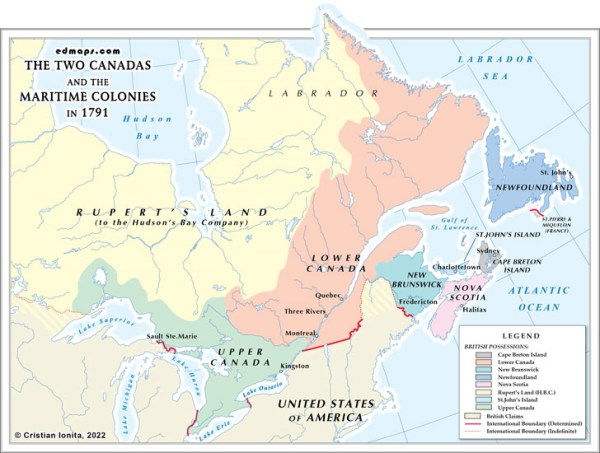
Old Land Roll in Lower Canada

The database below entitled Old Land Roll in Lower Canada as noted in the BAnQ’s Directory of Townships https://numerique.banq.qc.ca/patrimoine/details/52327/3035112?docref=ydD2bC568QoqleH8sQN1XA was prepared in May of 1966.

Almost 60 years later, Wikipedia in March of 2023 updated a Directory of Townships with basically the same information, plus details relating to today’s current locations and regions.https://en.wikipedia.org/wiki/List_of_townships_in_Quebec

List of townships in Quebec

From Wikipedia, the free encyclopedia

This article lists the townships of Quebec in Canada. The townships (Frenchcanton) no longer represent administrative divisions recognized by the Ministry of Municipal Affairs and Housing (Quebec) (MAMH). Only municipal townships, formed from one or more townships, such as township municipalities and united township municipalities, are recognized.[1] Many geographic townships are still conterminous with municipalities.

Click on the link below to open.

The Great Volunteer Soldier Recruitment of 1653

Next month marks 370 years since my six times great grandfather and his brother volunteered to join a militia to protect the city of Montreal. Their voyage from France to our city would last five months and require two departures. They faced captivity, an epidemic and enough starvation and illness to cause the death of eight of their colleagues, but they survived.

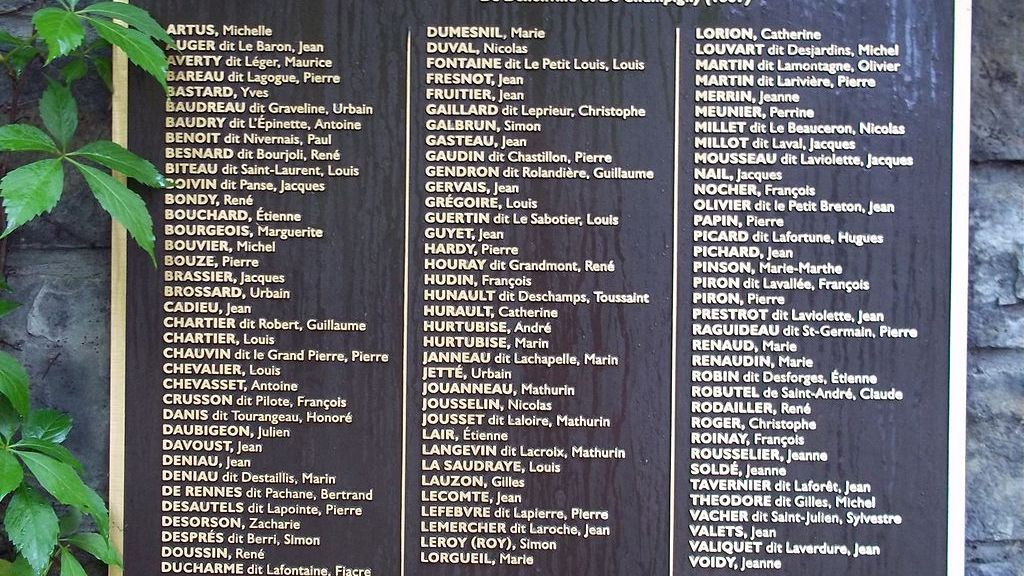
Marin Hurtubise and his brother André were among 154 men recruited by New France Governor Paul Chomedey de Maisonneuve to help protect the Fort Ville-Marie from Iroquois attacks. They signed five-year contracts with the Société de Notre Dame de Montréal to clear uncultivated land in New France for farming at a price of 100 livres per year1. Their employer, also known as the “Company of Montreal,” was originally founded in France in 1639 to establish a colony in Canada.

According to notes left behind by my grandmother, the Hurtubise brothers came from a town known as Sillé-le-Guillaume in Rouesse-Vasse, southwest of Paris in the Sarthe Departement in the Pays de la Loire region.

They travelled to St. Nazaire to join 120 other men and 14 women who set sail for New France on June 20, 1653. Among their ship mates was Marguerite Bourgeoys, a women with a desire to create schools in New France. She also founded the Notre Dame parish and set up housing for the filles du roi. In 1982, Pope Pius XII canonized her as Canada’s first female saint.

The trip in Captain Pierre le Besson’s ‘Saint-Nicolas-de-Nantes’ vessel2 did not go well.

Ships in that era were not the large luxury vessels we cruise on today. According to an unauthored essay that used to appear on the Maison Saint Gabriel website, they measured roughly 25-45 meters long and 8 meters wide. Passengers bunked in a single room at the back of the ship in unsanitary conditions in which everyone slept in their clothes. Buckets collected waste and vomit from those who couldn’t handle seasickness. Meals often consisted of dry biscuits, salt pork and fish.

In this case, the ship also leaked. The ‘Saint-Nicolas-de-Nantes’ took on so much water that after sailing 350 leagues (1600km), the crew had to return to Nantes. Passengers were left on an island off the coast of France to wait for another month until a replacement ship could be found. According to Marguerite Bourgeoys’ diary, some of the recruits deserted their posts and swam back to France.

“Sieur de Maisonneuve and all of his soldiers stopped on an island from which there was no escape. Otherwise, not a single one would have stayed. Some even set about swimming to save themselves since they were furious and believed they had been taken to perdition.”3

On July 20th, after a St. Marguerite’s day mass, the replacement ship set sail for the New World with the Hurtubise brothers and Marguerite Bourgeoys on board. This voyage, which featured many storms, an outbreak of the plague and eight deaths (Jacques Audru, Olivier Beaudoin, René Cadet, Jean Chaudronnier, Louis Doguet, Michel Lecomte, Joachim Lepallier and Pierre Moulières), doesn’t sound any better than the first, save for the sea-worthy vessel.

After 64 days, the ship landed at Cap-Diamant, on September 22, 1653. At that point, it seems that the ship was set on fire in the middle of the river. Bourgeoys’ writings imply that it got stuck so that high tide couldn’t even free it.

For the next two months, New France Governor Jean de Lauzon tried to keep the voluntary soldiers and marriageable women in Quebec to defend that city, in part by refusing to provide the barges needed to sail the Saint Lawrence River to Ville-Marie.

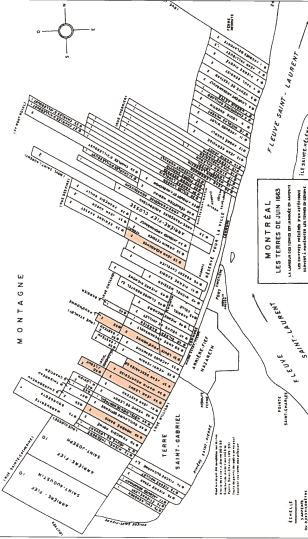
Eventually, de Maisonneuve prevailed. The group arrived at Ville-Marie on November 16th.4 They were all given land grants next to the Saint Laurence River. Later, Marin and five neighbours settled in Côte St. Antoine.5

André Hurtubise died six years after the brothers arrived in Montreal. Marin lasted 19 years, successfully marrying and having six children during that time. He died in Montreal on May 12, 1672.6

Sources

1Aubry, Louis, Famille Hurtubise Gendron, https://www.mes-racines.ca/fichiers/Lign%E9es/H/Hurtubise-Gendron/Hurtubise-Gendron.pdf, accessed May 2, 2023.

2“Ancestors on the World Stage,” https://www.apointinhistory.net/granderecrue.php, accessed May 2, 2023.

3Les Écrits de Mère Bourgeoys, p. 46

4“La Grande Recrue de 1653.” http://louisianalineage.com/recrue1653.htm, accessed May 2, 2023.

5MacKinnon, Janet S. The Settiement and Rural Domestic Architecture of Côte Saint-Antoine, 1675—1874, thesis 2004

6Find a Grave, database and images (https://www.findagrave.com/memorial/144617536/marin-hurtubise: accessed 02 May 2023), memorial page for Marin Hurtubise (26 Oct 1631–12 May 1672), Find a Grave Memorial ID 144617536, citing Ancien cimetière Notre-Dame (1672-1830), Montreal, Montreal Region, Quebec, Canada; Maintained by AW (contributor 47829810).

Photo of commemorative plaque courtesy of Jean Gagnon, CC BY-SA 3.0 https://creativecommons.org/licenses/by-sa/3.0, via Wikimedia Commons.

Aunt Amelia’s Ledger

with additional research by Justin Bur

Some of my female ancestors are almost invisible. They got married, had children and left no other traces of their lives. But a few left paper trails such as letters, journals and drawings. My two-times great-aunt Amelia Josephine Bagg (1852-1943) was one of them. Married twice but with no children of her own, she became deeply involved in the family real estate business.

Amelia was the third of the five children (one boy, four girls) of Montreal landowner Stanley Clark Bagg (SCB) and his wife, Catharine Mitcheson Bagg. The children grew up in the family home, Fairmount Villa, near what is now the corner of Sherbrooke and St. Urbain streets. There, they had a big garden to play in and no doubt a nanny to care for them when they were little and a governess to educate them.

Unlike many women of her time and class, Amelia found the opportunity to use her education.

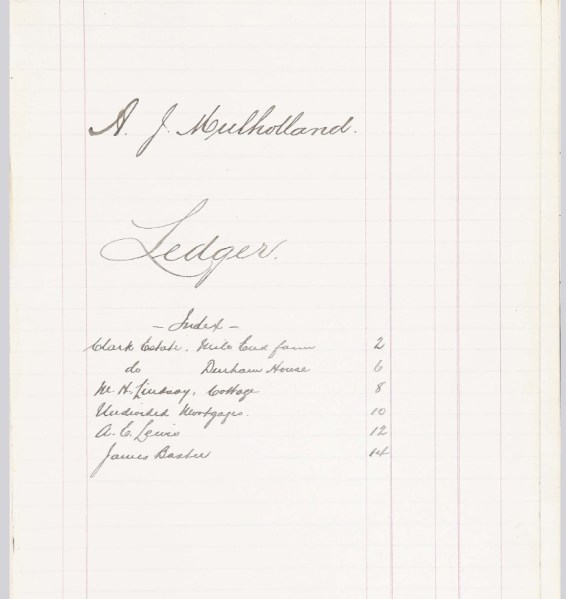
Amelia Mulholland’s ledger, McCord Stewart Museum, https://collections.musee-mccord-stewart.ca/internal/media/dispatcher/261758/preview p. 5.

SCB had inherited several large properties on the Island of Montreal, extended along the west side of St. Lawrence Street (now busy Boulevard Saint-Laurent). During his lifetime, this was agricultural land and, although he was trained as a notary, SCB made his income by leasing his properties to farmers.

He died unexpectedly at age 53, in 1873, when Amelia was just 21. SCB named his wife and her brother (who was a Philadelphia lawyer) as executors of his estate.1 Son Robert Stanley Bagg (RSB), a recent law graduate from McGill University, took on the responsibility of managing it. Over the years, the widowed Catharine and her daughters had a great deal of input into decisions about the estate, with Amelia being the daughter who took the greatest interest.    

Around the end of the century, Montreal grew rapidly. Business leaders developed new industries, founded banks and built railways, and immigrants arrived to fill newly created jobs. Property belonging to SCB’s estate could now be divided into lots and sold to people who wanted to build homes or invest in rental housing. Around 1890, some legal hurdles prevented the family from selling the most valuable properties, however, the family managed to resolve these problems. That will be a story for another time.

Amelia’s letter to brother Robert Stanley Bagg, McCord Stewart Museum,  https://collections.musee-mccord-stewart.ca/en/objects/416400/correspondance  p. 43

With these issues resolved, Amelia and her siblings divided up some of the land and became owners of lots that they could sell or buildings they could rent out themselves. Amelia became an independently wealthy woman.

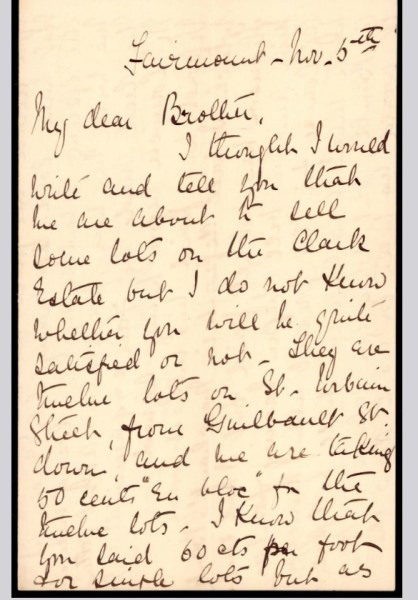
She also developed an interest in the details of the family real estate business, keeping track of land prices, interest rates and other factors influencing real estate sales. In the fall of 1890,2 while her brother took his wife and children on an extended trip to England, Amelia coordinated decisions on new property sales. She wrote to ask for his advice and to bring him up-to-date on family news.3

“Fairmount, Nov. 6th

“My dear Brother,

“I thought I would write and tell you that we are about to sell some lots on the ‘Clark Estate’ but I do not know whether you will be quite satisfied or not. They are twelve lots on St. Urbain Street, from Guilbault St. down, and we are taking 50 cents “en bloc” for the twelve lots. I know that you said 60 cents per foot for single lots but as this is for twelve lots we thought perhaps it was better not to lose the sale.4 Bob said that you told him we could take less than the price named, and McMann said he was selling lots of Park Avenue for 45cts.7 I hesitated for a long time as I did not wish to make a sale that you would not approve, but Kate was in favor of selling, so also was Bob, and Helen and I did not know what to do….5

“Vipond has paid his interest today which I will deposit in Merchant’s Bank. Thomson has not yet paid but I had sent him another bill before hearing from you. Of course for the present all money both interest and capital will be deposited in the bank, but when you return we think it would be better for us to draw the interest and leave only the capital in the bank.….”

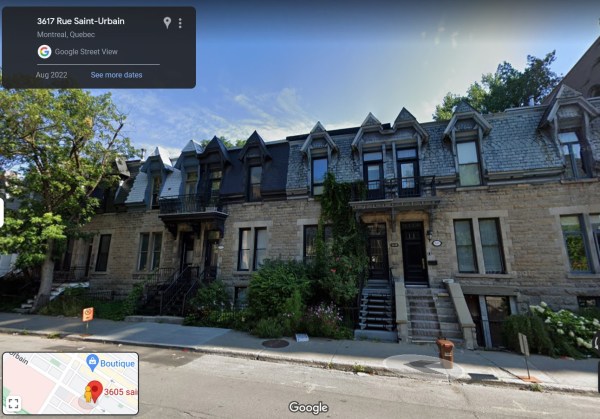
Row houses on St. Urbain Street near Prince Arthur. Google Street View

Much of the Bagg estate was still leased out to farmers at that time, and one day a month was reserved for tenants to deliver the rent. In the same letter, Amelia referred to this so-called reception day, but she was actually describing the arrival of her sister Mary Heloise Lindsay’s fifth child on Nov. 3, 1890. Mary and her husband Robert Lindsay lived at 436 St. Urbain. Amelia told her brother:

Kate and I made out the Nov. statements of rents due and gave the list to Bob so that when the people paid he could check them off. We were surprised at an unexpected arrival at 436 St. Urbain Street on Monday. It is true that is the reception day there now, but this particular visitor was not expected just then. It was a dear fat little girl! She arrived at 8 o’clock in the evening.”

Amelia also kept track of the sales of lots from the estate between 1890 and 1900 in a hardcover ledger with ruled pages. My mother eventually inherited that ledger. Her cousin had given numerous family letters, business records and other documents to the McCord Stewart Museum (a Montreal museum of social history) some years earlier, but my mother hung on to the ledger. After she died, I found it in a desk drawer in the spare bedroom.

When I started to research the Bagg family and their role in Montreal history, the ledger’s importance as a record of those land transactions became clear, so I donated it to the McCord.6 I hope Amelia would have approved.

This article is also posted on http://www.writinguptheancestors.ca.

See also:

Janice Hamilton, “Stanley Clark Bagg’s Four Forgotten Daughters,” Writing Up the Ancestors, Sept. 30,2017, https://www.writinguptheancestors.ca/2017/09/stanley-clark-baggs-four-forgotten.html

Janice Hamilton, “My Great-Great Aunts, Montreal Real Estate Developers,” Writing Up the Ancestors, Oct. 11, 2017, https://www.writinguptheancestors.ca/2017/10/my-great-great-great-aunts-montreal.html

Janice Hamilton, “John Clark, 19th Century Real-Estate Visionary,” Writing Up the Ancestors, May 22, 2019, https://www.writinguptheancestors.ca/category/john-clark

Notes and Sources

  1. City of Philadelphia (Pennsylvania). Register of Wills Office; Wills, No 772-802, 1887, Ancestry.com. Pennsylvania, U.S., Wills and Probate Records, 1683-1993 [database on-line, entry for Catharine Mitcheson Bagg, accessed April 2, 2023], original data: Pennsylvania County, District and Probate Courts. This is a copy of the will that is very easy to read. It was probably copied in Philadelphia because McGregor J. Mitcheson, Catharine’s brother and an executor of SCB’s will, died in 1886. About a month after SCB’s 1873 death, notary J. A. Labadie deposited at the land registry office in Montreal a copy of the 1866 will and the 1870 codicil and a declaration of death. Bureau d’enregistrement Montréal-Ouest, no 74545, registered 6 September 1873; at Registre foncier du Québec, online.
  2. Amelia did not note the year on her letter, but we know it was written in written in 1890 because that was the year her niece Marjorie Mary Clark Lindsay was born. 

3. Correspondance de la famille Bagg. McCord Museum, Fonds Bagg, P070/B08,  https://collections.musee-mccord-stewart.ca/en/objects/416400/correspondance  p. 43 (accessed April 3, 2023)

4. RSB must have told them to hold out for the full price. The lots were not sold until the following year. On Nov. 18, 1891, real estate agent and furrier Robert Lamb purchased not just the 12 lots mentioned here, but an extended row of 22 lots, paying 60 cents a square foot.

5. The people mentioned here are probably Amelia’s sisters Katherine Sophia Mills and Helen Frances Lewis. Bob was likely Robert Lindsay, her sister Mary’s husband. McCann was a real estate agent.

6. Amelia Josephine Bagg Mulholland, Grand livre, 1891-1927, McCord Museum, Fonds Bagg, P070/B07,1. https://collections.musee-mccord-stewart.ca/en/objects/293626/a-j-mulholland-ledger (accessed April 3, 2023)

Ypres Gas Attack Survivor Returns Home

Part Two of Two

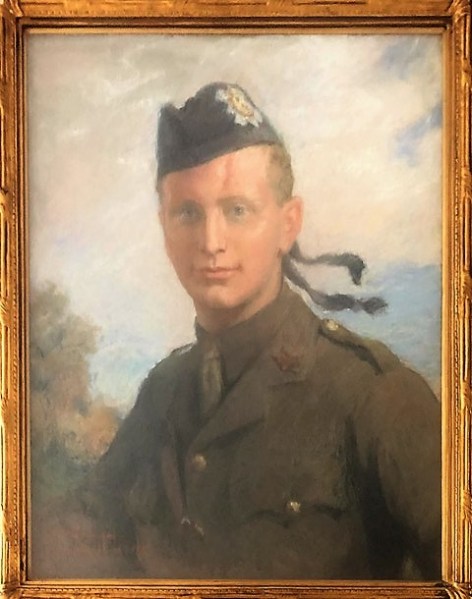
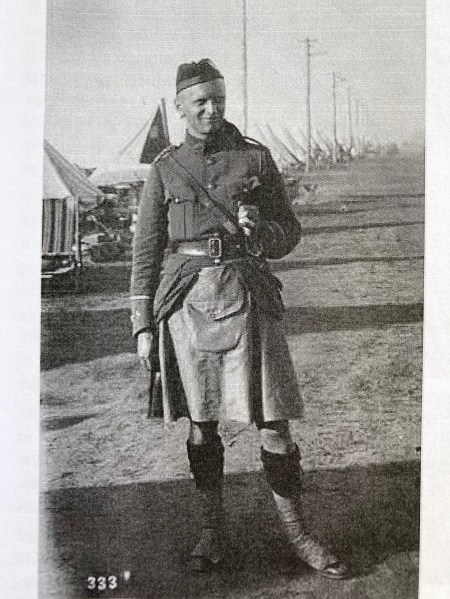
Six months after surviving the battle at St. Julien, Belgium, and the German gas attack in 1915, something entirely different brought Captain Stanley Bagg Lindsay (1889-1965) to his knees. He slipped and fell in the trenches while on active duty, and needed surgery on a hernia on his left side. He was officially declared unfit for duty and was granted sick leave to recover back home in Montreal, Quebec, for the winter.

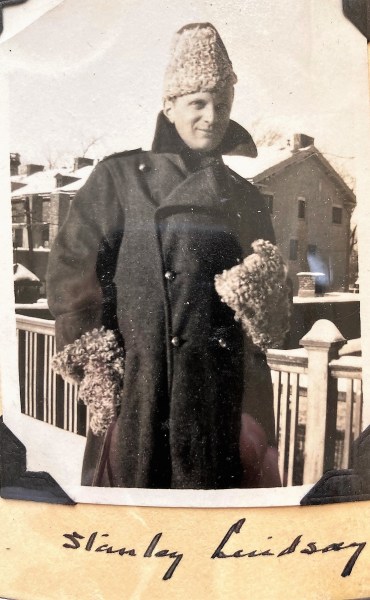
Stanley Lindsay – winter 1916

Within months of his return to England, the hernia recurred on his right side needing immediate surgery and his health never fully recovered after that. Several bouts of influenza also plagued him throughout the war, before and after his hernias, and weakened him for the rest of his life.

He was 29 when the war ended. He returned to Montreal, but did not resume his studies at McGill University, choosing instead to follow in his father’s footsteps and become a stockbroker. His salary as a Captain had brought in an average of $142 per month during his four years of service. This translates into $3900 per month in today’s dollars. He quite possibly returned to civilian life with a decent nest egg with which to begin his new career.

Stanley’s health issues did not appear to hinder his long career as a stockbroker and eventually he became a partner at Crutchlow, Deare & Co. According to family lore, he purposefully sold off the family’s portfolio of stock investments just before the Great Crash of 1929.1 Perhaps his war experience left him with some kind of sixth sense.

Although Stanley never married, he remained close to his two brothers (and their families) and his three sisters.

Two of his sisters, Marjorie and Marguerite, had been nurses during the war with the Information Bureau,2 a Canadian Red Cross organization in London which cared for Canadian soldiers. Marguerite died young in Cartwright, Labrador, in 1926 while volunteering with the Grenfell Mission.3

Stanley lived with Marjorie and their parents at 455 Sherbrooke Street West (previously known as The Prince of Wales Terrace) until their father’s death in 1931. Then they moved with their mother into an apartment at 1009 Sherbrooke Street West until her death in 1938 and remained there until their own deaths: Marjorie in 1961 and Stanley in 1965. His eldest sister Ada lived in Vancouver with her husband Julius Griffith and their only son, Julius, who became a well known Canadian artist.4

Stanley’s two brothers – my grandfather Sydenham5 (an Anglican priest) and Lionel (a pediatrician) – provided him with ten nieces and nephews to spoil. He absolutely adored my mother Ann and showered her with his love and gifts. He must have been devastated when she died of Hodgkin’s Disease at the age of 36 in November, 1961, having lost his sister Marjorie earlier that year.

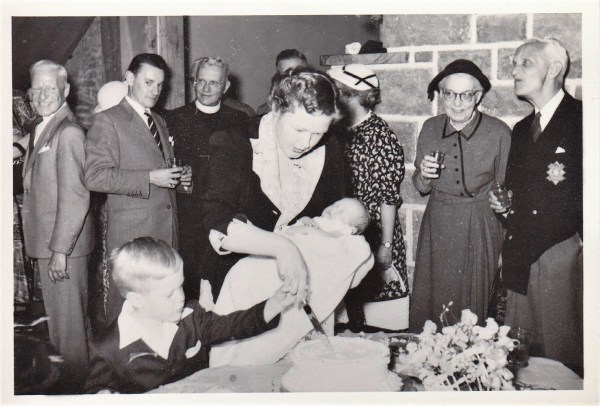
Stanley Lindsay (far right) at Ann’s baby’s christening party 1953

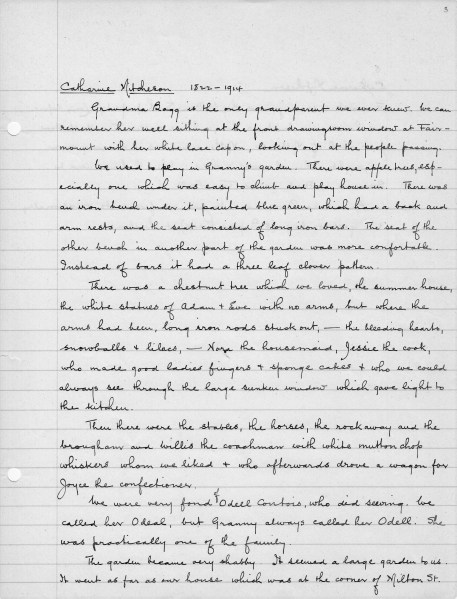
Luckily for me, he devoted his free time to the family history. I have pages upon pages of his beautifully (legible!) handwritten notes about that side of our family. All the usual dates and facts were recorded, but in a clear, more descriptive fashion.

One of his pages about his grandmother, Catherine Mitcheson Bagg, recalled a visit to her home as a boy:

We can remember her well sitting at the front drawing room window at Fairmount with her white lace cap on, looking out at the people passing.

We used to play in Granny’s garden. There were apple trees, especially one which was easy to climb and play house in. There was an iron bench under it, painted blue green…. There was a chestnut tree which we loved, the summer house, the white statutes of Adam and Eve with no arms, … the bleeding hearts, snowballs and lilacs … Nora the housemaid and Jessie the cook, who made good ladies fingers and sponge cakes and who we could always see through large sunken window which gave light to the kitchen.

There were the stables, the horses, the rockaway and the brougham and Willis the coachman with white mutton chop whiskers whom we liked and who afterwards drove a wagon for Joyce the confectioner. We were very fond of Odell Comtois who did sewing…. She was practically one of the family.

The garden became very shabby. It seemed a large garden to us. It went as far as our house which was at the corner of Milton Street. The west side adjoined the Wilson-Smith property. Long before our house was built, a large house called Tara Hall stood just north of Milton Street. Mother [Mary Heloise (Bagg) Lindsay] remembers it burning down one night when she was a child. Where the house used to stand is a street called Tara Hall.”

As well as being everyone’s favourite uncle, an excellent family historian and a successful stockbroker, Stanley belonged to several local clubs including the Canadian Club, the University Club and the Royal Montreal Golf Club.6

After almost dying at Ypres during the Great War, Stanley lived another fifty years.

1https://wiki2.org/en/The_Crash_of_1929 – as referenced 2023-02-23

2https://genealogyensemble.com/?s=the+mothering+bureau

3https://genealogyensemble.com/2022/07/27/miss-lindsay-the-early-years/

4https://www.gallery.ca/collection/artist/julius-griffith – as referenced 2023-02-23

5https://genealogyensemble.com/2016/04/05/the-priest/

6Obituary – The Gazette, 1965-03-03

Mathilde Bruneau Career Woman

Marie Mathilde Bruneau

I never expected to find much information about my great-grandfather’s sister, Mathilde Bruneau. I knew her name, dates, the fact she had a twin brother and that she never married. That was all. Then when searching Newspapers.com, Mathilde, born on a farm in southern Quebec appeared on the social page of the Fall River, Massachusetts Daily Herald. It was reported that she had been visiting her brother Aimé Bruneau and then returned to her teaching duties at the Rhode Island Institute for the Deaf in Providence, Rhode Island, only twenty miles from her brother’s home.

Sophie, Helene & Mathilde Bruneau in New York

Mrs. Mary Ann Lippitt founded the school in 1876. Her daughter Jeanie became deaf after a bout of scarlet fever so her mother taught her daughter to speak and read lips, as no schools for the deaf existed at that time. Mary Ann’s husband Henry Lippitt was the Governor of Rhode Island and had political influence, so he persuaded the state to take over the operation of the school. In 1893 the school moved to a large new building which could hold 60 students. This might have been the time Mathilde began teaching there. The school is still operating today.

I don’t know how Mathilde ended up teaching deaf students. Did she answer a newspaper ad while visiting her brother? Before teaching the deaf, Mathilde had been a French teacher in New York City along with her sister Virginie. Virginie didn’t stay there but returned to Quebec to marry.

Mathilde had not yet moved to Rhode Island 1887 when the social page reported on an earlier visit to her brother Aimé, in Fall River. I don’t know where Mathilde obtained her teaching credentials as I haven’t found records of her training. Her sister Virginie attended McGill Normal School. Did Mathilde begin her teaching career in Montreal before moving to New York?

Mathilde was one of thirteen children of Barnabé Bruneau and Sophie Marie Prudhomme, born in St-Constant, Quebec, south of Montreal, in 1844. She had a twin brother Napoleon, one of very few twins in my family tree. In the 1871 Canadian census, she was listed as living with her parents in St-Constant (and two years older than her twin brother), so she was at least 27 when she moved to New York City. Napoleon stayed on the farm but he also had a career as a veterinarian and a Justice of the Peace.

Sisters Sophie, Mathilde& Elmire with Washington Huntley

Although some of her siblings became American citizens, it seems she never did. After Mathilde retired from teaching, she moved back to Quebec. She maintained her independence and didn’t live with her twin brother in St-Constant or even with one of her sisters, instead she was a lodger in John Dooley’s house on Bordeaux Street in Montreal.

Mathilde Bruneau

She appeared again in a newspaper in April 1912, “Miss Matilda Bruneau 68, 1149 Bordeaux St. fell on the sidewalk corner of Mary Ann and Erables last night and broke her left leg. She was taken to the Royal Victoria Hospital” reported the Montreal Gazette. The weather the day before, Easter Sunday, had been very rainy and well above freezing so an icy sidewalk probably wasn’t the cause of her fall.

She died only four months later. PerhapsHer her leg never healed. I didn’t find a death certificate or cause of death, just a certificate of burial signed by two of her sisters. Marie Mathilde Prud’homme Bruneau was buried with her parents in the Baptist cemetery in Grande-Ligne, Quebec.

Notes:

Rhode Island School for the Deaf https://rideaf.ri.gov/AboutUs/index.php

Mabel Hubbard, who later became the wife of Dr. Alexander Graham Bell was deaf and also taught by Mrs. Lippitt. Jeanie Lippitt later went to Dr. Bell for voice training lessons. Dr. Bell had to discontinue these lessons to devote himself full-time to the development of the talking machine.

Fall River Daily Herald June 30 1898, Page 7. Newspapers.com accessed Jan 12, 2023. Miss M P (Prudhomme) Bruneau was an instructor at RI School of the Deaf.

The Providence News February 21, 1893 Newspapers.com accessed Feb 17, 2023. A new school building was dedicated. 35 pupils enrolled with a capacity for 60. 

In the 1911 Canadian census, Matilde was living on Bordeaux Street in the Maisonneuve district of Montreal as a lodger with a Mr John Dooley and his family.

Fell and Broke Leg: Montreal Gazette April 8, 1912, page 3. Newspapers.com accessed Jan 23, 2023.

Her sisters Virginie and Sophie signed her burial record. There is no cause of death April 15, 1912.

Laura Lacombe, Who Were You?

Perhaps the only picture of my mother’s cousin, Laura Lacombe, fourth from left in a Crepeau family picture circa 1914.

Genealogy is a gift that keeps on giving. A few years ago, when the 1921 Canadian census came online, I anxiously consulted it to see a Crepeau listing for my mother (4 months old), my uncle Louis, my aunts Alice and Cecile (20 and 17) and my 15 year old Aunt Flo, listed as adopted under the name Florida St-Martin.

Bingo! That’s what I had been waiting to see for 10 years!

In the 1911 census, my Aunt Flo is listed with her birth family, the St-Martins but I wasn’t 100 percent sure the listing was hers. (I had only a vague recollection of her birth family’s name. The family name St-Martin had come to me in a light-bulb moment in the middle of the night!) So this 1921 listing confirmed my subconscious’ powers. I suddenly felt very smart.

Aunt Flo peeking out at my mother in around 1925.

But, I also noticed another name in the Crepeau household on the 1921 census, Laura Lacombe, niece, born 1892. I had never heard this name before, so I took another peek at the 1911 census. Laura Lacombe is listed there, too. I had missed it.

Now I was really confused. (I suddenly didn’t feel so smart.) I rationalized that I might have missed Laura ten years earlier when the 1911 census came online because the Crepeau family listing is at the bottom of one page and Laura’s name comes up on the top of the next. Or maybe I did notice Laura’s presence on the census and just assumed she was one of the many young girls brought in over the years to help my grandmother, Maria, keep house.

Whatever the reason, it did not take long before I figured out who this Laura Lacombe was. She was the daughter of my grandmother’s sister Melina Roy Lacombe who had died in the mid 1890’s leaving behind two young children, Raoul and Laura.

On the 1901 census Laura is living with her grandmother (my great-grandmother) Melina Gagnon Roy and my grandmother, Maria; also Maria’s brother Louis and sister Eugenie who is married to a James Deslaurier. Maria and Louis are mistakenly listed under Deslauriers. (For this reason, I had a lot of trouble finding Maria on the 1901 census at first. ) Melina Gagnon Roy is listed as chef or head of the household.

So, when Maria, my grandmother, got married later in 1901 to the ambitious Jules Crepeau, she took in the twelve-years-younger Laura. Or maybe Laura moved in with them in 1906, after the death of the grandmother.

Now, the real question begs: how come I never heard about Laura before? Was she for some reason a family secret?

Over the decades, I never heard my Aunt Flo or my own mother speak of this cousin – and they both liked to talk about the Crepeau family in the early days.

The answer might lie in another document I found: Laura’s death certificate. You see, she died only a few months after the 1921 Census man came around – and a few months more after my mother’s birth. My grandfather, Jules Crepeau, signed her death certificate. No reason for the death is given, which makes it all very sketchy. (I’m not embarrassed to say, I looked for the name “Lacombe” among my many French Canadian DNA cousins on Ancestry. The name hardly appears at all. Phew!)

Still, I have to ask. Why the silence surrounding Laura’s life. A real mystery, it is.

Home Service During the War

My grandfather was 26 years old when Canadian Prime Minister William Lyon Mackenzie King recommended the country declare war on Germany in a radio speech on Sunday, September 3, 1939. Seven days later, Canada officially declared war on Germany and created the Royal Canadian Air Force (RCAF) Special Reserve, which was placed on active service.

I’m not sure what Grandpa Joseph Isidore Alfred Gabriel Arial was doing that year, but he probably lived in Edmonton after his last known job as a radio inspector ended in February 1936. He may have built and renovated houses with his cousins.

Eventually, he would contribute to what would become the world’s largest flight training program, although like many military volunteers, he never considered his contribution worthwhile. I remember standing in his garage as a 12-year old hearing him tell me how he regretted not doing his part during World War II. It never occurred to me that he had actively served in the RCAF until decades later when I found his release papers. It turns out that he honourably served for from February 20, 1941 to September 5, 1945.

It turns out that he’s among a great many men who volunteered to go to Europe to fight and ended up staying in Canada to keep the British Commonwealth Air Training Plan (BCATP) operational.

Britain, Canada, Australia and New Zealand officially created the British Commonwealth Air Training Plan on December 17, 1939, King’s 65th birthday but efforts to get it going began even earlier than that.

According to Dunmore, the British Commonwealth Air Training Plan began just after Adolf Hitler became chancellor of Germany in January 1933. “The Air Ministry suggested a scheme whereby Canadian, South African, and New Zealand air force cadets could be granted short-service commissions, serve five years in the RAF, then return home for reserve services.”1

Shortly thereafter, in 1936, Vincent Massey, the Canadian High Commissioner to Britain presented British Air Minister Lord Swinton’s suggestion that some airmen be trained in Canada prior to joining the RAF.

Later in 1936, Scottish pilot RAF Group Captain Robert Leckie described a plan to create “a Flying Training School formed in Canada” in a memo to Air Commodore Arthur W. Tedder. In this memo, he pointed out that more than a third of the RAF officers in WWI had been Canadian. The idea was proposed, but the Canadian Cabinet rejected the plan in favour of a Canadian-run training school instead. 2

In 1937, 15 Canadians were trained under the plan.

When Germany annexed Austria to the Third Reich in 1938, the Canadian government increased the number of Canadians able to join the RAF to 120 per year and later it went up to 138. That plan attracted a total of 400 Canadian pilots to the RAF.

It took from May 1938 until April 1939 to convince the Canadian Government to train up to 50 British pilots and 75 Canadian pilots. Eight flying clubs, in Calgary, Hamilton, Montreal, Regina, Toronto, Vancouver and Winnipeg were recruited to do the training. In August 1939, five RAF officers (Ken McDonald, Dick Waterhouse, Jackie Mellor, Desmond McGlinn and Leslie Smallman) crossed the Atlantic by ship from Southhampton, England to Montreal and then to Trenton to help set up navigation training in Canada.

By April 29, 1940 the first 168 RCAF recruits entered No. 1 Initial Training School in Toronto getting the BCATP air training plan fully underway. Just in time too. By June that year, France fell to the Nazis.

Over the next four years, Canada built more than 100 pilot training facilities in every province and territory.

“Looking back it is difficult to grasp the BCATP in all its dimensions,” wrote J.F. Hatch, in his 1983 book describing the project. “In themselves, the statistics are impressive: 131,553 [plus 5,296 RAF and Fleet Air Arm personnel trained prior to July 1, 1942] aircrew trained for battle, through a ground structure embracing 105 flying training schools of various kinds, 184 support units and a staff numbering 104,000. When war was declared the RCAF had less than two hundred aircraft suitable for training, many of them obsolete. In December 1943 there were 11,000 aircraft on strength of the BCATP.”3

I suspect that my grandfather kept many of those planes flying as an air mechanic in Fort William. Clearly this work contributed greatly to the allied war effort, but most of the stats about its importance talked about front-line combatants, not the 6,000 behind-the-scenes people who made the project operational.

The Canadian Government post about the project, for example says: “Of the Canadians trained in the BCATP, 25,747 would become pilots: 12,855 navigators; 6,659 air bombers; 12,744 wireless operators; 12,917 air gunners, and 1,913 flight engineers.”4

Also, several of the daily diaries for this period include the arrival of billiard tables, the building of skating rinks, sports tournaments and multiple leisure activities,5 so perhaps it’s no wonder that volunteer soldiers who served on these bases felt like they sat out the war.

1 Dunmore, Spencer. Wings for Victory: The Remarkable Story of the British Commonwealth Air Training Plan in Canada. Toronto, Ont.: McClelland & Stewart, 1994, p10.

2 Dunmore, Spencer. Wings for Victory: The Remarkable Story of the British Commonwealth Air Training Plan in Canada. Toronto, Ont.: McClelland & Stewart, 1994, pp24,25,26.

3 Hatch, F. J. The Aerodrome of Democracy: Canada and the British Commonwealth Air Training Plan, 1939-1945. Ottawa: Directorate of History, Dept. of National Defence, 1983, 222 pages.

4Veterans Affairs Canada, Historical Sheets, The British Commonwealth Air Training Plan, https://www.veterans.gc.ca/eng/remembrance/classroom/fact-sheets/britcom, accessed March 7, 2023.

5Daily Diary – Links – No. 2 Elementary Flying Training School, https://rcaf.info/rcaf-stations/ontario-rcaf-stations/rcaf-station-fort-william/, accessed March 7, 2023.

Auntie Madge, the Riveter

Page one of the Montreal Star read “Canada is Now Officially at War.” The article goes on to describe the declaration of war on Sunday, September 3, 1939:

“The declaration of war called forth a feverish activity, disturbing the quiet of a mellow Sabbath day on the very edge of autumn. … Thousands of people … heard the roll of bugles and drums, but, this time, with a martial motive. The Army Services Corps were parading with placards calling for volunteers in their vital lines of military service.” 1

Both my dad, Edward McHugh, and my uncle, James McHugh, volunteered to serve in the Canadian military. Edward went into the Royal Canadian Air Force (RCAF) and James joined the Royal Canadian Hussars, the armoured car division of the Canadian Armed Forces. Edward was stationed in Yorkshire, England and James saw active duty in France.

While the McHugh brothers were in Europe fighting the war, Canada was being transformed. Madge Angell, James’ wife, worked in one of the many factories that manufactured armaments for the war effort. She was a riveter and one of the one million Canadian women who worked in plants that produced munitions, weapons, and equipment during the Second World War. Veronica Foster, Ronnie, the Bren Gun Girl, represented these women and became a Canadian icon. Foster worked for the John Inglis Company Ltd. on the production line for the Bren light machine guns. She was photographed for a propaganda campaign under the direction of the National Film Board of Canada. These pictures were used to encourage Canadian women to participate in the war effort.2

Unknown photographer, Veronica Foster, an employee of John Inglis Co. Ltd. and known as “The Bren Gun Girl” posing with a finished Bren gun in the John Inglis Co. Ltd. Bren gun plant, Toronto (May 10, 1941), contemporary print from vintage negative. National Film Board of Canada. Photothèque / Library and Archives Canada e0007604533

Canada not only needed women to directly support the war and work in the munitions industries; it was also essential that they fill jobs traditionally held by men. Women worked on airfields, in factories, and on farms. They developed a reputation for fine precision work in electronics, optics, and instrument assembly. With the men away from the farms, the women took on the extra work. Lumberjacks became lumberjills. They also drove buses, taxis, and streetcars. Notably, Elsie Gregory MacGill was the first woman in the world to graduate as an aeronautical engineer. She worked for Fairchild Aircraft Limited during the war and in 1940, her team’s design and production methods were turning out more than 100 Hurricane combat aircraft per month.4

Elsie MacGill. Source: Library and Archives Canada 5

Canadian women wanted to play an active role in the military and lobbied the government. As a result, more than 50,000 women served in the armed forces:

  • The Canadian Women’s Army Corps;
  • The Women’s Division of the Royal Canadian Air Force;
  • The Women’s Royal Canadian Naval Service (Wrens); and
  • Nursing sisters. 6
Second World War painting, Private Roy, Canadian Women’s Army Corps, by Molly Lamb Bobak.7 

For women who did not work or were not members of the military, there were also many opportunities to contribute to the war effort. Women were asked to reduce their consumption of goods that were in short supply and to recycle. Goals were set to collect tons of rubber products to transform them into tires and other needed items for the war. Ration books were assigned.8 My grandmother, Grace Hunter, loved to cook and bake and she would often speak about the challenges of rationing during the war. At that time, all baking was home made, so the rationing of flour, butter, and sugar was difficult.

Scarcity of food lead to rationing.9

My grandmother also knit socks, gloves, and other knitted clothing for the troops that were delivered by the Red Cross. Women made warm clothing for the soldiers at the front, as well as quilts and bandages. As well, women groups sent books, newspapers, and treats to military hospitals.10 Nana was also active in organizing the “send off” and “welcome home” parties for the Montreal servicemen. My mom, Patricia Deakin, was a teenager during the war and her mother recruited her to help at these parties. She enjoyed these parties and felt that she was doing something for the war effort. An extra bonus was that she thought that the servicemen were very handsome.

  1. The Montreal Star, 4 September 1939, page 1, Newspapers.com, accessed 4 January 2023.
  2. Wikipedia web site, Veronica Foster, https://en.wikipedia.org/wiki/Veronica_Foster, accessed 9 January 2023.
  3. National Gallery of Canada web site, The Other NFB: Canada’s “Official Portrait,” Rynor, Becky,  1 March 2016, https://www.gallery.ca/magazine/your-collection/the-other-nfb-canadas-official-portrait, accessed 16 February 2023.
  4. Government of Canada web site, Women at War, https://www.veterans.gc.ca/eng/remembrance/classroom/fact-sheets/women, accessed 16 January 2023.
  5. Goldstream News Gazette, Canadian women making history: A life of firsts in flying colour, 29 April 2017, https://www.goldstreamgazette.com/business/canadian-women-making-history-a-life-of-firsts-in-flying-colour/, accessed 30 January 2023.
  6. Government of Canada web site, Women at War, https://www.veterans.gc.ca/eng/remembrance/classroom/fact-sheets/women, accessed 16 January 2023.
  7. Private Roy, Canadian Women’s Army Corps, painting by Molly Lamb Bobak, Beaverbrook Collection of War Art (online), Canadian War Museum, 19710261 1626, accessed 16 January 2023.
  8. Government of Canada web site, Department of Veterans Affairs, Timeline – Women and Warhttps://www.veterans.gc.ca/eng/remembrance/those-who-served/women-veterans/timeline, accessed 30 January 2023.
  9. The Montreal Gazette, 1943, Library and Archives Canada, PA 108300, accessed 30 January 2023.
  10. Government of Canada web site, Department of Veterans Affairs, Women on the Home Front,  https://www.veterans.gc.ca/eng/remembrance/those-who-served/women-veterans/homefront, accessed 30 January 2023.

Virginie Bruneau Dutauld The Protestant Teacher

Virginie Bruneau in New York City

Virginie Bruneau, born in St. Constant, Quebec in 1840, became a teacher. “She enjoyed the distinction of being one of the group of teachers to receive the first French Canadian diplomas from the McGill Normal School.”

The school was established in 1857 by John William Dawson, McGill’s first Principal with an agreement between the university, the government and the Colonial Church and School Society to educate Quebec’s protestant public elementary and secondary school teachers and produce teachers who could turn young minds into university material. The Colonial Church and School Society had been dedicated to the maintenance and financing of Anglican schools.

McGill Normal School 30 Belmont Street, Montreal

Applicants to McGill’s Normal School were examined in reading, writing, the elements of grammar and arithmetic and “needed to produce certificates of good moral character from their clergyman or minister of religion under whose charge they have last been.” The earlier schools judged teachers qualifications only on their common sense and reputation. The one-year course earned an elementary diploma and students attended for two years for a Model School diploma required to teach higher grades. Students had to be at least 16 years old and teach at least three years after graduating.  The first class contained 35 women and five men. So Virginie, born in 1840 could have been in the first class.

The school opened at 30 Belmont Street in downtown Montreal. In 1907 it moved to the west of the island and became part of MacDonald College.

After graduating, Virginie first taught in Montreal and then later, of all places, New York City. She was my great grandfather Ismael’s sister, the third child and second daughter of Barnabé Bruneau and Sophie Marie Prudhomme. Like many of her siblings, she looked for a life beyond the farm in St Constant.

I don’t know how or where she met her husband Francois Dutaud. He was from the same region of Quebec, born in Napierville, to Joseph Dutaud and Isabelle Cyr but he also spent time in the United States. He lived in Boston for several years. There, he worked for the Tuft Brick Company. He returned to Canada in 1875, where he farmed and had a successful grain business in Grande-Ligne, Quebec.

Francois Dutauld

Did Virginie give up the bright lights of New York City to teach at the Feller Institute in Grand-Ligne? Is that where she met Francois? Henriette Feller was a Baptist missionary from Switzerland who came to Quebec to convert Catholics to Protestantism. The hostility of Catholics in Montreal forced her to move south. Madame Feller’s first school was in the attic of her log cabin but eventually a large stone building was constructed. She and Charles Roussy her colleague, were responsible for the conversion of Virginie’s parents in the 1850s.

Virginie was 38 when she married and she and Francois had only one child, Gustave Dutaud, born in Grand Ligne in 1879.


The couple moved to Montreal to live with their son when Francois became ill. He died a year later. Virginie continued to live with Gustave until her death in 1926 from arteriole sclerosis. Her obituary said she was of proud Huguenot stock but I don’t think this was necessarily true. Yes, she was a French Protestant but her Bruneau line had been practising Catholics for centuries.
Notes:

Picture of Virginie by S.A. Thomas 717 Sixth Ave New York. He was a photographer from 1853 to 1894 when he died at 71.

https://numerique.banq.qc.ca/patrimoine/details/52327/4280081

The Educational Record of the Province of Quebec April – June 1964 Vol LXXX No. 2

McGill Normal School: https://education150.mcgill.ca/images/MNS-dOC20.pdf

McGill.ca/about/history/features/dawson accessed September 12, 2022.

Virginie Bruneau Dutaud Obituary. Montreal Star, Montreal, Quebec. April 28, 1926 page 31. Newspapers.com accessed April 19, 2022.

https://numerique.banq.qc.ca/patrimoine/details/52327/1955334 Picture of Feller Institute

Walter N. Wyeth D.D. – Madame Feller and the Grande Ligne Mission, Philadelphia Pennsylvania. WN Wyeth 1898

https://archive.org/details/henriettafellerg00wyetuoft

My Parents’ Courtship

As a child, I never imagined what life was like before my parents had my brother and me. But once in a while they would talk about their courtship and what it was like to meet right after World War 2.
When war broke out in 1939, my dad, Edward McHugh, signed up right away. He was stationed in Yorkshire, England and only returned home when the war ended in September 1945. He was already 31 and normally would have been considered a confirmed bachelor.

My mom, Patricia Deakin, would often speak about the day the war ended. She worked for the Sunlife Insurance Company of Montreal. The Sunlife Building was located on Dominion Square in downtown Montreal. When word got out that Germany had surrendered, all of the office workers in downtown Montreal just left their offices and walked out into the streets to express their joy. My mom described it as an amazing outburst of pure joy and celebration of the end of a long and painful war.1

Celebrations in the streets of Montreal at the end of WW2

When Edward went to war, he intended to return to work for his employer, the Canadian Celanese located in Drummondville and his employer had guaranteed his employment. However, my dad decided to stay in Montreal.

At that time, my mom’s brother, Jack Deakin, was dating Norine Scott. Norine and Patricia became great friends. The picture below shows them in the Laurentians for a day of skiing.

Norine Scott (left) and Patricia Deakin at the ski hill

Both the Canadian National and the Canadian Pacific operated trains from Montreal to the Laurentians, known as the “snow trains,” otherwise known as the P’tit train du Nord.2 Below is one of the Canadian Pacific posters.3

Promotional poster for snow trains

It wasn’t long before Norine introduced her young and eligible Uncle Eddie to my mom and that was the beginning of their courtship.

Both Ed and Patricia loved going to the movies and their Saturday night dates were often a meal at Bens Delicatessen, followed by a show. Bens was a well known delicatessen in Montreal that was famous for its Montreal-style smoked meat. In 1908, Benjamin Kravitz and his wife Fanny Schwartz opened a sweet shop on Saint-Laurent Boulevard and then added sandwiches, using Benjamin’s mother’s recipe. In 1929, they moved to 1001 Burnside (now de Maisonneuve), in the theatre and night club district of the city, and then to their final location in 1949.4

Bens Store Front5

My parents were married on May 21, 1949 at St. Columba Anglican Church in Notre-Dame-de-Grace. This church was built in 1920 but has now been sold to a developer.6 My grandparents would have been parishioners of the church as they lived just 10 minutes away.7 The post WW2 period was marked by a housing shortage. Pressure on the housing shortage was due to demobilized soldiers returning home, and the increase in newly created families. My parents, like many post WW2 newlyweds, lived with my grandparents after the wedding.

St. Columba Anglican Church, Notre-Dame-de-Grace, Montreal

The wedding announcement in the Montreal Star on May 30 1949, describes the bride as wearing:

“A gown of white slipper satin made with nylon yoke on Grecian lines and with train. Her veil was of tulle illusion, was finger tip length, held with a bandeau of lilies of the valley and orange blossoms. She carried a cascade bouquet of white carnations and bavardia.”8

The wedding announcement goes on to say that the reception was held at the Montreal West City Hall, in the music room. This photograph of the wedding party is probably taken outside the Montreal West Town Hall.

From left to right: Alistair Lamb, Mary McHugh, Ronald Lamb, John Deakin, James Meikle, Edward McHugh, Patricia Deakin, Melba Jones, Norine Scott, Dorothy Newcombe, Grace Hunter, George Deakin

The wedding announcement continues:

“Mr. and Mrs. McHugh went to Pleasant View Hotel, North Hatley, for their honeymoon, the bride wearing for travelling a three-piece suit of beige Scotch mist, with white straw hat and green accessories and a corsage of white carnations.”9

Founded in 1897 and located on Lake Massawippi, North Hatley is one of the prettiest villages in Quebec.10 Below is a post card of the Pleasant View Hotel:11

Pleasant View Hotel, North Hatley, Quebec
Patricia Deakin and Ed McHugh, North Hatley
  1. Courtesy Cadeau, C, All About Canadian History, The End of World War II in Canada, Montrealers celebrate VE Day, https://cdnhistorybits.wordpress.com/2015/11/11/ve-day-vj-day-canada/, accessed 29 November 2022.
  2. Baladodiscovery.com, Saint-Sauveur History, https://baladodiscovery.com/circuits/900/poi/10159/saint-sauveur-history, accessed 27 December 2022.
  3. Pinterest, Kirill Blinov, accessed 26 December 2022.
  4. Wikipedia, Bens De Luxe Delicatessen, https://en.wikipedia.org/wiki/Bens_De_Luxe_Delicatessen_%26_Restaurant, accessed 7 December 2022
  5. Stanton, Michael, 2005
  6. Memento Heritage Montreal, St. Columba Church, https://memento.heritagemontreal.org/en/site/st-columba-church/#:~:text=Built%20in%201920%2C%20the%20church,the%20Polish%20and%20Korean%20communities, accessed 27 December 2022.
  7. Lovells Directory, 1949, Deakin, page 1120, accessed December 20, 2022.
  8. Newspapers.com, McHugh-Deakin wedding announcement, 30 May 2022, accessed 22 November 2022.
  9. Ibid.
  10. Eastern Townships, North Hatley, Things to Do in North Hatley, https://www.easterntownships.org/towns-and-villages/45050/north-hatley#:~:text=Founded%20in%201897%2C%20the%20village,village%20centre%20are%20all%20unique., accessed 28 December 2022.
  11. Pleasant View Hotel, North Hatley, Quebec, Photogelatine Engraving Co. Limited, 19?, Bibliothèque et Archives nationales du Québec, 0002643996, accessed 28 December 2022.