
By Susan Gingras Calcagni
My great-grandfather, William Irvine, born on 31 August 1864 in Maryton, Kirriemuir, Forfar, Scotland1 was devastated by the death of his eldest daughter, Mary Ann, in 1911.2 Heartbroken, William was ready to hand over his lease as a publican and make preparations to sail to Canada with one of his daughters, Georgina. The 1911 census reveals that William was a Spirit Merchant at the Camperdown Pub located at 144 High Street in Dundee, Scotland. William and his family were living at 22 Peel Street in Lochee, Dundee,3 just a 10-minute walk from the pub. This was a popular pub with the workers of the Camperdown Works, the largest jute factory in the world at the time.4 By spring 1912 William had found a new owner who was interested in taking over the pub and William had finalized preparations to emigrate to Canada.
Subsequently, William was shocked and dismayed to learn that his emigration to Canada would need to be delayed. James Jones, the new owner, could not take over the lease to the pub as planned. His son was due to return from India and the transfer of the lease had to wait until his return. This would have been overwhelming for William and this new development significantly altered the plans he had set in motion for a new life. He had come this far and would hold on to the one silver thread to achieve his goal. I can only imagine his strength and determination in the face of this situation and the need to change his plans.
While I was growing up, my Aunt Gladys Fairlie, my mum’s sister, was very keen to learn from her grandmother, Betsy, William’s wife, about her family history. As William Irvine died in 1931 in Montreal, Quebec,5 Betsy was the only one living to tell the family stories. Now here is where the family lore comes into play. Gladys was born in Canada, and not having immigrated, she would ask her grandmother why they came to Canada. Betsy told her that it was due to the death of their eldest daughter. It was said that this broke William’s heart and therefore he decided to leave Scotland for Canada. One can only dare say how devastated they must have been when forced to contend with the loss of their daughter, Mary Ann, at the tender age of 17 years old. As genealogists, we are often under the impression that our ancestors usually emigrated for economic reasons and opportunities to better their lives. In this case, it was not the sole cause for my family. It was heartbreak, and further research revealed that it was an overwhelming one for William.
While researching William and Betsy’s immigration to Canada, I found that William was a widower at the time of his marriage to Betsy (something we weren’t aware of).6 A well-known step in researching family history is to leave no stone unturned, so I dug deeper into the records to learn that William had first married in December 1887.7 Unfortunately the death of Mary Ann in 1911 was not the first tragedy in his life. On 8 February 1888, his first wife, Mary McGregor Grimmond died days after giving birth.8 This was followed quickly by the death of their twin daughters, [Mary and unknown] on 29 February 1888.9 Chills ran through my body as I could only imagine how devastated my great-grandfather must have felt with grief and sorrow in his heart. My quest to learn more had increased ten-fold.
Moving forward, in 2002 plans for travel to Scotland were underway to learn more about my ancestors and especially about William and Betsy’s emigration to Canada. My Aunt Gladys and I were embarking on a fact-finding mission with the hope of confirming the stories she had been told by her grandmother over the years. Airline tickets were purchased and reservations were booked with plans to spend time in Dundee. I sent emails to the Dundee City Archives to book appointments to review the records to locate the address of the Public House where William was a publican and any other pertinent particulars we may extract. Meanwhile, I contacted the Balgay Cemetery in Dundee to plan a visit to the gravesite of Mary Ann Irvine. My Aunt Gladys had always yearned to locate and visit her grandfather’s pub and her Aunt Mary Ann’s gravesite. My desire to seek out these details were equally shared. My mission was underway and there was no disappointing my aunt.
With all the information swirling in my head, I was eager to start my quest. However, here is where my curiosity really started to unfold. Gladys was also told that William had his passage to Canada in the making and that the new owner of the Public House requested that William delay his departure, as noted above in this story. When we visited the Dundee Archives, you can imagine how thrilled we were when shown the entry at the Dundee City Archives10 with evidence that there was indeed an alteration in the transfer of the lease for the Public House located at 144 High Street, Lochee, Dundee between William Irvine and James Jones, Spirit dealers. Betsy, William’s wife, told the story that William was dismayed that he was required to stay on longer just until Mr. Jones’ son arrived back from India. Mr. Brian Cullens of the Dundee City Archives, who I had contacted by email, remarked that day on our visit that William probably had needed to alter his arrangements for his passage to Canada. This delay in the transfer of the lease saved William and Georgina’s lives. Originally William and Georgina had booked their passage on the RMS Titanic that left Southampton, England on April 15, 1912 but these tickets had to be cancelled. Eventually William and Georgina travelled on the Allan Line’s SS Scandinavian which departed from Glasgow on June 29, 1912, two months after the RMS Titanic’s fated voyage.11 After confirming at the Dundee City Archives that William did, indeed, change his travel plans made Aunt Gladys and I realize that we were in Dundee in 2002 because of this remarkable twist of fate.
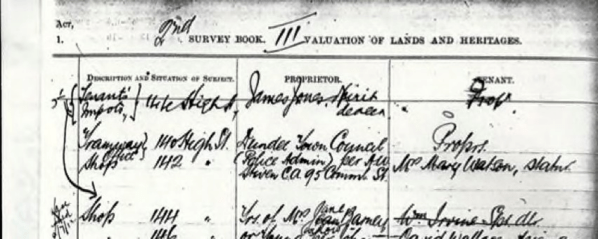
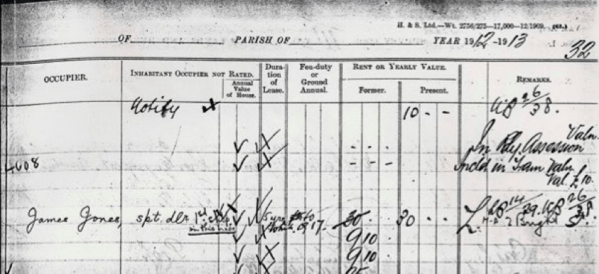
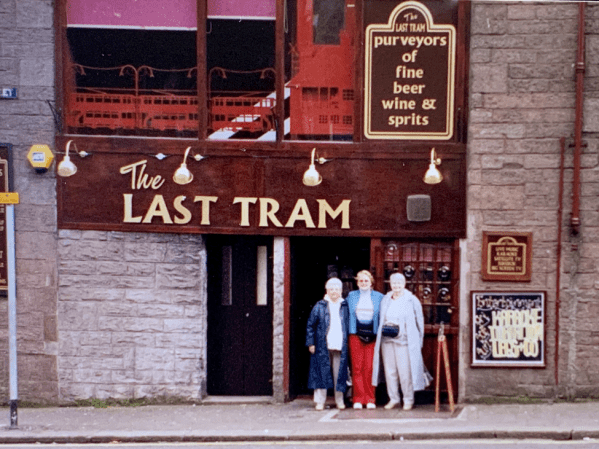
While in Dundee in 2002, we also visited the site of William Irvine’s pub which was then called the “Last Tram” located at 144-146 High Street. Below is a picture taken during this trip. This name of the pub honoured the historic end of the Dundee’s tram service in October 1956. In earlier years, the Camperdown Tavern, was nicknamed the “Tommy” or the Wounded Tommy. The soldiers of WWI who were badly wounded and who recuperated in Bright Street nearby the tavern at the Union Street Church Hall were nicknamed the “Tommies.” They were patrons of the tavern because the wounded soldiers would find it easy to enter and exit with no steps from the street level.12
Often, as genealogists, we are asked why we do family history. Greater than the sum of these fragments, here is one of my responses. On the train ride leaving Dundee, Gladys and I were sitting there, and while crossing the Tay Rail Bridge, my aunt turned and looked at me. In a surreal tone she expressed her thoughts, “What would my grandparents and my mother think to know that I was there and sat in the family’s Public House, the same brick and mortar, and visited the Balgay Cemetery gravesite of my aunt that I had never met.” This squeezed my heart knowing that I had fulfilled a dream of the person who has always been my soul mate and inspiration in life and genealogy, my dearest Aunt Gladys.
- New Register House Scotland, Statutory Birth Records, 1864, William Irvine, accessed 2000.
- ScotlandsPeople, Statutory Death Records, 1911 Mary Ann Irvine, accessed 2006.
- ScotlandsPeople, 1911 UK Census, accessed 2011.
- Wikipedia, Camperdown Works, https://en.wikipedia.org/wiki/Camperdown_Works, accessed 22 June 2026.
- Ancestry, Drouin Collection, Grace Anglican Church, Montreal, Quebec, accessed 5 August 2026.
- New Register House Scotland, Statutory Marriage Records, 1892, William Irvine and Betsy Smith Lawson, accessed 2000.
- ScotlandsPeople, Statutory Marriage Records, 1887,William Irvine and Mary McGregor Grimmond, accessed 2008.
- ScotlandsPeople, Statutory Death Records, 1888, Mary McGregor Grimmond, accessed 2008.
- ScotlandsPeople, Statutory Death Records, 1888, Mary McGregor Grimmond Irvine, accessed 2008.
- Dundee City Archives, Liquor Licensing Records, William Irvine, accessed 2002.
- Findmypast, Passenger Lists leaving UK 1890 -1960, William Irvine, accessed 2007.
- Wikipedia, Camperdown Works, https://en.wikipedia.org/wiki/Camperdown_Works, accessed 6 August 2026.

