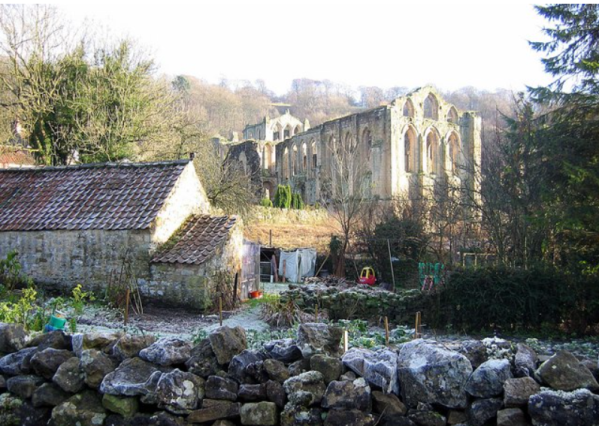
Tag Archives: North YOrkshire

Revelations on the Moors

Lately, I came into possession of a family heirloom, a book of poems, that allows me to see deep into the heart and mind of one of my great grandfathers, a rare gift for a genealogist.

I didn’t inherit this book from a relation: I got it off the Internet! And it took quite a few years for the book to find its way home.

Initially, I knew just two thing about the Reverend John Forster (1850-1926) my dad’s maternal grandfather. He was a Methodist minister and he developed dementia later in life. The story goes: one night he woke his wife of many years and asked, “Woman, what are you doing in my bed?” My grandmother, Dorothy Forster Nixon, told my mother the serio-comic story when she visited us in Montreal in 1967.

When I started researching John Forster’s life in 2017 (fifty years later!) for a story on this blog, it took me all of ten seconds to find out a lot more about him. The Primitive Methodists have a comprehensive website with bios of former Ministers.

According to John Forster’s bio there, he was the son of a Northumberland farmer; he joined the PM church in 1874 after attending a revival; he was very well read but never ‘paraded’ his knowledge; he married twice, my great grandmother Emma Cowan being his second wife; he had four children, a son by his first marriage and daughters, Agnes, Norah and Dorothy with his second wife.
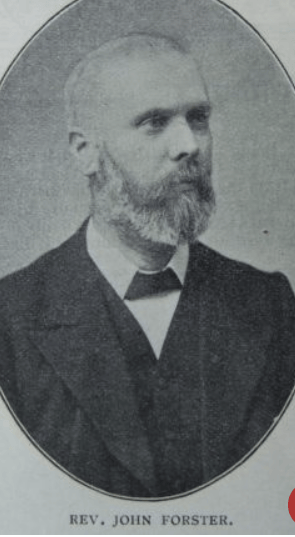
Rev. John on the Primitive Methodist Website

Apparently, John worked the evangelical circuit for forty years, from Carlisle to Sunderland, two years here, two years there. My grandmother was born in 1895 in Middleton-on-Teesdale, County Durham.

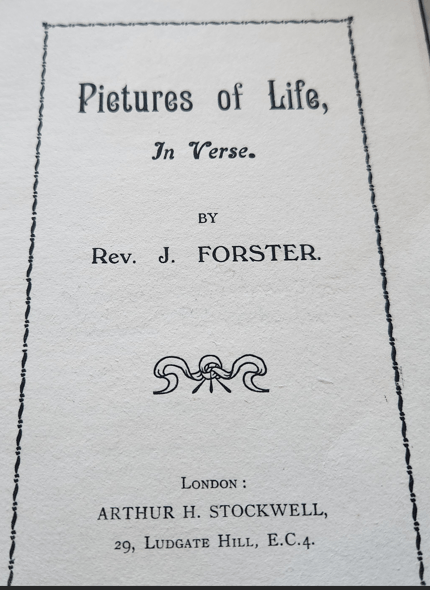
John also wrote articles and poems for the P.M. Connexional Review and other venues and he had a book of poems, “Pictures of Life in Verse” published in 1923. Apparently, these poems contained ‘lyrics of extraordinary charm and grace.”

Boy, wouldn’t it be fun to read these poems.

I immediately contacted the website manager. Yes, they had a library but the book was lost.

I checked the Internet, no luck. (The book was available, however, at the British, Scottish and Welsh national libraries.)

So I wrote my two pieces about Reverend John without any samples of his poetry.

For some reason, just the other day, I tried again. This time, I found Pictures of Life in Verse on Abebooks at an antiquarian bookstore in the south of England.
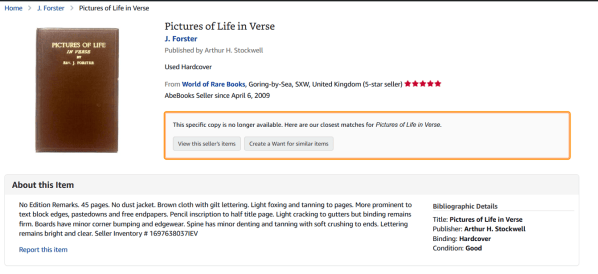
According to the blurb there was an inscription in pencil on a front page. Could this inscription be by a family member, I wondered. Could this volume be a genuine family heirloom about to come home to me? I filled in my credit card info and pressed “purchase.”

When the little brown volume arrived, I immediately checked and, well, maybe the inscription was pencilled in by my great aunt Norah, but if she wrote this she spelled her name wrong.
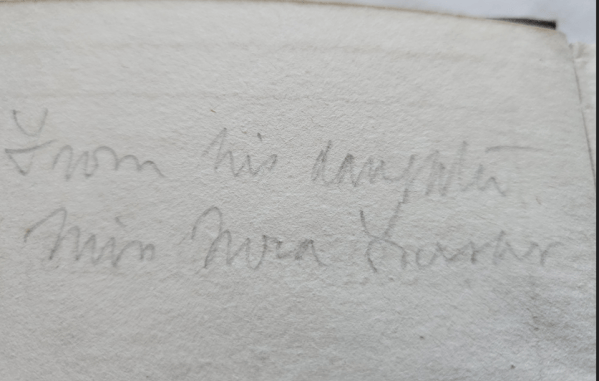
(It is likely someone else wrote this, not Norah. She too got dementia. She was a concert pianist and school music mistress.)

Whatever, this volume of sacred and profane romantic poetry published over 100 years ago is a true family treasure.

That night I perused the twenty or so poems in the book and, yes, I liked them very, very much. They are, indeed, charming as well as thoughtful.

It seems that my great grandfather saw God in nature, not surprising for someone whose vocation brought him up and down the sun-dappled Dales and brooding Moors of Northern England.

A couple of snippets:

The bee makes love to all the flowers-

White and Yellow and Blue and Red –

He woos them all for hours and hours,

And kisses them all ere he goes to bed.

….

Seems Gillimoore village, with nothing to show

To mark it off from a hundred such,

Hardly distinguishable each from each.

Then, all in a flash, the purple sea

Of heathers before you so gloriously;

Acres and acres, and miles on miles,

Northword the August moorland smiles.
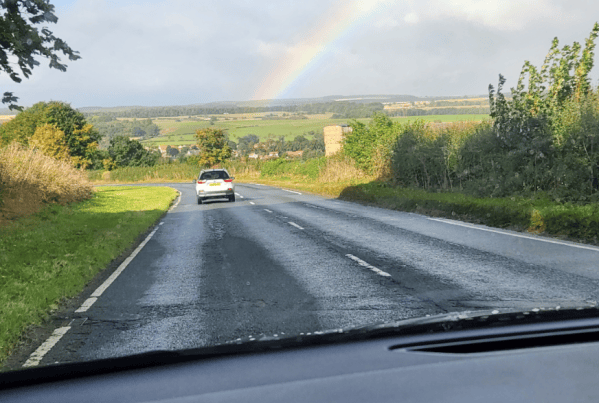
(Driving into Helmsley. We visited North Yorkshire in September 2024. Later, we drove to Whitby through the moors and they were, indeed, glorious.)

Rev. John was clearly an empathetic man, too, a good thing for a Minister.

Mother and Son (abridged)

My boy’s alive, but he’s dead to me;

Was it but yesterday that he

Sat on my lap and stood on my knee?

…

He talks to me of things afar,

Which unto him familiar are,

To me remote as any star.

…

He talks of politics and laws,

Of human rights and the people’s cause,

In a ready way, as one who knows.

Is this poem about John’s relationship with his Mom? She was a farmer’s wife and John left to join the Primitive Methodists who helped organize early labour unions in the UK. Even though many of their followers were illiterate, their ministers had to take probationary exams on many ‘abstruse’ subjects. (John’s adjective.)

Yes, John’s working class flock was made up of simple people, miners, farmers and factory workers, and some poems in the collection are about tradesmen. Here a postman performs his duties oblivious to the joys and heartbreak he brings to people on a daily basis.

The Postman (abridged)

In a coat of blue with facings red,

And a stiff-peaked cap upon his head;

Across his shoulders a canvas bag,

With parcels and letters all asag…

…A careless-hearted Mercury he

To carry the fiats of destiny

Down the street from side to side,

Whistling he goes with hasty stride.

Another romantic poem about the simple life is called The Stone-breaker (abridged).

He rises early to his toil,

He breathes the fragrant morning air,

Released by evening with a smile,

He goes to bed without a care.

Having the sun he needs no clock,

His carpet is the turf so green,

The passing shepherd and his flock,

To him are good as change of scene.

According to the UK Census, my father’s paternal grandfather, Robert Nixon was a delver in a quarry in Hemsley, North Yorkshire in 1911. Reverend John was posted in Helmsley from 1912 to 1914. Could this poem be about Robert? Robert’s son, also Robert, a footman turned Malayan planter, and John’s daughter, Dorothy, married in 1921. She moved to Malaya to be with her new husband. (Robert Sr. according to his 1933 obit was also a lay Methodist Minister and a forestry/mill superintendent during WWI.)

Here’s a poem where John Forster wonders if penning poems is a vanity exercise – or a therapy of sorts.

The Bard’s Dilemma (abridged) “with apologies to the Shade of WS:”

To write or not to write, that is the question.

Whether ‘tis nobler in the bard to suffer

The stings and itches of his vanity,

Or to take a pen, and shed a sea of ink,

And by composing end them.

So, he is plagued with self-doubt but has a sense of humour about it.

In his poem The Inexpressible (abridged) John suggests that logic and intellect hinder true understanding.

“ Of give me a speech

To learn and to teach,

Not things that are wrought

In the smithy of thought.”

So, even more self-doubt, here. Is book-learning a waste of time?

The poem, Insomnia (abridged) seems personal:

I lay me down, I lie quite still,

Sleep surely will not stay;

But now the minx o’er yonder hill

Peeped, laughed, then ran away.

She is a maiden coy and shy,

Affrighted by a stare,

And so I close my eyes and try

To catch her unaware.

These days they understand there is a connection between lack of sleep and Alzheimer’s. As it happens, my father also succumbed to that disease and he, too, was an insomniac. (My mom said his insomnia was ‘because of the war.’)

Which brings me to my very own revelation on the Moors: As I reflect on these ‘romantic’ poems, written by my very down-to-earth North of England great grandfather, I realize that I am not merely looking into the mind of the Reverend John Forster, Victorian Age Primitive Methodist Minister. I am seeing deeper into the mind of my own father, Peter Nixon.

My father, born in 1922 (the year T.S. Eliot penned the prophetic The Wasteland, turning naturalism and romanticism on its ear, was an Oxford rugby star, RAF pilot and reluctant chartered accountant. But he was never more himself than when he was remarking on the shape of a flower or behavior of an insect on the many nature walks he took me on, and he did this in a child-like way I could relate to. He may not have resembled his maternal grandfather John Forster in physiognomy or frame, (physically he took after the rugged, sporty Nixon side) but he was most decidedly the Reverend John in character! He was a simple, gentle, thoughtful person who could not abide city living.

That I cannot deny as I read these old family poems. What a revelation, really. What a gift to me.

Five complete poems, three possibly autobiographical and one that proves my great-grandfather didn’t let Darwin’s theories get in the way of his faith.

The Road on the Hill

In a gray house, in a lone dale,

Beside a brawling burn,

Which babbled strange things to itself,

With many a leap and turn,

We lived, my brother Jim and I,

And many a summer’s day

We spent, beside the idle burn,

The idle hours in play.

And still two things we wondered at,

That always were in sight,

The turnpike winding round the hill

And the hill’s towering height.

We saw the people walk the road,

From hour to hour they sped,

We saw them vanish round the turn,

And knew not where it led.

We looked up at the towering height,

In childish wonder fond,

We knew so well the hither side,

But not the side beyond.

Jim’s feet have never trod that road,

Which once he wondering eyed,

But he has trod the mystic hill,

And seen the other side.

And I have trod the turnpike road

And turned the curving hill,

But the dark mountain’s farther side

Is secret to me still.

‘Tis I have seen beyond the bend,

And he the summit’s path,

For I have walked the road of life,

And he the road of death.

The Simple Life

The eldest is off on the train

The next one is singing within,

The youngest two skipping outside,

Oh hear you their quarrelsome din?

O happy the man with a wife,

Of happy the wife with the child,

And grandmother’s too can enjoy

The live that is lively and mild.

Of life that is simple, and free

From the cares that environ the great;

The health and the peace and the love,

The small but sufficient estate.

The joys that are natural and pure,

the Cares so eventless and calm,

The aims that are wisely defined,

Contentment that falls like a balm.

O think of the joys that are lost

In fretting for things we have not,

O think of the bliss we may find

Enjoying the things we have got.

We will build a neat house for ourselves,

On the slope of the sun-fronting hill;

In the winter with books on our shelves,

In summer a garden to till.


And, then, when the evenings are sweet,

In the long, lingering, sad Autumn time,

If the old mood romantic comes back,

Perhaps we may jingle a rhyme.

And there let us live, let us die,

Satisfied with the things of our lot,

On earth, if remembered on high,

Content to be quickly forgot.

(Me: Not so quickly, after all!)

The Worm Track

How very curious as I sit,

And scratch my name upon a stone,

That I by accident should hit,

Upon the work of one long gone;

A worm, who wriggled, blind and prone,

In the wet sand with motion slow,

And left his track so plainly shown,

Long, long ago! Long, long ago!

That sand is stone, and now when split,

Revealing what is marked thereon,

I see Time’s long procession flit

Past me me in many a vague aeon;

And think, “Time has been long begun

When that work made his markings so,

And earth even then had ancient grown,”

Long, long ago! Long, long ago!

Of their descent, more than a bit,

Men boast in supercilious tone;

Behold a worm’s, compared with it,

What have they got to boast upon?

His proof of long descent is drawn

Upon the rock without a flaw;

His ancestry goes back, you’ll own,

Long, long ago. Long, long ago.

My Wife and I

My wife and I have but one mind;

Like vessels filled from each other’s o’erflow,

All our thoughts pass too and fro,

For we’ve everything in common you know.

The bits of gossip, but nothing unkind,

‘Tis so nice, when I get home at night;

Feet on fender in the firelight,

To tell her them all; all the odds and ends

Of news picked up among my friends;

What one has said and another done,

And the last good tale that made such fun,
And all the happenings of the day.

To my wife alone be sure to tell,

The secret I was to guard so well;

For we’ve but one mind between us you see,

She is I and I is she.

When I get home, where we go to bed,

I’ll tell her this, to myself I say–

For I forget—alas, she is dead.

John’s first wife, Mary Chaytor appears to have died in childbirth. The Primitive Methodists supported women’s equality, suffrage etc and they allowed women to preach! It is likely John’s second wife, Emma Cowen, helped him out, perhaps even taking over the pulpit when he was indisposed. Farming wives, of course, have always worked alongside their husbands. The children too for that matter.

The Worker of the Future

He sings as he toils to the joyful tune

Which life beats out in his heart and brain,

He sings as he toils as the lark soars in June,

For his soul exults in the fight and strain.


He sings as he toils, for toil is sweet

When the sense is keen and the soul is free;

When strength has winged the hands and the feet,

And health in the veins is melody.

He sings as he toils for the fruit is his own,
The artist’s joy and the maker’s pride

Are his are the products shaped and grown,

And he walks the earth with the freeman’s stride.

He sings as he toils; his song of praise

To the Maker of all good things is paid;

Who made Man his helper, His good to upraise,

And perfect the world Himself has made.

(The Primitive Methodists worked to improve working conditions for the average man and woman.)

Afterward: I have written stories about my grandmother Dorothy Nixon here on GE. A Terrible Beautiful Life and The Jungle Librarian.

John’s poems, showing she was a middle child with a much older male half-sibling, also help to explain her character and that I’ll tackle in a future essay.

The Prettiest Village in North Yorkshire

Here I am carrying our haul from the craft fair. This is one of the most photographed houses in the UK apparently. Its image is found on cookie tins, etc.

During my childhood in the 1960’s, my father, Peter, often promised to take me to England where his parents were born and where he spent all of his school years. On one occasion the ticket and passport were in my hungry little hands. But, somehow the trips always fell through. “Business,” he said, but I knew it had to be more than that.

My father’s ties to England were strained. He actually was born in Malaya to British expats, Robert Nixon and Dorothy Forster from the north of England. As was the tradition, he and his younger sister, Denise, were sent back to England at a very tender age to attend school – and to live with random relations during the summer months.

Being a child of Empire, he had no clannish ties to England, and, yes, many sad associations with the country, abandonment for one. This likely accounted for his ambivalence about going back ‘home.’

(I read somewhere that upper class British parents were cruel to their children just for this reason, to discourage attachments that would keep their children close to home when the Empire needed them. My father’s people definitely were not upper class, not nearly, but it amounted to the same thing.)

It wasn’t until the mid 1990’s that my father finally decided to cross the pond – on his own this time. He stayed with his sister Denise in Hampshire and took drives north, one time to see ‘an old auntie’ – or so he said.

My father had passed away before I ever got to England. That was in 2006. I, too, stayed in Hampshire with my Aunt Denise. I had a lovely time. My aunt was a most loving and gracious host.

Only twice before had I met my Aunt Denise, the first time when she surprised us in Montreal in 1978 (I had just graduated from university) and then in 2005, when she travelled to Canada to see my father in his final days.

Arriving at her Hampshire home, I noticed something rather touching on the side-board in her living room: a framed photograph taken of us at the summit of Mount Royal back in 1978.

The photo on the side-table. Whether she had put it there 30 years before or whether she had just put it there for my visit, it was a nice gesture.

After visiting Denise, I stayed in quaint Harrow-on-the-Hill because my cousin Peter, a former England rugby star, was a teacher at Harrow School. He took me to eat in the prof’s dining hall in that storied institution.

Just recently, in September of 2024, inspired by some YouTube videos, I took my second trip to England, a genealogy trip to Helmsley, North Yorkshire where my grandfather, Robert, a lowly footman at Duncombe Park in 1911, was born.

I had long wanted to visit Helmsley but my husband isn’t keen on driving in England. My son has no such qualms however so we went took the trip together.

After settling into our comfy air bnb cottage in the center of town, we took the nearby path, part of the famous coast-to-coast Cleveland Way, six miles back and forth to Rievaulx village where my father’s great grandmother Ann Nesfield lived most of her life – and where his grandmother, Mary-Ellen Richardson was born.

The Fairy Staircase (Emily Carr’d-up). Going down was almost as hard as going up, the stairs were so unevenly spaced.

As I staggered up-and-down the daunting Fairy Staircase between Helmsley and the small village of Rievaulx, I mused to myself about all the ancestors who likely trod on the same steep, uneven steps. No doubt trysts and assignations happened on these stairs, tucked away as they are in the woods between the two places.

That long six mile walk did me in, though, so the next day I did not feel like visiting York, our planned destination. Instead, we drove to a nearby village Thornton-le-Dale. The YouTube video claimed it was the prettiest village in North Yorkshire, so why not?

We walked around the picturesque place, bought some gifts at a crafts fair in the Town Hall, visited the duck pond as well as a thatched cottage that is famous in the UK, and then ate chili at a place called Baldersons Welcome Cafe in the center of town. There was a very classy gift shop attached – so we browsed.

Then we embarked on a shorter one mile hike on a very narrow path past gurgling streams and through fields of grazing sheep to an odd little place, Ellerburn, that consists of two or three delightful thatched cottages and one (rather smelly) church, St. Hilda’s, founded in the early Saxon era. Then we drove back to Helmsley, things getting a little tense in the town of Pickering because of a U-turn that got us trapped on a very narrow, very steep street.

We took a photo of this resto’s sign, not realizing it is a family business and has been so for a century.

Helmsley has long been the market town in the area. Today, it is a pretty touristy kind of place with fancy hotels and even a Micheline starred resto. My father’s ancestors, I have learned, were farmers, labourers and preachers. I imagine boiled mutton and oatcakes were their mainstays, not “herb fed chicken with liver parfait” and the likes served up today in the local eateries.

My son and I had a great trip, despite the many rainfalls, first to Edinburgh, then to Helmsley and then on to Whitby on the coast whence came the Nesfields who, of course, were mostly fisherman and sailors.

Ellerburn, “where time stands still,” a place so small the Google car didn’t get there- but you can have a meal in the “Tea Cozy” tea room.

But, the oddest of coincidences: Two weeks after I had returned home to Canada, my Ancestry app sent me a ‘photo hint’ for someone in my tree and I recognized the restaurant my son and I had just visited in Thornton-le-Dale, Baldersons Welcome Cafe! (Had it shown up before our trip, it would have meant nothing to me.)

It seems Ethel Nixon, my great aunt, who I had hidden away in my Ancestry family tree, married a local man, PB Balderson in 1925, a fact I had forgotten. It took me only a few minutes of Internet research to discover that the restaurant I had visited by chance was a 100 year old family business!

I contacted the resto on Facebook and Ethel’s great granddaughter replied. She told there’s a picture of the family on a wall inside the restaurant. Too bad! We had dined in the outside garden area.


What a missed opportunity!

Driving into Helmsley on good roads (thank goodness). Was the rainbow for me – or are rainbows frequent because of the highly variable North Yorkshire weather? (Precise weather forecasts are useless in these parts, we learned.)

So, my great aunt Ethel Nixon, unlike her older brother Robert, the footman turned Malayan planter, stayed close to home marrying a local man in the bakery business. They moved around a bit, but eventually started up bakery/cafe in oh-so-pretty Thornton-le-Dale. Perhaps Ethel was the ‘old auntie’ whom my father saw during his England trip. She died in 1996.

The cafe (now also a bakery and gift shop) stayed in the family and has been managed down the decades by Ethel’s children, grandchildren, and great grandchildren. All this is a town considered, then and now, to be one of the prettiest places in the North of England.

Lucky Edith. Lucky descendants.

Cool, wet Whitby. Whitby Castle at the top. Anne Nesfield my dad’s great grandmother was born in suburban Sleights. Hence his middle name : Nesfield. Whitby and Pickering in Ontario are named after these towns. The original surveyor was apparently from North Yorkshire.
YES IT DOES!

The ‘old auntie’ apparently explained that his father, Robert Nixon, humble servant, of Hemsley, North Yorkshire went to Malaya in 1912 because he got ‘the daughter of the local Earl’ pregnant. A close relation who contacted me on this blog claimed he was always told that Robert got a servant pregnant. No biggie there.

So either Robert was sent away by an angry and rich father or he REALLY didn’t want to marry a poor girl like himself and decided to get as far away as possible. How awful!

(I haven’t yet found an unknown relation on Ancestry.) It cost money to travel to Malaya, though – and the opportunity to go out there and possibly get rich was usually given to the sons of wealthy men.

Happiness in Marriage

A piece of speculative genealogy fiction

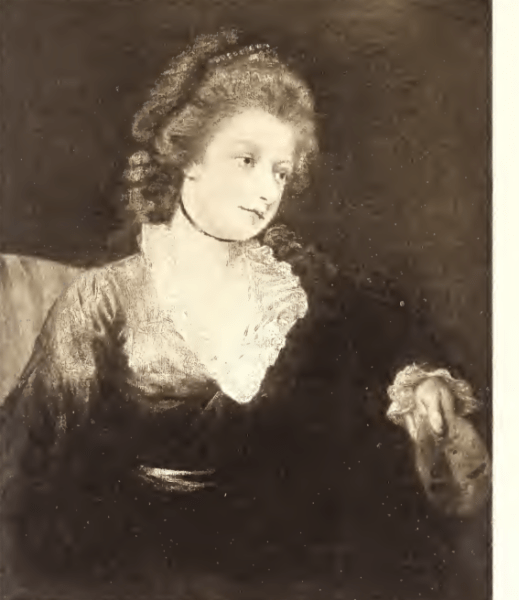
Antonia Willoughby, ancestor of Mr. Lumley Hodgson on his mom’s side.1


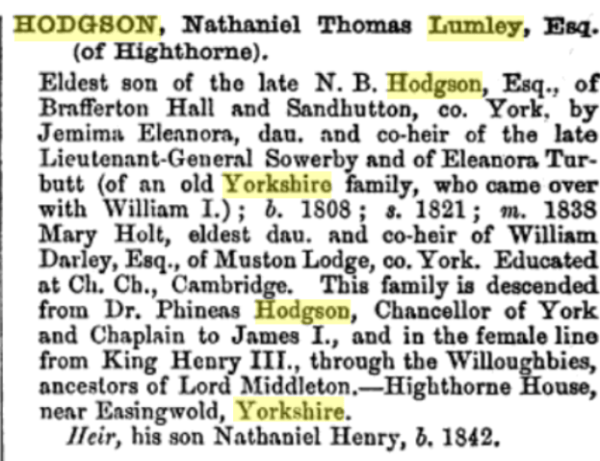
As is typical, I know little about the life of my great great grandmother, Ann Nesfield, a cook from North Yorkshire, UK except the basics: birth (1838), death (1912) marriage (1861) and children (10) but thanks to the Internet I know a great deal about her employer, Nathaniel Thomas Lumley Hodgson, a member of the landed gentry. So, just for fun, I have strung together this little fiction about my great great grandmother from some intriguing facts about Mr. Lumley Hodgson found online.

August 23, 1861. “Happiness in marriage in entirely a matter of chance.” I read that in a book by Miss Austen.

As it happens, I am getting married in less than a week to a tailor from the tiny village of Rievaulx, a man I hardly know, a Mr. Thomas Richardson. He visits my place of employ twice a year in the spring to make up my Master’s riding clothes.

Although most of my Master’s clothing is bought in London, he prefers Mr. Richardson, who lives only 12 miles away, for his country apparel.

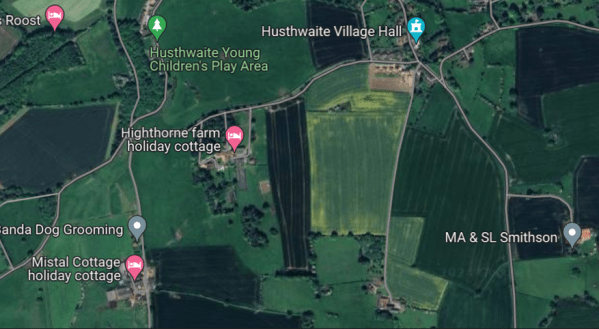
My name is Ann Nesfield. For many years now, I have been engaged as a cook at Mr. Nathaniel Thomas Lumley Hodgsons’ farm estate, Highthorne, near Husthwaite. It is a leisurely employment. I feed his small family, the household staff and the three farmhands. It is rare that important visitors come to stay, and if they do they come on business and sup at the local inn where they can haggle in manly fashion.

You see, Mr. Lumley Hodgson is a breeder of fine horses, of field hunters and of race horses. He trades mostly in the strong reliable Cleveland Bay, a local breed of which he is reet fond.

The Cleveland Bay, he informs everyone, was originally bred centuries ago by the local Cisterian Monks as a pack horse. Later, after the dissolution, the Cleveland was bred with some fleet and graceful Turkman stallions.

Today the Cleveland Bay is used in the field, both to hunt and to plow.

Mr. Hodgson seldom fails to tell his customers how 30 years ago he rode his own Cleveland Bay the one hundred and seventy five miles to and from Cambridge where he attended university.

If that doesn’t impress, he then relates the story of how another local man rode his Cleveland mare 70 miles a day for a week for jury duty in Leeds. Or how another man once burdened his beast with 700 pounds and rode 45 miles to Ilkley and back.

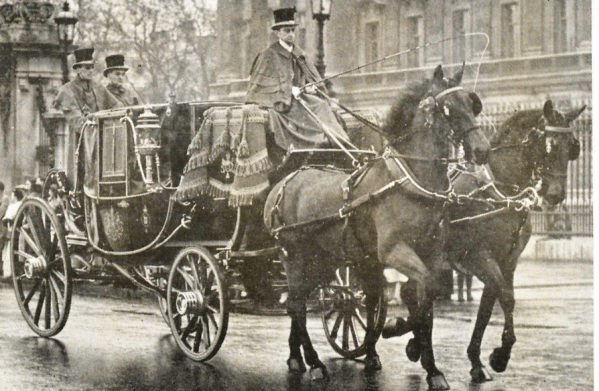
“The breed is being ruined,” Mr. L.H. likes to say, “by the London fashion for flashy carriage horses of 16.5 or 17 hands. Leggy useless brutes they are. All action and no go.”

Leggy Cleveland Bay Carriage Horses.

Mr. L.H. calls himself a farmer but he is a gentleman-farmer with a pedigree as impressive as his osses’. At Cambridge he shared lodgings with the great scientist Charles Darwin. This is also summat he usually tells a prospective client, for Mr. L.H. is a canny businessman and this association can only help him, considering his occupation.

There are rows and rows of stables on his 107 acre farm near Husthwaite that sits on one of the seven hills in the area. The main house, they say, was given as a reward many years ago to one of William the Conqueror’s faithful knights.

As I said, my Master’s household is small, made up of his wife Mary Darley (whose family owns many yackers of land in Yorkshire) two daughters, Julia, 22 and Emma, 8, as well as a nurse, a housemaid and a cook, yours truly.

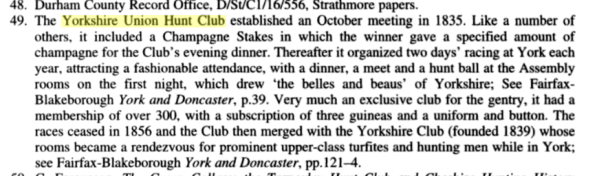
At 23, I have been summat of a sister to Julia, who is sharp-witted but shy in company. She is destined never to marry. At least, there is never any talk of it, not since 1857 and the bachelor’s ball at the Yorkshire Union Hunt Club. So, on fine evenings, I am the one to accompany Julia out riding. We take two bay mares who she says are descended from the Darley Arabian, the daddy of all Thoroughbreds.

I am told I have a better seat than she does, but only by the groom, a Mr. Jack Bell. At breakfast time he likes to call out to me “Mornin’ Milady, grand day i’n’it”- a bit of a jape – and then he laughs showing a great gap where his front teeth should be.

A signed copy of the Voyage of the Beagle lies in a place of honour in Mr. Lumley Hodgson’s private library and has for decades. You can be sure I have never read it, but Julia has and told me all about it. She is the one who had me read Pride and Prejudice. She likes to lend me her favourite novels so she can explain them to me.

Over the years, I have heard (mostly overheard) so much about this Beagle book I feel as if I have read it and even been on the great sea voyage myself to the GA-LA-PA- GOS Islands and seen with my own eyes the strange and colourful creatures there.

Mr. Darwin has lately published another book called, I think, the Origin of Species. A copy arrived by messenger to Highthorne late last year.

This new book of Mr. Darwin’s has caused quite a stir locally. At a Methodist church service a month ago the minister bellowed that Darwin’s theory of evolution is blasphemous. Flippin’ ‘eck! The theory says we all come from monkeys! Mr. Lumley Hodgson – not in attendance – later told the minister that the theories in the book apply only to animals not to humans, but the minister was not satisfied. He said the question of the origin of all species was decided long ago and by an infallible source. He meant the Bible, of course. “God made the animals of the earth after their species as explained by Noah’s Ark.”

So, my Master, who can’t escape this connection with Mr. Darwin now, has decided to quit the farm for a while.

A few days ago he assembled the staff in the south hall and told us he is selling off his best hunters and other stock (including Emma’s comely Cobb pony and his prize Nag stallion) and moving his family to town for the winter. His excuse is that some of his horses have the equine flu (two have already been put down) and he thinks it might be catchin’ to humans.

No matter what the real reason for his takin’ his family to town, the result is that I am left in the lurch with no employment and no place to stay.

But just yesterday, Mrs. L. H. called me into her sitting room, the one with all the paintings of Julia’s frightsome-lookin’ ancestors, and pronounced, “Ann, you must marry Mr. Richardson, the tailor from Rievaulx. He is a respectable man who needs a wife. His sister, who has been housekeeping for him, has suddenly left for abroad. He says he is comfortably settled now in his own cottage and ready to marry and raise a family.”

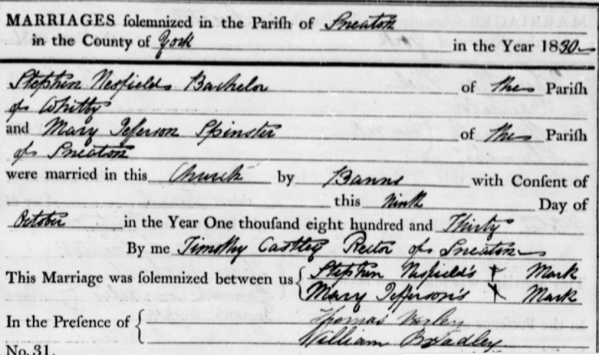
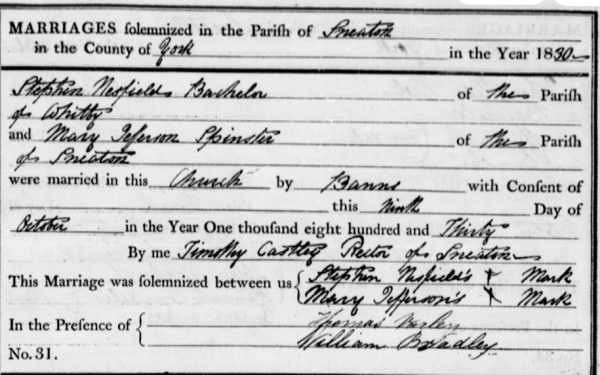
X marks the spot where my illiterate ancestors Mary Jeferson (Jefferson)of Sneaton and Stephen Nesfield of Whitby, Ann Nesfield’s parents, signed their marriage certificate in 1830.)

I must have looked very confused because she continued: “You remember Mr. Richardson from the spring? He waxed ecstatic over your Lamb’s Tail Pie and Tipsy Trifle.” (I did. Seems to me he had eyes for Julia back then.) “He says he needs a wife schooled in numbers to help him keep the accounts. And as Rievaulx is an isolated place, he requires a strong healthy girl who can walk the trails back and forth to Helmsley herself on market day. He is often on the road, so you will not have the use of his carriage as you do here to go to market in Easingwold. Yes, you must marry Mr. Richardson and very soon, too. We can have the ceremony right here in Husthwaite. But first you must visit him in Rievaulx. You can stay at our cousins the Lumleys who have a big farm there.”
So, it is set. My days of making simple Yorkshire meals for a small, ‘appy family in a reet bonnie setting near Husthwaite- and cantering over the dales at darkening with my almost sister Julia – are over.

Highthorne Farm is now a holiday destination, as is Birdsall rectory Manor, near Malton, North Yorkshire where Emma and Julia Hodgson, both unmarried, spent their old age with their brother, Captain Lumley Hodgson, according to 1911 UK Census. Lumley Hodgson’s mother’s relations, the Middletons (Willoughby) owned that place. On that census, Ann Nesfield Richardson was a widow living with her youngest daughter at New Cottage, Rievaulx, running a grocery. She died a year later.

I am off to Rievaulx to marry and make childer with a stranger. Otherwise, all that is left for me is to flit home to Whitby and that I cannot do. My mother is long dead and my father is in line to finish off his days at the workhouse should none of my half-siblings take him in.

Mr. Lumley Hodgson, his ‘ead filled with other worries, has no objections and no opinions on the subject either, although he jokes, “It’s either Mr. Richardson or Mr. Bell for you, I fear.”

But, I ‘ave watched Mr. Bell as he slips the belly-band around the more skittish horses in his care with a firm but gentle hand, keepin’ his voice soft and melodious all the while and I ‘ave noticed how his muscular shoulders glisten after an honest day’s work and I do not think the joke to be as funny as that.

But Jack is a lowly farmhand and Mr. Richardson is a country tailor with a ready clientele and a sweet sunny cottage of his own, Abbot’s Well, with a fine prospect of the Rievaulx Monastery ruins. As I trot along on foot to Helmsley, my poke brimmin’ with dragonwort balm, tansy oil and other home-made potions to sell at market, I can watch from a distance as the Earl of Feversham’s family and friends go a-huntin’ o’er the heathery moors outfitted in all their finery on their own spirited Cleveland Bay/Thoroughbred crosses.

That is the selling point, according to Mrs. Hodgson: The cottage (complete with a little garden for growing my special herbs) and the mannerly profession.

But as Mrs. L. H. was quick to explain, this alliance is a major step up for me. I am but the daughter of a day labourer.

So, I hope Miss Austen is right, that it is ‘best to know as little as possible about the defects of your marriage partner,’ because I know almost nowt about this Mr. Thomas Richardson, except that he enjoys my tipsy trifle. (The trick is to use a lot of high quality whiskey). Still, that is as good a start as any, I reckon.

END

childer: children

Summat: something

Poke: bag

darkening: dusk

reet: very

nowt: nothing

Almost all of the entries for the Lumley-Hodgson’s in the press, mostly Yorkshire press, were related to Mr. L. H.’s businesses, horse and cattle breeding. By the 1870’s he was considered an expert ‘from the old school’ so his curmudgeonly opinions on the ‘horse question’ were much in demand and have left a long paper trail.

Yes, a notice in the paper in August 1861 said Mr. Lumley Hodgson was leaving Highthorne for ‘the health of his daughters.” (The girls were likely not frail, since Julia lived to a ripe old age and Emma was playing competitive doubles tennis in her thirties, I think.) And, yes, a week later, my great great grandmother, Ann Nesfield got married at Husthwaite.

There aren’t many entries in the ‘social notes’ for the ladies of the family despite their good breeding; In 1857, Julia Lumley-Hodgson attended the last? hunt and supper at the Yorkshire Union Hunt Club, (a horse-racing club) where the fashionable young could mingle.

A hunt ball was given in 1867 at Highthorne. And in 1875, Mrs. Lumley Hodgson and Miss Hodgson (likely the much younger Emma) attended a bachelor’s ball in York.

Mr. Lumley-H died in 1886. A notice to creditors was put in the paper, his farm stock, ‘valuable hunters’, and effects put up for auction and his farm “in excellent condition” advertised for let… perfect “for a gentleman fond of rural pursuits.” In 1891 his wife (and girls?) were at Birdsall Manor near Malton (owned by Lord Middleton, a L.H. relation) and Mrs. L.H. was seeking a groom of good character, who must be single to work there. In 1911, her son Captain Hodgson, a widower, was at Birdsall Manor with Julia and Emma, both still single ladies with “private income’ listed where occupation should be.

  1. A few reports suggest Mrs. Lumley Hodgson dealt in fine art. The portait above was owned by her, found on Archive.org in A History of the Works of Sir Joshua Reynolds, Getty Museum publication. The weirdest entry about Lumley-Hodgson was that as an infant he sued his mother, Jemima, for land. Another online entry about Highthorne says he leased it in 1815. He would have been seven!

The Darley Arabian was brought to England from the East by the Alton, Yorkshire branch of Darley’s. Mary was from the Muston Lodge branch. They come from the same family originally.

Hard Life, Beautiful View

The path my 2 times great grandmother Anne Nesfield took to work and marry in 1860 era. People in Sleights tended to stay put until the opening of the railroad in 1840.

My father, Peter, born Kuala Lumpur, Malaya in 1922 of hardscrabble North of England stock, always signed his name Peter N.F. Nixon Esq., something I found a wee bit pretentious. He was just a chartered accountant, after all. The F stood for Forster, the N for Nesfield.

I knew Forster was his mother’s surname. I didn’t know until very recently upon doing his genealogy that Nesfield was his father’s paternal grandmother’s name.

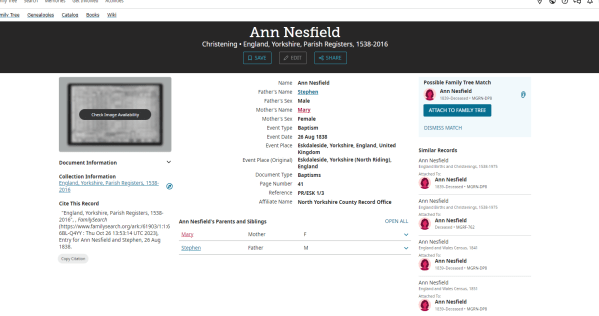
Ann Nesfield, my 2x GG was born in 1838A in Sleights near the lovely coastal town of Whitby at the North East corner of the North Yorkshire Moors to Stephen Nesfield of that place and Mary Jeferson of nearby Sneaton.

Stephen was a labourer. He and Mary were both illiterate as they signed their 1830 marriage certificate with an X.

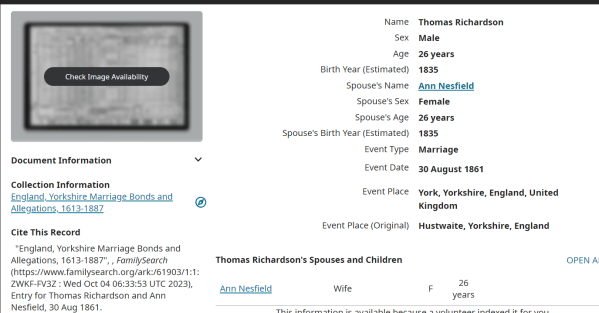
The August 30, 1861B marriage record for Thomas Richardson and Ann Nesfield has them wed in Husthwaite, 40 miles to the south west but still on the Moors. Thomas was from nearby Rievaulx, a small town of 229 people (10 farms and 26 cottages, one school house and no pub) famous then as now for its monastery ruins.

According to the 1861 UK Census, Ann had been working in Husthwaite as a cook at an estate/farm, Highthorne, belonging to one Nathaniel Thomas Lumley Hodgson, Esquire (sic) gentleman horse-breeder who had been a crony of Charles Darwin’s at Cambridge! 3Thomas according to the same Census is living in Rievaulx with an older sister.

Ann and Thomas Richardson go on to have ten children over twenty years with my father’s grandmother Mary-Ellen, 2nd born in 1862, destined to marry one Robert Nixon, a quarryman from the adjacent market town of Helmsley.1

Now, I imagine Ann Nesfield’s existence in rural England post-Industrial Revolution wasn’t that easy despite her initial skilled position as a cook for a small family at a Yorkshire Dales farm/estate. And who can know about her 1861 marriage to Thomas Richardson. Tailors and drapers, especially in small towns, were still solidly working class.

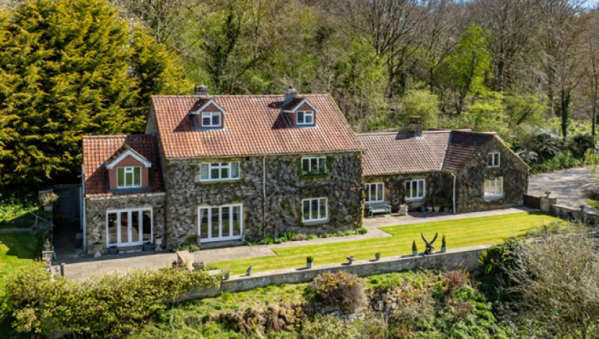
Abbott’s Well cottage today on Northern Living magazine..1,500,000.00 cost. I imagine in the early days it had no extension.It’s up on the ridge in Rievaulx. I didn’t walk up there on my 2024 visit. I knew it was obscured by brush on the roadside. I originally thought it was one of the pretty thatched cottaged down the hill on the road (because it was claimed so on a earlier post online.)

It is also possible Ann married right then out of necessity. It was announced in the 24th of August 1861 Yorkshire Gazette (just one week before Ann’s marriage) that Lumley-Hodgson Esq. was selling off some fine animals and leaving his farm for the winter ‘due to the health of his daughters.’

The view from the garden. Roger Smith. Geograph Project Creative Commons

In the beginning, Thomas and Ann Richardson lived at the Richardson family abode, Abbot’s Well, a cozy-looking medieval cottage in Rievaulx, a town that started out as the inner court of one of the richest Cistercian Monasteries in England founded in 1132. The Monastery was destroyed by Henry VIII in 1532 at the very beginning of the infamous dissolution. New homes were then built with stone from the monastery, homes that were used to house various workers from the nearby Duncombe Park Estate of Lord Feversham.

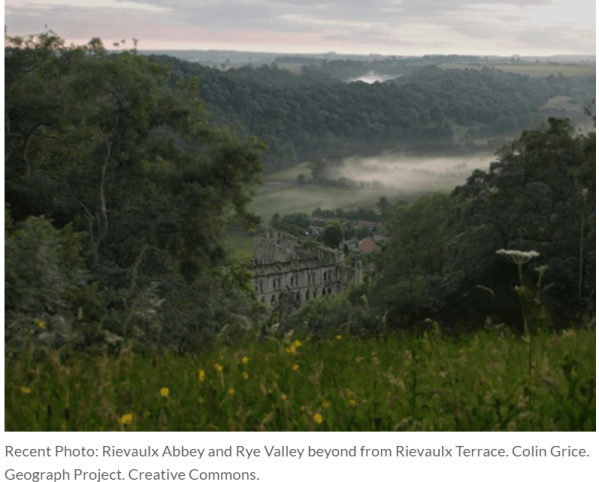
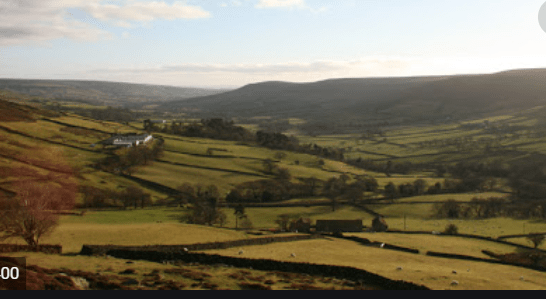
The view from the little garden of Ann’s heritage house, by all accounts, was simply stupendous.

I discovered a 1830’s travelogue online that already describes the town of Rievaulx as ‘quaint’ and ‘picturesque’ and ‘historic,’ claiming the view from the ridge of the vale and ruins “offers a combination of beauties that must be seen to be enjoyed and once seen can never be forgotten.”2

A century later, in the 1930’s, a nephew of the 1st Lord Feversham of Duncombe Park in Helmsley was living at Abbot’s Well House (built 1906 and 30 meters away from the cottage) and Lady Beckett, the widow of the 2nd Lord Feversham, was offering tours of the cottage in benefit of local nurses “with the small garden providing an excellent prospect overlooking the monastery ruins.” Her tours continued well into the 1950’s.

And in May, 1984, the London Times remarked upon a recent sale of the modern Abbot’s Well House. “That a view is worth something is proved by the recent million pound plus sale of the modern Abbot’s Well with a two acre garden that has a view of the 12th century abbey and the Rye Valley beyond.”

I have to wonder, in the 1860’s, did Ann’s heart sing out every time she went out to hang the laundry with my great-grandmother, Mary-Ellen, at her feet? Or did she lament the leaky roof, drafty windows or the lack of bedrooms for her growing family? Was living beside these majestic monastery ruins a comfort to her or merely a haunting reminder of how things can fall apart?

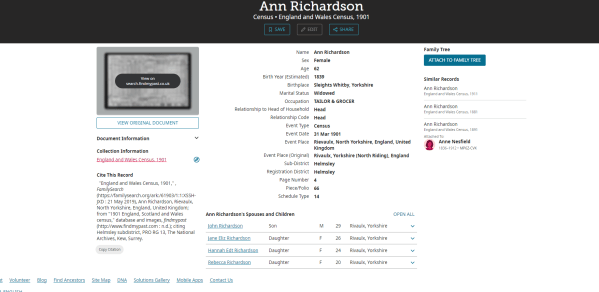
As it happens, the Richardsons did move out of Abbot’s Well sometimes after 1881 and before 1891, but they did stay in town. The 1891 UK Census has the family living at New Cottage in Rievaulx, with Thomas still a tailor and draper but also, now, a grocer. The 1901 CensusC has Ann a widow with four grown children still at home, one son working as a general labourer but three girls in their twenties performing “home duties.” Ann is now the tailor/grocer in the family. In 1911, one year before her death at 74, Ann is still at New Cottage, working as a grocer and living with her youngest daughter who is 30 and married.

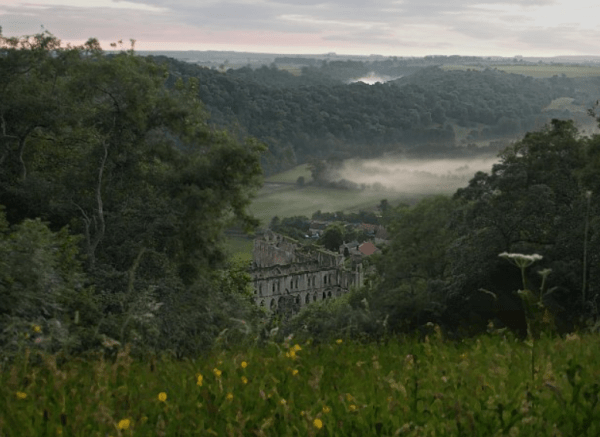
Recent Photo: Rievaulx Abbey and Rye Valley beyond from Rievaulx Terrace. Colin Grice. Geograph Project. Creative Commons.
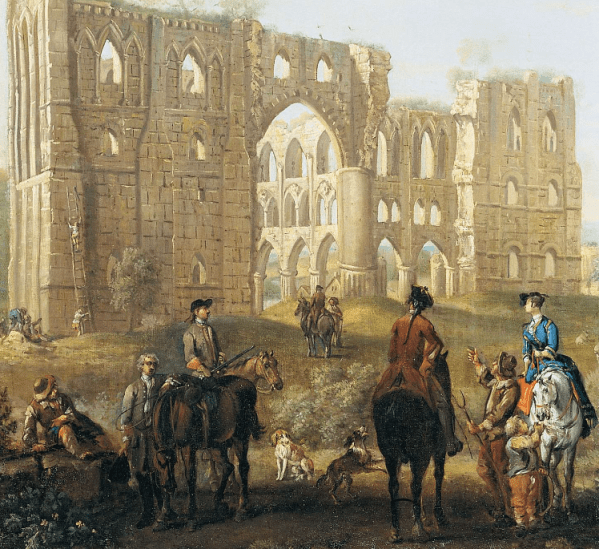
Duncombe Hunting Party. 1728. John Wooten. Yale Collection of British Art. Creative Commons . My ancestors would be the labourers in the background or the scruffy attendants:)

My father’s working-class ancestors lived in picturesque towns all along the route from Whitby to Helmsley; pretty places with colourful names like Goathland, Kirbymoorside and Ugglebarnby. Whitby, where Ann Nesfield lived her early years, is also a North of England beauty spot from what I see on YouTube with surrounding coastal villages as lovely as anything in Italy’s Cinque Terre.

So, although little of consequence about Ann Nesfield’s life can be gleaned from the genealogical record, one thing about the woman cannot be denied. She spent her entire existence surrounded by the breath-taking beauty of the North Yorkshire Moors. That, I think, has to have taken the edge off her own hard-scrabble existence.

Notes:

Thank you to the Ryedale Family History Group for all their kind and expert help and especially to Valerie Slater for helping me sort out the many Ann Nesfields in the Whitby area born circa 1838.

(Apparently, there’s a lot of mix up over these Anns in online family trees. I have to redo part of my tree, now! And it doesn’t help birth dates on the UK Census are only guesstimates 🙂

A walk around Rievaulx Terrace National Trust: https://www.bing.com/videos/riverview/relatedvideo?q=youtube+a+walk+around+rievaulx+terrace&mid=7CB260977EE2F240F3D27CB260977EE2F240F3D2&FORM=VIRE

  1. Robert Nixon Sr, my great grandfather, 1863-1937, who married Nesfield’s daughter, Mary Ellen Richardson, was a delver in the quarry in 1911 according to the UK Census, but he had other occupations. I know because I found his short obit from 1937 from the Yorkshire Post on the British Newspaper Archive database:

“Mr. Nixon was for man years foreman timber leader with messrs William Frank and Sons and with Mr Bentham King. Later worked for the Duncombe Park Estate, and during the war was put in charge of the felling of timber at Waterloo. He was a Sunday school superintendent and a local preacher in the Methodist circuit for over half a century.”

The 1921 census says Robert is working as head quarryman at Duncombe for the Trustees of the Earl of Feversham who was under age. The former Earl had died in 1915 in the war.*I wonder if the Nixons had an IN with the Earl? A Nixon and a Richardson were pallbearers at the Dowager Feversham’s 1889 funeral.

2. Ross, Stephanie. The Picturesque, an eighteenth century debate. Journal of Aesthetics and Art Criticism. 1967

Esquire: Modern British. Polite term as appendix to a surname of someone without any other title implying genteel birth. Earlier, for English gentry rank below a Knight.

3. Both Darwin and Lumley Hodgson were ‘admitted pensioners under Mr. Shaw 1827. at Christ’s College a Divinity School.” Apparently, nature studies and divinity studies were considered compatible back then, as in ‘all God’s creatures.” Both graduated in 1832, although Darwin completed his exams in 1831. The Darwin Archives of Cambridge contains a January 1831 letter where a friend is asking Darwin if Lumley Hodgson has passed. “I don’t see his name anywhere, I am almost afraid to ask.”

Nesfield Rugby genes. My father’s nephew 1973, Rugby for Cambridge and England. My father, co-captain, 1939 Rugby for St Bees School Cumberland. My grandfather, 1912 Rugby for Duncombe Park where he was a footman. Through DNA I discovered other Ann Nesfield descendants played rugby for Scotland.

CITATIONS

A: Ann Nesfield Baptism 1838 Family Search
2. Ann’s marriage to Thomas Richardson 1861 Family Search
C: 1901 Census. Ann at Home running the family business with her girls.

The unwed moms of the North Yorkshire Moors

Ye Olde Homestead: Farndale, Yorkshire moors. Farndale-holidays.co.uk
To see other notable landmarks, including Castle Howard visit https://farndalecottages.co.uk/out-and-about/heritage/

While cobbling together my fathers’s family tree 1, I discovered that his paternal Nixon line2dies out in 1834, when Robert Nixon is born in Marton, North Yorkshire, taking his surname from his mother, Hannah Nixon of nearby Kirkdale. Their reputation is redeemed five years later in 1840 when Hannah marries Christopher Neesam of Osmotherly shortly after she gives birth to a second child, a girl.

There’s no record of Robert’s birth or who Robert’s real father is – and, thanks to further research, I think I know the reason why.

Judging from my father’s family tree,unwed motherhood was not unusual among these Yorkshire farmers.

Church records from rural Yorkshire in medieval times and beyond back up my observation. They reveal that unwed mothers were, indeed, commonplace even way-back-when and the number of unwed mothers in that place only increased over the next few centuries, most notably in the northern ridings.3

As it happens, Yorkshireman Robert Nixon, Hannah Nixon’s illegitimate child, gets married in 1857 to a kindred spirit, Martha Featherstone. Martha, too, had been born out of wedlock in 1835.

Martha’s mom, Mary Featherstone of Pickering, like her mother-in-law Hannah Nixon Neesam before her, gets married a few years later, in 1840, to one Joseph Shaw. 6

Oddly, the DNA cousin matches/tree matches suggest my father is related to both Joseph Shaw and Mary Featherstone,* so this could be a case of a very delayed marriage, for whatever reason.

Maybe that is Hannah Nixon’s case, too. However, I’ve yet to find any Neesam DNA connection to my father’s tree.

In the small town of Rudby (7 miles from Marton, just north of the moors) as much as ten percent of women had children out of wedlock in the early 1800’s. These unwed mothers were stigmatized not only for religious reasons but because they were costly to the town. Sadly, the ‘bastardy wages’ paid to these mothers didn’t do much to end their woes or improve their children’s prospects. An illegitimate child was twice as likely to die in infancy as a child with legal parentage.

Local authorities in Rudby believed that most unwed mothers were the result of ‘courting couples’ where the young man involved was simply marriage-averse, sometimes preferring jail time to tying the knot. It didn’t help the situation, they said, that many unmarried tenant farmers were content with their ‘live-in’ servants (sic).

Modern scholars examining these same records acknowledge that adultery and incest (and, let’s face it, rape) inflated the number of unwed mothers in England but, they think, not to any great degree.4

Grim history, indeed, but my research findings do get brighter.

According to another source5, unwed mothers in the country did have it better than their counterparts in more urbanized areas. A more stable population likely made for a better support system for these women.

In fact, unwed mothers in 18th and 19th century rural Yorkshire weren’t even expected to name a father. A gal in the family way just told her own mom who gathered up her hat and shawl and headed out to find an eligible young man to take the bio-father’s place. (Practical people, those Yorkshire farmers.)

Unwed mothers were also protected by the old Norse superstitions still adhered to by many. One of these superstitions maintained that pregnant women had magical powers, so they were not to be crossed.

The workhouse in Helmsley, hometown of the Nixon clan from the 1800’s onward. Unmarried mothers might end up here to pay off their ‘bastardy’ support, where they were allowed to nurse their child but twice a day. 3

.

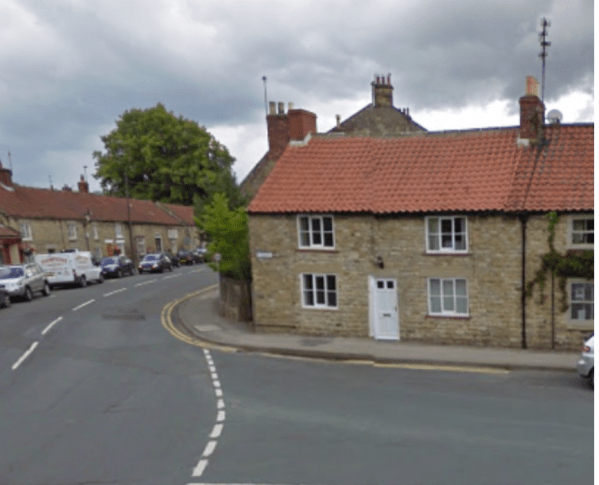
The street in Helmsley where the Nixons lived in 1911. My grandfather, Robert Nixon, was born here in 1890. In 1911, he was a footman at Duncombe Park. Supposedly he got a girl pregnant right about then so he was sent out to Malaya in 1912 to be a planter. Family myth says this woman was either a fellow servant or the Earl’s daughter. Considering the high cost of going to Malaya in the day and that posts in Malaya were given out to sons of richer men, I suspect the woman was from an important family. This would have made a great sub-plot on Downton Abbey, a fictional story that unfolds in the same area.

1. I admit that I mostly used other people’s research to compile my tree. My father, a child of the Raj, told me little about his British roots. The only information I had to go on was that his mother’s father was a Methodist minister and that some of his ancestors were hanged for sheep stealing. See Border Reiving Ruffians. Also see Dissenters and Poets.

But after I compiled his tree with ancestors from places like Helmsley, Farndale and Appleton-le-Moors, I discovered, through DNA, that the ‘cousin trail’ matches on Ancestry supports the tree, 100 percent, at least for the first few generations. My father has matches both in centimorgans (dna) and tree with people on all branches of the tree.

Let me give you one example: When I discovered, using a stranger’s tree, that my father had a great grandmother, Anne Nesfield from Sleights, this explained his rather silly middle name to me. My father signed his name P N F Nixon, as in Peter Nesfield Forster Nixon.

The Nesfield clan of Ugglebarnby etc. Yorkshire is a well established. My father is a close genetic match with someone else with this Anne Nesfield in his tree. These genes make great rugby players as both sides have world-class players.

2. In genetics, the male Y chromosome haplogroup (or set of common alleles passed from father to son) is a much valued tool used by historians and ethno-anthropologists to track historical population movements back to the bronze age and even farther. All haplogroups are assigned letter and number signatures. My Yorkshire father Peter Nixon’s Y dna haplogroup is I1 Z63. I1 is the most common haplogroup in Northern Europe.

Apparently, my father’s Z63 subgroup dominated Northern Germany before the arrival of Charlemagne (who infamously lopped off the heads of thousands of male Saxons) and has has deep origins in Jutland (Denmark). Yorkshire is the most Anglo Saxon region in all England.

3. Hastings, R. P. Poverty and the Poor Law in the North Riding of Yorkshire: 1780-1837. Unwed mothers often had to repay their bastardy wages by employment in the Workhouse. In Victorian Times in Helmsley, as recommended by the authorities, mothers in workhouses were permitted to nurse their children only twice daily. The infants’ diet was supplemented with ONE meal of cow’s milk sweetened with sugar.

4. ibid ( That seems odd to me as I know that Emmeline Pankhurst turned to woman suffrage advocacy when she saw so many young teen patients in her husband’s Manchester clinic who were pregnant by incest.)

5. Gillis, J.R. For Better For Worse: British Marriages from 1600 to Present.

6. There is no birth record for either Robert Nixon or Martha Featherstone. Census records are what the genealogies go by.


My father’s ancient heritage on mytrueancestry.com.

I found this on Youtube, an interview with Tamara Hoggarth, born 1860 in Marton. (The poster says “She’s speaking English, I promise.” According to his blurb, she also had an illegitimate child before marrying

Here it is

My Grandfather, North Yorkshire and Discobulus

VenusandAdonis

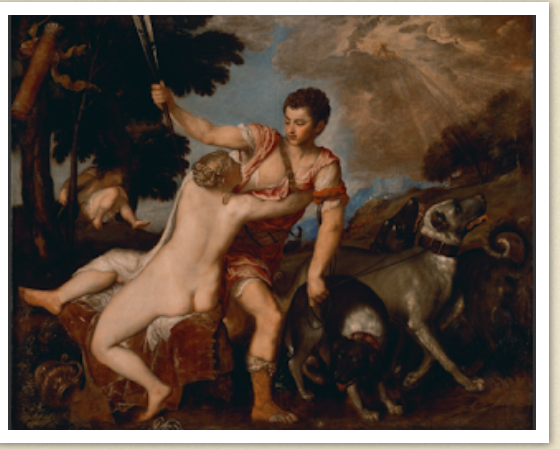
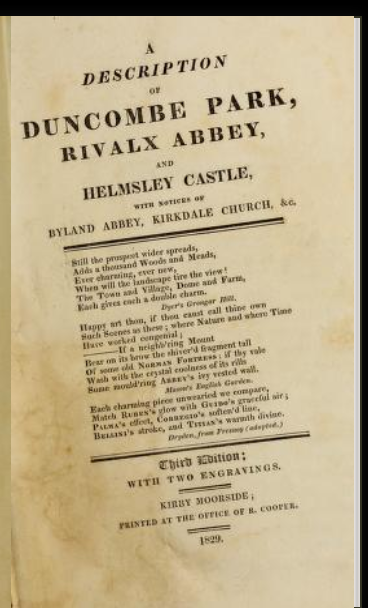
Venus and Adonis by Titian. This Renaissance painting is now at the Getty Museum in Los Angeles but it once graced the Hall of Duncombe Park in Helmsley, North Yorkshire. I know this because of a precious little volume from 1829 I found on archive.org, A Description of Duncombe Park, Rivalx Abbey and Helmsley Castle.

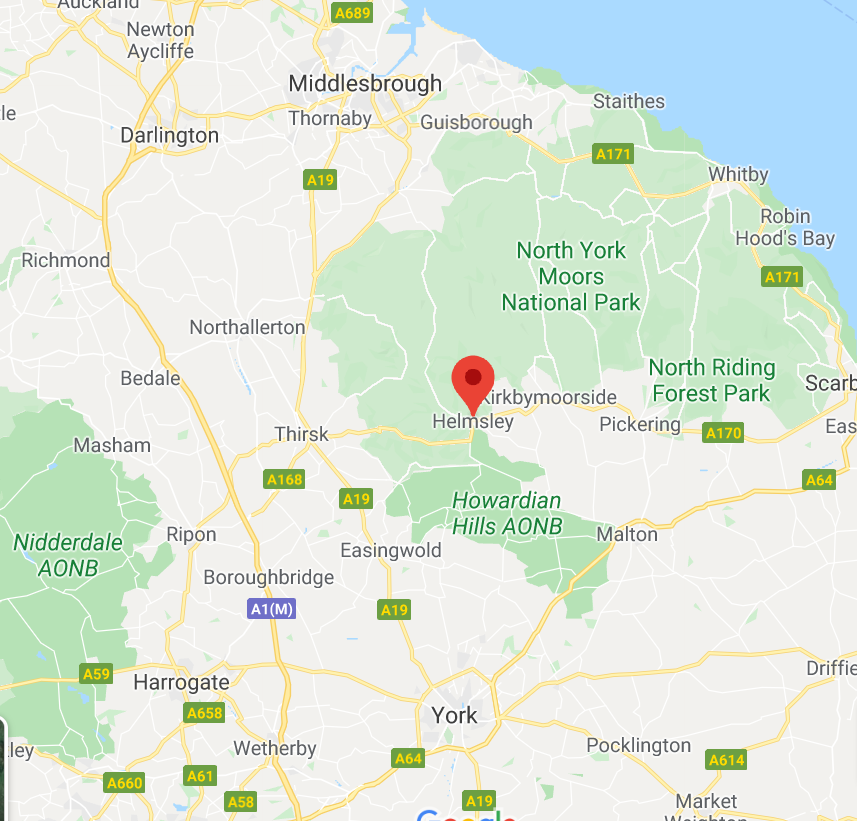
As it happens, my father’s  paternal ancestors are from Helmsley, today a picturesque market and tourist town on the River Pye in the Ryedale District.

helmsley

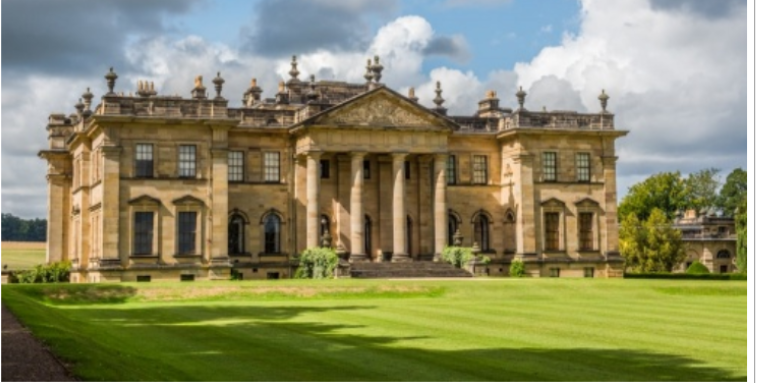
Duncombe Park  was once an imposing structure in the Doric style built in 1718 overlooking Helmsley Castle not far from Thirsk where the vet who inspired All Creatures Great and Small worked. It was the seat of the Earls of Feversham.

My grandfather, Robert Nixon (1890-1967), was born to Robert Nixon Sr. and Mary-Ellen Richardson.

helmsleynixonhouse

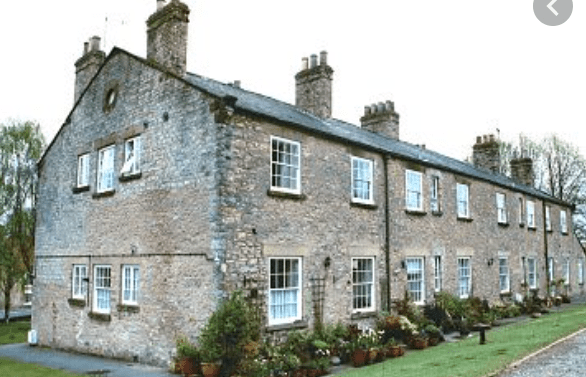
This stretch of very unimposing row houses is where the Nixons lived in 1911, according to the UK Census.

Abbott’s Well today, Northern Living Magazine on sale for 1,500,000! I’m guessing that it was smaller back then with different windows.I wonder if it had a thatched roof like many other Rievaulx homes.


 Mary-Ellen was from nearby Rievaulx, a village famous for its cathedral ruins. She was born in Abbot’s Well, a large cottage on the ridge.  Her dad was a tailor.

RobertCENSUS

According to this census, Robert Nixon Sr. was a delver in a quarry in Rievaulx in 1911.

The same census page says my grandfather, Robert Jr.  21,  was a footman, likely at Duncombe Park. Robert was a strapping 6 foot 4 inches tall. The gentry liked their footmen to be fine physical specimens, but this was not always a good thing if Nixon family lore can be counted upon.

According to an English ‘auntie’ of my  father’s, the daughter of ‘the local earl’ went ga-ga for young Robert back in the day, so the love-struck girl’s powerful father sent him away, far away to Malaya.

I have no picture of Robert, but I recall seeing one decades ago and he looked like my dad, Peter.  So here’s a picture of Peter in 1958 holding our new puppy, Spotty, a coonhound. My father was also 6 foot four inches tall.

father

This might be true: posts in Malaya were for the children of well-off families, not delver’s sons. However, a Nixon cousin told me his mother told him Robert got another servant pregnant. Nothing earth-shattering in that, though, is there?

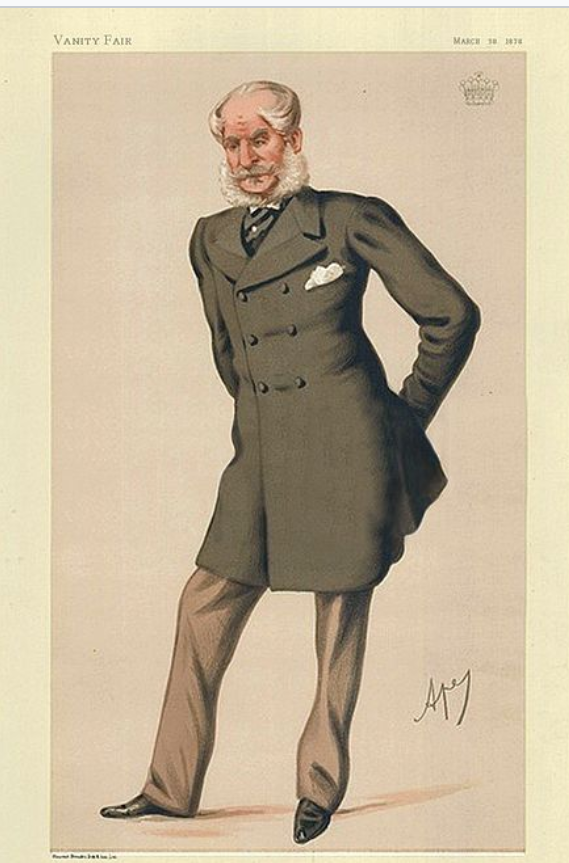
I see that the sitting Earl of Feversham had only very young children. he would die in the war and Robert Nixon Sr. would work for the trustees of the under-age Earl. This is a Vanity Fair pic of the first Earl of Feversham from Wikipedia.

Lord Feversham 1829-1915

According to travel records, my grandfather, Robert,  took a boat to Malaya (willingly or unwillingly) in 1912 to work at a rubber estate in Klang, Selangor.

He returned to England after WWI to marry my grandmother, Dorothy Forster, from County Durham, whose father was an itinerant Primitive Methodist preacher posted in Helmsley between 1912 and 1914.

MRsDOROTHYNIXON

Dorothy followed him to Malaya in December, 1921 and my dad was born ten months later on October 24.  Robert later became Manager of the rubber estate.   Both my grandfather and grandmother were interned at Changi Prison during WWII.

According to the 1829 book, Duncombe Park was  home to a treasure trove of classical paintings, among them the Titian shown at top, but also a Da Vinci, a Reubens, a Rembrandt  as well as Discobulus, described as ‘the finest statue in England.’

My grandfather never did get to see these great works of art in person because most were burned in a fire in 1879.  Back then, some of these paintings were worth five thousand pounds.

The Discobulus and the DaVinci work were lost in the fire but Titian’s Venus and Adonis was saved to eventually find its way to California and the Getty Museum.

Duncombe was rebuilt in the Baroque Italianate style and used as a backdrop to the 2012 British mini-series Parade’s End, with Benedict Cumberbatch.  I love that mini-series, so it is all very appropriate.

Duncombe

Dunscombepark1