Lately, I came into possession of a family heirloom, a book of poems, that allows me to see deep into the heart and mind of one of my great grandfathers, a rare gift for a genealogist.
I didn’t inherit this book from a relation: I got it off the Internet! And it took quite a few years for the book to find its way home.
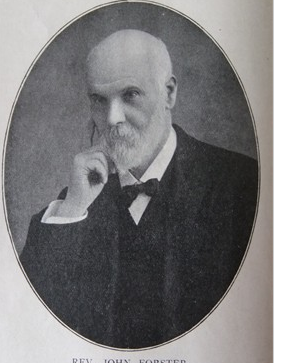
Initially, I knew just two thing about the Reverend John Forster (1850-1926) my dad’s maternal grandfather. He was a Methodist minister and he developed dementia later in life. The story goes: one night he woke his wife of many years and asked, “Woman, what are you doing in my bed?” My grandmother, Dorothy Forster Nixon, told my mother the serio-comic story when she visited us in Montreal in 1967.
When I started researching John Forster’s life in 2017 (fifty years later!) for a story on this blog, it took me all of ten seconds to find out a lot more about him. The Primitive Methodists have a comprehensive website with bios of former Ministers.
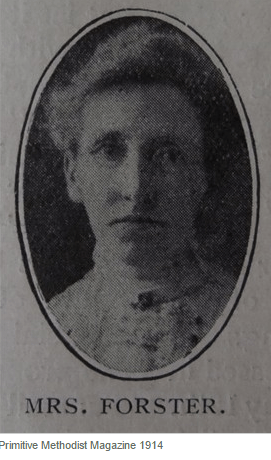
According to John Forster’s bio there, he was the son of a Northumberland farmer; he joined the PM church in 1874 after attending a revival; he was very well read but never ‘paraded’ his knowledge; he married twice, my great grandmother Emma Cowan being his second wife; he had four children, a son by his first marriage and daughters, Agnes, Norah and Dorothy with his second wife.
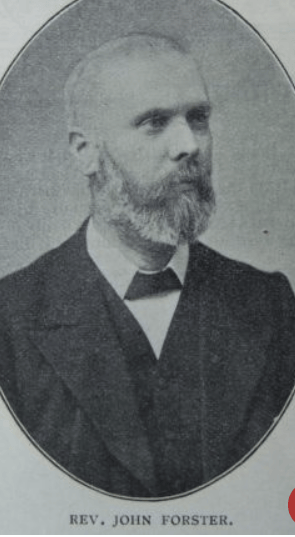
Apparently, John worked the evangelical circuit for forty years, from Carlisle to Sunderland, two years here, two years there. My grandmother was born in 1895 in Middleton-on-Teesdale, County Durham.
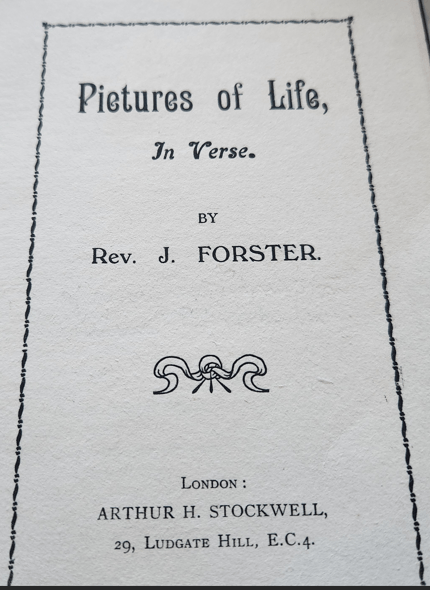
John also wrote articles and poems for the P.M. Connexional Review and other venues and he had a book of poems, “Pictures of Life in Verse” published in 1923. Apparently, these poems contained ‘lyrics of extraordinary charm and grace.”
Boy, wouldn’t it be fun to read these poems.
I immediately contacted the website manager. Yes, they had a library but the book was lost.
I checked the Internet, no luck. (The book was available, however, at the British, Scottish and Welsh national libraries.)
So I wrote my two pieces about Reverend John without any samples of his poetry.
For some reason, just the other day, I tried again. This time, I found Pictures of Life in Verse on Abebooks at an antiquarian bookstore in the south of England.

According to the blurb there was an inscription in pencil on a front page. Could this inscription be by a family member, I wondered. Could this volume be a genuine family heirloom about to come home to me? I filled in my credit card info and pressed “purchase.”
When the little brown volume arrived, I immediately checked and, well, maybe the inscription was pencilled in by my great aunt Norah, but if she wrote this she spelled her name wrong.
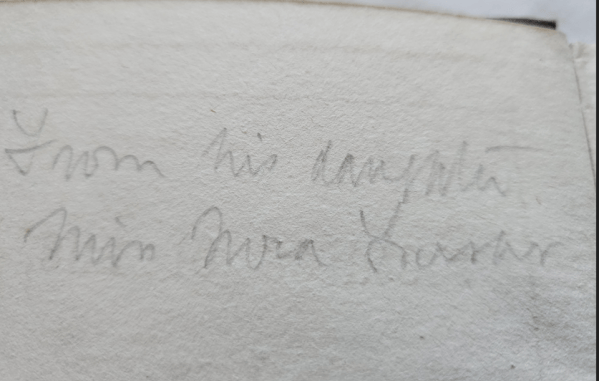
(It is likely someone else wrote this, not Norah. She too got dementia. She was a concert pianist and school music mistress.)
Whatever, this volume of sacred and profane romantic poetry published over 100 years ago is a true family treasure.
That night I perused the twenty or so poems in the book and, yes, I liked them very, very much. They are, indeed, charming as well as thoughtful.
It seems that my great grandfather saw God in nature, not surprising for someone whose vocation brought him up and down the sun-dappled Dales and brooding Moors of Northern England.
A couple of snippets:
The bee makes love to all the flowers-
White and Yellow and Blue and Red –
He woos them all for hours and hours,
And kisses them all ere he goes to bed.
….
Seems Gillimoore village, with nothing to show
To mark it off from a hundred such,
Hardly distinguishable each from each.
Then, all in a flash, the purple sea
Of heathers before you so gloriously;
Acres and acres, and miles on miles,
Northword the August moorland smiles.
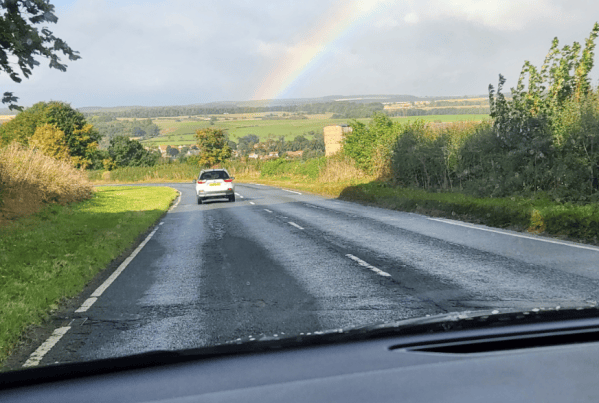
(Driving into Helmsley. We visited North Yorkshire in September 2024. Later, we drove to Whitby through the moors and they were, indeed, glorious.)
Rev. John was clearly an empathetic man, too, a good thing for a Minister.
Mother and Son (abridged)
My boy’s alive, but he’s dead to me;
Was it but yesterday that he
Sat on my lap and stood on my knee?
…
He talks to me of things afar,
Which unto him familiar are,
To me remote as any star.
…
He talks of politics and laws,
Of human rights and the people’s cause,
In a ready way, as one who knows.
Is this poem about John’s relationship with his Mom? She was a farmer’s wife and John left to join the Primitive Methodists who helped organize early labour unions in the UK. Even though many of their followers were illiterate, their ministers had to take probationary exams on many ‘abstruse’ subjects. (John’s adjective.)
Yes, John’s working class flock was made up of simple people, miners, farmers and factory workers, and some poems in the collection are about tradesmen. Here a postman performs his duties oblivious to the joys and heartbreak he brings to people on a daily basis.
The Postman (abridged)
In a coat of blue with facings red,
And a stiff-peaked cap upon his head;
Across his shoulders a canvas bag,
With parcels and letters all asag…
…A careless-hearted Mercury he
To carry the fiats of destiny
Down the street from side to side,
Whistling he goes with hasty stride.
Another romantic poem about the simple life is called The Stone-breaker (abridged).
He rises early to his toil,
He breathes the fragrant morning air,
Released by evening with a smile,
He goes to bed without a care.
Having the sun he needs no clock,
His carpet is the turf so green,
The passing shepherd and his flock,
To him are good as change of scene.
According to the UK Census, my father’s paternal grandfather, Robert Nixon was a delver in a quarry in Hemsley, North Yorkshire in 1911. Reverend John was posted in Helmsley from 1912 to 1914. Could this poem be about Robert? Robert’s son, also Robert, a footman turned Malayan planter, and John’s daughter, Dorothy, married in 1921. She moved to Malaya to be with her new husband. (Robert Sr. according to his 1933 obit was also a lay Methodist Minister and a forestry/mill superintendent during WWI.)
Here’s a poem where John Forster wonders if penning poems is a vanity exercise – or a therapy of sorts.
The Bard’s Dilemma (abridged) “with apologies to the Shade of WS:”
To write or not to write, that is the question.
Whether ‘tis nobler in the bard to suffer
The stings and itches of his vanity,
Or to take a pen, and shed a sea of ink,
And by composing end them.
So, he is plagued with self-doubt but has a sense of humour about it.
In his poem The Inexpressible (abridged) John suggests that logic and intellect hinder true understanding.
“ Of give me a speech
To learn and to teach,
Not things that are wrought
In the smithy of thought.”
So, even more self-doubt, here. Is book-learning a waste of time?
The poem, Insomnia (abridged) seems personal:
I lay me down, I lie quite still,
Sleep surely will not stay;
But now the minx o’er yonder hill
Peeped, laughed, then ran away.
She is a maiden coy and shy,
Affrighted by a stare,
And so I close my eyes and try
To catch her unaware.
These days they understand there is a connection between lack of sleep and Alzheimer’s. As it happens, my father also succumbed to that disease and he, too, was an insomniac. (My mom said his insomnia was ‘because of the war.’)
Which brings me to my very own revelation on the Moors: As I reflect on these ‘romantic’ poems, written by my very down-to-earth North of England great grandfather, I realize that I am not merely looking into the mind of the Reverend John Forster, Victorian Age Primitive Methodist Minister. I am seeing deeper into the mind of my own father, Peter Nixon.
My father, born in 1922 (the year T.S. Eliot penned the prophetic The Wasteland, turning naturalism and romanticism on its ear, was an Oxford rugby star, RAF pilot and reluctant chartered accountant. But he was never more himself than when he was remarking on the shape of a flower or behavior of an insect on the many nature walks he took me on, and he did this in a child-like way I could relate to. He may not have resembled his maternal grandfather John Forster in physiognomy or frame, (physically he took after the rugged, sporty Nixon side) but he was most decidedly the Reverend John in character! He was a simple, gentle, thoughtful person who could not abide city living.
That I cannot deny as I read these old family poems. What a revelation, really. What a gift to me.
Five complete poems, three possibly autobiographical and one that proves my great-grandfather didn’t let Darwin’s theories get in the way of his faith.
The Road on the Hill
In a gray house, in a lone dale,
Beside a brawling burn,
Which babbled strange things to itself,
With many a leap and turn,
We lived, my brother Jim and I,
And many a summer’s day
We spent, beside the idle burn,
The idle hours in play.
And still two things we wondered at,
That always were in sight,
The turnpike winding round the hill
And the hill’s towering height.
We saw the people walk the road,
From hour to hour they sped,
We saw them vanish round the turn,
And knew not where it led.
We looked up at the towering height,
In childish wonder fond,
We knew so well the hither side,
But not the side beyond.
Jim’s feet have never trod that road,
Which once he wondering eyed,
But he has trod the mystic hill,
And seen the other side.
And I have trod the turnpike road
And turned the curving hill,
But the dark mountain’s farther side
Is secret to me still.
‘Tis I have seen beyond the bend,
And he the summit’s path,
For I have walked the road of life,
And he the road of death.
The Simple Life
The eldest is off on the train
The next one is singing within,
The youngest two skipping outside,
Oh hear you their quarrelsome din?
O happy the man with a wife,
Of happy the wife with the child,
And grandmother’s too can enjoy
The live that is lively and mild.
Of life that is simple, and free
From the cares that environ the great;
The health and the peace and the love,
The small but sufficient estate.
The joys that are natural and pure,
the Cares so eventless and calm,
The aims that are wisely defined,
Contentment that falls like a balm.
O think of the joys that are lost
In fretting for things we have not,
O think of the bliss we may find
Enjoying the things we have got.
We will build a neat house for ourselves,
On the slope of the sun-fronting hill;
In the winter with books on our shelves,
In summer a garden to till.
And, then, when the evenings are sweet,
In the long, lingering, sad Autumn time,
If the old mood romantic comes back,
Perhaps we may jingle a rhyme.
And there let us live, let us die,
Satisfied with the things of our lot,
On earth, if remembered on high,
Content to be quickly forgot.
(Me: Not so quickly, after all!)
The Worm Track
How very curious as I sit,
And scratch my name upon a stone,
That I by accident should hit,
Upon the work of one long gone;
A worm, who wriggled, blind and prone,
In the wet sand with motion slow,
And left his track so plainly shown,
Long, long ago! Long, long ago!
That sand is stone, and now when split,
Revealing what is marked thereon,
I see Time’s long procession flit
Past me me in many a vague aeon;
And think, “Time has been long begun
When that work made his markings so,
And earth even then had ancient grown,”
Long, long ago! Long, long ago!
Of their descent, more than a bit,
Men boast in supercilious tone;
Behold a worm’s, compared with it,
What have they got to boast upon?
His proof of long descent is drawn
Upon the rock without a flaw;
His ancestry goes back, you’ll own,
Long, long ago. Long, long ago.
My Wife and I
My wife and I have but one mind;
Like vessels filled from each other’s o’erflow,
All our thoughts pass too and fro,
For we’ve everything in common you know.
The bits of gossip, but nothing unkind,
‘Tis so nice, when I get home at night;
Feet on fender in the firelight,
To tell her them all; all the odds and ends
Of news picked up among my friends;
What one has said and another done,
And the last good tale that made such fun,
And all the happenings of the day.
To my wife alone be sure to tell,
The secret I was to guard so well;
For we’ve but one mind between us you see,
She is I and I is she.
When I get home, where we go to bed,
I’ll tell her this, to myself I say–
For I forget—alas, she is dead.
John’s first wife, Mary Chaytor appears to have died in childbirth. The Primitive Methodists supported women’s equality, suffrage etc and they allowed women to preach! It is likely John’s second wife, Emma Cowen, helped him out, perhaps even taking over the pulpit when he was indisposed. Farming wives, of course, have always worked alongside their husbands. The children too for that matter.
The Worker of the Future
He sings as he toils to the joyful tune
Which life beats out in his heart and brain,
He sings as he toils as the lark soars in June,
For his soul exults in the fight and strain.
He sings as he toils, for toil is sweet
When the sense is keen and the soul is free;
When strength has winged the hands and the feet,
And health in the veins is melody.
He sings as he toils for the fruit is his own,
The artist’s joy and the maker’s pride
Are his are the products shaped and grown,
And he walks the earth with the freeman’s stride.
He sings as he toils; his song of praise
To the Maker of all good things is paid;
Who made Man his helper, His good to upraise,
And perfect the world Himself has made.
(The Primitive Methodists worked to improve working conditions for the average man and woman.)
Afterward: I have written stories about my grandmother Dorothy Nixon here on GE. A Terrible Beautiful Life and The Jungle Librarian.
John’s poems, showing she was a middle child with a much older male half-sibling, also help to explain her character and that I’ll tackle in a future essay.