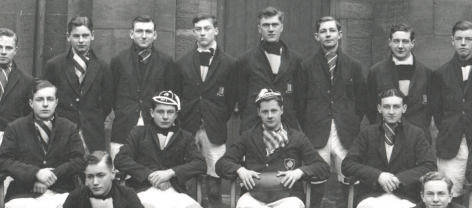
St Bees Senior Rugby XV 1939. Courtesy of St. Beghian Society website.
I am so far ahead, now. I can stop for a cigarette. We’re not allowed to smoke in front of the junior students.
The rugby match with the Geordies wears heavy on my mind, to divert from the other… They are tough, those townies, built low to the ground, built for rugby and the claustrophobic confines of the coal mines.
I am Vice-Captain of the Senior XV, so it is a big responsibility. To lose to them would be an indignity, and yet they are so very hungry to beat us.
I draw on my unfiltered Player’s Navy Cut cigarette slowly, glacially, to try and stop time to stop thinking about my – our- uncertain future.
But before I get two drags, I hear the sound of someone huffing and puffing his way up the grassy path toward me, a small boy, a freckled red head. It’s Cowen, one of the new fellows, the asthmatic, courageously plodding toward me
I have to ditch this ciggy fast. I toss it into the grass.
At the same time, the same grass rustles under my feet and I instinctively jerk to once side like a silly sock puppet. Did the boy see me?
Yes, he did. ‘Are you afraid of snakes?” asks the boy, through his wheezes, in a non-judgmental matter of fact way.
I don’t answer.
“You were smart to get out of the way,” the boy persists. “It might be a poisonous adder. They can be found in a variety of habitats, including fields, meadows, hillsides and moors as well as coastal dunes.
“They have a grey or brown coloured body with a zigzag pattern along their back. Harmless grass snakes are mostly found in wetlands. They need frogs to eat.”
This Cowen boy, one of the new group from Mill Hill School in London that is being turned into a wartime hospital, is a small, copper-topped encyclopedia of nature, it seems.
“How do you know all this?” I ask Cowen. Mother’s mother is a Cowen from Bishop Auckland in Durham. The Cowans were shopkeepers, mostly. Or they worked in the lead mines in Alston, Cumberland. Could we possibly be related? Well, we are all related around here. Especially the Border Reiving families: Forster, Nixon, Kerr, Armstrong, Bell, Johnson, Elliott, Graham, Scott.
This small wheezing boy replies, “My father told me.”
“I am afraid of snakes,” I admit to the younger boy. His naïve self-confidence has made me lower my guard.
“But, I have good reason to be, “ I add, squinting menacingly at him. I was born in Malaya and by the time I could walk I learned to watch out for the meter long orange necked keelbacks or die an agonizing death on the spot.” I grab my throat with both my hands and pretend to squeeze, bugging out my small blue eyes.
“I don’t know about Malayan snakes,” the boy soberly continues, unimpressed by my histrionics. I may be a member of the Shakespeare Club, but I am no accomplished thespian.
He continues.“ I know a bit about Indian snakes. I’ve heard stories.”
“Are you a child of the Raj as well?” I ask him with genuine interest.
“No, my father is a civil servant in London. Foreign office. But he loves the outdoors. He takes me to Northumberland every summer on camping trips. While Mother visits her sister in Kent.”
This is getting far too personal, so I change the subject.
“Where are the others?” I ask authoritatively because I am supposed to care.
“They stopped to raid the gulls’ nests even though I told them only a few gulls will have laid by now. As the smallest in the group, I knew they’d want to dangle me over the cliff to grab the eggs, so I just kept on running. My lungs are burning.”
The boy admits this with no embarrassment, this plucky new boy with the asthma and caring father.
“We’ll never make it to the lighthouse at Whitehaven, at this rate,” I say, not that I care.
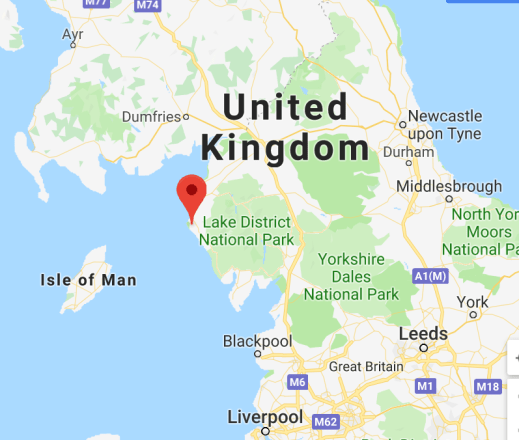
St Bees on the Coast of Cumbria.
“Too bad. I’d like to see the radar installation. If the war persists, I will likely be put in radar. I am a math’s major.”
I hardly hear him. The mere idea of fried eggs, however sketchy the source, thrills me. I am starving, what with these new war time rations.
“It isn’t like being in the Air Force,” he continues, “ but radar is important to catch the German subs when they attack. It’s too bad this war will be over soon, because I would like to work in radar, scanning for enemy submarines.”,
I had forgotten about the radar station at the lighthouse. I too am a math’s major destined, they tell me, for a desk job in statistics. But I have the keen eyes and reflexes of a fighter pilot and that is where I want to end up, if I have to go. Dropping bombs on the enemy.
As if reading my mind, the boy says,
I know they say radar is for layabouts, but they’ll never let me fly. I’m short-sighted. “
Do you have good eyes?
“Twenty-fifteen, like Brian Sellers, the cricketer “ I say, bragging. My long distance vision is, indeed, exceptional. Right now I can see two navy boats out on the grey waters of the Irish sea.
Warship sightings are commonplace these days.
Cowen lowers his eyes and opens up once again: “ I wish I were like you, an athletic stiff with spiffing eyesight, so I could get into the RAF and fly exciting bombing missions.”
Here’s a boy who spends summers camping with his father, who teaches him all about snakes and nature, and he wants to be like me. I haven’t seen my father since I was five years of age – and that is a good thing from what little I remember. My sister and I spend holidays with aunts who don’t want us around. They do it because of the money Grandmother Forster, aka Emma Cowen, left them.
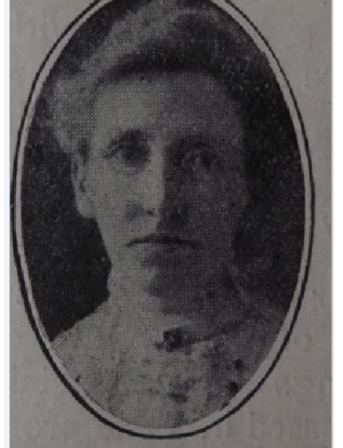
Peter’s Grandmother, Emma Cowen of Bishop Aukland, Durham in 1914.
I don’t tell Copper-top this, of course. There’s a pause in the conversation. I sweep the grass with my foot for my cigarette butt – and to pretend I am not afraid of anything as insignificant as an English snake.
“Are you going to enlist in the RAF – before they conscript you?” the boy asks after a few minutes. Maybe fly bombers over in Europe? The village boys who have turned 18 are already signing up voluntarily. They want to get the best missions.
“They would, wouldn’t they?” I reply. “What else do they have to do?”
And, I tack on for no good reason, “I assure you, you do not want to be like me.”
“What?” The boy wrinkles his freckly red brow. I have confused him, this sweet naïve boy with his happy loving family.
“Well,” I change the subject. “You won’t be spending this coming summer in Northumberland with your father. They are keeping the school open for LDV training for all of us, senior and junior school. LOOK, Duck and Vanish.
“Yes, I know about Land Defense. But everyone thinks it will be safer here. That’s why Mill Hill pupils were sent up to St. Bees,” says Cowen. “More boys from London are sure to arrive if the war doesn’t end soon. Their mothers will insist.”
“Do these mothers know that Barrow-in-Furness is just down the coast and it is a ship building port and likely to be a target of German bombs?”
I say this to scare him. I want to be cruel at this moment. Truth be told, I resent this happy wheezy boy with the unkempt shock of red hair sticking straight out of the top of his head. War or no war, St Bees is a spartan place and is all about teaching British boys survival skills, on the rugby field mostly. Land Defense Volunteers Training is somewhat redundant.
But, then again, what do we schoolboys, happy ones like Cowen or unhappy ones like me, know about true survival?
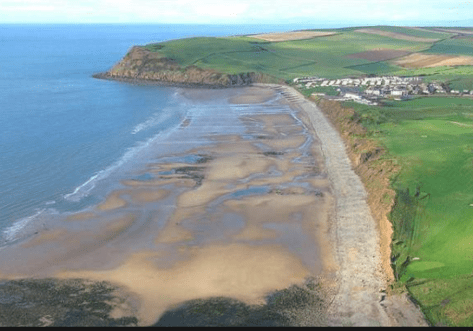
St Bees Head courtesy of visitcumbria.org