Tag Archives: John Forster

Socialists and Auctioneers

grandmmdmdmmdm

Emma Forster. Reprinted courtesy of the genealogy website myprimitivemethodists.org

Yippee!

For a while there I thought I had an illustrious ancestor, Joseph Cowen, the radical Liberal MP from Newcastle-on-Tyne. Here was someone I could be proud of and  someone my ‘socialist’ brother, living in Europe, could be proud of, too. Or, so I thought.

Upon looking up my great-grandmother Emma Cowen’s father, John, on familysearch.org ,  I discovered that the man was born in Blaydon Manor, Durham, which would make him the brother of this famous Joseph Cowen.

There was no other John Cowen born in Durham in 1832, his birth year, so it had to be him. Right?

I texted my brother in socialist Denmark along with a capture of a statue of Joseph in the town of  Newcastle. “Look, who we’re related to. We’re NOT the descendants of lowly coal-miners. He’s got Daddy’s eyebrows, doesn’t he?)

My brother, probably washing down his grass-fed beef with an artisanal beer, immediately texted me back:  “That doesn’t sound right to me.”

So, I double checked to find I had been foiled by a census typo.

My real ancestor John, great great grandfather, was misspelled in the 1841 UK Census under John Cowin. This John Cowin was born 1932 in South Bedburn, Durham. Another later Census entry for the family confirms Emma Cowan’s dad was born in Bedburn.

Emma is my great-grandmother from Durham, who married John Forster, Primitive Methodist Minister, from Cumberland, who produced Dorothy in 1895, who married a Malayan planter, Robert Nixon (from Helmsley) in 1921 and whom I only met once in my life, 1967, the year of Expo67.  Dorothy is subject of my play Looking for Mrs. Peel.

So, it seems, I am not the descendent of a radical liberal politician, friend to Anglo-Jewry, but a descendant of one John Cowen, a Victorian Age auctioneer.

(And that is correct, because Emma Cowen was born on Eliot Street, in Crook and Billy Row, Durham, and his auction house was located there, I discovered on yet another online document.)

Because I had to know, I checked to see that the profession of auctioneer was a pretty lucrative one at the time, although one that was despised because it preyed on human misery.  Thackery, apparently, simply hated auctioneers.

Bankruptcy was often used in Victorian era novels to make a point about human greed and to propel the plot. George Eliot’s Mill on the Floss, which I just listened to online, includes a sad, plate-by-plate  description of a family bankruptcy.

Going backwards in time over the UK Censuses, I discovered John was the son of a grocer, Joseph, Crook and Billy Row, Durham, who was the son of another grocer, Joseph  from Auckland Bishop, who was the son of someone who worked in the lead smelters at Alston, Cumberland. (If I got things right.)

Lead smeltering. Now, there’s the hideous job I was looking for! If your ancestry  can’t be illustrious, it might as well be pitiful.

It didn’t take me long to find out all about the lead mining industry in Alston, Cumberland, where most of my Cowens lived. (The place is still crawling with Cowens.)

There are lots of books out there on the subject. I downloaded one off Archive.org  about Alston and ‘its pastoral and mining people.’

For a time, apparently, lead mining was the only industry in the area, so my ancestor had no choice.

He had about 8 kids so the work didn’t dampen his mojo.

Lead was in everything back in the Victorian era, even in food, up until 1900 or so. (Lead actually smells and tastes nice, as any girl from the 1960’s who skipped on the sidewalks of our polluted  city streets knows very well.)

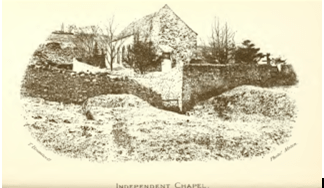
These Durham Cowen’s were all religious, described  as dissenters. Their births and marriages were registered at Redwing Chapel, Garrigle, Cumberland.

Here’s a drawing of the same chapel in the book about Alston and its people.
redwingchapelpic

Dissenters and Poets


john

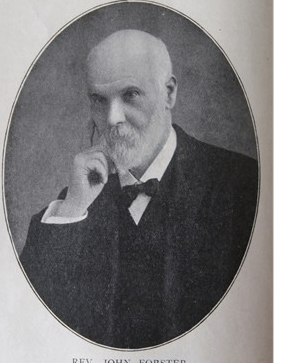
Reverend John Forster. Published with the permission of the Primitive Methodist Ancestor Website.

Late in his life, Somebody Forster, my great-grandfather, awakened from his night’s sleep to ask his wife of many decades, ‘Woman, what are you doing in my bed?”  It was dementia.

Until lately, this serio-comic anecdote was the only thing I knew about my father’s mother’s father, other than that he was a Methodist Minister from the North of England. But, just last month, I accessed the 1901 UK Census, (for free, yea) and it took me about thirty minutes to find out all I could want about my great-grandfather Somebody.

First, I looked up my grandmother, Dorothy Forster, who I knew was born in 1895 in Middleton-on -Teesdale, County Durham, UK,  to see that her father was a Reverend John from Knockburn, Northumberland; her mother Emma, a former Cowen from Crook,  and, more importantly, that John was a Primitive Methodist Minister. (I checked. PM’s were dissenters; socialists and pacifists, apparently.) *1

Then, googling the keywords “John Forster” and “Primitive Methodist,”  I  landed on a webpage from a genealogy site, myprimitivemethodistancestors.org , with a short biography of Great-granddad John, with  grainy photos of him and wife Emma taken in 1914.

Apparently, John Forster, a bookish, self-educated son of a farmer, was an accomplished essayist who penned over fifty articles for the Connexions Magazine of the Primitive Methodists on sundry weighty topics including “Heredity in Relation to Morals” and “Primitive Methodism and the Labour Question.”(He also served as a Temperance Committee; amusing, as his daughter, my Grandma Dorothy*, could really slug back the gin!)

I was most intrigued, though, to see that John had published a book of poetry, in 1923, shortly after my father, his grandson, was born at the European Hospital near Kuala Lumpur, Malaya. The author claims that Reverend John’s poems ‘contain lyrics of extraordinary charm and grace.’

(Well, I know the Wasteland was published in 1922, ushering in modernity, it is claimed, but no one said anything as nice about T.S. Eliot’s poem 😉

Curious, of course, about these verses, I contacted the Primitive Methodism Website’s administrator, asking for help. She immediately emailed me back a longer biographical article about John Forster, but no examples of his poems.  The volume in question, Pictures of Life in Verse seems to have gone missing from the church/museum library.

Quelle Bummer!

There’s good news, though. This longer article lists Reverend John’s assignments or ‘circuits’ in chronological order.  The Forster family moved often, it seems, around the area:  Thornley, Crook, Middleham, Bradford, Middleton-in-Teesdale, (a very pretty sheepy village) about six other towns, then, it said, “his present one (1912) being Helmsley.”

Bingo!  I know from the 1911 UK Census, that Helmsley is the hometown of my grandfather, Robert Nixon.  Clearly, alliances were made in that era that resulted  in the marriage of John and Emma’s second daughter, Dorothy, to Robert Nixon, son of a delver in the local Rievaulx quarry, although a Great War would delay official matrimony.

Dorothy would have been 17 in 1912 and fresh out of her co-ed Quaker boarding school and Robert Nixon just 22, and working in service as a footman.3

Perhaps Robert’s prospects weren’t good enough for the righteous Reverend John. In 1913, according to online records,4 Robert, travelled to Malaya to work as a labourer in a rubber plantation. During WWI, Dorothy worked as a land girl, leading enormous Clydesdales through the woods, a comical sight as she was only 5 foot tall.*5

The same records also reveal that Robert returned to England in 1916, now the plantation’s Assistant Manager. This trip home was very likely to secure a wife for real as rubber company officials insisted their employees return to the UK to find respectable British (see: white) wives.

Whatever transpired back in Helmsley, North Yorkshire in 1916,  on December, 1921, *6 Reverend John Forster, perhaps taking time off from penning one of his charming verses, sent his second daughter, Dorothy  off to  Selangor, Malaya. She’d become pregnant almost immediately upon arrival. I know because my father, Peter, was born on October 23, 1922.7


  1. Checking into Emma Cowan’s parentage, I see that her ancestors belonged to this same church, Redwing Chapel, that has an online presence! United Congregation of Red Wing Chapel, Garrigill, and Low Chapel, Alston, Cumberland; http://www.fivenine.co.uk/family_history_notebook/source_extracts/parish_registers/cumberland/redwing_registers.htm
  2. Website: Myprimitivemethodistancestors.org
  3. UK Census 1911
  4. UK Immigration and Transportation Records http://www.familysearch.org
  5. Family Lore
  6. UK Immigration and Transportation Records. After WWI, there were many, many more unmarried women than men in England, so perhaps this had something to do with Dorothy’s decision to go to Malaya to marry Robert Nixon. They did not get married in the UK, or at least I can’t find any record of a marriage.
  7. Family lore, (my Aunt Denise, who died last month) said that Robert kept his Asian mistress after marriage. Dorothy eventually got her own boyfriend, a colonial lawyer who remained faithful to her until her death in 1971. Both Dorothy and Robert were interned at Changi Prison in Singapore during WWI. Dorothy was Women’s Camp Commandant for a term. I only met my grandmother once in 1967, when she came to visit. Robert  died while she was at our house in Montreal’s Snowdon district.  He fell off a ladder at his daughter’s, Denise, in Farnborough, Hants, UK.  I recall the telegram. I recall, also, that my grandmother managed to wipe a tear or two from her eyes. I’ve written about my Colonial Grandmother in a play Looking for Mrs. Peel, which makes it all the more amusing that my great-grandparents were named John and Emma.