Category Archives: Genealogy

The Huguenot Families of the Hauts-de-la-France

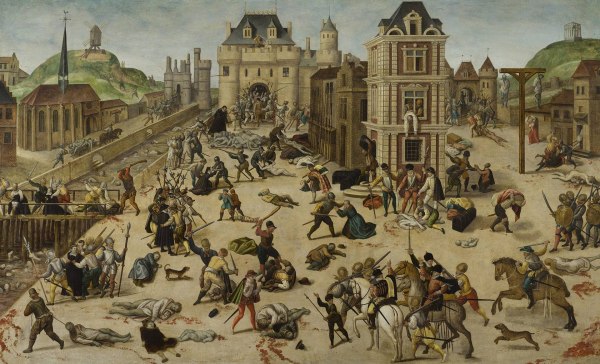
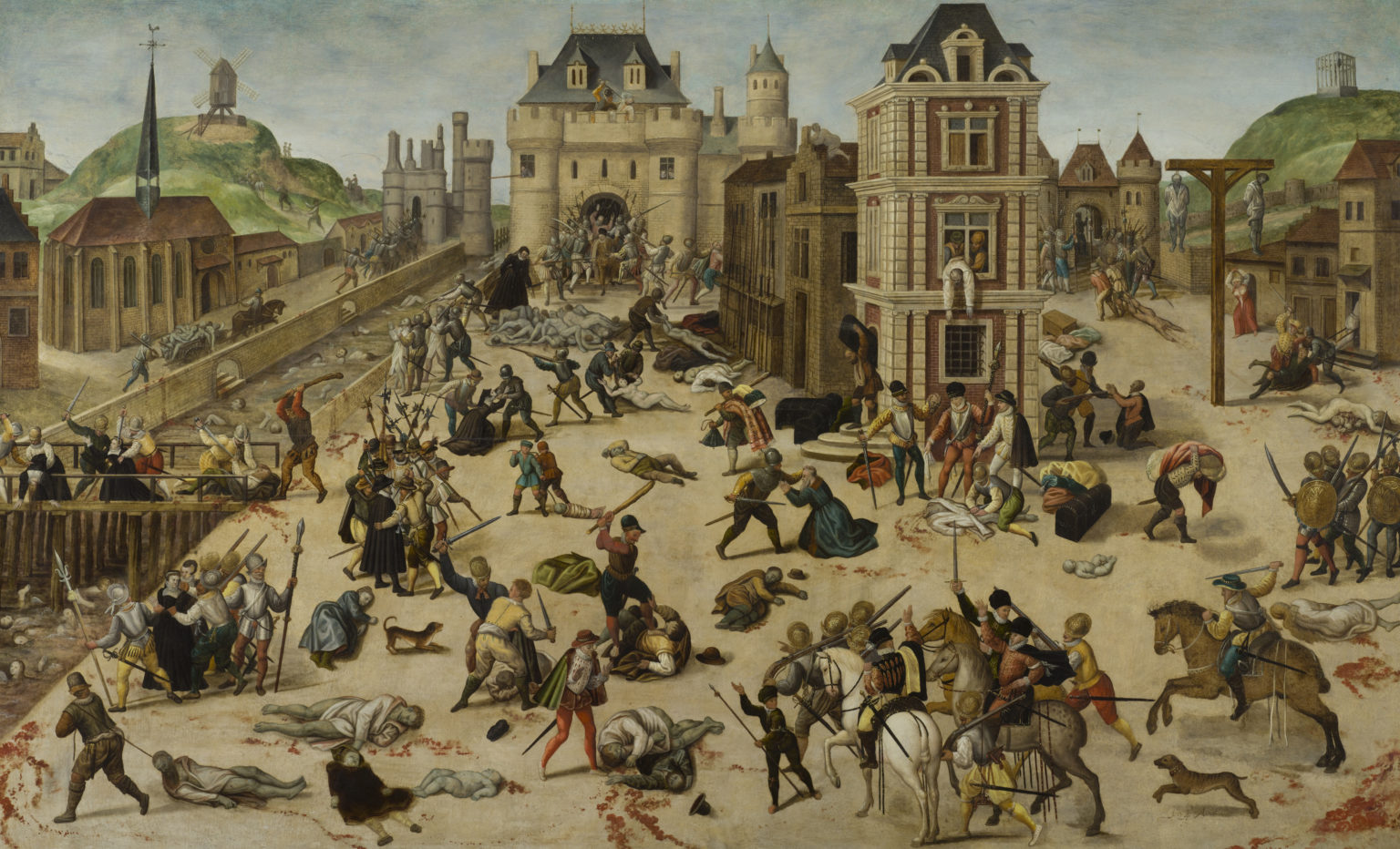
The St. Bartholomew’s Day massacre of French Protestants (1572). It was the climax of the French Wars of Religion, which were brought to an end by the Edict of Nantes (1598). In 1620, persecution was renewed and continued until the French Revolution in 1789.

François Dubois – Current valid link to file (same source): Musée cantonal des Beaux-Arts; direct link to the image: [2] Original link (museum homepage only): Musée cantonal des Beaux-Arts.

  • Public Domain
  • File:La masacre de San Bartolomé, por François Dubois.jpg
  • Created: between circa 1572 and circa 1584 date QS:P571,+1550-00-00T00:00:00Z/7,P1319,+1572-00-00T00:00:00Z/9,P1326,+1584-00-

François Dubois
The Massacre of Saint-Barthélemy, circa 1572-1584

Details Share

  • François Dubois (Amiens, 1529 – Geneva, 1584)
  • The Massacre of St. Bartholomew, circa 1572-1584
  • Oil on walnut wood , 93.5 x 154.1 cm
  • Gift of the Municipality of Lausanne, 1862
  • Inv. 729
  • © Cantonal Museum of Fine Arts of Lausanne

This painting represents the massacre of Protestants started in Paris on August 24, 1572 and continued for several days, known as the Saint-Barthélemy massacre. It stages the main episodes of this bloody page of the Wars of Religion in a striking view of the city of Paris.

The topography is manipulated to show the main locations of this tragedy. On the left you can see the church of the convent of the Grands-Augustins (now gone) where the tocsin sounded which triggered the killings, the Seine and the Meuniers bridge. In the center, the Louvre and Catherine de Medici, the black widow, considered the main instigator of the massacre. In the foreground, the private mansion of Anne de Laval, in front of which Admiral de Coligny, leader of the Protestant party, was killed before being defenestrated, beheaded and castrated. Gathered around his corpse, the leaders of the Catholic party, the Dukes of Guise and Aumale and the Chevalier d’Angoulême. On the right, the Saint-Honoré gate and, on the hill of La Villette, the gibbet of Montfaucon, where the body of the admiral will be hung upside down. Bringing together more than one hundred and fifty figures,

This painting is quite exceptional because of the quality of its execution, but also because contemporary representations of Saint-Barthélemy are very rare. It bears on the first step of the steps of the hotel in front of which Admiral de Coligny is assassinated the inscription “franciscus Sylvius Ambianus pinx[it]”. The location of this inscription, the signature of the painter François Dubois, of whom it is the only painting known to date, says a lot about the convictions of this Protestant from Amiens who took refuge in Geneva after the massacre.

Find out more: web dossier

Click the above link to open in a new window.

Edward MacHugh, the Gospel Singer

During his lifetime, Edward McHugh made several trips back and forth across the Atlantic Ocean, but there was a world of difference between his first trip and his last.1

Edward was 19 when he immigrated from Scotland to Canada in 1912 with his widowed mother, his two brothers, his sister-in-law and his brother’s seven children. Destined for Montreal, they traveled on the steamship S.S. Grampian in third class, or steerage. Edward would have slept on a bunk bed and shared his room with other family members, and meals would have been served at long communal tables in the dining room.2

Forty years later, in 1951, he traveled first class from Southampton to New York on the luxurious R.M.S. Queen Elizabeth ocean liner.3 He would have enjoyed a spacious stateroom, first class lounges and formal dining. He could have ordered anything he wanted from room service.4 There would have been plenty of space to store his eleven pieces of luggage.5

By that time, Edward had retired and was able to afford first class passage because of his successful career as a musician. This is the story of how a talented, working-class young man from Scotland and Montreal became famous in America as the Gospel Singer.

Edward, born in 1893 in Dundee, Scotland, came from a family of jute-factory workers of Irish heritage. His father was a yarn dyer.6 When the family arrived in Canada, they settled in Verdun, a district of Montreal located close to the factories that would have provided employment for the three McHugh brothers. Edward worked as a manual labourer in the rail yards on the locomotives.7

Shortly after his arrival in Canada, he made his public singing debut at Montreal’s Hunt Club, singing God Save the King. The Duke of Connaught, then the Governor General of Canada, heard him sing and was instrumental in sending him to study at London’s Royal College of Music.8 This college accepted both students who paid tuition and students who won entry through competitions.Given Edward’s humble background, it is probable he had a scholarship.

By 1919, Edward had decided to pursue a musical career so he left Montreal, settled in New York City and continued his studies .10

It took a few years for Edward’s career to take off, but in 1927, Edward was invited to sing The Old Rugged Cross, an evangelical hymn written in 1912,11 on Boston radio station WEEI.12 The next day, the station received 2,300 letters praising Edward’s baritone voice. His choice of hymn and the timing were excellent. Gospel songs had become increasingly popular as they were easier to sing than traditional hymns. 13

In 1938, Edward published a compilation of gospel hymns and poems.14 His fame grew and, by the 1940s, he was nicknamed the Gospel Singer and he was a regular on NBC radio.16

In 1947, an ad for Edward’s 15-minute radio program appeared in Billboard Magazine. It claimed, “Edward MacHugh, Your Gospel Singer, [. . .] who is said to have the most perfect diction of any singer without sacrificing warmth . . . ”19

It wasn’t just the quality of his voice that made him popular; he seems to have tapped into a need for comfort in troubled times. During World War II, his fans often requested he sing God Will Take Care of You,17 a song that must have soothed people whose loved ones were risking their lives serving their country.

When asked about gospel music, Edward replied, “A lot of people think that hymn-singing is ‘corny.’ That’s okay with me. I get my satisfaction in giving real pleasure to a great number of people and perhaps in being some small help in times of trouble and affliction.”18

It is clear that Edward’s beautiful baritone voice moved many listeners. He popularized hymns and gospel songs through his radio shows, compilations, records and concerts,20 and he sang songs of simplicity, devotion and encouragement in times of pain.

After he retired in the 1940s, Edward and his wife Jennie lived a quiet life in Norwalk, Connecticut. They had no children. During his retirement, Edward continued to make records and take part in religious festivals and church anniversaries. He passed away in 1957 at the age of 63 in Fort Lauderdale, Florida.21

Note: At some time in his life, Edward changed his name from McHugh to MacHugh

  1.  “UK, Outward Passenger Lists, 1890-1960,” database, Ancestry.com, Edward McHugh, Grampion,  Glasgow to Quebec, leaving May 11, 1912.
  2.  Gjenvik, Paul K., Glenvick Gjonvik Archives (GG Archives), Collection of Travel Brochures, online <http://www.gjenvick.com/HistoricalBrochures/CunardLine/FranconiaAndLaconia/1912/05-ThirdClassAccommodations.html#axzz4ZumLRf5j>, accessed 13 February 2017.
  3.  “UK, Outward Passenger Lists, 1890-1960,” database, Ancestry.com, Edward McHugh, Queen Elizabeth, Southampton to New York, leaving October 6, 1951.
  4.  The National Railway Museum, York, England, U.K., photo and description of a first-class cabin on the Queen Elizabeth, 1950, online < http://www.nrm.org.uk/ourcollection/photo?group=British%20Transport%20Commission&objid=1996-7038_BTF_837_P_43>, accessed 13 February 2017.
  5.   “UK, Outward Passenger Lists, 1890-1960,” database, Ancestry.com, Edward McHugh, Queen Elizabeth, Southampton to New York, leaving October 6, 1951.
  6.  McIntyre, Alistair, “Significant Scots, Edward McHugh.” Unknown posting date. Electric Scotland, online < http://www.electricscotland.com/history/other/mchugh_edward.htm&gt;, accessed 13 February 2017.
  7. “Edward MacHugh,” obituary, Ottawa Journal, 6 February 1957, p. 5.
  8.  “E. MacHugh Ex-Gospel Singer Dies.”Undated clipping, ca.1957, from unidentified newspaper. Privately held by Sandra McHugh, Montreal, Quebec
  9. Wikipedia, Royal College of Music, Early Years,  https://en.wikipedia.org/wiki/Royal_College_of_Music , accessed 13 February 2017.
  10. 1920 United States Federal Census, 1920, Manhattan, New York City, New York, Enumeration District (ED) 829, sheet 2, Ward 11 a.d., Dwelling 250, apt. 39, Edward McHugh: digital image, Ancestry.com (http://www.ancestry.comaccessed 27 February 2017)
  11. Wikipedia, The Old Rugged Cross, https://en.wikipedia.org/wiki/The_Old_Rugged_Cross, accessed February 13, 2017.
  12. McIntyre, Alistair, “Significant Scots, Edward McHugh.” Paragraph xx http://www.electricscotland.com/history/other/mchugh_edward.htm
  13. Wikipedia, Gospel music,  https://en.wikipedia.org/wiki/Gospel_music#19th_century, accessed February 13, 2017.
  14. MacHugh, Edward, compiler. Treasury of Gospel Hymns and Poems.  Winoa Lake, Indiana: The Rodeheaver Hall-Mack Co., 1938.
  15.  “U.S. Border Crossings from Canada to U.S. 1825 1960, database, Ancestry.com, Edward McHugh, Buffalo, New York, U.S.A, June 16, 1935.
  16. McIntyre, Alistair, “Significant Scots, Edward McHugh.” 
  17. “E. MacHugh Ex-Gospel Singer Dies.” Privately held by Sandra McHugh.
  18. E. MacHugh Ex-Gospel Singer Dies.” Privately held by Sandra McHugh.
  19. The Billboard Magazine, 7 June 1947, p. 11.
  20. Concert poster Jordan Hall, October 15, year unknown.
  21.  “Edward MacHugh,” Ottawa Journal, 6 February 1957.

Huguenot Families of Ancient France in the Region of Grand East

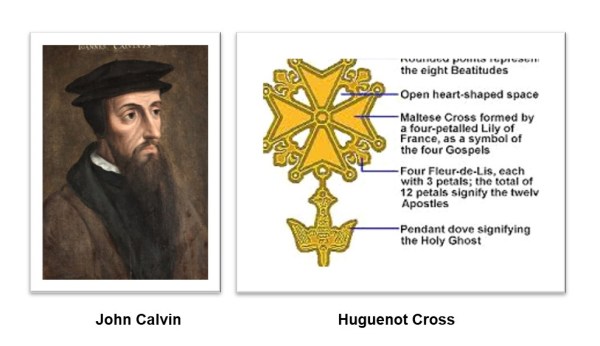
The Huguenots were a religious group of French Protestants who held to the Reformed, or Calvinist, tradition of Protestantism

Click the above link to open.

Bon Soir et Dors Bien – Good Night Sleep Well

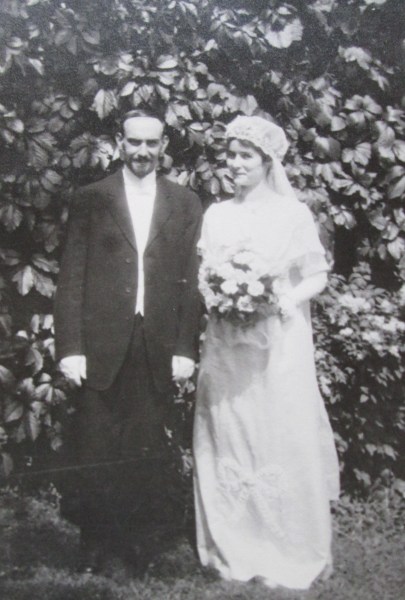
Rene Raguin & Beatrice Bruneau Wedding 1912

“Bonsoir et dors bien”, is how my mother ended her nightly phone calls with her parents. These were some of the few French words I ever heard her speak, which was strange as French was both her parent’s mother tongue. Why did we only speak English?

René Raguin my grandfather, was from Fleurier, Switzerland and came to Canada to teach at the French Protestant school in Pointe aux Trembles, Quebec. He later taught in Trois Rivieres and finished his career at Baron Byng, a school of the English Protestant School Board of Greater Montreal. He also taught teachers how to teach French at McGill University’s summer school.

Beatrice Bruneau met René Raguin when they were both teaching at the Pointes aux Trembles school. This was the one French Protestant school in the Montreal area. Grannie as we called her, descended from French Canadian stock, although born in Green Bay Wisconsin. Her father Ismael Bruneau was a French Presbyterian minister. Her mother Ida Girod was a French speaker from Switzerland and also a Protestant.

René spoke English fluently but with a heavy accent. He always used English when talking with us, his grandchildren and we called him Grandfather. I always wondered why he never communicated with us in French as a French teacher. One much older cousin Don Allchurch, always referred to him as Grandpère as he did speak to him in French.

Beatrice’s father Ismael Bruneau, was “pure laine”, French Canadian through and through. His early ancestors arrived in Quebec from France in the 1630s. His family of Catholics converted to Protestantism in the 1850s and that is where the English crept in. Ismael wasn’t thrilled to speak English as he wrote to his youngest sister Anais, “I write to you in English, dear sister, not to show you I can write a few words in that barbarous language, but for your good as well as mine, for practice makes perfect.” Many of Ismael’s siblings moved to the United States, spoke English and married English speaking spouses.

French was spoken in his home but Ismael’s children all went to English Protestant schools as the French schools were all Catholic and they didn’t even allow Protestants to attend. In the family, religion trumped language. Most of his children also married English-speaking people. His two sons continued to speak to each other in French.

Beatrice Bruneau Raguin

My mother grew up in Dixie on the border of what is now Lachine and Dorval. It was then an English community. Because her father Rene Raguin taught for the English board they didn’t have to pay school fees and so attended English Protestant schools. The children didn’t want to speak that other language. Some evenings her father would say that only French would be spoken at the dinner table. The children wouldn’t say a word and only eat what they could reach.

Rene Raguin

The Scots and Irish immigrants who were my father’s family settled in Toronto and spoke only English. I don’t remember him speaking French to anyone. He always regretted that he couldn’t speak French. He too went to English Protestant schools.

Dorothy, Beatrice, Rene & Mary

We were schooled before French Immersion and though there was some talk about sending us to French Schools, they were still all Catholic and not a choice, so we also attended English Protestant schools.

So in a generation, the French family became English. We didn’t call my mother every night but as we left after a visit she had a new English saying, “Safe home.”

Notes:

A Short History of the Bruneau-Girod Families: Ida Bruneau Ste. Agathe des Monts, Quebec May 1993. Forbes Publications Ltd. Calgary, Canada.

My sister remembers the phrase as “Bonsoir et dors bien Maman” but I said sometimes she was talking to her father.

The Great Volunteer Soldier Recruitment of 1653

Next month marks 370 years since my six times great grandfather and his brother volunteered to join a militia to protect the city of Montreal. Their voyage from France to our city would last five months and require two departures. They faced captivity, an epidemic and enough starvation and illness to cause the death of eight of their colleagues, but they survived.

Marin Hurtubise and his brother André were among 154 men recruited by New France Governor Paul Chomedey de Maisonneuve to help protect the Fort Ville-Marie from Iroquois attacks. They signed five-year contracts with the Société de Notre Dame de Montréal to clear uncultivated land in New France for farming at a price of 100 livres per year1. Their employer, also known as the “Company of Montreal,” was originally founded in France in 1639 to establish a colony in Canada.

According to notes left behind by my grandmother, the Hurtubise brothers came from a town known as Sillé-le-Guillaume in Rouesse-Vasse, southwest of Paris in the Sarthe Departement in the Pays de la Loire region.

They travelled to St. Nazaire to join 120 other men and 14 women who set sail for New France on June 20, 1653. Among their ship mates was Marguerite Bourgeoys, a women with a desire to create schools in New France. She also founded the Notre Dame parish and set up housing for the filles du roi. In 1982, Pope Pius XII canonized her as Canada’s first female saint.

The trip in Captain Pierre le Besson’s ‘Saint-Nicolas-de-Nantes’ vessel2 did not go well.

Ships in that era were not the large luxury vessels we cruise on today. According to an unauthored essay that used to appear on the Maison Saint Gabriel website, they measured roughly 25-45 meters long and 8 meters wide. Passengers bunked in a single room at the back of the ship in unsanitary conditions in which everyone slept in their clothes. Buckets collected waste and vomit from those who couldn’t handle seasickness. Meals often consisted of dry biscuits, salt pork and fish.

In this case, the ship also leaked. The ‘Saint-Nicolas-de-Nantes’ took on so much water that after sailing 350 leagues (1600km), the crew had to return to Nantes. Passengers were left on an island off the coast of France to wait for another month until a replacement ship could be found. According to Marguerite Bourgeoys’ diary, some of the recruits deserted their posts and swam back to France.

“Sieur de Maisonneuve and all of his soldiers stopped on an island from which there was no escape. Otherwise, not a single one would have stayed. Some even set about swimming to save themselves since they were furious and believed they had been taken to perdition.”3

On July 20th, after a St. Marguerite’s day mass, the replacement ship set sail for the New World with the Hurtubise brothers and Marguerite Bourgeoys on board. This voyage, which featured many storms, an outbreak of the plague and eight deaths (Jacques Audru, Olivier Beaudoin, René Cadet, Jean Chaudronnier, Louis Doguet, Michel Lecomte, Joachim Lepallier and Pierre Moulières), doesn’t sound any better than the first, save for the sea-worthy vessel.

After 64 days, the ship landed at Cap-Diamant, on September 22, 1653. At that point, it seems that the ship was set on fire in the middle of the river. Bourgeoys’ writings imply that it got stuck so that high tide couldn’t even free it.

For the next two months, New France Governor Jean de Lauzon tried to keep the voluntary soldiers and marriageable women in Quebec to defend that city, in part by refusing to provide the barges needed to sail the Saint Lawrence River to Ville-Marie.

Eventually, de Maisonneuve prevailed. The group arrived at Ville-Marie on November 16th.4 They were all given land grants next to the Saint Laurence River. Later, Marin and five neighbours settled in Côte St. Antoine.5

André Hurtubise died six years after the brothers arrived in Montreal. Marin lasted 19 years, successfully marrying and having six children during that time. He died in Montreal on May 12, 1672.6

Sources

1Aubry, Louis, Famille Hurtubise Gendron, https://www.mes-racines.ca/fichiers/Lign%E9es/H/Hurtubise-Gendron/Hurtubise-Gendron.pdf, accessed May 2, 2023.

2“Ancestors on the World Stage,” https://www.apointinhistory.net/granderecrue.php, accessed May 2, 2023.

3Les Écrits de Mère Bourgeoys, p. 46

4“La Grande Recrue de 1653.” http://louisianalineage.com/recrue1653.htm, accessed May 2, 2023.

5MacKinnon, Janet S. The Settiement and Rural Domestic Architecture of Côte Saint-Antoine, 1675—1874, thesis 2004

6Find a Grave, database and images (https://www.findagrave.com/memorial/144617536/marin-hurtubise: accessed 02 May 2023), memorial page for Marin Hurtubise (26 Oct 1631–12 May 1672), Find a Grave Memorial ID 144617536, citing Ancien cimetière Notre-Dame (1672-1830), Montreal, Montreal Region, Quebec, Canada; Maintained by AW (contributor 47829810).

Photo of commemorative plaque courtesy of Jean Gagnon, CC BY-SA 3.0 https://creativecommons.org/licenses/by-sa/3.0, via Wikimedia Commons.

Archives of the Old Regime

Features :

  • Archives nationales d’Outre-Mer &  Biblothèque Archives Canada (Library Archives Canada)
  • France Archives – Regional & Local
  • BnF Gallica – Revues savantes in 95 départements de France (95 regions) – The latter dossiers will not describe your own family or families but will tell you about the life of your ancestors in ancient France.

Aunt Amelia’s Ledger

with additional research by Justin Bur

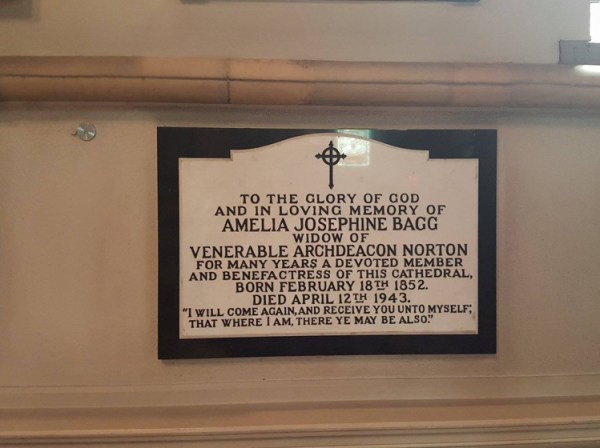
Some of my female ancestors are almost invisible. They got married, had children and left no other traces of their lives. But a few left paper trails such as letters, journals and drawings. My two-times great-aunt Amelia Josephine Bagg (1852-1943) was one of them. Married twice but with no children of her own, she became deeply involved in the family real estate business.

Amelia was the third of the five children (one boy, four girls) of Montreal landowner Stanley Clark Bagg (SCB) and his wife, Catharine Mitcheson Bagg. The children grew up in the family home, Fairmount Villa, near what is now the corner of Sherbrooke and St. Urbain streets. There, they had a big garden to play in and no doubt a nanny to care for them when they were little and a governess to educate them.

Unlike many women of her time and class, Amelia found the opportunity to use her education.

Amelia Mulholland’s ledger, McCord Stewart Museum, https://collections.musee-mccord-stewart.ca/internal/media/dispatcher/261758/preview p. 5.

SCB had inherited several large properties on the Island of Montreal, extended along the west side of St. Lawrence Street (now busy Boulevard Saint-Laurent). During his lifetime, this was agricultural land and, although he was trained as a notary, SCB made his income by leasing his properties to farmers.

He died unexpectedly at age 53, in 1873, when Amelia was just 21. SCB named his wife and her brother (who was a Philadelphia lawyer) as executors of his estate.1 Son Robert Stanley Bagg (RSB), a recent law graduate from McGill University, took on the responsibility of managing it. Over the years, the widowed Catharine and her daughters had a great deal of input into decisions about the estate, with Amelia being the daughter who took the greatest interest.    

Around the end of the century, Montreal grew rapidly. Business leaders developed new industries, founded banks and built railways, and immigrants arrived to fill newly created jobs. Property belonging to SCB’s estate could now be divided into lots and sold to people who wanted to build homes or invest in rental housing. Around 1890, some legal hurdles prevented the family from selling the most valuable properties, however, the family managed to resolve these problems. That will be a story for another time.

Amelia’s letter to brother Robert Stanley Bagg, McCord Stewart Museum,  https://collections.musee-mccord-stewart.ca/en/objects/416400/correspondance  p. 43

With these issues resolved, Amelia and her siblings divided up some of the land and became owners of lots that they could sell or buildings they could rent out themselves. Amelia became an independently wealthy woman.

She also developed an interest in the details of the family real estate business, keeping track of land prices, interest rates and other factors influencing real estate sales. In the fall of 1890,2 while her brother took his wife and children on an extended trip to England, Amelia coordinated decisions on new property sales. She wrote to ask for his advice and to bring him up-to-date on family news.3

“Fairmount, Nov. 6th

“My dear Brother,

“I thought I would write and tell you that we are about to sell some lots on the ‘Clark Estate’ but I do not know whether you will be quite satisfied or not. They are twelve lots on St. Urbain Street, from Guilbault St. down, and we are taking 50 cents “en bloc” for the twelve lots. I know that you said 60 cents per foot for single lots but as this is for twelve lots we thought perhaps it was better not to lose the sale.4 Bob said that you told him we could take less than the price named, and McMann said he was selling lots of Park Avenue for 45cts.7 I hesitated for a long time as I did not wish to make a sale that you would not approve, but Kate was in favor of selling, so also was Bob, and Helen and I did not know what to do….5

“Vipond has paid his interest today which I will deposit in Merchant’s Bank. Thomson has not yet paid but I had sent him another bill before hearing from you. Of course for the present all money both interest and capital will be deposited in the bank, but when you return we think it would be better for us to draw the interest and leave only the capital in the bank.….”

Row houses on St. Urbain Street near Prince Arthur. Google Street View

Much of the Bagg estate was still leased out to farmers at that time, and one day a month was reserved for tenants to deliver the rent. In the same letter, Amelia referred to this so-called reception day, but she was actually describing the arrival of her sister Mary Heloise Lindsay’s fifth child on Nov. 3, 1890. Mary and her husband Robert Lindsay lived at 436 St. Urbain. Amelia told her brother:

Kate and I made out the Nov. statements of rents due and gave the list to Bob so that when the people paid he could check them off. We were surprised at an unexpected arrival at 436 St. Urbain Street on Monday. It is true that is the reception day there now, but this particular visitor was not expected just then. It was a dear fat little girl! She arrived at 8 o’clock in the evening.”

Amelia also kept track of the sales of lots from the estate between 1890 and 1900 in a hardcover ledger with ruled pages. My mother eventually inherited that ledger. Her cousin had given numerous family letters, business records and other documents to the McCord Stewart Museum (a Montreal museum of social history) some years earlier, but my mother hung on to the ledger. After she died, I found it in a desk drawer in the spare bedroom.

When I started to research the Bagg family and their role in Montreal history, the ledger’s importance as a record of those land transactions became clear, so I donated it to the McCord.6 I hope Amelia would have approved.

This article is also posted on http://www.writinguptheancestors.ca.

See also:

Janice Hamilton, “Stanley Clark Bagg’s Four Forgotten Daughters,” Writing Up the Ancestors, Sept. 30,2017, https://www.writinguptheancestors.ca/2017/09/stanley-clark-baggs-four-forgotten.html

Janice Hamilton, “My Great-Great Aunts, Montreal Real Estate Developers,” Writing Up the Ancestors, Oct. 11, 2017, https://www.writinguptheancestors.ca/2017/10/my-great-great-great-aunts-montreal.html

Janice Hamilton, “John Clark, 19th Century Real-Estate Visionary,” Writing Up the Ancestors, May 22, 2019, https://www.writinguptheancestors.ca/category/john-clark

Notes and Sources

  1. City of Philadelphia (Pennsylvania). Register of Wills Office; Wills, No 772-802, 1887, Ancestry.com. Pennsylvania, U.S., Wills and Probate Records, 1683-1993 [database on-line, entry for Catharine Mitcheson Bagg, accessed April 2, 2023], original data: Pennsylvania County, District and Probate Courts. This is a copy of the will that is very easy to read. It was probably copied in Philadelphia because McGregor J. Mitcheson, Catharine’s brother and an executor of SCB’s will, died in 1886. About a month after SCB’s 1873 death, notary J. A. Labadie deposited at the land registry office in Montreal a copy of the 1866 will and the 1870 codicil and a declaration of death. Bureau d’enregistrement Montréal-Ouest, no 74545, registered 6 September 1873; at Registre foncier du Québec, online.
  2. Amelia did not note the year on her letter, but we know it was written in written in 1890 because that was the year her niece Marjorie Mary Clark Lindsay was born. 

3. Correspondance de la famille Bagg. McCord Museum, Fonds Bagg, P070/B08,  https://collections.musee-mccord-stewart.ca/en/objects/416400/correspondance  p. 43 (accessed April 3, 2023)

4. RSB must have told them to hold out for the full price. The lots were not sold until the following year. On Nov. 18, 1891, real estate agent and furrier Robert Lamb purchased not just the 12 lots mentioned here, but an extended row of 22 lots, paying 60 cents a square foot.

5. The people mentioned here are probably Amelia’s sisters Katherine Sophia Mills and Helen Frances Lewis. Bob was likely Robert Lindsay, her sister Mary’s husband. McCann was a real estate agent.

6. Amelia Josephine Bagg Mulholland, Grand livre, 1891-1927, McCord Museum, Fonds Bagg, P070/B07,1. https://collections.musee-mccord-stewart.ca/en/objects/293626/a-j-mulholland-ledger (accessed April 3, 2023)

Great Uncle James Went to Reform School

James Orrock, my two-times great-grandfather, was a farm labourer in Scotland in the mid 1800s. Agricultural labourers did not work all their lives on one farm. It was common for farm servants, both men and women, to attend farm hiring fairs. They would then hire themselves out to the highest bidder.1

Hiring Fair

According to the 1851 census, James worked on a farm in the village of Marykirk, Kincardineshire.2 His wife-to-be, also a farm servant, worked on a different farm located in the same village. They married two years later. By then they had moved to Kirken, in County Angus.3 Mary and James went on to have seven children and it is no surprise that their children were born in different villages, as James would have moved from job to job, always as a farm servant. The various censuses indicate that James worked as a ploughman, farm servant, or agricultural labourer. His family followed him as he moved for work. In 1863, their daughter, Martha Linn died of small pox at the age of three.4 Two years later tragedy struck again when James died at the age of 33 from tuberculosis.5

When Mary became a widow, her situation would have been precarious. James had been sick for a long time and had been unable to work. Mary had to find a way to provide for her children. Farm servants were usually lodged at the farm where they worked. Families often had small dwellings, with a small yard, where they could have a garden and a henhouse.  With the death of James, Mary would have also lost her home. It is no surprise that she moved to Arbroath, perhaps in the hope of working in the jute and sailcloth mills. At the time of James’ death, demand for jute was high due to the American Civil War6 and work was available in the mills. Mary would soon learn that, while Arbroath provided employment, it also provided additional worries about her son, James.

The 1871 census shows Mary living with four of her six remaining children in Arbroath.7 Her eldest son, Alexander, 17, worked as a farm servant in a village about 10 km away, in Kirkden.8 Ann and Jemima, 16 and 14, would have been working. David and Jane were in school. But where was James, only 12 at the time?

I found James in the 1871 census listed as an inmate at the Mars Training Ship for Homeless and Destitute Boys, about 35 km away from his family.9 This ship was moored on the river Tay at Woodhaven Harbour, Wormit, Fife from 1869 to 1929.10

The HMS Mars was built in 1848 and saw military service in the Crimean War. Deemed surplus in 1869, it became a training ship with space for 400 boys with the objective to take destitute and homeless boys off the streets of Dundee, Edinburgh, and Glasgow and train them for service in the Royal Navy or the Merchant Marine at their discharge at age 16.11 

The Mars Training Ship was an initiative put forth by Lord Provost William Hay and members of the elite. Truancy and vagrancy were rife in the cities of Scotland, due to overcrowding, unemployment, and poverty. The inmates of the Mars were often picked up for truancy or for begging and were sent to the training ship for five years by magistrates. The boys were poor, orphans, beggars, or homeless or sometimes they had just fallen in with the wrong crowd.12

Mars Training Ship Institution 13

The move from farm life to a bigger urban centre would have been difficult for James. He was 12 when he shows up as an inmate in the Mars Training Ship and he was probably sent there at the age of 10 or 11. There is no way to know why he ended up there. We know that his family was poor. It is probable that he wandered the streets while his mother and two sisters worked long hours in the jute mills. He may have been a difficult child as he suffered from mental illness later on in life.14

The Mars Training School was an industrial school, as opposed to a reform school. The boys did not have a criminal record; however, in some ways they were prisoners. All of the boys were very poor and many of them were homeless. For those who did have homes, they were deliberately given very little opportunity to maintain connections with family and friends.15

Upon arrival on the ship, a medical officer examined the boys once they were stripped. The children then washed, put on their uniforms, and were assigned a number. From then on, they were only referred to by their number. Even the boys called each other by their numbers.16

The day on the Mars ship would begin early, at 5:30 a.m. The boys scrubbed the deck, had breakfast, and then said their prayers. In the morning they learned English, arithmetic, geography, and music. The afternoons were dedicated to practical skills such as shoe repairing, clothing and sail-making, woodworking, metalworking, tailoring and seamanship. The boys were attended by doctors and dentists and were well fed. There was less disease onboard than in the crowded and unsanitary cities of Dundee, Edinburgh, and Glasgow. To further reduce the chance of disease, the boys would make an annual trip to Elie, a coastal town, allowing a skeleton crew to fumigate and clean the ship. 17

James would have been discharged from the ship when he was 16. Records of his later life did, indeed, indicate that he worked as a seaman.18

  1. https://www.historyscotland.com/history/farm-servants-and-the-hiring-fairs/, accessed 15 March 2023. Picture of the engraving of a hiring fair courtesy of History Scotland website.
  2. National Records of Scotland, 1851 census, Parish of Marykirk, County of Kincardineshire, James Orrock, Scotland’s People, downloaded 27 March 2023.
  3. National Records of Scotland, Old Parish Registers, Church of Scotland marriages, Kirken, James Orrock and Mary Watson, Scotland’s People, downloaded 27 March 2018.
  4. National Records of Scotland, 1863 Deaths, Parish of Dunnichen, County of Forfar, Martha Linn Orrock, Scotland’s People, downloaded 8 March 2023.
  5. National Records of Scotland, 1865 Deaths, Parish of Dunnichen, County of Forfar, James Orrock, Scotland’s People, downloaded 9 April 2018.
  6. The Textile Industry of Arbroath since the Early 18th Century, Turner, W.H.K., The Abertay Historical Society, 1941, p.15
  7. National Records of Scotland, 1871 census, St. Vigeans, Arbroath, Mary Orrock (Watson), Scotland’s People, downloaded 16 March 2023.
  8. National Records of Scotland, 1871 census, Kirkden, Angus, Alexander Orrock, Scotland’s People, downloaded 23 March 2023.
  9. National Records of Scotland, 1871 census, Woodhaven, Forgan, Fife, 1871 census, James Orrock, Scotland’s People, downloaded 15 March 2023.
  10. Wikipedia, HMS Mars, https://en.wikipedia.org/wiki/HMS_Mars_(1848)#:~:text=HMS%20Mars%20was%20a%20two,July%201848%20at%20Chatham%20Dockyard.&text=She%20served%20as%20a%20supply,the%20River%20Tay%2C%20off%20Woodhaven, accessed 19 April 2023.
  11. The Mars Training Ship and Elie, Gordon Douglas, 13 January 2017, https://www.eliehistory.com/uncategorised/mars-training-ship-elie-gordon-douglas/, accessed 23 March 2023.
  12. Maritime Trail Dundee, Mars Training Ship, https://www.dundeemaritime.co.uk/Mars, accessed 23 March 2023.
  13. The Herald Scotland, From Mars to Dundee: The prison ship that shaped generations, Ron McKay, https://www.heraldscotland.com/news/17996129.mars-dundee-prison-ship-shaped-generations/, accessed 24 March 2023.
  14. General Registers of Admissions in Lunatic Asylums, 1888, James Orrock, downloaded 22 March 2023.
  15. Whyte, Christine, HMS Mars: An industrial school in the late 19th century, Scottish Journal of Residential Child Care, Volume 20.2, https://strathprints.strath.ac.uk/84204/1/Whyte_SJRCC_2021_HMS_Mars_an_industrial_school.pdf, accessed 11 April 2023.
  16. Ibid
  17. The Mars Training Ship and Elie, Gordon Douglas, 13 January 2017, https://www.eliehistory.com/uncategorised/mars-training-ship-elie-gordon-douglas/, accessed 24 March 2023
  18. National Records of Scotland, 1930 Deaths, Parish of Liff and Benvie, County of Angus, James Orrock, Scotland’s People, downloaded 8 March 2023.

Ypres Gas Attack Survivor Returns Home

Part Two of Two

Six months after surviving the battle at St. Julien, Belgium, and the German gas attack in 1915, something entirely different brought Captain Stanley Bagg Lindsay (1889-1965) to his knees. He slipped and fell in the trenches while on active duty, and needed surgery on a hernia on his left side. He was officially declared unfit for duty and was granted sick leave to recover back home in Montreal, Quebec, for the winter.

Stanley Lindsay – winter 1916

Within months of his return to England, the hernia recurred on his right side needing immediate surgery and his health never fully recovered after that. Several bouts of influenza also plagued him throughout the war, before and after his hernias, and weakened him for the rest of his life.

He was 29 when the war ended. He returned to Montreal, but did not resume his studies at McGill University, choosing instead to follow in his father’s footsteps and become a stockbroker. His salary as a Captain had brought in an average of $142 per month during his four years of service. This translates into $3900 per month in today’s dollars. He quite possibly returned to civilian life with a decent nest egg with which to begin his new career.

Stanley’s health issues did not appear to hinder his long career as a stockbroker and eventually he became a partner at Crutchlow, Deare & Co. According to family lore, he purposefully sold off the family’s portfolio of stock investments just before the Great Crash of 1929.1 Perhaps his war experience left him with some kind of sixth sense.

Although Stanley never married, he remained close to his two brothers (and their families) and his three sisters.

Two of his sisters, Marjorie and Marguerite, had been nurses during the war with the Information Bureau,2 a Canadian Red Cross organization in London which cared for Canadian soldiers. Marguerite died young in Cartwright, Labrador, in 1926 while volunteering with the Grenfell Mission.3

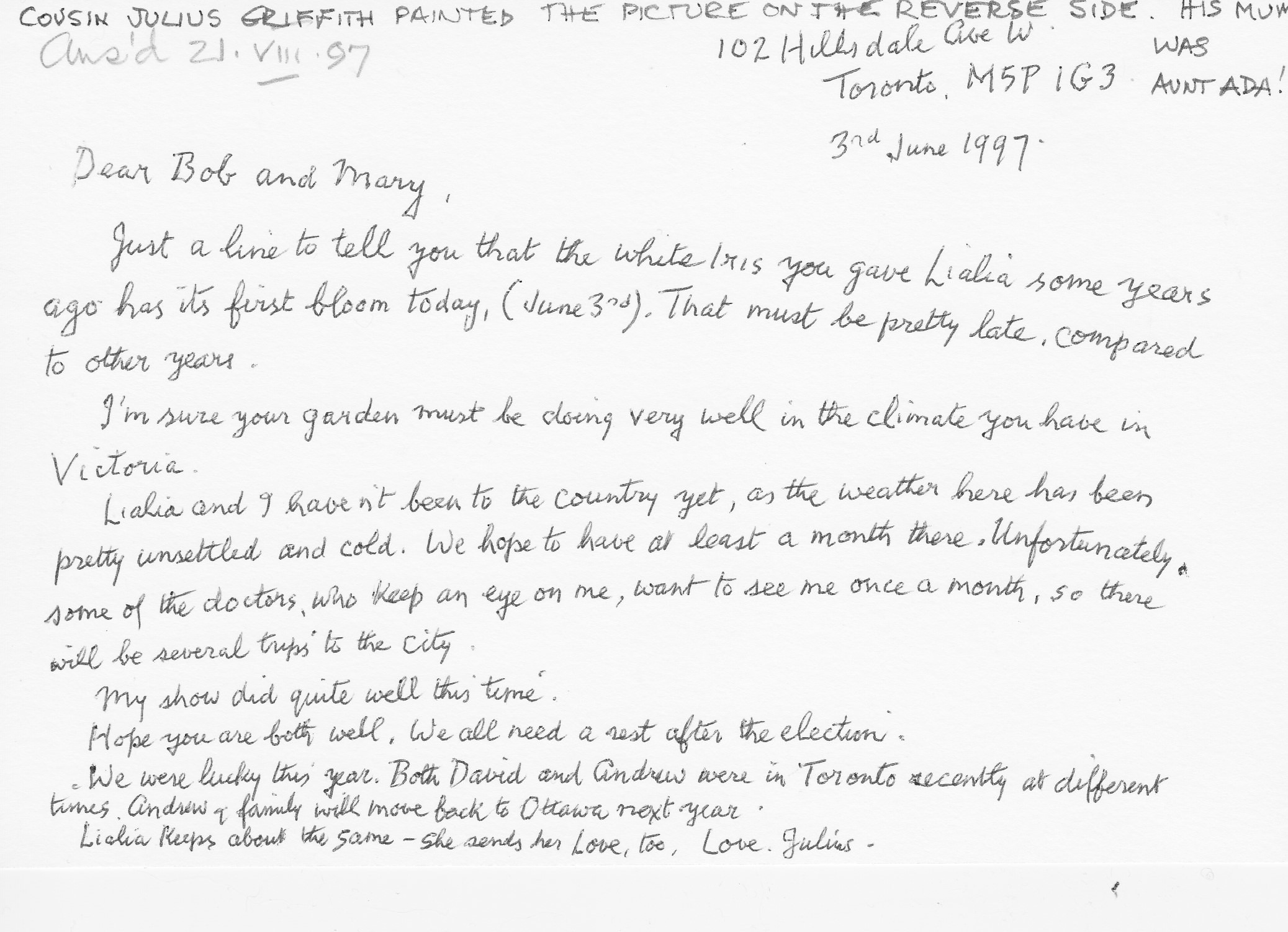
Stanley lived with Marjorie and their parents at 455 Sherbrooke Street West (previously known as The Prince of Wales Terrace) until their father’s death in 1931. Then they moved with their mother into an apartment at 1009 Sherbrooke Street West until her death in 1938 and remained there until their own deaths: Marjorie in 1961 and Stanley in 1965. His eldest sister Ada lived in Vancouver with her husband Julius Griffith and their only son, Julius, who became a well known Canadian artist.4

Stanley’s two brothers – my grandfather Sydenham5 (an Anglican priest) and Lionel (a pediatrician) – provided him with ten nieces and nephews to spoil. He absolutely adored my mother Ann and showered her with his love and gifts. He must have been devastated when she died of Hodgkin’s Disease at the age of 36 in November, 1961, having lost his sister Marjorie earlier that year.

Stanley Lindsay (far right) at Ann’s baby’s christening party 1953

Luckily for me, he devoted his free time to the family history. I have pages upon pages of his beautifully (legible!) handwritten notes about that side of our family. All the usual dates and facts were recorded, but in a clear, more descriptive fashion.

One of his pages about his grandmother, Catherine Mitcheson Bagg, recalled a visit to her home as a boy:

We can remember her well sitting at the front drawing room window at Fairmount with her white lace cap on, looking out at the people passing.

We used to play in Granny’s garden. There were apple trees, especially one which was easy to climb and play house in. There was an iron bench under it, painted blue green…. There was a chestnut tree which we loved, the summer house, the white statutes of Adam and Eve with no arms, … the bleeding hearts, snowballs and lilacs … Nora the housemaid and Jessie the cook, who made good ladies fingers and sponge cakes and who we could always see through large sunken window which gave light to the kitchen.

There were the stables, the horses, the rockaway and the brougham and Willis the coachman with white mutton chop whiskers whom we liked and who afterwards drove a wagon for Joyce the confectioner. We were very fond of Odell Comtois who did sewing…. She was practically one of the family.

The garden became very shabby. It seemed a large garden to us. It went as far as our house which was at the corner of Milton Street. The west side adjoined the Wilson-Smith property. Long before our house was built, a large house called Tara Hall stood just north of Milton Street. Mother [Mary Heloise (Bagg) Lindsay] remembers it burning down one night when she was a child. Where the house used to stand is a street called Tara Hall.”

As well as being everyone’s favourite uncle, an excellent family historian and a successful stockbroker, Stanley belonged to several local clubs including the Canadian Club, the University Club and the Royal Montreal Golf Club.6

After almost dying at Ypres during the Great War, Stanley lived another fifty years.

1https://wiki2.org/en/The_Crash_of_1929 – as referenced 2023-02-23

2https://genealogyensemble.com/?s=the+mothering+bureau

3https://genealogyensemble.com/2022/07/27/miss-lindsay-the-early-years/

4https://www.gallery.ca/collection/artist/julius-griffith – as referenced 2023-02-23

5https://genealogyensemble.com/2016/04/05/the-priest/

6Obituary – The Gazette, 1965-03-03

The Meter Man

Lately, we have been reading about the rising costs of heating and fuel around the world which reminded me of childhood memories of the ‘Meter Man’

The main power we used when I was a child was coal and gas. Our electricity meter was in the cupboard, under the stairs, similar to Harry Potters’s bedroom. The cupboard was a tiny addition just enough room to hold the meter. The only time it was opened was to insert a shilling for an allotted amount of electricity and gas. However, we usually packed it full until someone forgot and, we are all watching the telly, when….a blackout! Everything electric shut off.

Everyone I knew had a meter there were no monthly electricity bills at least not for our working-class family. We all had a handy supply of shillings ‘for the meter’ a kind of ‘pay as you go’ system.

The British Shilling

For some strange reason, we did not have any torches – or a flashlight as you call them here. Instead, we would scramble around in the dark, to the cupboard under the stairs to find a shilling, – usually piled on the top of the meter, thank goodness – hastily shoving it in the meter or ‘feeding’ it as we used to say, and everything lit up again and back to the programme on the telly.

An Old Shilling Meter Of The Type We Used

Once a month, the ‘meter man’ would come, open the meter with his special key and sit in the kitchen with a cuppa and count out the shillings in the meter, calculate what we owed and then leave a pile of shillings for us. That rebate at the end of the month was a godsend we would pack the meter until you could not get any more in. Sometimes, though, we forgot to feed the meter, hence the blackouts!

There is an old 1966 movie called ‘Funeral In Berlin with Michael Caine as British Spy Harry Palmer. Palmer goes to someone’s flat in London and the man there asks him for a shilling to put in the gas meter or no heat or electricity and no cup of tea.

Arriving in Canada in 1979, was a shock to see the waste of electricity, water, and all the sources that as a child were drilled into us NOT to waste. The first thing we noticed downtown was all the offices ablaze late at night.

Montréal From Mount Royal, Pre-1970

Not to say that we in England did not leave lights on at night, but they were street lamps and certainly not office lights left on all night. Even the Christmas decorations were turned off after midnight. However, as the capital city, London was the biggest culprit, with Piccadilly Circus ablaze with advertisements at night.

The Outskirts of London at night

I have to say, that even when I was a child, we were ALL very careful about heat and not wasting it. The usual cry when we left a door open or failed to close a window ‘Shut that door! Were you born in a barn?! We had curtains up inside the front door and long slinky ‘sausages’ made from one old nylon stocking and stuffed with rags, on the floor of each door to keep the draughts out.

British homes were never really insulated well. In fact, they still are not. My son’s home in London built in the late 1800s has stone blocks with ‘air spaces’ in between for ‘airflow’ because of the humidity! He is just as vigilant about keeping an eye on the meters as we were. We taught him well. I just hope that the so-called ‘new builds’ in England, are better insulated. If not all the heat just goes out the walls and up the chimney.

Houses in the UK were and are not ever, really warm and cosy as they are here, in Canada, even with the addition of central heating which is strictly regulated or timed, as Hydro Quebec is urging us to do now, to come on in the morning as we get up, turn off as we leave and on again at night.

Today, it is a case of ‘been there, done that’ and still we do it. Old habits die hard. Although now we are retired we keep the heating on at a nice comfortable 21C and during the Summer, the A/C is on ALL DAY!! Gasp! My husband still patrols the timers though…

I have to wonder, how we are going to cope in the future with climate change and fuel prices soaring. How will North America manage? Will we be bringing back the old meters? Only time will tell.

During research for this article, it would appear that in England, pre-paid meters are indeed now being used again. Called smart meters they can be paid with a credit card, as defaulting on monthly billing payments seem to be on the rise.