Category Archives: genealogy

Who were the Irish Presbyterians?

My father’s family were all professed Presbyterians, a religion which originated in Scotland. This included both those on his Scottish father’s side and his Irish mother’s side. Religion was very important in all their lives. They were part of a church, “which had a noble band of loyal devoted men and women who have counted it their chief joy to seek its highest welfare”.

It was not until 1843 that marriages performed by Presbyterian ministers were legally recognized in Ireland. My two times great grandparents, Susan Dodds and Alexander Bailey married in that year in Armagh were some of the first to have a recognized Presbyterian marriage.

The name Presbyterian comes from their form of church governance, an assembly of elders. These protestant churches trace their roots to the Church of Scotland whose theology emphasizes the sovereignty of God and following only the scriptures. The Scottish Reformation of 1560 shaped this Church, when many broke with Rome, led among others, by John Knox. This religion was brought to Ireland from Scotland with the migrations of people in the 1600s. Irish Presbyterians were never a single entity. Groups splintered, formed new congregations, united with others and broke apart again.

The majority of the Irish remained Catholic even when Henry VIII founded the Anglican Church, the Church of England and then the Church of Ireland. Most protestants lived in the north. While they soon outnumbered the Church of Ireland, the life of an Irish Presbyterian was not easy.

The government passed the Test Act in 1704, which stated that those wishing to hold civil or military office had to prove they had taken communion in the Church of Ireland. The Church of Ireland demanding tithes also angered the Presbyterians. Even after the Toleration Act of 1719 passed and Presbyterians were not penalized for their beliefs, they still felt estranged, which contributed to the large scale North American emigration in the early 1800s.

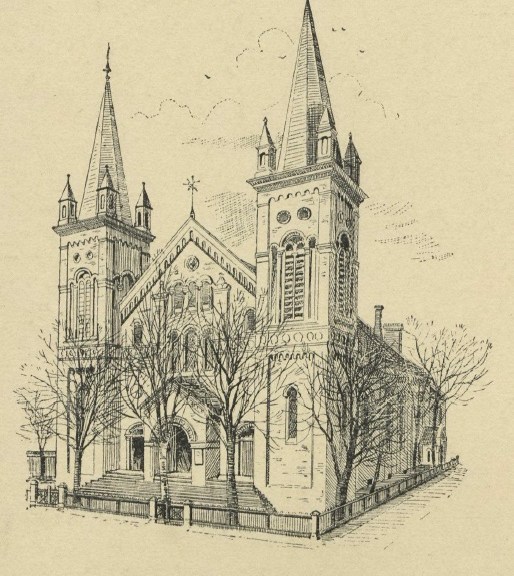
When the Susan and Alexander Bailey arrived in Toronto, they probably attended Knox Presbyterian Church, opened in 1820 as the First Presbyterian Church of York, Upper Canada. This church started by Scottish immigrants, welcomed the Irish but they wanted their own church and organized the Second Presbyterian Church in 1851.
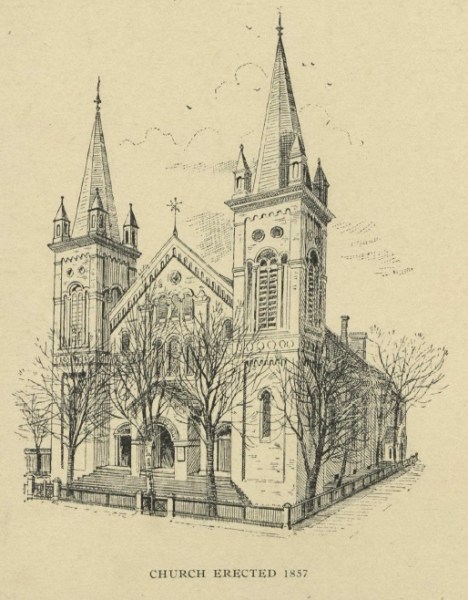
Cooke’s Presbyterian Church, Toronto, Ontario, Canada

The congregation raised money for a minister’s stipend and met first in St Lawrence Hall and then an empty Methodist church on George Street. This church soon became too small for the current members and the many others asking for seats. A new property purchased at Queen and Mutual St for 475 pounds soon a housed brick church.

There used to be many churches in the area as Toronto had a Sabbath Day Law with no public transport running on Sundays. People had to walk to church.

The new building became Cooke’s Church, named for Henry Cooke an Irish Presbyterian minister who in 1834 united the Irish Presbyterians. With his ordination in 1808, his ministry began in Northern Ireland. He reformed both the church and public education. He believed that the only music in churches should be what God created. There could be voices singing but no man-made musical instruments. When he died there was a massive funeral march through Belfast with all religious denominations in attendance.

The congregation kept growing. The church was renovated, enlarged and then in 1891 a new church that could hold 2000 worshipers was built on the same site. The Irish always knew they would be welcome in Cooke’s Church.
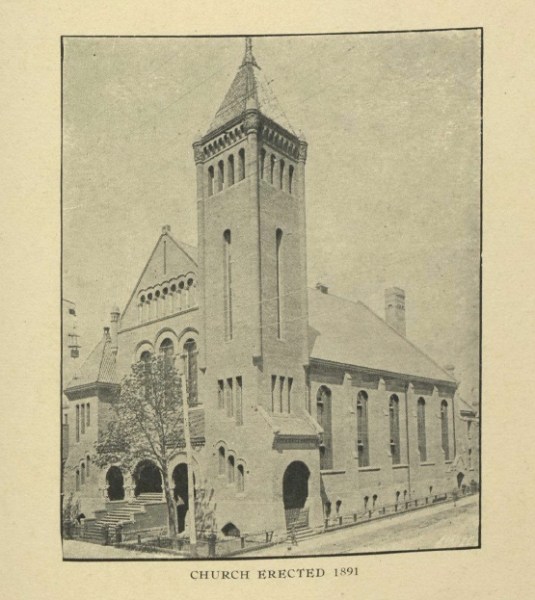
The new Cooke’s Presbyterian Church, Toronto, Ontario, Canada

My great grandparents, William Eagle from County Monaghan and Eliza Jane Bailey, were members of Cooke’s Church. William served as an elder until his death. Both their daughters, Amy and Minnie, were very involved in church life. Amy sang in the choir and served as secretary and treasurer of other societies. Minnie was the President of the Young Women’s Mission Band which had formerly been the Ernest Helpers Society. Their mother Eliza served on the Women’s Association as well as being Honorary President of the Women’s Foreign Missionary Society.

Donald and Alice Sutherland, another set of great grandparents, although Scottish Presbyterians were also members of Cooke’s Church. Their children were named in the anniversary booklet. Mary, the Christian Endeavor Society flower convenor and Wilson on the Junior Visiting Committee. It is there that my grandparents, William Sutherland and Minnie Eagle met and were married by Reverend Andrew Taylor.

In 1925 the Presbyterians, Methodists and Congregational Unionists joined together to form the United Church of Canada. The congregations of Cooke’s Church and Knox Church both voted against the union and remained part of the Presbyterian Church of Canada. Knox Church is still an active church celebrating its 200th Anniversary this year.
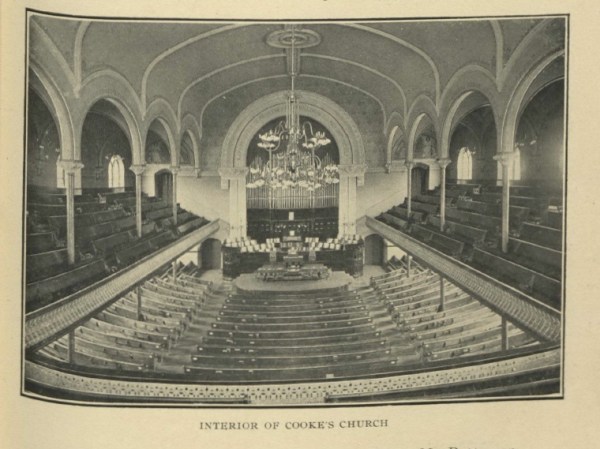
Cooke’s Church interior with their large organ.

Cooke’s Church closed in 1982. There were few parishioners left as most had moved away from the downtown. It’s glory years only a memory when it was the most pretentious structure in the city, a landmark on East Queen Street and a great spiritual influence. It was torn down in 1984 and is now a parking lot.

Notes:

Roulston, William J. Researching Presbyterian Ancestors in Ireland, Ulster Historical Foundation 2020.

Alison, James. Annals of Sixty Years Cooke’s Presbyterian Church Toronto 1851 – 1911. 1911.

https://en.wikipedia.org/wiki/Presbyterianism accessed October 18, 2020.

In Ireland there were many Presbyterian Sects:

The Presbyterian Church of Ireland

The Non-Subscribing Presbyterian Church

The Secession Church

The Reformed Presbyterian (Covenanters) Church

There is a story about my great grandfather Donald Sutherland leaving his church because they purchased an organ. He seemed to subscribed to the ideas of Henry Cooke. According to a story in the Toronto Star, in 1880, a group of parishioners heard the choir had brought a organ into the church for choir practice. These people entered the church and dragged the offending instrument into the street. A riot ensued. Some were arrested and all were suspended from the church. They went off and formed their own church. Was this the incident Donald was involved with?

A story about Susan Dodds https://wordpress.com/post/genealogyensemble.com/1691
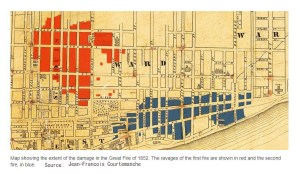
The Great Fire of 1852

The Great Fire of 1852 in Montreal

The strongest portion of this dossier resides with John Lovell (Lovell Directory) on pages 8 and 9 – At a point in time when readers at Genealogy Ensemble realize that their ancestor or ancestors in 1852 had lost their home or homes as per a listing of streets of Montreal in which streets practically all houses were destroyed on July 15th 1852 – See pages 4 and 5 for the streets most affected by this major fire.

Very few books still in print are available in 2020 about this event. On the other hand, Érudit, McCord Museum, BAnQ Numérique, BAnQ Patrimoine, BAnQ Advitam, BAnQ Documents, Collections Canada have books relating to the Great Fire.

BAnQ Patrimoine and BAnQ Documents are two new (fairly new) online dossiers introduced by Bibliothèque et Archives nationales du Québec without fanfare (hype) in which one will find online and in-house digitized dossiers (documents) which address historical events.

Click here to access  Great Fire of 1852 in Montreal

Contents:     The Great Fire of 1852 in Montreal

Introduction

Pages   4 -10    Authors

Pages 10-11   Repositories

Pages 11 -15  History

Indexing Is So Easy On Family Search

So, what exactly IS ‘indexing’ for FamilySearch.org? Besides being an interesting hobby it can sometimes be a  surprising one too.

Take for instance my experience.  One day, when I was deep into indexing a batch of ‘US Death Certificates’ I was quite engrossed and had been indexing for an hour or so when I realised I had been entering as the  ‘Cause of Death’  ‘GSW (Gun Shot Wounds) to head and chest’ more than once.  A few dozen times.  I checked again the title of the batch I had downloaded and there it was, “Chicago, Illinois, Cause of Death – 1900 to 1930s! The days of Al Capone and the Chicago gangs. It was at once chilling and thrilling! You just never know what you may find.

As a volunteer, I do the data entry of the original human records worldwide from centuries ago to the present day,  in any language we choose. The data we index consists of births, deaths, marriages, banns, obituaries, christenings, newspaper items, and baptisms, also, historical records and many other interesting items worldwide. These original documents are scanned, then uploaded to Family Search for us to download and index  (type out) what we see on the documents.

After we enter the information and return them it does not matter if we have made a mistake because the records are checked and arbitrated more than a few times for accuracy before being uploaded to the Family Search site.

It is exciting to see documents that are just now seeing the light of day, and will soon be uploaded to Family Search where we all benefit from the contributions of volunteers like me and that I use to find my ancestors.

In 2013,  I helped index the United States 1940 Census. When you first start out searching for your ancestors, usually the first place to go is the Census of that country, area and year in which they were born and lived in. That monumental task was completed well within the time range expected and up and running far sooner than anticipated.

Then, in July of 2014, the FamilySearch website asked for volunteers for two full days of indexing by asking everyone we knew to join in. This, in part, is their response after that weekend.

“We hoped to have an unprecedented 50,000 contributors in a 24-hour period. FamilySearch volunteers excelled, surpassing that goal by 16,511! That’s right—66,511 participants in one day! Incredible!  We are grateful for the patience and persistence of many volunteers who faced technical difficulties due to an overwhelming response.”

We who helped the indexing that day were offered the badge below.

I have been using this site for many years and I feel that by indexing I am giving back for all the free information I have been able to find over the years. I find it is an absorbing and interesting hobby.  I am never bored.

Many more batches of names, dates and historical facts now await for us to index and to provide a name or a lead for someone who is searching for their ancestors.

Just remember, you are helping to add millions of data for us genealogists to find plus as a side benefit, indexing can help you become a better researcher as you become more familiar with the wide variety of historical documents available to you and the type of information each contains.

So, why not give this interesting hobby a try?  Your first step is to log on to the link below for more information and good luck!

https://www.familysearch.org/indexing/get-started-indexer#/web

NOTES

FamilySearch, historically known as the Genealogical Society of Utah, which was founded in 1894 is owned by The Church of Jesus Christ of Latter-day Saints (The Mormons) but you certainly do not have to share their beliefs to volunteer to index or have a free account to search for your ancestors.

The site is always in the process of digitizing the bulk of their genealogical records, as well as partnering with genealogical societies to digitize other records of genealogical value. Most genealogical sites have obtained their records from this site.

FamilySearch Hits 8 Billion Searchable Names in Historical Records

FamilySearch subscribers worldwide make family discoveries from its free records online.Nonprofit FamilySearch published its 8 billionths free searchable name from its worldwide historic record collections online. The milestone is even more astounding when you think that each name is someone’s ancestor—8 billion family connections just waiting to be discovered. Read about if here.
https://media.familysearch.org/familysearch-hits-8-billion-searchable-names-in-historical-records/


The Not-at-all Wicked Stepmother – Part 2

When my mother died in November 1961, my father hired various nannies to run the household and look after his four children. The revolving nanny door made it difficult and stressful for everyone and finding a new wife and mother quickly became Dad’s priority.

A friend suggested he compile a checklist of his seven most important criteria, which were all essential and the absence of any one eliminates the prospect. Several names were scrawled on his list but there was nobody named Elizabeth. Our future stepmother must have been completely off the grid!

Elizabeth Fulcher arrived in Montreal from England in 1961 to teach at a girls’ private school. Once she had settled into her new life in Montreal, she joined a social club in the spring of 1962, and she met my Dad, Tom Anglin, there. After a few games of tennis, they began to date regularly. Thinking back to that time, she recalls: I thought he was a nice, honest person”.

This wasn’t going to be your typical whirlwind romance.

Elizabeth took the opportunity to get to know the four of us children, as well as Dad, while they were dating. It seemed to be a mutually advantageous relationship for us all as Elizabeth had always wanted a family and now a family wanted her. However, the decision required rational thought as well as emotional feeling. Years later, she admitted her love for us equalled her love for our father.

Tom proposed nine months later, in February 1963, choosing the woman who would love his children just like Captain Von Trapp chose Maria in “The Sound of Music” — our favourite family movie. Elizabeth recalled, “He proposed after we went to a dinner dance at the Queen Elizabeth Hotel. I had an idea that he was going to, it was in February and could have been a Valentine’s Day Dance. He could charm and was a good dancer so I always felt good about dancing with him.”

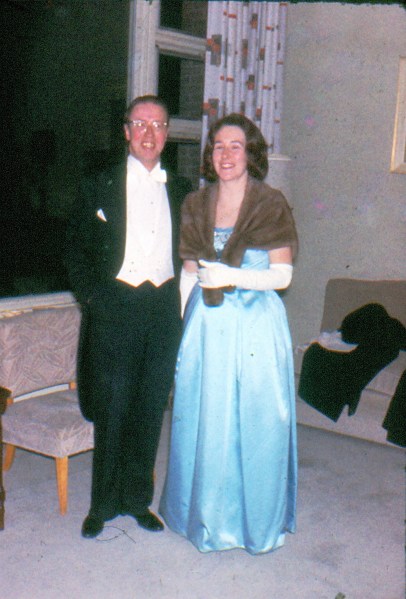
Their Engagement – Elizabeth and Tom going to the Ball 1962

My father arrived in England, only two days before the wedding in July 1963, after organizing summer camps for the children and a leave of absence from his company. Fortunately, he had already passed muster when Elizabeth’s twin, Diana, spent the previous Christmas with us all.

They married in the local church in Iken, steps away from where Elizabeth grew up. Her stepmother, Eileen, decorated the church with masses of flowers, Diana was her bridesmaid and the children of the local farm hands made up the choir. Family and friends watched eagerly as Elizabeth walked down the aisle to the organist’s rendition of…what else but “Oh Canada”!

The newlyweds briefly honeymooned around Western Europe skipping the last stop as Elizabeth just wanted to go “home” and start her new life as wife and stepmother. “We had four days in England to pack up and leave,” she says. “Then we picked up the kids from camp the next day. We all drove out to the summer cottage in Knowlton (Eastern Townships, Quebec) and Tom went back into Montreal to work during the weeks”.

I had just turned six years old when I stepped off the camp bus. I remember looking down at the clogs on my stepmother’s feet and thinking “those are funny shoes” and at the same time realizing “this is my new mother”.

The whole family moved back to Montreal at the end of the summer. The children (aged six to 14) started back to their schools and Tom returned to work. Elizabeth launched into her new life with an impressive and loving energy. Fully committed to her new role, she oversaw the needs of the children, carefully managed a monthly budget, and prepared dinner for six every night… never failing to greet Tom at the door with a kiss and asking about his day.

There wasn’t a hint of wickedness in our new stepmother.

1963- My stepmother, Elizabeth, with her new (instant) family

Five more summers in Knowlton flew by with just the four of us children before the family grew to include my three half-sisters born between 1966 and 1971.

Ultimately, her physical education training continued to prove useful as she juggled a houseful of babies and teenagers!

The not-at-all wicked stepmother – Part 1 (The Unsung Hero)

Montreal Transit

“Eddie! Come on, Ed. Frank forgot his lunch and you have to take it to him.”

Ed’s heart sank. He had no school today but, instead of playing with his friends, he would have to make his way all the way from Verdun to Montreal West so that he could give Frank the lunch he forgot. It was sitting right there, on the kitchen table when Frank left – and he forgot it again!

My uncle, Frank McHugh, worked as a tramway driver and he drove the tram on the 63 or 64 route that went along Sherbrooke Street West in Montreal. The unlucky little boy who always had the job of taking him his lunch was my dad, Edward McHugh.

Uncle Frank’s full name was Francis Strachan McHugh. He was born in Dundee, Scotland in 1904 and emigrated to Canada with his parents and six siblings in 1912. His younger brother, Edward, was born in 1914. So, by the time Frank had found work as a tramway driver in the 1920’s, Edward was old enough to travel across the city and bring him his lunch.

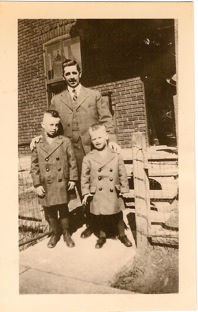
Thomas McHugh with sons, Edward (left) and James (right). Edward was about eight years old in this picture, about the time he would have carried Frank’s lunch to him.

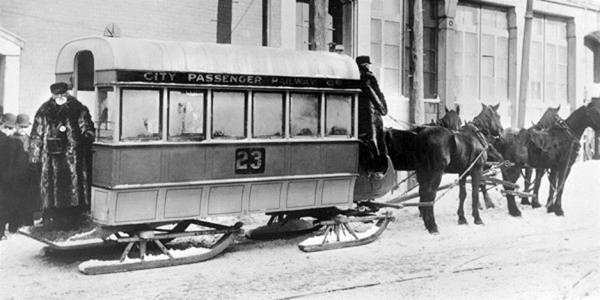
The first public transportation company in Montreal, The Montreal Passenger City Railway Company (MPCRC) was established in 1861 when the first horse-drawn tramway came into service along Notre Dame Street. The horse-drawn tramway had two employees on-board, a driver and a conductor who collected the fares. The passengers simply hailed the tram when they wanted to get on and signaled to the driver when they wanted to get off.1

Horse-drawn winter tramway on St. Catherine Street (around 1877), Société de transport de Montréal (STM) website, Tramways History

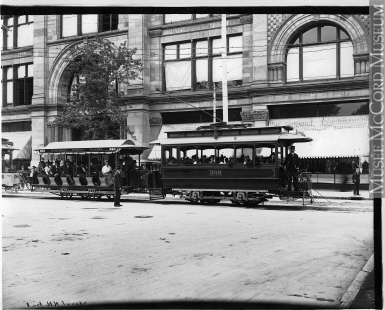
The MPCRC eventually became the Montreal Street Railway Company (MSRC). The MSRC introduced the first electric powered tramway, The Rocket, on September 21, 1892. The electric tramways immediately became very popular as they were much faster than the horse-drawn tramways. 2

By the time Uncle Frank became a tram driver, his employer was the Montreal Tramways Company (MTC). The MTC, created in 1911, acquired all the other transit companies on the island at that time. The citizens of Montreal, concerned that a private company had a monopoly over the public transit in the city, put pressure on the city, and the Montreal Transit Commission was created in 1918 to oversee the MTC. 3


Electric trams, Ste-Catherine Street, Montreal, McCord Museum, Wm Notman and Son, 1895

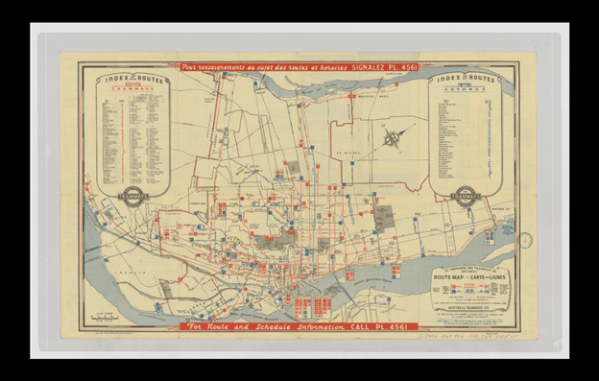
At the time that Uncle Frank worked as a tramway driver in the early 1920s, it was the peak of the operation of the tramway system in city. At that time, the MTC carried nearly 230 million passengers per year. 4 In 1924, the company published this map of the Montreal Transit system.5


Route map of bus and tramways in Montreal, Bibliothèque et Archives nationales du Québec, collection numérique

By the mid-1920s, the city began transitioning to buses, with the first major replacement of the tramway in 1936 in the city’s east end on Notre Dame Street. 6 Uncle Frank followed suit and drove the bus that went along Sherbroooke Street West. But by that time, if he forgot his lunch, he was out of luck.

When cars became popular in Montreal in the 1950s, Uncle Frank quit his job as a bus driver and became a taxi driver.


Frank McHugh and his wife, Molly Baxter
.
  1. http://www.stm.info/en/about/discover_the_stm_its_history/history/tramways-history#:~:text=Created%20in%201911%2C%20the%20Montreal,quality%20of%20the%20service%20offered, accessed October 18, 2020
  2. Ibid.
  3. Ibid.
  4. Ibid
  5. Société de transport de Montréal (STM) website, Tramways History, http://www.stm.info/en/about/discover_the_stm_its_history/history/tramways-history#:~:text=Created%20in%201911%2C%20the%20Montreal,quality%20of%20the%20service%20offered,accessed October 18, 2020
  6. http://www.stm.info/en/about/discover_the_stm_its_history/history/tramways-history#:~:text=Created%20in%201911%2C%20the%20Montreal,quality%20of%20the%20service%20offered, accessed October 18, 2020

Life and death on the farm

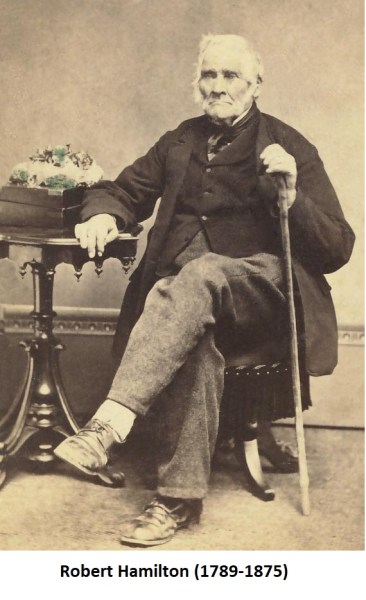
A few years ago, someone gave me a copy of the Hamilton family tree, starting with immigrant couple Robert Hamilton ((1789-1875) and his wife Elizabeth Stobo (1790-1853) and including up to six generations of their descendants.  Dates, places and occupations were not mentioned, however, and I wondered who these distant relatives were.  Fortunately, the Hamilton family is well documented on Ancestry.ca, however, the Scottish habit of using the same names over and over makes the task confusing.

Their health also interested me. A number of my direct ancestors died of heart disease, so I wondered whether my great-grandfather James Hamilton’s siblings also suffered from this condition.

In 1829, Robert and Elizabeth immigrated from the town of Lesmahagow, Lanarkshire to Scarborough, Canada West, now a suburb of Toronto, Ontario, where many of their friends and relatives also settled. When they arrived, their children – Elizabeth, Janet, Agnes, Robert, Margaret and James — were still young. Robert continued to practice his trade as a weaver, meanwhile reinventing himself as a farmer.

Elizabeth Stobo died at age 63, while Robert Hamilton lived to the ripe old age of 86. Two of his sisters also came to Canada, and both had long lives. Agnes Hamilton (1791-1878) and her husband Robert Rae and their four young children arrived in Ontario in 1832. Robert Rae was killed by a falling tree within weeks of their arrival, but Agnes and her children eventually purchased their own farm in Lambton County, Southwestern Ontario. According to her death record, Agnes died of “old age” at 87.

Robert’s younger sister, Janet Hamilton (1800-1882), married in Canada. Her husband, farmer John Martin, was originally from Dumfriesshire. John died at age 83 and Janet succumbed to “dropsy from heart disease.” at 81. The Martins had two sons and a daughter.

Scarborough Township had fertile soil and the Hamiltons must have enjoyed their new lifestyle because the next generation were all farmers. The 1861 census – 32 years after the family immigrated – showed that four of Robert’s children remained in Scarborough Township and neighbouring Markham, while the other two settled about 230 kilometers away in Southwestern Ontario. Eventually one branch of the family – mine – became pioneers again, this time moving to Western Canada.

Robert’s and Elizabeth’s eldest daughter, Elizabeth (1817-1894), married farmer William Oliver (c. 1814-1904), who was from Dumfriesshire. Around 1842, the couple settled in a part of Scarborough that did not yet have a road. They cleared the trees, built a two-story stone house and established a farm that became known for its beautiful flower garden. When they finally sold the property some 35 years later, it brought them more than $100 an acre! They retired to Agincourt, where Elizabeth died of cancer at age 76. They had no children.

In 1842, Janet Hamilton (1818-1897) married Robert Reid (1810-1880), who also came from Lesmahagow. They raised nine children on their farm in Markham. According to her death record, Janet died at age 79 of “old age and heart disease” and all of her sons and daughters died of stroke or heart disease between the ages of 49 and 89.

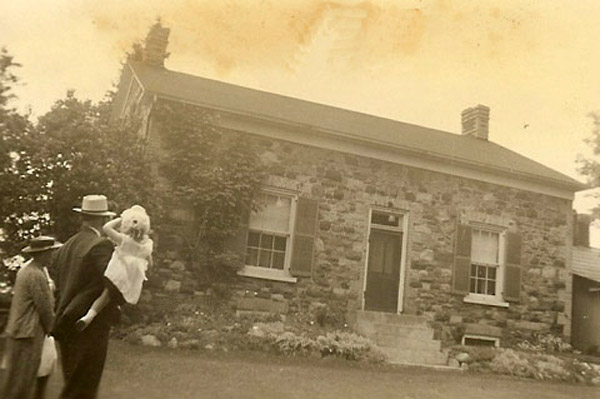
Robert Hamilton’s stone farmhouse in Agincourt, Scarborough. This photo was taken in the early 1940s. courtesy Alison Wright.

Agnes Hamilton (1821-1897) married Scarborough farmer James Green (c. 1816-1872) from Dumfriesshire and raised seven children. Agnes’s many grandchildren called her Nannie. When James and his family left Ontario, Agnes’s son James purchased his uncle’s Scarborough property. Agnes died of bronchitis at age 76.

Robert Hamilton (1824-1871) was a farmer like his father, but he left the Scarborough area for cheaper agricultural land in Bosanquet Township, Lambton County. This part of Southwestern Ontario, near the shores of Lake Huron, was opened to settlement in the 1830s, but development was hampered in the early years by a lack of roads. It remained rural, and farmers there grew primarily wheat and peas and raised pigs and cattle. Robert and his wife, Janet Smith (1824-1899), had five children. Shortly after being counted in the 1871 census, Robert died of typhoid fever at age 46. In the 1881 census, the widowed Jennet was listed as “female farmer,” living with her grown daughter and three sons. In many families, the oldest son would be counted as head of the family, but not in this one. Of their children, only James married, and some of his descendants still live in the area today. Robert, his wife and children are buried in Pinehill Cemetery, Thedford, Ontario.

Margaret Hamilton (1827-1891) married James Gordon (c. 1820-1903) and had seven children. They settled in Middlesex County, in Southwestern Ontario, around 1860 and farmed there for 22 years. After selling that property, they purchased a small garden farm. Margaret died at age 64 of angina. Descendants of this family also remain in Southwestern Ontario.

As for James Hamilton (1829-1885), after farming in Scarborough for more than 20 years, in 1882 he became a founding settler of Saskatoon, which at that time was an alcohol-free community of farms surrounding a tiny hamlet. His wife and family moved West the following year. In 1885, James travelled east to visit his relatives and he died there of a heart attack at age 56. He is buried beside his parents in St. Andrew’s Presbyterian Cemetery, Scarborough.

Thus I discovered that the first generation of my Scottish immigrant ancestors were farmers and that most enjoyed long lives, although heart disease made a frequent appearance in their death records. My great-grandfather was the outlier, leaving Ontario for the West long before any other members of the extended family did so. And while his sons went to university and became professionals, the majority of their cousins remained in farming for at least one more generation.

Notes: Here are some suggestions for researching this period of Ontario history.

Local organizations, such as the Scarborough Historical Society, are an invaluable resource.  See http://scarboroughhistorical.com.  Several books about the community mention Scarborough’s early settlers by name. See  The Township of Scarboro, 1796-1896, edited by David Boyle, Toronto, 1896 (http://www.archive.org/stream/cu31924028900970/cu31924028900970_djvu.txt) Also, The People of Scarborough: A History, by Barbara Myrvold, published by the City of Scarborough Public Library Board, 1997, gives a comprehensive overview of the community’s history. It is available online as a PDF from the Toronto Public Library.

Scottish baptismal records can be found on Familysearch.org. The image of this church document should be viewed on the Scotland’s People website. 

If you find your early Ontario ancestor on Ancestry, you will likely see links to other references to that person, although occasionally the link is to another person with a similar name, or to a son or daughter.

The original marriage documents contain identifying information such as the names of the parents of the bride and groom and occupations.

View census records to see where the family was living every ten years, the name of the current spouse, the names of the children living in the same household, and each person’s occupation. The 1901 census includes the day, month and year of each individual’s birth, although that date may not correspond with other records. (Census informants made mistakes.) City directories are also useful, although they only list the household head.

Ontario death records from this period can be found on Ancestry.ca by searching the database “Ontario Canada, Deaths and Deaths Overseas, 1869-1948.” Some women are listed under their married names, others under their maiden names. These death documents usually include the date and place of birth as well as the date, place and cause of death.

(This article is also published on http://writinguptheancestors.blogspot.com.)

Cousins KNown and Unknown

For many children, cousins are their first playmates. Others never get to meet their cousins even as adults. I have experienced both scenarios.

When my father, Ian Angus, and his brother Oswald were discharged from military service following WW II, they returned to their home in Quebec City and the jobs they left when they enlisted. Ian settled in the suburb of Sillery and Oswald in Ste. Foy. Both eventually had three children each.  Although the children did not attend the same schools, they visited frequently and celebrated holidays and birthdays with their parents and grandparents.

Angus cousins with fathers and grandparents

My mother’s Willett family came from New Richmond on the Gaspe Coast. Two of her brothers, together the fathers of four children, remained there. Keith and my grandfather worked the family farm. Ralph, an electrician, built a home across the road from the farm. Every year my father bundled the family into an old Pontiac he named Rebecca and drove eight hours to spend the summer holidays with my Willett uncles, aunts and cousins. The kids picked strawberries, fished in the brook, and swam in the frigid waters of the Baie de Chaleur, a story much like Cynthia Rylant’s in The Relatives Came. “Then it was hugging time. Talk about hugging!” 1

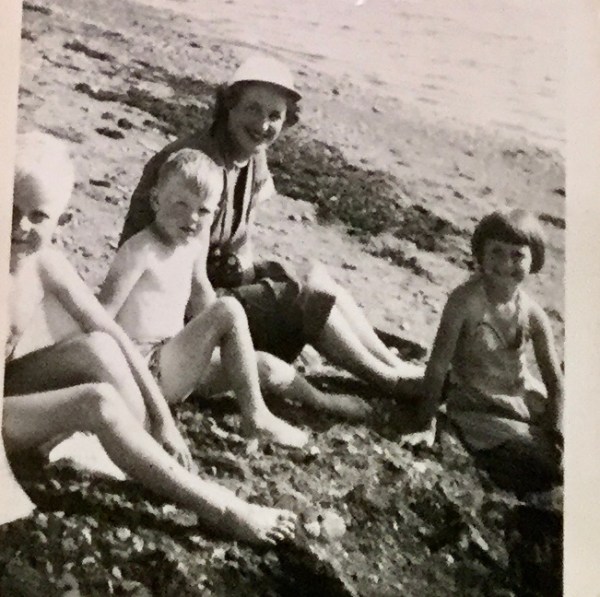
Willett cousins with Aunt Kay on Baie de Chaleur beach

My seven Angus and Willett cousins were playmates as children and we remain close to this day.

But my mother had other siblings, two sisters who never married and a brother who married but died young and childless.

A third sister, Madge, also died young leaving two young sons, David and Paige, aged four and six. Their father owned an apple orchard in Abbotsford south of Montreal. Albert remarried and fathered two more children. He kept in touch with Madge’s family by sending a barrel of apples to each household every Christmas although the families never actually got together.

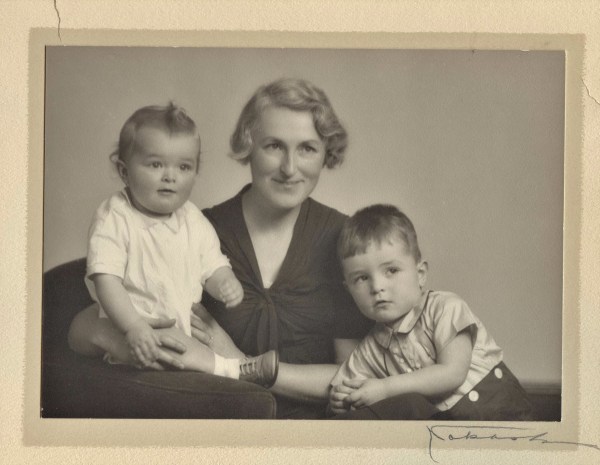
Paige and David with mother Madge

David grew up to become a notary in Montreal where I finally met him as an adult. He never married. When his father died, his step-mother and half-sister Louise moved into his home in Westmount where they remained until his mother’s death. Louise moved to Whitby, Ontario and later David joined her when he retired.

Paige forever remained a romantic mystery. My mother and aunts spoke about his early career in the Royal Canadian Airforce and a stint with the Canadian Snowbirds, a RCAF demonstration squadron, with adventures in the sky that further romanticised him for me. He later moved to the United States to fly with American Airlines and in 1971 he applied for American citizenship.2 He, too, never married. In 1972 a news article listed him as First Officer and one of the crew of Flight 96 flying from Los Angeles to New York who safely landed a plane load of 56 passengers and 11 in crew in Detroit when the cargo hold burst open in flight.3

A few years ago, David phoned to tell me that Paige had been diagnosed with Alzheimer’s, the disease that has haunted the Willett family. My mother and five of her six siblings died with Alzheimer’s and now Paige was the first of our generation to succumb. David and Louise helped him to move back to Canada and enter a care residence in Ottawa near the home of his half- brother Stephen. In 2014, two years later, David called to tell me Paige had died at age 75. We had never met; we were never playmates; we were not even adult friends.

And what happened to David? I have not heard from him since he called about Paige’s death.  My emails do not bounce back but they are never answered. The message on his telephone says that his phone cannot accept incoming calls. My calls to all the Whitney names listed in Ottawa and Whitby prove fruitless. None of them are the Whitney family for whom I am looking. Ancestry gives me David’s his birth date but not that of his death. Perhaps David, who would now be 86, is still alive but struggling with Alzheimer’s, the curse of the Willett family.

  1. Rylant, Cynthia. The Relatives Came. Scholastic Inc. New York, 1985.
  2. Ancestry.ca, Nevada Naturalization Petitions, 1956-1991
  3. Wikipedia.org. American Airlines Flight 96

The Rebellions of 1837-1838 in Lower Canada

The Rebellions of 1837-1838 10-04-2020

The Battle of Saint-Eustache, Lower Canada

https://en.wikipedia.org/wiki/Rebellions_of_1837%E2%80%931838#/media/File:Saint-Eustache- Patriotes.jpg

In 1837 and 1838 Upper and Lower Canada led rebellions against the Crown and the political status quo. The root cause of resentment in Upper Canada was against the corruption and injustice by local politicians

Louis-Joseph Papineau and his  Patriotes, as well as more moderates led the rebellion in Lower Canada. Their pleas for responsible government, were rejected in London.

The rebellion led directly to Lord Durham‘s Report on the Affairs of British North America, and to The British North America Act, 1840, which partially reformed the British provinces into a unitary system, leading to the formation of Canada as a nation in 1867.

Among the recommendations in this report was the establishment of responsible government for the colonies, one of the rebels’ original demands (although it was not achieved until 1849). Durham also recommended the merging of Upper and Lower Canada into a single political unit, the Province of Canada.

The contents of this database: contains splendid books, essays, studies, articles, biographies, dissertations, papers of the English and French languages. Many of these works are written by university professors, historians, a few archivists of the 19th and 20th centuries plus those of more recent times.

Notes: above excerpts are from en.wkipedia.org    and The Canadian Encyclopedia.

Click here to open the database: The Rebellions of 1837-1838 10-04-2020

Pages   1 – 44     Authors

Pages 44 – 52     Patriotes

Pages 53 – 54     Repositories

Pages 54 – 57    History

The Châteauguay, Lacolle, Ormstown and Plattsburgh hostilities of 1812-1814

https://broeder10.files.wordpress.com/2014/02/war_of_1812_map.jpg

The Battle of Châteauguay

The Battle of Châteauguay on October 26, 1813, was one of many skirmishes during the War of 1812. .Approximately 1,500 Canadian and Aboriginal soldiers commanded by Lieutenant Colonel Charles-Michel de Salaberry confronted and halted Hampton’s force of more than 4,000 men near Ormstown They thwarted an attack by the U.S. in their attempt to capture Montreal, in order to cut off a major supply route for the Canadian and aboriginal soldiers.

Salaberry and his men used several clever tactics and tricked their opponents by blowing bugles and shouting, giving the impression that they were a much larger group.. This trickery was successful.

The skirmish itself lasted several hours and involved intense and repeated thrusts and volleys on each side.

Salaberry’s force of militiamen, Voltigeurs Canadiensfencibles and Aboriginal allies were able to fight back the Americans, who soon retreated.

The Battle of Châteauguay, a national historic site is 50 km southwest of Montréal on the north bank of the Rivière Châteauguay between the towns of Très-Saint-Sacrement de Howick and Ormstown.

This database contains several free online books of interest to both historians and genealogists.

Contents: Map of conflict area. Authors, Archives and History

Click Download to view the attached file.

Margaret votes

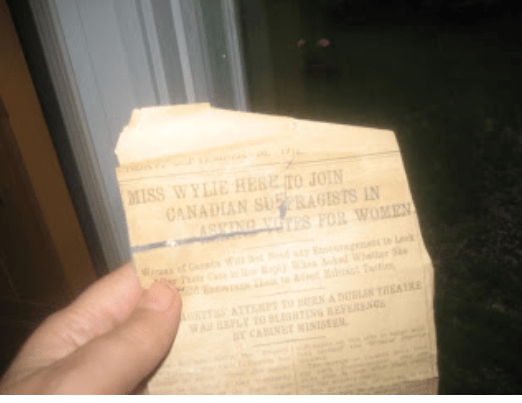
Nicholson Clipping of the 1912 visit to Montreal of militant British suffragette, Barbara Wiley. At least one Montreal society lady, a Mrs. Weller, wife of an electricity magnate, openly admired the suffragettes. She visited them in London and soon after invited Miss Wiley to speak at her Westmount home. where she got many of her friends to subscribe to Votes for Women, Mrs. Pankhurst’s militant -minded magazine. Most upper crust women who admired Pankhurst kept it under wraps. Mrs. Pankhurst was simply despised by many people, especially men.

Suffragist: A person who advocates for votes for women.

Suffragette: Someone who advocates militant methods to win the vote for women.

If you come from Protestant Canadians, especially Presbyterians or Methodists, it is likely you have a female ancestor or two from 100 years ago who believed that women should have the vote.

It’s safe to say, however, that none of these ancestors ever marched in a suffrage parade, as did some American women. They likely didn’t throw hatchets at store windows, either, as did some British suffragettes. Nor did they ransack golf courses or go on hunger strikes in jail like the most militant suffragettes in England.

The Canadian Woman Suffrage Movement was much more tame (dull and boring) than in the UK or even in the US. In 1913, in Canada, the movement was controlled by a group of elite matrons, most with wealthy husbands, who were highly invested in the status quo. They did not want working class women or even ‘excitable’ young women of their own class to enlist in their suffrage associations. Most of them weren’t ‘equal rights’ suffragists.

Some of these ladies wanted the vote solely to cleanse society of its undesirable elements – to impose their values on others. Some wanted to clean up or “purify” what they saw as a corrupt City Hall, that allowed prostitution (the social evil) and alcohol consumption to flourish. Others wanted the vote to improve the lives of children of all classes because they believed men only cared about money. These were maternal suffragists and probably in the majority.

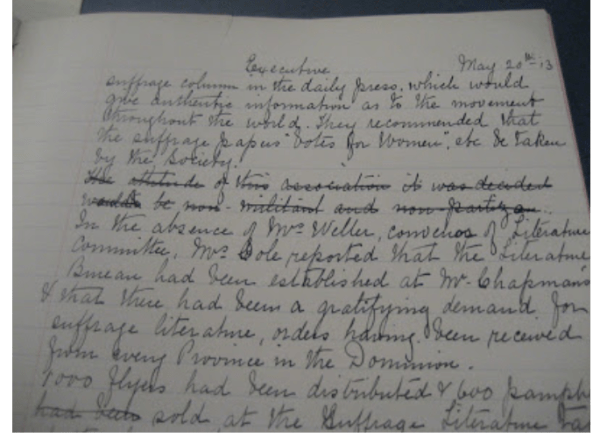
Page from minute book of Montreal Suffrage Association at BANQ.. Hmm. Someone has crossed out a line claiming the association is non-militant. Ha ha. They also want to subscribe to Pankhurst’s Votes for Women magazine.

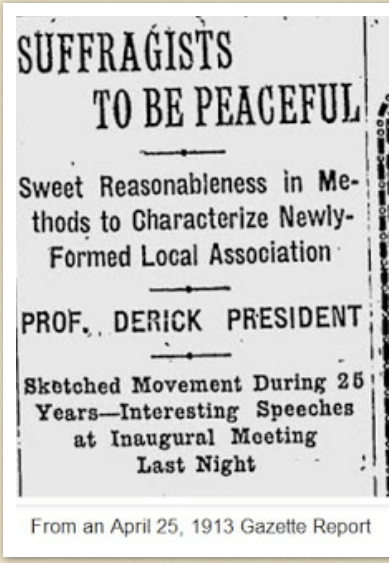
The Montreal Suffrage Association was launched in March 1913 at the height of the Canadian movement. The MSA was led by Miss Carrie Derick, McGill Botany Professor and the former President of the Montreal Local Council of Women. Two other McGill profs were on the Board of the MSA, they were male, of course, along with two church ministers (one of whom was a real Pankhurst hater) and socialite and philanthropist Julia Parker Drummond.

At their inaugural meeting, the MSA promised to conduct a ‘ sweet and reasonable education of the people.”

My husband’s great grandmother, Margaret Nicholson of Richmond, Quebec and her three daughters, Edith, Marion and Flora, were not invited to join the MSA, even if the girls lived and worked in Montreal. Even though they attended suffrage evenings sponsored by the MSA.

Still, they were avid supporters of woman suffrage. They left behind (for my own education) many newspaper clippings like the one at top covering all aspects of the topic.

I also have a 1908 letter from Margaret to her husband, Norman, recounting a huge argument she had about the vote with an anti-suffrage preacher relative. ‘I told him we don’t live in St Paul’s time and I don’t milk cows out in the field. ” St Paul was often invoked to prove women’s place is in the home.

Edith writes this in a 1913 letter from Montreal. “We are going to hear Mrs. Snowden (moderate suffragist from England) speak at St James Methodist Church, but she is not militant and for this I am very sad.”

So, she was all for the militant suffragettes, who were at their naughtiest and noisiest in 1913, employing incendiary and sensational tactics “deeds not words” to get their point across and making all the North American news feeds.

Canadian women finally won the vote, in May 1, 1918. A select few, those women with men active at the war front, had been allowed to vote in the infamous – and very undemocratic – conscription election of 1917.

Margaret Nicholson did not have a close relative in the war. She voted for the first time in December, 1921.

I have that letter too. Here is what she wrote:

December 7, 1921, Richmond, Quebec.

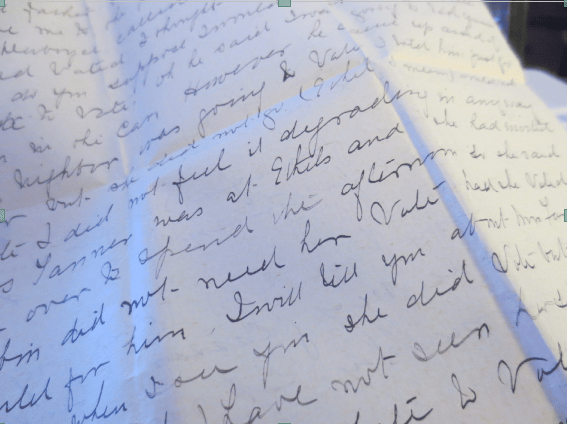
Mr. Fraser and I went down to vote at around 11:30. I did not want anyone calling of me and asking to drive me to the poll. I wanted to go independently. Mr. Duboyce called at about 3:30 and asked me if I had voted. I said, “ Do you suppose I would wait until this late hour to vote?” He was going to take me down in the car. He then came up and asked if my neighbour, I mean Ethel, would go to vote. Well, she would not. Later, I was invited over to Ethel’s. She said Tobin did not need her vote, but if she was going to vote, she would vote for him. Mrs. Farquarson did vote, but seemed ashamed. I have not seen her since. Mrs. Montgomery came last night, but too late to vote.

Of, I am so delighted with this country!

It did not feel degrading in any way.

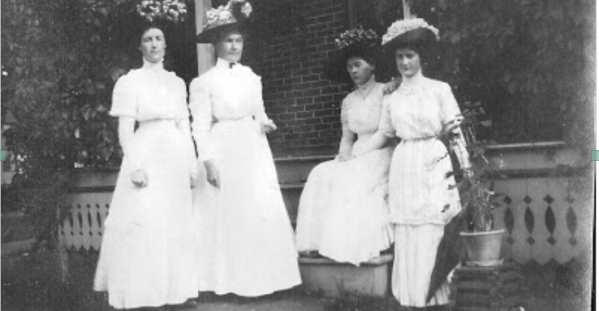
Margaret Nicholson and her daughters, circa 1910 in their fancy white dresses.
Margaret’s 1921 letter to her husband. “How I love this country..”

If you would like to read more on the weird Montreal Suffrage Movement in 1913, you can find Furies Cross the Mersey on Amazon.ca.

I mix the story of the Nicholsons with the story of Carrie Derick and the Kenney sisters, Sarah and Caroline, who moved from England to Montreal and tried to start a militant movement. They were the sisters of Annie Kenney, Mrs. Pankhurst’s famous first lieutenant. I believe I was the first person to figure this out..thanks to Google News Archives.

If you want to read more about the Canadian suffragists and their involvement in the Conscription election, read my Service and DIsservice, also on Amazon.ca KINDLE.