Category Archives: Greece

My Grandpapa and the Greeks

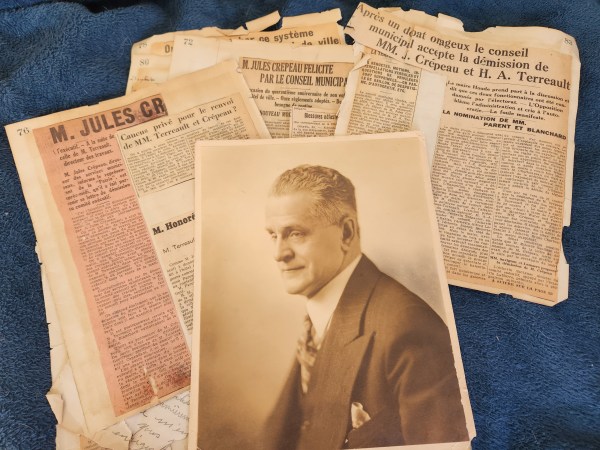
Pages from the WWI era scrapbook my Aunt Flo kept. (I threw out the cover as it was shedding).

My mom liked to tell me that her father, Jules Crepeau, started work at eight years old in the 1880’s sweeping the floors at Montreal City Hall and that by the Roarin’ Twenties he had risen to be the highest paid civil servant in the city.

This family myth spoke volumes to me: my grandfather was a self-made man and a man of the very highest calibre.

By 1921, when my mother was born, Jules was Director of City Services responsible for just about everything that came down in the city, from the Prince of Wales’ official visits to damage control during typhoid epidemics to the handing out of liquor licenses in the Prohibition Era

All seven city departments were under his control, including and most significantly, the Police Department. My mother said that my grandfather occasionally brought her to work at City Hall. This must have made quite a huge impression on her.
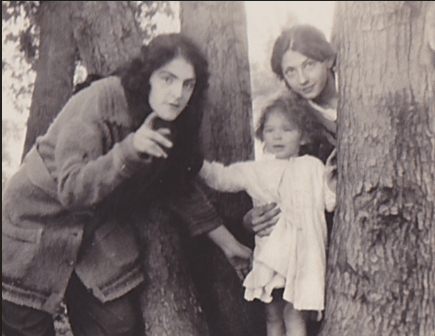
My aunts Alice and Flo and my mom, circa 1922.

My grandfather’s City Hall file reveals that he started out young as an intern in the city Health Department in 1888 and by 1901 he had worked his way up to the position of Second Assistant City Clerk, * aka the person who sees all the paperwork that passes though City Hall.

Jules had complete recall so this was a useful learning experience. In 1921, he landed that plum post of Director of City Services, a new position set up specifically to ensure an even distribution of municipal assets across the wards. Before the post was created, community groups from across the spectrum were invited to give their input on the subject.

I have since learned that Montreal’s burgeoning Greek community most probably had a hand in his promotion.1

A few years after my mom died in 2009, I took a closer look at a disintegrating family scrapbook my Aunt Flo had kept. It contained yellowed news clippings from 1928 and 1930. In 1928, my father was being applauded for his 40 years of stellar service at City Hall. In 1930, he was being forced out by new Mayor Camillien Houde.

I noticed that the dilapidated black volume had originally been a minute book for The Crethan Company, a confectionery/food distribution company run out of Clarke Street by a handful of Greek men as well as my grandfather.
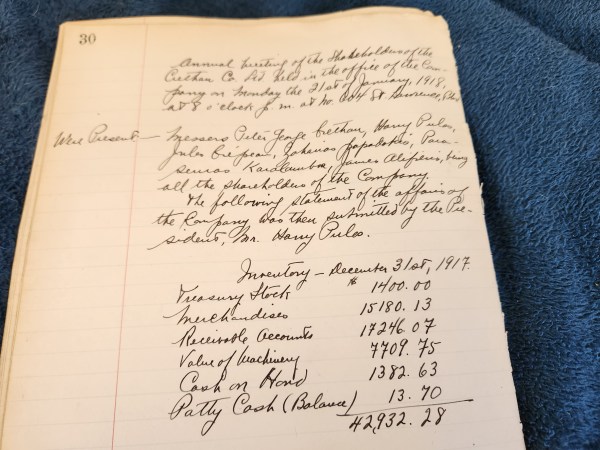
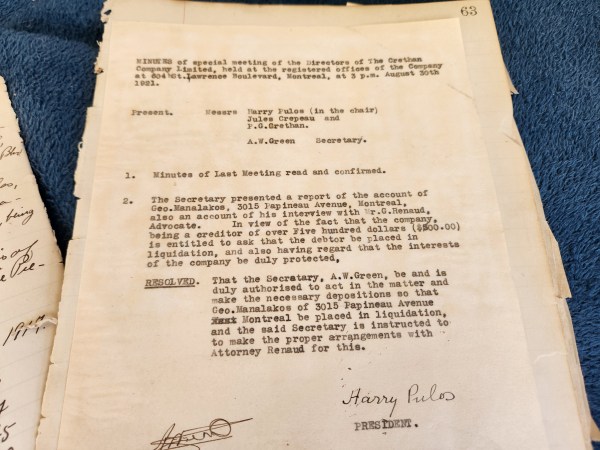
1917 minutes. Crethan Company. The company distributed food, olive oil, fruits, confections. Likely supplying Greek restaurants.
oops. Someone didn’t pay their bills

The President was Harry Pulos aka Harambolous Koutsogiannapoulos, the defacto leader of the early Greek Community in Montreal.2 How interesting.

You see, by that time, I had researched my genealogy and discovered that my mom’s Uncle Isadore Crepeau had been VP of United Amusements, a movie distribution titan founded in the 1910’s by Laconian immigrant George Ganetakos. Ernest Cousins, an Anglo businessman was President..

So, I checked to see if these two men, Harry Pulos and George Ganetakos, were related: the answer is very likely.3

My mother had never mentioned her father’s Greek connections, not once, but she did talk about working in the Montreal movie biz before she was married.

In 1941, right out of Marguerite Bourgeoys secretarial school, my mom got a job at RKO Movie Distribution, a United Amusements affiliate.4 Both companies were located on Monkland Avenue in Notre Dame de Grace, near her family home at the corner of Oxford and Monkland. (LINK to story I Remember Maman)

Taking an even closer look at the Minute/Scrap Book I suddenly noticed the significance of the dates. The Crethan Company was started in 1916 and ran until (at least) 1922 when the minutes end.
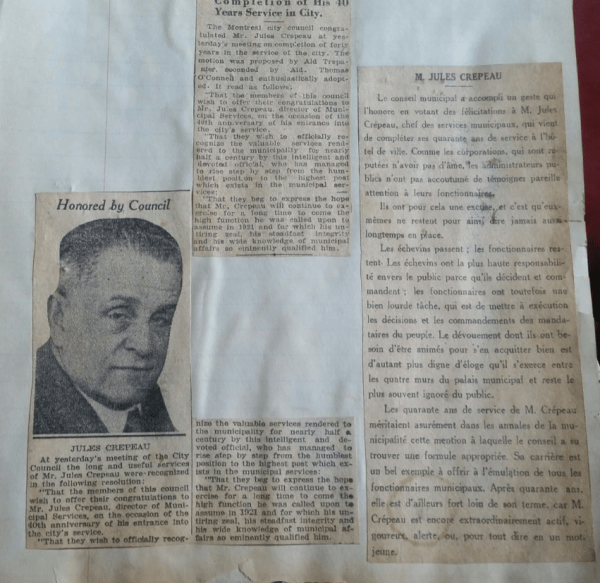
Honored by council in 1928, thrown out in 1930.

Grandpapa Jules seems to have aligned himself at just the right time with these ambitious men from Laconia. They probably helped him land his prize post and, in turn, he helped them with motion picture and restaurant licenses. 5I can’t prove it, but Jules almost certainly got his brother Isadore, an insurance salesman, his gig as VP of United Amusements.
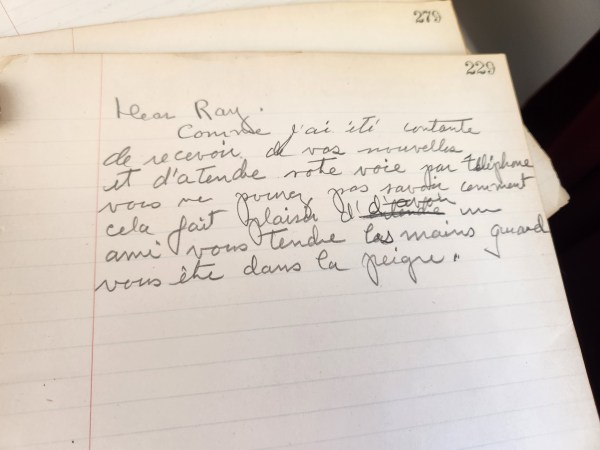
How did this get in there? A weird letter, likely my Aunt’s with spelling mistakes.
Dear Ray. How happy I was to receive your news and to hear your voice by telephone. .you can’t imagine how nice it is when a friend extends his hands when you are ‘dans la peigre.” Does she mean piege as in trap.Pegre as in underworld. If she meant Pegre, is she using a metaphor for ‘being grounded’ or does she truly mean ‘in the underworld?

In 1927 came the fatal Laurier Palace Motion Picture House Fire, where 78 children perished in a crush to the door. It was a real game changer in Quebec, and my grandfather got caught smack in the middle. He was blamed for looking the other way when citations were given to movie houses for letting in children unaccompanied by an adult.

George Ganetakos, using the name George Nicolas, immediately set up a fund for the victims. During the inquest my grandfather brought in Earnest Cousins to plead for continued Sunday showings. Isadore also spoke. Sunday showings for adults were allowed to continue.

As it happens, two years before in late 1924 during an inquest into organized crime, corrupt policemen and Montreal’s sex industry, a cop-on-the-take took the stand and accused the Greeks of “corralling” children into movie houses and warned, “one day there’s going to be a fire and no one will be able to get out.” He wasn’t even being asked about movie houses: He brought this up out of the blue. I suspect this cop was a go-between and he was sending a coded message to my grandfather.

My grandfather certainly thought so. He had that same policeman fired the very next day.
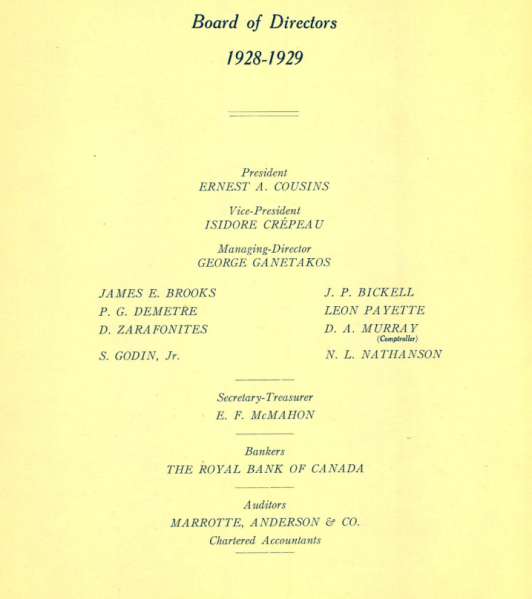
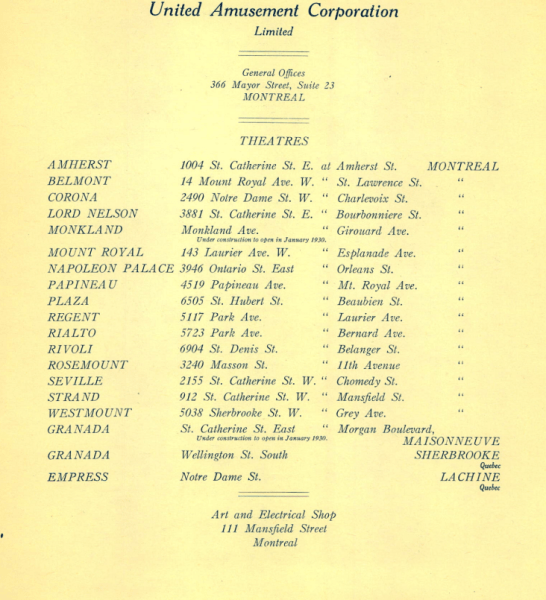
Top: 1929 annual report United Amusements. Isadore would ‘fall’ out of his 7th story office window in 1933. Bottom: movie houses owned by UA. The list of these movie palaces would grow. My Great Uncle Isadore was shown on a talkie film at the opening of the Monkland Theatre. Isadore’s glass company would make a mural to adorn the Rivoli. It’s still there today. (Mcgill digital archives.) N.L. Nathanson, an American was in Toronto, head of Famous Players. The two companies were associated.

My grandfather, in turn, was ousted in 1930 by the new Houde administration, but not before negotiating a huge life pension, likely in exchange for his silence. In 1937, during the Depression his hefty pension was rescinded by City Hall as an emergency measure – and just two weeks later my grandfather got run over by a plain clothes policeman near his home in NDG. Hmm. He spent 3 months in hospital and died the next year of complications at the age of 59.

My opinion only: Obviously my grandfather had nothing to do with the fatal fire, but his enemies may have had a hand in it.

The Laurier Palace was owned by Syrians, a group that was often conflated with Greeks back in those days.

Funny, whenever I’d ask my mom why I couldn’t go to the movies as a child she would tell me the story of ‘all the little babies who died in the Laurier Palace Fire’ and she’d pretend to rock an infant in her arms.

She didn’t know the real story.

The End

  1. L.O. David, the patrician head City Clerk, was a scholar who preferred working on his history books over the bureaucracy of City Hall. My eager-beaver grandfather got to do all the work! Montreal had universal male suffrage, but in the century earlier Montreal was an English majority city and the Mayors had to have 10,000 dollars in the bank just to run and the aldermen had to have 2,000 dollars and be fluent in speech and writing. They abolished these rules in and around 1910 as the city grew, absorbing the suburbs. The city became majority French. They also abolished the rule that an English Mayor must follow a French Mayor. Populist mayors, petit bourgeois, were now elected instead of the well-educated professionals of the Victorian Age. It must also be noted that the post of Mayor became less and less powerful, almost a figurehead in the 1920’s with the Executive Committee having all the sway. 1910 saw an immigration boom, so there were important votes to be had among these newcomers.
  1. To Build the Dream, Sophia Florakas Petsalis. 2000 explains that Koutsagiannopoulos was a pre-turn of the twentieth century arrival who had a fruit store across from where Eaton’s would be built, a highbrow location. Phillip’s Square was so ritzy, it was one of the few areas female students from Royal Victoria College up on Sherbrooke, were permitted to venture. According to the book, Pulos made sure to take care of his fellow Laconians, finding them jobs upon landing, etc. Other names on the board: Pappas, Antoniou; Economides; Crethan, Pappadakis, Karalambos and at one point a Forget.
  2. Drouin (Greek EvangelizmosChurch Montreal) reveals that in 1907 a Zarafonity from Dourali Laconia married a Koutsgiannopoulos- a marriage witnessed by Ganetakos, also from Dourali. He likely had a Zarafonitis mother. Koutsogiannopoulos also was godfather to John Zarafonity son.
  3. Lovell’s Directory reveals this fact. She lived on Monkland and Oxford with her Mom and brother and sisters. Her dad died in 1938.

Greek men (mostly from Laconia, many related),were involved in all aspects of the movie distribution industry in Montreal back in the day. Ganetakos was only the most prominent of these movie men. The Syrians who were conflated with Greeks in the newspapers might have been Pontic Greeks from Turkey.

These new Canadians often started out working in the food industry, often pushing carts through the streets, then starting up stalls and then expanding into stores, cafes and restaurants.

The story goes that Ganetakos’s uncle, Demetre Zarafonitis, started playing ‘flickers’ at his fancy uptown café, the Cosy Parlour near Phillips Square, and that George noticed these early movies were more popular than the ice cream.So he started up his own motion picture house, the Moulin Rouge in 1908.

Two decades later, George Ganetakos was working out of his palatial office on Monkland Avenue, distributing Hollywood films for Famous Players and RKO, building architectural masterpieces like the Rialto Theatre on Park Avenue, and getting lots of press in the Hollywood trade journals. (My grandfather got a fair bit of press there as well.)

It seems that George Ganetakos was as much of a self-made man than my grandfather. However, I had contact with a descendant of the Zarafonitis’ and she was told her ancestors got the bum deal.

Greeks were referred to as Syrians in the press and they faced obstacles to their success by established merchants. People complained the cart pushers yelled too much on the street. At one point, the city wanted to tax stall merchants 200 a year as they did regular stores. An alderman, one loyal to my grandfather, spoke up for them saying this would force them out of business.

  1. During the Coderre Inquiry into Police Malfeasance in 1924, a policeman on the stand said that Jules personally forced policeman to look the other way when it came to underage clients of movie houses. He also said Greeks ‘corralled’ young children into the movie houses. He brought this up out of context. No one cared about children and movie houses. In those days, across North America, Sunday showings were often an all- kid affair. (The parents got an afternoon off). And besides, the streets at that time were dangerous with horses and autos running amok with no street rules. The Inquiry was about illegal booze and, mostly, the sex trade. In Juge Coderre’s final report in 1925, published in the Gazette and other places and rehashed for a 1926 US Senate hearing into Prohibition, the testimony getting into a two page spread in the New York Times, Coderre imperiously asked, “Who is this man Jules Crepeau who tells the Chief of Police what to do?”
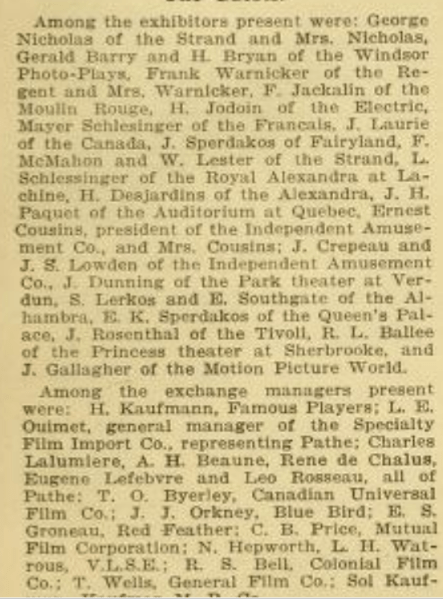
A strange bit from a May 20,, 1916 Motion Picture World with the guestlist for a bash in honor of a Pathe movie star in town written by a Gazette reporter. Seems to show my Grandfather J. Crepeau with Ernest Cousins of “Independent Amusement”. Is this a typo, supposed to be I for Isadore? Either way a mystery. Did my grandfather dip his toe into the movie business as well as the food business in 1916? Or did Isadore have the movie gig as early as 1916? George Nicholas at top is likely George Ganetakos. (I have to delve deeper. I believe Indepent Amusement became United Amusements.) And is the T Wells my husband’s grandfather? See all the Greek names? Sperdakos, Lerakos etc. and M. Ouimet of the legendary Ouimetoscope.
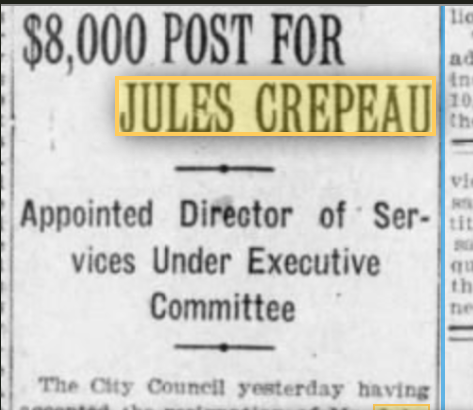
Dec, 1921.

Greek Tragedy

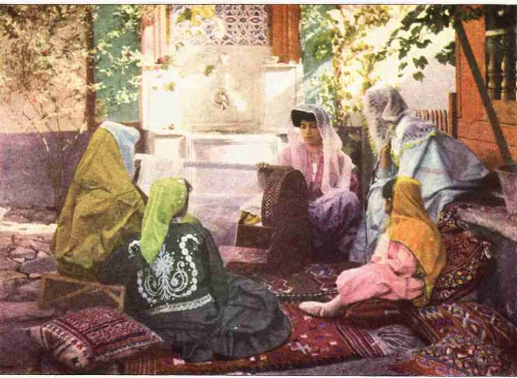
Syrian girl with her wares. (National Geographic, November, 1925. Article cited below. This magazine is in the public domain according to Library of Congress. Gervaise Courtellemont. Lumiere company.


Prologue: In my last post I explained how I recently learned, through DNA, that my biological father was likely Pontic Greek on the father’s side. Pontic Greeks are Orthodox Christian Turks who believed they are descended from ancient Greeks, who once lived on the southern coast of the Black Sea in cites like Samsun and Trabzon and who speak either a unique form of Greek or Turkish. In that post, I also wrote about the 1923 population exchange between Greece and Turkey. Here, I elaborate.

In 2010, I visited my older brother who lives in Denmark at his holiday home in Plomari, Lesbos, Greece. The large island of Lesbos is off the northwest coast of Turkey. On a good day you can see Turkey from the capital city of Mytilini. It’s only 17 miles away.

Back in 2010, before I explored my DNA, I naturally assumed I was half French Canadian and half Yorkshire British, just like my older brother, but I also knew, deep down in my heart of hearts, that I resembled the Greek locals, both in looks and in temperament.

Plomari village from the back window of my brother’s place.
The harbour is two streets down.

Today, I understand that I am very likely related to some of those local Greek citizens on Lesbos, perhaps even closely related. I know this because of a photograph I recently discovered in an article from the November, 1925 National Geographic magazine.

Greek refugees arriving in Mytilini. 1923

There is no shortage of online information on the 1923 Greek/Turk ‘population exchange’ that came on the heels of a horrific event referred to back then as ‘The Smyrna Holocaust,’ but I had high hopes that this story entitled History’s Greatest Trek. Tragedy stalks through the near east as Greece and Turkey exchange 2,000,000 of their people, written in real time by a world class journalist in a world class magazine, would shed some light on the path my Pontic bio-father (or grandfather) may have taken to reach Montreal, Canada in 1954.

I have tree matches in Samsun, a port on the Black Sea in northern Turkey. My mother, who lived and worked in the Notre Dame de Grace area of the city, likely knew Greek men whose grandparents fled Smyrna (now Izmir) in 1922, on the west coast of Anatolia on the Mediterranean Sea. Could I connect the two places?

I was not disappointed. Right at the beginning of the sixty page article there’s a picture of a young Greek man from Samsun. The caption reads: A Refugee from Samsun. He took part in the first trek of 100,000 refugees from the Anatolian interior.

According to online sources, post WWI, most elite Greeks in Samsun were killed off and all other able-bodied men sent into the interior to join the Turkish army.

Clearly, some of these Pontic Greek men and women escaped the Turkish hinterland to make it to the Mediterranean coast and Smyrna in 1922, in the hope of catching a ride to safety.

This 60 page article from 1925 is a classic piece of National Geographic reporting. It is workman-like in its execution with a prose style on the flowery side. The article offers readers a succinct historical and political perspective on the infamous 1923 population exchange between Greece and Turkey. The reporting is objective: The Muslim story is discussed with as much respect as the Christian story. And, of course, the article contains many, many photographs, about one hundred of them. Oddly, the prettiest colour ones all depict quiet Turkish life.

There’s a fascination here with exotic dress, from what I can see.


Still, the author, Melville Chater, pulls no punches as he uses his gift with words to capture the true horror of the situation in the port of Smyrna during the late summer of 1922: the hope, despair, death and disease and, eventually, the chaos, the total breakdown of civilized life.

Chater and his companion were in that coastal city when the Greek military lines collapsed in August, 1922, effectively ending the three year old Greco-Turkish war. They were in Smyrna in September to witness the Greek soldiers flee home on their military barques, leaving only ‘neutral’ observer boats in the habour.

Immediately thereafter, they saw the victorious Turkish cavalry enter the city, the riders’ left palms outstretched in a peace gesture, and a few days hence they witnessed the great fire of Smyrna that forced local citizens to flee in chaos to the quay and mix with the tens of thousands of refugees from further afield amassed there. By this time “the city had become a gigantic blast furnace… Affrighted faces mingled with wild-eyed animals, and human cries with the neigh of horses, the scream of camels, and, last, the squeaking of rats, as they scuttled by in droves from the underworld of a lost Smyrna.”

The beginning, late August, 1922.

“Refugees from anywhere within 150 miles inland herded seaward into Smyrna. At first they came in orderly trainloads or in carts, with rug-wrapped bedding, some little household equipment, and perhaps even a few animals, But as the distant military momentum speeded up, the influx became a wild rabble of ten, then twenty, then thirty thousand a day. Their increasingly scanty possessions betokened a mad and yet madder stampede from the scene of sword and fire, until September 7 saw utterly destitute multitudes staggering in, the women wailing over the first blows of family tragedy, whereby mothers with no food for their babies had been forced to abandon their older children in wayside villages….

….By now Smyrna’s broad quay swarmed with perhaps 150,000 exiles who camped and slept there, daily stretching their rugs as makeshift shelters against the sun, whose furnace-like heat was the mere forerunner to a terrible epic of fire.”

The Greek Army flees,the Turkish cavalry arrives.

On September 23rd, a fire breaks out in the Armenian quarter. The Turks give permission for women and children and old men to leave. People are dispatched to Athens to organize a flotilla of rescue boats. The Turks then give the rescuers one week to evacuate the refugees or they will be forced into the interior. Further chaos ensues.

“Uncounted hundreds were crushed to death or pushed over the quayside to drown, on that first day, when eight ships, convoyed by American destroyers left with 43,000 souls aboard. For those left behind there remained but six more chances—a chance a day—then the black despair of deportation into the interior.

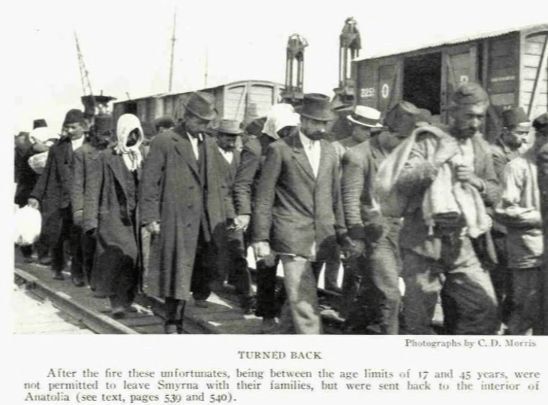
These men were not allowed to leave Smyrna after the fire with their families. “Everyone from peasants to bankers” is how these Anatolian Greek refugees are described in the article. Also as “human derelicts” and descendants of ‘those adventurous spirits who had followed Alexander the Great into Asia.” Some men apparently escaped at Smyrna, swimming to rescue boats under the cover of night. Some wealthier men bought their way onto boats. 300,000 thousand people were evacuated in two weeks, including 100, 000 ‘cellar-hiders’ in Smyrna, uncovered by the Turks in a house-to-house search.

The aftermath:

A notification is posted permitting (well, forcing) all non-Muslims to leave Asia Minor before November, 30, 1922. Hoardes of Anatolian Greeks, former prisoners of war, men, women and children, head to the Black Sea coast.

“With ship-deserted quays, as at Smyrna, and with the Black Sea ports glutted with sidewalk-sleeping, disease breeding paupers, who had been thrifty cottagers a few weeks before, the gap was finally bridged by the arrival of Greek ships flying the Stars and Stripes and convoyed by American destroyers….

….”By January, 1923, Athens had slammed its official doors protesting against further expulsions.”

With a big nudge from the US, Britain and the League of Nations, Athens agreed to accept hundreds of thousands more Christian Greek refugees in an exchange for Muslims living in Greece.

The exchange would begin in May, 1923 and be carried out in various ways. Most Greek refugees are funnelled to the Athens region as well as to Thessonaliki in the northern part of Greece and to some Aegean Islands like Lesbos.

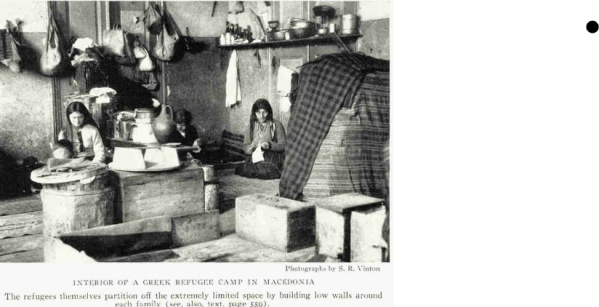
They live in refugee camps rife with disease and death. There is little usable land left in Greece due to past wars.

Greece, then a country of 6 million souls, would take in almost a million and a quarter refugees within a year of the Smyrna disaster, increasing its population by 25 percent.

“There is no adequate parallel whereby to convey even remotely a picture of Greece’s plight in 1923,” Chater summarizes.

Pretty heavy stuff – and yet the 1925 magazine article somehow manages to maintain the feel of a breezy travelogue.

Greek refugee camp Macedonia

Epilogue:

In the style of Virginia Woolf’s 1925 masterpiece Mrs. Dalloway, I imagine a comfortably middle class lady, back in the mid 1920’s, perhaps my husband’s grandmother in her favourite club chair in her cottage in Westmount, flipping through this very issue of the National Geographic, cup of tea in one hand. The inky new pages crackle as she turns them with her free hand. “How awful,” she whispers under her breath when she gets to the bit about the Greek women holding their still-born babies at their breasts because they had no place to bury them. And, then, “How pretty,” as she eyes the flowing costumes on the Turkish women, the colourful mosques and the charming minurats. And, then, as she comes to the full-page advertisement for Campbell’s Soup at the end of the article, she perhaps thinks, “Yes, tomato soup for the children, for tomorrow’s lunch.”

Here’s the archive.org link.

https://archive.org/details/nationalgeographic19251101/page/550/mode/2up?q=mosques

Easter Celebrations

I am spending this week madly rushing around to get ready for Easter Sunday. My husband is Greek and we celebrate Easter with Greek traditions on this day. Forty guests are expected at our house for the celebrations.

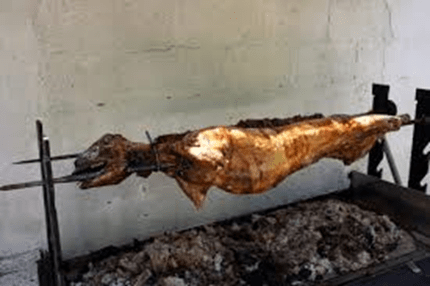
The star of the show will be a lamb on a spit. The “lamb team” starts early in the morning to prepare the lamb, filling the inside cavity with herbs, onions, and lemon, and then sewing it up. It will turn on the spit for many hours. We used to take turns turning the lamb but now we have an electric motor to do the job.

Courtesy Greek Boston

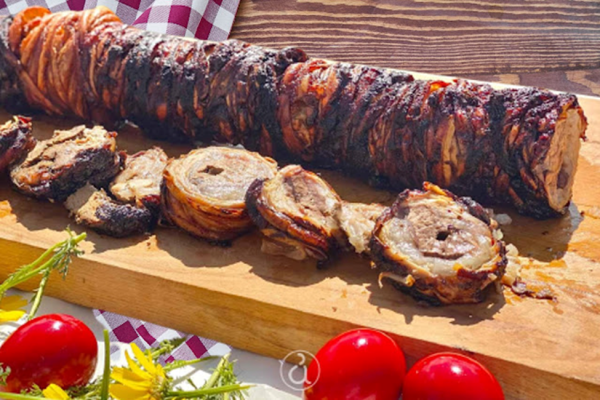
My husband and his uncle will also prepare the kokoretisi early Sunday morning. Kokoretsi is also roasted on the spit. Kokoretsi is a traditional dish of lamb intestines wrapped around seasoned offal, including sweetbreads, hearts, lungs, and kidneys.1 Everyone loves it, although I have to confess that I do not find it appetizing. Surprisingly none of the younger people in our family are interested in learning how to make it.  In a decade or so, kokoretsi may no longer be served.

I found a picture of kokoretsi on the My Greek Food Recipes blog, one of my favourite sites for Greek recipes:

Courtesy My Greek Food Recipes©. All Rights Reserved.

Of course, the lamb will be accompanied by many Greek favourites such as tzatziki, spanakopita, lemon potatoes in the oven, and more.

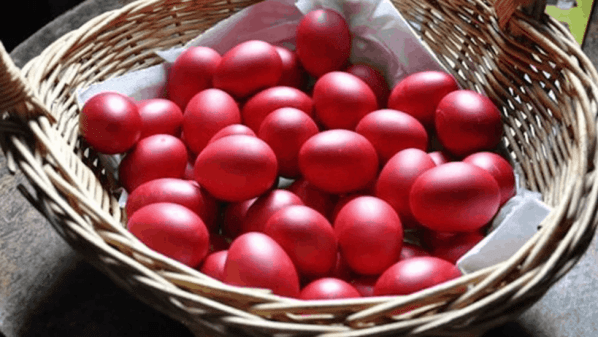
Another highlight of the day will be the Tsougrisma, a game played by bashing eggs together. Easter eggs are dyed red, representing the blood of Christ shed on the cross.2 Once dyed, red eggs are woven and baked into tsoureki, a three-braided Easter bread representing the Holy Trinity.3 The rest of the eggs are used as a table decoration and are used to play Tsougrisma, which means “clashing” and “cracking” in Greek. The cracking tradition symbolizes the resurrection of Christ and birth into eternal life.4

Courtesy Greek City Times

To play the game, each players holds an egg, finds another player and taps the end of the egg lightly against the other player’s egg. They then tap together the ends that are not broken. They then move on to other players until both ends of their egg are broken. The person who has an unbroken egg at the end wins the game.5

Of course, the Easter Bunny also visits us on this important day. The children are always very excited to hunt for Easter eggs in the back yard.

I am really looking forward to this day of celebration with our family and friends.

  1. Wikipedia, Kokoretsi, https://en.wikipedia.org/wiki/Kokoretsi, accessed 16 April 2025
  2. The Greek Food Shop, How to play the red egg game, 13 April 2019, https://greek-food-shop.com/2019/04/13/the-best-greek-easter-tradition-how-to-play-the-red-egg-game/?srsltid=AfmBOop0byvUV9-0uNZ0blsMeOGivhbWh8gIqWrTxx9w3PV9Rd6qTRcE, accessed 16 April 2025
  3. The Spruce Eats, Greek Easter Egg Game, https://www.thespruceeats.com/greek-easter-egg-game-1705738, accessed 16 April 2025
  4. The Spruce Eats, Greek Easter Egg Game, https://www.thespruceeats.com/greek-easter-egg-game-1705738, accessed 16 April 2025
  5. The Spruce Eats, Greek Easter Egg Game, https://www.thespruceeats.com/greek-easter-egg-game-1705738, accessed 16 April 2025

Liquid Gold

Homer said in the 8th century BCE that olive oil was liquid gold. The olive tree reached Greece sometime in the 28th century BCE, introduced by the Phoenicians.1 A staple in Mediterranean cuisine, olive oil has been used for religious rituals , medecines, as fuel in oil lamps, as well as to make soap. Spartans and other ancient Greeks rubbed themselves with olive oil when exercising in the gymnasia.2 Aristotle also described the use of olive oil as a contraceptive. Mixed with either oil of cedar, ointment of lead, or ointment of frankincense, this mixture can be applied to the cervix to prevent pregnancy.3 The olive tree was so important to the ancients Greeks that they awarded an olive wreath to the winners of the Olympic games, symbolizing peace.4

I just came back from visiting my husband’s family in Greece and, as it was October, many of the conversations revolved around when each household would harvest their olives. Obviously, not everyone in Greece has olive trees, but it is common on the islands and in rural areas for each household to have olive trees. The olives are harvested to extract olive oil for family consumption. From the conversations that I listened to, it was important to harvest the olives just before they fell off the trees. This would ensure that the olives were at their greatest weight.  They should also be harvested before they are fully ripe, when they start to change colour to a purple colour, but are not yet fully black. The olive oil will be extracted from the olives at the local mill and it is important to time one’s appointment so that the olives do not sit too long after harvesting and sour.

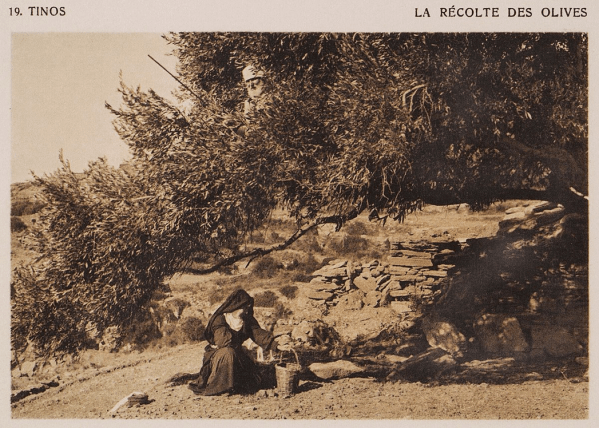
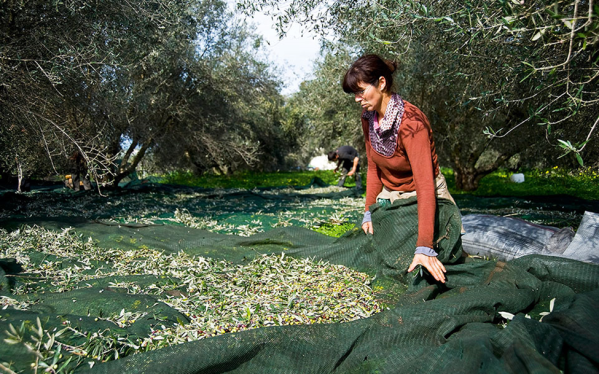
Family olive harvesting has not changed much over the years. Olives are usually harvested by hand, with a rake that dislodges them gently so that they fall onto a tarp or a net at the bottom of the tree. All stray olives are gathered up and leaves and sticks are sifted out as much as possible.

Olive harvesting on Tinos, 1919 5

An example of the nets used to harvest olives

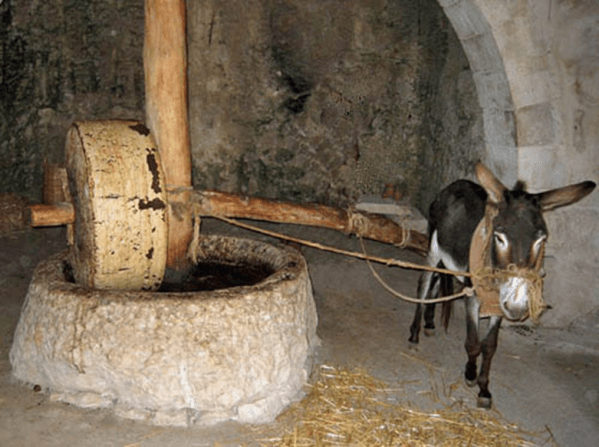
Olive oil was formerly extracted using millstones. The olives were emptied into a stone basin and ground into a mash. The millstone was harnessed to a donkey. The mash was then scooped out and poured into baskets that allowed the olive oil to drain out into vats. 7

Old stone olive mill8

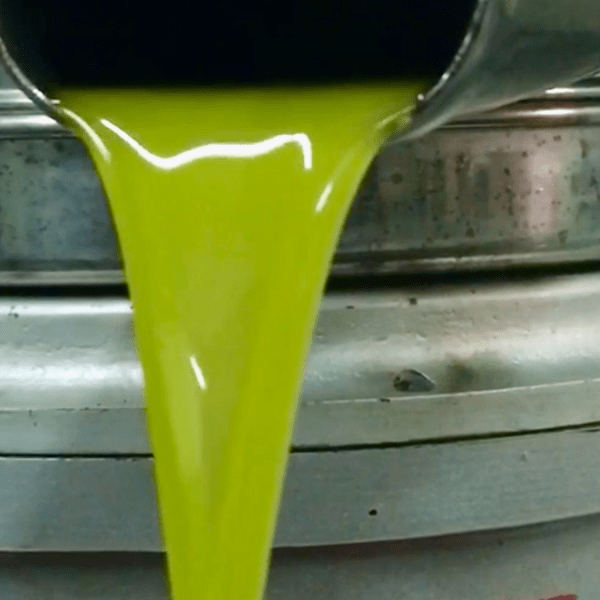
I had the opportunity to visit a modern mill this olive season and, while mechanized, the process is identical. The purpose is to squeeze the oil from the olives to extract “liquid gold.” Initially the olives are weighed. The first machine separates the olives from any leaves and sticks and washes them. They are then sent to a barrel that crushes the olives and extracts the oil. As the oil is extracted, the machine counts the number of liters as the oil pours into a separate basin. Once this process is finished, the oil is poured into individual containers so that the client can take these containers home. At the mill that I visited, the olive pulp or mash is put into a compost pile.

Liquid gold 9

  1. https://en.wikipedia.org/wiki/Olive_oil, accessed 31 October 2022.
  2. Ibid.
  3. Ibid.
  4. Wikipedia, Olive Wreath, https://en.wikipedia.org/wiki/Olive_wreath, 1 November 2022
  5. Baud-Bovy, Daniel et Frédéric Boissonnas, Des Cyclades en Crète au gré du vent, Geneva, Boissonnas & Co, 1919.
  6. Greece is travel, culture, gastronomy and more, Crete, Olive Oil: The Past, Present and Bright Future of Crete’s Lifeblood, https://www.greece-is.com/olive-oil-the-past-present-and-bright-future-of-cretes-lifeblood/, 3 November 2022
  7. Traveling Classroom Foundation, Making Olive Oil, http://travelingclassroom.org/?p=1379, 3 November 2022
  8. Ibid.
  9. Green Golden Gold, https://www.greengoldengold.de/en, accessed 3 November 2022

Greece, Beautiful Greece

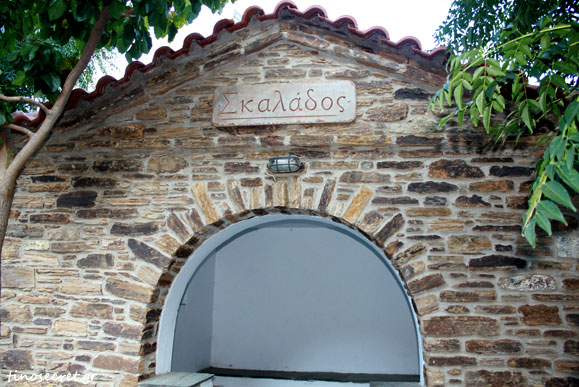
Have you ever been to Greece? Great food, good weather, beaches. I could go on and on. But my favourite part about visiting Greece is staying in the ancestral home of my husband located on the island of Tinos in the beautiful village of Skalados.

My mother-in-law, born in 1932, has lots of stories of growing up in this lovely village. When she was born, the village had no running water, no electricity, and no roads. It is hard to imagine as everyone now has internet, televisions, washing machines, and one or two cars per family.

While she was growing up, the villagers’ took their water from the well located in the village. It was hard work carrying the water that the household needed from the well to the home. They also used the well for washing the clothes. Women would help each other, as washing was heavy and hard work. Everything that they needed had to be carried to the well, including the clothes. To my surprise they used a blue rinse for the whites. 

Well in Skalados, Tinos (courtesy Tinosecret)

The village had two wood ovens and these were also shared. On baking days the families would bring their bread and dishes that needed to be cooked in the oven.

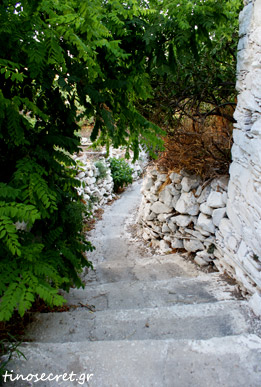
If you have been to Greece, you will have noticed that the stairs in the villages are wide and long, with a small step.  These stairs were designed for donkeys, which explains their design. My husband’s grandfather used a donkey as his means of transportation as there was no road to the village until the 1970s. The whole island is crisscrossed with “donkey paths” that are now either overgrown or used as walking paths.

Stairs – Skalados (courtesy Tinosecret

I am already looking forward to my next visit.