Category Archives: Writing

Friday factoid: Military Service Records

You can get more detail about your ancestors if you consult the service records in person.

My grandfather’s previous job as a baker, his relationship with women and the letters send to his family were all part of his service record, but I had to scan every page carefully for these fascination details. I still remember reading those words in the middle of a long form: “burned letters from girlfriends.”

Oh I wish they hadn’t done that.

That crucial form wasn’t part of the genealogy package my mom got before she died either. Nor was the form that talked about his job as a baker before the war or his leave without notice. Nor his will. Perhaps other family members wouldn’t want to know such things, but they are crucial hints to his impulsive character.

Researchers can consult the military service records of anyone who died while serving for the Canadian Armed Forces via Library and Archives Canada.

You can also consult the records of soldiers who died after they served, although you may have to provide staff with copies of obituaries.

The process is straightforward, but time-consuming. Request the records you need prior to visiting Library and Archives Canada, if you can.

I began my search at this site:

http://www.bac-lac.gc.ca/eng/discover/military-heritage/Pages/military-heritage.aspx

To find the records of Richard Charles Himphen, I selected the World War II Military Service Collection and typed his last name and first names into the box.

That gave me this screen:

RichardCharlesServiceRecordScreen

This provides all the information you need to access the records.

Click on order records and you get this window:

Orderacopy

I highly recommend that you go  look at the entire record. My mom got the genealogy package of her father’s service record before she died. It didn’t contain nearly as much as his service record shows.

Hope your search is a worthwhile as mine was.

Farewell Sergeant Himphen

I have been searching for any information about my dad Sergeant Richard Charles Himphen since I was a very little girl. My mother has now passed away and did not ever want to share information about him and I suppose always found it to be such a sad time in her life.”

My mother wrote these words in an email on June 9, 2005.

Similar words are read frequently by librarians, archivists and others who hold sacred information about our ancestors.

RichardCharlesHimphenMy grandfather was among 45,000 Canadian soldiers who died during World War II. In addition to his wife and daughter, he was grieved by parents Charles and Violet, brother Robert and two sisters, Rita and Margarite.

Other women grieved too, including Miss M.E. Cull from Kent, who thought she was his fiancée.

Our family found out about her because of a single page in his service file report that says she made a claim as his fiancé.

She wasn’t his only special someone either. Another page in that same file says: “destroyed letters from girlfriends.”

Those same records detail Richard’s military career, which began on a part-time basis at the age of 17. He’d already worked for two years as a baker’s helper at the Canada Bread Company by the time he joined the Active Militia of Canada in October 1937. He was assigned to the 30th Battery of the RCA, where he served until June 1939.

A year later, he left his job to enlist full-time as a private. He signed up with an infantry battalion called the Irish Regiment of Canada, which trained at Camp Borden. His enthusiasm for his chosen path seems clear from a statement on a form he filled out in April 1941. His answer to “state any employment or ambition you may have,” was “soldiering.”

He married Evelyn Doris Johnson in June at the Silverthorne Avenue Baptist Church and shipped overseas in August 1942.

His daughter Marilyn Violet, my mother, was born the following April. He got notice of her birth by telegram in Britain.

His regiment was sent to Italy before he could get home to see her. They arrived in Naples in November.

On May 4, 1944 Richard stuck his left thigh on a bayonet while taking cover in a slit trench during shelling in Cassino. He couldn’t walk for 13 days, but recovered fully.

He fought in Italy for four more months. On September 13, during an action taking Coriano from the enemy, he was mortally wounded.

Major Gordon Brown, who took part, described the day afterwards in a history pamphlet:

in the early hours of the morning, before dawn, the Irish swept down from Besanigo Ridge into the valley which separated it from Coriano Ridge, and began to work their way up towards the town…“B” Company, under Captain Bill Elder, completed the job by finishing the clearing, and covering the Castella feature.”

Richard was pierced under the spine and suffered a “sucking wound to the chest” on his right side. He was brought to the 93 BG Hospital, where he died October 12.

His will was a single signed page in his pay book:

DSC09387In the event of my death, I give the whole of my property and effects to Mrs. R.C. Himphen, 663 Old Weston Rd, Toronto, Ont”

It was signed, but neither dated nor witnessed.

Autumn in the life of Louise Thérèse Lareau

She  died in the fall of her 38th year, just after the leaves of Quebec turned colour then fell. The vibrant red of the maples formed a backdrop for the yellow leaves of the birch trees and the oranges of the oaks.

Twenty years earlier, Louise Thérèse Lareau married her husband Joseph. Together, the couple had ten children.

Three of them died before their mother did.

Louise Thérèse’s first son, baby Joseph died only a few weeks after he was born. 

Her next eldest child, a daughter named Marie-Reine, died in February, 1784, a week after she celebrated her eighth birthday and her parents celebrated their ninth wedding anniversary. She was the eldest of four children then, and one imagines that it was her responsibility to take care of the baby, Marie-Anne. The family celebrated Marie-Anne’s first Christmas just two months earlier.

By the end of February, the baby died too.

The family of six became a family of four: Louise Thérèse and her husband Joseph with their two daughters Josephe-Angelique and Marie-Thérèse.

The family somehow survived the rest of the winter. Spring arrived, and by the following autumn, Louise Thérèse was pregnant again. The birth of her second son, also named Joseph, cheered the family up in time for St. Patrick’s Day, 1785.

The couple had three more daughters and another son after that. All four children were born as the trees around them began displaying fall colours. Marie-Catherine was born on November 22, 1786; Charlotte came on October 4, 1788; Guillaume was born on September 22, 1792 and Marie-Victoire arrived on October 19, 1794.

Marie-Victoire’s birth was too much for Louise Thérèse. She died two weeks after the little girl was born.

The church did a census the following year, in 1795. It showed the rest of the family living on St. Georges Street in Faubourg St. Jean, the lower town of Quebec City. Joseph was a carpenter and their building was one of only a few on that street without a number. By then, three of the children–Josephe-Angelique, Marie-Therese and their second son Joseph–could receive communion with their father.

Note: This is a non-fiction version of a previous story about Louise Thérèse’s life.

Which family members lived during World War II?

According to my genealogy software, there are 66 people in my current family tree who were alive when Canada declared war on Germany on September 9, 1939, including all four of my grandparents.

DSC09387
Richard Charles Himphen’s only will was a note about his wifeat the back of his log book. He died in Italy.

By the time the last battle in continental Europe ended on May 20, 1945 the number of people alive was up to 70, even though 45,400 Canadians died in the war, including my mother’s father. My mother and father were among the people born during this time.

According to demographer David Foot, 2.2 million people were born in Canada during this time, just ahead of the baby boom that began two years later.

I never realized how clear demographic trends become while doing genealogy.

What does researching our ancestors tell us?

The first ancestor I chose to research in detail was a woman who lived in Quebec City two centuries ago. She was born during a war, married a carpenter at 18, bore 10 children, grieved the death of four children, and died when she was only 38 years old.

Other than feeling grateful that my life is easier and longer than hers, what can I possibly gain by learning about her life?

More importantly, why should you, my reader, care about her at all?

There are lots of answers to this, depending on who you are, what you’re doing and what you need now, but for me, all these reasons can be described in a single word: hope.

The best thing about researching and reading about ancestors is the feeling of hope created by those actions.

Much of my drive is personal. I’m writing to learn about myself. If you’re one of my relatives, you probably read my stories hoping to learn something about yourself too. We both want to know whether the lives of our ancestors affected those of our grandparents and parents especially if that changed where we live now and who we know.

In the case of that woman from two hundred years ago, if her children died because of genetic health risks, we’ll want to know so that we can try to prevent the same thing happening to ourselves or our loved ones.

Her history might illuminate some of the personality quirks in our family, or you might wonder whether our long line of strong independent women began with her.

If you’re questioning whether that applies to you, think again. The more I do genealogy, the more I realize how many people might be connected to my family either through blood, historic friendship or past quarrels. Anyone in the world might be related somehow. Judy Russell writes about discovering some of these lost family members via genealogical research and new DNA tools in “Oh Charlie” at http://www.legalgenealogist.com/blog/2014/02/02/oh-charlie/. Her article is making me reconsider genetic testing.

Researching our ancestors and sharing about the experience enables all of us to contribute to a wider understanding about who we are, what we’ve been and where we live in a bigger context too.

Even if we aren’t related in any way, the stories genealogists tell have lessons for anyone interested in righting past wrongs, illuminating communities or exploring a particular place. Janice Hamilton’s research on one of her ancestors, for example, has provided helpful background to a group of locals who provide tours of the Mile End neighbourhood of Montreal. You can read her stories about the Baggs and the community they helped found at http://writinguptheancestors.blogspot.ca/.

So often, the stories we hear about the past are myths made up of half-truths. Looking into the details of an actual person’s life reveals a series of events that are complicated, nuanced and full of foibles. Circumstances often carry people in different directions than what might have otherwise been expected.

By figuring out what actually happened to whom and sharing any surprises we discover widely, we all get closer to the truth. Getting closer to truth creates possibilities for beauty, understanding and diversity.

Note: This post is cross-posted from http://arialview.ca.
Then again, maybe you’re different? Why do you research your family history?

Family History Writing 2014 Begins!

Today is the beginning of Family History Writing 2014.

Lynne Palermo, from http://www.thearmchairgenealogist.com/ challenges all of us to place a family history story on our blogs every day this month. She’s also created an online forum so that those of us participating can ask questions and share our work with one-another.

AnneMargueriteMarieHurtubiseArial

I’m participating for the first time. My challenge is to begin communicating some of the stories about ancestors identified by my grandmother, Anne Marguerite Hurtubise Arial, in a family tree that goes back to 1589. Looking through her documents shows how hard researching family history used to be prior to the on-line resources we have today. Marguerite’s documents include letters to researchers, cousins and authorities, mostly in Quebec, where many of her ancestors hail from. She’d be blown away by the National Archives digital resources now available via http://www.banq.qc.ca/, especially Iris and Pistard.

Although all of her work seems to be accurate so far, few sources and original documents are included in the package of material passed on to me. After digitizing her work, I’m now redoing her research and attaching sources to it for future generations. I’m also working on the family tree on my mother’s side.

This month, I’ll share some of the stories I’ve discovered while redoing her research.

Note: This post is cross-posted from http://arialview.ca.

Writing Your Family History

For some people, genealogy is enough. BMDs, children’s names and extended family trees keep them busy. But some of us want more. We want to learn the details of our ancestors’ lives, find out what historical events affected them – and then write about them.

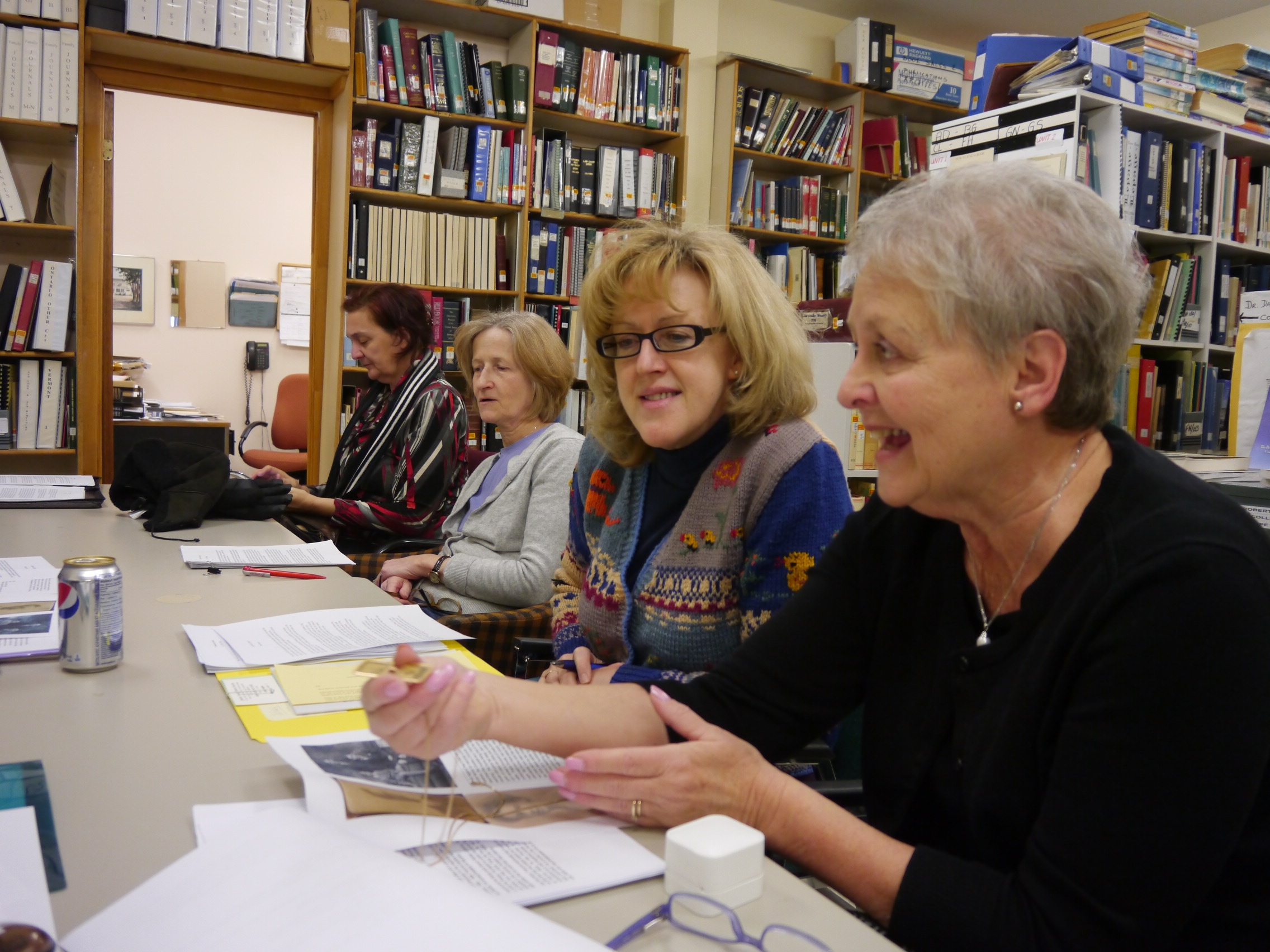
Once a month a group of us meet at the Quebec Family History Society library to share our ancestor’s stories, try to improve our writing skills, and learn from each other. There are two rules: articles are limited to 500 words, and we must list our sources. It isn’t always easy, but it is fun.

Image

This month Claire wrote about her great-grandfather François Evariste Fortin, a merchant and contractor in Pembroke, Ontario who lost and then rediscovered his Catholic faith. Barb’s story was about her grandfather James Rankin Angus, a Scottish carpenter who worked on the construction of the ocean liner Lusitania, then spent 20 years running a book store in Quebec City.

Lucy has been writing about the Hanington family, the first English settlers in Shediac, New Brunswick. Janice’s subject was Robert Hamilton, a Scottish weaver who took up farming in Scarborough, Upper Canada. Mary told the story of great-grandfather Ismael Bruneau, a French-speaking Protestant minister.

Dorothy wrote about Norman Nicholson, her husband’s great-grandfather, an ordinary man who had one extraordinary habit: for five decades he kept track of every aspect of his life, from business expenses to a dating diary.

Oskar focused on Abraham Martin, from whom his granddaughter is descended. The Battle of the Plains of Abraham was fought on his land, but consensus about Abraham’s life ends there. Some stories say he was a farmer, others call him a river pilot. Some accounts say he returned to France for several years, others say he stayed in Quebec. Oskar clarified the confusion even if he didn’t resolve the conflicts.

Ruth wrote about her search for John Morrison. This being a common name, she couldn’t figure out which John Morrison in the 1861 census of Scotland was hers. John’s mother’s name was the less common Robina, and his daughter was also Robina, so she looked for Robina and found John in Illinois.

Next month some of us may do rewrites and others will tackle new subjects, but we are all making progress on writing our family histories, 500 words at a time. To learn more about this Special Interest Group, go to http://qfhs.ca/cpage.php?pt=90.