She Owned A Cottage

Seventy years ago in 1951, my grandmother Millicent (1895-1982) Granny-Lin finally got the cottage she had always wanted. My grandfather Sydenham (1887-1975)The Priest had it built for her on the waterfront of Shediac Bay in New Brunswick.

Truly a dream come true, she aptly named it “Iona Cottage” for “I own a cottage”!

Iona Cottage 1955

The person who designed their simple cottage somehow knew exactly what they wanted. A small eating nook off the kitchen led into the living room with a fireplace and the three small bedrooms branched off from there. A simple door leading to the patio enticed family and guests outside to enjoy the view of the Bay.

Just around the corner from Iona Cottage stands St. Martin’s-in-the-Woods Anglican Church built almost 200 years ago by Millicent’s great grandfather, and the founder of Shediac, William Hanington. There is a huge monument beside the church where he and some of his family are buried. On Sunday mornings during their summers, Millicent and Sydenham would stroll down the lane to church. Sydenham was an Anglican priest and would sometimes hold the summer church services thereby giving the local priest a break.
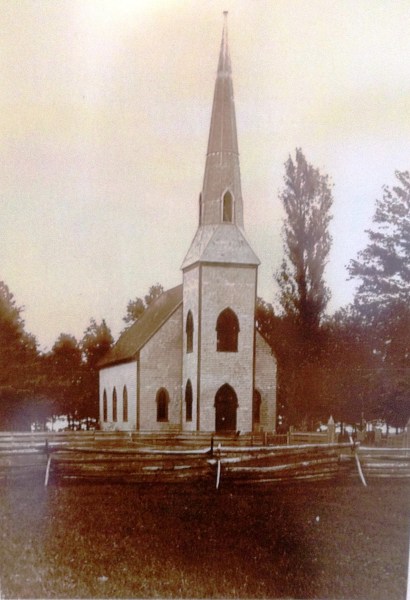
St Martin’s-in-the-Woods Anglican Church est.1822

Millicent grew up in Montreal as the youngest of six girls. Her pharmacist father moved the family from Shediac to Montreal in 1890 to study medicine at McGill…at the age of 45! During the summer breaks, the family returned “home” to Shediac. After completing his degree in 1894, Dr. Hanington Pharmacist then Doctor and family remained in Montreal where he set up a practice… but they always spent their summer holidays in Shediac.

Millicent and Sydenham hosted many summer family gatherings at their Shediac cottage over the years. There are numerous photos taken on the patio in front of the impressive red brick chimney. An endless assortment of Millicent’s sisters (and sometimes their husbands) would line up along the side of the house enjoying the sun and cool breeze off the water. A few photos have captured some of the bravest taking an icy cold dip in the bay.
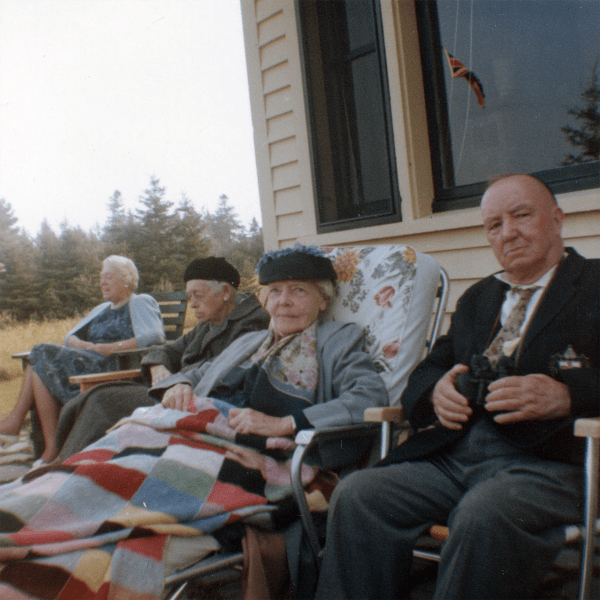
Millicent’s sisters and brother-in-law circa 1965

In July 2015, my sister and I took a “sister pilgrimage” trip to the New Brunswick area, and finding Iona Cottage was the top priority. We recognized it immediately even although the light yellow cottage from our memories had been painted a lovely country blue. The surrounding grounds looked immaculate and a quick peek in the window assured us that it was well loved inside and out. What a terrible disappointment when no one answered our knock at the door. We snapped a few photos of house and garden (and us!) for our travel album and to share with the rest of the family.
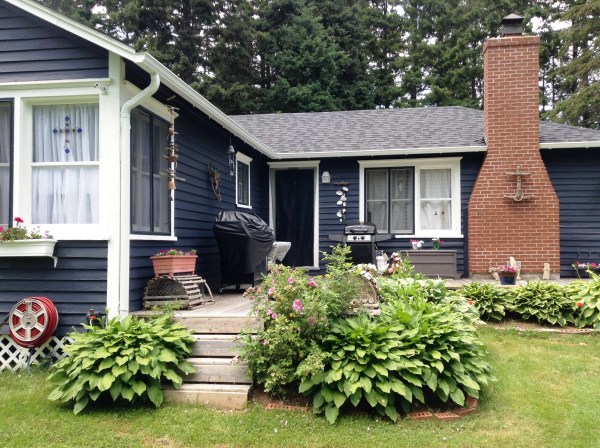
Iona Cottage – July 2015

Upon my return home, I wrote a short story about our “sister pilgrimage” and published it on the Genealogy Ensemble website Sister Pilgrimage. A year ago, the current owners of Iona Cottage read my story and contacted me by email. They are the fourth owners (since 2018) and are thrilled to share my scanned copies of the old photos of their cottage.

How surprising to learn that they already had a copy of my favourite photo… a gift from their neighbour. It captured four-year old me in front of Iona Cottage during the summer of 1961 when I visited with my mother shortly before she died of cancer that November.
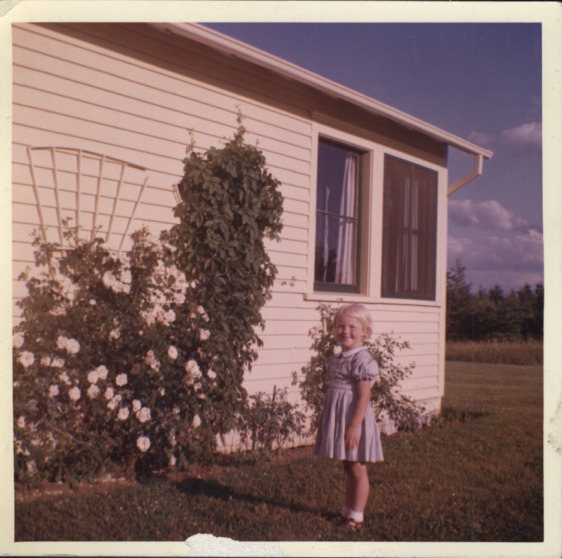
Here I am at Iona Cottage – Summer 1961

My only other stay at Iona Cottage was some twenty years later when my cousin and I flew into Moncton to spend a long weekend with our grandmother. In an era before highways, two lane roads between Quebec and New Brunswick made the drive impossibly long, which might explain the lack of visits over the years

Notes for Blueprints for Iona Cottage – Feb 1951 – by Tom Anglin

Recently my cousin unearthed a real treasure in his inherited boxes of memorabilia – an envelope marked: “Blueprints – Iona Cottage”. I took a quick look before sending them off to the current owners and to my utter amazement I saw that MY FATHER had drawn up the plans for his in-law’s cottage! I had no idea. What a joy for me to see his handwritten notes in the lower right-hand corner…and no wonder the cottage was so perfect for Millicent and Sydenham.

Happy 70th Anniversary Iona Cottage!

L to R – Neighbour, Sydenham and Millicent (Iona cottage at the right)

The Courtship of Ann and Tommy – Part 1

The Courtship of Ann and Tommy – Part 2

The Courtship of Ann and Tommy – Part 3

Atikamekw Nations of Québec

Atikamekw Nations of Manawan (Manouane) of Québec

The Atikamekw of Central Quebec is the smallest First Nation in Quebec regarding the number of residents within their territory. Authors and historians have researched the Atikamekw. They have written numerous articles.

https://numerique.banq.qc.ca/patrimoine/details/52327/3961544?docsearchtext=La%20Tuque

Included within this database one can access numerous Parish Church Register documents as noted in the example below. BanQ numerique documents of baptism, marriage and deaths are accessible through the many BanQ numerique links throughout the database.

Click the above link and open in a new window

The Harvester Scheme

When I was a little girl, I would spend hours with my grandfather in his home workshop. He would make all kinds of things and I used to love watching him at work. I still have some of the tools he made, as well as a cribbage board and a turntable that swings the Scrabble board around to face each opponent. He crafted a complete house of Barbie furniture for my dolls and, to my delight, he asked me my opinion about every single piece. I felt both the weight of responsibility for deciding what each bed and chair would look like, and pride in participating in this project with him.

My grandfather, George Deakin (1901 -1983,) born in Sheffield, England, learned these skills when he was a young man. His father was a miner and George also worked for the coal mining companies of Sheffield, which were significant employers in the early 1900s. Gramps was a fitter which means that he made parts either for piping or for equipment and machinery.1, 2

I used to ask my grandfather why he came to Canada and the answer was always the same and always emphatic. “I did not want to work in the mine.” Sometimes he would go on to explain that, when he left, he still worked above ground for the mining company. However, he was a very short man and he knew that it was a matter of time before he would be required to work underground. Small men were valuable in the low tunnels of the coal mines, but the work was dangerous and unhealthy. Gramps had no intention of ever working underground.

So in 1923, he came to Canada as part of the Harvester Scheme. That year, Canada had a bumper wheat crop and North America could not provide the labour needed to harvest the crop.  Under the Harvester Scheme, the two major Canadian railway companies entered into an agreement with the British government to transport 12,000 workers out west where they would earn $4.00 per day plus board. 3

He ended up in Manitoba and the Canadian west must have suited him because he used to enjoy talking about his time on the farm. The days were long and the men worked hard but Gramps found it satisfying to work so hard.  And how the workers enjoyed the hearty meals that the women of the farm prepared for them!

He only stayed one harvesting season in Manitoba because, once that bumper crop had been harvested, there was no more work. He took the train to Montreal and easily found work as a draftsman at the Northern Electric plant. He had learned to read and draft drawings in Sheffield and his skills were in high demand. He worked at the Northern Electric plant in Lachine all his life, even during the Great Depression.

When Gramps first arrived in Canada, he was not sure he would stay.4 But after he met and married my grandmother in 1925, they settled in the Montreal suburb of Verdun and raised two children.

Here, he was able to work all his life in a job that he loved. He especially enjoyed the attention to detail that went into designing. And when he wasn’t designing at work, he was making tools, games, and Barbie furniture for the family.

1 Canada. “Immigration Records (1865 – 1935)” Database. Library and Archives Canada.  BAC-LAC, http://www.bac-lac.gc.ca/eng/discover/immigration/immigration-records/passenger-lists/Pages/introduction.aspx#d: 2017.

2 http://www.occupationsguide.cz/en/POVOL/148.htm

3 Foster, John Elgin, The Developing West:  Essays on Canadian History in Honor of Lewis H. Thomas, Edmonton: University of Alberta Press, 1983

4 Canada. “Immigration Records (1865 – 1935)” Database. Library and Archives Canada.  BAC-LAC, http://www.bac-lac.gc.ca/eng/discover/immigration/immigration-records/passenger-lists/Pages/introduction.aspx#d: 2017.

Refugees in Quebec

https://www.canada.ca/en/immigration-refugees-citizenship/services/refugees/history.html

Canada: A History of Refuge

What Does “Refugee” Mean?

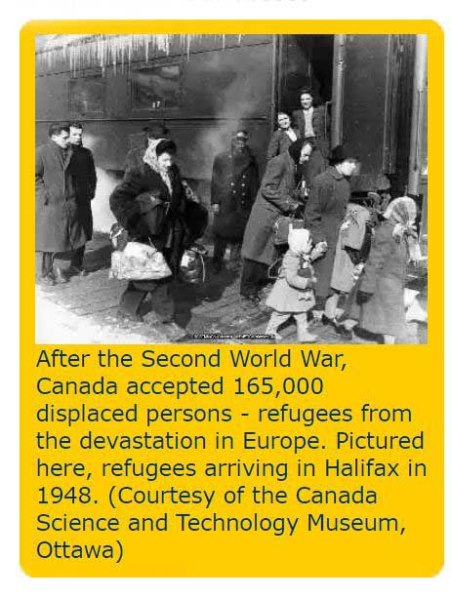
It is not as easy to define “refugee” as one might expect. In its simplest meaning, a refugee is a person who flees his or her home country because of fears of persecution or abuse, particularly by their own government. However, the meaning is affected by political change, public perception and history. According to Immigration, Refugees and Citizenship Canada and the United Nations High Commissioner for Refugees, refugees are people who have been forced to leave their country and who are afraid to return because of war, violence or persecution based on race, religion, nationality, political opinion or membership in a particular social group.

Navigate through the exposition to learn more about refugees in Canada.

This above database prepared by Jacques Gagné consists of books, articles and theses written by numerous authors on the subject of refugees that have come to Quebec and their contributions.

Open the link in a new window.

A VERY YOUNG MARRIAGEABLE GIRL

Church of Saint Sulpice in Paris, France

Over the years many authors have written about ‘les filles du roi, otherwise known as the King’s (Louis XIV’s) daughter’s. Eight hundred young women were part of a settlement scheme from 1663 -1674 in New France, now Quebec, Canada.

Much less was written and noted about a group of women who ventured into the new world. Prior to the King’s daughter’s arrival, the Company of One Hundred Associates between the years 1634 and 1662 recruited tradesmen, labourers and 262 young women. The purpose was to create a French settlement.

Elisabeth Radisson, my seventh great grandmother, along with her sister, Francoise and her half-sister Marguerite all signed contracts. What prompted them to sign these contracts, particularly when they were so young?
Elisabeth Radisson was born in about 1637 in St. Sulpice, Paris, Ile de France, France.

Pierre Esprit Radisson Sr, their father was a well-to do bourgeois. He owned a clothing store in Paris. He married Madeleine Henault, the widow of Sebastien Hayet, who died leaving his young wife with a year-old daughter, Marguerite, born in 1632. Several documents have indicated that the marriage of Pierre and Madeleine took place in 1635. Together the couple had 3 children, Francoise about (1636) and Elisabeth about (1637) and Pierre, the famous explorer. The dates of his birth vary. There are discrepancies indicating that it was sometime between (1636 -1640)

There are several dates given for the passing of Pierre Senior. There is a document explaining an inventory upon his death dated 1641.3. The year of his demise seems most likely to be is 1646. Most documents give his date of birth as 1590 and it appears he died at the age of fifty-six, on November 25, 1646, in Paris leaving Madeleine to care for four young people between the ages of 15 and 9. 4.

In 1646 these three young girls, Elisabeth, age 9, Francoise about 10 years old and Marguerite at 15 each signed a contract as ‘filles à marier’. They set sail for New France. 5. After a lengthy crossing they arrived and settled in Trois- Rivières. Pierre may have come with them although a document indicates “he immigrated from France to Canada on the 24th of May, in 1651”.6.

After her arrival little is written about Elisabeth settling in her new home. We do know Elisabeth was able to sign her name. During a ten-year period in Trois-Rivières very little is known about where she lived as a young girl. One might presume that she was with her siblings. The first record other than her arrival in Canada is 8-7-1657 in Trois Rivières when she was the godmother of Marie-Anne Chouard or Chouart. This child might have been the daughter of Elisabeth Radisson’s half-sister. Marguerite.

Later that year there was a notarial contract signing on October 8, 1657, before her marriage to Claude Jutras. At that point she would have been 19 years old.7.

Her husband to be, Claude Jutras dit Lavallée was also born in Paris about 1627 and he arrived in Trois-Rivières 1656 as a soldier. He was stationed at the garrison in Trois Rivières. 8.

Elisabeth Radisson and Claude Jutras dit Lavallée were married on November 05, 1657, 9. at the Church of the Immaculate Conception in Trois-Rivières.10.

Within the first year of their marriage Elisabeth gave birth to a daughter, Madeleine. Over a period of twenty years, the couple had nine children, 6 girls and 3 boys. Most of the children lived to adulthood. Sadly, Marguerite died at the age of nineteen giving birth to twin boys. Young Claude was sixteen at the time of his death.11.

Five of the daughters married and Marie Joseph chose to enter the Ursuline convent. Pierre became a voyageur and acquired a seigneury.

The census of 1671 noted that Claude Jutras was no longer a soldier, but rather had become a habitant or settler. Life appears to have been kind to the family. By the year 1679 after a number of land transactions the Jutras had acquired wealth and were now considered members of the bourgeoisie, among the well to do families.12.

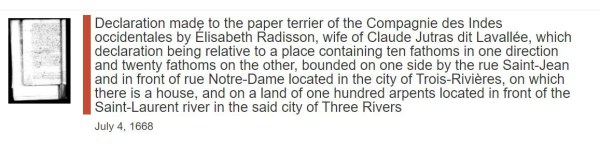
The above document is only one indication of the many financial contributions Elisabeth’s made to the Jutras family wealth.13.

Claude Jutras dit Lavallée died the 28th of November 1710 and was buried that same day in Trois-Rivières, Québec, Canada.14.

Elisabeth Radisson lived for nearly twelve years after Claude’s passing. She died on the 11th of May 1722 and is also buried in Trois-Rivières.15.

Below is the church record of Elisabeth’s burial.

  • Sources:

1.https://www.wikitree.com/wiki/Project:Filles_%C3%A0_marier# Bilingual_Biographies

2.https://www.worldcat.org/title/before-the-kings-daughters-the-filles-a-marier-1634- 1662/oclc/50411950?referer=di&ht=editionGAGNE, PETER J. Before the King’s Daughters: The Filles a Marier, 1634-1662. Pawtucket, RI: Quintin Publications, 2002. Pages 303-316. 

Maple Stars and Stripes — Click and open in a new window

3.https://www.sgq.qc.ca/images/_SGQ/BD_web_libre/Actes_notaries_des_pionniers_de_Paris.pdf  page  169

4.https://www.geni.com/projects/Marriageable-Girls/14207

5.https://www.amazon.ca/Histoire-Nouvelle-France-3-Marc-Lescarbot/dp/114403213X

6.https://en.wikipedia.org/wiki/Pierre-Esprit_Radisson#Birth_and_emigration_to_New_France

7.https://www.geni.com/projects/Marriageable-Girls/14207

  https://genealogie.quebec/stemma4web/info/index.php?no=37300

8.http://www.apointinhistory.net/jutras.php

   9.http://www.migrations.fr/FILLE_A_MARIER/fm_mariage_R.htm

10.https://huntingtonfamily.org/genealogy/getperson.php?personID=I3940&tree=johnandtuly

11.http://www.migrations.fr/FILLE_A_MARIER/fm_mariage_R.htmIbid

https://numerique.banq.qc.ca/patrimoine/details/52327/3313859?docsearchtext=ELisabeth%20Radisson

12.http://www.apointinhistory.net/jutras.php

13.https://numerique.banq.qc.ca/patrimoine/details/52327/3313859?docsearchtext=ELisabeth%20Radisson

14.https://greenerpasture.com/Ancestors/Details/31555  & https://www.myheritage.com/names/claude_jutras

15.http://www.migrations.fr/ACTES_SEPULTURES_FM/sepultures_filleamarier.htm#R

Plaisance (Placentia) 1655-1713 & Le French Shore 1713-1783

The European presence in Newfoundland goes back to the early 16th century. In their autobiographies, John Cabot and Jacques Cartier, explorers, both indicated the presence of Basque fishermen along the shores of the Gulf of St. Lawrence, the Strait of Labrador, the southern and northern regions of the Island of Newfoundland.

The extraction of oïl from whales caught off the coast of the Gulf of St. Lawrence and the cod fish industry along the coasts of Newfoundland and Labrador were major industries with market places in Continental Europe, the British Isles.

This database contains a selection of authors who have written books, articles, and dissertations about the great fishing era off the Grand Banks of Newfoundland.

Plaisance
(Placentia)
1655-1713
&
Le French Shore
1713-1783

Writing up the ancestors with Janice Hamilton

It was a joy to speak with journalist and genealogist Janice Hamilton about her ancestors, her recent book « Reinventing Themselves, » and surprises she’s discovered while researching and writing her family history.

Listen to the episode on Mixcloud, SounderFM or any other podcast player you use.

For more information, refer to:

Reinventing Themselves Book

Writing Up the Ancestors Blog

Janice’s stories on Genealogy Ensemble

University of Manitoba Archives Hamilton Collection

Frank Opolko’s interview of Janice:

A History of Québec
Québec Past and Present 1608-1876 Part Two

This image has an empty alt attribute; its file name is 51lu9dojs3l._sx331_bo1204203200_-1.jpg

Sir James MacPherson Le Moine, author of Quebec Past and Present was born in Quebec in 1825 and was a Law Professor at Laval University. From 1869 to 1899, he was an inspector of revenue for the district of Quebec.

He was also a founding member of various organizations such as the Institut Canadien de Québec, the Royal Society of Canada and the National Archives of Canada.

He was an accomplished author and wrote many books. One of those that garnered much attention,  Maple Leaves, Les Pêcheries du Canada, and several books on Canadian history. He was a true fact finder and  his eyewitness accounts were of interest to his readers.

Sir James MacPherson Le Moine was involved with the Literary and Historical Society of Quebec. He served as president in 1871, 1879–1882, and 1902-1903.

Click the link to access the file. Open in a new window

Canadian Tourists in India, 1900

When Helen Frances (Bagg) Lewis and her husband Edward travelled from Shanghai to Canada in 1900, they took a circuitous route through India, sightseeing along the way. In a travel journal written 25 years later, Helen described the highlights of that trip, including three frightening encounters with snakes.

Helen was my great-grandfather Robert Stanley Bagg’s youngest sister. She and Edward lived in Shanghai for several months in 1899. They even considered staying there, but decided instead to relocate to Canada’s west coast, rather than return to their hometown of Montreal.

They left Shanghai aboard a P&O steamer and explored Hong Kong for a month before taking a second-class cargo ship to Ceylon (now Sri Lanka), arriving in Columbo on New Year’s Day, 1900.

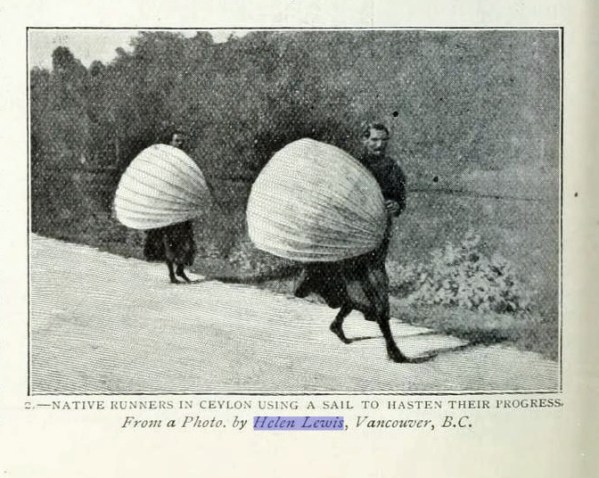
Helen Lewis’s photo of runners in Ceylon was published in Wide World Magazine.

Their first stop in India was in the southern city of Madura, and Helen wrote that the timing of their visit was perfect.

“It happened to be a gala day at the Temple of Madura, so all the sacred elephants were out in procession, bedazzled with garlands of flowers and state paraphernalia. The procession over, we were allowed to mount a couple of them, and never shall I forget my first experience of riding on the back of one of those stately animals….”

Luck was with them again in Puri, a city famed for what Helen called the “Juggernaut” Temple, an elaborate Hindu temple dedicated to the deity Jagannath. But seeing the dirty exterior of the bungalow where they had arranged to stay, Helen felt disappointment.

Her spirits “sank to zero” when she realized that the rustling they heard came from a nest of cobras on the roof. While inspecting the property further, she encountered a government officer, Major H.. The only white man in the district, he was so pleased to meet some English-speaking people that he invited them to stay with him for three days.

Early in the morning of their last day in Puri, a messenger arrived with the news that a tiger had entered a nearby village and carried off a woman. “Major sahib” was asked to immediately go and kill the animal. Both the major and Edward agreed, leaving Helen in the house with a number of servants, none of whom spoke English.

She decided to explore the rambling bungalow and found herself in the “snake room,” where the major kept an enormous collection of “vicious reptiles in tanks and cages, for scientific purposes. At my entrance, these monsters almost simultaneously rose up and hissed at me, so that my retreat was by no means leisurely.” She was much relieved when the two men returned after a successful hunt, and she noted in her journal that she still treasured the tiger’s claws, a souvenir of their visit.

From Puri, the couple continued by train to Calcutta and Darjeeling, where they were thrilled to view the Himalayas in perfectly clear weather. They then moved on to the sacred city of Benares, on the banks of the Ganges River.

In their next destination, Lucknow, Helen experienced “a narrow escape from a venomous cobra who was coiled up on the stone parapet, enjoying his noonday siesta.”

“On bending over the parapet to peer down, I accidentally touched his head, when he reared and stretched out his neck to strike. Terror lent me wings and I made for shelter. The driver was as keen as I to move on, as the Hindus consider it desecration to kill any animal, and I urged him forward fearing lest Edward — who was on the beach below, photographing sun worshippers, — might return at that moment and insist upon starting off on a cobra hunt. As it happened, I did not say a word about the episode to him until some days later in Agra, where I met with my second cobra adventure.”

Helen found Agra and its famed Taj Mahal interesting, but her encounter with the snake was even more memorable.

“Whilst driving close to the river one afternoon, one of our wheels must have grazed his slumbering body, for suddenly sprung to his full length, he struck with such force at the hood of our open gharry [a horse-drawn cab] as to hit the brim of my broad sun hat, and send it forward over my face. Luckily at the moment I did not realize what a narrow escape I had had.”

Over the next few weeks, the couple continued their explorations. Finally, in March, they sailed from Bombay, through the Suez Canal to Venice and Trieste. From there, they made their way via Paris to Cherbourg and crossed the Atlantic to New York. Edward continued to Vancouver to arrange for their new home, while Helen stopped in Montreal for several weeks to visit family and friends.

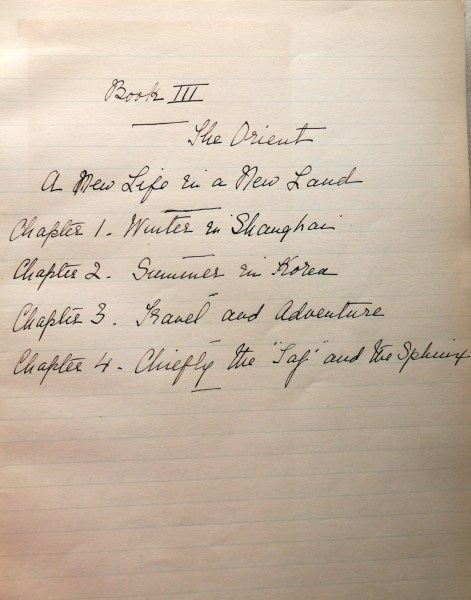
Note: This account is part of a series of journals Helen wrote later in life, handwritten in black ink in a lined, leather-bound book. These excerpts are from Book III, The Orient:  A New Life in a New Land. She did not complete this volume and I do not know whether the others have survived. This one now belongs to a descendant of Helen’s niece, Ada Lindsay.

Quebec Past and Present

A History of Quebec

1608-1676

Part One of two

This compilation consists of various books and documents that have been written about the Carignan-Salière Regiment and their contribution to the development of New France.

Click the link below and open it in a new window:

Working together to help genealogists discover their ancestors