Louis Chaboillez, Notary of Missisquoi Bay, 1787-1813

If your Loyalist ancestors settled in the Missisquoi Bay area of Quebec, including towns such as Frelighsburg, Philipsburg, Saint-Armand and Pigeon Hill, the files of notary Louis Chaboillez might help you learn something about them.

This area, located just north of the Vermont border near Lake Champlain and the Richelieu and Pike Rivers, has a long history. The shore of Missisquoi Bay was once the site of an Abenaki village, but in the mid-1700s, the governor of New France divided the land into vast estates called seigneuries. Two of the seigneuries in this part of Quebec were the St. Armand and the Foucault Seigneuries. The first owner of the Saint-Armand seigneury was a Quebec City man who built ships for the King of France, and later, this seigneury was owned by a senior British colonial administrator.

Although New France became the British colony of Lower Canada in 1763, the seigneurial system of land ownership remained in effect until 1854. But long before 1854, many new settlers began to arrive in the area, and they wanted to own their own property.

Thousands of Loyalists who had been loyal to the British during the American Revolution left the United States for Canada in 1784. In the Missisquoi Bay area, they built homes, farms, flour mills, schools and churches. The government of Lower Canada had to find a way to sort out titles to properties in this and similar areas, and it gave this responsibility to certain notaries. The man who undertook this task in the Missisquoi Bay region was Louis Chaboillez. A notary who practiced between 1787 and 1813 in the Judicial District of Montreal, he was assigned to legalize the allotment of lands in the Eastern Townships of Quebec and in the Richelieu River Valley. He served families in the Eastern Townships until the arrival of notary Léon Lalanne in the spring of 1799.

You can find the collection of notarial acts written by Louis Chaboillez between 1787 and 1813 at the Bibliothèque et Archives nationales du Québec (BAnQ) in downtown Montreal. The acts are on microfilm under Cote (Fonds) # CN60,S74 (1787-1813). The original fonds (collection) includes 14.67 metres of documents and one map. It appears that all documents written by Chaboillez were reproduced, with the exception of the map, on microfilms # 3291, 3292, 3293, 3294, 3295, 3296, 3297, 3298, 3299, 3300, 3301, 3302, 3303, 3304, 3305, 3306, 3307, 3380, 3496, 3497 and 3733. A few additional acts were reproduced on Cote (Fonds) #ZQ601.

As of October, 2016, the notarial acts of Louis Chaboillez were not available on the BAnQ’s website (http://bibnum2.banq.qc.ca/bna/notaires/).

The main Montreal branch of the Bibliothèque et Archives nationales du Québec is located at 535 avenue Viger Est, Montréal, QC H2L 2P3; Tel : 514-873-1100 #4 or 1-800-363-9028; email: archives.montreal@banq.qc.ca. The archives is open from Tuesday through Saturday every week; please verify for actual opening hours and legal holidays. See  www.banq.qc.ca/archives/entrez_archives/centres_archives/ca_montreal.html.

Louis Chaboillez’s notarial acts can also be found in the Parchemin collection, compiled by Archiv-Histo, under cote # 06010074 (1787-1813). The Parchemin collection is available at libraries throughout Canada and the United States. Archiv-Histo is an associate society of the Chambre des notaires du Québec.

The collection of notarial acts on Parchemin is the largest and most precise in Quebec. Not all of the documents produced by Quebec notaries between 1663 and 1900 are available at BAnQ repositories across the province. Parchemin tells you where notarial acts (minutiers) are kept, and which ones were destroyed by fire. To learn more, see https://www.archiv-histo.com/EN/index.php.

Compiled by Jacques Gagné  gagne.jacques@sympatico.ca  2016-10-16


Bomb Sites, School and Rebuilding A City

My first memory as a child born at the end of WW2 was of playing mainly in our streets and neighbouring streets.  I was still very small, but I do remember the barrage balloons still flying high in the sky, floating gently on the breeze, and we would lie on the ground and watch them. It was many years before I realised what they actually were, which was a large balloon anchored to the ground by cables and often with netting suspended from them, serving as an obstacle to low-flying enemy aircraft.

We would play among bricks wood rubble, stones large slate roof tiles and broken water pipes, at a site at the end of our street. The reason for all the rubbish was because it was a bombed site. A house, like the ones in our street, had once stood there but no more. We had adventures at those bomb sites especially with the broken water pipes. What young child can resist playing with water? Especially if you can make dams and ponds with all the available stones bricks and wood. It was a sad day when the water was eventually turned off.

We also knew not to play in a bomb site with tape around it, as that likely contained an unexploded bomb. There were parks in Plymouth, but because of the massive damage caused by bombs dropping on this Royal Naval city, these had still not been cleared of the debris and were dangerous.

When I started school, at three years of age that same rubble was negotiated as we walked over it to get to the school building and again when I was 11 and starting at the ‘big school’ – the same one my mum had gone too – there were still signs of war damage.

Shortages of everything was acute. Years later we had no books in our school. The teacher had one for each subject, which he or she would read aloud to us and then pass it around. We had paper pen and ink, but no copybooks to write on, only a sheet of paper. Later, copy books were issued when I was about 14.

The school was OK, but all the teachers were old and not very interested in anything new and certainly, they did not catch my interest but I did love History, Geography and reading. English comprehension writing and spelling were favourites too. Sums were completely beyond me, and nobody cared to go over them again if I got lost, or to take the time to explain anything. There were about 45 children in each class so on reflection, there must not have been much time to explain everything again, but just to get the lesson over with.

Re-building our country was a long time coming It was the early 1950’s before the clearing of bomb sites even began, and I grew up in the 60’s watching our city being completely razed and then rebuilt.

Years later as English social history became an interest, I was to learn about the Anglo-American Loan that helped the rebuilding of our country. ¹ ²

¹https://en.wikipedia.org/wiki/Anglo-American_loan

“The Anglo-American Loan Agreement was a post World War II loan made to the United Kingdom by the United States on 15 July 1946. The loan was for $3.75 billion (US$57 billion in 2015) at a low 2% interest rate; Canada loaned an additional US$1.19 billion”

By the way, these loans were eventually paid off in full, in 2006!”

²BBC NEWS | UK | UK settles WWII debts to allies

“It is hard from a modern viewpoint to appreciate the astronomical costs and economic damage caused by this conflict. In 1945, Britain badly needed money to pay for reconstruction and also to import food for a nation worn down after years of rationing.  “In a nutshell, everything we got from America in World War II was free,” says economic historian Professor Mark Harrison, of Warwick University. “The loan was really to help Britain through the consequences of post-war adjustment, rather than the war itself. This position was different from World War I, where money was lent for the war effort itself”

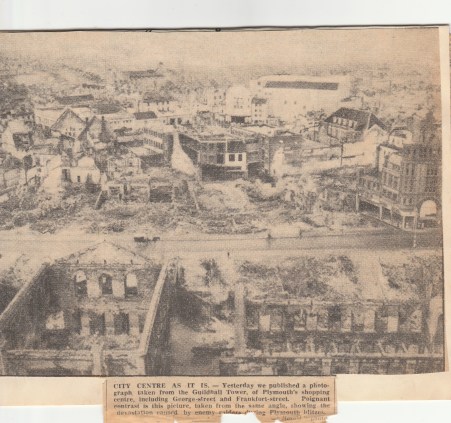
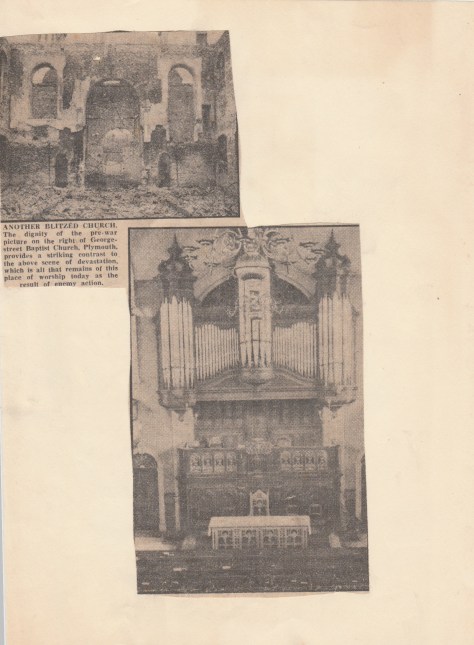
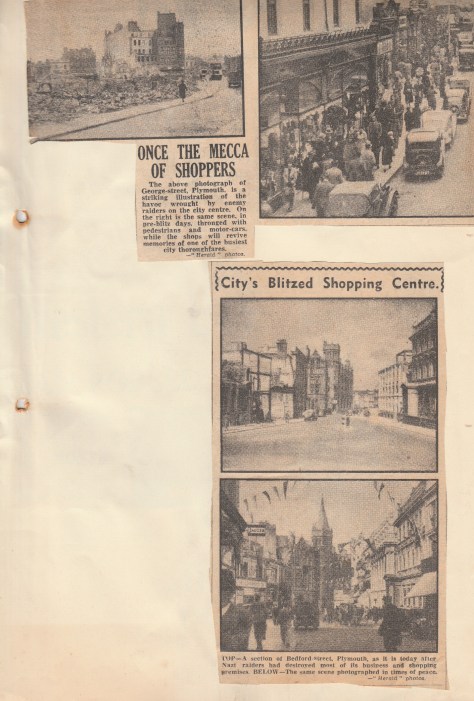
Below are newspaper cuttings that my Gramps saved during the war and gave to me for a project I had to write for school about our ancient city. They show Plymouth before and after the blitz and were the kind of bombed sites I played in as a child.

These two photos show Plymouth City Centre before, in 1939 and after an enemy raid in 1942.

I find the captions very interesting. The one below reads: ‘The City Centre as it was, tomorrow we intend to post a photo of the same scene as it appears today after most of the buildings have been smashed by enemy action” img_20161102_0005img_20161102_0003

Below, 1942 St. Georges Baptist Church a before and after view

george-st-baptist-church-1942

Plymouth Shops before and after the Blitz

plymouth-shops-before-and-after-raids

Credit is given for photos from ‘The Plymouth Evening Herald’ Plymouth, Devon UK.

Cinderella Spinster

Single women, or spinsters as they were once called, did not generally live independently or own a home in the 1800’s. So it was with my second great aunt, Annie Eleanor Kelly of Quebec City.

Until her father William Kelly died in 1902 at the age of eight-two 1. , the census records every ten years list Annie Kelly as living under his roof. 2. Family legend claims that she served as a missionary at one point but I have not found any supporting documentation.

Annie was one of five children born to William Kelly, a coal merchant, and his wife Jane Jamieson. Two brothers and a sister died young. Her remaining sibling Emma Jane married Peter Brodie. Annie’s mother lived until she was seventy-one and I presume it was Annie who cared for her parents during the last years of their lives. 3.

According to his will, William bequeathed to his married daughter Emma the property and house he owned on 1908 Valier Street. To his spinster daughter he bequeathed all his interests in the Quebec Coal Company, all the money in his bank accounts, and all his shares and stock. He also left to her all his household furniture, goods and effects. 4.

One wonders where William thought Annie would put these goods and effects when the house itself went to her sister. He appears to have simply followed the mores of the time. Emma’s husband must deal with the house. There is no evidence that Peter and Emma ever lived there.

The 1911 census finds Annie living with newlyweds Jean Brodie and James Angus, my grandparents. Where she lived from her father’s death to that date is not known. Annie was fifty-seven when she moved in and she stayed there until she died at seventy-four. Jean was the little niece William described in his will as having been taken into the care of her aunt. His sizable bequeath to Annie was “partly in remuneration of her long service in the family and towards me, and to help provide for a little niece she has taken in her care”. 5.

The term “long service” sounds like Annie may have been the family Cinderella.

There has been much speculation as to why Emma gave the care of her youngest daughter over to her sister. It is uncertain if Jean moved into her grandfather’s home to live with her aunt or if her aunt acted as a nanny in the Brodie home. The expression “taken in her care” would suggest the former. There were two other Brodie children, Carrie and Lawton, who appeared to have stayed with their parents.

Or was Emma actually Jean’s mother, despite the names Emma and Peter Brodie on Jean’s baptismal certificate? 6. It is not unheard of for the child of an unwed mother to be raised by a sister. Annie would have been twenty-six when Jean was born. Secretly I like to think she experienced love and romance sometime in her life.

Whatever the reason, clearly the bond between aunt and niece was as strong as any maternal bond.

Undoubtedly, much of the furniture, goods and effects left to Annie by her father were moved into her niece’s home. It may also have been Annie’s money that saved the Angus family when my grandfather’s bookstore went bankrupt during the Depression. As a child, I remember hearing about “Auntie Annie” but I was too young to remember any details. She would have been an integral part of my father’s childhood but my interest in her life came too late for me to ask for more information.

Today I look at some of the beautiful antiques I inherited from my grandmother and ponder their provenance. Might they have been the inheritance of Annie Kelly, spinster aunt?


Research Notes and Sources:

  • Burial Record, Mount Herman Cemetery, Quebec City, November 15, 1902 (on file with author)
  • Census records up to and including 1901, 1911, 1921, 1931, Library and Archives Canada
  • Kelly Family Bible (owned by author)
  • Last Will of William Kelly, 6th June, 1901. Louis Leclerc, Notary Public in the city of Quebec (on file with author)
  • Ibid
  • Baptismal certificate of Jane Jamieson Brodie – on file with author
  • For many years baptismal documents were used in lieu of birth certificates in Quebec. One could obtain a passport with a baptismal certificate. I did not obtain a birth certificate until 1992.


Profile Your Ancestors 4th Video Released

The fourth video in my Profile Your Ancestor series is now available.

This series is designed to encourage genealogists to write narrative stories about their research, such as those on the Genealogy Ensemble blog.

These kinds of stories:

  • deepen your research by encouraging you to look into tiny details you might not otherwise question;
  • are more widely read, even by people who don’t necessarily appreciate how important family history research can be;
  • are great ways to compile a book about your ancestors; and
  • can be fun ways to reach out to other family members.

This video summarizes the points I made in videos 1,  2, and 3 to get you writing such stories about your ancestors. It also invites anyone struggling to consider joining my upcoming profile your ancestors course. This is a great way to get some assistance getting started.

If you’ve got some stories written, I’d love to see links to them in the comments below.

Notary Peter Lukin Sr. and the Christie Seigneuries

Notary Peter Lukin Sr. helped the people of the Upper Richelieu River Valley and Eastern Townships of Quebec sort out land ownership issues between 1790 and 1814. Among his clients were Loyalists and other American-born settlers who had moved north of the border in search of farmland, as well as British, Scottish and Irish-born families.

Although New France was ceded to Britain in 1763 and became the Lower Canada colony, the old seigneurial land-ownership system of New France persisted until 1854. The seigneurial system began in the 1600s as a tool to control the settlement of New France. The king granted large areas of land to influential people including military officers and members of the aristocracy. The seigneurs then rented out farm lots to the habitants, or tenants. The habitants paid rent in cash or grain in exchange for land management assistance and various rights from the seigneurs. This system determined the way rural society in New France developed. When the British abolished the system in 1854, the colonial government had to introduce a means for the tenants to buy their farms.

One area in which the seigneurial system existed was in the Upper Richelieu Valley, an area with very fertile soil that attracted many settlers. The valley stretches next to the Richelieu River, which flows north out of Lake Champlain in northern Vermont and  empties into the St. Lawrence River near the town of Sorel. Lieutenant-Colonel Gabriel Christie acquired five seigneuries in this region following the fall of New France. The Christie Seigneuries remained in his family’s possession long after the seigneurial system was officially abolished.

In her book The Christie Seigneuries; Estate Management and Settlement in the Upper Richelieu Valley 1760-1854 (McGill-Queen’s University Press, 1992), historian Françoise Noël wrote that seigneurial property rights were used to control access to land, timber mills and other resources in the area for many years.

On May 8, 1790, Peter Lukin Sr., a notary and Justice of the Peace in the Judicial District of Montreal, was appointed as one of several notaries assigned to legalize the allotment of lands in the Eastern Townships and the Richelieu River Valley, including the Christie Seigneuries.

The seigneurial system was never implemented in the Eastern Townships, which was settled in the late 1700s and early 1800s.

The notarial acts of Peter Lukin Sr., 1790-1814, Cote # CN601, S269, can be found on microfilm at the Bibliothèque et Archives nationales du Québec (BAnQ) in Montreal. The BAnQ Montréal is located at 535 avenue Viger Est, Montréal, QC, H2L 2P3; Tel: 514-873-1100 plus option 4, plus option 1; Toll Free: 1-800-363-9028 plus option 4 plus 1; email: archives.montreal@banq.qc.ca

http://www.banq.qc.ca/archives/entrez_archives/centres_archives/

http://bibnum2.banq.qc.ca/bna/notaires/

A database of the Christie Seigneuries, “The Upper Richelieu Valley Database by Seigneury,” prepared by Françoise Noël can be found at http://faculty.nipissingu.ca/noel/files/2013/01/Christie_Seigneuries_by_Seigneury.pdf

Noël also identified three other early notaries who served in the region of the Christie Seigneuries within the Upper Richelieu River Valley:

Pierre de Mérut Panet – Notary, Judicial District of Montréal 1755-1778

Pierre Lanctot – Notary, Judicial District of Montréal 1809-1850

Pierre Besse – Notary – Judicial District of Richelieu 1811-1813

The Notarial Acts of Pierre de Mérut Panet likely address the British officers who were granted lands in the Upper Richelieu River Valley and perhaps also in the Lower Richelieu River Valley (the Sorel area) who fought with military leaders James Wolfe, Jeffery Amherst, James Murray, Charles Saunders, Thomas Gage, George Townshend and Robert Monckton at the Battle of the Plains of Abraham in 1759 and at the Conquest of Montreal in 1760.

Charles Clarke, Pewter Manufacturer of Waterford

If you google Charles Clark Waterford pewter, you may see some ads on ebay for antique dishes made by this Irish pewter manufacturer in the early 1800s. You may find his name in my blog post about the Shearman family, and you may also come across a 2009 post on RootsWeb by Lorraine Elliott, looking for more information about him.

Earlier this year, Lorraine, who is descended from Clarke’s grandson Robert Clarke Shearman, got in touch with me. Charles Clarke was an ancestor to both of us. I’m descended from his granddaughter Martha Bagnall Shearman, who immigrated to Canada in 1847. Robert, who was Martha’s brother, settled in New Zealand.

p1090873
The large plate on the top left was made by Charles Clarke. It is on display in the National Museum of Ireland, Decorative Arts and History in Dublin. HR photo

Lorraine did some research on Clarke and discovered quite a bit about his professional accomplishments, although his personal life and family connections are still something of a mystery.

Charles Clarke (  – 1830) was a Waterford ironmonger and brass founder as well as a maker of pewter flat ware in this ancient city in southeast Ireland. He was active in metallic crafts from at least 1788 until his death.

An advertisement in the Waterford Mirror on June 8, 1807, advised Charles’ customers that he made plumbing supplies and sold tea and coffee urns. Ten years later, the same newspaper reported that his factory had made a beautiful set of wrought iron gates, “a model of lightness, simplicity, strength and elegance,” for the Chapel Yard at Craig in nearby County Kilkenny. His foundry designed and made bells for many of Waterford’s churches, and he made stills, condensers and brewing coppers for the distilling and brewing industries.

He may have been in the family business. Waterford Streets Past and Present lists Nehemiah & William Clarke, Brass Founders, Braziers and Engine Makers on Peter Street in 1788. There is also a solo listing for William Clarke. Pigot’s 1824 City of Dublin and Hibernian Provincial Directory listed Terence Clarke, hardwareman and ironmonger, on Waterford Quay. How these people may have been related to Charles is unknown.

Charles was located on Barronstrand Street by 1790 with what appears to have been a household ironmongery shop at the front of the building and a foundry and a factory in the rear. He lived nearby at 38 Barronstrand Street.

p1230019
Modern Barronstrand Street, Waterford. JH photo

The year 1782 was an eventful one in Ireland, with members of the Irish volunteer militia forcing the British government, which then ruled Ireland as a colony, to make Ireland an equal partner. These attempts at reform soon failed and political unrest continued throughout Charles’ life. Meanwhile, on Dec. 18, 1782, The Dublin Hibernian Journal announced the marriage of “Mr. Charles Clarke of Peter St. to Miss Bennett, late of Bath.” Bath is located in southern England, across the Irish Sea from coastal Waterford.

Charles had at least two daughters, Charlotte and Arabella, however, the girls may have been half-sisters. It is likely that Charlotte Bennett Clarke — the mother of both Martha Bagnall Shearman and Robert Clarke Shearman — was the daughter of Charles Clarke and Miss Bennett. The 1955 article in the Waterford News noted that Arabella Clarke died in 1822, age 13, at her father’s residence in Barronstrand Street. It is not clear whether there were other children, or when Miss Bennett died.  Lorraine found hints that Charles married several times, however, Clarke is a common name.

When Charles died on Jan. 9, 1830, there was no male heir willing or available to inherit his business and, according to the Waterford News, it was sold to Samuel Woods and renamed the Phoenix Foundry.

See also:

Breaking Through my Shearman Brick Wall, July 6, 2016, http://writinguptheancestors.blogspot.ca/2016/07/breaking-through-my-shearman-brick-wall.html

Christ Church Cathedral, Waterford: A Tale of Two Weddings, June 8, 2016, http://writinguptheancestors.blogspot.ca/2016/06/christ-church-cathedral-waterford-tale.html

This article is also posted on writinguptheancestors.blogspot.ca.

Notes:

Charles Clarke is mentioned in two booklets by David Hall: Types of English Pewter and Brass, Bronze and Copper, 1600-1900.  Both are published by the author in association with the National Museum of Ireland and available at the shop in the National Museum of Ireland – Decorative Arts and History, Dublin.

See Robert S. Hill, “Shearman, Robert Clarke”, from the Dictionary of New Zealand Biography, Te Ara – the Encyclopedia of New Zealand, http://TeAra.got.nz/en/biographies/1s10/shearman-robert-clarke.

The National Archives of Ireland has a transcript of Charles Clarke’s will, dated 1830 and proved in the Prerogative Court. (Reference number IWR/1830/F/217, volume 4/236/16.) The executor was William F. Clarke of Waterford.

Lorraine found other references to Clarke marriages in Waterford, however, we do not know how these individuals were related to Charles. In 1771, Miss Clark of Peter Street married Capt. Thomas Doyle. In 1773, Mr William Clarke, brass founder of Waterford, married Miss Thomson.  In 1792, Miss Jane Clarke of Peter Street married Mr. Magrath, cabinet maker. The National Archives of Ireland has an abstract of a marriage licence grant for William F. Clarke to Mary Mackesy, dated 1826, for the Waterford and Lismore diocese.

Miss Bennett, late of Bath, is of great interest to me because she is represents the most distant of my direct maternal ancestors, but without more information, it is hard to trace further back in that line.

Why Profile Your Ancestors

I’ve just published a video outlining why I profile my ancestors. In brief, it says that genealogists who take time to write stories about their ancestors ask better questions, are able to frame their research in time and place, and communicate well.

This is the first video in a series. To get them in your inbox, sign up for my Notable Nonfiction list and select the Profile Your Ancestor group.

Loyalist Settlers and their Notaries: Leon Lalanne

If you had ancestors who were early immigrants to Quebec’s Eastern Townships, the records of notary Leon Lalamme might help you learn details about their lives, but you will have to travel to Sherbrooke to consult them.

The first Europeans to settle in the Eastern Townships region (now known as Estrie) were farmers from Vermont, New York state and New Hampshire. They were looking for free land. After the American Revolution, Loyalists who had supported the British flooded across the border. Having supported the losing side in the war, they were promised new land in Canada. Most of them came from Massachusetts, Connecticut, New York, Rhode Island, Pennsylvania and Vermont.

The trouble was that, in this part of Lower Canada, other settlers were already living on the land. The colonial government passed an act to legalize the allotment of lands in the Eastern Townships, and several notaries were appointed to settle these issues.

Among the notaries appointed to this task were two from Montreal: Louis Chaboillez, who practiced from 1787 to 1813; and Peter Lukin, who practiced from 1790 to 1814. Pierre Gamelin, who practiced in Saint-Jean-sur-Richelieu from 1815 to 1855, was a third appointee.

Leon Lalanne.was another notary who served Loyalist & non-Loyalist American families in the Eastern Townships. He practiced between 1799 and 1845. He lived in the village of St. Armand (now known as Frelighsburg) until 1842, then moved to Brome County and served families there until his retirement.

As well as acting as a notary to former American families, he also served the needs of Dutch, Scottish, British, Irish and French Canadian residents. His records at the Archives nationales du Québec are mostly in the English language, and total 8.23 linear metres (28 feet). Notarial acts cover agreements such as land sales and rentals, marriage contracts, wills, apprenticeships and protests over unpaid loans.

The microfilms of Lalanne’s notarial acts (Cote # CN 502, S26) are stored at the Bibliothèque et Archives nationales du Québec (BAnQ) in Sherbrooke, They have not been digitized. The BAnQ Sherbrooke is located at 225 rue Frontenac #401, Sherbrooke QC J1H 1K1, tel: 819-820-3010, toll free: 1-800-363-9028; email: archives.sherbrooke@banq.qc.ca

On the web: www.banq.qc.ca/archives/entrez_archives/centres_archives/

Note that the Bedford Judicial District (District judiciaire de Bedford) was a group of villages, towns and townships within Missisquoi, Brome and Shefford counties. The St. Francis Judicial District (District judiciaire Saint-François (Sherbrooke)) included villages, towns and townships in Sherbrooke, Stanstead, Compton, Richmond and Wolfe counties.

Among the other notaries who practiced in the Eastern Townships and southwestern Quebec in the early 19th century were Edouard Faribault, Farnham,1826-1832; Richard Dickinson, Bedford, 1826-1877; Henry Bondy, Sweetsburg,1829 -1869; Samuel Gale, East Farnham, 1802-1819; Louis Barbeau, Laprairie, 1804-1864 (his files were burned, but some still exist in the Ellis Papers at the Archives); Pierre Besse,1809-1810, Trois-Rivières and 1811-1854, Richelieu.

Over the next few months, I intend to post more information on the notaries who served the residents of the Eastern Townships. Some, but not all, of these notaries are included on the website of the BAnQ; see http://bibnum2.banq.qc.ca/bna/notaires/

Finally, thanks to Pennie Redmile for help with this post. She has been a family lineage researcher for 35 years and is also an expert on Quebec notarial records. She has compiled information on hundreds of Loyalist and non-Loyalist families, plus British, Scottish, Irish families who settled in Missisquoi, Brome and Shefford Counties, as well as the Upper Richelieu Valley (Missisquoi Bay) from the 1780s onward. She is now retired.

Compiled by: Jacques Gagné  gagne.jacques@sympatico.ca    2016-10-10

Not Once, But Twice

by       Claire Lindell

In the mid 1600s and for nearly one hundred years there was great unrest between “Nouvelle France” and New England. Many inhabitants were caught in the crossfire of the Indians and Canadian soldiers. Anne, a young girl from Dover, New Hampshire witnessed it all first hand, not once, but twice.

Anne was born in 1681 in Cocheco, (Dover) New Hampshire where her father, Benjamin Heard ( born February 20, 1644) was a shoemaker. He had come from England and married Elizabeth Roberts. There were nine children. Anne was the sixth.

In September of 1690 Anne Heard, aged nine, was captured for the first time and soon recovered by a Captain Church and returned to her family. On Sunday, January 25th 1692, Abenaki Indians, numbering 150 and soldiers from Sillery, near Quebec City  burned the homes and garrisons of the citizens near York and Dover. 73 citizens were taken prisoner and among them was Anne, captured for the second time. She spent a year living with the Indians and was eventually was brought to Montreal.

Between the years 1693 and 1700 Anne was raised by Pierre Prud’homme, a master gunsmith, and his wife, Anne Charles. It is thought that Pierre was able to purchase her freedom. She became a house servant. On April 10, 1694 she was baptized and confirmed in Notre Dame Basilica by the Bishop of Quebec City.

Several years passed and little is known about Anne during that time. Along the way she met Sebastien Cholet dit Laviolette, a young weaver from France. On the  October 17th 1705, two days before their marriage the future spouses met with the Notary Adhemar to clarify and sign their wedding contract according to the custom of Paris. Anne being from another country there were legal issues that needed to be addressed.

October 19, 1705, Sebastien and Anne were married by a Sulpician priest, Henri-Antoine Meriel in Notre Dame Basilica in Montreal.  The young couple moved in to a rented home on Saint Paul Street and within the year their first child, Marie Anne was born. Four more children were born while they lived in Montreal.

cholet-cove

Sebastien had foresight and began buying property on the island outside the wall surrounding Montreal. In 1707 he purchased land bordering on Lake St. Louis in what is now know as Valois Bay ( Anse Sebastien Cholet between Point Charlebois and Point de Valois) in the city of Pointe-Claire. Although he owned the land he did not move with his family to the area until 1714. Once they settled in their new home, the family continued growing, but not without deep heartache for  Anne. Between 1711 and 1720  she had witnessed the death of seven of her children. Her eleventh child Jacques was born in 1723. The first three children and the last survived to adulthood.

st-joachim-pointe-claire-2Saint Joachim Church Pointe-Claire

April 14th, 1728 Sebastien died at the age of 49 leaving Anne in good hands financially. Three years later on the August 1, 1730 she married a widower, Claude Sansart Le Petit Picard,  in Saint Joachim Church in Pointe-Claire. He died December 25th 1739 and Anne spent her final days with her youngest son, Jacques. She died on January 2, 1750 and is buried in Pointe-Claire.

Anne experienced heartache and hardships throughout her lifetime. She was captured twice by Indians and lost seven of her eleven children. She possessed courage and perseverance. Many would have crumbled under the load.


The Needlework Sampler

Edited 2024-09-09

(I am very fortunate to have my 3x great grandmother’s needlework sampler hanging on my wall.)

I can hardly contain my excitement! Mother says it is time that I learn my stitches and embroider my very own sampler. And I am only ten years of age! 

What a shame, though, that I must complete my daily chores before I am allowed to work on my sampler!  I wish my little brother would help out a bit more.  However, I must remember that Mother and Father work so very hard and we must do our part without complaint.

Creating the border around the outside edge has been excellent practice getting used to the needle and thread.  I have quickly mastered this simple first stitch.  Oh, how I love the stiffness of the cotton fabric! The silk threads feel heavenly but are annoying when they get tangle too easily. And it’s a shame that their colours aren’t somewhat brighter. Mother says the important thing is to learn the stitches and never mind complaining about the rest.  She has many to teach me  – the cross-stitch, the slipstitch, the whip stitch, the satin stitch and eventually the French knot!

Sometimes it’s difficult to pay attention during my classes at school.  The headmaster tells us that James Madison is our President and that we have 15 stars and 15 stripes on our flag which represent all our states.  The British are restricting our local trade and making our young American men join their Royal Navy which doesn’t seem fair.  And what about the Indians…is America ours or theirs?  It’s very hard to concentrate and be a good pupil when I’d rather work on my sampler!

I’ve started sewing my alphabet letters now.  Capitals first and then the lower case ones.  They are quite tricky and take a lot of patience.  Oh, how I wish I had more patience!  But Mother says that I am doing very well and that some girls are two or three years older than I am before they begin their samplers.

The other day, my brother put a huge beetle in my sewing basket!  Ewww! Why do boys have to be so silly? Maybe if he did more chores, he wouldn’t have time for pranks!

Numbers are wonderful. Stitching twelve numbers is much simpler than all those upper case and lower case alphabet letters!

It’s hard to believe the number of stitches that I’ve already completed  when there so are many more to go.  Much patience is needed.

…and less chores!  Just think how quickly I could finish my sampler if I didn’t have my daily chores!

Hurry! The daylight won’t last much longer and it’s too difficult to see my stitching by candle light.

I am focusing on stitching my name now.  I like my name.  Mary House.  It looks and sounds very neat and tidy – like a row of my very best stitching.

Beside my name, I am now slipstitching the date.  It takes quite a while to create a sampler so the only the year is sown in: “my eleventh year” and 1811 A.D.  “My eleventh year” sounds so much grander than “ten years old”.  I know A.D. stands for the number of years since the death of Jesus.  Ah! Maybe I should pray for more patience.

My stitches are improving and I haven’t had to undo as many lately.  Undoing stitches is almost worse than doing chores!

Now I am working on the short poem and it is as follows:

                          When I am dead and laid in grave

                          And all my bones are rotten

                          When this you see remember me

                          Lest I should be forgotten

I wonder who wrote this poem.  It makes me sad.  And can you imagine someone admiring my sampler after I die?

At last I am finished my sampler!  Mother praised me saying that I did a very fine job indeed.  I am thrilled with it and very proud of myself. I will store it safely under my bed until I grow up.


NOTES:

 Mary was my 3x great grandmother. She died in 1830 at 29 years old.  Her sampler hangs proudly in our home.  She is not forgotten! 

The excerpt is a verse from the famous poem “To His coy Mistress” by Andrew Marvell (1621-1678)

Working together to help genealogists discover their ancestors