Tag Archives: Alberta

REMEMBERING GREAT-GRAND-UNCLE

Arthur Symons, Private, 56th Battalion, Canadian Over-Seas Expeditionary Forces.
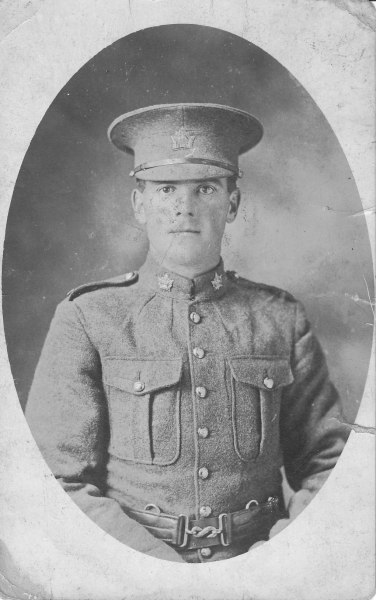
I once had a great-granduncle, Arthur. Until I started doing Genealogy, I had no idea there was such a title, but there it is, and I had one.

Of course, I never met him, but, as it is Remembrance Day I wanted him to be remembered.

My Granny’s mother, Lilian, had a family of five siblings, and Arthur was her younger brother. He was four years younger than her. Granny told me that Arthur immigrated to Canada in the early 1900s.

Despite many searches. I could find no information on his immigration. However, months after I started my research, I came across a border crossing Manifest from Canada to Sweetgrass, Montana.

It had all the information I had been searching for!

At this point, I was not sure he was even married, but the info on the border crossing gave me missing details and Arthur was beginning to become a real person.

The Manifest stated Arthur was 50 years old, accompanied by his wife, Catherine, son Alexander, and daughter Dorothy. It was dated the 18th of July, 1936. The family were visiting Yellowstone Park and Glacier Park. it gave Arthur’s address in Calgary, Alberta and his occupation as a Postal Porter. (1) It stated that he arrived in Canada at Halifax, Nova Scotia on the 19th of March, 1901 on the SS. Soman.

I haven’t yet found the passenger list for the SS Soman, but I keep looking.

When WWI broke out, he enlisted in the 56th Battalion Canadian Over-Seas Expeditionary Forces on May 3, 1915, in Calgary, Alberta. He was shipped back to the UK for training. While ‘back home’, he visited his sister Lilian – my great-grandmother – and had these photos taken with his sister and my Granny, Edith Bevan O’Bray.
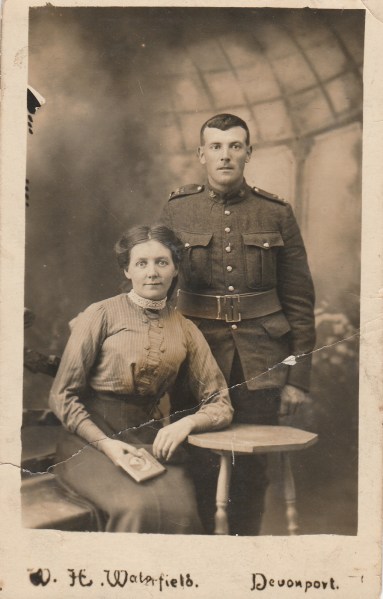
Arthur Symons with his sister Lilian Symons Bevan. C. 1914-18
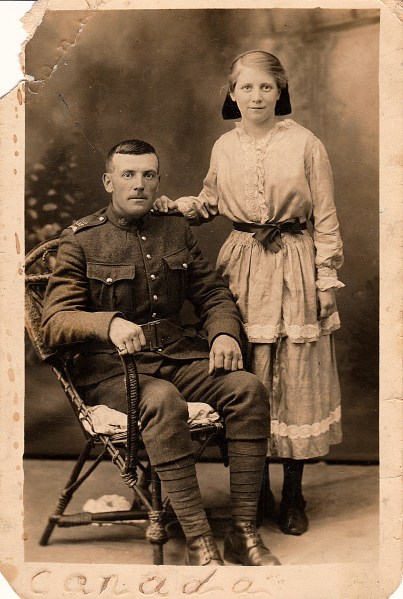
Arthur Symons with my Granny, Edith Bevan C. 1914-18.

Arthur Symons was born in Leicester, Leicestershire, England, in 1886. His siblings were Lilian Mary Symons—my great-grandmother; Thomas, who died in infancy; Arthur, Olive, and Ada, who was my Gran’s favourite Aunt, and only two years older than her.

Aunt Ada was also my Godmother. Together, they joined the WRNS (Women’s Royal Naval Service) in 1918 (2)

Great-grand-uncle Arthur fought at the Battle of Passchendaele and was severely wounded in the right leg, right hand and left foot. He was transferred to the Granville Special Hospital, located in Ramsgate, Kent, England. An orthopaedic facility to treat soldiers with damaged limbs. Later because of air raids on the Kent coast, the hospital was moved to Buxton. He was medically discharged on 28th August 1919.

In part Two, I will explore his stay in the Granville Special Hospital for Canadian troops. The first line of his medical records, dated November 29, 1917, stated he was “Dangerously ill.”

(1) Canadian Postal Porter – Porter – Worker having manual handling duties, typically at a large sorting office or railway station in London. Tasks included the loading, unloading, segregation and transfer of mailbags or other containers. Porters were also employed at some other locations, such as the PO Savings Bank.

(2) Granny and her Aunt in the Women’s Royal Naval Service.
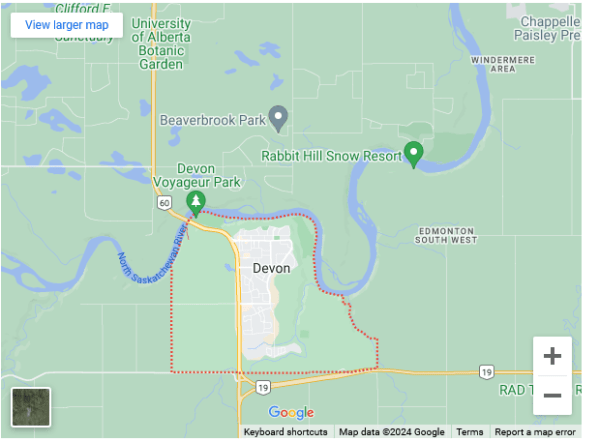
Devon, Alberta, Devon, England.

My eldest Grandson is called Devon. His full name is Devon John Charles. Named after both his grandfathers. His parents initially, wanted to name him Even. However, there is already a cousin in our family of that name. His mum suggested Devon which suited both parents.

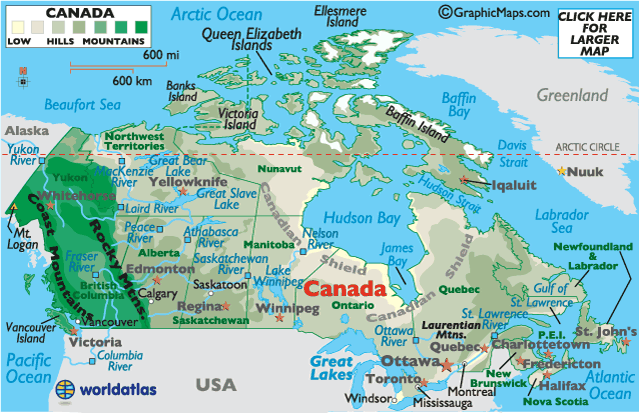
When Devon’s family moved to Alberta, we were surprised to learn he and his family were moving to Devon, Alberta! I was keen to learn the history of Devon, Alberta and here is what I found.

Devon, Alberta Canada

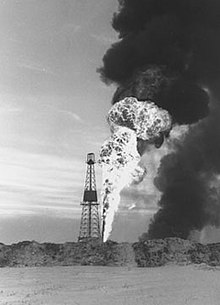
One of the largest oil discoveries in the world was discovered on February 13th 1947 (I would have been two years old). Leduc No 1 well struck oil and the new town of Devon was constructed by Imperial Oil to accommodate its workers.

Leduc Oil No. 1. Devon, Alberta Canada

The company wanted a well-planned town so Devon holds the distinction of being the first Canadian community to be approved by a regional planning commission.

The town was planned according to modern town-planning principles by the Edmonton District Planning Commission and CMHC. It was labelled “Canada’s Model Town” since it was the first municipality in Canada to be approved by a regional planning commission. The town grew extremely quickly, but because of planning controls, its development was orderly”. (1)

Devon was named after the Devonian formation seen in the strata tapped in the Leduc No. 1 oil well, which in turn is named for the county of Devon in England. Its economy is still based on the oil and gas industry; however, the addition of the Devon Coal Research Centre is helping to diversify the economy (2)

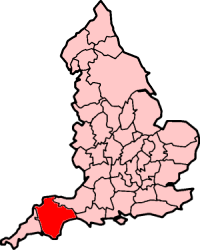
I was born in Plymouth, Devon but its history goes back millennia. Situated in South West England and bordering Cornwall, there is evidence of occupation from the Stone Age onwards. Recorded history begins in the Roman period when it was a ‘Civitas(3) meaning a social body of citizens united by law. (3) It was then a separate kingdom for centuries until it was incorporated into early England. A largely agriculture-based region, tourism is now vital.

Ancient Extent of Devon, England

The name “Devon” derives from a tribe of Celtic people who inhabited the South-West peninsula of Britain at the time of the Roman invasion.

The last time I visited Plymouth, Devon I was tickled to be able to send my grandson a letter addressed to Devon, in Devon Alberta, from Devon, England. The lady in the Post Office even pointed out how amusing that was.

(1) (2) https://www.thecanadianencyclopedia.ca/en/article/devon

(3) https://en.wikipedia.org/wiki/Civitas

The French Canadians in Western Canada

canewzz


The Archives nationales du Québec in Montréal on Viger Avenue are the repository of a wonderful and unique collection of books of marriages, baptisms, deaths of French Canadian families who left the Province of  Québec between 1840 and 1930 for destinations in Western Canada, especially in Alberta and Manitoba.

Monsieur Daniel Olivier,  former archivist at the Bibliothèque de la Ville de Montréal on Sherbrooke Street East, the latter no longer in operation, referred to for years as Salle Gagnon was responsible with the assistance of his associates for the acquisition of many of the books of marriages, baptisms, deaths, and burials outlined in this research guide.

Madame Estelle Brisson, former archivist at the Archives nationales du Québec on Viger Avenue East in Montréal with the assistance of her associates was also responsible for the acquisition of many of the books of marriages, baptisms, deaths, and burials outlined in this research guide compiled by Jacques Gagné.

Click on the link            The French Canadians in Western Canada