
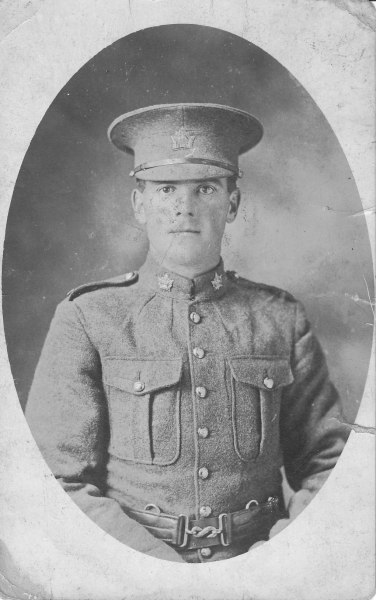
This is part two of my Great-Grand Uncle Arthur Symons’s experiences in WWI. Arthur emigrated to Canada in 1901, arriving in Halifax, Nova Scotia, on the SS Soman. (1)
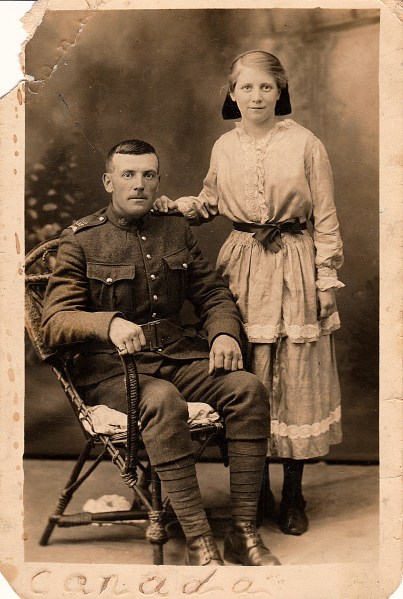
When WWI broke out, Uncle Arthur enlisted in the 56th Battalion Canadian Over-Seas Expeditionary Force in 1915 in Calgary. He was then shipped back home to the UK to train. While there, he visited his sister Lilian and her daughter Edith, my Grandmother.
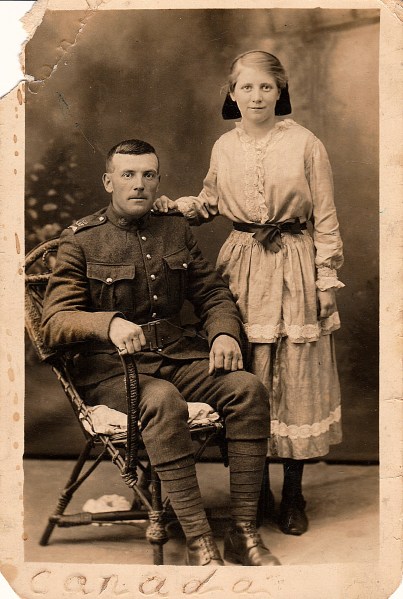
Arthur Symons with Edith Bevan his niece, my Granny.
Granny was 15 years old.
At Salisbury, Wiltshire, England, the Canadians trained for four months, most of it in terrible mud, as England experienced one of its wettest winters in decades. While most troops stood up well to the awful conditions, Canadian equipment did not. Much of it was soon discarded in favour of British types. The Canadians learned basic soldiering in England after a hasty mobilization and a difficult, uncomfortable winter. Their real training would come at the front.
After training, Arthur was sent to France and later Belgium. At the Third Battle of Ypres, better known as Passchendaele, the troops fought there from July to November 1917. Both sides suffered appalling conditions and heavy casualties. “The name Passchendaele has become synonymous with mud, blood and futility”. Arthur was wounded in 1917 at Passchendaele. (2)
The Government of Canada Library and Archives search had Arthur’s Attestation Papers and detailed medical treatments at “No. 4 General Hospital Dannes Camiers” (2) among many other hospital visits.
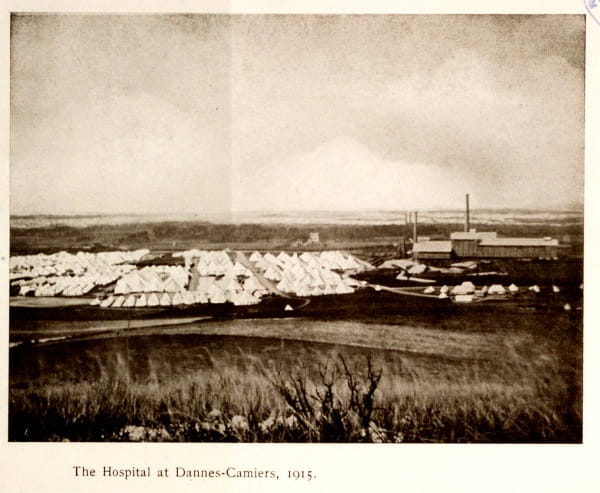
Searching for Dannes Camiers Hospital, led me to the Royal College of Surgeons of England and the following information. (2)
Shortly after the war broke out, McGill University organised the ‘No. 3 Canadian General Hospital’ to serve in France. The hospital was established at Dannes Camiers in the Pas-de-Calais area on 19th June 1915 under canvas. A staff of 35 Officers, 73 Nursing Sisters and 190 rank and file. Life under canvas that cold wet November was tough, with deep mud, storms, frost and collapsing tents. The conditions so undermined the health of one Lieutenant Colonel Yates that he was invalided to England where he died the following year.
Arthur’s admission to the Dannes Camiers Hospital was on the 29th of October 1917. The first line of his medical records states he is ‘Dangerously ill’ with GSW (gunshot wounds) R. Leg fracture and left foot.
By the 16th of November, Arthur is now ‘seriously ill’ There follows 99 pages – starting with his Attestation Paper – then very detailed treatments and x-rays from various hospitals in France, England and Alberta, Canada. It makes for fascinating reading.
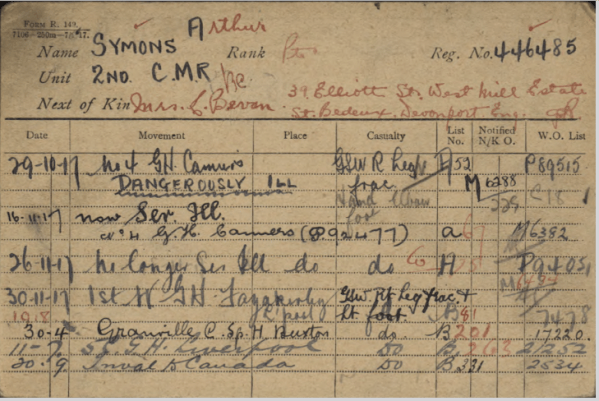
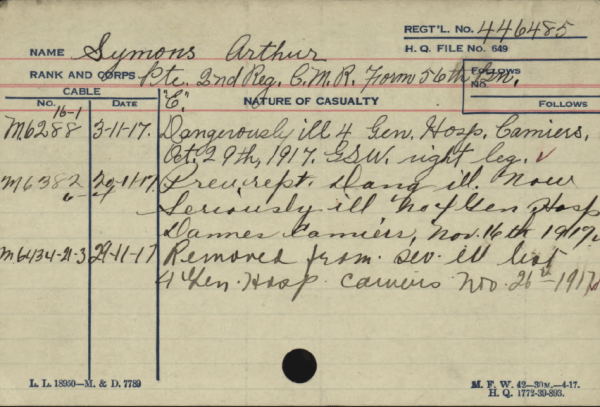
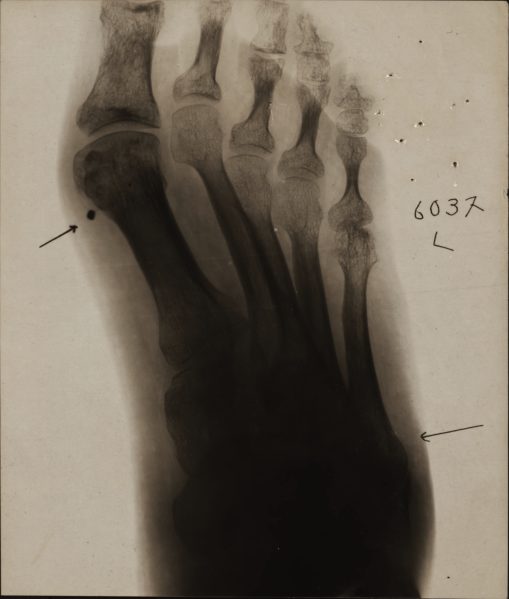
Three pages from Arthur’s 99 pages of hospital notes and X-rays.
On the 30 of November 1917, Arthur was transferred to the 1st West General Hospital Fazakerly, Liverpool England. After 5 months of treatment, Arthur was again moved to the Canadian Special Hospital Buxton, Derbyshire, England.
NOTE: Amongst the patients at Buxton, was Frederick G Banting, who would return to Canada after the war to continue research into diabetes and the use of insulin in its treatment, for which he was awarded the Nobel prize. (3)
His last transfer was on July 11, 1918, to the 5th Canadian General Kirkdale, Liverpool, England.
Eventually, on the 20th of September, 1918, Arthur was Invalided to Canada. He was sent to the Ogden military convalescent hospital in Calgary, Alberta. A short visit to the Calgary General Hospital, then back to Ogden.
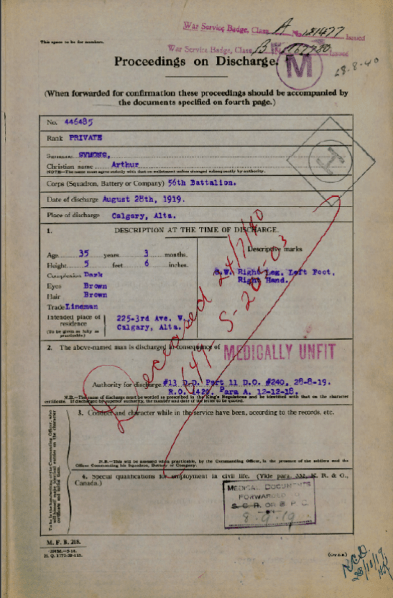
Finally, after nearly 2 years at 5 different hospitals, Arthur was sent to the Banff Rest Camp, and discharged on August 28, 1919, medically unfit for further service. He was 35 years old.
Arthur went on to marry and have two children and was employed in the Civil Service
This rather poignant note dashed across his discharge papers state ‘Deceased 24/7/40’
Excerpt from The Calgary Herald, July 26, 1940, page 2
Arthur Symons, 54, of 2409 Centre Street South, died in hospital here Wednesday afternoon. Born in Leicester, England, he came to Calgary 32 years ago and was employed in the civil service for 17 years. He is survived by his wife, Catherine, one son, Arthur, and one daughter, Dorothy. Alberta Death Reg. #1940-08-201498
Great-Grand Uncle Arthur Symons is buried in Burnsland Cemetary, Calgary Alberta, Canada. (Photo credit Ron Reine)
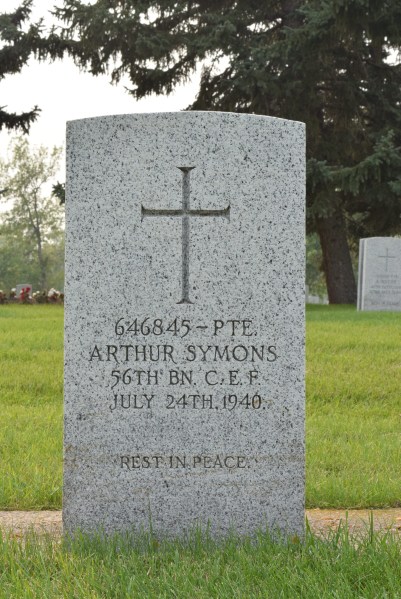
RIP Uncle Arthur.
Part 1 of Great-Grand-Uncle Arthur’s experiences in WW1:
(1) https://genealogyensemble.com/2024/11/11/remembering-great-grand-uncle/
(4) Dr. Frederick Banting
 Genealogy Ensemble