
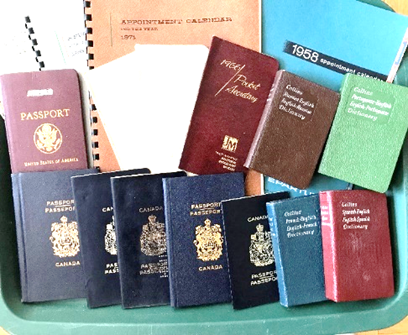
For the past twenty-five years since my Dad’s passing, a green bin containing documents he meticulously saved during his lifetime of ninety-two years have been carefully preserved. All these years it has been in my possession and carefully followed me during several moves. The photograph below shows some of these items including passports, monthly and pocket calendars.
With Father’s Day rapidly approaching it seemed fitting to prepare a story about one of my father’s many travels during his working career.
On a rainy dismal May afternoon, it was time to open the bin and gather some information about one story that came to mind about a trip he made to Russia many years ago. Amidst all his treasures, would it be possible to find what was needed to write the story I had heard? Upon opening the bin before beginning the search, a question arose, why had Dad so copiously preserved all these items? Did he plan to someday write his memoirs about all the wonders of the world he had seen over the years? Had time caught up with him and he was just too busy creating more stories and never had a chance to write them? We will never know and so, it has come about that it is a task left for me to relate some of these stories about his life and travels.
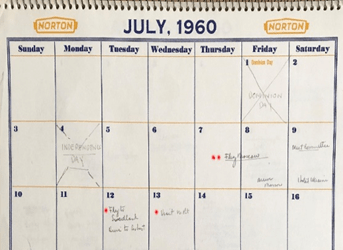
After searching through the passports, I found the one about his trip to Russia in 1960 and noted that it also appeared in his July calendar.
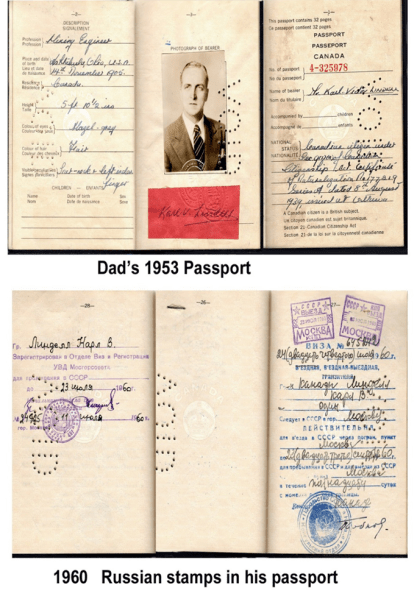
Having gathered the information and photographs, along with several Google searches it was time to begin writing.
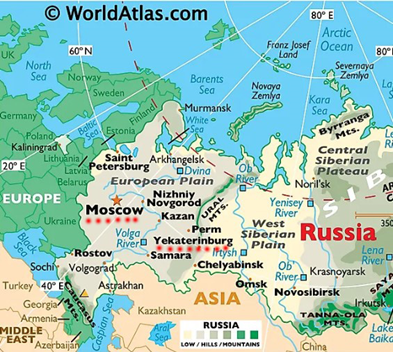
The map shows the area Dad and Ivan, the company lawyer visited.
Asbest, is in the Ural Mountains not too far from Moscow and relatively close to Ekatrinberg.
A portion of a map of Russia indicating the area of the open pit in Asbest, in the area of Sverdlovsk in the Ural Mountains.
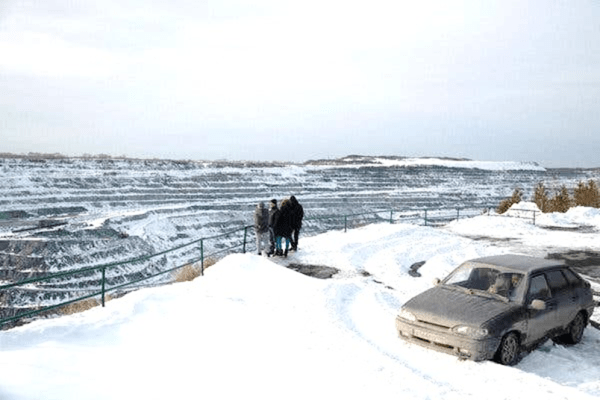
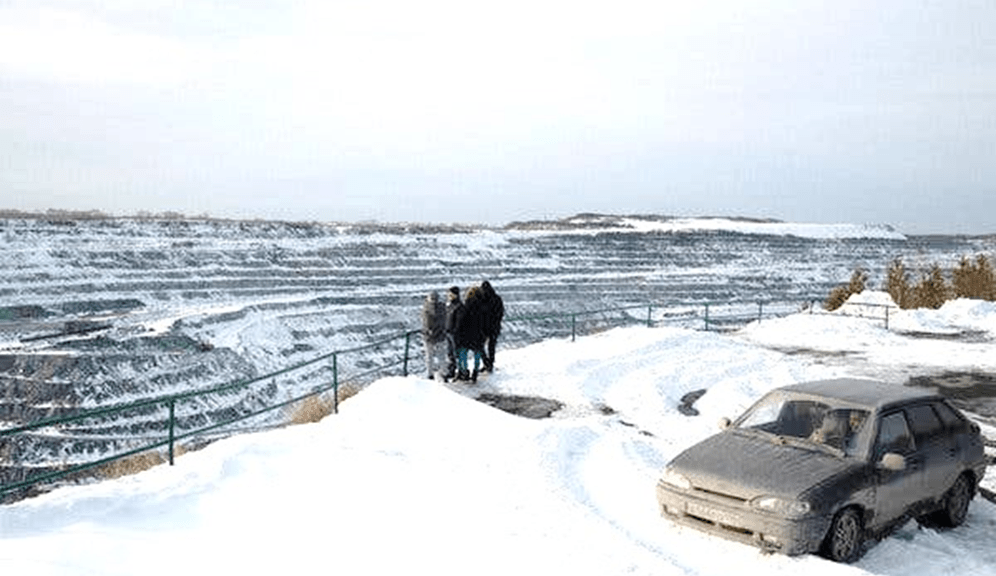
A viewing platform at the quarry that supplies Uralasbest, a leading maker of asbestos. Credit…James Hill for The New York Times.
In the above photograph we can grasp the enormousness of the open pit.
In an article in the New York Times written by Andrew Higgins “In Asbest, Russia, Making Asbestos Great Again” Published in April 2019.
“Uralasbest last year increased its asbestos production to 315,000 tons, 80 percent of it sold abroad, from 279,200 tons.
The city of Asbest, after more than 130 years of intensive mining, still has enough chrysotile asbestos buried in the ground to keep Uralasbest in business for at least another century, providing its customers, mostly in Asia and Africa, do not take flight.”
“Uralskii Asbestovyi Gorno-Obogatitelnyi Kombinat” (Ural Asbestos Mining and Processing Plant), commonly known as “Uralasbest” is a Russian company headquartered in the city of Asbest in the Sverdlovsk region. The company has been incorporated in 1918. The main activity of the company is asbestos mining. The plant is the largest Russian manufacturer of non-metallic building materials, which are available fo road and rail construction. The annual capacity 12 million tons..
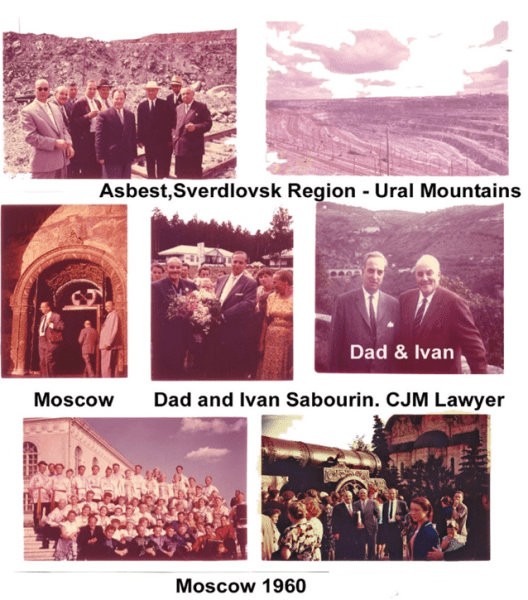
Dad, along with the Canadian Johns-Manville Company lawyer, Ivan Sabourin, and his Russian counterparts visited the open pit in Asbest which was most definitively the largest open pit Dad said that he had ever seen.
They also had the opportunity to visit Moscow and take in some of the country’s cultural heritage. This was at a time after WWII and Stalin’s passing, during Nikita Khrushchev’s leadership, when Russia was in the process of change, before Gorbachev, and long before Putin.
Dad pointed out while relating this story of his experience in Russia that we were always under the impression that Asbestos, Quebec maintained the status of the largest open pit in the world.
When Dad returned home, he noted that all the billboards, tourist, and marketing information would need to be re-evaluated. Asbestos, Quebec could no longer claim the title of the largest open pit in the world. New indicators were prepared and posted:
“The open pit in Asbestos, Quebec, Jeffrey Mine is the largest in the free world”.
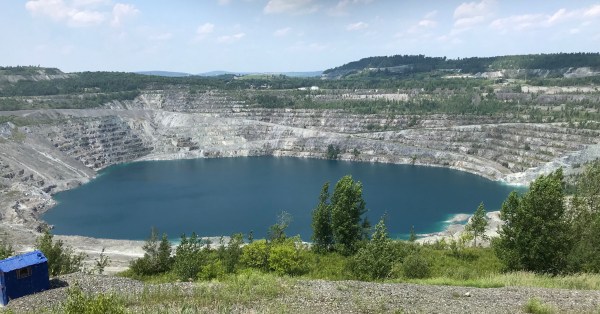
Jeffrey Mine, Asbestos, Quebec 2019: Claire Lindell
Canadian Johns-Manville Company ceased operations in 2012 due to a national ban on the sale of asbestos.
Dad often brought home souvenirs, and, on this occasion, it was the wooden stacking dolls, known as matryoshkas. They were a big hit among his grandchildren who over the years spent many an hour playing with them.
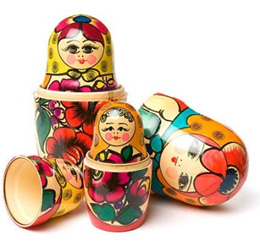
Matryoshka –wooden stacking dolls
https://en.wikipedia.org/wiki/Matryoshka_doll
Matryoshka is often seen as a symbol of the feminine side of Russian culture.[14]
Furthermore, matryoshka dolls are used to illustrate the unity of body, soul, mind, heart, and spirit.
***********************************************************
As Father’s Day approaches it is a good time to reflect on the many blessings we have received from our fathers. Although he spent hours, days, and weeks away from home on extensive trips, it never ceases to amaze me how he found time for his family. Many an occasion, one would have thought he was too busy with work, nevertheless, he found time and made it his business to be present at the special events in our lives. With six children, no doubt that took much juggling of his calendar to be present at these events.
Thank you, Dad. Kiitos
Other Sources:
Once The Largest Asbestos Mine in the World – Canada – Open Pit – YouTube video
https://www.history.com/topics/holidays/fathers-day#origins-of-father-s-day
 Genealogy Ensemble