Tag Archives: Bagg Montreal

Fairmount Villa

by Janice Hamilton and Lucy Anglin (second cousins)

Fairmount Villa was the home of our great-great-grandparents, Montreal notary and landowner Stanley Clark Bagg (1820-1873,) or SCB, and his wife, Catharine Mitcheson Bagg (1822-1914). SCB died of typhoid at age 53, but Catharine continued to live in the house with her son and four daughters until they all married, and she remained there until her death at age 92. 

1913 – CMB, Mary Heloise Lindsay, Ada Griffiths & son Julius

In his family history notes, Stanley Bagg Lindsay, SCB’s and Catharine’s grandson and Lucy’s great uncle, reminisced about playing in Granny’s garden. “There were apple trees, especially one which was easy to climb and play house in. There was an iron bench under it, painted blue green…. There was a chestnut tree which we loved, the summer house, the white statutes of Adam and Eve with no arms, … the bleeding hearts, snowballs and lilacs … Nora the housemaid and Jessie the cook, who made good ladies fingers and sponge cakes and who we could always see through large sunken window which gave light to the kitchen.” 

“There were the stables, the horses, the rockaway and the brougham (buggy) and Willis the coachman with white mutton chop whiskers whom we liked and who afterwards drove a wagon for Joyce the confectioner. We were very fond of Odell Comtois who did sewing…. She was practically one of the family.” 

Stanley Lindsay continued in his notes about visiting Granny Bagg: “We fondly remember her sitting at the front drawing-room window at Fairmount, her white lace cap perched on her head, watching the world go by.”  He concluded, “The garden had become quite shabby.” “It seemed a large garden to us. It went as far as our house which was at the corner of Milton Street. The west side adjoined the Wilson-Smith property. Long before our house was built, a large house called Tara Hall stood just north of Milton Street. Mother [Mary Heloise (Bagg) Lindsay] remembers it burning down one night when she was a child. Where the house used to stand is a street called Tara Hall.”10

The property records date back 300 years.  In 1701, the land where the house later stood belonged to a religious community called the Charon Brothers.  Later, in the mid-1700s, the Grey Nuns (Soeurs grises) inherited it.  Around 1780, the sisters sold three lots at the crest of the hill, which would later become Sherbrooke Street. These lots were subdivided and resold multiple times. In 1837, merchant Stanley Bagg (the father of SCB) purchased lot number 58A at a sheriff’s auction.  Sheriffs often seized properties when owners couldn’t pay their debts and auctioned them off at a discount for new buyers.  
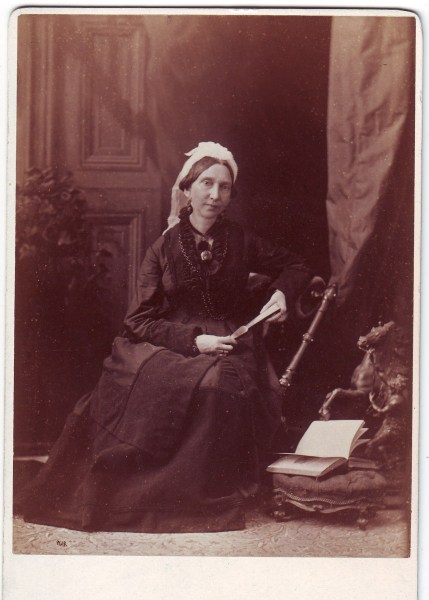
Catharine Mitcheson Baggcirca 1843

When SCB and Catharine were married in 1844,5 Stanley sold the property to his only son. It was at the north-west corner of Sherbrooke Street, running 2½ arpents north along Upper Saint–Urbain Street to the property line of Durham House, where SCB was born and grew up.

The notarial act in which the transfer was recorded described the Fairmount property as having “a two-storey stone house and other buildings thereon erected.”6 So the house was probably still under construction in 1844, and SCB and Catherine lived at Durham House with Stanley for a few years until Fairmont Villa was built. Their first child, who died at age two, was born at Durham House, but the others were all born at Fairmount Villa.

Some years later, an addition was added to the west side of Fairmount Villa. It included SCB’s office and a second front door so that farmers coming to pay the rent they owed to SCB did not have to walk through the house to get to the office.7

In his letter to The Montreal Gazette, Sydenham Bagg Lindsay, Stanley’s brother and Lucy’s grandfather, also noted there was a family chapel at Fairmount Villa, called the Oratory of the Holy Cross. “The stained glass window in this chapel depicted Christ as the Saviour of the World; it was given in recent years to the Anglican Church at Lake Echo….”9

Sydenham explained that the name Fairmount Villa was reminiscent of Philadelphia. Catharine Mitcheson grew up in a rural area just north of Philadelphia called Spring Garden.8 (It is part of the city today.) Philadelphia’s famous Fairmount Park was located nearby. The naming of Fairmount Villa after a place associated with Catherine’s early life was something of a family tradition: the house in which Catharine grew up was called Menteith House, after Catharine’s mother’s birthplace, Menteith, Perthshire, Scotland.

This painting of Monteith House, the family home in Spring Garden, was painted by Catharine Mitcheson. Bagg family collection. 

After Catharine’s death in 1914, the house was sold to the Asch advertising company, which eventually became known as Claude Neon. The City of Montreal expropriated the property in 1948 in order to widen Saint-Urbain Street. 

In September 1948, The Montreal Gazette published a letter announcing the demolition of Fairmount Villa, a house that had stood proudly on Sherbrooke Street near Saint Urbain for over a century. 

The house has been gone for over 75 years, yet it’s not entirely forgotten.  After all, Fairmount Avenue in Montreal’s Mile End neighbourhood was named in its honour in 1892!

Photo credits:

Studio of Inglis, “Residence of Stanley Clark Bagg,” 1875, Bibliothèque et Archives nationales du Québec http://numerique.banq.qc.ca/patrimoine/details/52327/1956159 (accessed Dec 6 2019)

Chas. E. Goad, Atlas of the City of Montreal from special survey and official plans, showing all buildings and names of owners, 1881, plate VII; detail of digital image, digital image 10, Bibliothèque et Archives nationales du Québec,http://numerique.banq.qc.ca/patrimoine/details/52327/2246915?docref=MtCYGy_XY512L82RM1ifMA (accessed Dec. 16, 2019)

Photographer unknown. Catharine Mitcheson Bagg in her 90th year, 1912. Photo glued into the Bagg Family Bible, Bagg Family Fonds, McCord Museum, Montreal.

Sources:

1. Sydenham Bagg Lindsay, “Montreal Landmark Destroyed,” Letters From Our Readers, The Montreal Gazette, Sept 1, 1948, p. 6. 

2. Justin Bur, Yves Desjardins, Jean-Claude Robert, Bernard Vallée et Joshua Wolfe, Dictionnaire Historique du Plateau Mont-Royal, Montréal: Les Éditions Écosociété, 2017, p. 149.

3. Justin Bur, email to the author, Dec. 9, 2019. 

4. J.A. Labadie, Inventory of Stanley Clark Bagg’s Estate, notarial act #16732, 7 June 1875, item no. 236;  Bibliothèque et Archives nationales du Québec. 

Stanley Bagg only bought about half of lot 58A, but he also purchased two neighbouring lots, greatly expanding the grounds. Later, SCB sold off a part of the property that he didn’t want, creating a long narrow piece of land along Upper Saint Urbain Street that he divided into lots. 

5. The wedding took place on Sept. 9, 1844 at Grace Church, Philadelphia. 

Historical Society of Pennsylvania; Philadelphia, Pennsylvania; Historic Pennsylvania Church and Town Records; database and images; Reel: 1078; Ancestry.com (www.ancestry.ca, accessed Dec. 16, 2019,) entry for Catharine Mitcheson; Citation Year 1844, Pennsylvania and New Jersey, Church and Town Records, 1669-2013, citing Historic Pennsylvania Church and Town Records. Philadelphia, Pennsylvania: Historical Society of Pennsylvania. 

6. Henry Griffin, notarial act # 20645 (approximate page number;) June 1, 1844; also mentioned as items 235 and 237 in the inventory of SCB’s estate, prepared by J.A. Labadie, notarial act #16732; Bibliothèque et Archives nationales du Québec.  

7. Stanley Bagg Lindsay, handwritten notes on Stanley Clark Bagg; Lindsay family collection. 

8. 1840 United States Federal Census, database; Ancestry.com (www.ancestry.ca, accessed Dec. 16, 2019), entry for Robert Mitcheson; Citation Year:1840; Census Place: Spring Garden Ward 1, Philadelphia, Pennsylvania; Roll: 487; Page: 259; Family History Library Film: 0020555; citing Sixth Census of the United States, 1840. (NARA microfilm publication M704, 580 rolls). Records of the Bureau of the Census, Record Group 29. National Archives, Washington, D.C.

9. Sydenham Bagg Lindsay, Ibid.

10. Stanley Bagg Lindsay, handwritten notes on Catharine Mitcheson; Lindsay family collection.
Horses, Snowshoes and Social Life

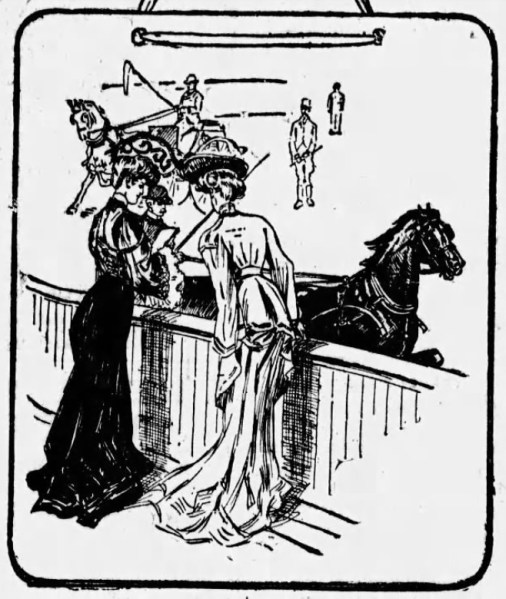
Horses were a common part of daily life in turn-of-the-century Montreal. Tradesmen delivered milk and other items by horse and cart, fire engines were horse-drawn, and many people got around the city in horse-drawn carriages in summer and sleighs in winter. For those who could afford it, horseback riding, horse racing and horse shows were also popular.

My great-grandfather Robert Stanley Bagg (1848-1912) was a skilled rider and every spring in the early 1900s, he and his wife, Clara, attended the Montreal horse show, held in suburban Westmount. Hunters, jumpers, harness horses and ponies competed for honours, but the show seems to have been more of a social activity than a sporting one, and proceeds from a tea served during the afternoon’s events were donated to the Society for Prevention of Cruelty to Animals.

Illustration of ladies enjoying the Horse Show, 1904. Source: The Montreal Star, May 7, 1904, p. 20

The Montreal Star published columns of names of attendees, and in 1904, the paper noted that R. Stanley Bagg had a private viewing box. Perhaps, like other boxholders, he and Clara entertained guests at dinner prior to the evening events.

Two years later, the Star reported that Clara, dressed in green tweed with a black hat trimmed with white, attended the show with her sister-in-law Amelia Norton, in a purple dress and a white hat, and her daughter Evelyn, in a grey homespun dress and a pale blue hat, trimmed with white.1

Stanley was still riding at age 59 when was injured in an accident on Mount Royal, the mountain that rises behind the city center. The Star reported that he was riding on rough ground near the park ranger’s house when his horse stumbled on a rock, fell and rolled over on one side, pinning Mr. Bagg beneath him. Two men who happened to be nearby helped him get up and encouraged him to rest for a few minutes before riding home. Stanley had sprained his shoulder, hit his head and his face was badly scraped, however, he soon recovered.2

Snowshoeing was also a popular sport in Montreal, and one of Stanley’s favourite winter activities. Between the end of November and the beginning of March, the city’s rival snowshoeing clubs competed in races, held weekly “tramps” over the mountain and organized longer excursions to other locations on the Island of Montreal. Club social activities usually included an annual dinner, charity fundraisers and lots of singing. Stanley was a member of the St. George Snowshoe Club, and it had its own club song with a chorus that began, “Hurrah! Hurrah! It’s jolly on the snow. Hurrah! Hurrah! The stiffest storm may blow.…”3

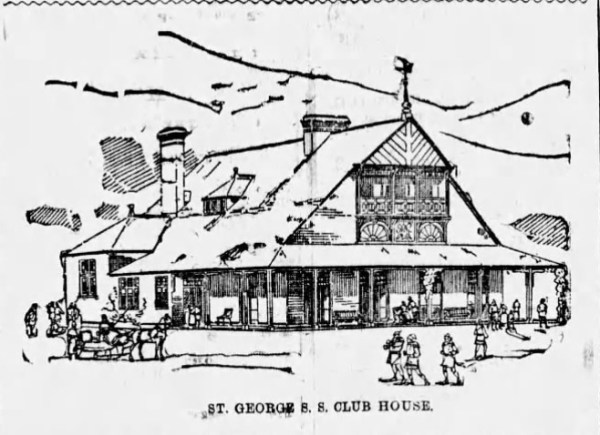
Stanley was on his club’s building and furnishing committee, overseeing the construction of a new clubhouse at Côte St. Antoine. The building was constructed in the early English stye of architecture, with spacious verandas on all sides, a high-pitched roof with dormers and a square entrance hall that gave way to an assembly room with a huge fireplace and large windows overlooking the veranda. When the club house held its grand opening on the evening of December 21, 1887, Stanley was among those who led the way from the Windsor Hotel downtown to the new building.4

The St. George Snowshoe Club’s new clubhouse. Source: The Montreal Star, Feb. 12, 1887, p. 6

When he wasn’t enjoying sports, Stanley, a lawyer, worked in the Bagg family real estate business.  Family life was also important, especially when they were travelling together or on summer holida

Stanley was married to Clara Smithers (1860-1946). One of eleven children, she was the daughter of Charles Francis Smithers, president of the Bank of Montreal, and his wife, Irish-born Martha Bagnall Shearman. When he started pursuing Clara in 1880, Stanley was age 32 and living at home at Fairmount Villa with his mother and sisters. (His father had died in 1873.) Stanley and Clara were married on June 8, 1882 at St. Martin’s Anglican Church in the presence of guests who included “the elite of our inner social circles.”5

The couple’s eldest child, Evelyn St. Clare Stanley Bagg, was born in 1883, and another daughter – my future grandmother – Gwendolyn Stanley Bagg was born in 1887. Their third child, Harold Fortesque Stanley Bagg, arrived in 1895.

Having started a family, Stanley and Clara must have realized it was time to own a house of their own, so Stanley hired architect William McLea Walbank to build a house at 436 Saint-Urbain, near his mother’s home. It was completed in 1884. 

According to a newspaper report, it was a handsome, well-finished brick villa of the Early English style of architecture, on Upper St. Urbain Street. The house contained all the modern conveniences of the time and was heated by Spence’s patent hot water furnace throughout. It claimed to be rat-proof. The bricks were all of Montreal manufacture and compared favorably with imported pressed bricks.

The family did not stay there long, however. In 1890, Lovell’s city directory listed Stanley as living in Georgeville, Quebec, while his sister Mary, the wife of stock broker Robert Lindsay, was living in the house on St. Urbain. Stanley had purchased a large house in Georgeville, on Lake Memphremagog, although it was probably a summer residence. Montreal was a very dirty and unhealthy city, especially in the heat, so many Montrealers left town during the summer months.

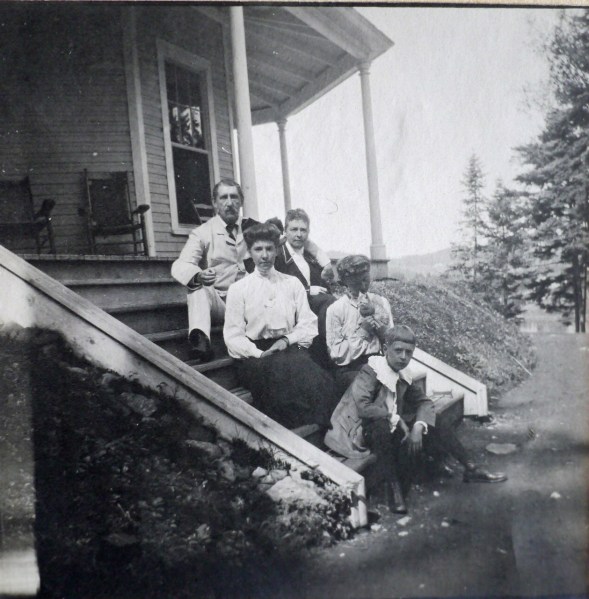
The Bagg family on summer holiday. Source: Gwendolyn Catherine Stanley Bagg, Portrait of the Family, Cacouna, 1903, McCord-Stewart Museum, M2013.591.134

It does not appear that the Baggs owned the Georgeville house for many years. My grandmother acquired a camera around 1901 and her snapshots showed family summer vacations at Cacouna on the lower St. Lawrence River, at a rented a house on a lake near Ste. Agathe in the Laurentian Mountains, and at a summer hotel at Kennebunk Beach, Maine.

As for their city home, perhaps Stanley and Clara realized that their house on St. Urbain was not in the city’s most desirable neighbourhood. The place to live in Montreal was on the southwest slope of Mount Royal, an area known as the Golden Square Mile. Montreal was the financial and industrial capital of Canada, and businessmen were making fortunes and building mansions in that part of the city.

Stanley purchased a lot at the western edge of the Golden Square Mile, the corner of Sherbrooke Street and Côte des Neiges Road, and architect Walbank designed a new red sandstone house for him. Construction started in 1891, and the Baggs were living there by 1892. It was Stanley’s home until his death from cancer in 1912.6 Clara then divided the house into two apartments and remained there until she died in 1946.

Sources:

  1. “Horse Makes Farewell Bow Tonight,” The Montreal Star (Montreal, Quebec), May 12, 1906, p. 12, digital image, https://www.newspapers.com/image/738949773; accessed Aug. 4, 2024.
  • “Snowshoeing; The Red Cross Knights; St. George’s Snowshoe Club Inaugurated Last Night,” The Gazette, (Montreal, Quebec), Dec. 21, 1887, p. 8, digital image, https://www.newspapers.com/image/419349867; accessed Aug. 3, 2024.
  • “Marriage Chimes: Fashionable Wedding at St. Martin’s Church Yesterday,” The Gazette, (Montreal, Quebec), June 9, 1882, p. 3.

The Priest

Sydenham Bagg Lindsay (1887-1975)

The recent McGill graduate and qualified Associate of the American Guild of Organists in New York City cautiously approached his father, in 1908, with his dream to enter the priesthood.  His father, a stockbroker, answered simply: “Not much money in it!”  But there was no doubt Sydenham Bagg Lindsay had a vocation.

He studied theology at the Montreal Diocesan Theological College and then at Lichfield Theological College in England.  In 1910, he was ordained Deacon in Montreal and then an Anglican Priest in 1911.

He served in various parishes in the Montreal area including St. John the Evangelist where he met his wife, Millicent Thorpe Hanington, daughter of Dr. James Peters Hanington.  They were married in 1918 at the height of the flu epidemic when only thirty guests were allowed in the church!

Soon after that, he became Assistant Priest at St. Matthews, Quebec City, then Trinity Church in Beauharnois.  Two years later he was given his first parish – St. Mark’s in Valleyfield.  He continued with his ministry all over the Diocese of Montreal and some of his parishes included St. Aidan’s in Ville Emard and St. Simon’s in St. Henri. Finally in 1940, he became the rector of the Church of the Advent on Wood Avenue, in Westmount.

During the depression, when he was at St. Simon’s in the slums of Montreal, not only did  it take real ingenuity to produce the Christmas pageant without any money but the confirmation veils were stolen just a few minutes before the Bishop arrived![1]

World War II brought an end to the depression, but also, alas, an end to the lives of some of his parishioners.  His daughter, Mary Kerr, recalled that “many a bereaved parent, spouse or friend told us what a help my father was in their time of sorrow.”[2]

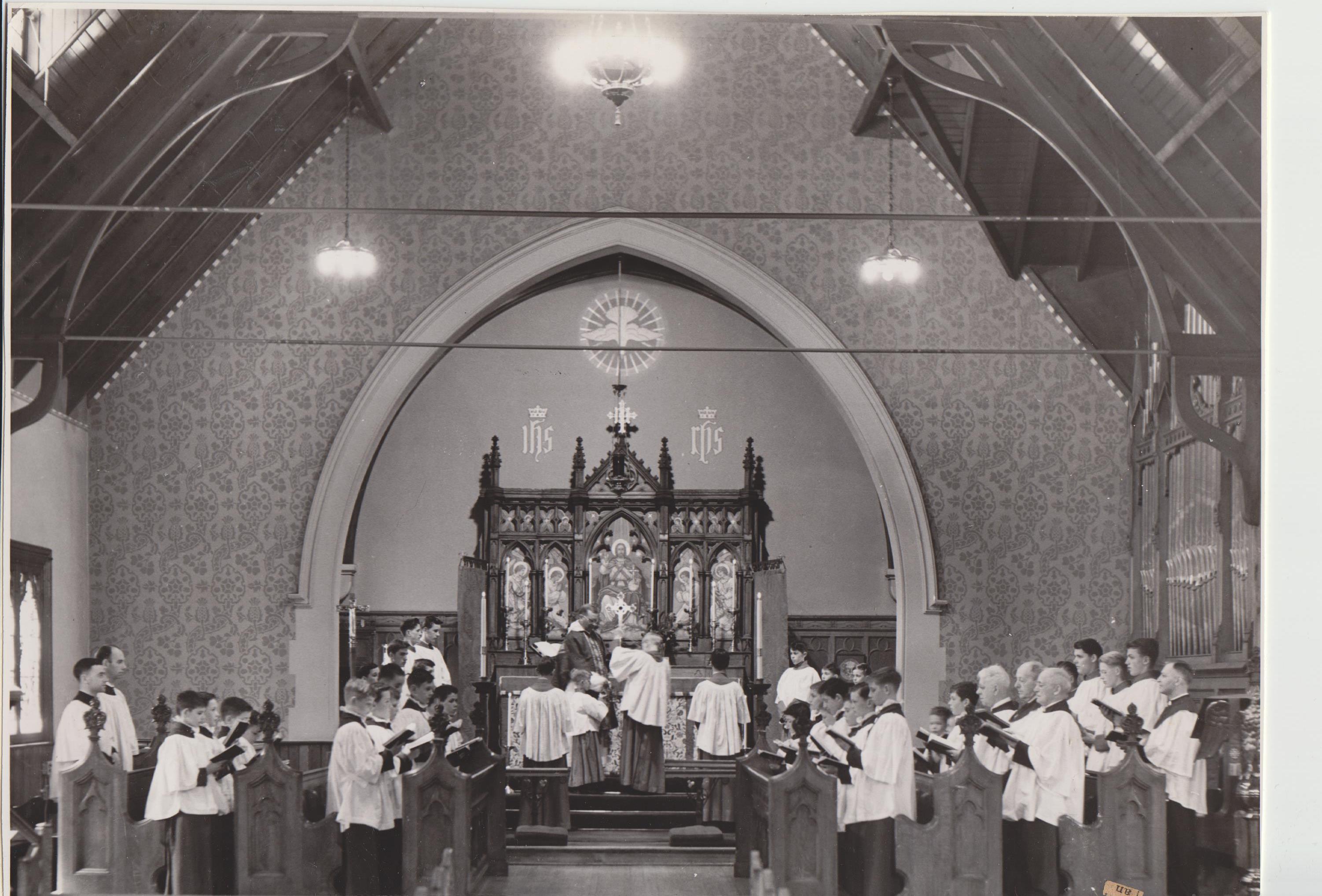
As rector of the Church of the Advent, he built up the parish and the boys’ choir which became quite famous and drew a large congregation.  It was a great thrill for him.

In his “spare” time, Sydenham was a classics scholar and church historian and kept up a correspondence with people all around the world, including missionaries and the fellowship in Western Canada.  He also regularly contributed to the “Letters to the Editor” column in the newspaper writing “no more than three or four sentences but always to the point, saying all that need be said in a few words”[3].

He also wrote and published the following four books:  A Historical Sketch of St. Columba’s Parish, Montreal, The Church of England and the Reformation (A Lecture Delivered in the Diocesan College, Montreal, on the 10th March 1954), Bishops of the Lindsay Clan (1957) and The Three Hours’ Vigil (1965).

In 1950, he was made an honorary Canon of Christ Church Cathedral   His health began to fail in 1953 and he retired as Rector of the Church of the Advent.  He stayed on as assistant priest, happily and humbly helping his successor. There may not have been “much money” in his calling but his “golden” jubilee in the ministry was celebrated in style in 1960. I was only three years old at the time.

I, however, remember him fondly as my Grampa-Lin, quietly joining in the family get-togethers.  He loved his grandchildren and amused us in his special way.  When pouring out drinks at family dinners, he would ask us: “Would you like ginger ale or Adam’s ale?” – Adam’s ale being water, of course!

 Church of the Advent


[1] Personal recollection of his eldest daughter, Mary Thorpe Lindsay Kerr, 1993.

[2] Personal recollection of his eldest daughter, Mary Thorpe Lindsay Kerr, 1993.

[3] The Gazette article “Canon Lindsay’s 50 years of Service.” Oct 14, 1961