
It constantly amazes me how technology can influence where people live.
When I was examining the lives of my great great grandparents and their predecessors on my fathers’ side for instance, I noticed that their moves usually followed easier travelling circumstances.
In 1815, for example, a small settlement known as Bear Brook arose along the border of a small creek by the same name. The area is now in Russell County. Initially, settlers from Montreal used the waterway to get there. By 1820, a new road from Montreal replaced it to link then-Bytown (Ottawa) through Cumberland, Clarence Point, Plantagenet Mills, L’Orignal and Hawkesbury.
My great great great grandparents were among many French-Canadian families from Lower Canada who travelled along the new road to settle in the area in 1854 to farm.
There must have been some Irish among them too, because part of the community was renamed Sarsfield twenty years later to honour Irish hero Patrick Sarsfield.
By then, loggers used the old creek and to float timber to mills in Carlsbad Springs. They were still doing so when Gustave Hurtubise was born in Sarsfield in 1884. Gustave, the elder brother of my great great grandfather was the first child from our family born in the town. Two years later, our cousin Sévère D’Aoust built the Roman Catholic Church in the village where my great grandfather Jean-Baptist would be christened. That same year, the community lobbied for a local stop along J.R. Booth’s Railway line in 1886. They built a small building to entice Booth.
Jean-Baptist Hurtubise arrived in Sarsfield on February 16, 1889. His future wife, Marie-Berthe (known as Martha) Gourdine, was born in a neighbouring town, Clarence Creek, October 3 the same year.
The year the youngsters turned eight, the Old Montreal Road got paved and engineers constructed the Canadian Northern Railroad through Cumberland to Hawkesbury.
They were only 16 years old when the two got married in Clarence Creek on January 7, 1915
My grandmother, Anne Marguerite Hurtubise was born in the same town the following November. Her sister Donna came a year and a half later.
The family left Sarsfield and moved to Cluny, Bow River, Alberta, sometime between Donna’s birth in 1917 and the 1921 Canadian Census. By this time, the train was established across the country, so they and others took it to go west.
For some great shots of various buildings in the town from that period, refer to the images on http://www.prairie-towns.com/cluny-images.html.
Somehow, the couple got land and a home. In 1921, the Census reported that 31-year-old Jean owned a farm with a three-bedroom wooden house on it.1 It was located in section 7, township 22, range 21, Meridian 4. His wife Martha and the two girls didn’t work.
Unfortunately, they arrived just in time for five successive droughts that we now know as the Prairie Dry Belt Disaster.
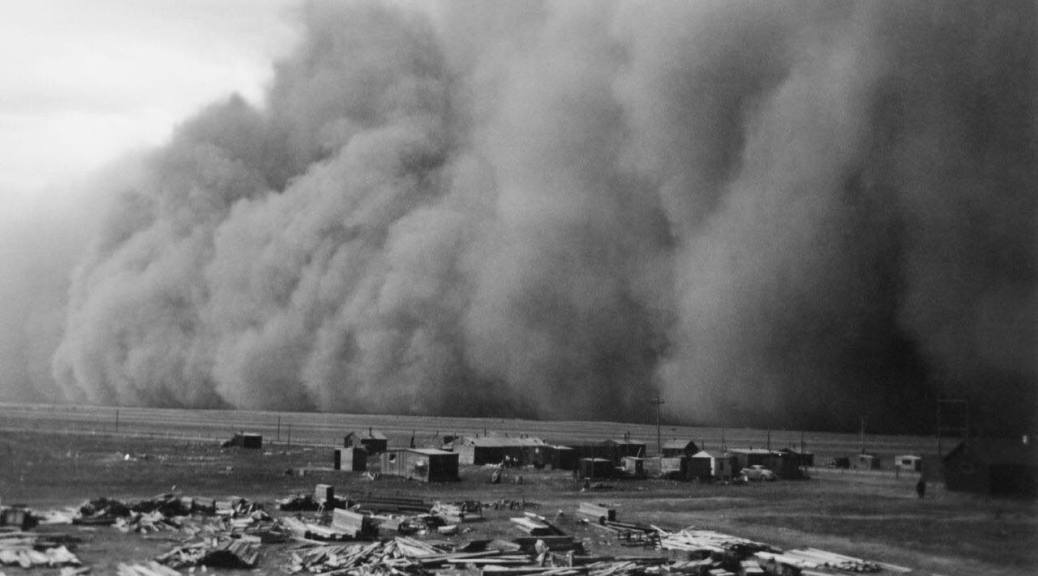
In 1931 and 1932 they suffered from the dustbowl, when top soil was so dry that it blew into homes.
Then the locusts came in 1933.
I grew up listening to stories about those times, but got a better understanding of what they faced when looking at the photos on a University of Saskatchewan website https://drc.usask.ca/projects/climate/.
My great great grandparents were among 750,000 farmers who had to abandon their farms between 1930 and 1935.
By 1938, the family had moved to Edmonton and my grandfather and his wife had to depend on the incomes from their daughters’ jobs, my grandmother as a nurse and her sister as a clerk, to survive.
1Data from the 1921 Census of Canada, Enumeration District 2, Bow River, Alberta, section 7, township 22, range 21, Meridian 4, page 6, line 28.
 Genealogy Ensemble