Tag Archives: Greece

Greek Tragedy

Syrian girl with her wares. (National Geographic, November, 1925. Article cited below. This magazine is in the public domain according to Library of Congress. Gervaise Courtellemont. Lumiere company.


Prologue: In my last post I explained how I recently learned, through DNA, that my biological father was likely Pontic Greek on the father’s side. Pontic Greeks are Orthodox Christian Turks who believed they are descended from ancient Greeks, who once lived on the southern coast of the Black Sea in cites like Samsun and Trabzon and who speak either a unique form of Greek or Turkish. In that post, I also wrote about the 1923 population exchange between Greece and Turkey. Here, I elaborate.

In 2010, I visited my older brother who lives in Denmark at his holiday home in Plomari, Lesbos, Greece. The large island of Lesbos is off the northwest coast of Turkey. On a good day you can see Turkey from the capital city of Mytilini. It’s only 17 miles away.

Back in 2010, before I explored my DNA, I naturally assumed I was half French Canadian and half Yorkshire British, just like my older brother, but I also knew, deep down in my heart of hearts, that I resembled the Greek locals, both in looks and in temperament.

Plomari village from the back window of my brother’s place.
The harbour is two streets down.

Today, I understand that I am very likely related to some of those local Greek citizens on Lesbos, perhaps even closely related. I know this because of a photograph I recently discovered in an article from the November, 1925 National Geographic magazine.

Greek refugees arriving in Mytilini. 1923

There is no shortage of online information on the 1923 Greek/Turk ‘population exchange’ that came on the heels of a horrific event referred to back then as ‘The Smyrna Holocaust,’ but I had high hopes that this story entitled History’s Greatest Trek. Tragedy stalks through the near east as Greece and Turkey exchange 2,000,000 of their people, written in real time by a world class journalist in a world class magazine, would shed some light on the path my Pontic bio-father (or grandfather) may have taken to reach Montreal, Canada in 1954.

I have tree matches in Samsun, a port on the Black Sea in northern Turkey. My mother, who lived and worked in the Notre Dame de Grace area of the city, likely knew Greek men whose grandparents fled Smyrna (now Izmir) in 1922, on the west coast of Anatolia on the Mediterranean Sea. Could I connect the two places?

I was not disappointed. Right at the beginning of the sixty page article there’s a picture of a young Greek man from Samsun. The caption reads: A Refugee from Samsun. He took part in the first trek of 100,000 refugees from the Anatolian interior.

According to online sources, post WWI, most elite Greeks in Samsun were killed off and all other able-bodied men sent into the interior to join the Turkish army.

Clearly, some of these Pontic Greek men and women escaped the Turkish hinterland to make it to the Mediterranean coast and Smyrna in 1922, in the hope of catching a ride to safety.

This 60 page article from 1925 is a classic piece of National Geographic reporting. It is workman-like in its execution with a prose style on the flowery side. The article offers readers a succinct historical and political perspective on the infamous 1923 population exchange between Greece and Turkey. The reporting is objective: The Muslim story is discussed with as much respect as the Christian story. And, of course, the article contains many, many photographs, about one hundred of them. Oddly, the prettiest colour ones all depict quiet Turkish life.
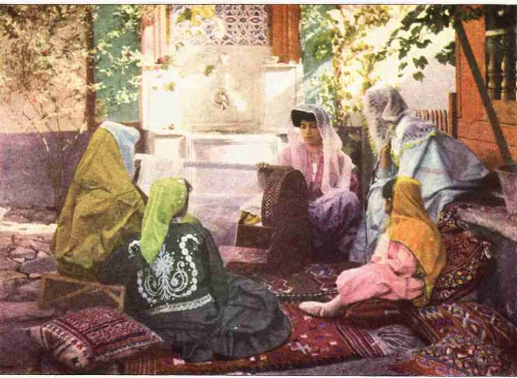
There’s a fascination here with exotic dress, from what I can see.


Still, the author, Melville Chater, pulls no punches as he uses his gift with words to capture the true horror of the situation in the port of Smyrna during the late summer of 1922: the hope, despair, death and disease and, eventually, the chaos, the total breakdown of civilized life.

Chater and his companion were in that coastal city when the Greek military lines collapsed in August, 1922, effectively ending the three year old Greco-Turkish war. They were in Smyrna in September to witness the Greek soldiers flee home on their military barques, leaving only ‘neutral’ observer boats in the habour.

Immediately thereafter, they saw the victorious Turkish cavalry enter the city, the riders’ left palms outstretched in a peace gesture, and a few days hence they witnessed the great fire of Smyrna that forced local citizens to flee in chaos to the quay and mix with the tens of thousands of refugees from further afield amassed there. By this time “the city had become a gigantic blast furnace… Affrighted faces mingled with wild-eyed animals, and human cries with the neigh of horses, the scream of camels, and, last, the squeaking of rats, as they scuttled by in droves from the underworld of a lost Smyrna.”

The beginning, late August, 1922.

“Refugees from anywhere within 150 miles inland herded seaward into Smyrna. At first they came in orderly trainloads or in carts, with rug-wrapped bedding, some little household equipment, and perhaps even a few animals, But as the distant military momentum speeded up, the influx became a wild rabble of ten, then twenty, then thirty thousand a day. Their increasingly scanty possessions betokened a mad and yet madder stampede from the scene of sword and fire, until September 7 saw utterly destitute multitudes staggering in, the women wailing over the first blows of family tragedy, whereby mothers with no food for their babies had been forced to abandon their older children in wayside villages….

….By now Smyrna’s broad quay swarmed with perhaps 150,000 exiles who camped and slept there, daily stretching their rugs as makeshift shelters against the sun, whose furnace-like heat was the mere forerunner to a terrible epic of fire.”

The Greek Army flees,the Turkish cavalry arrives.

On September 23rd, a fire breaks out in the Armenian quarter. The Turks give permission for women and children and old men to leave. People are dispatched to Athens to organize a flotilla of rescue boats. The Turks then give the rescuers one week to evacuate the refugees or they will be forced into the interior. Further chaos ensues.

“Uncounted hundreds were crushed to death or pushed over the quayside to drown, on that first day, when eight ships, convoyed by American destroyers left with 43,000 souls aboard. For those left behind there remained but six more chances—a chance a day—then the black despair of deportation into the interior.
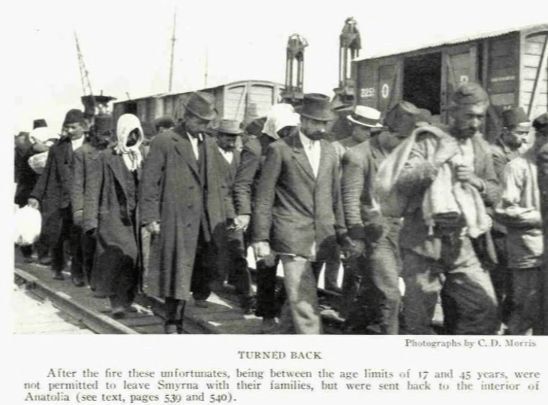
These men were not allowed to leave Smyrna after the fire with their families. “Everyone from peasants to bankers” is how these Anatolian Greek refugees are described in the article. Also as “human derelicts” and descendants of ‘those adventurous spirits who had followed Alexander the Great into Asia.” Some men apparently escaped at Smyrna, swimming to rescue boats under the cover of night. Some wealthier men bought their way onto boats. 300,000 thousand people were evacuated in two weeks, including 100, 000 ‘cellar-hiders’ in Smyrna, uncovered by the Turks in a house-to-house search.

The aftermath:

A notification is posted permitting (well, forcing) all non-Muslims to leave Asia Minor before November, 30, 1922. Hoardes of Anatolian Greeks, former prisoners of war, men, women and children, head to the Black Sea coast.

“With ship-deserted quays, as at Smyrna, and with the Black Sea ports glutted with sidewalk-sleeping, disease breeding paupers, who had been thrifty cottagers a few weeks before, the gap was finally bridged by the arrival of Greek ships flying the Stars and Stripes and convoyed by American destroyers….

….”By January, 1923, Athens had slammed its official doors protesting against further expulsions.”

With a big nudge from the US, Britain and the League of Nations, Athens agreed to accept hundreds of thousands more Christian Greek refugees in an exchange for Muslims living in Greece.

The exchange would begin in May, 1923 and be carried out in various ways. Most Greek refugees are funnelled to the Athens region as well as to Thessonaliki in the northern part of Greece and to some Aegean Islands like Lesbos.

They live in refugee camps rife with disease and death. There is little usable land left in Greece due to past wars.

Greece, then a country of 6 million souls, would take in almost a million and a quarter refugees within a year of the Smyrna disaster, increasing its population by 25 percent.

“There is no adequate parallel whereby to convey even remotely a picture of Greece’s plight in 1923,” Chater summarizes.

Pretty heavy stuff – and yet the 1925 magazine article somehow manages to maintain the feel of a breezy travelogue.
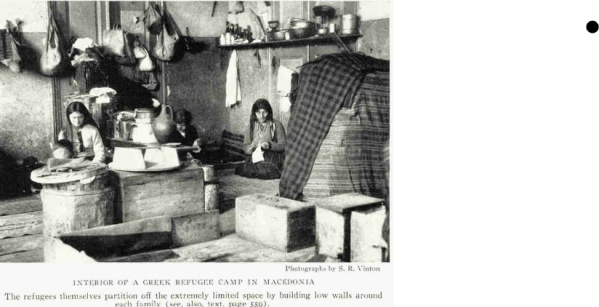
Greek refugee camp Macedonia

Epilogue:

In the style of Virginia Woolf’s 1925 masterpiece Mrs. Dalloway, I imagine a comfortably middle class lady, back in the mid 1920’s, perhaps my husband’s grandmother in her favourite club chair in her cottage in Westmount, flipping through this very issue of the National Geographic, cup of tea in one hand. The inky new pages crackle as she turns them with her free hand. “How awful,” she whispers under her breath when she gets to the bit about the Greek women holding their still-born babies at their breasts because they had no place to bury them. And, then, “How pretty,” as she eyes the flowing costumes on the Turkish women, the colourful mosques and the charming minurats. And, then, as she comes to the full-page advertisement for Campbell’s Soup at the end of the article, she perhaps thinks, “Yes, tomato soup for the children, for tomorrow’s lunch.”

Here’s the archive.org link.

https://archive.org/details/nationalgeographic19251101/page/550/mode/2up?q=mosques
Liquid Gold

Homer said in the 8th century BCE that olive oil was liquid gold. The olive tree reached Greece sometime in the 28th century BCE, introduced by the Phoenicians.1 A staple in Mediterranean cuisine, olive oil has been used for religious rituals , medecines, as fuel in oil lamps, as well as to make soap. Spartans and other ancient Greeks rubbed themselves with olive oil when exercising in the gymnasia.2 Aristotle also described the use of olive oil as a contraceptive. Mixed with either oil of cedar, ointment of lead, or ointment of frankincense, this mixture can be applied to the cervix to prevent pregnancy.3 The olive tree was so important to the ancients Greeks that they awarded an olive wreath to the winners of the Olympic games, symbolizing peace.4

I just came back from visiting my husband’s family in Greece and, as it was October, many of the conversations revolved around when each household would harvest their olives. Obviously, not everyone in Greece has olive trees, but it is common on the islands and in rural areas for each household to have olive trees. The olives are harvested to extract olive oil for family consumption. From the conversations that I listened to, it was important to harvest the olives just before they fell off the trees. This would ensure that the olives were at their greatest weight.  They should also be harvested before they are fully ripe, when they start to change colour to a purple colour, but are not yet fully black. The olive oil will be extracted from the olives at the local mill and it is important to time one’s appointment so that the olives do not sit too long after harvesting and sour.

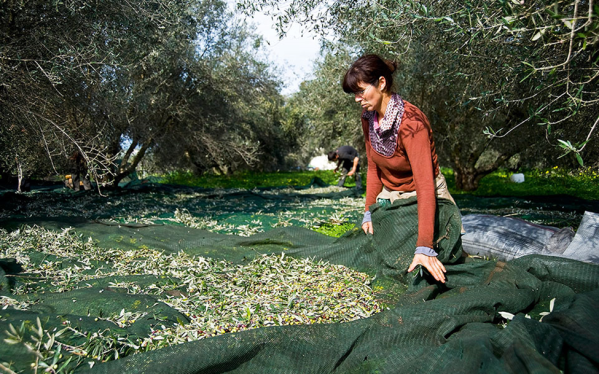
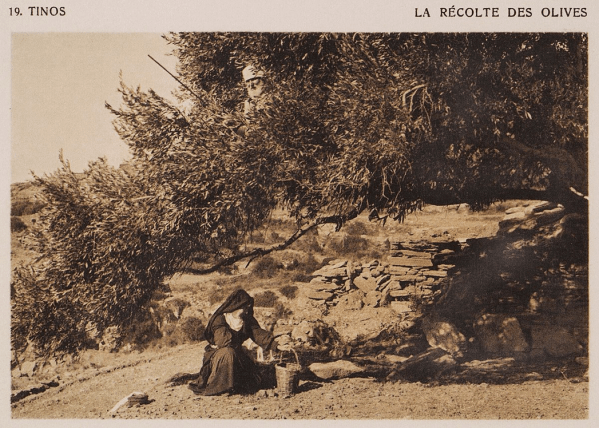
Family olive harvesting has not changed much over the years. Olives are usually harvested by hand, with a rake that dislodges them gently so that they fall onto a tarp or a net at the bottom of the tree. All stray olives are gathered up and leaves and sticks are sifted out as much as possible.

Olive harvesting on Tinos, 1919 5

An example of the nets used to harvest olives

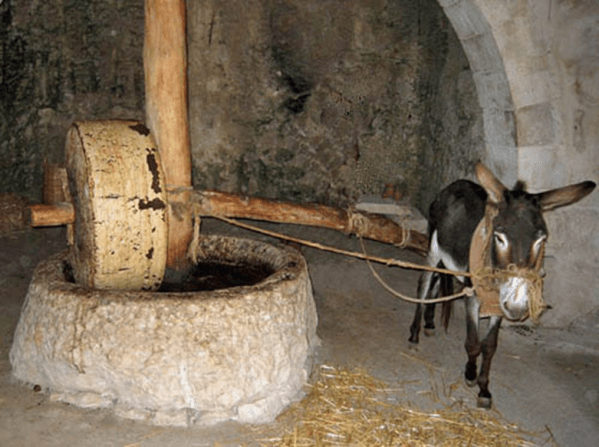
Olive oil was formerly extracted using millstones. The olives were emptied into a stone basin and ground into a mash. The millstone was harnessed to a donkey. The mash was then scooped out and poured into baskets that allowed the olive oil to drain out into vats. 7

Old stone olive mill8

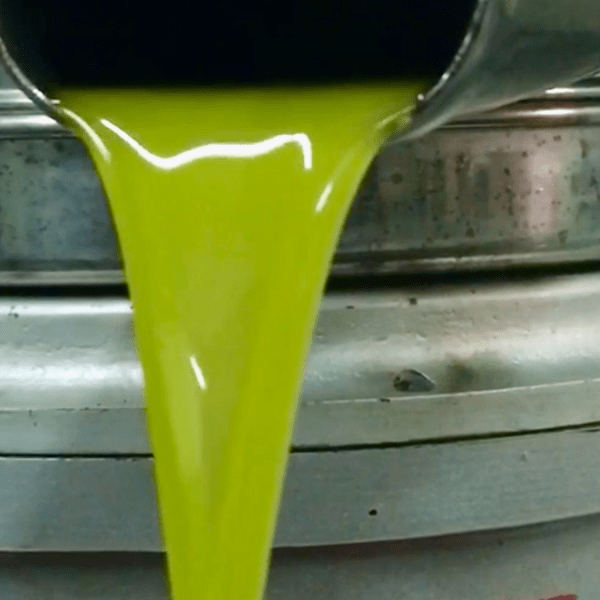
I had the opportunity to visit a modern mill this olive season and, while mechanized, the process is identical. The purpose is to squeeze the oil from the olives to extract “liquid gold.” Initially the olives are weighed. The first machine separates the olives from any leaves and sticks and washes them. They are then sent to a barrel that crushes the olives and extracts the oil. As the oil is extracted, the machine counts the number of liters as the oil pours into a separate basin. Once this process is finished, the oil is poured into individual containers so that the client can take these containers home. At the mill that I visited, the olive pulp or mash is put into a compost pile.

Liquid gold 9

  1. https://en.wikipedia.org/wiki/Olive_oil, accessed 31 October 2022.
  2. Ibid.
  3. Ibid.
  4. Wikipedia, Olive Wreath, https://en.wikipedia.org/wiki/Olive_wreath, 1 November 2022
  5. Baud-Bovy, Daniel et Frédéric Boissonnas, Des Cyclades en Crète au gré du vent, Geneva, Boissonnas & Co, 1919.
  6. Greece is travel, culture, gastronomy and more, Crete, Olive Oil: The Past, Present and Bright Future of Crete’s Lifeblood, https://www.greece-is.com/olive-oil-the-past-present-and-bright-future-of-cretes-lifeblood/, 3 November 2022
  7. Traveling Classroom Foundation, Making Olive Oil, http://travelingclassroom.org/?p=1379, 3 November 2022
  8. Ibid.
  9. Green Golden Gold, https://www.greengoldengold.de/en, accessed 3 November 2022

Petimezi

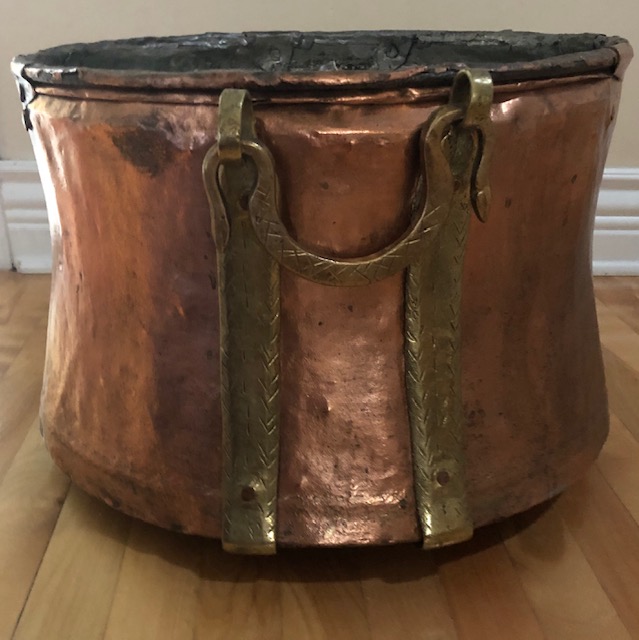
We were visiting my mother-in-law in Greece when my husband brought out a blackened cauldron from storage. He placed it on the table with great ceremony and announced that we were bringing it back to Canada. “But first,” he said, “we need to restore it.”

The next day we hauled the cauldron down to the Monastiraki area of Athens. Mainly this area has little souvenir shops and is a great place to go shopping. In the winding roads behind the shops you can find all sorts of workshops. This is where we found a coppersmith who could restore the cauldron to its former glory.

My mother-in-law believes that the cauldron may be around 125 years old. Her grandmother, Maria had gone to Turkey, around 1900. She was a young women then and had gone to work as a domestic in the rich homes of Constantinople. Maria came back to Greece and to her native island of Tinos during the Greek-Turkish population exchange of 1923. She brought back with her many objects from Constantinople and my mother-n-law believes that the cauldron was one of them.

My husband’s mother remembers her mother making petimezi in the cauldron over a wood fire. Petimezi (from the Turkish word pekmez)1 is made by boiling down the juice of the grapes, after removing the skins and squeezing the grapes through a sieve to extract the juice. The juice, or must, is then boiled down to a thick syrup. There is no fermentation involved.2 It is still made today on the island of Tinos but previously it was widely used by every family as a natural sweetener when there was no other sweetener available.

One can also add marl, a sterile soil. This soil clarifies the liquid and neutralizes the acidity of the must.3 Even today, some of villagers on the island of Tinos will add marl to the grape must.

Another family memory is that sometimes ashes were added to the petimezi when they were making it. Adding the ashes would ensure that the dirt would rise to the surface where it could be skimmed off, a way of sterilizing the must.4

Today this copper cauldron, completely restored, sits proudly in our home.

Cauldron


  1. Wikipedia web site, “Grape Syrup,” https://en.wikipedia.org/wiki/Grape_syrup, accessed October 16, 2019.
  2. Ibid.
  3. Rafaelli, Lucia, We Love Istanbul web site, “The Healing Syrup of the Turks : Pekmez,” December 28, 2015,https://www.weloveist.com/pekmez, accessed October 16, 2019,
  4. Fonini, Real Greek Recipes web site, “How to make grape molasses – reduced grape must, https://www.realgreekrecipes.com/how-to-make-grape-molasses-reduced-grape-must/, accessed October 16, 2019.

Lifting Up

“My father will be lifted up soon,” my husband, Georges, said to our dinner guests. I could see the puzzlement and consternation on their faces as his father had been dead over three years. Our guests were obviously wondering what exactly this meant and how to react.

I hurriedly intervened by saying, “Georges, in Canada, we leave corpses in the ground forever.” Now our guests were really confused.

Georges then explained the funeral rites in his native village of Skalados, on the island of Tinos, Greece.

Skalados is a small village with a population of under a hundred permanent residents. In the summer, the population can more than double as the families who have left the village to live elsewhere, mainly Athens, come back to enjoy their summer break on the island of Tinos.

Skalados is a Roman Catholic village and the cemetery is Catholic. When one of the villagers die, bells ring from the Catholic Church of Saint John to announce the death. The funeral service is held fairly quickly, usually within twenty-four hours, as is the custom in many hot countries. Embalming is not usual in Greece.

While the person is placed in a coffin, the person is not buried with the coffin.  The deceased is wrapped in a shroud and carefully placed in vault that has a dirt bottom, cement sides and a marble covering. There are eight places or vaults in Skalados. This means that, at some point, the person must be exhumed to make way for others.

I remember my mother-in-law explaining that when her father had been ‘lifted up’ (σήκωσε), she was the one who lovingly washed his bones with wine and prepared them to be transferred to a small chapel that is part of the cemetery. The bones are placed in a vault, identified with the person’s name and often the birth and death dates, along with a picture.

Today, though, it is not necessarily a relative who will wash and prepare the bones. One can hire someone to do this.

The Eastern Orthodox Church is considered the prevailing religion of Greece, as 90% of the population belongs to this church. Roman Catholics represent less than 1%. 1 It is no surprise that the Catholics in Tinos hold memorial masses for their loved ones as the Eastern Orthodox Church requires.  A memorial mass is held on the third, ninth and fortieth day after death, as well as three months and six months following the death, and on the first anniversary of the death and sometimes three years after the death.2

After the funeral and the memorial mass, coffee, liqueur, alcohol, and other refreshments are served. These refreshments are provided by the bereaving family and are quite elaborate. My mother-in-law explained that when she was young, relatives and friends came from far, often on donkeys, and would need a meal before the long journey home. This tradition still continues today.

Also, in the village of Skalados, the family gives a loaf of bread to each household. The family in each home will then say a prayer for the deceased’s soul during their evening meal.

The Greek Orthodox Church prohibits cremation, therefore it is not common for the Roman Catholics in Greece to have their loved ones cremated.3 For the moment, the closest crematorium is in Bulgaria, although the Greek government has approved plans for a crematorium in Athens, despite the opposition of the Greek Orthodox Church. There is overcrowding in the cemeteries and people are exhumed after three years to make room for others.4

It is the custom for bereaving women in the Orthodox Church to wear black for at least two years following the deaths of their loved ones. The Catholics of Tinos also follow this tradition.


  1. Wikipedia, Religion in Greece, accessed May 20, 2019
  2. Wikipedia, Memorial Service in the Eastern Orthodox Church, accessed May 19, 2019
  3. Everplans web site, Eastern Orthodox Funeral Traditions, accessed May 20, 2019
  4. The Guardian, March 12, 2019, Greece defies church with step towards first crematorium, accessed May 20, 2019

My Husband, a Rare Type of Greek

My husband is funny, thoughtful, generous, and kind.  Is this why he is a rare type of Greek? No, it is actually because of his religion.

The population of Greece is 11 million and the Greek constitution recognizes the prevailing religion of the country as Eastern Orthodox.  In fact, 81 to 90% of the population are practicing Orthodox.1  My husband is Roman Catholic, of which there are only 50,000 to 70,000 in Greece, or less than 1%. 2

My husband’s family comes from the Cyclades Island of Tinos. In 1207, Tinos came under Venetian rule and was ruled by the Venetian overlord Ghizi, a relative of the Doge of Venice.  Constantinople was a significant trading partner with Venice and Tinos is located on the trading route.3 My husband’s great-grandmother’s name was Concepta Ghizi.  This does not mean that she was necessarily a descendant of the overlord. It was common for people working for the overlord to have taken his name.

Today, the Island of Tinos has a significant Roman Catholic population, with entire villages being Catholic.  When I was in Tinos two summers ago, I visited the Cathedral of My Lady in the village of Xinara.  This is where a portion of the Roman Catholic records are kept.

What a privilege it was to meet the Archivist, Irini Fyrigou.  Each village on the island maintained and still maintains registers of births, marriages, deaths, and other events and she consulted the register for the natal village of my husband’s family.  She also cross referenced to the register of the main town of the island.  It was such a thrill to see the original entries in Italian, with the older entries in Latin.

The meeting with the Archivist confirmed what we always suspected.  These Roman Catholics are the descendants of Venetians who have managed to maintain their religion for centuries.

Florakis E. Alekos is an historian whose speciality is the Island of Tinos and he has researched the origins of the surnames.  My husband’s last name is Delatolas.  The first time this name was registered on the island, it was written De La Tolla (from Tolla).  Tolla was apparently a village near Venice.  My mother-in-law’s maiden name is Fyrigos.  This name designates someone from the island of Kythera, located south of the Peloponnese Peninsula as this island was known as Cerigo during the period of Venetian domination.  The person from Cerigos would have been designated as o Σερίγος (Cerigos), becoming 0 Φυρίγος (Fyrigos) over time. This island was also on the trading route between Venice and Constantinople. 4

So this is why my husband, a Roman Catholic, is indeed, a very rare Greek.


  1. Wikipedia web site, Demographics of Greece, http://en.wikipedia.org/wiki/Demographics_of_Greece#CIA_World_Factbook_demographic_statistics, accessed April 10, 2019
  2. Wikipedia web site, The Catholic Church in Greece, http://en.wikipedia.org/wiki/Roman_Catholicism_in_Greece, accessed April 10, 2019
  3. Tinos 360o web site, 3 http://www.tinos360.gr/istoria_eng.html, accessed April 10, 2019
  4. As explained by Irini Fyrigou, June 2016.


The Dovecotes of Tinos

By Sandra McHugh

I have lucked out. My husband comes from the island of Tinos, Greece and we go there every year. I am always struck with the breathtaking beauty of the island. Some villages nestle in the valleys and others perch on the hillsides. The hills are terraced with stone walls and sheep, goats, and cows graze in the fields. Tinos may resemble other islands in the Cyclades, but what is unique to Tinos is the number of dovecotes scattered across the landscape. If you were to visit Tinos, you would be astonished at how many of them there are. While the exact number of them is not known, it is believed that there are over 1,000. This is quite impressive for an island that is 195 square kilometers. 1

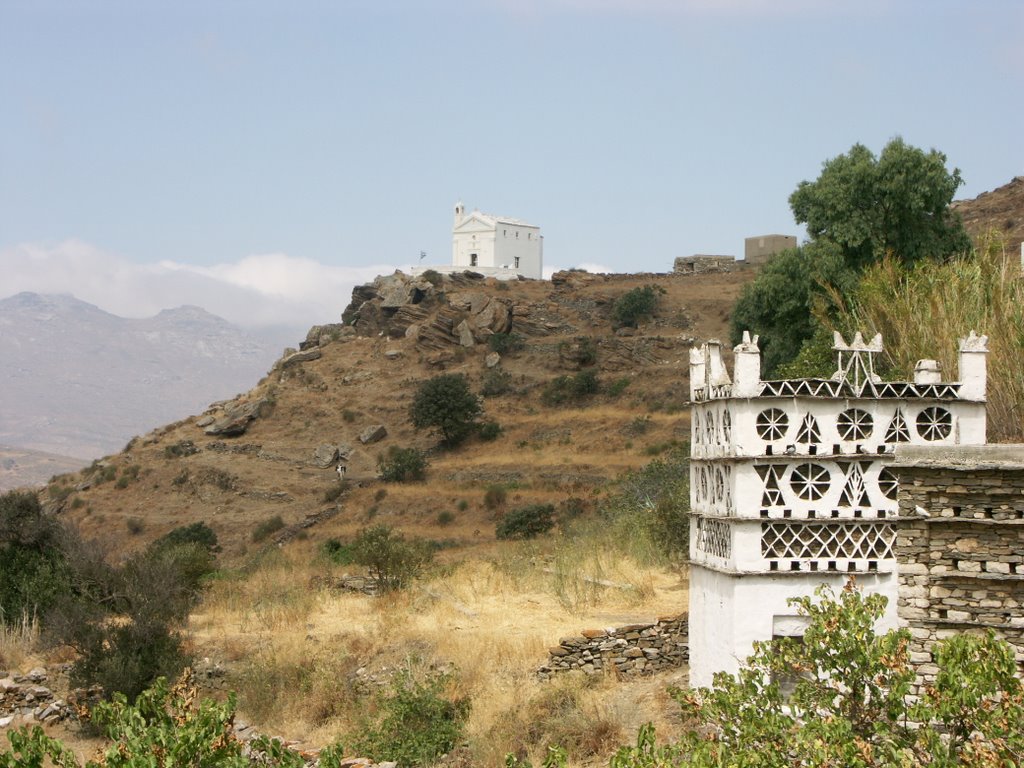
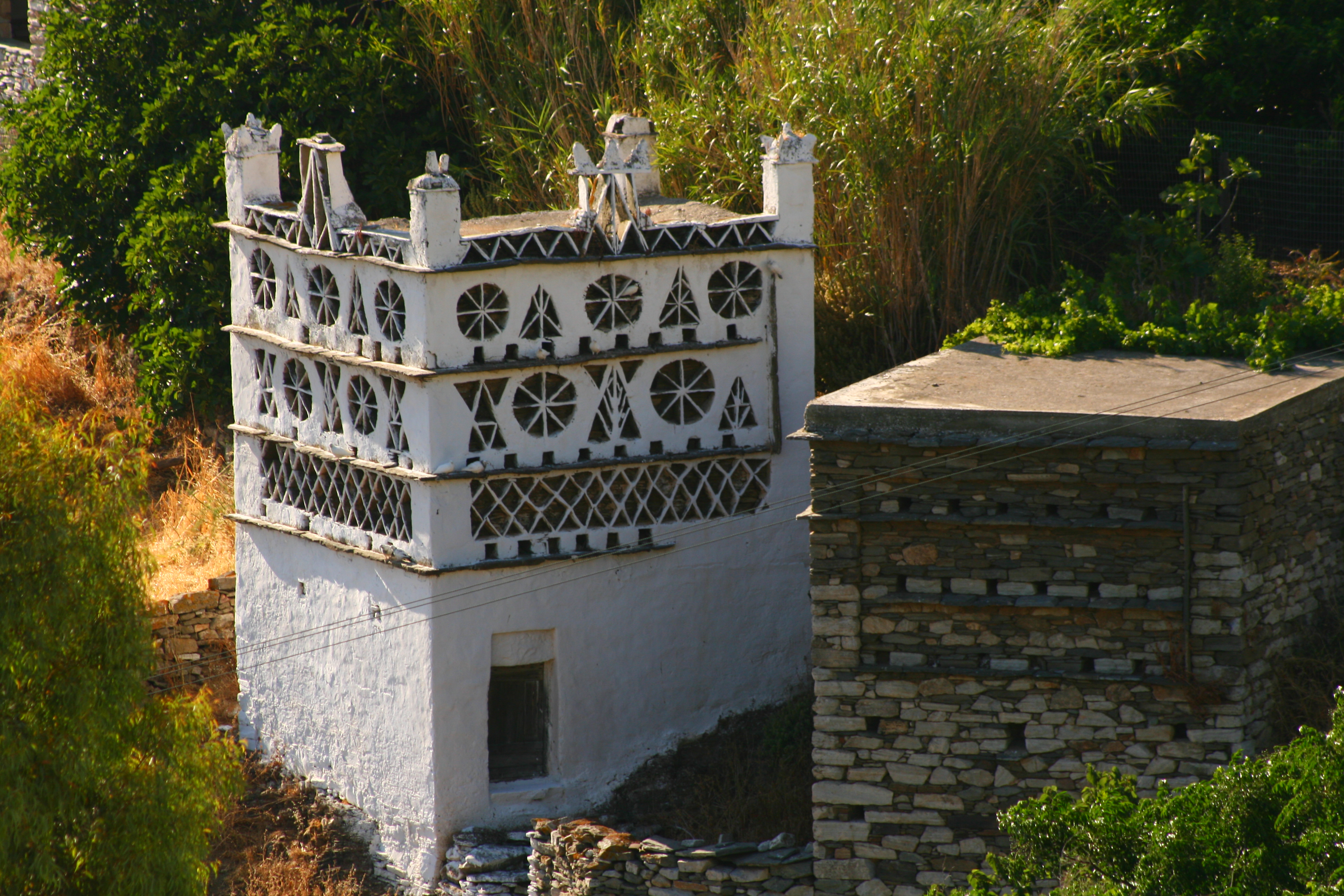
They are truly beautiful as you can see in these photographs below.  This dovecote used to belong to my husband’s grandfather.

Antonios' dovecote

IMG_7044

Dovecotes are not just decoration. During the 1900s, dovecotes significantly contributed to the family finances. They were kept in the family and passed on from generation to generation. My husband inherited a dovecote from his father, who had inherited it from his uncle. While very few people eat dove today, my husband remembers his grandmother serving dove, more specifically in soups made with the meat and carcass of the doves. Most importantly, the family also used the dove droppings as manure. The droppings were well known as high quality fertilizer.

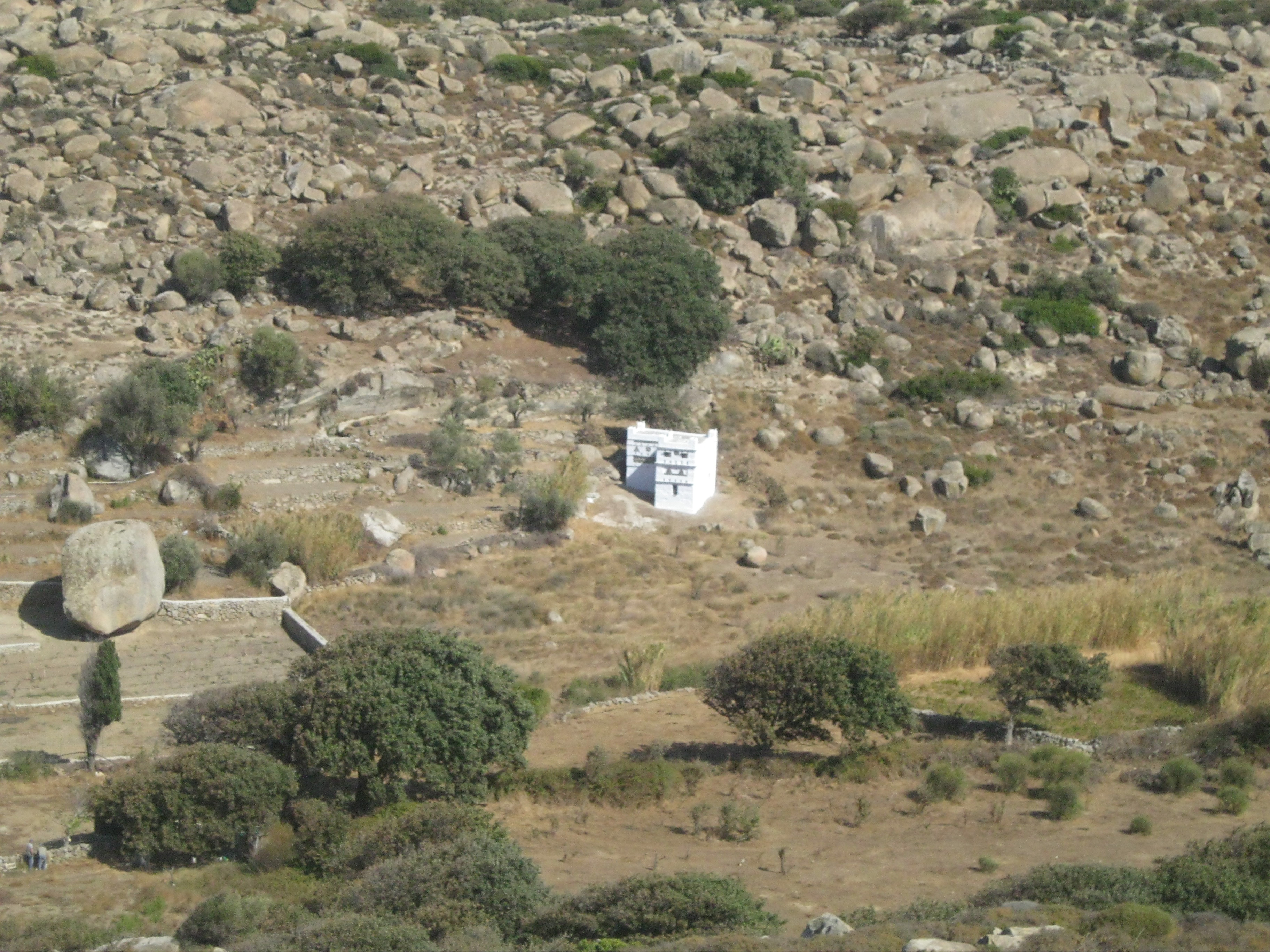
Here Is a picture of my husband’s dovecote, nestled in the valley.

IMG_4251

It was the Venetians who originally introduced breeding of doves to the island of Tinos when they conquered the island in 1204. They ruled the island for five centuries until 1715. During Venetian rule, dove breeding was only practised by the noble, or ruling classes. The noble families had ‘le droit des colombiers’ or the right to possess doves. These were concessions bestowed by the Doge of Venice.  In 1715, the Turks ruled the island, but did not inhabit it. The island was returned to Greece in 1821. 2

Most of the dovecotes were built during the 17th and 18th centuries. During this time, dove meat was not limited to local consumption. It was considered a delicacy and exported as far as Smyrna and Constantinople.

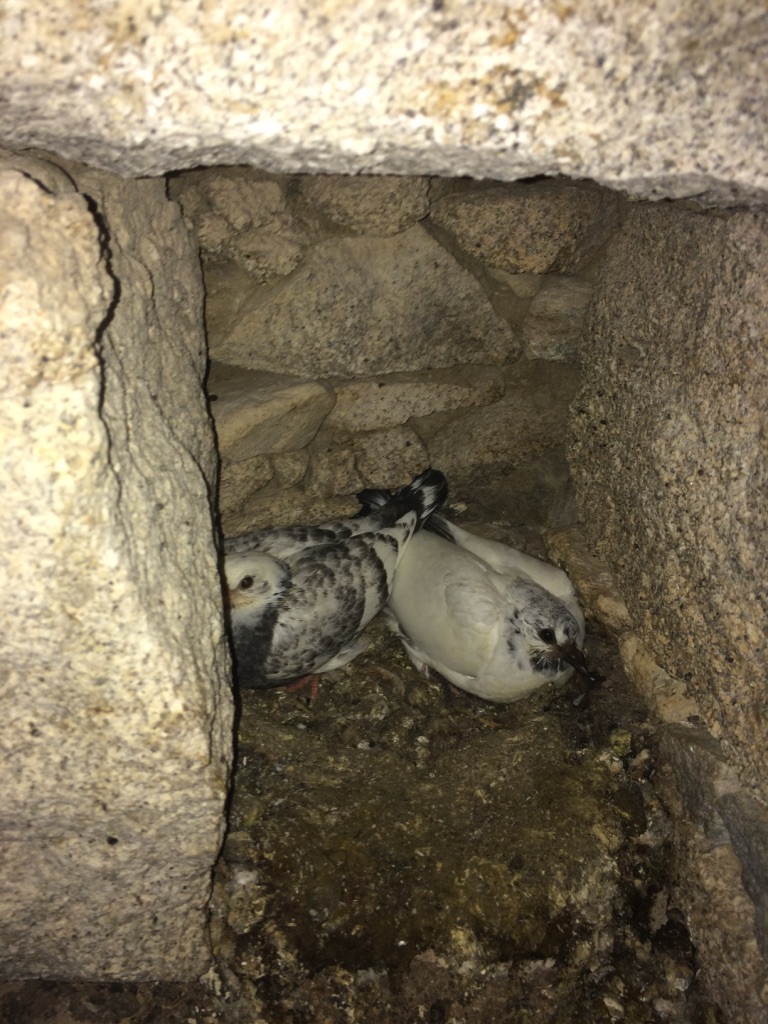
When the Venetians ceased to rule Tinos, concessions to practice dove breeding were no longer necessary. The inhabitants started to build their own dovecotes. They were built in areas conducive to breeding, such as rural areas near cultivated fields and where a water supply was available. 4 They were built on slopes that took into consideration the wind and would allow the doves to fly easily in and out of the dovecotes. The doves nest in the square holes built in a single or double row. Small stone slabs that protrude provide perches for the doves. 5

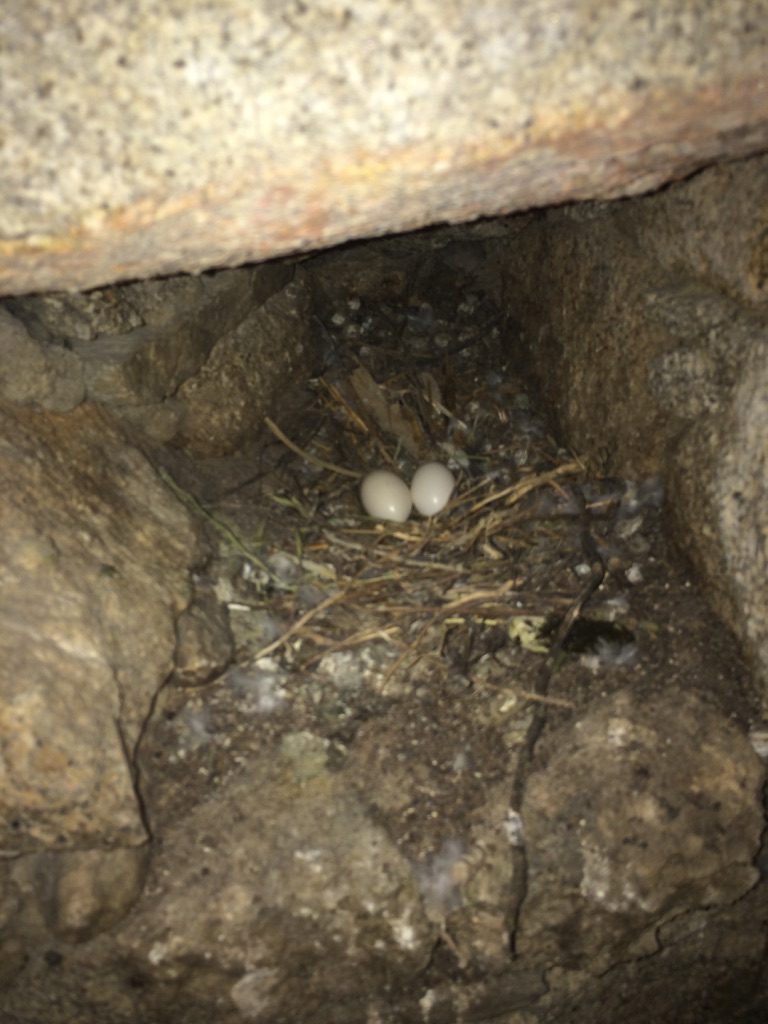
Here is a picture of some doves nesting and some eggs.

UNADJUSTEDNONRAW_thumb_57UNADJUSTEDNONRAW_thumb_54

Dovecotes are made out of slate clay and are whitewashed. They are two stories high. The doves live on the second floor and the first floor is used for storing tools and agricultural equipment. They are elaborately decorated with geometric patterns and non-geometric patterns such as cypress trees. It is believed that these patterns attract the doves. 6

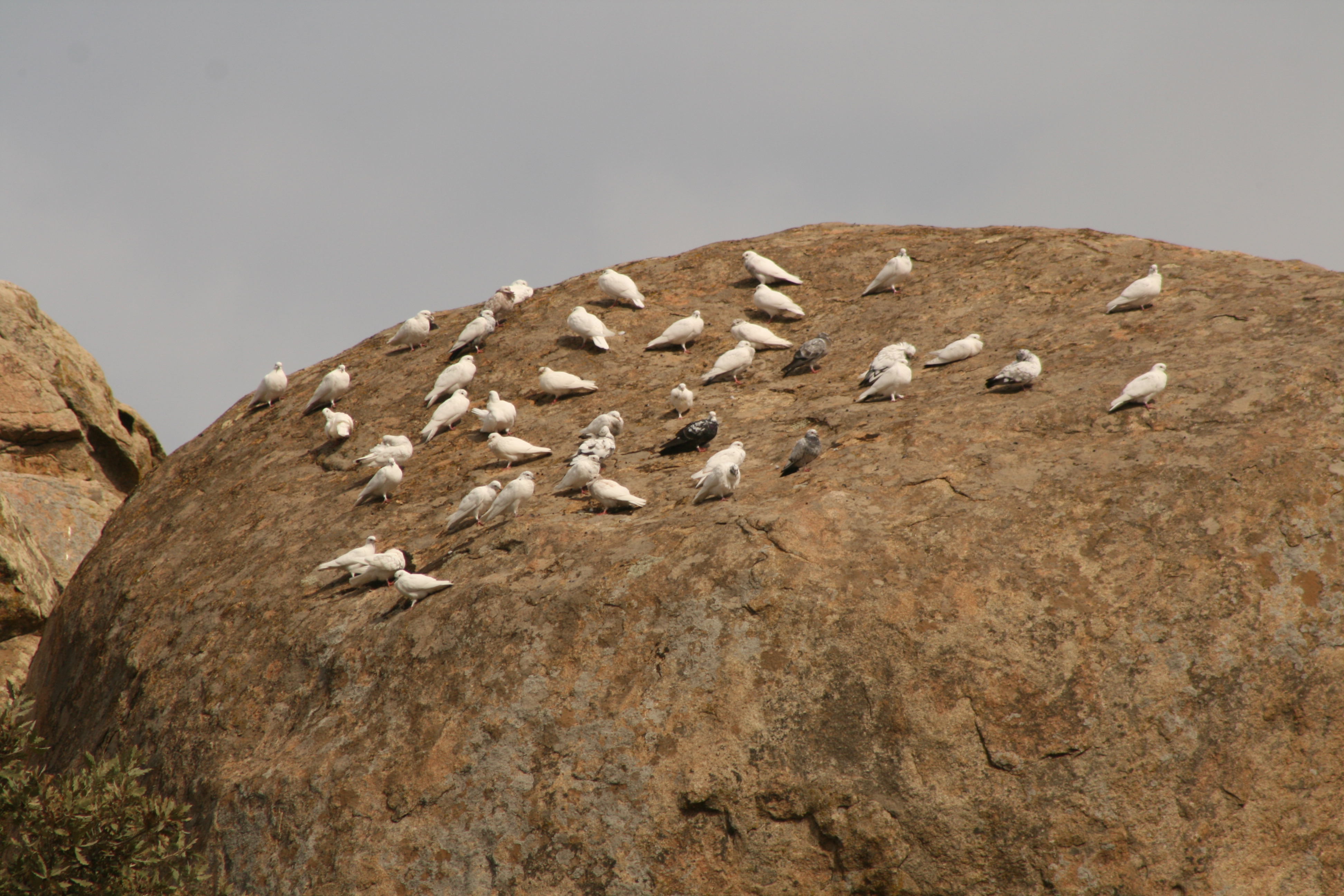
Here is a close up picture of my husband’s dovecote. These doves are fed and their only predators are snakes. There are about 30 doves living in this dovecote at any one time. We know approximately how many doves are living here by counting them in a picture.  There is great pleasure in continuing to breed doves, a practice that has lasted centuries.

DSC06981[1]

IMG_2679

1 https://tinos360.gr/paradosi_eng.html

2 Author not identified, PDF document entitled Dovecotes of Tinos in Archnet.org

3 https://tinos360.gr/paradosi_eng.html

4 http://www.greeka.com/cyclades/tinos/tinos-other/tinos-dovecotes.htm

5 https://tinos360.gr/paradosi_eng.html

6 http://www.greeka.com/cyclades/tinos/tinos-other/tinos-dovecotes.htm