Tag Archives: Halifax

REMEMBERING GREAT-GRAND-UNCLE

Arthur Symons, Private, 56th Battalion, Canadian Over-Seas Expeditionary Forces.
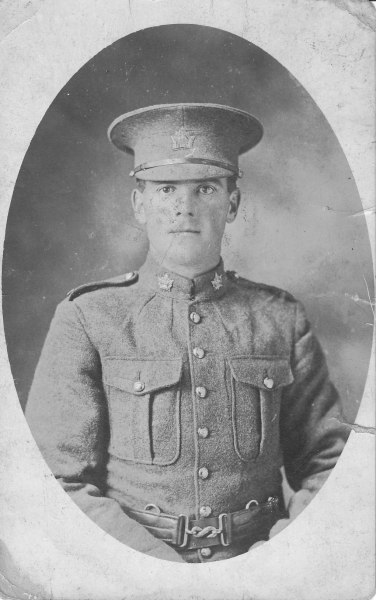
I once had a great-granduncle, Arthur. Until I started doing Genealogy, I had no idea there was such a title, but there it is, and I had one.

Of course, I never met him, but, as it is Remembrance Day I wanted him to be remembered.

My Granny’s mother, Lilian, had a family of five siblings, and Arthur was her younger brother. He was four years younger than her. Granny told me that Arthur immigrated to Canada in the early 1900s.

Despite many searches. I could find no information on his immigration. However, months after I started my research, I came across a border crossing Manifest from Canada to Sweetgrass, Montana.

It had all the information I had been searching for!

At this point, I was not sure he was even married, but the info on the border crossing gave me missing details and Arthur was beginning to become a real person.

The Manifest stated Arthur was 50 years old, accompanied by his wife, Catherine, son Alexander, and daughter Dorothy. It was dated the 18th of July, 1936. The family were visiting Yellowstone Park and Glacier Park. it gave Arthur’s address in Calgary, Alberta and his occupation as a Postal Porter. (1) It stated that he arrived in Canada at Halifax, Nova Scotia on the 19th of March, 1901 on the SS. Soman.

I haven’t yet found the passenger list for the SS Soman, but I keep looking.

When WWI broke out, he enlisted in the 56th Battalion Canadian Over-Seas Expeditionary Forces on May 3, 1915, in Calgary, Alberta. He was shipped back to the UK for training. While ‘back home’, he visited his sister Lilian – my great-grandmother – and had these photos taken with his sister and my Granny, Edith Bevan O’Bray.
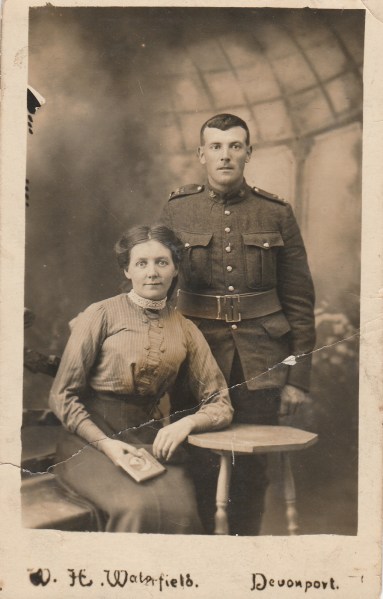
Arthur Symons with his sister Lilian Symons Bevan. C. 1914-18
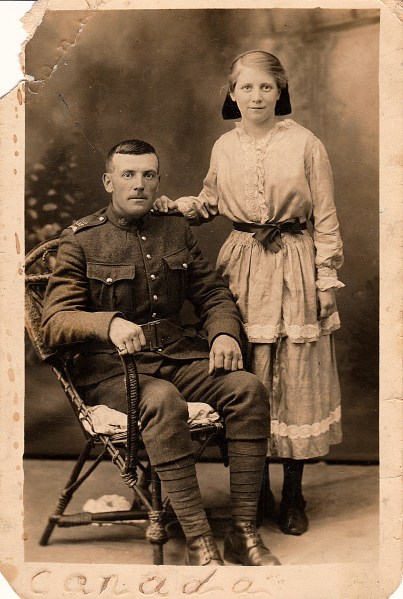
Arthur Symons with my Granny, Edith Bevan C. 1914-18.

Arthur Symons was born in Leicester, Leicestershire, England, in 1886. His siblings were Lilian Mary Symons—my great-grandmother; Thomas, who died in infancy; Arthur, Olive, and Ada, who was my Gran’s favourite Aunt, and only two years older than her.

Aunt Ada was also my Godmother. Together, they joined the WRNS (Women’s Royal Naval Service) in 1918 (2)

Great-grand-uncle Arthur fought at the Battle of Passchendaele and was severely wounded in the right leg, right hand and left foot. He was transferred to the Granville Special Hospital, located in Ramsgate, Kent, England. An orthopaedic facility to treat soldiers with damaged limbs. Later because of air raids on the Kent coast, the hospital was moved to Buxton. He was medically discharged on 28th August 1919.

In part Two, I will explore his stay in the Granville Special Hospital for Canadian troops. The first line of his medical records, dated November 29, 1917, stated he was “Dangerously ill.”

(1) Canadian Postal Porter – Porter – Worker having manual handling duties, typically at a large sorting office or railway station in London. Tasks included the loading, unloading, segregation and transfer of mailbags or other containers. Porters were also employed at some other locations, such as the PO Savings Bank.

(2) Granny and her Aunt in the Women’s Royal Naval Service.
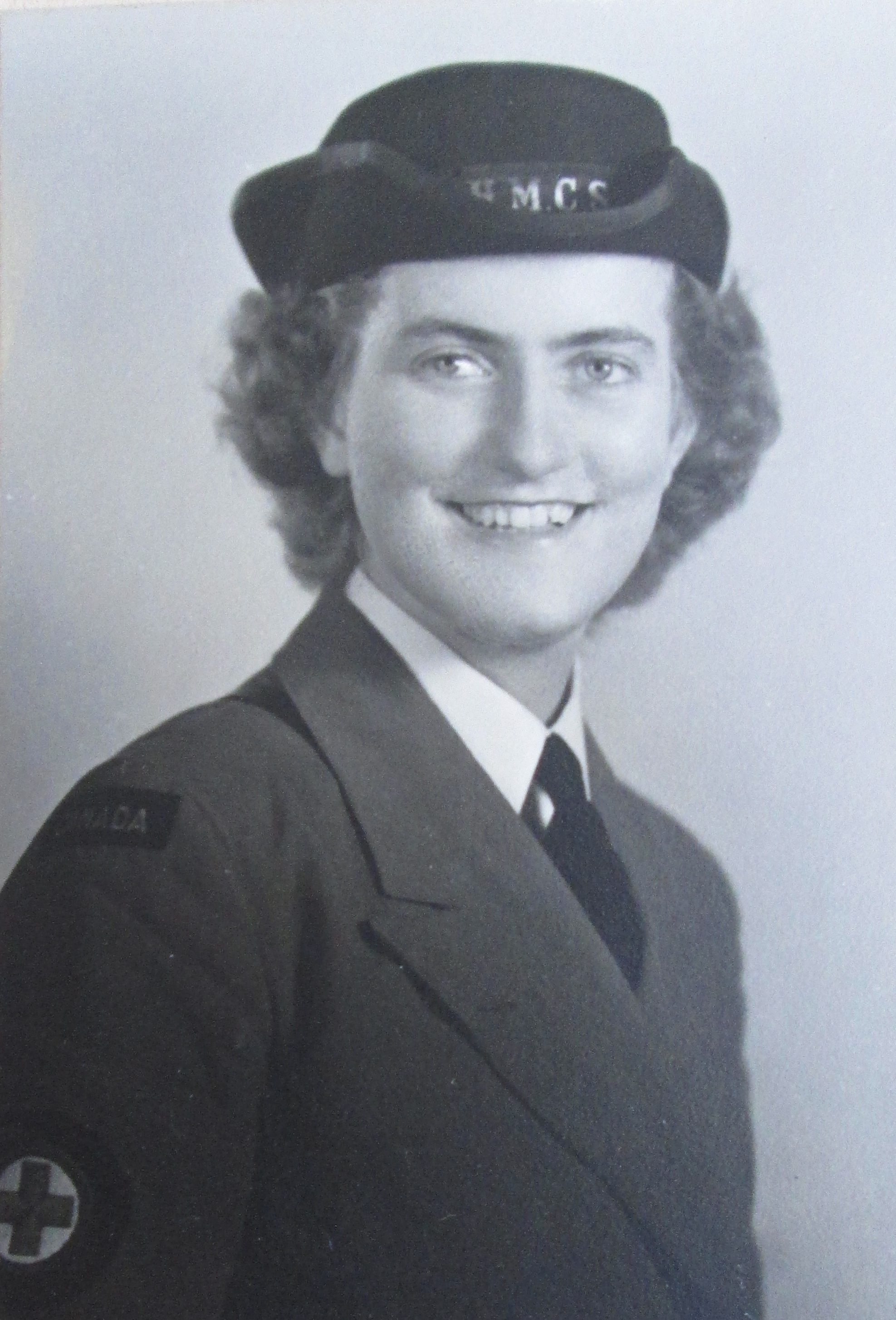
A Wren’s Story: Dorothy Isabel Raguin

IMG_9015

Dorothy Raguin my mother, joined the Women’s Royal Canadian Naval Service (WRCNS) known as the Wrens in April 1943. She left a job teaching grade three at Berthelet School in Montreal to help in the war effort and to look after her brothers, Robert and Arthur Raguin, both serving in the Navy.

She had graduated from The High School of Montreal Girls School in 1939 and then attended MacDonald College for teacher’s training and began her teaching career.

War was declared in September 1939, but it wasn’t until three years later that the Women’s Royal Canadian Naval Service was formed. Dorothy was one of over 6000 women who joined the navy, allowing the shore-based men to go to sea. The navy was the last of the forces to admit women. The first recruits were cooks, clerks and laundry maids but by the end of the war, women filled 39 trades including communication operators, signalman, coders and radar plotters. Their pay was also raised from two-thirds of a man’s to eighty percent. The Navy found women were useful.

The Wrens were inundated with applications even though the Army and Airforce had been recruiting women for two years. These women wanted to join the Navy. As the smallest of women’s services, it claimed to be the most selective. The Wrens were known to have recruited a “better type” of girl. They were ladies, not sailors and kept their hats on indoors.

There was a short three-week course at the WRCNS training centre HMCS Conestoga, in Galt Ontario. This facility which had been a girls reform school was referred to as a “stone frigate.” The women put on the Wren uniform and had a rapid transition into military life. They were given physical training, drill practice and learned about naval traditions and customs.“ They all seemed anxious to serve and do something constructive to help win the war. I found them very receptive to naval tradition and amenable to discipline, said Superintendent Carpenter. ”¹

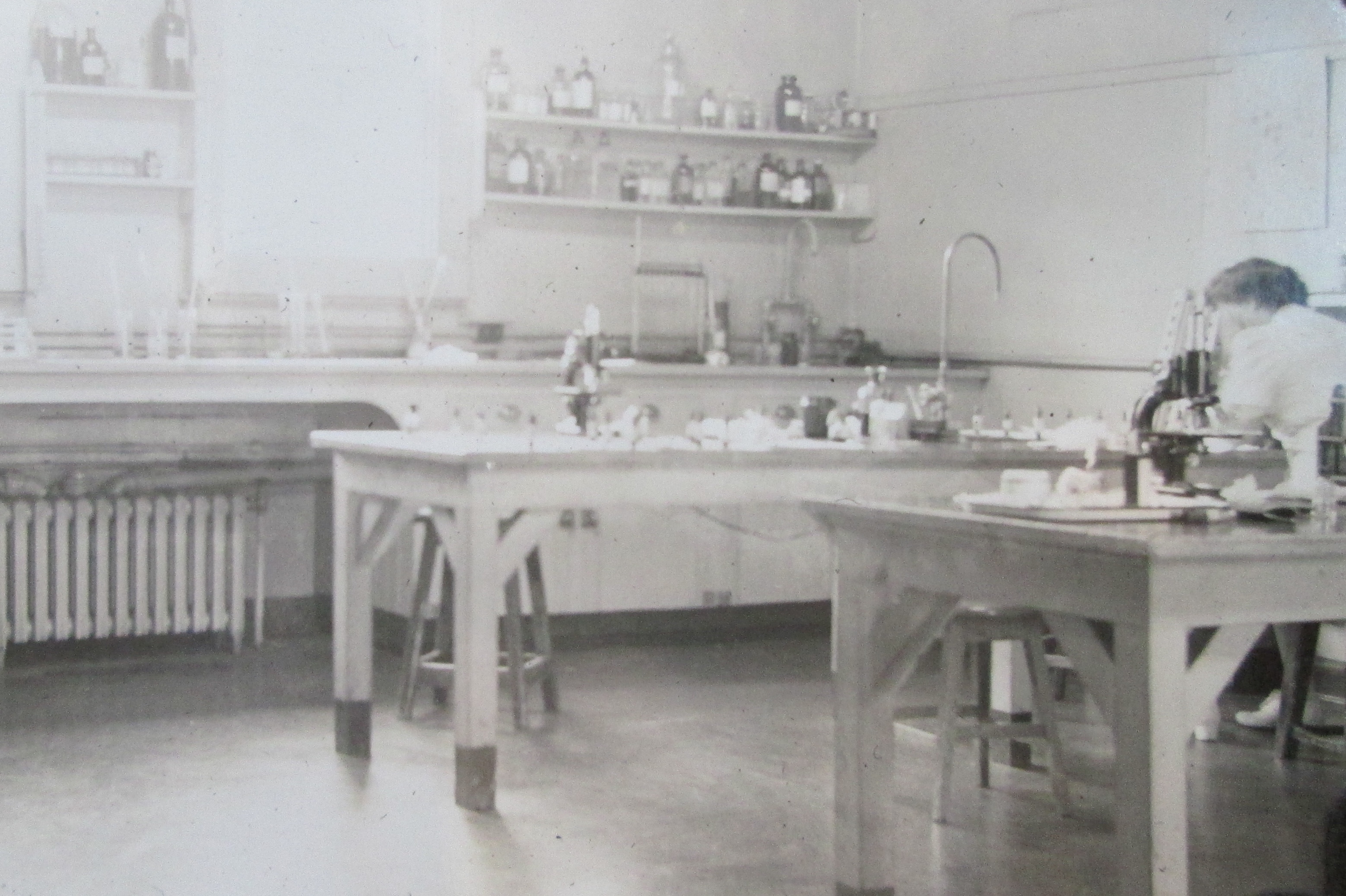
Dorothy was drafted to HMCS Cornwallis September 1943. Mom’s first posting was to a hospital base, Stadacona in Halifax, Nova Scotia. A family friend, Miss Fellows was in charge of the women and had two sick berth attendant positions available. These were prime positions working in the laboratories. One was in haematology and the other in urinalysis. Mom chose blood and a friend got the other position.


IMG_8721
Lab in Halifax 1944


It wasn’t all work, marching and standing in lines. In their free time, they visited the scenic places around Halifax including Peggy’s Cove and Chester NS. There were always men coming and going from the ships and the Wrens used to take some of the patients rowing on the Arm. As innocent women, they were warned to be careful walking on Gottingen Street which had buildings right to the sidewalk, as they could be grabbed from the doorways! Dorothy celebrated her 21st birthday in the Navy with a lobster dinner at the Lord Nelson Hotel, a treat by her cousin Richard Scrivner who was then a Navy Commander. It was her first lobster and she never had another. There was also trip with other Wrens to New York City. They didn’t have to pay for their hotel and received meals for free as a thank you for their service.

IMG_8727
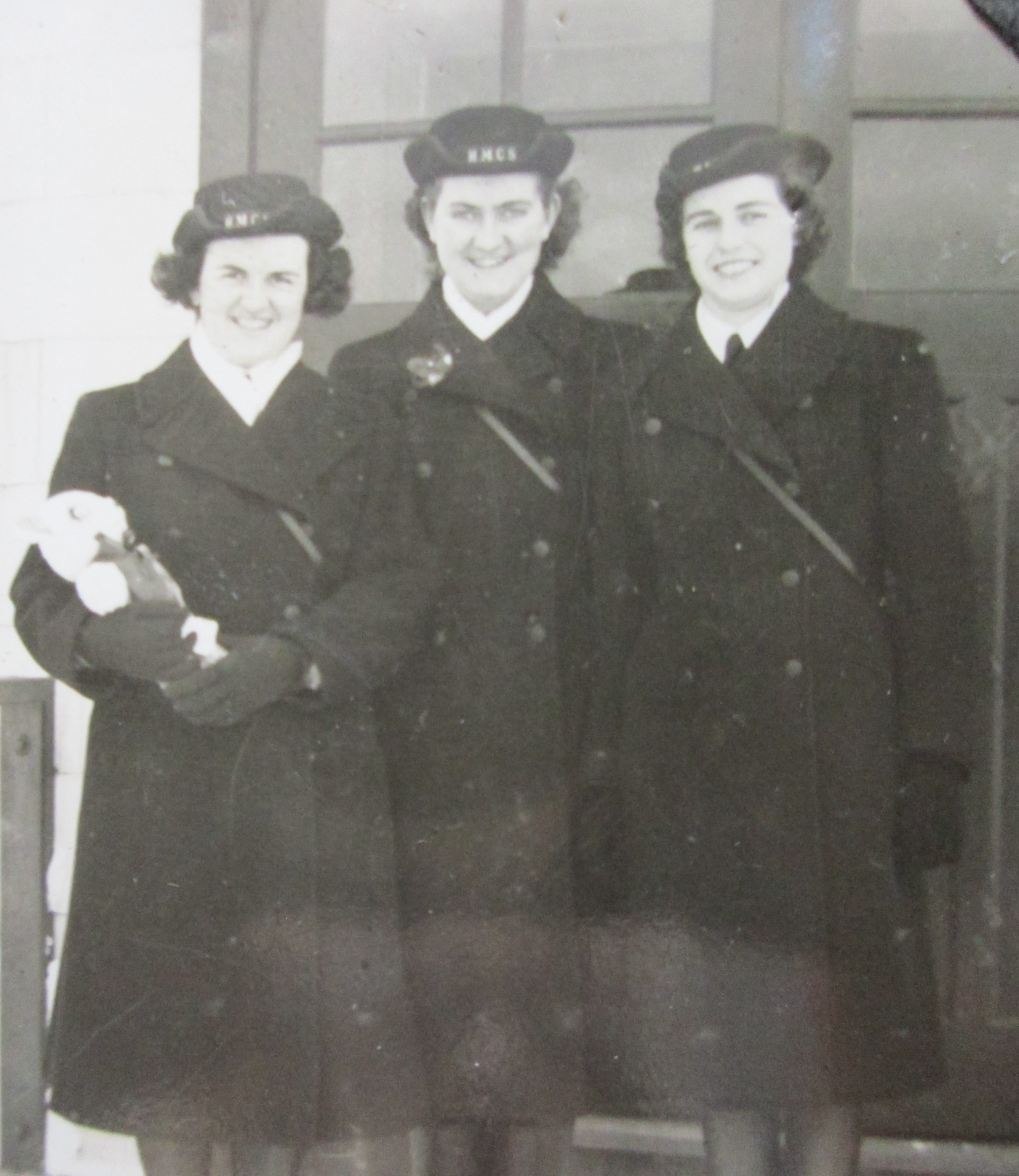
Doreen, Dorothy, Gwen

One of her teaching friends Mary Hawkins wrote in May 1943 from Halifax. “Dorothy Raguin and I met at the ANA (Army, Navy, Airforce) Club yesterday. She looks fit and is getting a kick out of the Wrens. She was in the School for Teachers the year before I was and was teaching at Berthelet. She left a month after I did – to join the Navy. I asked her if the Wrens get their tot of rum and she said, No, but apart from that everything is just the way Nelson left it. I know what she meant.”²

She finished her duty doing discharge physicals at the Royal Canadian Naval Hospital (RCNH) St Hyacinthe, Quebec. Her transfer was mentioned in the Tiddley Times, the Wrens newsletter. “Our hospital staff have been lucky in the acquisition of Dorothy Raguin, Aileen Fee and P.O. Anne Hawke, all lab. technicians with first-hand experience from Halifax.”³ The WRCNS disbanded in August of 1946 as women were not needed in peacetime.

Dorothy saw her brothers only once while she was in the Navy. She arranged dates for them when their ship came into Halifax. Happily, they managed to survive without her care and returned home safely.

IMG_8784
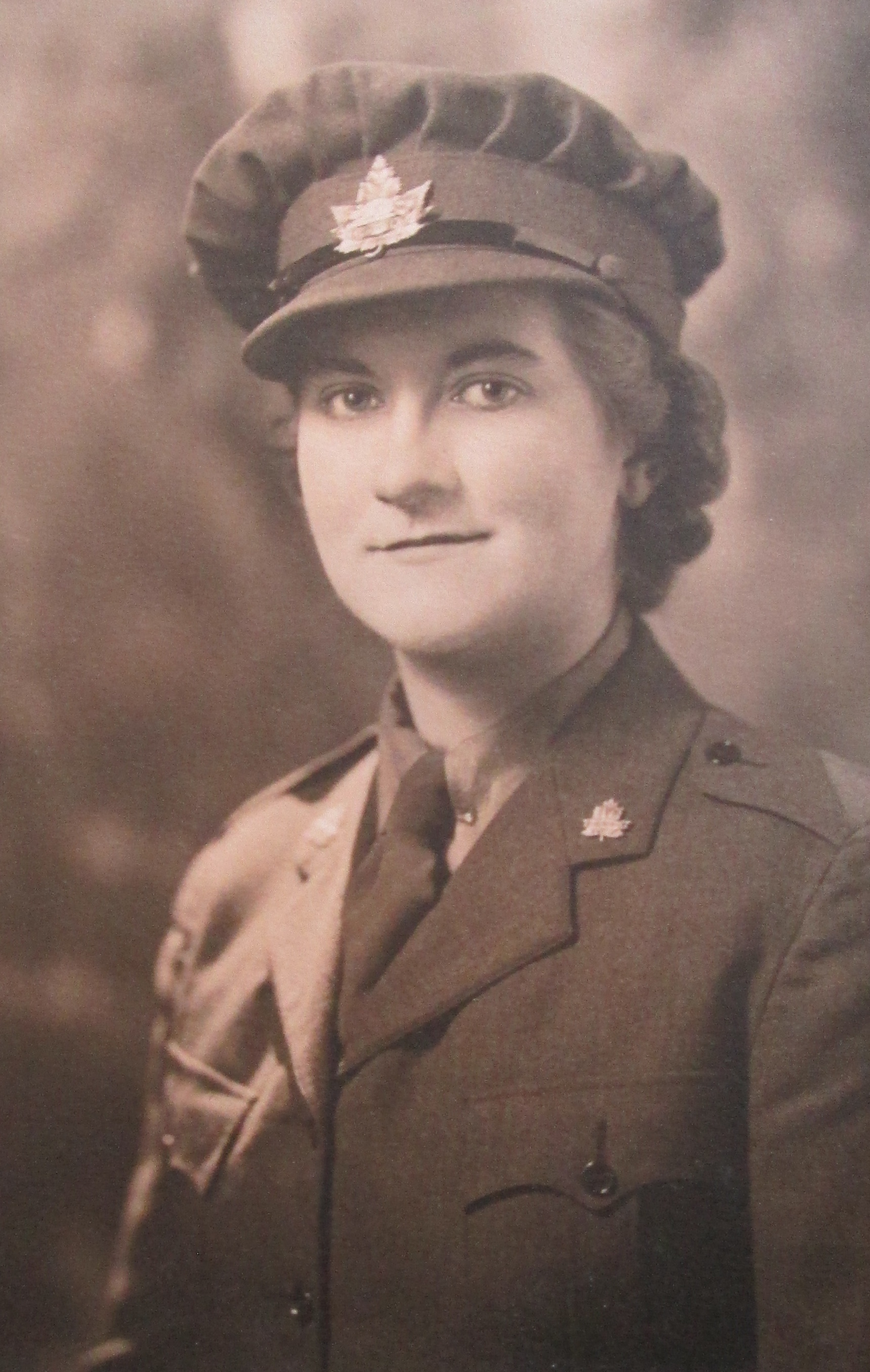
Dorothy Raguin in the Women’s Volunteer Reserve Corps before 1943.


My mother Dorothy Raguin Sutherland, died recently, at 95. She was proud of her service in the Navy and so to honour her and her service to Canada I am posting this story.

Notes:

  1. Superintendent Carpenter on Navy Radio, Recorded10 June 1943 for broadcast 14 and 16 June on CBC. Library and Archives Canada: MG30 E 391 Volume 1.
  1. Buch, Mary Hawkins., and Carolyn Gossage. Props on Her Sleeve: The Wartime Letters of a Canadian Airwoman. Toronto: Dundurn, 1997. Print.
  1. Tiddly Times May – June 1945 Wrens Newsletter page 26.
  1. Huba, Diane., The Wrens 70th Anniversary 2012. Starshell Volume VII No. 58, Spring 2012.
  1. Dorothy Raguin Sutherland reminiscences as told to the author.
  1. www.navaireview.ca/wp-content/uploads/public/vol3num3/vol3num3art5.pdf
  1. www.thecanadianencyclopedia.ca/en/article/wmens-royal-canadian-naval-service/
  2. In the third picture, Dorothy Raguin is not wearing a Wren’s uniform but rather the Women’s Volunteer Reserve Corp (W.V.R.C.) uniform. The main goal of this organization was to fundraise for the war efforts and train women in war-related tasks.

Here is a link to my father Donald Sutherland’s war years.

https://wordpress.com/post/genealogyensemble.com/4615