That was the first question that ran through my mind as I began to try to verify what seems to be indicated by a wedding photo of Jean-Baptiste Hurtubise and Marie-Berthe Charette from my grandmother.
My grandmother’s handwriting below the picture indicates: “Mom & Dad Hurtubise, January 7, 1915.”
Census records from 1901 indicate that they were both 25 years old at the time,[1] another fact I wonder about.
Why would a young man of that age be free to marry and settle down when World War I was in full force? Perhaps this is an indicator of how remote the war seemed to Francophone families in Canada prior to the conscription crisis of 1917.
By that time my great-grandfather would have two children and wouldn’t be required to serve. My grandmother, their first child, was born twelve months after they married.
In addition to her parents’ wedding photo, my grandmother kept only two other pictures. One is a photo of a church, presumably where the wedding took place. The other shows four large church bells. Why are they important?
Turns out that the church in the photo still exists, and it still serves a Franco-Ontarian population! I found it by referring to the census showing Marie-Berthe, called Martha, living in Clarence Creek in 1911.
According to Kim Kujawski, Clarence Creek, which is near Ottawa in Ontario, was founded in 1853 by French Canadian farmers from St. Augusine Quebec.
At the time of Jean and Martha’s marriage, it had two steeples, but now the smaller steeple on the right side is missing. I know the church is the same one, however, because a duplicate of my grandmother’s photo appears on the history page of the parish website. [2]
I’m extrapolating from the facts, but it seems as though Martha’s family were among 170 that remained within the parish after 80 others left in 1908. The bells were part of a renewal show of strength two years later. The families expanded their church, bought the bells and hired famed Montreal decorator Toussaint-Xénophon Renaud[3] to renew the interior. His work can still be seen today.
Sources:
[1] Data from the 1911 Census of Canada: her birthdate appears on Enumeration District 21, Cumberland Township, Russell, Ontario, Sarsfield Village, Léonard Village, Bear Brook Village, page 7, line 48; his on Enumeration District 112, Cumberland Township, Russell, Ontario, Sarsfield Village, Léonard Village, Bear Brook Village, page 3, line 25
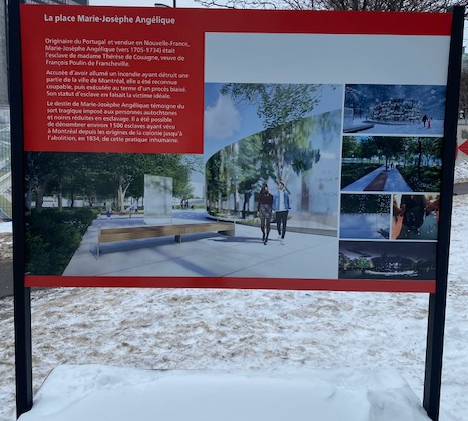
Since this story was originally published, the City of Montreal has added a poster next to Metro Champs de Mars to make it clear that Marie-Josèphe Angélique’s park will be within the Place de Montrealais!
Thanks to Annie for letting me know, and thanks for everyone who made sure that her story is not forgotten!
Original Story
For an hour on the first cold day of the year last month, I wandered around City Hall looking for the memorial park named after an enslaved woman whose torture led to her conviction for arson in 1734. She was then ridiculed, hanged, and her body was burned to ashes and thrown to the wind.
I couldn’t find it.
I’m not sure what happened from the time the park was created in 2012 to today, thirteen-and-a-half years later, but the one-time park still appears on Google Maps. In person, I couldn’t find anything to indicate where it might be.
According to various articles on the web, a green space just west of Champs de Mars métro station honours Marie-Josèphe Angélique’s memory. The official inauguration of the park took place on Aug. 23, International Day for the Remembrance of the Slave Trade and its Abolition, 2012.
As I walked through the area last month, the one-time park seemed to be encompassed in a massive construction site underway for Place des Montréalais, a new public space being created next to the Champ des Mars metro on Viger Street. The posters on site explaining the current project included nothing about Marie-Josèphe Angélique.
Despite being honoured with an award-winning film, a bronze plaque, lilies and a presentation by Governor General Michaelle Jean in 2006, and a public park created by the city of Montreal in 2012, she’s disappeared again.
Before this experience, I was already struggling to see Angélique as the symbol of freedom and resistance she serves for many, but I don’t want her to be forgotten. Did she set the fire or was she a convenient scapegoat? If she didn’t, who did? As I began exploring her story last month as part of a project for NANOWRIMO (the National Novel Writing Month), she served as a reminder of the kind of unnecessary suffering a biased political, policing and justice system can create. Despite the fact that she was a victim of slavery, hatred, spite, racism, class bullying and the worst that a mob could throw at her, her spirit remained strong and unrelenting.
Angélique proclaimed her innocence until the day she was tortured, throughout the court case, and through questioning. Despite that, three weeks after the fire, she was hanged, ridiculed publicly, then burned with her ashes tossed into the wind. Clearly, the authorities at the time wanted her punishment to be seen and remembered.
I read the details about Marie-Josèphe Angélique’s case on Torture and the Truth, a fabulous website set up in 2006 by multiple people, including one of my genealogical mentors, Denyse Beaugrand-Champagne and one of my historian mentors, Dorothy W. Williams. Both of these women have researched, written, spoken and taught many people about the history of Montreal and why studying it is so important.1
The site is one of thirteen different “historical cold cases” established for classrooms across Canada. It was created through the work of six writers, a photographer, an artist, and two translators collaborating with six funding agencies, seven production partners, and 15 archive and museum partners.
It is one of the best historical websites I’ve ever read. If you do nothing other than read through this site, you will get a good overview of the community, the victim arsonist, and life in early Montreal.
As I read about Angélique’s story, she sounded like just the kind of person anyone would like to get rid of. She was a woman who told people she would burn them alive in their homes. She said so to her owner for refusing to grant her freedom, to other slaves for making her work harder than she wanted and to others too. To anyone who slighted her, she threatened the worst thing she could think of. She would burn their homes down.
When 45 houses in her small community did in fact burn down, people blamed her. In retrospect, it may have been an accidental kitchen fire that caused the flames, but her words came back to haunt them all.
The fire began at 7 p.m. on a Saturday evening in spring, April 10, 1734. In only three hours, it destroyed 45 homes and businesses on Rue Saint Paul. Even the Hôtel-Dieu hospital and convent, where people initially took shelter, burned to the ground. Hundreds of people were left in the cold; supplies from many merchants burned, never to be seen again.
Plus, who knows how many caches of fur got wiped out. At that time, Montreal was the centre of the fur trade, more than half of which was illegal trading with the Dutch and English communities in Albany, Boston and other communities to the south. According to a 1942 thesis by Alice Jean Elizabeth Lunn, furs were stored in the backs of shops and even buried just beyond the Montreal wall, which was still under construction at that time, in order to be shipped without being seen by New France authorities. A lot of money went up in smoke that day.2
Everyone in Montreal knew about the fire, given that all the church bells throughout the city began ringing when it started and continued until it was over and people were safe again. Although stone buildings existed at the time, most of the buildings were made of wood; fire could destroy them all.
I had ancestors who lived in Montreal then, the Hurtubise clan on my father’s mothers side. One of them, Jean Hurtubise, the grandson of Étiennette Alton and Marin Hurtubese, was thirty-nine years old, ten years older than Angélique when the fire took place. He and his wife Marie-Jeanne (Marie-Anne ou Marianne) Tessereau had been married for seven years in 1734.
Jean was born in Ville Marie and lived in Montreal for his entire lifetime, so he and his family would have experienced the fire, at least from a distance. They certainly would have seen the ordinance compelling witnesses to appear, given that “it was posted and cried out everywhere in the city and its suburbs.”
Jean and his family farmed a 3×20 arpent property they bought three years earlier from Raphael Beauvais and Elisabeth Turpin on Rue Côte Saint-Antoine.”3 The property was in a part of Montreal that was considered the countryside at that time. Their home was then one of four wood houses on Côte Saint-Antoine in 1731.4
Given that the area was still very rural, and on a major hill, I can’t help but wonder. Did they see the smoke rising into the sky as the hospitals and 45 other buildings in Ville Marie were destroyed?
They certainly had strong links to Ville Marie, particularly the hospital. His grandmother, Etionnette Alton, had died there in her 84th year twelve years earlier. They couldn’t have helped wondering what would happen to others like her, being treated in the hospital that the fire destroyed. Were they among the crowd clamouring for revenge? Did they go to Ville Marie to see Angelique hanged? Did they watch her corpse burning? Did they see her ashes spread into the wind? Did they care at all?
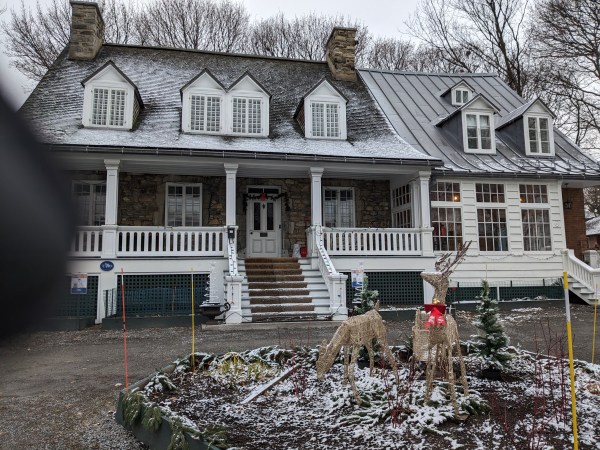
I can’t help but imagine that the controversial hanging effected all 2000 people who lived on the island that year. Five years after Angélique’s death, Jean built Hurtubise House, a storey-and-a-half fieldstone structure on land originally rented by his father in 1699 on Mount Royal. The family built the gabled home out of stone to protect themselves from fire, as required by a law passed the summer after Angelique’s death. You can still visit the home today.5
Sources
1 Beaugrand-Champagne, Denyse, Léon Robichaud, Dorothy W. Williams, Marquise Lepage, and Monique Dauphin, “Torture and Truth: Angélique and the Burning of Montreal,” the Great Unsolved Mysteries in Canadian History Project, 2006, https://www.canadianmysteries.ca/sites/angelique/accueil/indexen.html.
3 Roy, Pierre-Georges,, Inventaire des greffes des notaires du Régime français, Québec, R. Lefebvre, Éditeur officiel du Québec, 1942, 28 vol. ; 25-27 cm, Collections de BAnQ.
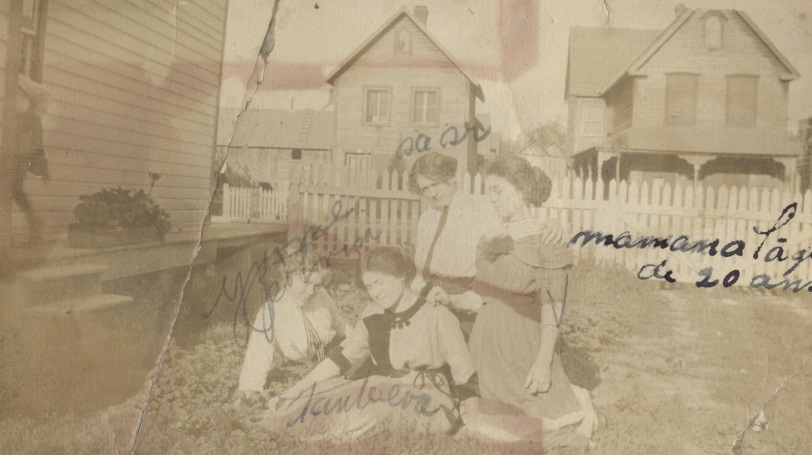
When my aunt turned ninety-six a few years ago, I prepared a short bio of her life, including photos of the farm where she grew up, baptism`s, confirmations and a wonderful photo of four people working in a farm yard.
Handwriting on the photo says “maman a l’age de 20 ans” and “papa” to identify my great grandmother, Marie-Berthe Charette and my great grandfather, with her two sisters “tante Eva” and “tante Ida.”
They are all on their knees, looking at the photographer. Jean is staring towards Marie-Berthe, who was also called Martha, with an extremely happy look on his face.
The shot is the only happy photo I have of the couple. In every other shot, they look solemn or downright miserable.
Martha was born on October 3, 1889, so if the note about her age is correct, the photo would have have been taken in 1909 or 1910, five years prior to their marriage. There’s no indication where the photo was taken. It could have been his parents’ farm, her parents’ farm, or given that they are also in the shot, perhaps even the farm where his brother Gustave and her sister Ida moved after they were married.[1]
Both Charette farms were in Clarence Creek, where their families had lived since at least 1891. His family farm was located in Sarsfield, a town right next door near the current Ottawa, Ontario.
The first Hurtubese/Charette couple was already married by the time of the happy photo in my grandmother’s photo album. Later, it would be Jean-Baptiste and Martha’s turn, then his younger brother Francois and her younger sister Dora.
All three couples would eventually follow middle Charette son Ernest, who began farming in Alberta.
My cousin says his mother used to talk about a horse and buggy ride after their family lost a farm due to a train expropriation. My aunt spoke to him about remembering her mom’s tears. I don’t know whether that trip precipitated their move to Alberta or took place afterwards.
All I know for sure is that after this photo was taken, the couple had two little girls, Donna and Marguerite. Then, sometime after their second daughters’ birth in 1917 and the 1921 Canadian Census, they bought a farm with a three-bedroom wooden house on it in Bow River, Alberta.[2]
After that, their life took a turn for the worse, and they lost everything. The dust bowl, the Depression, locusts…take your pick, they saw it all.
By 1941, the family was renting part of a house in Edmonton. He did odd jobs to get through the war years and beyond. They remained in Edmonton until her death in 1957 and his in 1959.
————————-
[1] Data from the 1911 Census of Canada, Enumeration District 21, Cumberland Township, Russell, Ontario, Sarsfield Village, Léonard Village, Bear Brook Village, page 7, line 48.
[2] Data from the 1921 Census of Canada, Enumeration District 2, Bow River, Alberta, section 7, township 22, range 21, Meridian 4, page 6, line 28.



 Genealogy Ensemble
