
Tag Archives: Jack Day

The Fuller Brush Salesman

The advertisement in the February 24, 1928 edition of the Montreal Star called for three reliable men to apply for a special sales campaign for the Fuller Brush Company.

My dad, Edward McHugh, probably answered an advertisement similar to this one when he finished school in the late 1920s. He worked as a Fuller Brush salesman for two years in Montreal. Alfred Fuller founded the Fuller Brush Company in 1906. The company produced good quality brushes and increased its sales force by advertising for salesmen. But the secret of its selling success was that each salesman (they preferred men in those days) had to sign a pledge in which they promised that “I will be courteous; I will be kind; I will be sincere; I will be helpful.”1

The salesmen left cards like this one when no one was home:
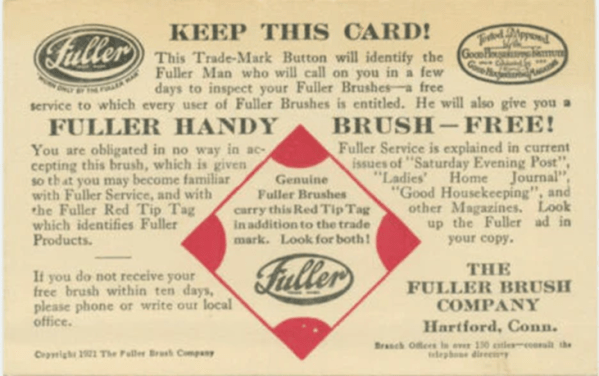
Image courtesy of the Fuller Brush Co., https://fuller.com/pages/fuller-brush-history, accessed March 13, 2024
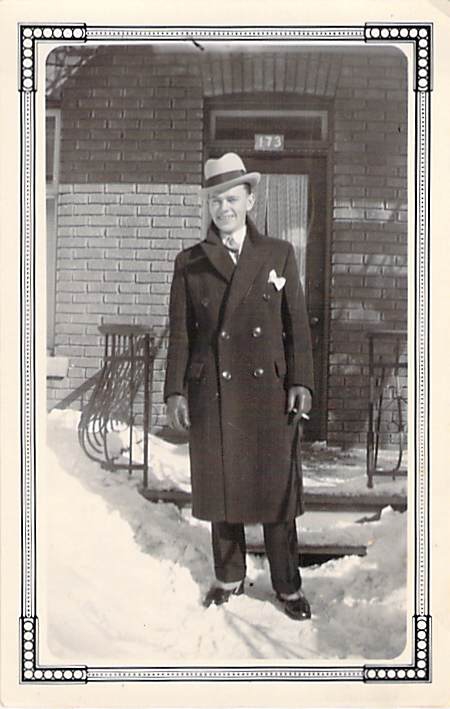
Edward McHugh

As you can see in the above picture, my dad was a snazzy dresser. Knowing him, he probably took a lot of care with his appearance when he was out selling brushes. I remember him polishing his shoes every morning before going to work.

I assume that he succeeded fairly well at selling Fuller Brushes.2 But he must have been restless and in search of adventure because he left Montreal after just two years of selling brushes. Just travelling to Bermuda would have been quite an adventure in itself. He would have started his trip by going to New York City by train where he would then take an ocean liner. The Furness Bermuda Line and operated regular passenger and mail service between New York and Hamilton, Bermuda at the time.3

Edward must have encountered some challenges selling Fuller Brushes in Bermuda as he ended up working as a bell hop in a hotel that catered to rich patrons from the U.S. and Canada. The tips he earned helped him pay for business college when he returned home to Montreal.4

The Princess Hotel, Hamilton, Bermuda5

By the time Dad completed his business and accounting courses, Canada was in the Great Depression. He again got itchy feet again and moved to Drummondville, Quebec with his older brother, Thomas McHugh, his sister, Sarah Jane McHugh, and her husband, Jack Day. In Drummondville, he did not work as a Fuller Brush salesman, a bell hop, or in business or accounting. He apprenticed as an electrician at the Celanese and worked there for eight years until 1940, when he enrolled in the Royal Canadian Air Force as an aircraft mechanic at the outset of World War II. The RCAF trained my dad in aircraft hydraulics and he was assigned to Bomber Command stationed in Yorkshire, England, for the remainder of the war.6

It is no surprise that Dad did not become an aircraft mechanic after the war. He loved being an electrician and his started his own electrical company, Provincial Engineering. He eventually sold his portion of the business. I remember him saying, “the boss always gets paid last.” After that, he joined a firm and worked in a supervisory capacity on the electrification of towns in regional Quebec such as Sept-Iles and Chibougamau.

Dad was curious and loved trying new things. He never backed down from a challenge.

When my dad retired, he and my mom travelled to Bermuda regularly for their winter getaways. He must have enjoyed going back and perhaps even having a meal or two at the hotel he worked at when he was a young bell hop.

  1. Fuller Brush Company website, History of the Fuller Brush Company, https://fuller.com/pages/fuller-brush-history, accessed 20 February 2024
  2. Library and Archives Canada, Military records, Edward McHugh
  3. Wikipedia, Furness – Bermuda Line, https://en.wikipedia.org/wiki/Furness_Bermuda_Line, accessed 26 February 2024
  4. Library and Archives Canada, Military records, Edward McHugh
  5. Historic Hotels of the World, Hamilton Princess, Hamilton, Bermuda, https://www.historichotelsthenandnow.com/princesshamilton.html, accessed 26 February 2024
  6. Library and Archives Canada, Military records, Edward McHugh

The Canadian Celanese and the Great Depression

“Damn!” My dad, Edward McHugh, cursed to himself. He thought ruefully that his great idea to change his job ten months ago did not work out very well. His first job after school was in the office of Henry Birks & Sons. While he was working there, he decided to take a bookkeeping class at night at Sullivan College and the A.R. Whittell Can Company thought that he showed initiative, was a snappy dresser, and would make a good salesperson. So they hired him. It was now 1931 and he had just been laid off because sales were dropping.1

McHugh, Ed Verdun

Edward McHugh in Verdun, Quebec, in the 1930s

Now what? Edward knew that the prospects of getting a job were bleak. Luckily Edward still lived at home with his parents and his father was a foreman at the Atlas Absestos Company.2 Still, it was worrisome.

It would be two years before Edward would find employment. He spent many evenings with his brothers and sisters, playing cards. During these evenings, their supper was sandwiches, made out of a loaf of white bread, some butter, and one can of salmon. 3

Maybe the idea to go altogether to Drummondville was hatched at one of the card parties. In any event, in 1933, in the depth of the Depression, the McHugh siblings, Edward, Thomas, Sarah Jane, and Sarah’s husband Jack, decided to move to Drummondville, Quebec to find work.

At that time and even though Quebec was hard hit by the Depression, the Canadian Celanese Company in Drummondville was a significant employer in the province, with 1,757 employees. The picture below shows the employees of the Canadian Celanese Company in that year.4

Celanese 1931

Moving to Drummondville would have been equivalent to immigrating to a new country. None of the members of the family would have had an automobile so the trip from Montreal to Drummondville would have had to be by train. As with many immigrants, their motives were financial.

As far as I know, they were all employed by the Canadian Celanese Company. The Celanese Corporation was founded in 1915 by two Swiss chemists, Camille and Henri Dreyfus and enjoyed significant success during WWI because of its development of synthetic fiber. The Canadian plant was built in 1926 in Drummondville. This location was chosen due to its proximity to a large expanse of forest, it was close to Montreal that was the centre of the textile industry at the time, and inexpensive hydro power  supplied by Southern Canadian Power was available.5

This picture of the Celanese, taken in the 1920s, shows that it was a significant manufacturing plant: 6

Celanese 1920s

My dad was hired as an electrician and worked in what was called the silk factory.7 The Celanese required electricians to work full time to ensure that the machines were never idle.

My dad and his siblings settled in and made a life in Drummondville. Both my dad and his brother, Thomas, played on the Celanese football team.8 Thomas married Simone Cloutier in 1937 and then died a year later in 1938 of an illness. Thomas is buried in the cemetery of the St. Frederic Church in Drummondville.9

Edward continued to work for the Celanese until the outbreak of the war. He signed up for duty in August 1940 at the Ste. Hyacinthe recruiting centre. The Celanese agreed to hire him once the war had finished but he did not go back.10

  1. Military records from WWII, Edward McHugh, Royal Canadian Air Force Attestation Paper. This information was in his employment records. It states that he left Henry Birks and Sons for a better job and that he was let go from A.R. Whittell because of lack of work.
  2. Although Thomas McHugh, Edward’s father, was deceased when the RCAF Attestation Paper was filled out, Thomas’ job at his death was noted. It is an assumption that he was working there in 1933. There is no indication that he was out of work during the Depression.
  3. As told to the author by her aunt, Elsie McHugh.
  4. The Ministry of Patrimoine Culturel, Province of Québec, http://www.patrimoine-culturel.gouv.qc.ca/rpcq/detail.do?methode=consulter&id=14311&type=pge#.W6gnEWhKiUk, accessed September 23, 2018.
  5. Ibid.
  6. Eastern Townships Archives Portal, https://www.townshipsarchives.ca/canadian-celanese-ltd 192?, accessed September 24, 2018.
  7. Military records from WWII, Edward McHugh, Royal Canadian Air Force Attestation Paper.
  8. Death of Thomas McHugh, “The Drummondville Spokesman,” “Thomas McHugh Passes Away,”May 27, 1938, accessed March 19, 2015. This article states that Thomas McHugh was on the Celanese football team. It is assumed that Edward was also on that team as his Attestation Paper said that he played football extensively.
  9. Marriage and death certificates of Thomas McHugh. Drouin Collection. St. Frederic Parish, Drummondville, Quebec.
  10. Military records from WWII, Edward McHugh, Royal Canadian Air Force Attestation Paper.