
It must have been a happy wedding. For a girl from humble American roots to marry the owner of one of Lower Canada’s (Quebec) vast seigneuries, this must have seemed like a wonderful match. And the groom had recently lost his parents, so his family members were no doubt pleased to see him marry.
Unfortunately, there was no fairy-tale ending to this story.
The bride was Sophia Mary Roy Bush. She was born Sophia Mary Bush around 1815, the daughter of farmer William Bush, of West Haven, Vermont, and his wife, Polly Bagg Bush. This family struggled financially, so Sophia had come to Lower Canada to live with her aunt and uncle, Sophia Bagg and Gabriel Roy, a landowner and politician, who had no children of their own.
The groom was Charles-Louis Lambert Dumont, born in 1806, the son of Eustache Nicolas Lambert Dumont.1 Eustache Nicolas had been a judge, militia officer, politician and co-seigneur of Milles-Îles, but he had accumulated crippling debts running the seigneury and had fallen out with his sister because their father had left them unequal shares of the seigneury.
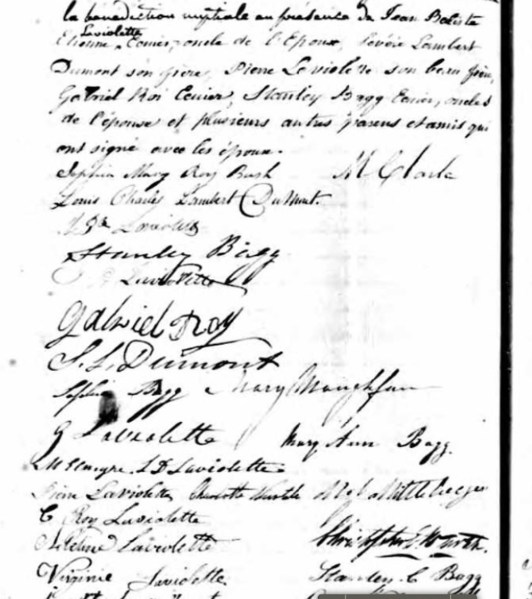
On the bride’s side, Sophia Bagg and Gabriel Roy signed the parish record book, as did the bride’s uncle Stanley Bagg, his 15-year-old son, Stanley Clark Bagg, and his mother-in-law, Mary Mitcheson Clark. Abner Bagg’s wife, Mary Ann Mittleberger, signed the register, as did her daughter Mary Ann. Among Louis Charles’ relatives who signed the book were his sister Elmire, her husband, Pierre Laviolette, and seven other members of the Laviolette family. The groom’s brother, Louis Sévère Dumont, was also present. Source: Quebec Canada Vital and Church Records (Drouin Collection) 1621-1968 for BM Dush, Saint Laurent, 1830-1840, Sept. 25, 1835, p. 106, www.Ancestry,ca.
The Dumont family had been seigneurs of Milles-Îles since 1743, owning a vast area of wilderness and fertile farmland northwest of Montreal. According to traditions that went back to the time of New France, the habitants, or farmers, paid rent annually to the seigneur, cleared the land and grew crops. The seigneur was responsible for building grist mills, saw mills and roads. In 1770, the Dumont family donated land for the construction of a Catholic church, and the village of Saint-Eustache grew up next to it. They later built the seigneurial manor house near the church.2
Charles-Louis’ and Sophia’s wedding was held at the parish church in Saint-Laurent, where the Roy family lived, on September 22, 1835. The newlyweds lived in the manor house in Saint-Eustache, but their life was not easy. Charles-Louis was learning how to administer the debt-ridden seigneury, arguing over money with his brother and fighting off court challenges over the property from his aunt. Then the couple’s first-born child, a daughter, died in 1837, shortly after her first birthday.
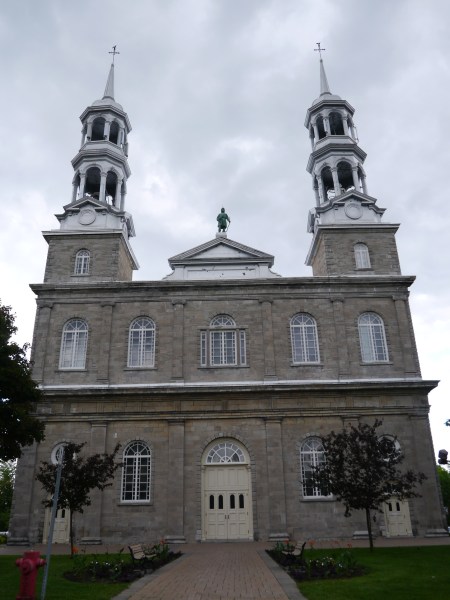
Meanwhile, social and political tensions were increasing in Lower Canada, and when the government refused to approve reforms, an armed rebellion broke out. On December 14, 1837, 1500 government troops and loyalist volunteers attacked the Patriotes, or rebels, who had barricaded themselves inside the church at Saint-Eustache. The government forces burned the church, the convent and much of the village. Seventy Patriotes died during the battle and 120 were taken prisoner.
Charles-Louis and Sophia had anticipated trouble and left Saint-Eustache for Montreal in November. When they returned in the spring, they discovered the manor house had been destroyed so they moved into a smaller house down the road. Their second child, Marguerite Virginie Lambert Dumont, was born there on August 21, 1838.
On June 27, 1841, Sophia died suddenly, age 26. The body of Charles-Louis, 36, was discovered in his house on November 1. His brother, Louis Sévère, died eight weeks later, age 31. None of the accounts of this family’s history explains these deaths, and several historians seem to suggest that these events were suspicious.4
Three-year-old Marguerite Virginie Lambert Dumont was now an orphan and future heiress.to the seigneury of Milles-Îles.
An arranged marriage
Her father had named Gabriel Roy as the little girl’s legal guardian in case something happened to him. Virginie was sent to live with the Roy couple in Saint-Laurent, but Roy, now 71 years old, realized he was unable to raise the child. She returned to Saint-Eustache where notary Frédéric-Eugène Globensky became her new guardian. He and his wife, who had no children of their own, brought her up, and she attended school at the convent in the village.
Everyone expected that when Virginie became an adult, she would marry her cousin Charles-Auguste-Maximilien Globensky (1830-1906), known as C.A.M. But in 1854, the government announced that the seigneurial system was to be abolished. Virginie’s marriage to C.A.M. was fast-tracked, with special permission from the church, and on July 21, 1854 she married C.A.M. She was just 15 years old.
In Quebec, a married woman’s property belonged to her husband unless they had signed a marriage contract making them separate as to property. In Virginie’s case, the seigneury was the dowry she gave to C.A.M.. He now became co-seigneur.5
C.A.M. was a tall and imposing man, not always liked in the community, but respected for his honesty and known for his intellect and his many interests, especially agriculture and railways. He is still remembered for the book he wrote about the causes of the Rebellion of 1837 in Saint-Eustache. His father, Maximilien Globensky, a lieutenant-colonel in the British Army, had led a company of volunteer militia at the Battle of Saint-Eustache.
The bitter fallout from the rebellion hung over Saint-Eustache for many years. But the aftermath of the battle was not the only shadow over Virginie’s life. There were disputes over the shared inheritance of the seigneury and its large debts. Virginie was in court several times, fighting family members over various property disputes.
Although the seigneurial system had been abolished, it took decades to dismantle. A committee evaluated property values and the habitants had the right to buy their farms from the seigneurs or continue to pay rent. As co-seigneurs of Milles-Îles, a territory so vast that it included the sites of the city of Saint-Jerome and the town of Saint-Sauveur, Virginie and C.A.M. were very wealthy.
C.A.M. built a new seigneurial manor house in Saint-Eustache and the family moved into it in 1865. Every Sunday, Virginie and her growing family sat in the front pew of the church, a privilege reserved for seigneurs.
Virginie and C.A.M. had eight children. When Virginie became ill, she made out her will, leaving C.A.M. as her sole beneficiary. She died August 19, 1874, age 36, and he remarried two years later.
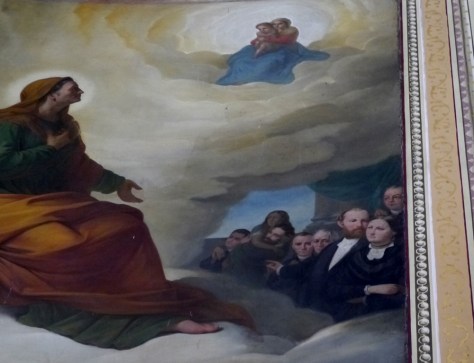
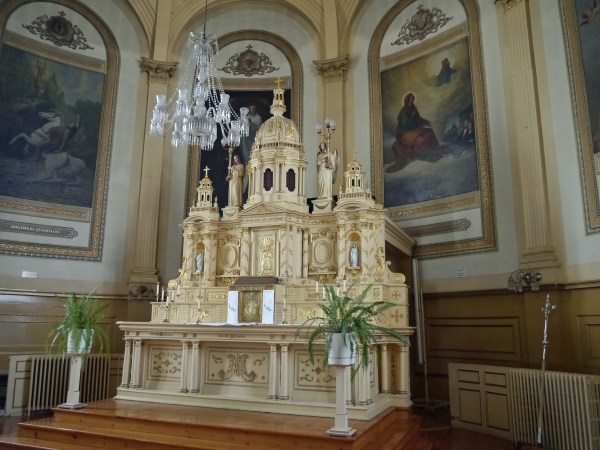
The year Virginie died, C.A.M. visited Rome and brought home a painting of the Adoration of Saint Anne in which Virginie, C.A.M. and the village priest were portrayed sitting at the saint’s feet. This huge painting hangs behind the altar of the parish church in Saint-Eustache to this day.6
Notes Concerning the Extended Bagg Family
Some written accounts refer to Sophia Mary Roy Bush as Gabriel Roy’s adopted daughter. The parish marriage record simply refers to her as the daughter of William Bush and Polly Bagg. Sophia’s birth parents were Protestant, so in 1827, Sophia was baptized Catholic and added Roy to her name. That church record refers to Gabriel Roy and Sophia Bagg as her sponsors. She was age 12 at the time and signed the parish record book herself. In French-speaking Quebec, people probably called her Sophie.
Polly (Bagg) Bush (1785-1856), Stanley Bagg (1788-1853), Abner Bagg (1790-1852) and Sophia (Bagg) Roy (1791-1860) were siblings. Their father was Phineas Bagg, a farmer from Pittsfield, Massachusetts who moved to the Montreal area with his family around 1795. Their mother, Pamela Stanley, was born in Litchfield, Connecticut and probably died in Pittsfield. Stanley and Abner were well-known Montreal merchants, but I had never heard of Polly or Sophia until I started researching the family.
Polly and William Bush had three other children besides Sophia. They were Pamelia Ann (1812-1880), who married Methodist Episcopal minister John W. York and lived in Benton County, Oregon; William Stanley (1816-1892), a Baptist preacher in the Lake George area of New York State; and Phineas (1820-1867) who moved to the Midwest with his parents before 1850. He is buried in Harrison Cemetery, Marion County, Illinois, along with his parents and three young daughters. (Polly’s grave in Illinois can be viewed on Findagrave.com, https://www.findagrave.com/memorial/65952231/bush) After Phineas’ death, his widow, Louisa, and two surviving daughters moved to Chattanooga, Tennessee.
Gabriel Roy (1770-1848) was born in Montreal, the son of a market gardener from France.8 His first wife was a widow 24 years older than him. She named him the guardian of her adopted daughter, Marie-Rosalie Sabrevois de Bleury, the heiress of a wealthy Montreal family, and he managed their affairs. Shortly after his first wife died in 1810, Gabriel married 19-year-old Sophia Bagg. The couple moved from the city to Saint-Laurent, now a Montreal suburb but at that time a rural area. He became a wealthy landowner, school commissioner and road commissioner, and in 1841 he was appointed to the Legislative Council of the Province of Canada,9 a position he held until his death at age 78. He was then referred to as l’Honorable Gabriel Roy. After his death, Sophia referred to herself as Sophia Bagg, veuve (widow) Gabriel Roy. In her will, she left money to the Catholic church and to many relatives. As requested in her will, and according to the church funeral record, she was buried in the Saint-Laurent parish church.
This article is a condensed version of several stories I wrote in 2014, 2015 and 2016 and posted on my personal family history blog, Writing Up the Ancestors (www.writinguptheancestors.ca). They were: The Doomed Marriage of Mary Sophia Roy Bush and Charles-Louis Lambert Dumont, posted Jan. 28, 2015; Marguerite Virginie Globensky, posted Jan. 28, 2015; Polly Bagg Bush: a Surprise Sister, posted May 23, 2014; Polly Bagg Bush and her Family, posted April 28, 2016 and William S. Bush, Baptist Preacher, posted May 19, 2016.
Sources:
1. In collaboration with W. Stanford Reid, “LAMBERT DUMONT, NICOLAS-EUSTACHE (Eustache-Nicolas),” in Dictionary of Canadian Biography, vol. 6, University of Toronto/Université Laval, 2003–, accessed March 21, 2026, https://www.biographi.ca/en/bio/lambert_dumont_nicolas_eustache_6E.html, accessed March 22, 2026.
2. André Giroux, Histoire du territoire de la ville de Saint-Eustache, tome 1, L’époque seigneuriale 1683-1854, Québec: Les Éditions GID, 2009, p. 49.
3. Samuel Venière, “Battle of Saint-Eustache” The Canadian Encyclopedia, https://thecanadianencyclopedia.ca/en/article/battle-of-st-eustache, accessed March 22, 2026.
4. André Giroux, Les héritiers d’Eustache-Nicolas, http://www.patriotes.cc/portal/fr/docs/revuedm/06/revuedm06_6.pdf accessed March 23, 2026.
5. Yvon Globensky, Histoire de la Famille Globensky, Montreal: Les Éditions du Fleuve, 1991, p. 110.
6. Globensky, p. 122
7. Notary J.A. Labadie, 18 mai, 1856, #14278, Bibliothèque et Archives nationales du Québec
8. E.-Z. Massicotte, “l’Honorable Gabriel Roy,” Bulletin des Recherches Historiques, vol. 31, Septembre, 1925, p347-348, https://numerique.banq.qc.ca/patrimoine/details/52327/2657299?docsearchtext=347%20Gabriel%20Roy accessed March 23, 2026.
9. “Legislative Council of the Province of Canada”, Wikipedia, https://en.wikipedia.org/wiki/Legislative_Council_of_the_Province_of_Canada, accessed March 23, 2026.
 Genealogy Ensemble