
Three generations of my ancestors – Stanley Bagg, Stanley Clark Bagg and Robert Stanley Bagg – shared the name Stanley, presumably in honor of Stanley Bagg’s mother’s maiden name, Pamela Stanley. Born in 1760, she was a sixth-generation American.
Three brothers, John, Thomas, and Timothy Stanley, with their wives and children, set sail for America from England in 1634. Their father, Robert Standly (c 1570-1605), was a whitesmith (meaning he made things out of metal) in Tenterden, Kent, in the southeast of England.1
They were part of a wave of strongly religious Puritan settlers who came to New England because they disagreed with the Church of England. Timothy Stanley (c. 1603-1648) and his wife Elizabeth (c 1602-1678) were my direct immigrant ancestors.
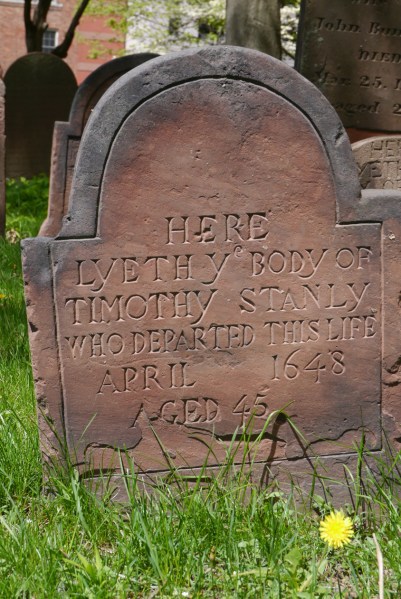
It could not have been an easy voyage for this extended family because John, the eldest of the brothers, died at sea, leaving his three young children to be raised by Thomas and Timothy. The Stanley family spent about two years in Cambridge, Massachusetts where Timothy was granted six acres of land and was named a freeman and admitted as a member of the Congregational church.2
Some Cambridge residents complained that there wasn’t enough land for all the new settlers. Then, after Pastor Thomas Hooker had a dispute with Massachusetts Bay Colony governor John Winthrop, Hooker and about 100 parishioners followed the old indigenous peoples’ trail south to the spot on the Connecticut River (also known as the Great River) that became Hartford.3
Timothy quickly established himself as a farmer in Hartford, and when a land inventory was taken in 1639, he held nine parcels of land of varying sizes. His house lot, including outhouses and gardens, was about two acres, on the west side of Front Street and with a view of the river. Later, he also bought property in Farmington, about 10 miles away.
The Stanley house was described in 1670 as follows: “It is a small, two-storey building, having on the first floor only the hall and “kitchinn”, the latter serving alike for a cook-room, living-room and parlor. Meager enough is the furniture: a deal table with a “form” or bench for sitting upon at meals, and standing in winter before the great open fireplace….. Such a luxury as a carpet is unknown.”4
Timothy and Elizabeth (whose maiden name is unknown) had seven children. The two eldest, Joseph and Timothy, were born in England; both died very young. Elizabeth, Abigail, Caleb, Lois and Isaac were all born in Hartford.5 Timothy also raised his niece Ruth.
Timothy was active in the community. He served on several juries, he served as a Hartford selectman (town official) and he was on a committee to distribute land.
As Puritans, their religious beliefs were central to their lives. Puritans believed that man was inherently sinful. Even though they were unworthy, God chose to save some people and to send others to hell, and there was nothing anyone could do to change this. They believed everything happened for a reason. Meanwhile, the Puritans believed in hard work, and in the importance of education.6
Timothy died in April, 1648, at age 45, and he is buried, along with many of the city’s founding settlers and their descendants, in the Ancient Burying Ground of Hartford, Connecticut, one of America’s oldest cemeteries.
The inventory of his estate, taken on Oct 16, 1648, totalled £332, of which £167 represented the value of his real estate. The inventory counted household goods such as a bedstead and pillows, a hall chest, kettles and dishes, several books, a warming pan and two muskets. The farm animals included six oxen, several cows, a horse, sheep, pigs and bees.7 The court ordered that all his children be awarded something from his estate, while the house and lands in Hartford went to son Caleb.
In 1661, the widowed Elizabeth married Andrew Bacon. By 1671, when she made out her will, Andrew had died and she had returned to Hartford to live with son Caleb’s family. Elizabeth Bacon died in 1678, around age 76.
Caleb Stanley
My direct ancestor Caleb Stanley (1642-1718) was Timothy and Elizabeth’s fifth child. In 1688, Capt. Caleb Stanley was appointed the important task of keeping Hartford’s ammunition safe. He was married three times: 1) Hannah Cowles, daughter of John Cowles, who died in 1690, age 44; 2) Mrs. Sarah (Foster) Long, died 1698, age 44; 3) Mrs. Lydia (Cole) Wilson, died 1732.
Caleb and Hannah had a number of children, most of whom died as infants, and Caleb had two more children with his second wife. My line of the family goes through Caleb’s and Hannah’s fifth child, Caleb Jr. (1674-1712). He was said to be one of the most distinguished men in the colony. He was secretary of the colony from 1709 until his death three years later, and he was appointed surveyor for Hartford County in 1700.
Calen Jr. married Hannah Spencer in 1696. They had no children and she died six years later. In 1704, he married Abigail Bunce, daughter of Thomas and Susanna (Bull) Bunce, and they had four children. Their eldest son, Timothy, was my direct ancestor.
This Timothy Stanley (1705-1787) inherited his father’s homestead in Hartford and sold it in 1742 when he moved to Harwinton, CT. By 1781, he was living in Wethersfield, CT. He married Mary Mygatt in 1729 and they had eight children, seven of whom grew to adulthood. Mary Mygatt died in 1786 at age 78, and Timothy died the following year, age 83.
Both Timothy and Mary were said to “own the covenant,” meaning they were bound to God and one another through a covenant. The covenant, a contract that rested on consent and mutual responsibilities, was an important aspect of the Congregational Church at this time.
Their eldest son, Timothy Stanley Jr, born in 1730, lived near Litchfield, CT and was probably a clothier. He married Mary Hopkins of Harwinton in 1754 and they had eight children. Mary Hopkins probably died around 1770. During the American Revolution, this Timothy enlisted with Capt. Beebe’s regiment, and he died on a British prison ship in New York Harbour in 1776.
Their fourth child was my four-times great-grandmother Pamela Stanley, born in Litchfield, CT in 1760. She married Phineas Bagg in Pittsfield, MA in 1780 and she probably died there around 1793. Phineas and his four children, Polly, Stanley, Abner and Sophia, immigrated to Canada around 1795.
Notes:
Members of the Bagg family probably believed their Stanley ancestors were wealthy landowners in England, but an article published in 2005 showed the immigrant family were, in fact, middle class. See Leslie Mahler, “Re-Examining the English Origin of the Stanley Brothers of Hartford, Connecticut: A Case of Invented Records,” The American Genealogist, vol. 80, July, 2005, p. 218. www.Americanancestors.org. However, despite their non-aristocratic origins, descendants of the Stanley family include several presidents of the United States. See Gary Boyd Roberts, compiler, Ancestors of American Presidents, 2009 Edition, Boston: New England Historic Genealogical Society, 2009.
The Ancient Burying Ground in downtown Hartford is the final resting place of many of the city’s founding settlers. A tall monument lists their names. The cemetery has an extensive website, http://theancientburyingground.org/ and is well worth a visit in person. See also Society of the Descendants of the Founders of Hartford, www.foundersofhartford.org
This story was first published on my personal family history blog, Writing Up the Ancestors, in 2018
Sources:
1. Leslie Mahler, “Re-Examining the English Origin of the Stanley Brothers of Hartford, Connecticut: A Case of Invented Records,” The American Genealogist, vol. 80, July, 2005, p. 218. http://www.Americanancestors.org, accessed July 24, 2013.
2. Robert Charles Anderson, The Great Migration: Immigrants to New England, series 2, vol. VI, Boston: New England Historic Genealogical Society, 2009. 463.
3. David M. Roth, Connecticut: A History. American Association for State and Local History, New York: W. W. Norton & Co., 1979, 39.
4. Israel P. Warren, compiler. The Stanley Families of America as descended from John, Timothy and Thomas Stanley of Hartford, CT, 1636. Portland, Maine: printed by B. Thurston & Co., 1887, 228.
5. Anderson, 465.
6. Francis J. Bremer, Puritanism: A Very Short Introduction, New York: Oxford University Press, 2009, 43.
7. Warren, 226.

