Tag Archives: McLeod

I am Born

Chapter 2 of Diary of a Confirmed Spinster a story based on family letters from the 1900 era from Montreal and Richmond, Quebec. The story in pdf form is archived online at National Library of Canada. (See below)
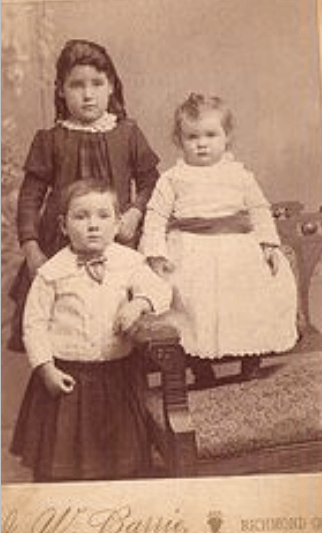
Edith, Herb and Marion Nicholson circa 1890

But, first, let’s go back to the beginning. (But which beginning? The beginning beginning. The I AM BORN beginning, to once again invoke David Copperfield, that despite appearances is not my favourite novel. Middlemarch is.)

Easy enough. I am born in January 1884 in a green clapboard rental house in Melbourne, Quebec, 10 months after my parents’ marriage.

I know this because I have been told and also because the proof resides in shaky ink strokes in my father’s Store Book for 1884.

His household accounts that he kept from 1882, before his marriage to 1921, the year he passed away.

Fifty years of family accounts, kept in little black books.

It could be claimed that the entire story of our family is told in these pocket-size volumes, the practical side at least. The down-to-earth work-a-day side.

I was born in early January 1884 because the store book has an entry on the 7th, inserting baby’s birth 25 cents. I have survived my first challenge.

Under that breast pump 75 cents. Breast shield 25 cents. Along with one quart of milk 5 cents, a loaf of bread 10 cents, a gallon of coal oil, 25 cents. Two cords of wood 8 dollars and 35 cents. 11 pounds of oatmeal 38 cents. One dozen herring 20 cents. 1 ½ pounds of steak 15 cents. And rent 25 dollars a month. The staples of bodily existence then and today: shelter, heat, light and daily bread.

On February 19th a baby cradle is purchased 3 dollars. And some flannel and some cotton for baby. And on April 28, baby’s picture 25 cents. I have officially arrived. I have survived the precarious early days. I am safe to be sketched in silver bromide.

On June 27, 1 baby carriage 6.37. October 1884, one crib. 2.75. Some wool for baby 2.60.

A year later, baby’s first shoes, 1.20. I am now officially a financial burden on my parents. They would spend a great deal on shoes and boots – and the mending of same – for me and my three siblings in the following decades.

In June 1886, a child’s broom is purchased. 15 cents and I begin to pay for my keep. In those days they began teaching girls the womanly arts very early.

Also purchased that month: baby’s first book. We are Scots after all, who value education above all else. “An education is something they cannot take away from you,” my mother always says.

Still, it’s something of a mixed message I am being sent, as a 2 and ½ year old. But I might as well get used to it. Being a female, I will be showered with mixed messages for most of my life.

Then, the narrative in numbers continues: 1890 to 1895 school fees 25 cents a month. The occasional slate 5 cents. Bottles and bottles of cough medicine 25 cents each. (Cough medicine had kick in those days.) Later scribblers 5 -7 cents. Skating rink 10 cents. Soda at Sutherland’s drugstore 5 cents. (Soda had kick in those days, too.)

Also pocket money for Edith 5 cents. I guess I was doing a lot more than sweeping by then. Oddly, my younger brother Herb received ‘wages’ for his household chores.

And then I grow up. St. Francis Academy 50 cents a month. Latin text 1.25. Euclid’s geometry 1.00, the Jamaica Catechism, 80 cents, etc.(Students must purchase their textbooks, many published by the Renouf Company of Montreal, who, in turn, cash city teachers’ paycheques for them, as women don’t have bank accounts.) And I get stockings and gloves at Christmas, just like Mother.

We are living in our own house by 1896, built at a cost of 2,718 dollars, not including landscaping. My father is by now a well-to-do hemlock bark dealer. Hemlock is plentiful in the E.T. and used in the leather tanning process. Father sells his bark to tanneries in Montreal, New Hampshire and Maine.
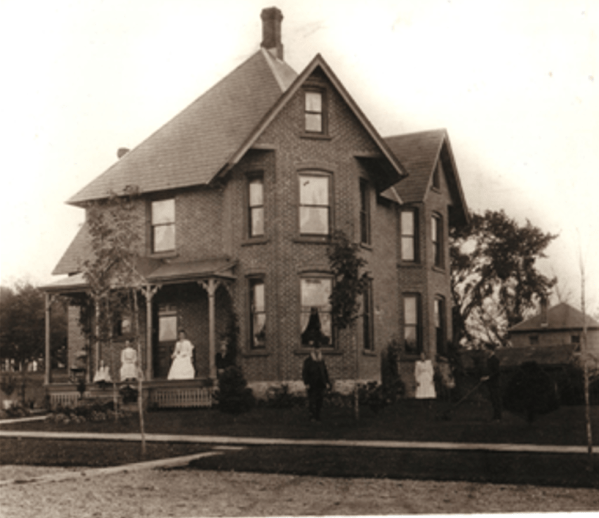
The mortgage on our house is 30 dollars a month, similar to what we paid on the rental house, but “Tighsolas” or House of Light in Gaelic is ours. And it is a fine house, a brick-encased Queen-Anne Revival in the good part of Richmond, not far from St. Francis Academy on College Street. (The kind of house seen often in Ontario but fairly rare in Quebec.) Building this house my father inspected every plank, brick and tile himself, tossing aside more than he used.

By now, as I said, I have three siblings, a younger brother, Herb and two younger sisters, Marion and Flora, born 1885, 1887, and 1892.
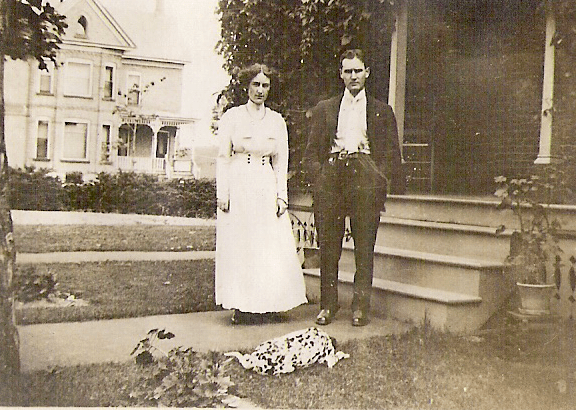
Edith and Herb circa 1910 in front of home in elegant part of Richmond.

By 1901 I am ‘fully out’ : corset for Edith 2.35. I start wearing my hair tied up around then, but only at dances. Combs for Edith: 20 cents.

I graduate from St. Francis Academy II in 1903 and a little later take a stenography course there. Stenography is an up-and-coming profession for women. 13.50 for the course. 1.28 for a shorthand book. 5 cents for a reporter’s notebook.
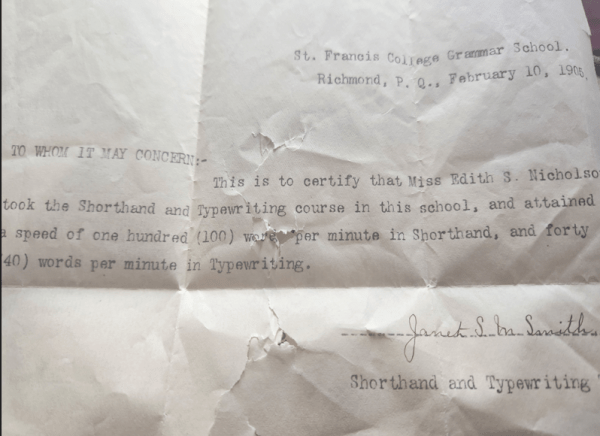
I pass the course with 100 words a minute in shorthand and 45 words a minute in typing, good enough to get a job, but my parents don’t want me going to the city to work. Life in the city for young working women is a dreary business, at least according to a cousin, Jessie Beacon, in a letter to Mother.

Jessie laments that she works until six at her insurance office, goes home to her boarding house for a “lousy hash complete with garnish of housefly” and then dresses for a predictably boring evening.

My parents are intent on saving me from such a degrading existence and seek a job for me in Richmond, but jobs for young people in country towns are few and far between.

Money is plentiful at home despite the fact my father has had to change lines of work. He now sells pulpwood instead of the bark. At Christmas, over and above the usual stockings and gloves, there are gifts of watches, rings and perfume.

In 1905 my younger sister, Marion, leaves for McGill Normal School and adventures in the Big City. My determined little sister has managed to convince my wary parents that the City is safe, as long as she rooms at the YWCA on Dorchester.

And, as Herb works in Montreal, at the E.T. Bank, she is not alone, so my parents permit her to go despite the great cost: 16.50 a month.

Everything in life is timing!

And I am left alone at home with my little sister, born nine years after me. My parents shower me with ‘pity gifts’ at Easter: 5.00 for a plaid “Montreal” dress. (Plaid voile is all the rage this year, I read it in the Delineator.) 2.35 for a ticket to see the Madame Albani concert in Sherbrooke. Opera singer Emma Lajeunesse, now in her middle age, is a ‘local’ girl from Chambly made good. She is world-famous, a long-time favourite at London’s Covent Garden. So, this is a huge event. All of the. E. T. seems to want to attend.

At 22, I feel like a debutante about to make her grand appearance under the patronage of a local legend. But nothing comes of it. No eligible young men come out to the home-coming concert.

But late 1906 the pulp contracts dry up. To add fuel to this fire, we are disinherited by a wealthy Maiden Aunt on her deathbed.

My brother takes this especially hard.

“Well, now that my house is being given to someone else, I will have to give up all hope of being rich and look at it as a fortune lost,” he writes in a letter home.

“My house? MY house?” exclaims Marion at Christmas. She is now working at Sherbrooke High School and boarding at a Mrs. Wyatt’s who has a daughter, Ruth, Marion’s age. “What has Father been telling him?”

I don’t tell my sister that Herb believes we were disinherited because Old Aunt Maggie did not approve of ‘working women.’

In June 1907 my father is desperate for work with a meagre 33 dollars left in his bank account. He applies to our local Member of Parliament, E.W. Tobin, to work as inspector on the crew building the Canadian Transcontinental Railway.

He receives a polite letter from their offices in Ottawa. They say they have their full complement of inspectors. They acknowledge that Tobin has been in to see them on his behalf.

Then in August a great bridge, half built, collapses, the Quebec Bridge. It was to be the world’s longest suspension bridge. 78 men die, mostly Mohawks from Cawgnawaga near Montreal.

The bridge was a component of the CTR. Magically, there is a need for inspectors at end of steel and father gets the call to La Tuque, to be Timber Inspector at 100 dollars a month.

My parents take out a 1,000 dollar insurance policy on my father’s life. It is well known that jobs on the railway are dangerous.

My mother exchanges one worry for another.

“What is a timber inspector? Is it safe? It doesn’t sound safe.”

And I am still at home, no income, no prospects.

Then arrives a letter from Reverend J. R. McLeod, my mother’s cousin living in a town half way between Montreal and Quebec City.

Three Rivers, Sept. 1907

My dear Friend,

I have but a few minutes to write as prayer meeting is starting. I was asked yesterday by the Manager of Works in a village 15 miles from here if I could find a suitable girl to teach a small school, about 10 children. My thoughts went to you. They will take you without a diploma. They offer $20.00 a month. I know you are fit for the position.
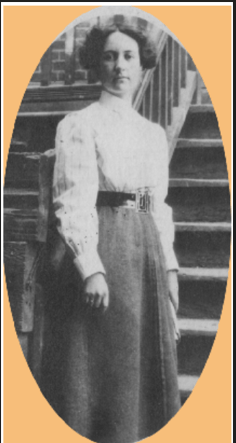
Edith as a school marm, likely 1911-1914 ish in a classic working girl shirtwaist blouse. Neckties were often worn with them.

Regards, Reverend J. R. Macleod

“Should I accept now, I mean that Father is away?” I ask my mother.

“It is your decision to make,” my mother replies. She does not seem surprised at all by the letter from her cousin.

Mother hands me another letter, just arrived in the mail, from a young friend of the family’s, Mary Carlyle. The correspondent omits the obligatory opening pleasantries and gets straight to the irksome point:

“Dear Maggie,

I am writing you with such good news. I am to be married! He is a George White and he is from Kingsey. He is a sweet, kind man, with a good position and very good looking, in my opinion. It is such a relief. I was worried I was destined to be a burden on Father.”

“Kingsey. So, that’s where all the perfect men are,” I say to Mother in a tired voice but my mind is suddenly made up. I climb the stairs to my room to scratch off a note to J.R. McLeod saying I will take the job as offered.

END

(This is Chapter 2 of a novellette I wrote, Diary of a Confirmed Spinster, part of School Marms and Suffragettes that can be found at the National Archives of Canada. The story is based on the letters and other memorabilia of the Nicholson family of Richmond, Quebec).

At National Library of Canada. Online collection.
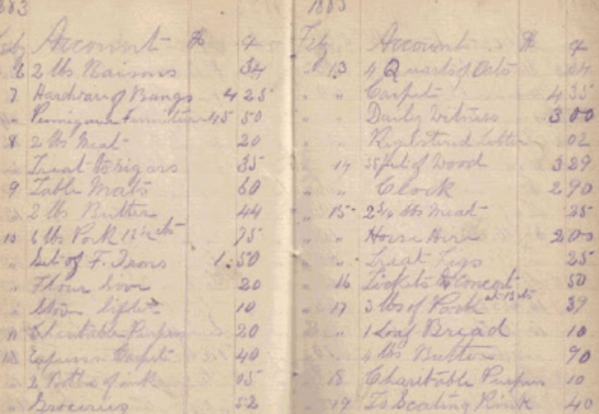
1883 store book: setting up house a year before Edith arrives. Table mats, a clock, flat irons and 45 dollars for furniture!!!

The Family Genealogist


letterpic

The truth is, family genealogists haven’t changed that much over the years. They are still the one in the family with time on their hands and the fierce determination to stick with it through all the brick walls and misinformation and family myth muddles. They still wonder, when all is said and done, if anyone in the future will value their hard work.

Well, I think future generations will care and something happened to me lately to prove it:

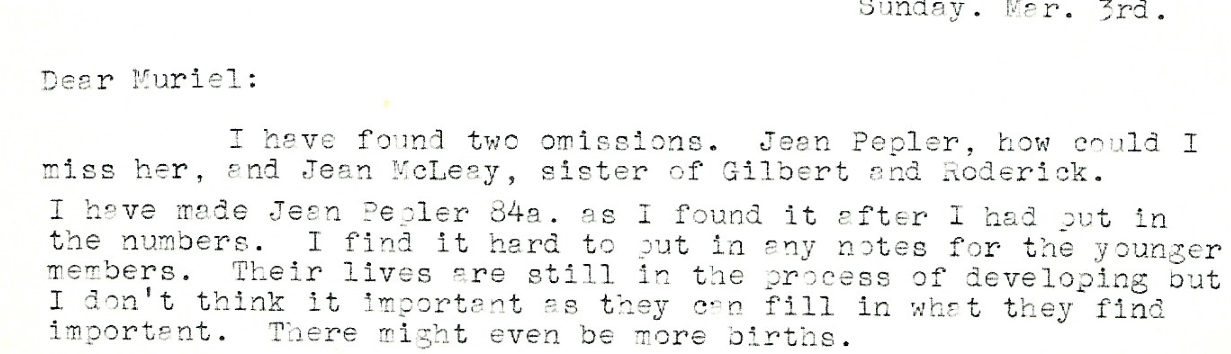
The evidence comes in the form of a letter dated only March 3rd, but I know it must be from the 1970’s. It is from a certain Isabel to a Muriel. The type-written missive appears to be the last in a series on the subject of creating a family tree– and, without ceremony, after the “Dear Muriel” salutation, the letter gets right to the point.

“I have found two omissions, Jean Pepler, how could I miss her? and Jean McLeah. I have made Jean Pepler 84a as I found it after I had put in the numbers.”

Jean Pepler is my husband’s great grandmother’s niece. I know this from a family tree I once had on hand, the McLeod Family Tree, and more particularly from about 300 family letters from the 1908-1913 period, letters I long ago transcribed and published in an online book, A FAMILY IN CRISIS.

But, until recently, when I received this 50 year old note, I did not know anything about Isabel or Muriel

Isabel, the genealogist of the letter, discovers another error. “I just found another error in these family notes. The Millers have two daughters. I forgot Annie…I’ll have to correct it before I send it.”

Yes, like all genealogists, past and present, Isabel has poured a lot of energy into her family project and after she’s typed out the family tree, just when she thinks she’s finished, she finds some errors!

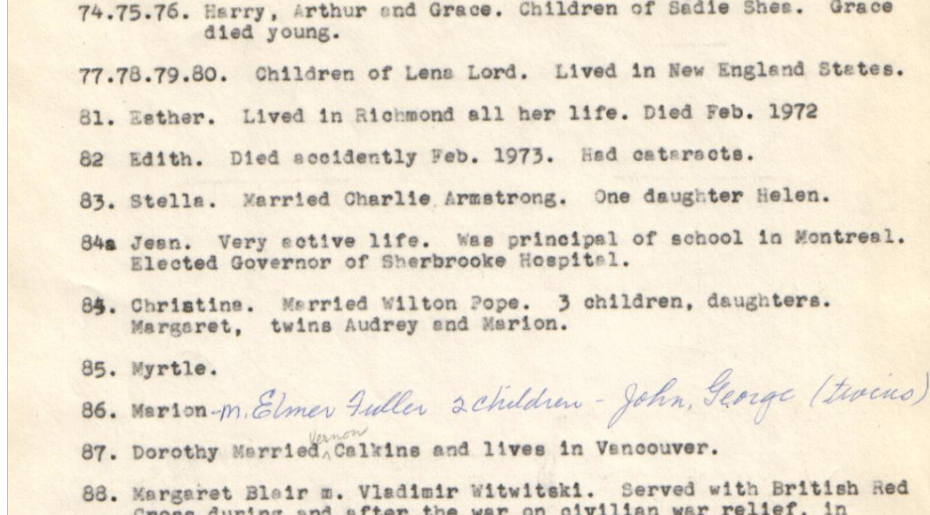
Not wanting to retype the whole tree chart, Isabel merely creates an in-between number for Jean Pepler, an esteemed Quebec educator, to use on the summary list at the of her document.

This wonderful letter was sent to me by my husband’s cousin, Debbi who still lives in Quebec. We didn’t know about Debbi either, not before then.

You see, when my husband got his DNA done a few years ago on Ancestry, he immediately discovered two first cousins (whom he knew very well) and a third cousin, Jean, he didn’t know at all.

He assumed this person was a third cousin because he shared 60 centimorgans of DNA with her, the average amount for third cousins. I contacted the woman to confirm the exact relationship.

My husband and Jean were second cousins once removed, related through my husband’s two times great grandparents John McLeod and Sara Maclean of Uig Carnish, Isle of Lewis Scotland. My husband’s great grandmother, Margaret Nicholson and Jean’s grandmother, Isabella Hill, were sisters living around the corner from each other in Richmond, Quebec in early 1900.

mcleod

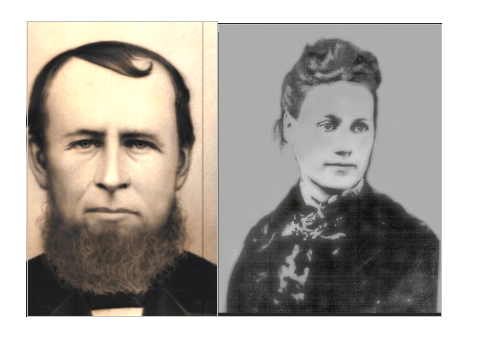
John McLeod of Uig Carnish Isle of Lewis, Scotland (Crayon Drawing) and his wife Sarah McLean McLeod, tintype.

These days, due to the Coronavirus, Jean is hunkering down with her daughter, Debbi, and they are passing the time exploring genealogy. Debbi saw my years old note on Ancestry.

“ I’m the one who is most interested in family,” Debbi wrote me. “Can you tell me more?”

So, I sent Debbi my compilation of Nicholson Family Letters that contain numerous mentions of Clayton and Isabella Hill. Clayton was a prosperous stone mason in Richmond who lived in a big house on ritzy College Street. Their son, Stanley, is Jean’s father. Their daughter Isabel (Hill Knott) is Jean’s aunt and Muriel (the letter’s recipient) is Jean’s mother, Stanley’s wife.

Isabel and Muriel were sisters-in-law.

Floraa

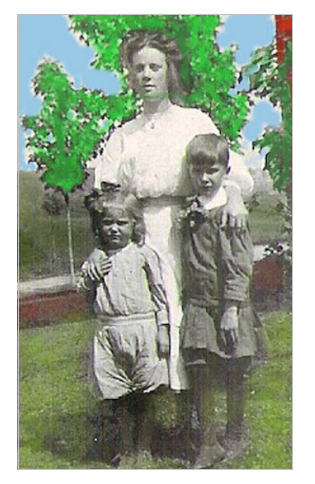
Flora Nicholson (1895-1978) my husband’s great aunt, with Stanley Hill and future family genealogist Isabel Hill Knott circa 1906

“Were there any other siblings in the McLeod Richmond family?” Debbi enquired of me. “ I’ve heard of Dan and Flora. Maybe a Mary-Jane, too?”

“I think I remember Mary-Jane from the letters, “ I replied. “ There was also a Christie in Illinois and a Sarah in Sarnia. But, I can’t remember any other siblings.”

I then explained to her that I once in my possession a McLeod family genealogy, neatly tied with shoelaces in a sturdy flip-board cover, but I’ve since misplaced it. Sad!

But, only a few days later, checking out some stored data on some random memory sticks, I stumbled upon some gifs of that same McLeod genealogy. (And, yes, we had missed some siblings!)

I emailed the gifs off to Debbi and that’s when she emailed me back a scan of her Great Aunt Isabel’s March 3rd letter from the 1970’s.

“As you can see, it’s the same genealogy. Jean Pepler is there at 84a!” Debbi wrote in the email.

What a serendipitous string of events had to unfold to marry these two documents, once again, almost half a century later!


peppler

Isabel’s Pepler page with new info added by a relation.

Today, with electronic communications, genealogists have so many tools at their disposal it is simply dizzying. Isabel’s letter reminds us that in the good old days it could take years and years of correspondence by mail or telephone to build a family tree – and typing it out before the age of White Out and word processors was an especially arduous task.

Isabel did, indeed, take a long, long time researching the tree:

“You should see my desk in the kitchen. At least now I can clean it up, getting rid of all the bits of notes I have gathered over the years.”

Isabel says that she spent three weeks at her kitchen table to type out the seven page genealogy.

“As this is all I have done for the past three weeks, I have no news….This has been hard work and has taken a lot of time but that is something I have plenty of.”

Isabel wasn’t sure, in the end, if she had done a good enough job:

“I find it hard to put in any notes for the younger members. There lives are still in the process of developing, but they can fill in what they find important. There might be even more births.”

And like many genealogists, then and now, she wondered if it was all worth the effort.

“What a job! Probably nobody will be interested because we have to accept that the world has changed.”

Well, it was worth the time and effort, Isabel, I can tell you that. Fifty years later many of us still do care. So, thank you for all the hard work you put into piecing together your (well, our) family tree.


Biology and Ambition

marioncanoing

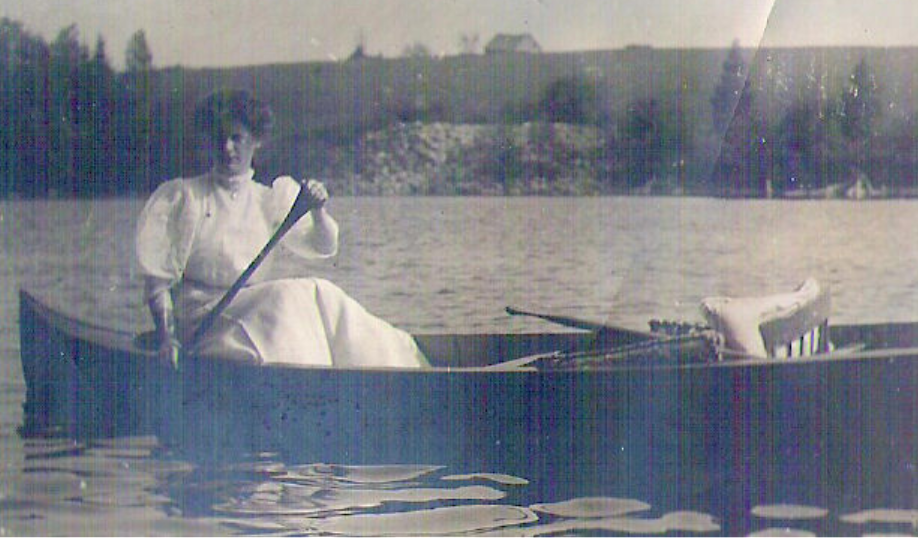
Marion canoeing circa 1907

Marion Nicholson, first year teacher at Sherbrooke High School in 1906-07, is serious about having a career. She is not focused, like so many of her colleagues, on finding a husband or ‘a pupil of one’ as soon possible. Or so she says in her letters home to her mom.

However, Marion’s “strictly private’ pocket diary  from 1907 suggests something else: that the young Richmond-born woman is very much torn between her biology and her ambition. In this little brown journal, eighteen year old Marion often comes off like a flighty Scarlett O’Hara type.

January 12: “Went to a card party and dance at Mrs. Griggs’. Had a grand time. Played cards with Mr. Watson, danced with Mr. Avery, had supper with Mr. Davidson and Mr. Sampson came home with me.” Marion even reflects on this coquettish behavior in a February 19th entry: “I believe I think too much of boys and am a flirt.”

Marion’s busy social life centers around skating parties at a Sherbrooke rink where she obliges many potential suitors – and turns down some others.

That Edwardian winter there are two young men fighting over the ultimate privilege to take Marion home from the ice rink, or the snow shoe club or the local youth hangout: Monty and Gordon.  It does get complicated.

Here’s the entry for January 28: “I slighted Monty by taking off my skates before his turn. He was quite huffy. I guess I will have to go skating with him tomorrow instead of driving with Gordon.”

For Feb 3: “Went to the theatre with Monty. I did not tell Gordon. Gordon was there by himself. He did not look our way the whole time.”

Eventually, this juggling act becomes too much for Marion. “I have decided who I like best and G is the one. I am tired of having two.”

In the spring of 1907, Gordon takes Marion canoeing.  The couple gets caught in a storm on the river and has to take shelter on shore. How romantic!  How promising!

By the time June rolls around,  Marion is getting anxious for the school year to end. It isn’t her work. She is exhausted from all the late nights and ‘dissipation’, as she refers to it in her diary. She returns to Richmond, 30 miles away, to spend the summer with her Mom and sisters.  Here, her social activities center on family friends: the Pepplars, the Clevelands, the McCoys, the Sutherlands and the Crombies.  In 1907, Richmond is a town without any eligible young men. They have all moved away to find jobs.

Marion helps support the family, so she isn’t expected to do work around the house. Most days she is bored silly.  She often sleeps in until noon. She sometimes spends afternoons taking ‘crazy’ photos with her Kodak.

Marion gets down on herself for this: “I think I am about the laziest person alive. All I have the gumption to do is sit and dream of what I would do if I tried. I have wasted two weeks of my vacation doing nothing, when I could have been practicing music or sewing. I hope I improve.”

In Richmond, Marion can go to church, twice a day if she wants. There are frequent afternoon teas hosted by society matrons, daily walks downtown to the mail to see if Gordon has written her, ice cream socials, croquet, tennis, strawberrying and country drives to places like Windsor and Kingsbury by horse drawn carriage.

Town tycoon Mr. Wales is the only Richmond citizen who has an automobile, but that will soon change.

Yes, it is the summer of 1907 (a year on the cusp of some game-changing technological changes)  and the living is far too easy for Miss Marion Annie Nicholson, an energetic young woman who, one day, will lead the PAPT teachers union while supporting four children as a single mom.

According to Marion’s 1907 diary, the most interesting thing to happen to her that summer is when some kittens get into the barn.­­

Oh, and there’s this entry for July 13th :“Lily Lyper nearly murdered. Great excitement.”

Even sleepy Richmond, Quebec had its share of scandals 100 plus years ago.

Mariaon1906sherbrooke

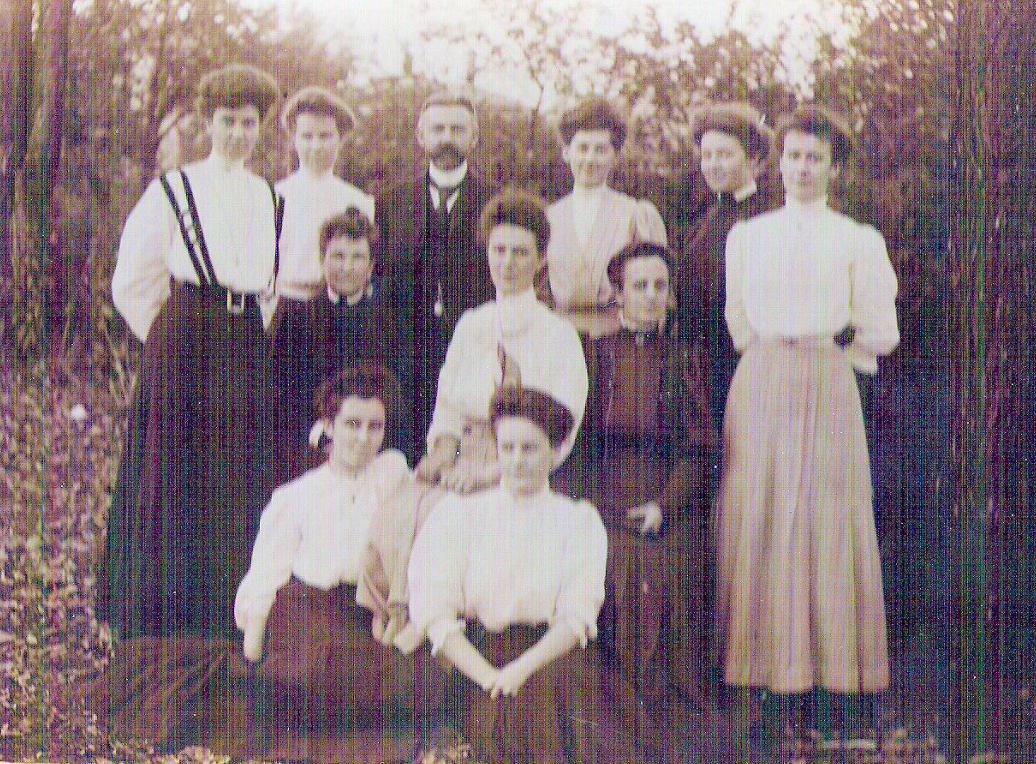
Marion, seated bottom and other Sherbrooke High Teachers 1906

tighsolas

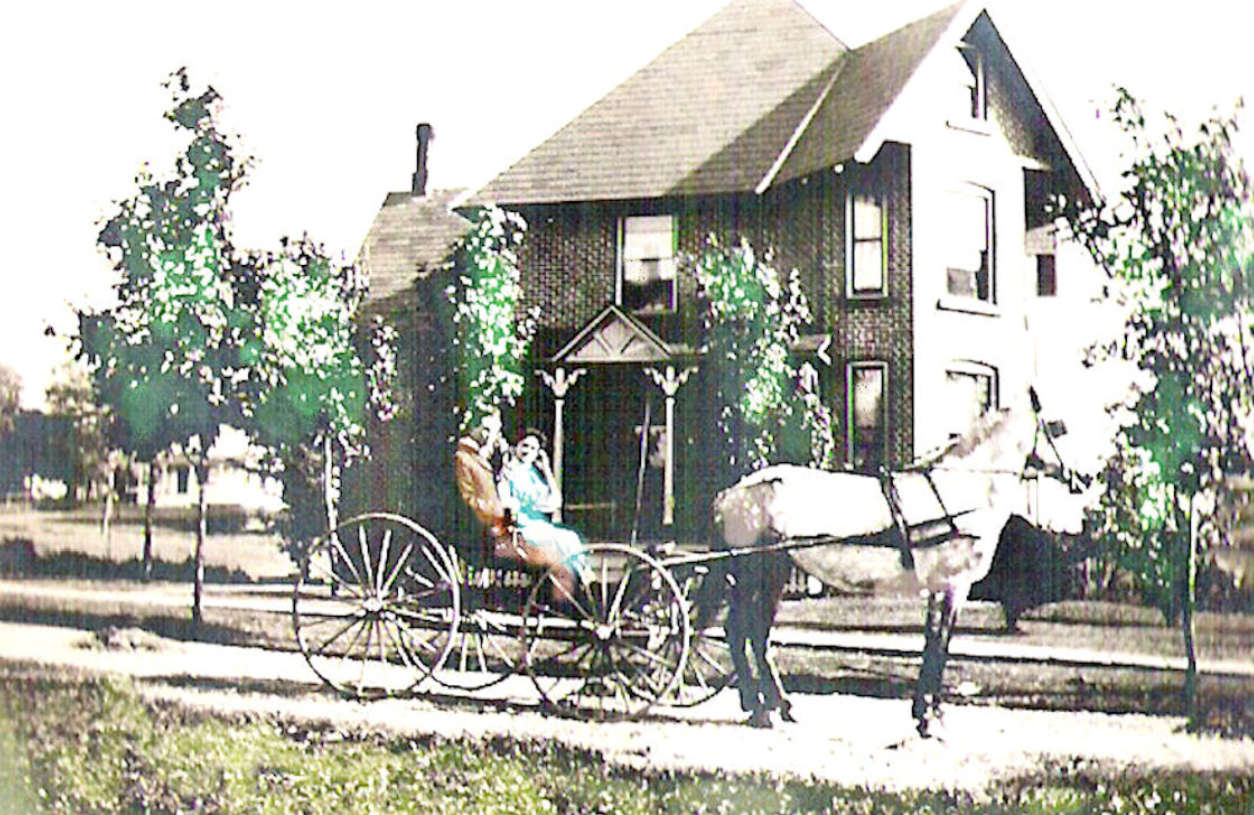
Marion and beau in front of Tighsolas, their house in Richmond, Quebec

Afterward: (added March 14)

Marion did not see much more of Gordon, the son of a wealthy Sherbrooke merchant who would  be making a very good salary, 3,000 a year, in 1911 at the age of 26, this according to the Census.

Gordon married a friend of Marion’s, it seems.  In 1913, Marion married Hugh Blair, the son of a prosperous Three Rivers lumber merchant,  although his parents did not favour the marriage because by that time the Nicholsons were broke.

Marion’s in-laws did not attend the October wedding at the Nicholson residence on Dufferin in Richmond. Marion’s marriage contract was a nasty piece of work  saying she got nothing but the furniture should the marriage break up FOR ANY REASON.

As it happens, Hugh died in 1927. Marion was left high and dry cut out of the Blair family business, so she rolled up her sleeves and went back to work becoming a Master Teacher and WWII era President of the Provincial Association of Protestant teachers in Quebec.

She never re-married, despite having many suitors, such was her sex appeal even in old age. She died of a heart attack in 1948, a few months after representing the Canadian Teachers Association at an UNICEF education conference in Sevres, France. The Editor of the Montreal Gazette (another admirer apparently) wrote her an editorial page eulogy: “With the death of Marian A N Blair, education in Quebec, indeed the entire nation, has suffered  a serious loss. ”

In the end, Marion did have it all, love, work and family. It just came with some major trials and tribulations. Apparently, she never complained.